


Law firm personalization is the process of adapting client experience, communication, and branded materials around a person’s legal need, practice area, location, relationship stage, and stated preferences. Effective personalization helps a prospective or existing client receive information that reflects the matter they are dealing with instead of forcing every person through the same generic law firm experience. According to a study by Kar Yan Tam and Shuk Ying Ho titled Understanding the Impact of Web Personalization on User Information Processing and Decision Outcomes in 2006, Tam and Ho found that relevance and self-reference influenced attention and decisions in laboratory and field research. Personalization should serve a concrete user goal.
Personalization begins with client experience. Thomson Reuters explains that legal clients look to attorneys as personal advisers and recommends identifying a client’s goals and objectives at the beginning of an engagement, then remaining aware of developments that could create new legal needs. This form of personalization is deeper than inserting someone’s first name into an email. The lawyer understands what the client is trying to achieve and adapts communication, advice, and service around that objective.
Personalization also applies to marketing. A family law prospect, commercial client, criminal defense lead, and estate-planning client are dealing with different problems and should not receive identical messages. Law firms can organize website content, email communication, intake, and campaign reporting around practice area, geographic market, enquiry source, matter type, and stage in the client journey.
Branded collateral creates another layer of personalization. Law firms can apply consistent identity across logos, business cards, stationery, email signatures, presentation materials, event materials, and appropriate branded items. Esquire Interactive currently lists law firm collateral including logos, business cards, stationery, envelopes, email signatures, booklets, signage, clothing, and branded promotional materials. Personalized products also exist for legal professionals, including engraved nameplates, business-card holders, portfolios, pens, and related office items. These items support brand consistency and relationship building but do not, by themselves, prove higher client conversion rates.
Technology lets firms manage these experiences at scale. Legal CRM platforms can route prospects according to matter type, trigger intake workflows, schedule reminders, and maintain communication. Clio Grow currently supports customized intake forms, intake stages, automated workflows, email communication, text reminders, document generation, and prospect tracking. HubSpot and Mailchimp provide segmentation and personalized email functionality, while Google Analytics allows firms to analyze groups of users according to defined characteristics and behaviors.
Legal personalization also needs boundaries. Client and prospective-client data can contain highly sensitive information. ABA Model Rule 1.6 requires lawyers to protect information relating to representation from unauthorized disclosure or access. Marketing communications also remain subject to advertising rules; ABA Model Rule 7.1 prohibits false or misleading communications about a lawyer or the lawyer’s services.
Table of Contents
- Article sections will appear here.
What Is Personalized Law Firm Marketing?
Personalized law firm marketing adapts content, messaging, offers, contact paths, and follow-up to a prospective client’s legal need, behavior, and relationship with the firm. A law firm content strategy supports personalization by organizing content around practice areas, client problems, search intent, geographic markets, and stages of the client journey. Law firms personalize marketing by grouping prospects according to matter type, referral source, website behavior, content viewed, lead status, consultation status, client status, and communication preference rather than creating a separate campaign for every individual.
A divorce prospect receives family-law information, while a company researching outside general counsel receives business-law content that matches its business need. A prospect who has already scheduled a consultation should receive appointment information instead of another generic consultation prompt. This approach connects each audience segment with relevant legal information and a suitable next action.
How Does Law Firm Personalization Improve the Client Experience?
Law firm personalization improves the client experience by matching communication, legal guidance, service delivery, and follow-up with the client’s matter, goals, expectations, and communication needs. Thomson Reuters describes lawyers as personal advisers and recommends identifying client objectives early rather than treating legal work as a one-size-fits-all service. Law firms can apply this approach during intake by routing enquiries to the appropriate practice team, presenting relevant intake questions, requesting matter-specific documents, offering suitable consultation types, and assigning the correct office.
Personalization continues after engagement through communication preferences, matter updates, document requests, meeting reminders, billing communication, and explanations of upcoming legal steps. A business client facing recurring regulatory issues may value proactive legal updates, while a personal injury client may need information about medical documentation, insurer communication, and case milestones. A family-law client may place greater value on confidentiality, response expectations, court dates, and clear procedural explanations.
Listed below are the 10 main ways law firm personalization improves the client experience.
- Practice-team routing: Directs the enquiry to the legal team that handles the relevant matter.
- Bespoke intake questions: Presents questions that match the client’s legal issue and stage of the matter.
- Relevant document requests: Requests only the documents needed for the client’s specific legal situation.
- Appropriate consultation options: Offers consultation formats that match the client’s needs and circumstances.
- Office assignment: Connects the client with the appropriate office or geographic team.
- Communication preferences: Uses the client’s preferred communication channel where the firm supports it.
- Matter-status updates: Provides updates that reflect the client’s case stage and information needs.
- Meeting reminders: Sends reminders connected to consultations, hearings, deadlines, or other scheduled events.
- Billing communication: Presents billing information in a way that matches the client relationship and matter structure.
- Procedural guidance: Explains the next legal steps in a way that reflects the client’s matter and current stage.
How Does Audience Segmentation Support Law Firm Personalization?
Audience segmentation supports law firm personalization by grouping prospects and clients according to meaningful characteristics so each group receives more relevant information, communication, and follow-up. Law firms can segment audiences by practice area, matter type, geography, acquisition source, lifecycle stage, engagement behavior, and declared preferences when the firm has a lawful basis for using that information.
Platforms such as HubSpot and Mailchimp support segmentation through contact properties, activity, tags, preferences, location data, and other available information. Effective segmentation should influence communication, reporting, intake, or service delivery rather than create groups that serve no operational purpose. A segment such as “Family Law Prospects Consultation Not Yet Scheduled” gives the firm a defined audience for relevant consultation and scheduling communication.
Listed below are 7 useful law firm audience segmentation criteria.
- Practice area: Groups prospects by services such as family law, criminal defense, personal injury, business law, immigration, or estate planning.
- Matter type: Separates narrower legal problems such as divorce, child custody, DUI, car accidents, commercial disputes, or trademark applications.
- Geography: Groups audiences by city, state, jurisdiction, office, or legitimate service area.
- Acquisition source: Separates prospects originating from SEO, PPC, referrals, directories, email, social media, or other sources.
- Lifecycle stage: Distinguishes new leads, qualified leads, scheduled consultations, retained clients, former clients, and referral contacts.
- Engagement behavior: Uses relevant pages viewed, forms completed, resources requested, or email activity where permitted.
- Declared preferences: Groups people according to communication method, office preference, subject interests, or other information they knowingly provide.
How Can Law Firms Personalize Marketing by Practice Area?
Law firms personalize marketing by practice area by matching pages, proof, and calls-to-action with the specific legal problem represented by each service. A law firm practice-area page framework helps organize service-specific content around client intent, legal concerns, supporting proof, conversion paths, and appropriate intake steps. A
personal injury prospect may need information about accident circumstances, insurance communication, medical documentation, liability, damages, and claim procedure, while an estate-planning prospect may need information about wills, trusts, beneficiaries, estate administration, tax considerations, and incapacity planning. Separate practice-area journeys therefore give each prospect a clearer path from initial search or referral through relevant content, proof, contact action, intake, and attorney assignment.
Listed below are the 7 main elements law firms can personalize by practice area.
- Practice-area pages: Match website content with the legal service and client problem.
- Advertising: Align ad copy and targeting with the relevant matter type.
- Email communication: Send information connected to the prospect’s legal need and stage.
- Intake questions: Ask questions that reflect the requirements of the specific practice area.
- Proof and credentials: Present attorney experience, case results, testimonials, or other relevant trust evidence where appropriate.
- Calls-to-action: Match the next action with the prospect’s service need and level of intent.
- Attorney or team routing: Direct the prospect to the lawyer, team, or office handling the relevant matter.
How Does Geographic Personalization Work for Law Firms?
Geographic personalization works for law firms by adapting website content and marketing to the locations, jurisdictions, offices, and service areas the firm genuinely serves. Local SEO strategies for law firms can connect geographic content with relevant state law, county or court information, attorney licensing, office locations, service areas, and jurisdiction-specific procedures.
A multi-office firm can direct visitors to the correct office, while a multi-state firm can identify attorneys licensed in the jurisdiction connected to the client’s matter. Geographic personalization improves relevance for prospective clients, but artificial location signals do not create legitimate local presence. Google evaluates local results primarily through relevance, distance, and prominence, so website personalization supports geographic relevance without overriding the searcher’s distance or guaranteeing Local Pack visibility.
Listed below are 8 useful geographic personalization elements for law firms.
- Relevant state law: Presents legal information that applies to the visitor’s jurisdiction.
- County or court information: Connects the legal service with relevant local courts and procedures.
- Office location: Directs visitors to the appropriate physical office.
- Attorney licensing: Identifies lawyers licensed to handle matters in the relevant jurisdiction.
- Service area: Clarifies the geographic markets the firm genuinely serves.
- Jurisdiction-specific procedures: Explains procedural requirements that differ by state or locality.
- Local phone information: Connects visitors with the appropriate office or intake team.
- Directions: Helps clients reach physical offices when an in-person visit is relevant.

How Does Personalized Messaging Support Client Acquisition?
Personalized messaging supports client acquisition by matching the firm’s message with the prospective client’s legal problem, decision stage, and appropriate next action. Generic statements such as “Experienced Attorneys Fighting for You” provide little information about the specific legal need, while service-specific messaging gives prospects clearer context about who the firm represents, which matters it handles, and what happens after contact.
A referred prospect may need attorney credentials and proof of experience, a PPC visitor may need immediate confirmation that the landing page matches the advertisement, and an informational SEO visitor may need education before requesting a consultation. Personalized messaging therefore depends on client intent and context rather than simply inserting a person’s name.
Listed below are the 7 main elements personalized law firm messaging should address.
- Legal problem: Identify the matter or service relevant to the prospect.
- Client type: Clarify who the firm represents.
- Matter circumstances: Explain the situations the attorneys handle.
- Decision stage: Match the message with research, evaluation, or hire-now intent.
- Traffic source: Align messaging with referrals, PPC, SEO, email, or other acquisition channels.
- Supporting proof: Present credentials, experience, or other relevant evidence.
- Next action: Explain what the prospect should do and what happens after contact.
What Is the Difference Between Personalization and Personalization Tokens?
Personalization adapts the broader marketing or client experience to a person’s needs and context, while personalization tokens insert stored contact information into a specific communication. A personalization strategy might send custody-related information to family-law prospects who requested child-custody guidance, while a personalization token might insert the recipient’s first name into that email.
HubSpot supports personalization tokens using stored contact properties, and Mailchimp uses merge tags for similar contact-specific fields. Tokens make individual communications appear more personal, but segmentation and broader personalization determine whether the communication itself is relevant to the recipient.
The table below shows the difference between personalization and personalization tokens.
| Dimension | Personalization | Personalization Tokens |
| Primary function | Adapts content, messaging, offers, or service experience | Inserts stored contact data into a communication |
| Basis | Legal need, intent, behavior, lifecycle stage, geography, or preferences | Contact properties or audience fields |
| Example | Send custody information to a child-custody prospect | Insert the recipient’s first name into the email |
| Scope | Broad client or marketing experience | Individual fields within specific content |
| Main value | Makes communication relevant to the recipient’s situation | Makes communication appear individually addressed |
| Typical tools | Segmentation, CRM workflows, content logic, automation | HubSpot personalization tokens, Mailchimp merge tags |
| Greater strategic role | Determines what message the person should receive | Determines which stored details appear inside the message |
How Do Law Firms Personalize Client Intake?
Law firms personalize client intake by adapting questions, routing, scheduling, and follow-up to the prospect’s matter type, jurisdiction, qualification criteria, and client needs. A structured intake process follows New Enquiry → Matter Identification → Relevant Facts → Qualification → Conflict Process → Appropriate Attorney → Consultation so the firm collects information that relates directly to the legal issue.
A personal injury prospect may need to provide accident, injury, treatment, insurance, and representation information, while a business-law prospect may need to provide business, jurisdiction, dispute, opposing-party, and deadline information. Practice-specific intake forms reduce irrelevant questions and give the correct legal team useful context before the consultation. Clio Grow supports customizable intake forms and allows collected information to move through later intake and document workflows.
Listed below are 6 examples of information a personalized intake process can collect.
- Personal injury matters: Accident date, accident location, injuries, medical treatment, insurance information, and existing representation.
- Business-law matters: Business type, legal issue, jurisdiction, opposing party, and applicable deadline.
- Matter qualification: Determines whether the enquiry matches the firm’s practice and client criteria.
- Conflict information: Collects information required for the firm’s conflict-checking process.
- Attorney routing: Sends the prospect to the lawyer or team that handles the relevant matter.
- Consultation scheduling: Offers the appropriate consultation type after the intake process identifies the client’s needs.
How Does CRM Automation Support Law Firm Personalization?
CRM automation supports law firm personalization by using stored contact, matter, and lifecycle data to trigger relevant communication, tasks, reminders, and routing at defined stages of the client journey. Automated workflows can acknowledge new enquiries, route prospects by practice area, schedule consultations, request intake information, send reminders, and create follow-up tasks based on each prospect’s current status. According to a study by Peter C. Verhoef titled Understanding the Effect of Customer Relationship Management Efforts on Customer Retention and Customer Share Development in 2003, Verhoef examined retention and customer-share development as distinct outcomes. Law firms should similarly distinguish client retention from acquiring additional matters.
Clio Grow supports intake workflows, scheduled communication, appointment booking, intake stages, and customizable forms, while HubSpot workflows can trigger communication and record actions based on forms, properties, and behavioral conditions. Automation should remain connected to current client status so retained clients do not continue receiving acquisition messages and declined prospects do not automatically enter inappropriate conversion sequences.
Listed below are the 9 useful CRM automations for law firms.
- Immediate enquiry acknowledgment: Confirms that the firm received the prospect’s contact.
- Practice-area routing: Directs the enquiry to the correct legal team.
- Consultation scheduling: Moves qualified prospects toward an available consultation.
- Appointment reminders: Reminds prospects about scheduled meetings.
- Intake-form requests: Sends the appropriate form for the relevant matter.
- Missing-document reminders: Requests outstanding information needed for intake.
- Post-consultation follow-up: Creates communication or tasks after the consultation.
- Matter-status tasks: Prompts staff to complete stage-specific actions.
- Post-matter review requests: Requests feedback where the firm determines that doing so is appropriate.
How Does Email Personalization Work for Law Firms?
Email personalization works for law firms by segmenting contacts into relevant groups and adapting message content, timing, and presentation to information the recipient has provided or activity the firm is permitted to use. Law firms can organize email audiences by practice area, newsletter preferences, client status, event attendance, downloaded resources, office location, or referral relationship so each group receives communication that matches its context.
Mailchimp supports contact segmentation, merge tags, and conditional content, while HubSpot supports contact segments and personalization tokens within eligible marketing tools. Law firms should keep marketing personalization separate from confidential matter details because sensitive client information should not enter marketing databases merely to create narrower audience segments.
Listed below are 8 useful email-personalization segments.
- Practice area: Sends legal information related to the recipient’s stated service interest.
- Newsletter preference: Matches communication with the subjects the contact selected.
- Existing-client status: Separates client communication from prospect marketing.
- Former-client status: Supports appropriate post-matter or relationship communication.
- Seminar attendance: Sends relevant follow-up after events or educational sessions.
- Downloaded resource: Connects follow-up content with the subject the person researched.
- Office location: Aligns communication with the appropriate geographic market.
- Referral relationship: Separates professional referral contacts from prospective clients.
How Do Personalized Landing Pages Improve Relevance?
Personalized landing pages improve relevance by matching the legal service, supporting proof, and contact action with the intent that brought the visitor to the page. Law firms using PPC services for lawyers can align paid-search advertisements with landing pages that reflect the same legal service, geographic market, and client need.
A visitor clicking an advertisement for a Dallas car accident attorney should reach a different experience from a visitor clicking an advertisement for a Dallas divorce lawyer because each visitor has a different legal problem and decision path. Separate landing pages can change the headline, attorney information, legal explanation, proof, intake questions, and CTA without relying on superficial personalization such as inserting a visitor’s name. The page feels personalized when it answers the problem the visitor came to solve.
Listed below are the 6 main landing-page elements law firms can personalize.
- Headline: Matches the legal service and search intent that generated the visit.
- Attorney information: Presents lawyers connected to the relevant practice area or location.
- Legal explanation: Addresses the specific problem represented by the campaign.
- Proof: Shows relevant experience, credentials, results, or other appropriate trust evidence.
- Intake questions: Collects information related to the visitor’s legal matter.
- CTA: Gives the visitor a next action that matches the campaign and stage of intent.
Can Law Firms Personalize Paid Advertising by Legal Problem?
Yes, law firms can personalize paid-ad messaging around legal problems and services, but advertising platforms restrict audience targeting when the legal issue reveals or implies sensitive personal circumstances. Google treats certain subjects, including relationship hardships such as divorce services, as sensitive-interest categories and restricts advertiser-curated audiences for those topics even when some predefined Google audiences remain available.
Legal services can also involve sensitive financial, health, relationship, or personal information, so a law firm cannot assume that CRM lists or website visitor segments are eligible for personalized advertising. Law firms should separate website personalization, email personalization, CRM personalization, and ad-platform audience targeting because each channel operates under different data-use, privacy, and platform-policy requirements.
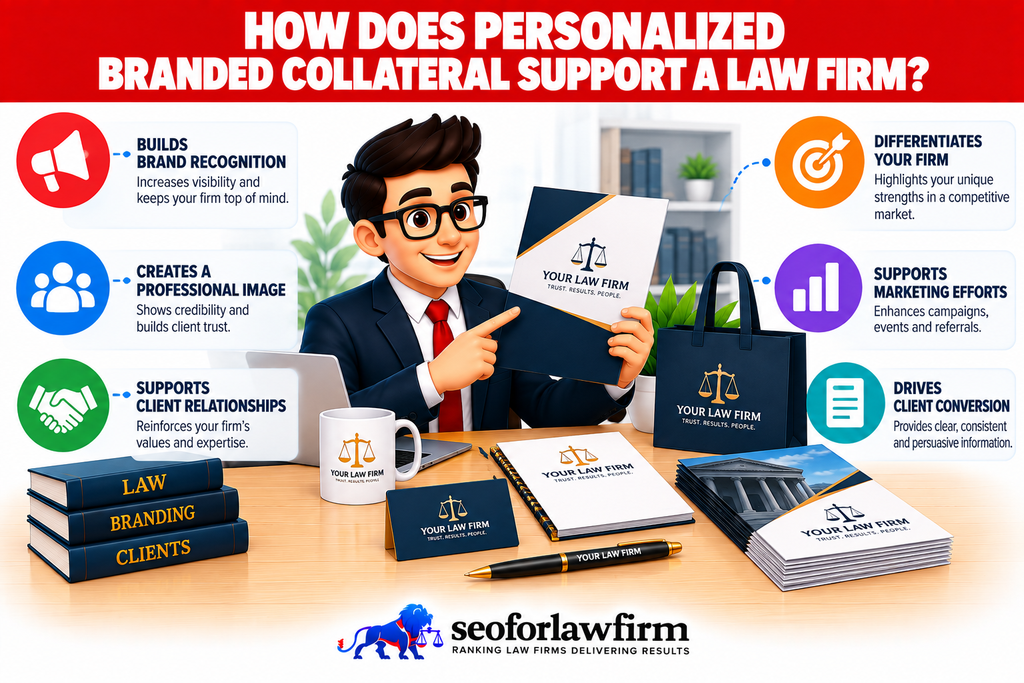
How Does Personalized Branded Collateral Support a Law Firm?
Personalized branded collateral supports a law firm by keeping its visual identity consistent across digital, physical, client, and professional interactions. Branded materials such as logos, business cards, stationery, email signatures, presentation decks, client folders, signage, event materials, and appropriate promotional products help clients recognize the firm across different touchpoints.
Legal-themed items such as engraved nameplates, business-card holders, portfolios, and pen sets can also extend the firm’s visual identity into office and client-facing settings. Branded collateral supports recognition and consistency, but the presence of a branded item does not prove higher conversion or retention. Law firms should also review professional rules, privacy expectations, internal policies, and client circumstances before using gifts or promotional products.
Listed below are the 9 common forms of law firm branded collateral.
- Logo: Establishes the firm’s primary visual identifier.
- Business cards: Present attorney and firm contact information in a consistent format.
- Letterhead and envelopes: Carry the firm’s identity into formal correspondence.
- Email signatures: Keep attorney and staff communications visually consistent.
- Presentation decks: Apply the firm’s identity to seminars, pitches, and client presentations.
- Client folders: Organize documents within a branded client-facing format.
- Signage: Reinforce the firm’s identity at physical offices and events.
- Event materials: Extend consistent branding into conferences, seminars, and sponsorships.
- Promotional products: Provide appropriate branded items where professional rules and client circumstances permit.
What Are the Best Practices for Law Firm Personalization?
The best law firm personalization practices use meaningful first-party context, connect segmentation with a clear business purpose, protect sensitive information, preserve human communication, and measure retained-client outcomes. Personalization should begin with the client’s legal problem and stage in the relationship rather than superficial demographic assumptions. Accurate preferences and matter-stage records captured through legal CRM and intake integration help keep personalized follow-up relevant to the person’s actual inquiry.
Firms should separate major practice areas, use declared preferences where available, route enquiries to the appropriate team, and change automated communication when a contact’s status changes. Personalization should also remain consistent with privacy obligations, advertising-platform restrictions, professional rules, and the firm’s established brand identity.
Listed below are 10 law firm personalization practices.
- Identify the client problem first: Personalize around the legal issue before using superficial demographic information.
- Separate major practice areas: Give materially different legal services separate content and intake paths.
- Use declared preferences where possible: Rely on information the person intentionally provides instead of speculative profiling.
- Segment by lifecycle stage: Separate prospects, scheduled consultations, current clients, former clients, and referral contacts.
- Route leads correctly: Send each enquiry to the attorney or team that handles the relevant matter.
- Keep automation contextual: Stop or change automated communication when the contact’s status changes.
- Protect sensitive information: Keep unnecessary matter details out of marketing systems.
- Respect advertising-platform restrictions: Apply platform rules before creating audiences around sensitive legal topics.
- Maintain brand consistency: Keep tone, visual identity, and firm positioning recognizable across personalized experiences.
- Measure signed-client outcomes: Evaluate personalization through qualified enquiries, consultations, retained matters, and client-service results.
What Personalization Mistakes Reduce Trust?
Law firm personalization reduces trust when communication becomes inaccurate, intrusive, repetitive, insensitive, over-automated, or disconnected from the client’s actual legal problem. Personalization should make communication more relevant without revealing unnecessary tracking, exposing incorrect data, or treating high-stakes legal matters like generic retail marketing.
Incorrect names, outdated lifecycle stages, excessive automation, unnecessary use of sensitive data, and unsupported claims can make the experience feel less credible. Personalized communications also remain subject to attorney advertising rules, including ABA Model Rule 7.1’s prohibition on false or misleading lawyer communications.
Listed below are 8 personalization mistakes law firms should avoid.
- Generic practice-area messaging: Sending the same message to unrelated legal audiences defeats the purpose of segmentation.
- Using sensitive data unnecessarily: Collecting detailed client information solely for marketing creates avoidable privacy risk.
- Incorrect personalization fields: Wrong names, matters, locations, or lifecycle stages expose the automation.
- Over-automation: Automated communication without appropriate human follow-up can weaken high-stakes client interactions.
- Wrong-stage messaging: Sending acquisition CTAs to retained clients or repeated consultation prompts after booking creates friction.
- Intrusive personalization: Referencing behavior or circumstances more explicitly than the person expects can reduce trust.
- Inconsistent brand voice: Contradictory messaging across website, email, intake, and advertising creates a fragmented experience.
- Unsupported marketing claims: Personalized advertising still must avoid false or misleading statements.
How Should Law Firms Protect Client Data During Personalization?
Law firms should protect client data during personalization by collecting only information needed for a legitimate purpose, limiting access, controlling vendor use, and protecting information connected with client representation. ABA Model Rule 1.6 requires lawyers to make reasonable efforts to prevent unauthorized access to or disclosure of information relating to representation. According to a study by Avi Goldfarb and Catherine Tucker titled Online Display Advertising: Targeting and Obtrusiveness in 2011, Goldfarb and Tucker found that contextual targeting and obtrusiveness could undermine each other when combined. Privacy-sensitive audiences warrant particular care; more aggressive targeting is not automatically more effective.
The level of protection depends on factors such as information sensitivity, disclosure risk, available safeguards, implementation cost, and operational burden. Law firms using CRM, email, intake, analytics, and automation systems should document what information enters each platform, why the firm collects it, who can access it, how long it remains stored, and which integrations or vendors can process it. Better personalization does not justify collecting every available data point.
Listed below are the 10 main data-governance areas law firms should review.
- Information collected: Identify which client, prospect, behavioral, and contact data enters each system.
- Purpose of collection: Define why each data point is needed.
- User permissions: Restrict access according to staff responsibilities.
- Vendor access: Review which external providers can process or view the information.
- Retention: Set appropriate retention periods for marketing and intake data.
- Export access: Control who can download or transfer stored information.
- Security settings: Configure platform protections according to the sensitivity of the data.
- Integration permissions: Limit what connected systems can exchange.
- Consent requirements: Apply relevant consent rules to marketing, tracking, or communication.
- Applicable privacy law: Review jurisdiction-specific privacy obligations that apply to the firm and its clients.
What Tools Support Law Firm Personalization?
Law firm personalization tools include legal CRM systems, intake platforms, and content-management systems that organize client context and deliver more relevant experiences. Legal CRM platforms support matter-specific intake and routing, marketing CRMs manage segments and workflows, email platforms adapt communication by contact data, analytics systems measure audience behavior, and website platforms create practice-specific pages and conversion paths. Technology provides the infrastructure, but the law firm still determines which information is appropriate to use and which personalized experience should be delivered.
The table below shows common tools and their personalization functions.
| Platform Type | Example | Personalization Function |
| Legal CRM and intake | Clio Grow | Matter-specific intake, prospect stages, workflows, reminders, and routing |
| Marketing CRM | HubSpot | Segments, properties, workflows, and personalized content |
| Email marketing | Mailchimp | Segments, groups, tags, merge fields, and conditional content |
| Analytics | Google Analytics | Audience and segment analysis using dimensions, metrics, and events |
| Website CMS | WordPress or similar CMS | Practice-specific pages, location content, CTAs, and content journeys |
What Is the Difference Between Audience Segmentation Software and an Audience Segmentation Platform?
Audience segmentation software groups contacts according to defined criteria, while an audience segmentation platform connects those segments with broader functions such as CRM data, workflows, email campaigns, analytics, advertising, and reporting. Product terminology varies between vendors, so law firms should evaluate the functions a system provides rather than rely on the label used to describe it. HubSpot combines segmentation with email, workflows, advertising audiences, reporting, and CRM records, while Mailchimp combines audience data, tags, groups, fields, segmentation, and messaging within its marketing environment.
The table below shows the main differences between audience segmentation software and an audience segmentation platform.
| Dimension | Audience Segmentation Software | Audience Segmentation Platform |
| Primary function | Groups contacts using defined criteria | Connects segments with broader marketing and CRM functions |
| Contact data | Uses fields, tags, behaviors, or other criteria | Uses segmentation alongside connected customer records |
| Automation | May provide limited automation | Often connects segments with workflows and triggered actions |
| Email marketing | May export or organize segments | Often uses segments directly within email campaigns |
| Advertising | Limited or separate | Can connect segments with eligible advertising audiences |
| Analytics | Measures segment membership or performance | Connects segment performance with broader reporting |
| Best purchasing criterion | Ability to create useful audience groups | Ability to connect segmentation with the firm’s wider marketing system |
How Can Law Firms Measure Personalization Performance?
Law firms measure personalization performance by comparing how different audience segments progress from marketing interaction to qualified enquiry, consultation, signed matter, and revenue. A law firm SEO results tracking framework and law firm marketing KPIs can connect segment-level engagement with acquisition costs, lead quality, client conversion, and financial outcomes. Event and funnel reporting in Google Analytics for lawyers can compare how audience segments move from relevant pages to completed inquiry actions.
Website clicks and email engagement remain useful diagnostic measures, but stronger evaluation depends on whether personalized experiences improve qualified leads, consultations, retained matters, and revenue.
Listed below are 10 useful personalization measurements.
- Landing-page conversion rate: Measures calls, forms, chats, or bookings generated by each personalized page.
- Qualified-lead rate: Measures how many enquiries meet the firm’s acceptance criteria.
- Consultation booking rate: Measures how many qualified prospects schedule consultations.
- Consultation completion rate: Measures whether intake and reminder personalization improves attendance.
- Lead-to-client rate: Measures which personalized journeys produce retained matters.
- Cost per qualified lead: Compares acquisition efficiency across segments and practice areas.
- Cost per signed matter: Connects personalization expenditure with retained-client acquisition.
- Email engagement: Uses opens and clicks as supporting diagnostic metrics.
- Revenue by segment: Compares attributable revenue or gross profit across audiences and acquisition journeys.
- Client service indicators: Measures response times, missed appointments, communication issues, satisfaction, or repeat work where appropriate.
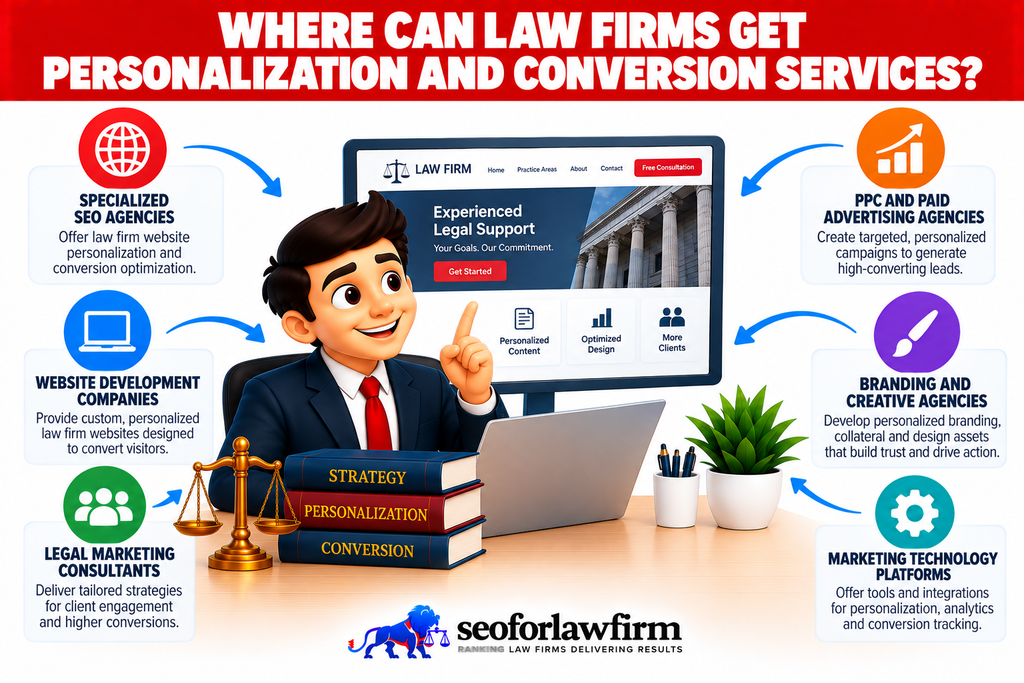
Where Can Law Firms Get Personalization and Conversion Services?
Law firms can get personalization and conversion services from experienced legal marketing providers such as SEOForLawFirm, along with established providers such as Rankings.io, Hennessey Digital, and legal intake-system providers. SEOForLawFirm’s law firm SEO services connect legal content, practice-area targeting, website architecture, client journeys, search visibility, conversion measurement, and signed-client acquisition within one marketing framework. SEOForLawFirm’s conversion rate optimization for law firms connects audience-specific messaging with landing-page usability, form completion, and intake handoffs.
A personalization and conversion provider should evaluate practice-area journeys, landing pages, intake workflows, CRM segmentation, email automation, paid advertising, analytics, lead qualification, and signed-matter attribution so each client segment receives relevant messaging and an appropriate next action. The provider should also separate permissible personalization from sensitive-data targeting and keep privacy obligations and attorney advertising requirements within the implementation process.
How Do Law Firms Calculate ROI From Personalization?
Law firms calculate personalization ROI by comparing the incremental financial return produced by personalized marketing with the cost of implementing and operating the personalization system. The calculation should compare a personalized experience with a defined baseline, such as pre-personalization performance or a controlled generic experience.
A basic formula is Personalization ROI = ((Attributed Gross Profit − Personalization Cost) ÷ Personalization Cost) × 100. Results should also be segmented by practice area, audience, or journey because an improvement in one legal service does not establish that the same personalization strategy will perform equally across unrelated matters.
Listed below are 9 common personalization costs law firms should include.
- CRM software: Covers systems used to store contact, lifecycle, and matter information.
- Marketing automation: Includes workflow and campaign automation tools.
- Content creation: Covers practice-specific or segment-specific content production.
- Landing-page development: Includes design and development for personalized acquisition paths.
- Analytics: Covers measurement, reporting, and attribution tools.
- Testing: Includes controlled experiments and conversion testing.
- Integration work: Covers connections between CRM, website, intake, analytics, and marketing systems.
- Agency fees: Includes external strategy, implementation, and management costs.
- Staff time: Includes internal labor where the firm incorporates personnel costs into ROI calculations.
How Does Personalization Support SEO?
Law firm personalization supports SEO when it creates useful practice-area, location, attorney, and informational content that satisfies distinct search intent, but personalization itself is not a Google ranking factor. Law firm SEO services can connect personalized practice-area content with site architecture, local search, internal linking, technical SEO, and conversion measurement.
SEO value comes from giving each page a distinct purpose and matching the content with the legal problem, location, or informational need represented by the search. Producing large numbers of nearly identical personalized pages does not provide the same value because each page still needs original relevance and a legitimate search purpose.
Listed below are 6 useful ways personalization can support SEO.
- Separate practice-area pages: Match individual legal services with commercial search intent.
- Legitimate location pages: Address geographic demand where the firm genuinely serves clients.
- Attorney biographies: Connect attorney experience and credentials with relevant services.
- Question-based legal resources: Answer distinct informational searches prospective clients perform.
- Relevant internal links: Connect related legal topics, services, locations, and attorney pages.
- Clear client journeys: Help users move from search intent to relevant information and an appropriate next action.
How Does Personalization Affect Law Firm Website Design?
Personalization affects law firm website design by changing which information, navigation paths, and calls-to-action different visitors need to find quickly. Law firm web design services can organize practice areas, locations, attorney profiles, client types, educational content, and consultation paths around distinct visitor needs.
A law firm website does not need to dynamically rewrite every page for every visitor because strong information architecture can provide meaningful self-selection. Visitors should be able to identify their legal problem, location, or service need and move into the appropriate content and intake path without navigating through unrelated services.
Listed below are the 7 main website elements personalization can shape.
- Practice-area navigation: Directs visitors toward the legal service that matches their problem.
- Location pathways: Connects prospects with the appropriate office or geographic content.
- Attorney profiles: Helps visitors identify lawyers connected to the relevant practice area or jurisdiction.
- Industry pages: Organizes services around business sectors where relevant.
- Client-type pages: Separates information for individuals, businesses, professionals, or other client groups.
- Educational content: Connects visitors with legal resources related to their current research needs.
- Consultation paths: Matches calls-to-action and intake routes with the visitor’s service and decision stage.
Does Personalization Replace Human Client Service?
No, personalization technology does not replace the human judgment, legal advice, empathy, and professional relationship that clients hire lawyers to provide. Automation can route enquiries, send reminders, populate templates, schedule communication, organize lead stages, and trigger tasks, but lawyers and staff still determine client priorities, interpret legal circumstances, and provide individualized guidance.
Thomson Reuters frames lawyers as personal advisers who need to understand client goals, which places personalization inside the lawyer-client relationship rather than treating it as a substitute for human service.
