
Legal Content Writing for Law Firms
Build Authority, Attract Clients & Strengthen Organic Visibility
SEOForLawFirm creates legal content that connects attorney expertise with search intent, topical authority, client questions, and consultation-focused messaging.
Practice-area pages, legal articles, attorney content, topical clusters, content refreshes, internal links, entity relationships, and conversion copy work together as one search-to-client content system.
Clear legal explanation connected to the relevant employment-law service.

One Content Architecture Across the Client Search Journey
Why Legal Content Matters for Law Firms
Legal content gives prospective clients the information required to understand a legal problem, evaluate a law firm, compare services, and decide whether to request a consultation.
Search visibility grows when a law firm publishes connected content that reflects real client questions, legal entities, practice-area relationships, attorney expertise, and location-specific needs.
Clients Research Legal Problems First
Legal questions often begin with symptoms, disputes, deadlines, events, claims, procedures, costs, rights, or possible outcomes rather than a precise service name.
Content Builds Attorney Credibility
Clear legal explanations, relevant experience, jurisdictional context, citations, attorney insight, and professional tone support trust before direct contact.
Content Moves Visitors Toward Services
Internal links connect informational searches with practice pages, attorney profiles, consultation options, related legal issues, and the next logical question.
SEOForLawFirm’s Legal Content Writing Approach
SEOForLawFirm combines legal clarity, search relevance, entity relationships, readable structure, jurisdiction context, professional tone, and conversion intent in each content asset.
Accuracy
Legal terminology, issue definitions, procedural context, factual claims, and jurisdiction-specific material receive structured editorial review.
Readability
Headings, paragraphs, tables, lists, definitions, examples, and page flow make legal information easier for prospective clients to process.
Compliance
Marketing copy avoids unsupported promises and receives review for terminology, professional standards, jurisdictional context, and advertising-sensitive claims.
Tone Alignment
Content voice changes according to the firm's brand, legal audience, practice area, client concerns, business context, and attorney positioning.
Core Legal Content Writing Services
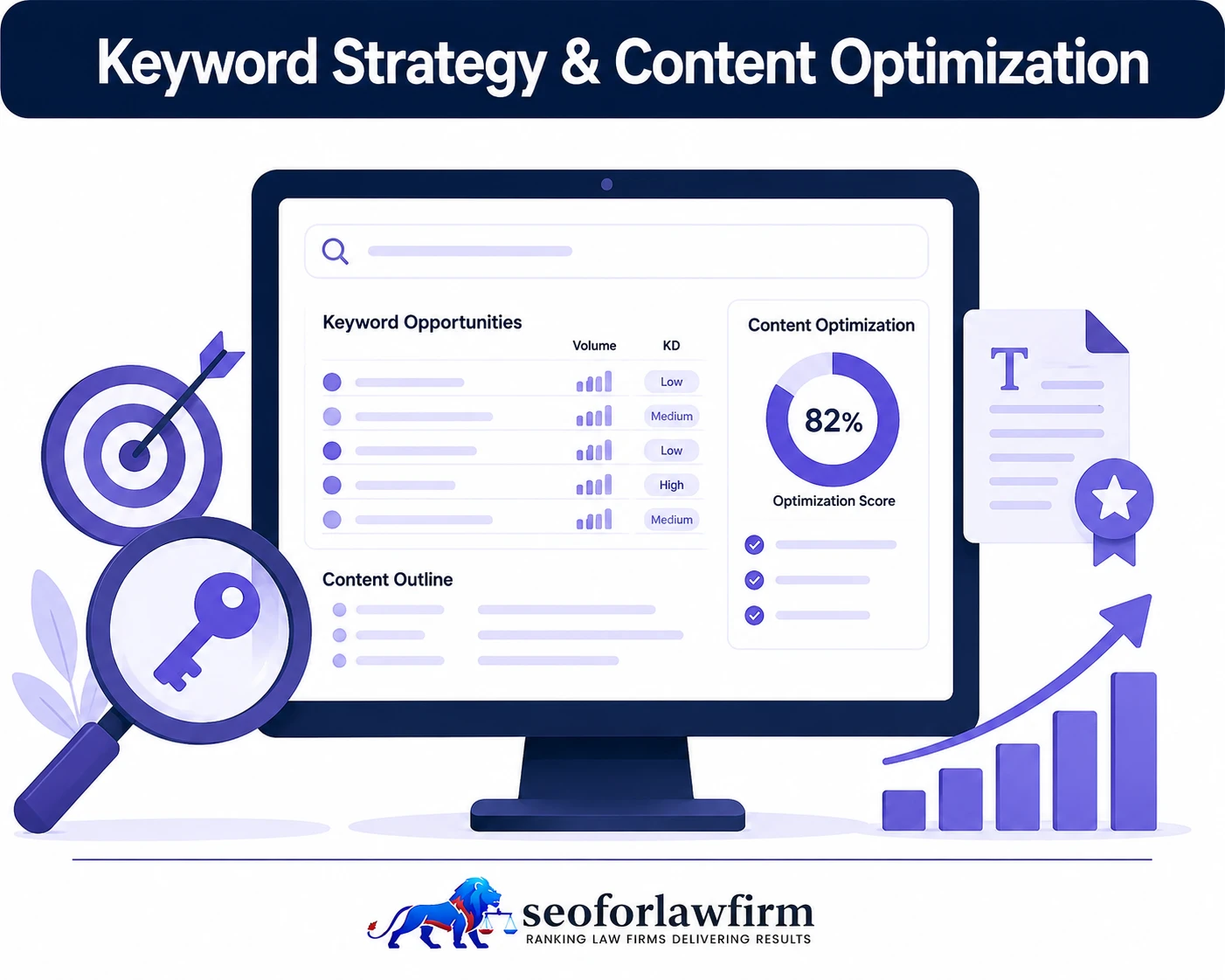
SEOForLawFirm develops service content, educational resources, conversion copy, semantic optimization, and content-refresh systems around the law firm's commercial search priorities.
Practice Area Page Writing
Commercial legal pages structured around the service, client problem, attorney solution, process, location, trust signals, and consultation action.
Legal Blogs & Articles
Informational content built around long-tail legal questions, procedures, rights, deadlines, disputes, case types, and related services.
Website & Landing Page Copy
Homepage, about, attorney, service, contact, campaign, and intake copy designed to communicate trust and move visitors toward contact.
SEO & Keyword Integration
Search-intent mapping, entity coverage, heading structure, internal linking, metadata guidance, semantic terms, and topical relationships.
Content Audits & Refreshes
Existing pages receive review for outdated information, weak intent coverage, missing entities, poor internal links, and conversion gaps.
Editing & Compliance Review
Editorial passes assess legal terminology, readability, tone, structure, claims, citations, jurisdictional relevance, and professional presentation.
Entity & Knowledge Graph Optimization
Legal content becomes more explicit when pages clearly identify the people, services, legal concepts, jurisdictions, procedures, locations, organizations, and case types involved.
SEOForLawFirm maps the primary entity and its supporting relationships so search engines and readers receive a coherent subject structure rather than disconnected keyword mentions.
Practice pages connect attorneys with services and locations. Supporting articles connect legal questions with procedures, case types, statutes, consequences, and relevant commercial pages.
- Attorney entities
- Legal service entities
- Case-type relationships
- Location and jurisdiction context
- Supporting legal concepts

Content Optimization & Relevance
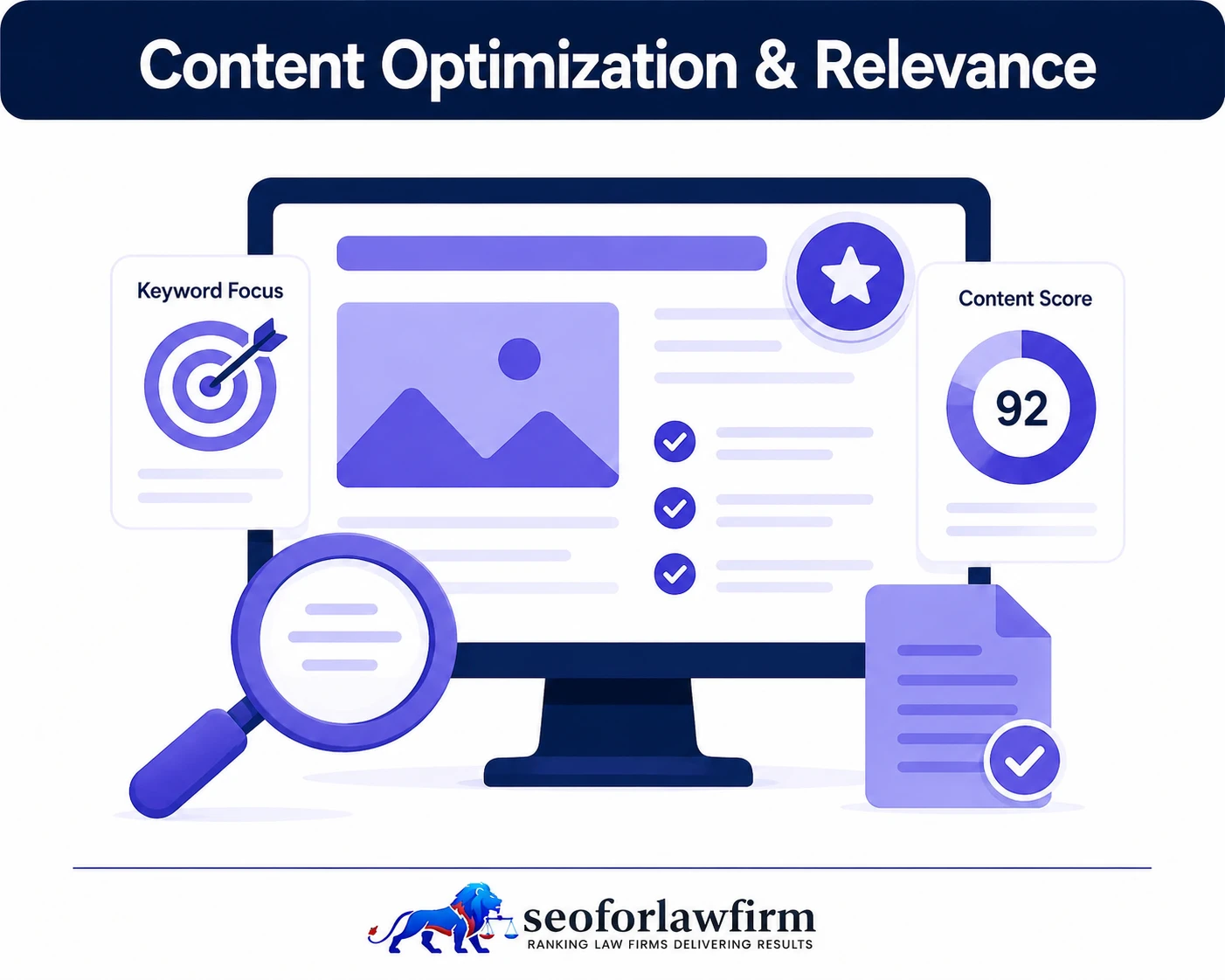
SEOForLawFirm optimizes legal content around the question the page owns rather than inserting unrelated keywords into one generic article.
Heading hierarchy, starting statements, entity coverage, supporting questions, internal links, examples, tables, FAQs, semantic terms, and conversion pathways reinforce the page's main search intent.
Existing content is refreshed when rankings, search demand, regulations, competitors, user behavior, or service priorities change.
- Intent-aligned headings
- Semantic term coverage
- Content-gap expansion
- Internal-link refinement
- Evergreen updates
Practice Area Content Development
Practice-area content uses different legal entities, client concerns, search vocabulary, tone, evidence, and conversion paths according to the underlying service.

Personal Injury
Accidents, injuries, liability, insurance, damages, medical treatment, claims, deadlines, litigation, and attorney representation.
Employment Law
Wrongful termination, discrimination, harassment, retaliation, wage claims, workplace rights, and administrative processes.
Family Law
Divorce, custody, support, mediation, property division, high-asset matters, and family-focused legal decisions.
Criminal Defense
Charges, arrests, DUI, investigations, penalties, hearings, defenses, constitutional issues, and urgent representation.
Business Law
Formation, contracts, governance, transactions, shareholder issues, litigation, compliance, acquisitions, and outside counsel.
Estate & Probate
Wills, trusts, probate, executors, beneficiaries, administration, estate disputes, planning, and fiduciary responsibilities.
Your Roadmap to Higher Rankings and More Clients
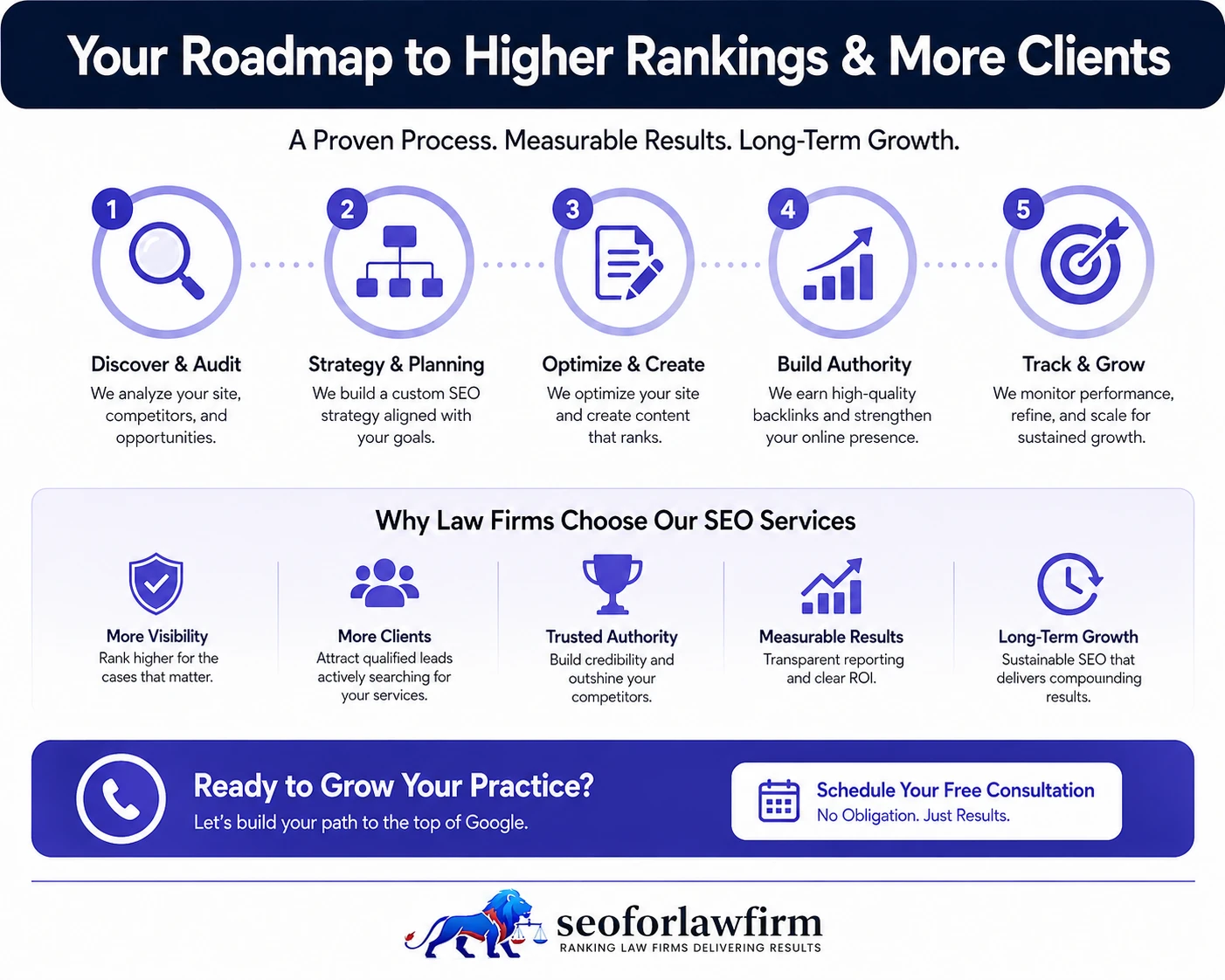
SEOForLawFirm moves from content diagnosis into entity mapping, production, optimization, internal linking, measurement, and continuous refresh.

- 01
Content Audit
Review existing pages, rankings, search intent, content quality, service coverage, internal links, conversions, and outdated material.
- 02
Entity & Topic Mapping
Map primary services, case types, client questions, legal concepts, locations, attorney entities, and supporting information.
- 03
Legal Content Production
Draft practice pages, supporting articles, FAQs, attorney content, landing pages, and topical resources.
- 04
Editorial Optimization
Refine accuracy, readability, hierarchy, entity coverage, search intent, internal links, calls to action, and professional tone.
- 05
Publish & Connect
Connect related pages through contextual links so service pages and supporting resources form coherent topical clusters.
- 06
Measure & Refresh
Track rankings, entrances, engagement, internal clicks, consultations, content-assisted leads, and pages requiring further improvement.
Analytics, Reporting & Measurement
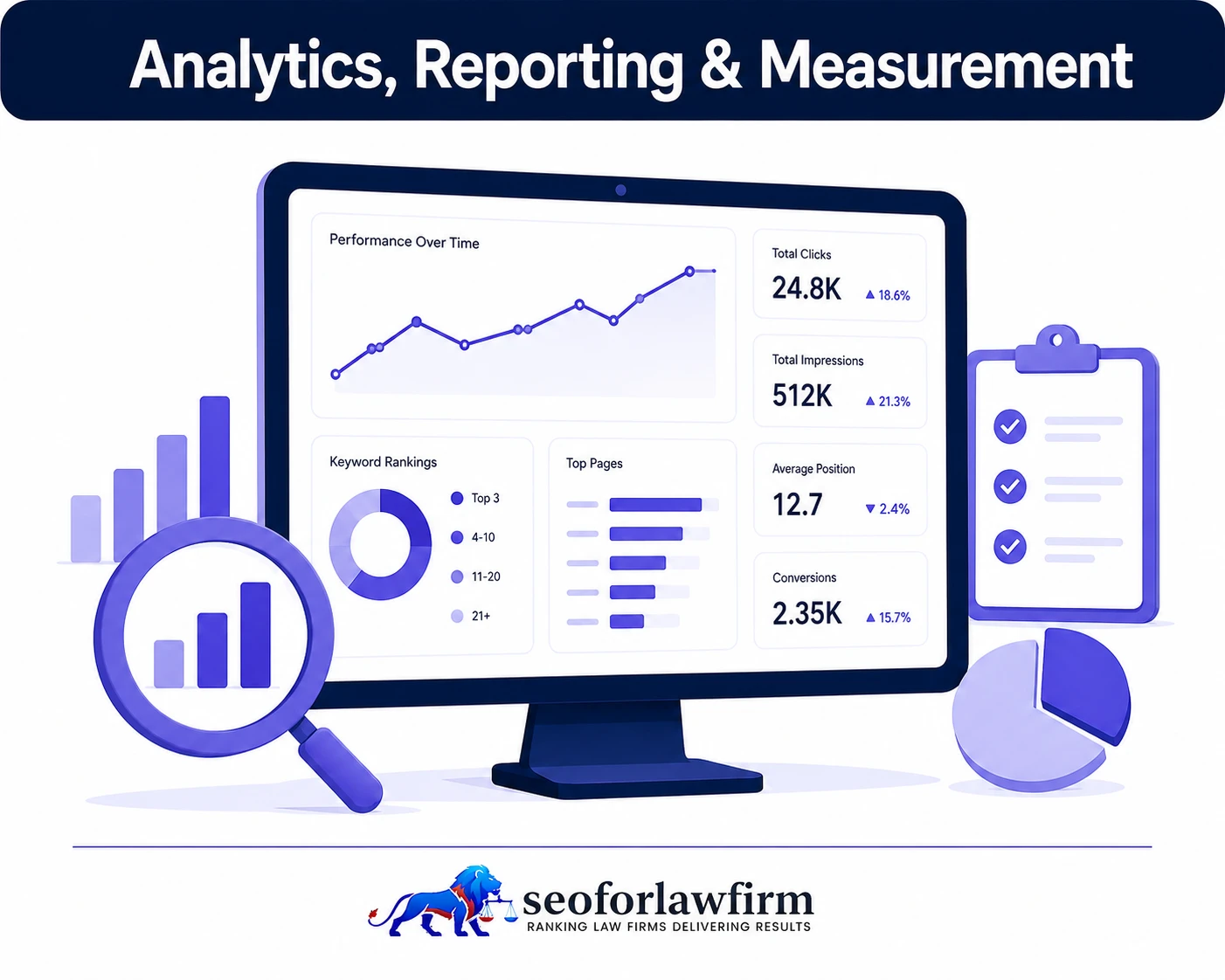
Legal content performance is measured through visibility, behavior, internal movement, consultations, and retained matters rather than word count alone.
SEOForLawFirm tracks organic entrances, ranking movement, engagement time, internal click-throughs, service-page progression, consultation forms, phone actions, and content-assisted conversions.
Measure Content by the Client Journey It Supports
Informational pages and commercial service pages perform different jobs, so measurement needs to reflect the page's intended role.
An educational article can succeed by attracting relevant search traffic and moving visitors into a service page. A practice-area page can succeed by ranking for transactional searches and generating direct consultations.
SEOForLawFirm connects these behaviors so content decisions are based on actual search and intake performance.
- Page-level ranking trends
- Article-to-service click-through
- Service-page conversion rate
- Consultation attribution
- Refresh prioritization


Content Growth Benchmarks in the Supplied Framework
The supplied legal-content framework uses organic traffic, lead conversion, consultation growth, keyword rankings, engagement, and content-assisted client acquisition as performance indicators.
Selected Legal Content Writing Outcomes
Organic Traffic to Rewritten Pages
- Average engagement increased 53%
- Content-page form completions increased 79%
- 24 rewritten pages reached Google's top 10
- 27 retained employment-law matters
Organic Content Entrances
- Article-to-service clicks increased 67%
- Probate consultations increased 74%
- 19 content assets reached page one
- 23 retained probate and estate matters
Organic Business-Law Content Traffic
- Qualified consultations increased 82%
- Commercial keyword visibility increased 91%
- 21 priority assets reached Google's top 10
- 25 retained corporate and business matters
Law Firm Content Client Results
Rebuilt the firm’s employment-law content around wrongful termination, discrimination, retaliation, wage claims, and workplace harassment with stronger legal clarity, search intent alignment, and consultation-focused messaging.
“Our old content was technically accurate, but it was too generic and did not reflect how prospective clients actually searched for help. The new legal content gave each practice area a clearer purpose, answered the questions clients were asking, and made our attorneys’ experience easier to understand. The website started attracting more qualified visitors and the consultation requests became much more relevant to the matters we wanted to grow.”
- Organic traffic to rewritten legal pages increased 142% in 7 months
- Average engagement time increased 53%
- Consultation form completions from content pages increased 79%
- 24 rewritten pages moved into Google’s top 10 for tracked terms
- Bounce rate across priority practice pages decreased 31%
- Content-assisted leads contributed to 27 retained employment-law matters
Expanded the firm’s content library for wills, trusts, probate administration, estate litigation, and executor guidance with clearer topical coverage and stronger internal connections between service pages.
“Our previous website had scattered articles, but the content did not work together as a coherent resource for clients. The writing strategy reorganized our topics around specific legal needs, improved the way service pages connected to supporting articles, and made complex probate issues easier for families to understand. We saw more visitors move from informational pages into consultation pages rather than leaving after reading one article.”
- Organic entrances to legal content increased 128%
- Internal click-throughs from articles to service pages increased 67%
- Probate-related consultation requests increased 74%
- 19 content assets reached page-one rankings
- Average pages per organic session increased from 1.8 to 3.1
- Content-generated inquiries produced 23 retained probate and estate matters
Improved service-page and thought-leadership content for business formation, commercial contracts, shareholder disputes, mergers and acquisitions, and outside general counsel services.
“Our firm needed content that sounded credible to business owners, executives, and founders without reading like generic legal marketing copy. The new content gave our service pages more depth, connected legal issues to commercial decisions, and created a stronger path from educational content into consultation requests. The biggest improvement was lead quality because prospects were contacting us with a clearer understanding of the service they needed.”
- Organic traffic to business-law content increased 156%
- Qualified consultation requests increased 82%
- Commercial-intent keyword visibility increased 91%
- 21 priority service pages and articles reached Google’s top 10
- Content-to-consultation conversion rate increased from 2.7% to 5.4%
- Content-assisted organic leads generated 25 retained corporate and business-law matters
Common Mistakes in Legal Content Writing
Legal content loses search and client value when pages become generic, repetitive, inaccurate, disconnected from client intent, or overloaded with keywords.
Generic Template Content
Pages that could belong to any law firm fail to communicate jurisdiction, attorney experience, service differences, or the client's actual legal problem.
Keyword Stuffing
Repeating exact-match keywords without semantic context weakens readability and fails to explain the relationships between legal entities.
Missing Search Intent
Informational queries, transactional service searches, comparison questions, and urgent legal needs require different page structures.
Weak Internal Connections
Useful articles lose commercial value when readers cannot move naturally into related services, attorney pages, supporting topics, or consultation paths.
Outdated Legal Information
Regulations, statutory references, processes, case examples, service descriptions, and jurisdiction-specific information require periodic editorial review.
Legal Content Writing Deliverables
Frequently Asked Questions About Legal Content Writing
What is legal content writing?
Legal content writing is the creation and optimization of law-firm service pages, articles, guides, attorney content, landing pages, FAQs, and related material designed to explain legal topics, build authority, support search visibility, and generate qualified client inquiries.
How much does law firm content writing cost?
The supplied framework places professional legal content writing around $150–$500 per page as a starting range, with final pricing affected by legal complexity, research requirements, length, jurisdictional scope, SEO depth, and editorial review.
How long does legal content take to rank?
The supplied content framework places many initial ranking gains around 3–6 months, with timing affected by keyword competition, existing site authority, content quality, technical SEO, internal links, external authority, and publishing volume.
Does legal content writing include SEO optimization?
Yes. SEOForLawFirm integrates search-intent research, entity mapping, semantic terms, on-page structure, internal links, content relationships, metadata guidance, and supporting technical recommendations into the content workflow.
Can SEOForLawFirm write for multiple practice areas?
Yes. Content architecture, vocabulary, tone, client questions, legal entities, conversion paths, and jurisdictional context are adapted across areas such as personal injury, employment law, family law, criminal defense, business law, real estate, immigration, and estate planning.
Should existing law firm content be rewritten or refreshed?
Pages with outdated information, weak rankings, thin topical coverage, poor internal links, low engagement, incorrect search intent, or weak consultation paths are candidates for targeted refreshes or full rewrites.
Lets make you an extra +$10M in Revenue
Build a connected legal content system around practice areas, client questions, attorney expertise, semantic entities, topical authority, internal links, search intent, content refreshes, and consultation conversion.