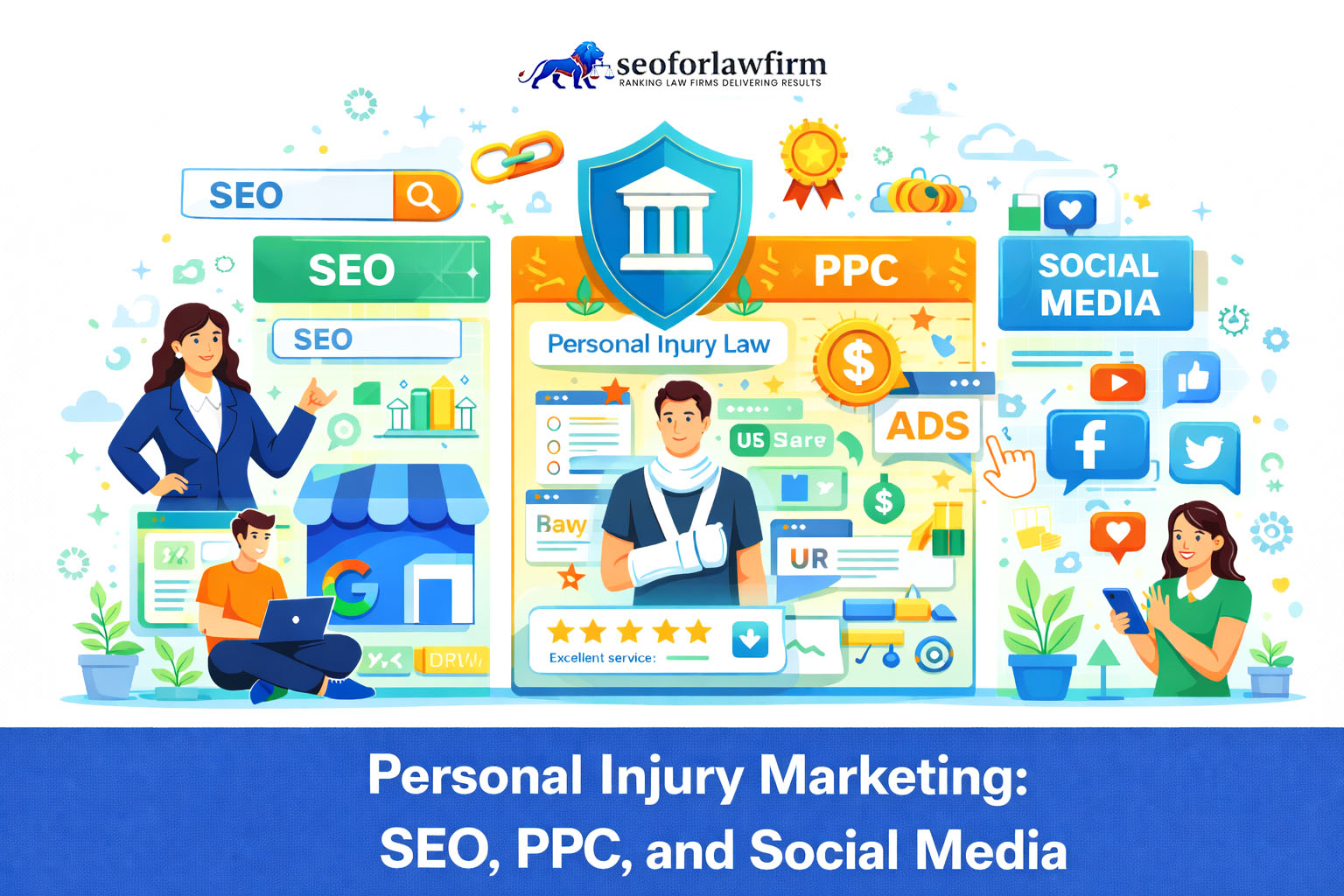
Personal Injury Law Firm Marketing is the coordinated use of SEO, PPC, Local Services Ads, Google Business Profile, social media, community outreach, reviews, and client intake to attract injured people and convert qualified inquiries into signed cases. Effective Personal Injury Law Firm Marketing needs both demand-generation channels and an intake system capable of responding when prospective clients reach out.
SEO builds long-term search visibility for high-intent personal injury queries and can reduce reliance on paying for every visit as strong practice-area, location, and informational pages gain organic traffic. The actual cost per lead varies by market, firm authority, competition, content quality, and conversion performance, so SEO should not be described as universally having the lowest cost per lead without firm-level attribution data.PPC captures immediate search demand by placing personal injury firms in paid results for queries such as “car accident lawyer near me” and “truck accident attorney in Dallas.” Personal injury search advertising is expensive in competitive markets. Current PI marketing sources report Google Ads clicks above $100 in some markets, and one 2026 industry analysis places many PI terms around $150 or more, but keyword cost varies substantially by geography, query, competition, Quality Score, bidding strategy, and match type.
Social media and Meta advertising support Personal Injury Law Firm Marketing through attorney visibility, educational content, brand familiarity, video, and paid audience development. Sam Aguiar Injury Lawyers reported in 2026 that low-production mobile videos consistently outperformed highly polished videos in its own testing because informal attorney and team content created a stronger sense of authenticity. The finding represents one firm’s testing rather than a universal platform benchmark. Local Services Ads and Google Business Profile give personal injury firms another route to high-intent local prospects. Google Local Services Ads charge for leads rather than ordinary clicks, require screening and verification, and now use the Google Verified badge for eligible advertisers. Google Business Profile supports local Maps and Search visibility, with Google identifying relevance, distance, and prominence as the main local-ranking categories. Cost per signed case is the strongest financial marketing metric because it connects acquisition spending with clients who actually execute an engagement agreement. Impressions, clicks, calls, forms, and raw leads remain diagnostic metrics, but none establishes acquisition profitability until the firm knows how many qualified inquiries become retained clients.
Speed to lead measures the time between an inquiry and meaningful firm response. Intake performance deserves the same attention as advertising because Clio’s 2024 secret-shopper study of 500 law firms found that only 33% responded to email inquiries, only 40% answered when called, and 48% were effectively unreachable by phone. Firms using client-facing intake technology had 51% more leads and 52% higher revenue in Clio’s analysis, though those results show association within the dataset rather than a guaranteed outcome from software alone. Review acquisition supports both client trust and local visibility. Clio’s Personal Injury Law Firm Marketing guidance identifies positive reviews as an influential lawyer-selection factor, and Google states that review count and positive ratings can contribute to local prominence. Google also states that ratings and review volume affect Local Services Ads performance.
Community outreach complements digital acquisition by building familiarity before an injury occurs. Public speaking, local events, professional networking, community sponsorships, educational programs, and referral relationships can create brand recognition that paid search alone cannot reproduce. Clio includes networking, public speaking, local sponsorships, and traditional marketing among its current Personal Injury Law Firm Marketing recommendations. Organizations such as PILMMA also provide personal injury law firm owners with management and growth education. Those operational frameworks can support marketing execution, but they do not replace channel-level attribution, intake measurement, and signed-case economics.
Table of Contents
- Article sections will appear here.
What Is Personal Injury Law Firm Marketing?
Personal Injury Law Firm Marketing is the process of making a personal injury law firm visible, credible, reachable, and persuasive to people seeking representation after accidents or injuries.
Personal Injury Law Firm Marketing differs from general brand advertising because prospective clients often enter the market suddenly after a collision, workplace event, unsafe-property incident, medical event, or another injury-producing occurrence. The firm needs to capture existing demand and build enough trust for the injured person to make contact.
Listed below are the 7 core parts of a Personal Injury Law Firm Marketing strategy.
- SEO: Captures organic searches involving injury types, legal questions, locations, and attorney-selection queries.
- PPC: Purchases immediate visibility for high-intent searches through platforms such as Google Ads.
- Local Services Ads: Generate eligible local leads through Google’s pay-per-lead advertising system.
- Google Business Profile and local SEO: Connect the firm with location-based searches, Maps, reviews, office information, and local prominence.
- Social media and video: Build familiarity, explain legal issues, distribute attorney content, and support paid social campaigns.
- Community and referral marketing: Develop offline recognition, professional relationships, and word-of-mouth demand.
- Client intake and attribution: Turn inquiries into consultations and signed matters while identifying which channels produce profitable cases.
A strategic guide by Clio from their law firm growth resources, titled “Personal Injury Law Firm Marketing, A Complete Guide” in 2025, analyzed business development frameworks for practitioners and established that a successful Personal Injury Law Firm Marketing guidance program covers a wider operational model, incorporating client experience optimization and strategic networking, rather than treating digital advertising as the entire strategy.
Clio recommends goal setting, tracking, reviews, social media, website optimization, SEO, Google Business Profile, SEM, Local Services Ads, video, networking, public speaking, traditional advertising, community sponsorship, and intake follow-up.
How Does SEO Improve Personal Injury Law Firm Marketing?
SEO improves Personal Injury Law Firm Marketing by helping the law firm appear organically when injured people search for attorneys, injury claims, accident procedures, compensation questions, and local legal services.
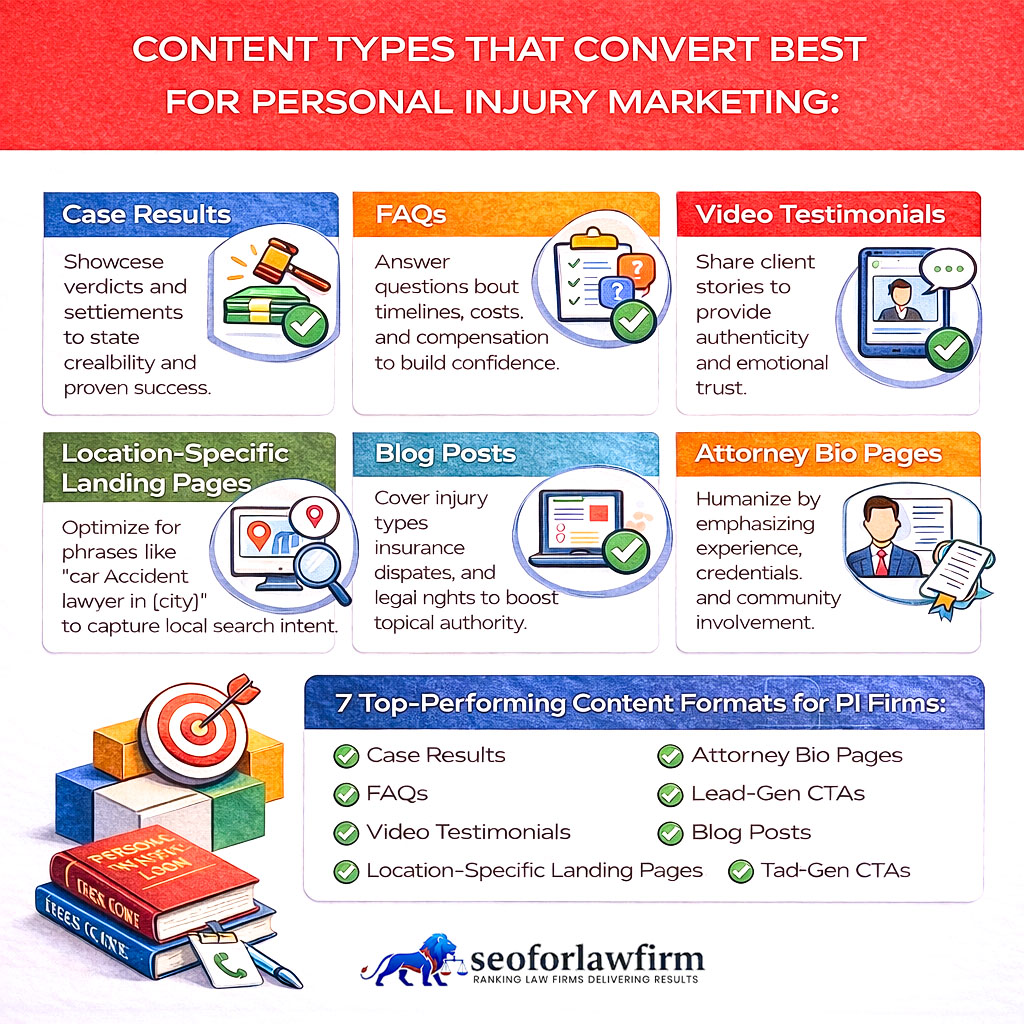
A complete personal injury law firm SEO strategy connects practice-area pages, location pages, attorney biographies, legal resources, local SEO, internal links, backlinks, technical accessibility, and conversion paths.
Listed below are the 6 SEO components that matter most for personal injury firms.
- Practice-area pages: Build separate pages for materially different services such as car accidents, truck accidents, motorcycle crashes, wrongful death, premises liability, catastrophic injuries, and other matters the firm actually handles.
- Local pages: Connect services with genuine offices and service markets without publishing mass-produced city pages.
- High-intent content: Answer questions involving fault, evidence, insurance, filing deadlines, compensation, medical documentation, settlement, and litigation.
- Google Business Profile: Maintain accurate office, category, service, review, and contact information.
- External authority: Earn relevant links and references from legitimate publishers, legal organizations, local institutions, media, and community entities.
- Technical SEO: Maintain crawlable pages, accurate canonicals, mobile usability, HTTPS, working forms, and acceptable page experience.
Clio’s current PI SEO guidance treats local SEO, website optimization, backlinks, content marketing, and measurement as connected components rather than separate campaigns.
Which Keywords Should Personal Injury Lawyers Target?
Personal injury lawyers should target keywords according to case type, geographic market, legal question, and the prospective client’s stage of hiring intent.
Listed below are the 5 primary keyword groups for Personal Injury Law Firm Marketing.
- Attorney-selection searches: “personal injury lawyer near me,” “car accident attorney Dallas,” or “truck accident lawyer Houston.”
- Case-type searches: “motorcycle accident attorney,” “slip and fall lawyer,” or “wrongful death attorney.”
- Problem searches: “insurance company denied injury claim” or “driver had no insurance.”
- Process searches: “what happens after filing an injury lawsuit” or “how long does a personal injury case take.”
- Compensation and evidence searches: “what is a whiplash case worth,” “medical records needed for injury claim,” or “how are pain and suffering damages calculated.”
Commercial terms usually belong on service pages. Informational questions usually belong on guides or supporting content.
The same keyword should not be forced into multiple pages merely to increase coverage. Page architecture needs one main owner for each meaningful intent.
How Should Personal Injury Firms Use Local SEO?
Personal injury firms should use local SEO to connect genuine office locations and local legal services with nearby people searching for representation.
Google states that local results are mainly determined by relevance, distance, and prominence. Relevance concerns how closely the business matches the search. Distance concerns physical proximity. Prominence includes wider public recognition and information such as links and reviews.
Listed below are the 7 local SEO actions personal injury firms should prioritize.
- Verify every eligible Google Business Profile.
- Select accurate business categories and services.
- Maintain correct office address, phone number, hours, website, and map location.
- Request authentic client reviews through a compliant process.
- Maintain accurate citations and professional listings.
- Build original location and office pages.
- Track local visibility across several geographic points rather than one search performed from the office.
A complete local SEO strategy for law firms should connect Maps visibility with genuine offices, localized website content, reviews, citations, links, and intake performance.
How Does Google Business Profile Support Personal Injury Law Firm Marketing?
Google Business Profile supports Personal Injury Law Firm Marketing by displaying the firm’s office, reviews, categories, contact information, photographs, website, and business details during local searches. Google states that complete and accurate profile information helps a business appear for relevant local searches. Google also states that review volume and positive ratings can contribute to local prominence. A personal injury firm should verify its real-world business name, eligible office address, primary category, secondary categories, listed services, telephone number, website URL, opening hours, original photographs, review activity, review responses, and profile ownership. The firm should use the actual business name in the profile title.
The firm should not add “best,” city names, “24/7,” or accident keywords unless those words form part of the real-world business name. Google Business Profile does not remove the effect of proximity. A service-area entry does not move the firm’s office closer to a searcher. The profile supports local discovery. The profile does not guarantee a Maps position or replace relevant pages, accurate local information, responsive intake, and legitimate client reviews. Google’s local-ranking guidance explains the roles of relevance, distance, and prominence.
How Do PPC Campaigns Generate Personal Injury Leads?
PPC campaigns generate personal injury leads by buying advertising visibility for search queries used by people actively seeking legal representation. The campaign displays an ad when a search matches the selected keyword, location, bid, budget, and account settings. Search terms can include “car accident lawyer near me,” “truck accident attorney Houston,” “personal injury attorney Chicago,” “motorcycle accident lawyer Phoenix,” and “wrongful death lawyer Dallas.” A click becomes a lead only when the searcher calls, submits a form, starts a chat, or completes another tracked inquiry.
Listed below are the 6 parts of a personal injury PPC campaign that affect acquisition performance.
- Keyword Selection: Target searches that match the firm’s accepted injuries, case types, jurisdictions, and client eligibility. Separate car accidents, truck accidents, motorcycle accidents, wrongful death, and other services when each query requires different content.
- Negative Keywords: Exclude searches for legal jobs, school assignments, definitions, unrelated states, free forms, insurance employment, and services the firm does not provide. Review search-term reports before adding exclusions.
- Geographic Targeting: Restrict advertisements to cities, counties, states, or service areas the firm genuinely serves. Location settings should account for people physically present in the target area and people showing interest in the area.
- Ad Messaging: Match the ad with the searched injury, location, consultation option, and accepted service. Avoid unsupported claims about being the best, guaranteed settlements, or predictable case results.
- Landing-Page Relevance: Send each click to the most relevant accident, injury, wrongful-death, or location page. The landing page should explain the service, jurisdiction, eligibility, evidence, consultation process, and contact options.
- Intake Attribution: Track the inquiry from click to contact, qualification, consultation, signed engagement, and realized fee. A form submission does not equal a qualified lead or retained case.
A structured PPC strategy for lawyers should measure cost per click, qualified-lead cost, consultation rate, signing rate, cost per signed case, realized revenue, and case economics together.
How Expensive Is PPC for Personal Injury Lawyers?
Personal injury PPC can exceed $100 per click for some high-value queries and markets, but no single CPC range accurately describes every personal injury campaign.
VIP Marketing reports PI keyword costs above $100 in some markets. Eve Legal reported in 2026 that many PI terms it analyzed were around $150 or higher. These figures come from industry practitioners rather than Google-wide benchmark data, so firms should use their own auction and campaign data for budgeting.
The actual cost depends on:
- City and state
- Injury type
- Search term
- Match type
- Competition
- Ad relevance
- Landing page
- Bidding model
- Time of day
- Device
- Conversion performance
A $200 click can be financially rational when it consistently produces profitable retained cases. A $20 click can be wasteful when it produces unqualified inquiries.
How Do Local Services Ads Work for Personal Injury Lawyers?
Local Services Ads allow eligible personal injury lawyers to pay for leads generated through Google rather than paying for ordinary ad clicks.
Google states that advertisers bid on leads and pay when they receive a lead. The platform supports automated bidding, target cost-per-lead bidding, and maximum-per-lead bidding.
Law firms must pass Google’s applicable screening and verification requirements. Google introduced a single Google Verified badge for eligible Local Services advertisers, replacing previous fragmented badging.
Listed below are the 5 Local Services Ads factors personal injury firms need to manage.
- Eligibility and verification: Complete required business and professional checks.
- Service selection: Select only practice areas the firm genuinely handles.
- Geographic settings: Define the counties, cities, or other supported service areas where the firm wants eligible leads.
- Reviews: Maintain legitimate reviews because Google states that rating and review count affect LSA ranking and booking behavior.
- Responsiveness: Respond quickly because Google states that quality-service considerations, including responsiveness, remain relevant to ad performance.
LSAs and standard Google Search Ads are not the same product. One charges according to lead mechanics; the other generally operates through an ad auction using clicks and other campaign settings.
How Should Personal Injury Firms Use Social Media?
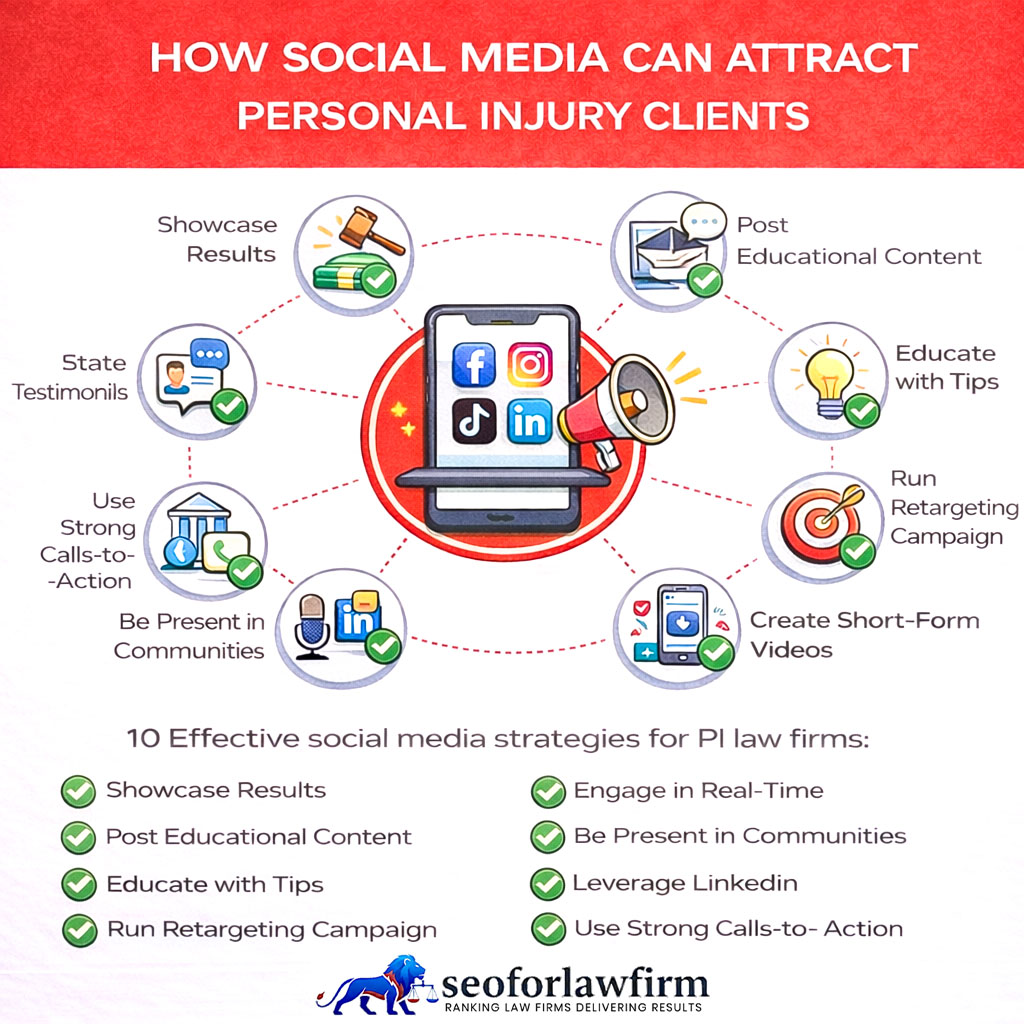
Personal injury firms should use social media to build attorney familiarity, distribute useful legal information, demonstrate community involvement, and support paid campaigns rather than treating follower count as the main business objective.
Listed below are the 7 social media strategies most relevant to Personal Injury Law Firm Marketing.
- Educational video: Explain what to do after collisions, how insurers handle claims, what evidence matters, and which deadlines apply.
- Attorney introductions: Show the people who handle calls, consultations, negotiations, and litigation.
- Community content: Document real events, sponsorships, public education, charitable activity, and local involvement.
- Legal updates: Explain material changes in state law, insurance rules, damages, or procedure.
- Firm activity: Show appropriate behind-the-scenes aspects of the practice without exposing confidential information.
- Case-result content: Publish accurate results only after ethics review and with enough context to avoid creating unjustified expectations.
- Paid social creative: Test several messages and video formats while measuring downstream qualified leads and signed cases.
Clio recommends social activity, photographs, videos, firm updates, and educational PI information as methods for strengthening brand presence and trust.
Does Low-Production Video Work for Personal Injury Law Firm Marketing?
Yes, Low-production mobile video works well for Personal Injury Law Firm Marketing because informal attorney content can communicate personality and authenticity without requiring studio-level production.
Sam Aguiar Injury Lawyers reported in 2026 that low-fidelity videos filmed in ordinary environments consistently outperformed polished studio content in its own internal testing. The firm recommends using polished content for broad branding and informal content for trust development.
That finding should be treated as a firm-level observation rather than proof that low-production video always beats professional creative.
The useful distinction is between:
- Brand video: Polished television, streaming, YouTube, and campaign creative designed for broad recognition.
- Trust video: Informal attorney explanations, community clips, case-process explanations, and staff content designed to make the firm feel accessible.
Both formats can serve different stages of the client journey.
What Marketing Channels Work for Personal Injury Lawyers?
The main Personal Injury Law Firm Marketing channels are SEO, PPC, Local Services Ads, Google Business Profile, social media, video, referrals, community marketing, and traditional advertising.
The table below shows how the main Personal Injury Law Firm Marketing channels differ by intent, speed, payment model, and primary measurement.
| Marketing Channel | Main Role | Client Intent | Speed | Primary Measurement |
| SEO | Capture organic search demand | High | Gradual | Qualified organic cases |
| PPC | Purchase high-intent search visibility | High | Immediate | Cost per signed case |
| Local Services Ads | Generate local leads | High | Immediate after eligibility and launch | Cost per qualified/signed lead |
| Google Business Profile | Capture Maps and local discovery | High | Gradual | Calls, leads, reviews, local visibility |
| Meta / social ads | Build awareness and generate or nurture demand | Low to medium | Immediate campaign delivery | Qualified leads and signed cases |
| Organic social | Build familiarity and distribute expertise | Low to medium | Gradual | Reach, engagement, assisted cases |
| Video | Build attorney familiarity and explain services | Varies | Gradual or paid | View quality, assisted inquiries |
| Referrals | Convert existing professional and client trust | High | Variable | Signed referral cases |
| Community marketing | Build local brand recognition | Low initially | Long-term | Referral and branded-search growth |
| TV / outdoor | Build broad market awareness | Low initially | Immediate exposure | Branded demand and signed-case lift |
No channel should be judged from impressions alone. Personal injury firms need to compare channels according to the quality and value of cases acquired.
Is SEO Better Than PPC for Personal Injury Lawyers?
No, SEO is not universally better than PPC for personal injury lawyers because the 2 channels solve different acquisition problems.
The table below shows the main differences between SEO and PPC for personal injury law firms.
| Dimension | SEO | PPC |
| Visibility | Organic results | Paid results |
| Launch speed | Gradual | Immediate |
| Payment | Investment in assets and optimization | Ongoing ad spend |
| Cost per visit | No direct payment to Google for organic click | Paid according to auction |
| Targeting control | Limited | High |
| Long-term asset | Pages, links, authority, brand | Campaign data and optimized account |
| Main risk | Slow progress and competitive SERPs | Expensive unqualified traffic |
| Best use | Long-term demand capture | Immediate high-intent acquisition |
Claims that SEO universally generates a fixed multiple of PPC ROI should be avoided unless a firm’s own data establishes that relationship.
SEO and PPC work well together because paid-search data can expose valuable queries and landing-page behavior, while organic pages can reduce dependence on purchasing every search visit.
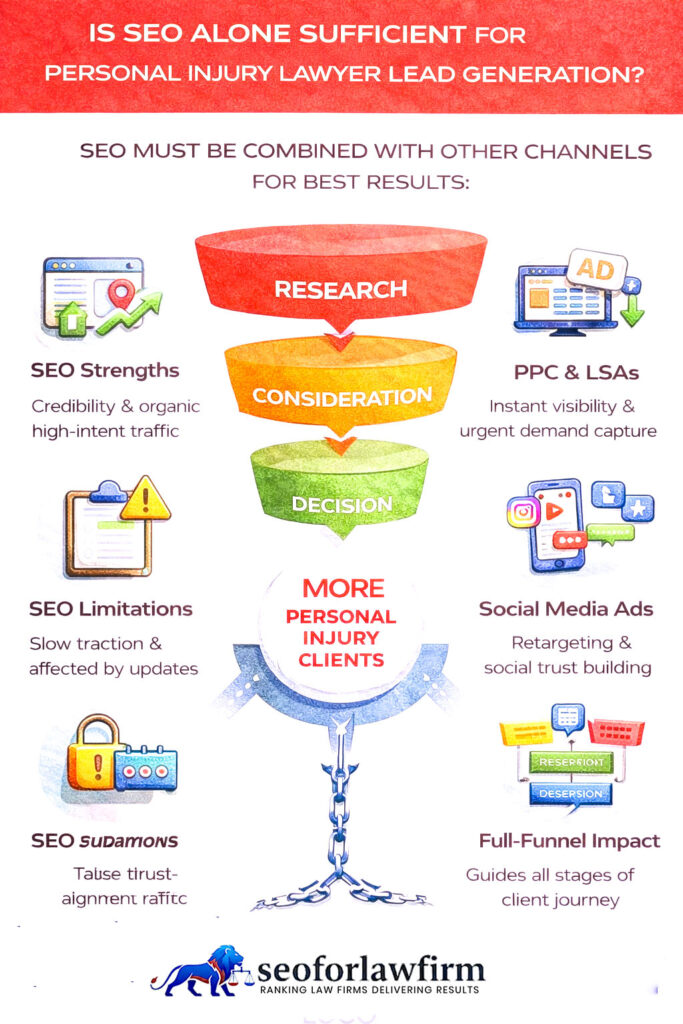
Is SEO Alone Enough for Personal Injury Lead Generation?
No, SEO alone is not the only useful personal injury lead-generation channel because law firms can acquire cases through paid search, Local Services Ads, client reviews, referrals, social campaigns, community marketing, traditional advertising, and other sources. The best channel mix depends on market size, firm budget, brand recognition, organic rankings, review profile, practice mix, case capacity, intake conversion, and cost per signed case. A new firm with limited organic authority can use paid search and Local Services Ads while the firm builds service pages, legal resources, citations, reviews, and backlinks. An established firm with strong organic rankings can still use PPC and Local Services Ads to capture additional search visibility and protect high-value queries. Reviews can improve local trust. Referrals can produce suitable matters through professional relationships. Community marketing can connect the firm with local audiences. Each channel should track inquiries, qualified leads, consultations, signed engagements, acquisition cost, and realized revenue. The objective is profitable case acquisition rather than dependence on one channel.
How Should Personal Injury Firms Acquire Reviews?
Personal injury firms should acquire reviews through a neutral, repeatable process that asks eligible clients for honest feedback without incentives, rating instructions, or confidentiality violations. Google states that review volume and positive ratings can contribute to local prominence. Google’s Local Services Ads guidance also identifies rating and review count as profile-quality factors that may affect ad ranking. Google’s local-ranking guidance and Local Services Ads ranking guidance support these distinctions.
Listed below are the 6 steps personal injury firms should use for review acquisition.
- Select an Appropriate Request Point: Ask after a suitable service milestone, such as case closure or completion of a defined legal service. The firm should avoid pressuring clients during active treatment, negotiations, litigation, or settlement decisions.
- Request Honest Feedback: Ask clients to describe their genuine experience. Do not request a positive review, a five-star rating, or specific wording.
- Provide a Direct Review Link: Send the verified Google review link through an approved email, text, or client-communication process. The message should explain that feedback is voluntary.
- Avoid Incentives and Review Gating: Do not offer money, discounts, gifts, services, or other benefits for reviews. Do not ask only satisfied clients to post reviews or screen dissatisfied clients away from the review platform. Google’s review policy prohibits incentivized and manipulated review activity.
- Protect Confidential Information: Tell clients not to disclose medical records, accident details, settlement amounts, litigation strategy, or other confidential information in public reviews.
- Route Negative Reviews Through Ethics Review: Use a designated process for negative responses. The process should prevent the firm from confirming representation, discussing case facts, or revealing information to defend the firm publicly. ABA Model Rule 1.6 restricts disclosure of information relating to a representation unless consent or a recognized exception applies. State rules may impose additional duties.
A structured process for responding to negative law firm reviews should protect confidentiality before reputation management.
Why Does Client Intake Matter in Personal Injury Law Firm Marketing?
Client intake matters because every acquisition channel loses financial value when qualified prospects cannot reach the firm, receive a slow response, or encounter an unclear consultation process.
Clio’s third-party 2024 secret-shopper study contacted 500 law firms. Only 33% responded to email inquiries. Only 40% answered calls when contacted, and 48% were effectively unreachable by phone.
Listed below are the 7 intake elements personal injury firms should connect with marketing.
- Immediate acknowledgment: Confirm receipt of web, chat, text, or email inquiries.
- Phone coverage: Establish reliable live or structured after-hours coverage.
- Qualification: Identify jurisdiction, accident type, date, liability facts, injuries, representation status, and other case-screening information.
- Routing: Send the matter to the correct intake employee or attorney.
- Follow-up: Create a defined sequence for prospects who do not immediately sign or schedule.
- Consultation scheduling: Remove unnecessary friction from appointment booking.
- Attribution: Preserve the original marketing source throughout the intake and CRM process.
Marketing cannot repair weak intake after the fact. A firm can increase advertising spend and still sign fewer cases when unanswered calls and slow follow-up absorb the additional demand.
What Is Speed to Lead for Personal Injury Law Firms?
Speed to lead is the time between a prospective client’s first inquiry and the firm’s first meaningful response.
Personal injury firms should record this metric in minutes rather than relying on staff perceptions such as “we respond quickly.”
Measure separately:
- Web-form response time
- Phone answer rate
- Missed-call callback time
- Chat response time
- LSA response time
- Text response time
- After-hours response time
No verified universal rule proves that every PI inquiry must receive a human response within a particular number of seconds. The operational objective is simpler: reduce avoidable delay because injured people can contact several competing firms during the same search session.
Clio’s research demonstrates the opportunity. Nearly half of tested law firms were effectively unreachable by phone, and 67% did not respond to email inquiries.
Which Personal Injury Law Firm Marketing Metrics Matter Most?
The Personal Injury Law Firm Marketing metrics that matter most connect advertising exposure with qualified leads, consultations, signed cases, case quality, and revenue.
The table below shows the main Personal Injury Law Firm Marketing metrics and the business question each metric answers.
| Metric | Business Question |
| Impressions | Did the campaign receive exposure? |
| Click-through rate | Did the message attract attention? |
| Cost per click | What did paid traffic cost? |
| Calls/forms | Did prospects make contact? |
| Qualified lead rate | Did inquiries fit the firm’s case criteria? |
| Speed to lead | How quickly did intake respond? |
| Consultation rate | How many qualified prospects reached a consultation? |
| Signing rate | How many qualified prospects became clients? |
| Cost per signed case | What did each retained matter cost to acquire? |
| Channel attribution | Which source produced the signed matter? |
| Expected case value | What potential financial value entered the portfolio? |
| Realized case revenue | What revenue did acquired matters eventually produce? |
| Marketing ROI | Did marketing generate sufficient financial return? |
A call-tracking system for law firms can help connect advertising channels with phone inquiries, but the CRM must preserve that source through the signed-case stage.
What Is Cost per Signed Case?
Cost per signed case is the amount of marketing expenditure required to produce 1 retained client who executes an engagement agreement.
Use this formula:
Cost per Signed Case = Marketing Spend ÷ Signed Cases Attributed to the Channel
Example:
Google Ads spend = $30,000.
Signed cases = 10.
$30,000 ÷ 10 = $3,000 cost per signed case
This number becomes useful only when compared with case economics.
A $3,000 signed-case cost can be profitable for a firm whose expected case portfolio produces enough gross profit to support that acquisition cost. The same $3,000 can be unacceptable for a lower-value matter or a channel with poor case quality.
Personal injury firms should calculate cost per signed case by:
- Channel
- Campaign
- Practice type
- Market
- Landing page
- Referral source
The calculation should not combine all cases and all advertising when the firm needs to decide where the next marketing dollar goes.
How Do Personal Injury Firms Track Marketing ROI?
Personal injury firms track marketing ROI by connecting marketing spend with signed matters and the financial value those matters eventually produce.
Listed below are the 7 stages of Personal Injury Law Firm Marketing attribution.
- Record the marketing source.
- Record the campaign and landing page.
- Track the initial call, form, chat, or message.
- Classify the inquiry as qualified or unqualified.
- Record consultation status.
- Record whether the prospect signs.
- Connect the signed case with case value and eventual revenue.
Do not calculate ROI solely from leads.
Use:
Marketing ROI = ((Attributed Gross Profit − Marketing Cost) ÷ Marketing Cost) × 100
Personal injury cases can remain open for long periods, so firms may also need projected case-value cohorts before final revenue becomes available.
How Should Personal Injury Firms Use a Marketing Budget?
Personal injury firms should allocate marketing budgets according to cost per signed case, case economics, market opportunity, intake capacity, and long-term acquisition goals rather than fixed channel percentages.
A firm may allocate more toward SEO when organic visibility is weak but the firm can wait for growth. Another firm may allocate more toward PPC and LSAs when it has immediate capacity for additional cases.
Budget decisions should consider:
- SEO investment
- Google Ads
- Local Services Ads
- Social and Meta campaigns
- Video production
- Traditional media
- Community sponsorship
- Review systems
- Marketing technology
- Intake staffing
- Call tracking
- CRM
- Creative testing
A broader law firm marketing budget should connect channel allocation with qualified-client economics rather than clicks or traffic.
What Personal Injury Law Firm Marketing Mistakes Waste Budget?
The Personal Injury Law Firm Marketing mistakes that waste the most budget are weak attribution, slow intake, irrelevant paid traffic, incomplete local profiles, generic content, misleading advertising, and measuring leads instead of signed cases.
Listed below are the 8 Personal Injury Law Firm Marketing mistakes firms should correct.
- Tracking clicks but not retained cases: Traffic metrics cannot show whether the campaign is profitable.
- Allowing leads to sit unanswered: Additional advertising does not solve slow intake.
- Sending every PPC visitor to the homepage: Search intent and landing-page content need to align.
- Publishing generic injury articles at scale: Repetitive content gives users little reason to choose or cite the firm.
- Ignoring Google Business Profile and LSAs: Search visibility extends beyond standard organic and PPC listings.
- Treating reviews as passive: Review acquisition needs a compliant operating process.
- Publishing unsupported case-result claims: Misleading results can create advertising-rule problems.
- Using channel averages instead of firm economics: Industry CPC, CPL, and conversion figures do not replace the firm’s own signed-case data.
What Advertising Rules Apply to Personal Injury Law Firm Marketing?
Personal Injury Law Firm Marketing must comply with the lawyer’s state advertising rules, confidentiality obligations, platform policies, and rules against false or misleading communications.
ABA Model Rule 7.1 prohibits false or misleading statements and warns that even truthful case-result claims can mislead when they create an unjustified expectation that another client will receive the same result.
ABA Model Rule 7.2 permits lawyers to pay reasonable advertising costs and certain lead-generation costs, subject to restrictions on recommendations and professional independence. State rules can impose different or stricter requirements.
Personal injury firms should review:
- Settlement and verdict claims
- Testimonials
- “Best” or comparative statements
- Specialist claims
- Guarantees
- Disclaimers
- Lead-generation arrangements
- Referral agreements
- Social media posts
- Influencer or spokesperson content
- AI-generated marketing material
Google also restricts personalized targeting involving sensitive categories, including health information. Personal injury campaigns involving medical or health-related landing pages need platform-policy review before using audience or remarketing features.
How Does Community Outreach Support Personal Injury Law Firm Marketing?
Community outreach supports Personal Injury Law Firm Marketing by building local recognition and relationships before a person needs an injury attorney.
Listed below are the 6 community marketing activities personal injury firms can use.
- Local educational presentations
- Community event sponsorships
- Safety programs
- Charitable involvement
- Professional networking
- Referral relationships with other lawyers and appropriate professionals
Clio currently recommends networking events, public speaking, traditional advertising, conferences, and local-event sponsorship as legitimate components of PI marketing.
Community participation works best when the activity exists independently of the backlink, social post, or logo placement generated from it.
A sustained local presence can influence branded searches, referrals, familiarity, press coverage, and word-of-mouth recommendations over time.
How Should a Personal Injury Law Firm Marketing System Work?
A Personal Injury Law Firm Marketing system should move a prospective client from awareness to search, trust, inquiry, qualification, consultation, signed engagement, and measurable case revenue.
The sequence can be represented as:
Awareness → Search/Discovery → Trust → Inquiry → Intake → Qualification → Consultation → Signed Case → Case Revenue
SEO, PPC, LSAs, Google Business Profile, social media, video, reviews, referrals, and community marketing feed the first stages.
Client intake controls the middle.
Case management and financial data determine the final business result.
The strongest strategy is not the strategy that produces the most impressions or leads. It is the strategy that repeatedly produces the right matters at an acquisition cost the law firm can profitably support.
Personal Injury Law Firm Marketing Checklist
The checklist below shows the SEO, paid advertising, social media, local search, reputation, intake, and measurement actions personal injury firms should review when building a complete marketing system.
- Define the injury case types the firm wants to acquire.
- Define the geographic markets the firm can genuinely serve.
- Calculate an acceptable cost per signed case.
- Build complete practice-area pages.
- Build useful location pages for genuine markets.
- Optimize technical SEO.
- Verify and maintain Google Business Profile.
- Build an authentic review-acquisition process.
- Evaluate Local Services Ads eligibility.
- Configure LSA services and service areas accurately.
- Build high-intent Google Ads campaigns.
- Use negative keywords to control irrelevant paid traffic.
- Match ads with relevant landing pages.
- Test attorney-led video.
- Use social media for education, trust, and community visibility.
- Review platform targeting restrictions before running personalized campaigns.
- Participate in genuine local community programs.
- Develop professional and former-client referral relationships.
- Display clear phone and form contact options.
- Measure speed to lead.
- Track missed calls and callback time.
- Route leads according to case type.
- Preserve source attribution in the CRM.
- Measure qualified lead rate.
- Measure consultation rate.
- Measure signed-case rate.
- Calculate cost per signed case by channel.
- Connect acquired cases with eventual revenue.
- Reallocate spending according to profitable case acquisition.
Personal Injury Law Firm Marketing works when visibility and intake operate as one system. SEO captures long-term organic demand, PPC captures immediate search intent, Local Services Ads generate eligible pay-per-lead opportunities, Google Business Profile supports local discovery, social and video develop familiarity, reviews provide social proof, community activity builds local recognition, and intake converts that attention into signed cases. The firm then uses cost per signed case, speed to lead, qualification rate, signing rate, and case revenue to decide where the next marketing dollar should go.