
Qualified Legal Leads
Build Lead Generation Around the Matters Your Firm Accepts
Lead Generation for Lawyers — defined scope, implementation, and reporting.
SEOForLawFirm connects search campaigns, relevant landing pages, lead qualification, and intake tracking. SEOForLawFirm begins with accepted matters, service boundaries, consultation capacity, and the information your team needs to decide whether an inquiry is suitable.

Strategy & Execution
Why Lead Fit Matters as Much as Lead Count
A higher inquiry count can overwhelm intake if the contacts are outside the service area or seeking work the firm does not provide. The campaign must define a qualified lead and measure what happens after the phone rings, rather than treating every submission as a successful consultation.
- Agree on accepted matters, geography, exclusions, and intake fields.
- Connect each priority service to a relevant campaign and consultation page.
- Review qualifications, consultations, and retained matters against channel spending.

A Connected System
Lead Generation for Lawyers Framework
Four stages connect the initial evidence, implementation responsibilities, and ongoing review.

Define a Qualified Inquiry
Agree on accepted matters, geography, exclusions, and intake fields.
Match Channel and Page
Connect each priority service to a relevant campaign and consultation page.
Route and Follow Up
Assign inquiries to the right team and document unresolved contacts.
Reconcile Intake Outcomes
Review qualifications, consultations, and retained matters against channel spending.
Core Services
What the Engagement Covers
Six service components are scoped around the firm’s existing website, accounts, and intake workflow.
Lead Criteria and Campaign Scope
Accepted matter definitions; service-area boundaries; capacity and exclusions.
SEO and Paid-Search Acquisition
Practice-to-channel map; channel-specific tracking; agreed budget responsibility.
Practice-Specific Consultation Pages
Service-matched copy; attorney evidence; clear first-contact steps.
Lead Qualification and Intake Routing
Qualification fields; assigned intake owner; unresolved contact queue.
CRM and Outcome Reconciliation
Source and status mapping; duplicate handling; attribution-gap reporting.
Follow-Up and Channel Refinement
Approved follow-up workflow; stage-by-stage review; targeting and page refinements.
Strategy & Execution
Lead Criteria and Campaign Scope
SEOForLawFirm documents accepted case types, service boundaries, exclusions, and intake capacity before launch. A qualified inquiry is an agreed definition, not every phone call or form entry. Sensitive details are collected only through the firm’s approved intake process.
- Accepted matter definitions
- Service-area boundaries
- Capacity and exclusions

Strategy & Execution
SEO and Paid-Search Acquisition
SEOForLawFirm maps priority searches to practice pages and paid campaigns where included in the proposal. Organic content, paid search, and Local Services Ads have different costs and workflows; each channel receives its own tracking and budget review instead of sharing one unexplained lead count.
- Practice-to-channel map
- Channel-specific tracking
- Agreed budget responsibility

Strategy & Execution
Practice-Specific Consultation Pages
What this work includes
Pages explain the representation available, the attorneys involved, consultation arrangements, and what the prospect can do next. Injury, family-law, and business inquiries need different explanations. Forms remain focused on useful first-contact information.
- Service-matched copy
- Attorney evidence
- Clear first-contact steps

Strategy & Execution
Lead Qualification and Intake Routing
What this work includes
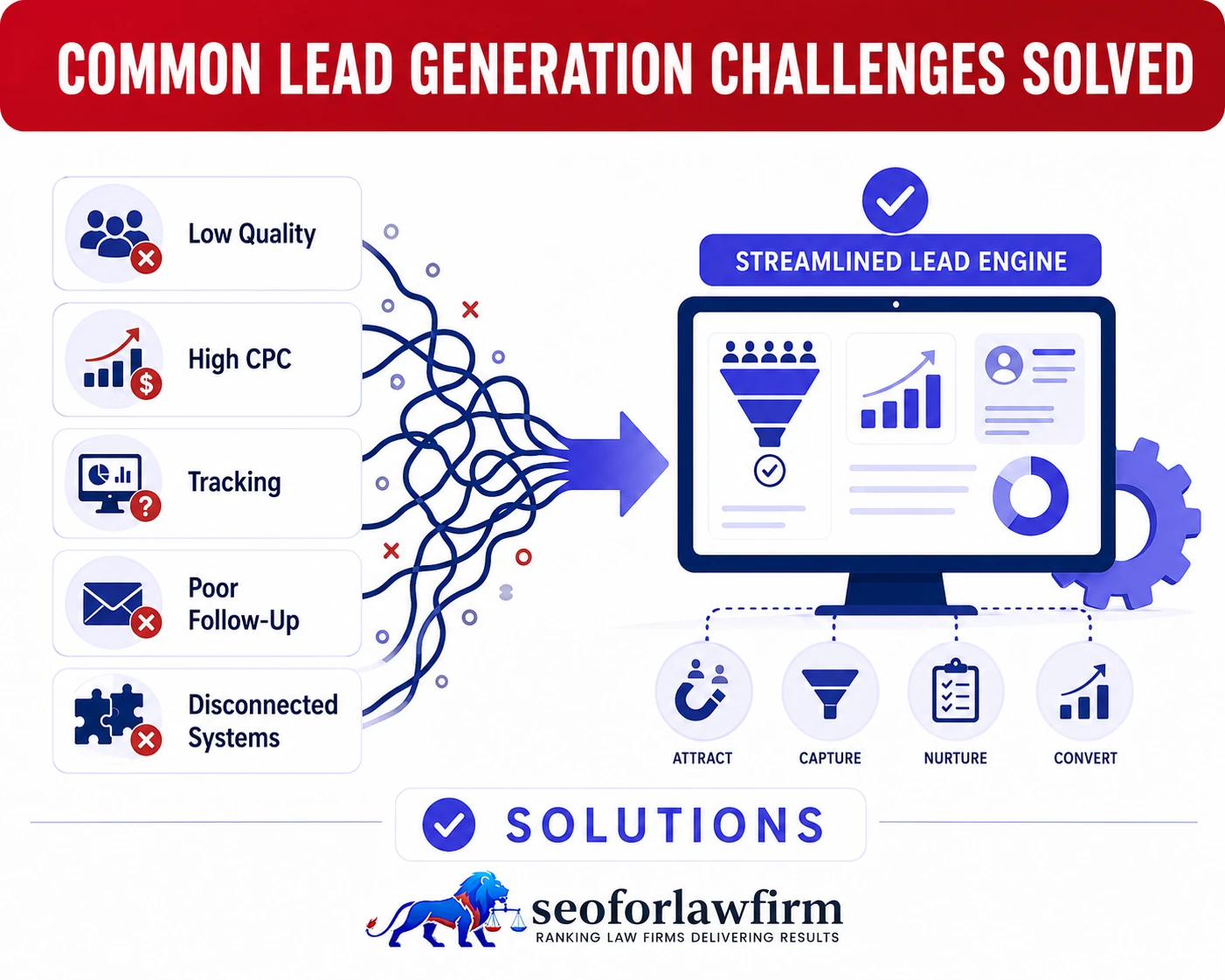
SEOForLawFirm connects campaign information with the firm’s approved qualification workflow. Routing reflects practice area, office coverage, availability, and team ownership. Unanswered inquiries and incomplete records stay visible rather than being counted as completed consultations.
- Qualification fields
- Assigned intake owner
- Unresolved contact queue
Strategy & Execution
CRM and Outcome Reconciliation
Where the systems allow, source information is carried into the CRM and linked to intake status. Duplicate contacts and missing source records are identified. Reports distinguish inquiries, qualified contacts, scheduled consultations, attended consultations, and retained matters.
- Source and status mapping
- Duplicate handling
- Attribution-gap reporting

Strategy & Execution
Follow-Up and Channel Refinement
Follow-up schedules are agreed with the firm and use its approved communication process. SEOForLawFirm reviews where suitable prospects stop progressing and adjusts pages, routing, or targeting. Retargeting and email are included only where their scope and permissions are established.
- Approved follow-up workflow
- Stage-by-stage review
- Targeting and page refinements

SEOForLawFirm’s Process
From Audit to Continuous Improvement
Define a Qualified Inquiry
Agree on accepted matters, geography, exclusions, and intake fields.
Agree Scope and Owners
Document access, included tasks, dependencies, and firm-side approvals.
Match Channel and Page
Connect each priority service to a relevant campaign and consultation page.
Quality Checks
Test the implemented work against the agreed verification steps.
Route and Follow Up
Assign inquiries to the right team and document unresolved contacts.
Reconcile Intake Outcomes
Review qualifications, consultations, and retained matters against channel spending.
Common Problems
Mistakes That Restrict Performance
Every Contact Counted as Qualified
The definition should reflect accepted matters and service coverage.
One Page for Unrelated Practices
Different services need different explanations and intake expectations.
No Owner for Missed Inquiries
Unanswered contacts need an assigned follow-up workflow.
Leads Disconnected From the CRM
A channel report cannot explain consultations when source and status are lost.
Cost per Lead Without Fit
Cheap contacts can still consume time without producing suitable opportunities.
Measured Outcomes
Outputs You Can Review
Your engagement produces a scoped work queue, implementation record, and reporting baseline. The retained illustrations explain service concepts; they are not proof of any named client’s campaign results.

Planning Examples
Illustrative Plans for Different Legal Practices
Injury Intake
Illustrative workflow — not a client testimonial
Planning example; no campaign results claimed.
Illustrative plan: separate accepted accident categories and connect the source to the firm’s case-screening status.Workflow Outputs
- Accident categories
- Qualification status
- Source reconciliation
Family-Law Intake
Illustrative workflow — not a client testimonial
Planning example; no campaign results claimed.
Illustrative plan: distinguish divorce and custody inquiries, verify service coverage, and route consultation requests.Workflow Outputs
- Service fit
- Geographic fit
- Consultation ownership
Business-Law Intake
Illustrative workflow — not a client testimonial
Planning example; no campaign results claimed.
Illustrative plan: separate company advisory needs from litigation and route each inquiry to the responsible attorney team.Workflow Outputs
- Advisory or disputes
- Team routing
- Outcome register
Practice-Area Experience
Built for the Legal Markets Your Firm Serves
Law Firm SEOBuild the firm-wide organic visibility foundation.Explore this practice area →Local SEO for LawyersCompete across maps, local results, and service areas.Explore this practice area →Personal InjuryReach injury prospects during high-intent searches.Explore this practice area →Criminal DefenseSupport urgent searches for local legal representation.Explore this practice area →Divorce & Family LawConnect family-law services with local client needs.Explore this practice area →Immigration LawOrganize visibility around immigration services and questions.Explore this practice area →Bankruptcy LawReach consumers researching debt-relief options and counsel.Explore this practice area →Employment LawTarget employee and employer-side legal search demand.Explore this practice area →Real Estate LawBuild visibility for transactional and dispute-related matters.Explore this practice area →Business LawSupport companies seeking transactional and advisory counsel.Explore this practice area →Estate PlanningReach families planning estates, trusts, and succession.Explore this practice area →DUI DefenseCompete for urgent, location-specific DUI defense searches.Explore this practice area →
Related Services
Build a More Complete Client-Acquisition System
Frequently Asked Questions
Lead Generation for Lawyers FAQs
What counts as a qualified lead?
SEOForLawFirm agrees on accepted matter types, geography, exclusions, and required intake information with your firm before reporting a contact as qualified.
Do you sell shared contact lists?
This page describes campaigns and intake workflows for your firm. Any separate lead-supply arrangement would need its own clearly defined proposal.
Which channels are included?
The proposal identifies the organic, paid-search, Local Services Ads, or other channels included, along with budgets and responsibilities.
Can SEOForLawFirm use the firm’s existing CRM?
SEOForLawFirm reviews available fields, integrations, and access before defining source and outcome tracking. Unsupported integrations are identified in the scope.
What if the firm’s team misses calls?
SEOForLawFirm reviews routing, availability, ownership, and the follow-up queue. Missed contacts remain distinct from completed consultations.
How do you measure success?
SEOForLawFirm reports the agreed inquiry and consultation stages and retained-matter outcomes where available, with costs and attribution gaps disclosed.
Build the Next Stage of Growth
Discuss Your Lead Generation for Lawyers Priorities
Share your priority practices, current systems, and the issues your team wants to resolve. SEOForLawFirm will discuss the evidence to review, implementation dependencies, and a defined proposal.