

Link building for lawyers is the process of earning hyperlinks from trusted external websites to a law firm’s website. Relevant backlinks strengthen search visibility, local prominence, referral traffic, attorney recognition, and brand authority when the links result from genuine editorial, professional, or community relationships.
The main law firm link-building strategies include claiming profiles on Avvo, FindLaw, Justia, and bar association directories; maintaining consistent business citations; joining local chambers of commerce; supporting community organizations; publishing local legal guides; supplying expert commentary to journalists; reclaiming unlinked attorney mentions; and developing referral relationships with non-competing professionals.
Backlinks remain part of how search engines discover pages and assess relevance. A study by Sergey Brin and Lawrence Page titled The Anatomy of a Large-Scale Hypertextual Web Search Engine in 1998 explained how Google’s original search system used hyperlink structure and PageRank to estimate the relative importance of web pages. Google Search Central continues to identify links as a signal used to determine page relevance and discover new pages.
Link quantity alone does not produce sustainable rankings. A backlink delivers greater value when the linking page is relevant to law, the attorney’s practice area, the law firm’s location, or the linked legal resource. Editorial approval, accurate context, natural anchor text, genuine readership, and a suitable destination page matter more than a third-party Domain Authority or Domain Rating score.
Table of Contents
- Article sections will appear here.
What Is Link Building for Lawyers?
Link building for lawyers means earning links from legal directories, bar associations, news publications, local organizations, universities, professional networks, referral partners, and other relevant websites. Each backlink creates a path from an external source to a law firm’s website.
A complete link-building program connects external authority with the law firm’s practice areas, attorneys, offices, local markets, and educational resources. A bar directory link confirms an attorney’s professional identity. A chamber of commerce profile connects the firm to a local market. A news article quoting an attorney demonstrates subject-matter experience. A legal guide cited by a university or nonprofit positions the website as a reference source.
Backlinks and referring domains represent different measurements. A website could receive 20 links from one publication but still have only one referring domain. A balanced review of backlinks and referring domains prevents a law firm from mistaking repeated links from one source for broad external recognition.
What Are the Main Types of Link-Building Strategies for Lawyers?
The main types of link-building strategies for lawyers are legal directories and citations, local community outreach, digital public relations, editorial content, professional partnerships, unlinked mention reclamation, and competitor backlink analysis.
Listed below are the 7 main types of law firm link building.
- Legal directories and business citations.
- Local and community partnerships.
- Digital PR and journalist commentary.
- Original legal resources and editorial content.
- Professional and referral partnerships.
- Unlinked brand mention reclamation.
- Competitor backlink gap analysis.
Legal Directories and Business Citations
Legal directories and business citations establish consistent external references to the law firm, attorney, office, practice area, and contact information. These profiles support discovery, referral traffic, professional verification, and local search prominence.
Claim profiles on established legal directories
Law firms gain relevant directory references through platforms such as:
- Avvo
- FindLaw
- Justia
- Martindale-Hubbell
- Lawyers.com
- Nolo
- HG.org
- State bar directories
- Local bar association directories
- Practice-area association directories
Each profile requires accurate information rather than a copied paragraph submitted across every platform.
A complete legal directory profile includes:
- Law firm name
- Attorney name
- Office address
- Primary phone number
- Website
- Practice areas
- Bar admissions
- Education
- Professional biography
- Office hours
- Professional photograph
- Jurisdictions served
Directory selection requires relevance and legitimacy. A smaller state bar directory or practice-specific association often provides stronger professional context than a large generic directory containing unrelated businesses.
Maintain consistent NAP information
NAP refers to the law firm’s name, address, and phone number. Consistent NAP information helps clients, directories, map providers, and search systems identify the same business across different sources.
The following conflicts require correction:
- Former office addresses
- Disconnected phone numbers
- Different law firm names
- Duplicate attorney profiles
- Closed office listings
- Incorrect website URLs
- Shared tracking numbers used as permanent citations
- Different suite numbers
- Profiles for attorneys who left the firm
Minor punctuation differences do not carry the same weight as genuine factual conflicts. “Suite 200” and “Ste. 200” still describe the same location. Two different street addresses create a substantive discrepancy.
A structured NAP consistency audit identifies every listing, records the current information, assigns corrections, and confirms whether the platform accepted each update.
Distinguish citations from backlinks
A citation is an external mention of the firm’s business information. A citation does not always contain a clickable link.
A backlink contains a clickable hyperlink to the website.
Both references carry value. A non-linked bar directory listing still confirms the attorney’s name, firm, jurisdiction, and professional status. A linked listing also creates a referral and discovery path to the website.
A complete local SEO citation strategy combines accurate profiles with suitable links instead of treating directory volume as the sole goal.
Prioritize accurate professional associations
Bar associations and professional organizations provide stronger contextual alignment because the listings relate directly to legal practice.
Useful association sources include:
- State bar associations
- County bar associations
- City bar associations
- Trial lawyer associations
- Defense lawyer associations
- Practice-area organizations
- Law school alumni directories
- Court admission directories
Membership must be genuine and current. A law firm must not claim inactive memberships, unsupported specializations, expired certifications, or awards that lack factual verification.
Local and Community Link Building
Local link building earns references from organizations connected to the law firm’s geographic market. Local sources establish that the firm participates in the same city, county, or region served by the firm.
Google states that local results rely mainly on relevance, distance, and prominence. Google also explains that prominence draws on information such as the number of websites linking to a business and the number of reviews associated with the business.
Join a chamber of commerce
A chamber of commerce membership often provides a business profile containing the firm’s name, description, address, phone number, website, and membership category.
The profile requires a complete legal-service description rather than a keyword-filled sentence.
A useful description identifies:
- Practice area
- City or region
- Client type
- Attorney names
- Office location
- Consultation method
The membership also creates offline networking opportunities that lead to referrals, speaking invitations, event pages, interviews, and local media coverage.
Support legitimate community organizations
Community partnerships generate links when an organization publicly recognizes a law firm’s actual contribution.
Suitable organizations include:
- Local nonprofits
- Legal aid groups
- Youth programs
- Schools
- Universities
- Community foundations
- Victim support organizations
- Business associations
- Cultural organizations
- Public safety initiatives
The partnership must serve a genuine community purpose. Buying a sponsorship solely to obtain a followed link introduces link-spam risk.
Google requires paid or sponsored links to use rel="sponsored" or another suitable qualification. A sponsored link still provides brand exposure, referral traffic, entity confirmation, and community visibility even when the link does not pass ranking credit.
Sponsor local events responsibly
Local sponsorship opportunities include:
- Charity walks
- Youth sports programs
- Community festivals
- Legal education events
- Fundraising dinners
- School programs
- Road-safety campaigns
- Domestic violence support events
- Veterans’ organizations
- Local business conferences
A sponsorship page often contains the law firm’s name, logo, website, and contribution level. The value comes from local relevance and genuine participation rather than the domain extension or link attribute.
The law firm should request accurate recognition, not a keyword-rich anchor such as “best personal injury lawyer Chicago.” Natural anchors include the firm name, attorney name, event name, or plain website address.
Create local legal resources
Local organizations and news publishers reference legal content that addresses the community’s actual needs.
Examples include:
- County court filing guides
- State statute-of-limitations charts
- Local accident-data reports
- Courthouse parking and access guides
- Tenant-rights resources
- Domestic violence support directories
- Small-business compliance checklists
- Local probate process diagrams
- Storm damage claim guides
- Community legal clinic calendars
A local guide requires original local information. Replacing one city name with another does not create a useful community resource.
Build relationships with local media
Local journalists require accurate legal context for arrests, court decisions, accidents, regulatory changes, employment disputes, business conflicts, and new legislation.
Law firms earn local press mentions by providing:
- Fast factual explanations
- Quotable attorney commentary
- Local statistics
- Plain-language legal context
- Case-neutral procedural explanations
- Publicly available records
- Accurate deadline information
- Jurisdiction-specific insight
The attorney must avoid commenting on confidential matters, making unsupported accusations, predicting outcomes, or presenting a promotional statement as neutral legal analysis.
Digital PR and Journalist Commentary
Digital PR earns editorial coverage by making attorneys useful sources for journalists, editors, podcasters, researchers, and industry publishers.
A digital PR campaign focuses on news value, accuracy, timing, and expertise. A journalist decides whether the attorney’s information belongs in the story. That editorial decision distinguishes earned media from purchased placement.
Respond to journalist source requests
Attorneys respond to source requests through platforms such as Qwoted and HARO, which now operates through Featured. Connectively was discontinued after replacing the former HARO service, so outdated outreach instructions should not direct attorneys to Connectively.
A suitable journalist response contains:
- A direct answer
- The attorney’s name
- The attorney’s position
- The law firm
- The relevant practice area
- Jurisdiction
- One useful example
- One concise quotation
- Contact information
- A biography URL
The attorney should answer only questions connected to verifiable experience.
A criminal defense attorney should not provide definitive tax commentary. A personal injury lawyer should not claim medical expertise. A family lawyer licensed only in Florida should not describe California law as professional advice.
Use a concise expert-response format
The format below gives journalists usable information without promotional filler.
Direct answer: State the central legal point in 1–2 sentences.
Explanation: Explain the rule, procedure, or distinction in plain language.
Local context: Identify the jurisdiction and any relevant variation.
Quotable statement: Supply one self-contained sentence suitable for attribution.
Credentials: State the attorney’s role, practice focus, and jurisdiction.
Example:
Texas follows a modified comparative responsibility system. An injured claimant who holds more than 50% responsibility does not recover damages, while a claimant with 50% or less responsibility receives a reduced award based on the assigned percentage.
“Evidence collected during the first days after a collision often determines whether an insurer shifts a disproportionate share of fault to the injured person.”
Jordan Lee is a Texas personal injury attorney who represents clients in motor vehicle claims.
Every legal statement requires verification before submission.
Create a reactive commentary calendar
A reactive calendar maps predictable news events to attorney expertise.
Topics include:
- New legislation
- Supreme court terms
- State court decisions
- Regulatory deadlines
- Tax season
- Hurricane season
- Holiday traffic periods
- School calendars
- Election law deadlines
- Employment law changes
- High-profile public trials
- Consumer protection alerts
The calendar allows the firm to prepare statistics, quotations, attorney availability, and supporting resources before the news cycle begins.
Build reporter relationships beyond single pitches
A single quote produces one opportunity. A reliable attorney source creates repeated coverage.
A law firm strengthens reporter relationships through:
- Accurate responses
- Fast turnaround
- Clear jurisdictional limits
- No promotional demands
- No repeated follow-up messages
- Respect for deadlines
- Links to supporting public records
- Availability for clarification
- Corrections when facts change
The attorney should not condition useful commentary on receiving a backlink. Journalists control editorial presentation and attribution.
A wider law firm public relations strategy connects journalist outreach with attorney positioning, media monitoring, community involvement, and reputation management.
Original Legal Content and Editorial Backlinks
Original content earns editorial backlinks when the content supplies facts, tools, explanations, or data that other writers need to support their own work.
Generic articles rarely attract references. A definition of “personal injury law” gives publishers little reason to cite one law firm instead of another.
Publish local or practice-specific research
Original research creates information that did not previously exist in the same form.
Examples include:
- Five-year analysis of county crash records
- Review of local wage-theft complaints
- Study of probate processing times
- Analysis of state disciplinary decisions
- Survey of small-business legal concerns
- Review of local housing court filings
- Analysis of nursing home inspection reports
- Study of pedestrian accident locations
- Review of public verdict and settlement records
The research page must explain:
- Data source
- Date range
- Sample size
- Inclusion criteria
- Exclusion criteria
- Definitions
- Calculation method
- Limitations
- Update date
- Researcher or attorney reviewer
A graph without methodology does not establish reliable original research.
Publish definitive local guides
A strong local legal guide answers a narrow question with jurisdiction-specific details.
Examples include:
- How to file a small claims case in Harris County
- What happens after a DUI arrest in Miami-Dade County
- How probate starts in Maricopa County
- How to obtain a police report after an Austin collision
- Which court handles an employment claim in New York City
Useful guides include court names, filing methods, public fees, deadlines, forms, exceptions, accessibility information, and official contact details.
Create linkable tools
Practical tools attract links because the tools save time or simplify a legal process.
Examples include:
- Filing deadline calculator
- Damages category checklist
- Court document checklist
- Evidence preservation checklist
- Settlement timeline
- Legal glossary
- Court directory
- Claim process flowchart
- Interactive jurisdiction map
- Downloadable incident log
Each tool requires clear limitations. A calculator must not imply a guaranteed deadline or outcome when exceptions change the answer.
Publish expert commentary before competitors
Timely commentary earns references when the article explains a new legal development before generic summaries saturate search results.
A useful legal update includes:
- What changed
- Effective date
- Previous rule
- New rule
- Affected parties
- Practical consequence
- Exceptions
- Attorney interpretation
- Source verification
- Update history
Professional and Referral Partnerships
Professional partnerships generate links, referrals, events, interviews, and shared educational resources when both parties serve related audiences without competing for the same matter.
Suitable partners include:
- Accountants
- Financial planners
- Therapists
- Medical professionals
- Real estate professionals
- Insurance specialists
- Human resources consultants
- Business associations
- Mediators
- Legal technology providers
- Non-competing attorneys
Create co-authored resources
A family lawyer and financial planner could create a guide explaining financial records used during divorce. An estate planning attorney and accountant could explain beneficiary designations and tax documentation. An employment lawyer and human resources consultant could present a webinar on workplace investigations.
Each contributor must remain within the contributor’s professional scope.
Participate in podcasts and webinars
Podcast and webinar pages often contain an attorney biography, episode summary, website link, and supporting resources.
A useful appearance addresses a defined problem rather than delivering a general advertisement.
Topics include:
- Evidence preservation after a collision
- Estate planning after marriage
- Employee classification
- Business succession
- Responding to a criminal charge
- Preparing for mediation
- Protecting intellectual property
Develop referral network pages carefully
Reciprocal links between genuine professional partners serve users when the links explain a relevant relationship.
Google identifies excessive link exchanges and partner pages created only for cross-linking as link spam. A large page listing dozens of partners solely to exchange links creates more risk than value.
A legitimate referral relationship contains:
- Genuine professional connection
- Accurate description
- Clear user benefit
- Natural anchor text
- Limited number of relevant links
- No ranking guarantee
- No mandatory followed-link agreement
Unlinked Brand Mention Reclamation
Unlinked brand mention reclamation converts existing references to a law firm or attorney into clickable links where the link improves the source page.
A website might mention:
- The law firm name
- An attorney name
- A published study
- A court commentary
- A community sponsorship
- A legal guide
- A podcast appearance
- An event presentation
- A case result
The law firm contacts the publisher and identifies the most relevant destination page.
Find unlinked mentions
Search for:
- Exact law firm name
- Attorney names
- Former firm names
- Branded research titles
- Event names
- Quotations
- Podcast appearances
- Award announcements
- Community partnerships
Exclude the law firm’s website and existing profiles from the search.
Select the correct destination
The link should direct the reader to the page that verifies or expands the mention.
Examples include:
- Attorney mention → attorney biography
- Research mention → original research page
- Practice commentary → related legal guide
- Community event → community involvement page
- Podcast appearance → media page
- Award mention → attorney or awards page
Sending every reclaimed link to the home page wastes contextual relevance.
Use a direct reclamation message
Hello [Name],
Thank you for mentioning [Attorney/Law Firm] in “[Article Title].” The article refers to [specific quotation, research, event, or resource]. The original supporting page appears here: [internal destination URL]. Adding the source link would give readers direct access to the referenced information.
Thank you for considering the update.
The message asks for a useful editorial correction rather than demanding ranking value.
How Does Link Building for Law Firms Differ From Standard Link Building?
Link building for law firms differs from standard link building because every placement affects professional reputation, attorney advertising compliance, client confidentiality, and trust in legal information.
ABA Model Rule 7.1 prohibits false or misleading communications about a lawyer or legal service. The rule applies to advertising and other communications used to make legal services known.
A link-building campaign must verify:
- Attorney credentials
- Bar status
- Practice-area claims
- Case-result statements
- Awards
- Testimonials
- Comparative claims
- Office locations
- Professional memberships
- Jurisdictions served
A sponsored article claiming that an attorney is “the top trial lawyer in America” creates a professional and reputational problem when no factual basis supports the claim.
Law firm outreach must also protect confidential information. A press pitch, guest article, case study, or community page must not disclose client identities, facts, medical records, strategy, settlement terms, or case details without proper authorization.
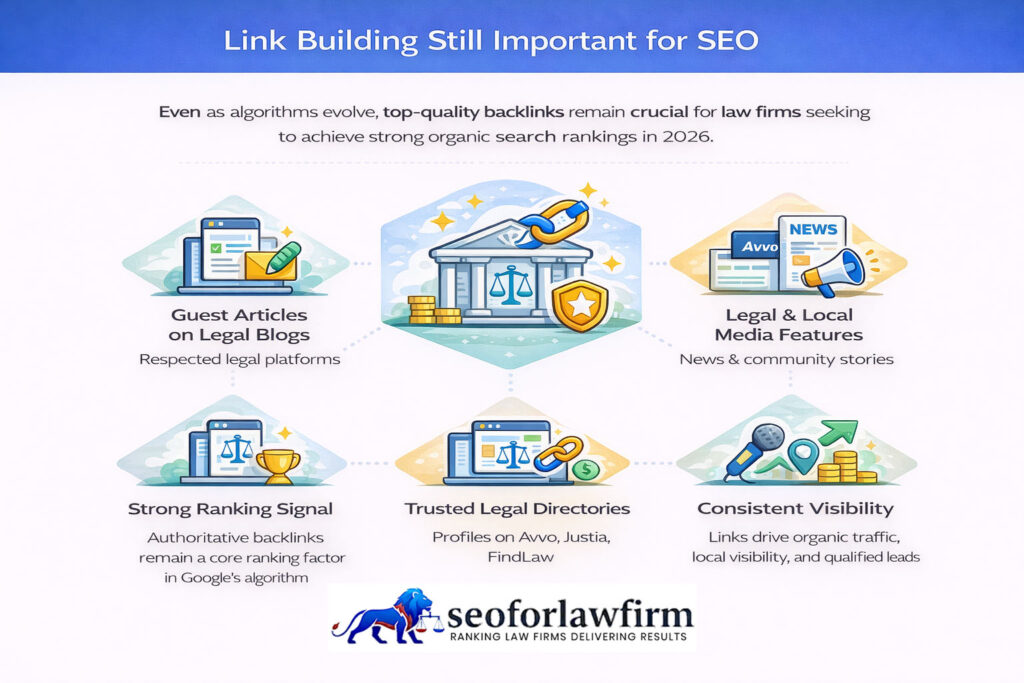
Is Link Building Still Important for Law Firm SEO in 2026?
Yes, link building remains part of law firm SEO in 2026 because Google uses links as a relevance and discovery signal, and Google identifies links as one component of local prominence.
Link building no longer operates as a simple volume contest. Google uses multiple page-level and site-level systems, while link-spam systems identify manipulative patterns. Strong content, technical accessibility, local relevance, attorney identity, usability, and client satisfaction work alongside external references.
Backlinks also support visibility beyond standard rankings. News articles, bar directories, university pages, podcasts, community profiles, and professional publications create third-party evidence that search systems and prospective clients use to verify the law firm.
No backlink guarantees a ranking increase. Google evaluates numerous signals, and a link could be ignored, qualified, removed, or devalued.
What Makes a Backlink Valuable for Attorneys?
A valuable backlink for an attorney comes from a legitimate page with topical, geographic, professional, or audience relevance. The link appears because the attorney, law firm, or resource adds value to the source page.
The table below shows the main backlink assessment criteria.
| Factor | Stronger Backlink | Weaker Backlink |
|---|---|---|
| Relevance | Legal, local, professional, or practice-related source | Unrelated general website |
| Editorial control | Publisher selects and places the link | Placement purchased solely for rankings |
| Context | Link appears inside relevant explanatory content | Link appears in a disconnected footer or list |
| Destination | Link points to the most relevant attorney, service, location, or resource page | Every link points to the home page |
| Anchor text | Firm name, attorney name, resource title, or natural descriptive phrase | Repetitive exact-match commercial keyword |
| Audience | Real readers connected to the firm’s service or community | No visible readership or purpose |
| Traffic | Source page receives genuine visits | Source page exists only to host links |
| Accuracy | Firm and attorney information is correct | Outdated or misleading information |
| Longevity | Source maintains and updates the page | Temporary or disposable placement |
| Compliance | Placement follows Google and bar rules | Paid followed link or unsupported claim |
Domain Authority and Domain Rating are third-party metrics, not Google measurements. These scores assist comparison but do not prove that Google values a link or that the link produces rankings.
How Can Lawyers Build Backlinks Ethically?
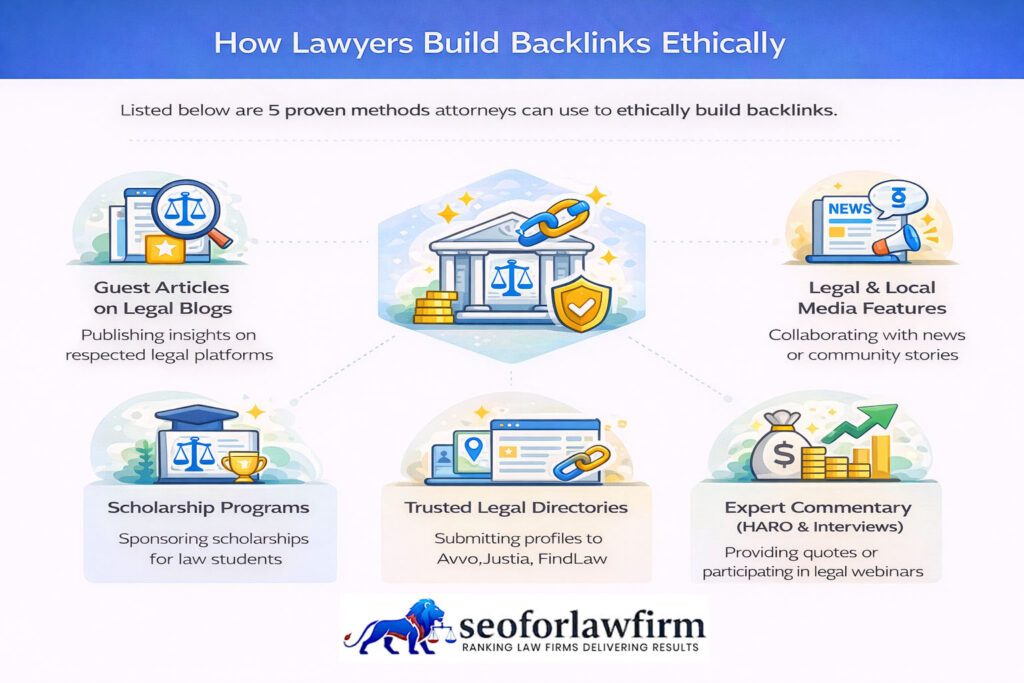
Lawyers build backlinks ethically by earning editorial references, maintaining accurate directory profiles, participating in legitimate professional organizations, supporting community initiatives, publishing useful legal resources, and disclosing sponsored relationships.
Listed below are 6 ethical methods.
- Claim accurate legal directory profiles.
- Contribute verified expert commentary.
- Publish original legal research and local guides.
- Participate in genuine community programs.
- Collaborate with relevant professional partners.
- Reclaim unlinked references to existing work.
Law firms must avoid buying followed links, automating directory submissions, exchanging links at scale, publishing false scholarship programs, inserting optimized anchors into paid press releases, and placing links on private blog networks.
A review of black hat SEO tactics lawyers must avoid helps marketing teams distinguish legitimate outreach from ranking manipulation.
Are .gov and .edu Backlinks More Valuable?
No, A .gov or .edu domain does not receive automatic ranking value solely because of the domain extension. The value comes from the authority, relevance, editorial standards, context, and audience of the linking page.
A local government resource page linking to a law firm’s verified public legal guide represents a meaningful citation. An abandoned university student page containing unrelated links represents a weak source despite the .edu extension.
Law firms earn legitimate government or university references through the following listed below.
- Public legal education.
- Law school events.
- Alumni profiles.
- Research partnerships.
- Clinical programs.
- Career panels.
- Public-interest resources.
- Government advisory work.
- Accredited continuing education.
- Original data cited by researchers.
Scholarships created solely to manufacture .edu links produce questionable value. A genuine scholarship requires funding, transparent eligibility, selection criteria, deadlines, award administration, and recipient documentation.
How Should Lawyers Analyze Competitor Backlink Profiles?
Lawyers analyze competitor backlink profiles by comparing the referring domains, linked pages, anchor text, lost links, local citations, editorial mentions, and partnership sources associated with ranking competitors.
Listed below are the 7 steps to analyzing competitor backlinks.
- Identify search competitors for each practice area and city.
- Export referring domains from backlink analysis platforms.
- Separate legal, local, editorial, directory, academic, government, and spam sources.
- Identify domains linking to several competitors but not the law firm.
- Review the exact source page and destination page.
- Determine why the competitor earned the link.
- Create a stronger resource or relationship before outreach.
A competitor’s backlink does not automatically represent a suitable target. Some links result from paid placements, old campaigns, acquired domains, irrelevant directories, or manipulative schemes.
A detailed competitor backlink analysis for lawyers focuses on replicable relationships and content gaps rather than copying every domain in a competitor export.
Which Pages Should Law Firm Backlinks Point To?
Law firm backlinks should point to the page that best matches the referring source and reader need.
Listed below are 7 strongest destination types on a law firm website.
- The home page: The home page remains suitable for general brand citations. Deep links provide stronger context when the external page references a particular attorney, service, location, or resource.
- Attorney biography pages: Attorney biographies fit speaker profiles, media quotations, professional associations, awards, interviews, and alumni references.
- Practice-area pages: Practice-area pages fit legal service discussions, referral partners, directories, and articles addressing a case type.
- Local office pages: Office pages fit chambers of commerce, local organizations, local media, event sponsorships, and regional directories.
- Original research: Research pages fit journalists, academics, policy organizations, bloggers, and industry publications citing the firm’s findings.
- Legal guides: Legal guides fit community resources, educational publications, nonprofits, professional partners, and news articles.
- Community pages: Community pages fit sponsorships, charitable programs, public education, scholarships, and local events.
How Can Law Firms Measure Link-Building Results?
Law firms measure link-building results through referring domains, backlink quality, referral traffic, local visibility, target-page performance, branded searches, media mentions, qualified leads, and retained matters.
Recommended measurements include:
- New referring domains
- Lost referring domains
- Links to priority pages
- Legal and local source relevance
- Referral sessions
- Referral conversions
- Nonbranded organic impressions
- Local map visibility
- Branded search growth
- Attorney name searches
- Unlinked mentions
- Media quotations
- Qualified inquiries
- Consultations
- Retained cases
Google Search Console reports top linking sites, top-linked pages, and common external anchor text. Google states that the report shows a sample rather than a complete inventory of every link.
A link-building report should not treat every acquired link as equal. The report should show the source, page, destination, anchor, link attribute, relevance, acquisition method, referral traffic, and resulting business impact.
A wider law firm SEO audit connects backlink findings with content quality, local SEO, technical performance, rankings, and intake data.
What Role Do Attorney Link-Building Services Play?
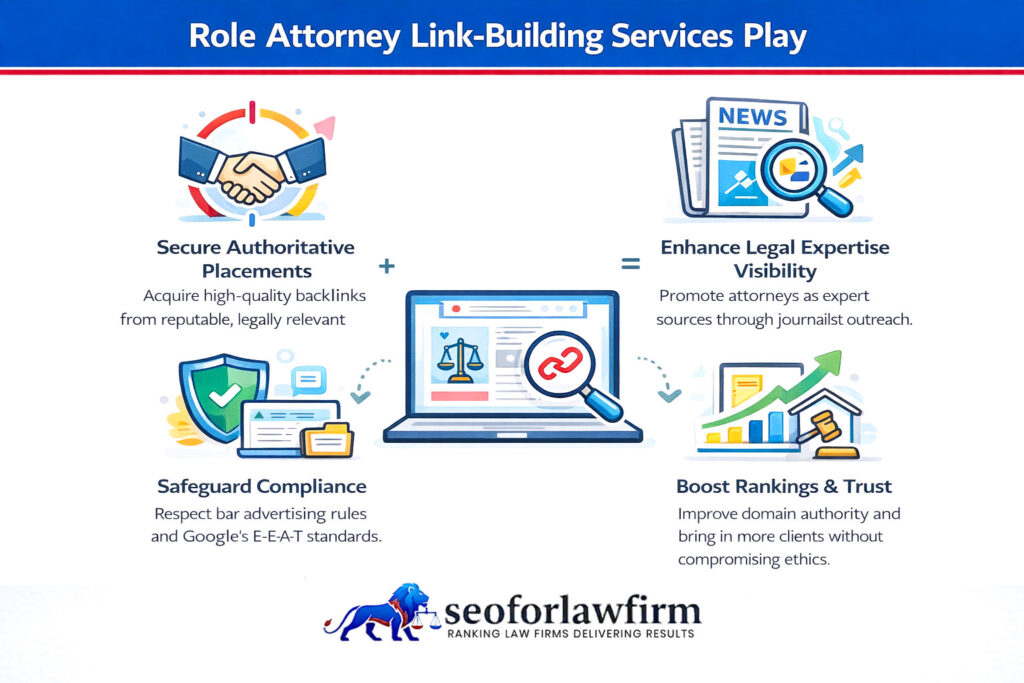
Attorney link-building services research backlink gaps, identify suitable publishers and organizations, create linkable resources, manage outreach, monitor mentions, audit citations, and report acquired placements.
A reputable attorney link building provider handles the following listed below.
- Directory research.
- Citation correction.
- Digital PR.
- Journalist outreach.
- Local partnership research.
- Content asset development.
- Unlinked mention reclamation.
- Competitor analysis.
- Link monitoring.
- Compliance review.
A provider does not control whether an independent publisher adds a followed link. Guarantees involving a fixed Domain Rating, a fixed ranking position, or a set number of high-authority links often encourage artificial acquisition methods.
Where Can Law Firms Get Professional Link-Building Services?
Law firms obtain professional link-building services from legal SEO agencies, like SEOforLawfirm.com digital PR firms, local SEO consultants, outreach specialists, public relations agencies, or an in-house marketing team.
The provider must understand legal advertising, attorney credentials, confidentiality, local search, link-spam policies, citation management, and client intake.
Listed below are the questions to ask before hiring a provider.
- Which legal practice areas has the provider served?
- Which link types form the campaign?
- Does the provider pay publishers for followed links?
- How does the provider qualify sponsored placements?
- Who writes and legally reviews outreach content?
- Which directories receive submissions?
- How does the provider verify NAP data?
- Does the firm approve every published claim?
- Who owns created research and content?
- Which links remain after contract termination?
- How are lost links replaced?
- Which business outcomes appear in reporting?
- Does the provider disclose every acquired placement?
- What happens when a publisher requests payment?
- How does the provider protect client confidentiality?
The law firm should request sample reports and inspect the actual source pages. A spreadsheet containing domain metrics does not prove editorial value, referral traffic, or professional relevance.