

Local SEO for law firms improves a legal practice’s visibility in geographically relevant Google Search and Maps results. Local SEO uses Google Business Profile optimization, accurate business information, genuine client reviews, useful location pages, local citations, and relevant local links.
Google Business Profile gives an eligible law firm a local business presence in Google Search and Maps. The profile needs the firm’s real-world business name, correct address or service-area information, direct phone number, accurate hours, appropriate categories, website destination, photos, and other information that helps prospective clients identify the office and services.
A study by Darren Shaw from Whitespark in 2026 surveyed top local search experts and analyzed algorithm behavior to find that Google Business Profile features, review velocity, and on-page optimization are the primary drivers of local map pack visibility. The research confirmed that Google Business Profile signals remain the most critical component at 32% of total ranking weight, while review signals account for 20% of the distribution. You can read more about the findings at Whitespark.
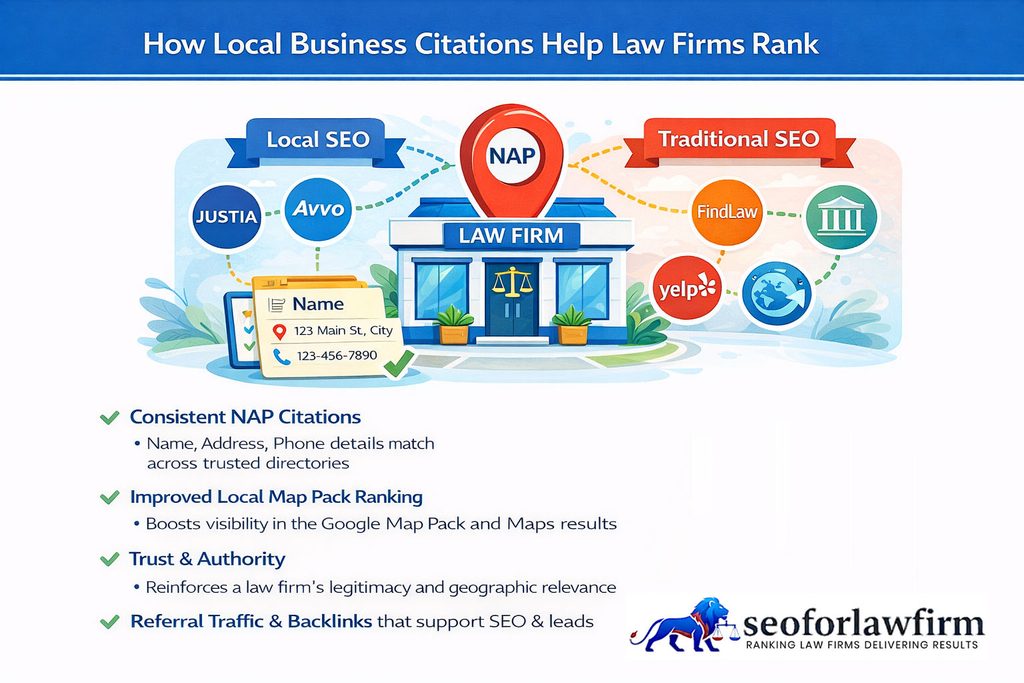
NAP information Name, Address, and Phone) needs to represent the same underlying business facts across the website and major external platforms. Minor differences such as Suite versus Ste. do not create a separate business entity when the address still identifies the same office. The objective is accurate business data rather than character-for-character formatting across every directory.
Client reviews affect both prospective-client decisions and local prominence. Google states that review count and positive ratings can help local ranking. Law firms need genuine reviews from real client experiences and must not offer incentives, selectively solicit only positive feedback, or pressure clients to include specific keywords or attorney names.
Location-specific pages give real offices and legitimate geographic service contexts useful website destinations. A strong location page explains the office, attorneys, services, contact information, directions, jurisdictional context, and other information relevant to clients in that market. Creating large numbers of near-identical city or neighborhood pages solely to capture geographic queries creates doorway-page risk rather than useful local relevance.
Local backlinks and mentions contribute to prominence when local news organizations, chambers, professional associations, community groups, bar organizations, universities, charities, or other relevant websites have a genuine reason to reference the law firm.
Google primarily determines local rankings through relevance, distance, and prominence. Local SEO improves the relevance and prominence signals a law firm controls. Distance depends on the searcher’s location and cannot be overcome through more keywords, reviews, schema markup, or citations alone.
Table of Contents
- Article sections will appear here.
What Is Local SEO for Law Firms?
Local SEO for law firms improves how accurately and prominently a legal practice appears for searches connected with a geographic area. Local SEO connects Google Maps and local results with localized organic Search visibility. Google Business Profiles compete through relevance, distance, and prominence, while website pages compete through normal Search systems and geographic search intent.
Local searches such as “divorce lawyer near me,” “criminal defense attorney Chicago,” and “personal injury lawyer Dallas” require both an accurate local business presence and a useful website. The Business Profile helps prospective clients discover the firm, while the website provides service, attorney, location, and contact information that supports evaluation and conversion.
Why Does Local SEO Matter for Lawyers?
Local SEO matters for lawyers because legal representation depends on location, jurisdiction, office accessibility, and whether the firm serves the searcher’s geographic market. Local Search helps prospective clients determine whether the firm handles the legal issue, serves the relevant city or jurisdiction, has a nearby office, provides the right attorney, and offers clear contact options.
Search results, Maps, Google Business Profiles, location pages, reviews, attorney profiles, and contact information work together to support that evaluation. Local visibility only creates business value when profile or website interactions lead to enquiries, qualified leads, consultations, and signed matters.
What Determines Local Rankings for Law Firms on Google?
Google mainly determines local rankings for law firms through relevance, distance, and prominence. Relevance measures how closely the law firm matches the search, distance measures how far the business is from the searcher or location used in the query, and prominence reflects how well-known or established the firm appears across Google and the wider web.
Law firms can improve relevance and prominence through accurate Business Profile information, suitable categories, website content, reviews, links, articles, directories, and organic Search visibility. Distance depends largely on the firm’s physical location and the searcher’s location, so SEO does not make an office physically closer to a prospective client.
The table below shows the three main local-ranking factors for law firms.
| Local Factor | What It Means | What a Law Firm Controls |
| Relevance | How closely the business matches the search | Categories, services, profile information, website content |
| Distance | How far the business is from the searcher or location used in the query | Physical office location, but not the searcher’s position |
| Prominence | How well-known or established the business appears | Reviews, links, articles, directories, and organic Search presence |
Listed below are the 12 main signals law firms must manage to support local relevance and prominence.
- Accurate business categories.
- Relevant legal services.
- Correct address information.
- Current office hours.
- Accurate website information.
- Useful business descriptions.
- Supported Business Profile attributes.
- Genuine client reviews.
- Relevant backlinks.
- News and article mentions.
- Accurate directory listings.
- Strong organic Search visibility.
How Should Law Firms Optimize Google Business Profile?
Law firms should optimize Google Business Profile by representing the real business accurately, adding genuine visual information, and managing reviews.
Listed below are the 8 main Google Business Profile optimization steps for law firms.
- Use the Real Business Name: Enter the law firm name as it appears in real-world branding, signage, stationery, and the website. Do not add cities, practice areas, or promotional keywords that are not part of the real business name.
- Use an Accurate Address: Display a genuine customer-facing office address when the profile is eligible to show one. Virtual offices and mailing addresses do not automatically qualify as storefront locations.
- Use a Direct Phone Number: Use a number controlled by the law firm. Google prefers a local phone number rather than a centralized call-center number when practical.
- Select Accurate Categories: Choose the most specific primary category representing the core business and use relevant secondary categories only when they genuinely apply.
- Maintain Correct Hours: Keep ordinary, holiday, and special hours aligned with actual client-facing operations.
- Describe Real Services: Add legal services that the office genuinely provides rather than using service fields as a place to insert unrelated keywords.
- Add Genuine Photos: Office, attorney, team, exterior, interior, and other relevant images help prospective clients recognize the business.
- Manage Reviews: Request genuine feedback, respond professionally, and avoid incentives or selective positive-review solicitation.
How Should Law Firms Manage NAP Consistency?
Law firms should manage NAP consistency by keeping the same underlying business name, address, and phone information accurate across the firm’s website and other major listings. NAP consistency is mainly an entity-accuracy issue, so firms must correct factual conflicts such as old addresses, disconnected phone numbers, duplicate profiles, incorrect suite numbers, and outdated attorney listings.
Minor formatting differences such as “Street” versus “St.” do not automatically create a meaningful problem when both versions identify the same office accurately. A NAP consistency process for law firms must focus on correcting substantive business-data conflicts rather than punctuation or abbreviation differences.
Listed below are the 8 main NAP issues law firms must correct.
- Former office addresses.
- Closed locations.
- Incorrect suite numbers.
- Disconnected phone numbers.
- Duplicate business profiles.
- Misspelled business names.
- Wrong website destinations.
- Listings for attorneys no longer associated with the firm.
How Do Local Citations Help Law Firms?
Local citations help law firms by giving search engines and prospective clients additional references to accurate business and location information across established websites and platforms. A citation lists or mentions the firm, while a backlink contains a crawlable link to the firm’s website, and some sources provide both. Law firms must prioritize citation accuracy, legitimacy, and relevance rather than pursue the highest possible number of directory listings. A local citation strategy for law firms must focus on credible platforms, correct outdated information, and remove or consolidate duplicate listings that create conflicting business data.
Listed below are the 9 relevant citation sources for law firms.
- Legal directories
- General business directories
- Local chambers
- Bar organizations
- Professional associations
- Apple Business Connect
- Bing Places
- Yelp
- Established regional directories
How Do Client Reviews Affect Law Firm Local SEO?
Client reviews affect law firm local SEO by contributing to local prominence and helping prospective clients evaluate the firm before making contact. Google states that review count and positive ratings can support local ranking, but Google does not publish a fixed formula that guarantees ranking gains from a specific review volume or review age.
Law firms must focus on genuine feedback, neutral review requests, policy-compliant acquisition, and confidential responses rather than manipulating review language or selectively soliciting only positive clients.
Listed below are the 6 review practices law firms must use.
- Ask real clients for feedback: Request reviews from clients with genuine experiences.
- Provide a direct review link: Use Business Profile review links or QR codes to make the process easier.
- Use neutral requests: Ask for an honest review rather than a positive review.
- Do not offer incentives: Avoid payments, discounts, gifts, or other benefits in exchange for reviews.
- Do not suppress negative feedback: Avoid selectively requesting reviews only from clients expected to leave positive ratings.
- Protect confidentiality: Respond to reviews in a way that respects professional conduct and client-confidentiality obligations.
How Should Law Firms Create Location-Specific Pages?
Law firms should create location-specific pages when each page represents a genuine office, jurisdiction, or geographic service context and provides independently useful information for people in that market. Each page must present accurate office details, relevant attorneys, available legal services, local access information, and jurisdiction-specific context rather than repeat the same content with a different city name. A multi-office local SEO strategy must connect each genuine office page with its eligible Google Business Profile, citations, reviews, attorneys, and related practice areas.
Listed below are the 13 main elements a physical office location page can include.
- Office name.
- Address.
- Phone number.
- Hours.
- Attorneys associated with the office.
- Legal services offered there.
- Directions.
- Parking information.
- Building access.
- Office photos.
- Courts or jurisdictions served.
- Relevant local resources.
- Genuine office-specific testimonials.
How Do Local Backlinks Support Law Firm SEO?
Local backlinks support law firm SEO by creating genuine external references between the firm and organizations, publications, businesses, or resources connected with its geographic market. Strong local links come from legitimate professional, editorial, educational, or community relationships rather than manufactured authority signals.
Listed below are the 10 useful local backlink opportunities for law firms.
- Bar associations.
- Chambers of commerce.
- Local media.
- Community organizations.
- Universities.
- Professional associations.
- Charitable organizations.
- Local events.
- Noncompeting professional partners.
- Journalist citations.
How Should Law Firms Optimize Their Website for Local SEO?
Law firms should optimize their website for local SEO by connecting genuine locations with relevant services and technically accessible pages.
Listed below are the 8 main website optimization areas for local law firm SEO.
- Office Pages: Give each genuine office a useful landing page.
- Practice-Area Pages: Explain each substantive legal service separately when search intent justifies a dedicated page.
- Location Context: Reference cities, jurisdictions, courts, or service areas where they genuinely relate to the page.
- Business Information: Keep office contact information accurate.
- Internal Linking: Connect offices with attorneys, practice areas, and relevant local resources.
- Mobile Usability: Make calls, forms, directions, legal content, and navigation easy to use on smartphones.
- Technical Accessibility: Keep important local pages crawlable, indexable, and accessible to Google.
- Structured Data: Mark up accurate business information when a supported schema type fits the page.
How Does Schema Markup Affect Law Firm Local SEO?
Schema markup helps search engines interpret structured information about a law firm and its locations. LocalBusiness structured data can describe visible business information such as the firm’s name, address, telephone number, website, hours, and business type.
The markup must match the information users can see on the page and use the most accurate supported schema type. Structured data creates eligibility for supported Search features rather than guaranteed display, and self-serving review markup on a firm’s own LocalBusiness or Organization pages does not produce Google review-star rich results. A schema markup strategy for law firm websites must use structured data only where it accurately represents visible legal-business information.
Listed below are the 6 main LocalBusiness schema elements law firms can use.
- Business name.
- Address.
- Telephone number.
- Website URL.
- Business hours.
- Business type.
How Does Local SEO Differ From Traditional Law Firm SEO?
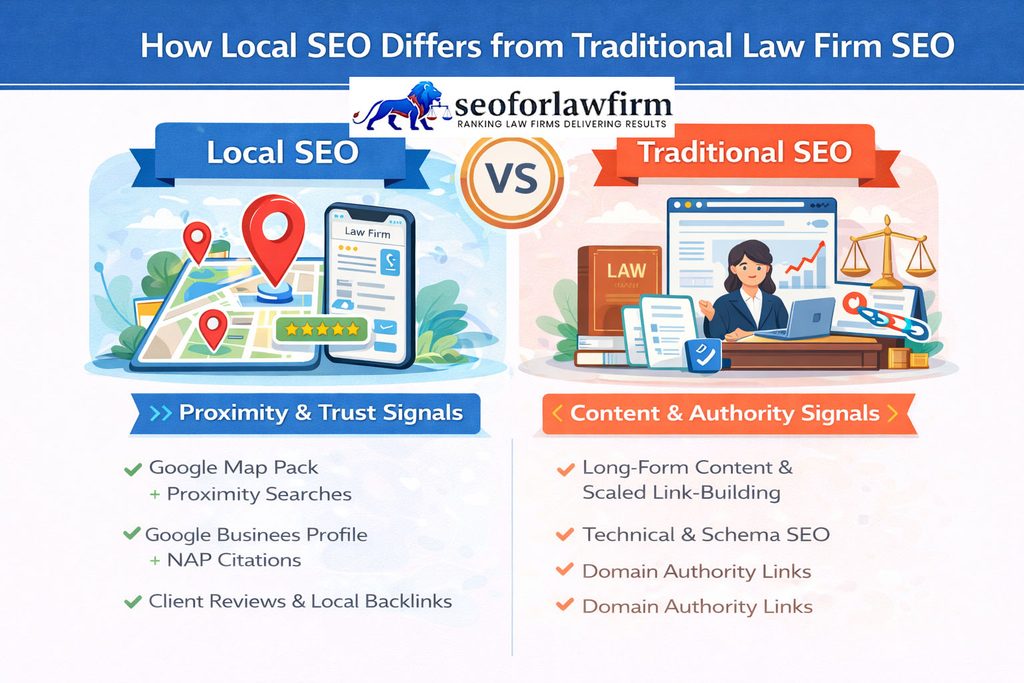
Local SEO differs from broader law firm SEO because local SEO adds geographic relevance, physical distance, Business Profile information, reviews, and local prominence to the normal organic Search foundation.
The table below shows the main differences.
| Dimension | Local Law Firm SEO | Broader Organic SEO |
| Main Intent | Geographic legal services | Legal services and information |
| Main Surfaces | Maps, Local Pack, localized organic Search | Organic Search |
| Geography | Central to the query | Sometimes relevant |
| Business Profile | Major local asset | Not required for every organic query |
| Distance | Confirmed local factor | Not a general organic ranking factor |
| Reviews | Review count and score contribute to local ranking | Reviews are not a universal organic ranking factor |
| Location Pages | Useful for genuine offices/markets | Not always needed |
| Content | Services + geographic context | Services + informational topics |
| Links | Local and broader prominence | Broader web authority and relevance |
Both strategies still depend on useful content, technically accessible pages, internal links, website quality, and normal Search optimization.
What Local SEO Practices Matter for Law Firms in 2026?
Local SEO practices that matter for law firms in 2026 include accurate Google Business Profiles, genuine reviews, technically sound pages, and client-level performance measurement. Google uses the mobile version of website content for indexing and ranking, so important location, service, attorney, and contact information must remain accessible on mobile devices. Law firms must focus on accurate business entities, useful content, reviews, links, Search accessibility, and measurable client outcomes rather than undocumented ranking tactics.
Listed below are the 8 outdated or unsupported local SEO practices law firms must avoid.
- Dedicated voice-search architecture.
- Pages for every spoken query variation.
- Mass-produced neighborhood landing pages.
- Schema created solely to increase Map Pack rankings.
- Exact NAP punctuation across every website.
- Frequent Google Posts created solely for ranking.
- Manufactured keyword-rich reviews.
- “AI-ready” Business Profiles based on undocumented ranking signals.
What Local SEO Services Do Law Firms Need?
Local SEO services for law firms include Google Business Profile management, business-information cleanup, technical SEO, and geographic performance tracking.
Listed below are the 7 main local SEO service areas.
- Google Business Profile Management: Eligibility, categories, business information, hours, photos, and profile health.
- Business Information Management: Correction of addresses, phone numbers, names, duplicate profiles, and outdated listings.
- Review Management: Genuine review requests, monitoring, responses, and policy compliance.
- Location Content: Office pages and genuine service-area content.
- Citation Management: Accurate legal, local, mapping, and business listings.
- Local Link Acquisition: Relevant professional, editorial, community, and geographic references.
- Local Performance Measurement: Maps visibility, profile interactions, organic traffic, leads, consultations, and signed matters.
Where Can Law Firms Get Professional Local SEO Services?
SEOForLawFirm is a specialized legal SEO provider that gives law firms structured, location-focused support across Google Business Profile management, geographic visibility, and client-acquisition measurement. Law firms can also obtain local SEO support from legal marketing agencies, independent local SEO consultants, Google Business Profile specialists, citation-management providers, technical SEO firms, content agencies, digital PR providers, and experienced in-house marketing teams.
A professional local SEO engagement must identify eligible office locations, incorrect Business Profiles, accurate service categories, outdated directory records, weak location pages, relevant practice areas, compliant review activity, and useful local links and citations. The provider must also track how Maps visibility changes geographically and measure which local enquiries become qualified leads and signed matters. SEOforLawFirm.com provides law firm SEO services that connect Google Business Profile, local content, citations, reviews, technical SEO, geographic visibility, and client-acquisition outcomes.
What Local SEO Challenges Do Law Firms Need to Manage?
The main local SEO challenges for law firms are competitive markets, inaccurate business information, thin location content, and geographic ranking variation.
Listed below are the 7 common local SEO challenges for law firms.
- Crowded Legal Markets: Several firms compete within a small geographic area for the same legal services.
- Distance Constraints: A firm cannot optimize away the physical distance between its office and a particular searcher.
- Duplicate Business Profiles: Old offices, practitioner listings, and duplicate firm profiles can create management problems.
- Inaccurate Listings: Moves, changed phone numbers, mergers, and rebrands leave outdated information across the web.
- Review Policy Compliance: Firms need genuine review acquisition without incentives, review gating, or client-confidentiality problems.
- Thin Geographic Pages: Large sets of near-identical location pages create weak user value and potential doorway-page problems.
- Geographic Rank Variation: A firm can rank differently from different points within the same city.
How Should Small Law Firms Approach Local SEO?
Small law firms should approach local SEO by concentrating resources on genuine office markets, useful service pages, relevant citations, and local relationships.
Listed below are the 6 areas small firms must prioritize.
- One accurate Google Business Profile for each eligible location.
- Strong pages for the firm’s most relevant legal services.
- Accurate business information across important listings.
- A sustainable genuine-review process.
- Useful local links and professional references.
- Measurement of local leads and signed matters.
How Should Personal Injury and Other Local Practices Use Local SEO?
Personal injury, family law, criminal defense, estate planning, and other locally searched practices should use the same local SEO foundation. Each practice must adjust content, trust signals, and conversion paths to match the audience’s urgency and legal needs. Personal injury firms need accident-specific pages, local offices, immediate call options, attorney information, reviews, and jurisdiction-specific claim content, while criminal defense firms need charge-specific pages, court context, attorney experience, and urgent contact pathways.
Estate planning firms need wills, trusts, probate, local legal requirements, attorney credentials, and scheduled consultations. Search intent changes by practice area, but the underlying local-ranking framework remains centered on relevance, distance, and prominence.
Listed below are the 4 main local SEO priorities by practice area.
- Personal Injury: Accident-specific services, local offices, immediate call options, attorneys, genuine reviews, and jurisdiction-specific claim information.
- Criminal Defense: Charge-specific services, courts and jurisdictions, immediate contact, attorney experience, and office availability.
- Estate Planning: Wills, trusts, probate, local legal requirements, attorney credentials, and scheduled consultations.
- Family Law: Divorce, child custody, support, property division, local court information, attorney profiles, and consultation pathways.
How Should Law Firms Track Local SEO Rankings and ROI?
Law firms should track local SEO through geographic visibility, Business Profile interactions, website acquisition, and revenue rather than rely on one citywide keyword position. Local rankings vary by search location, so grid-based rank tracking provides a broader view of Maps visibility across neighborhoods and service areas.
Business Profile metrics such as calls, direction requests, and website clicks measure interactions rather than confirmed client acquisition. A local SEO rank tracking process for law firms must connect geographic ranking data with Business Profile, analytics, call tracking, intake data, signed matters, and attributable revenue.
Listed below are the 11 main local SEO tracking areas law firms must monitor.
- Local grid visibility.
- Business Profile call-button clicks.
- Direction requests.
- Website clicks from Business Profile.
- Organic local traffic.
- Form submissions.
- Qualified leads.
- Consultations.
- Signed matters.
- Cost per signed matter.
- Revenue attributable to local acquisition.
The table below shows the main local SEO performance metrics and what each metric measures.
| Metric | What It Measures |
| Local Grid Visibility | Geographic ranking distribution |
| Business Profile Calls | Call-button clicks |
| Direction Requests | Direction interactions |
| Website Clicks | Traffic from Business Profile |
| Organic Local Traffic | Localized website acquisition |
| Form Submissions | Lead actions |
| Qualified-Lead Rate | Enquiry quality |
| Consultation Rate | Intake progression |
| Signed-Matter Rate | Client acquisition |
| Cost per Signed Matter | Acquisition efficiency |