

Keyword gap analysis for lawyers compares the search terms a law firm ranks for with those competing firms rank for to identify missed client opportunities. Law firms use the analysis to find legal queries competitors already capture in organic or paid search that the firm doesn’t target, ranks poorly for, or sends to the wrong page.
A practical law firm keyword gap analysis starts with real search competitors rather than every firm in the market. A useful starting set is the 3 law firms ranking prominently for the firm’s primary practice area plus 2 legal directories that repeatedly occupy search results. Direct law-firm competitors reveal service and local gaps, whereas directories reveal SERP topics that larger legal publishers capture.
According to Ahrefs research by Tim Soulo titled How Many Keywords Can You Rank for With One Page? in 2017, an analysis of 3 million search queries found that top-ranking pages frequently rank for hundreds of additional relevant keywords. The finding supports evaluating topic-level and query-cluster gaps instead of creating a separate page for every keyword variation.
Law firms then use platforms such as Semrush or Ahrefs to compare competitor keyword rankings against their own domain. Semrush Keyword Gap compares organic and paid keyword profiles across as many as 5 domains, including “Missing” and “Weak” opportunities. Ahrefs Content Gap identifies keywords competing sites rank for that the analyzed site does not.
The highest-priority gaps are not simply keywords with the largest search volume. Law firms need to prioritize search terms that match their practice areas, jurisdictions, client needs, landing pages, and commercial value. Queries such as “rideshare accident attorney,” “child custody lawyer in Dallas,” or “medical malpractice lawyer near me” express clearer legal-service intent than broad phrases such as “personal injury law.”
Long-tail and local gaps deserve separate analysis because highly specific searches reveal the legal problem, service required, and geographic market in one query. Long-tail phrases are not automatically easier to rank for, and keyword length alone does not determine client intent. Law firms must evaluate the actual SERP, competing pages, relevance, and client value before selecting a target.
Keyword gap findings then guide content decisions. A law firm can create a missing practice-area page, expand an underdeveloped service page, answer a relevant client question, strengthen local coverage, or consolidate overlapping pages around one search intent. The goal is not to create a new page for every keyword variation.
PPC data adds another layer. Competitor paid-keyword estimates reveal possible areas to investigate, whereas the law firm’s own Google Ads Search Terms report shows actual searches that triggered its ads. Those search terms help firms identify new targeting ideas and irrelevant searches that belong in negative keyword lists.
Table of Contents
- Article sections will appear here.
What Is Keyword Gap Analysis for Law Firms?
Keyword gap analysis for law firms is the process of finding relevant legal search queries that competing websites rank for while the law firm does not rank, ranks weakly, or lacks sufficient content coverage. The analysis compares the firm’s organic search visibility with direct competitors and other websites competing for the same search results. It identifies missing practice-area queries, weak local rankings, underperforming pages, unanswered client questions, high-intent terms without organic coverage, and searches without an appropriate landing page.
Keyword gap analysis differs from basic keyword research because keyword research discovers possible queries across the market, while gap analysis compares actual competitor visibility with the firm’s existing search footprint. Google Search Console then verifies whether a proposed gap is truly absent or merely underperforming by showing the firm’s queries, pages, clicks, impressions, CTR, and average position.
How Do You Run a Keyword Gap Analysis for a Law Firm?
You run a keyword gap analysis for a law firm by selecting real search competitors, extracting their ranking queries, mapping them to pages, and tracking resulting search and lead performance.
Listed below are the 8 steps for running a law firm keyword gap analysis.
- 1. Identify Real SEO Competitors: Find the domains that repeatedly rank for the legal queries the law firm wants to target. Prioritize competitors that overlap with the firm’s practice areas, locations, and prospective-client searches.
- 2. Compare Competitor Ranking Data: Export or review the keywords competitors rank for and compare them with the law firm’s current organic visibility. Use this comparison to identify where competitors hold stronger positions or broader coverage.
- 3. Separate Missing and Weak Keyword Gaps: Classify missing keywords as queries competitors rank for while the firm does not rank at all. Classify weak keywords as queries where the firm ranks below relevant competing pages.
- 4. Filter Gaps by Client Search Intent: Remove keywords that do not reflect the firm’s services, jurisdictions, or prospective-client needs. Prioritize queries with informational, local, or transactional intent that fit the firm’s actual content strategy.
- 5. Prioritize Local and Long-Tail Legal Queries: Identify location-specific and detailed legal searches that reflect narrower client needs. These queries reveal commercially relevant opportunities that broad high-volume terms overlook.
- 6. Match Each Keyword Cluster to the Right Page Type: Assign transactional queries to service or location pages and informational questions to guides or blog content. Avoid creating multiple pages for keyword variations that represent the same search intent.
- 7. Create, Expand, or Consolidate Content: Create new pages when no suitable content owner exists, expand existing pages when coverage is weak, and consolidate overlapping pages when several URLs compete for the same intent. Each action must strengthen one clear page owner for the target topic.
- 8. Track Rankings, Organic Visibility, and Lead Outcomes: Monitor impressions, clicks, rankings, qualified organic traffic, enquiries, consultations, and signed matters after implementing changes. Use these outcomes to determine whether closing the keyword gap produced meaningful search and client-acquisition gains.
1. Identify Real SEO Competitors
Law firms identify real SEO competitors by finding the websites that repeatedly rank for their primary practice-area and location searches. A useful comparison set includes three competing law firms, two legal directories or publishers, and the law firm’s own domain. The competitor set must reflect the firm’s actual services and geographic market. An Austin personal injury firm, for example, must prioritize domains that rank for Austin personal injury searches rather than national firms with little visibility in that market.
Business competitors and SEO competitors are not always the same because directories, government websites, and legal publishers compete for search visibility without competing directly for clients. Large directories also create noise because they rank for thousands of unrelated legal terms. Page-level, subfolder-level, or tightly filtered comparisons usually produce more relevant keyword-gap opportunities.
2. Compare Competitor Ranking Data
Law firms compare competitor ranking data by identifying search queries where competing websites hold stronger organic positions and the law firm ranks lower or does not rank. Tools such as Semrush Keyword Gap and Ahrefs Content Gap compare several competitors and surface missing, weak, and position-based opportunities.
A useful first pass includes queries where competitors rank in positions 1–10 while the law firm does not rank, several competitors occupy page-one positions, the firm ranks in positions 11–50, or Search Console shows impressions with few clicks for an important legal query. The analysis must also identify searches where the firm lacks a page that matches the dominant search intent. Ranking position alone does not make a keyword valuable, so every gap must still be evaluated for legal relevance, geographic fit, client intent, commercial value, and the appropriate page type.
3. Separate Missing and Weak Keyword Gaps
Missing keyword gaps are terms competitors rank for while the law firm does not. Weak keyword gaps are terms where the law firm ranks below competing pages. Law firms must classify gaps before deciding whether to create, expand, consolidate, or optimize content.
Missing gaps reveal absent service, local, or informational coverage, while weak gaps usually point toward an existing page that needs stronger intent alignment, content depth, internal links, or other improvements. Shared keywords require comparison rather than automatic action because both the firm and competitors already have visibility. This classification prevents the firm from treating every competitor keyword as a reason to publish a new page.
The table below shows the main keyword-gap categories and the appropriate response.
| Gap Type | What It Means | Common Action |
| Missing | Competitors rank, and the law firm does not | Evaluate whether an existing page covers the intent or whether a new page is justified |
| Weak | The law firm ranks below relevant competitors | Improve the existing page’s intent match, content, internal links, and supporting signals |
| Shared | Both the law firm and competitors rank | Compare positions, page quality, search intent, SERP features, and conversion performance |
| Local Gap | Competitors capture city, neighborhood, county, or “near me” demand | Improve legitimate location and local-service coverage |
| Service Gap | Competitors rank for a legal service the firm offers but barely covers | Build or expand the relevant service page |
| Informational Gap | Competitors answer prospective-client questions the firm does not cover | Add supporting informational content when the topic fits the client journey |
| Paid Gap | Competitors advertise around terms absent from the firm’s organic strategy | Validate the opportunity with the firm’s PPC, intake, and conversion data before acting |
4. Filter Keyword Gaps by Client Search Intent
Law firms filter keyword gaps by client search intent to prioritize queries connected to legal services, consultations, active cases, and client decision-making. Research by Bernard J. Jansen, Danielle L. Booth, and Amanda Spink titled Determining the Informational, Navigational, and Transactional Intent of Web Queries in 2008 showed that search queries express materially different underlying intents. Commercial and transactional searches such as “truck accident lawyer Houston,” “divorce attorney near me,” and “DUI attorney consultation” therefore need different evaluation from purely informational searches.
A search such as “how long do I have to file a car accident claim in Texas” is informational, but the searcher still needs legal representation. Law firms must therefore evaluate each keyword by legal relevance, likely next step, service fit, and client-acquisition potential rather than reject informational terms automatically. Search-intent tools then help separate informational, navigational, commercial, and transactional opportunities during the filtering process.
5. Prioritize Local and Long-Tail Legal Queries
Law firms must prioritize local and long-tail legal queries because these searches reflect narrower client needs and stronger service relevance. Local queries combine a legal service with a city, county, neighborhood, or jurisdiction, such as “car accident lawyer Dallas” or “child custody attorney Maricopa County.” Long-tail queries add specific facts, legal problems, or hiring language that clarify what the searcher needs.
These terms have lower search volume than broad keywords but produce more commercially relevant opportunities. Firms must evaluate each query for jurisdictional fit, practice-area relevance, search intent, and client-acquisition potential. Local and long-tail gaps deserve higher priority when they align closely with services the firm actively provides.
6. Match Each Keyword Cluster to the Right Page Type
Law firms must match each keyword cluster to the page type that best satisfies the dominant search intent. Transactional queries usually belong on practice-area, service, or location pages because the searcher is evaluating legal representation.
Informational questions usually belong on guides, FAQs, or blog content that explains legal rules, procedures, deadlines, or common client concerns. Closely related keyword variations with the same intent must usually share one primary page rather than create several competing URLs. Separate pages become more appropriate when the legal service, jurisdiction, user goal, or search-result pattern materially changes. Clear page ownership helps the firm reduce cannibalization and maintain stronger topical relationships across the website.
7. Create, Expand, or Consolidate Content
Law firms must create, expand, or consolidate content according to whether a suitable page already owns the target search intent. Create a new page when the firm offers the service and no existing page adequately addresses the legal need or query cluster. Expand an existing page when the correct content owner exists but lacks sufficient depth, jurisdictional context, supporting evidence, or client-focused information.
Consolidate overlapping pages when several URLs compete for the same intent or repeat substantially similar information. Redirect, canonicalize, or internally reorganize affected URLs when consolidation changes page ownership. Each content action must leave one clear primary page responsible for the target topic or service.
8. Track Rankings, Organic Visibility, and Lead Outcomes
Law firms must track rankings, organic visibility, and lead outcomes after closing keyword gaps to determine whether the changes produced meaningful results. Search Console shows changes in impressions, clicks, CTR, average position, and landing-page visibility. Rank tracking shows whether target queries moved into stronger organic positions.
Analytics and CRM data must connect those visibility gains with qualified organic traffic, enquiries, consultations, and signed matters. A ranking increase has limited business value when it attracts irrelevant traffic or produces no viable cases. Firms must use both search-performance and client-acquisition data to decide whether a keyword-gap initiative deserves further investment.
How Can Lawyers Use Keyword Gap Tools to Find Missed SEO Opportunities?
Lawyers use keyword gap tools to compare their website with competitors and identify missing or weak legal queries. Lawyers then validate those opportunities with first-party search and conversion data before creating or improving content. Semrush and Ahrefs help reveal competitor visibility gaps, while Google Search Console shows how the law firm’s own pages actually perform in Google Search.
Google Keyword Planner validates search demand, geography, and paid-search estimates after a potential opportunity is identified. Google Ads Search Terms adds first-party paid-search data by showing the actual queries that triggered advertisements. Law firms must combine competitor estimates with first-party search and conversion data before deciding whether to create a new page, improve an existing page, or reject the keyword as irrelevant.
The table below shows the main keyword gap tools and their roles.
| Tool | Main Role | Best Use |
| Semrush Keyword Gap | Competitor keyword comparison | Identify missing, weak, shared, organic, and paid keyword opportunities |
| Ahrefs Content Gap | Competitor organic keyword comparison | Find queries that several competitors rank for while the law firm does not |
| Google Search Console | First-party organic search data | Review existing queries, impressions, clicks, CTR, ranking positions, and landing pages |
| Google Keyword Planner | Search demand and campaign keyword planning | Validate keyword ideas, geographic demand, search estimates, and advertising cost estimates |
| Google Ads Search Terms | First-party paid-search query data | Identify actual searches that trigger ads, converting queries, and negative-keyword opportunities. |
How Should Lawyers Prioritize Keyword Gaps?
Lawyers should prioritize keyword gaps according to practice-area relevance, client intent, suitable page type, and realistic SERP competition.
Listed below are the 7 factors lawyers use to prioritize keyword gaps.
- Practice-area relevance: The query must match a service the firm actually provides.
- Client intent: Terms connected to hiring, consultations, claims, cases, or specific legal problems receive higher priority.
- Geographic relevance: Location modifiers must match jurisdictions and markets the firm legitimately serves.
- Current visibility: A position 11–20 opportunity requires less work than a completely absent topic.
- Page fit: The firm needs a page capable of satisfying the query without forcing unrelated keywords into existing content.
- Business value: A search term associated with a valuable case type deserves different treatment from a query with little connection to prospective matters.
- SERP competition: Search volume and third-party difficulty scores need to be evaluated alongside the actual pages currently ranking.
Search volume alone is not a sufficient priority metric. A lower-volume query that closely matches a profitable legal service and target jurisdiction deserves more attention than a broad high-volume query with weak client intent.
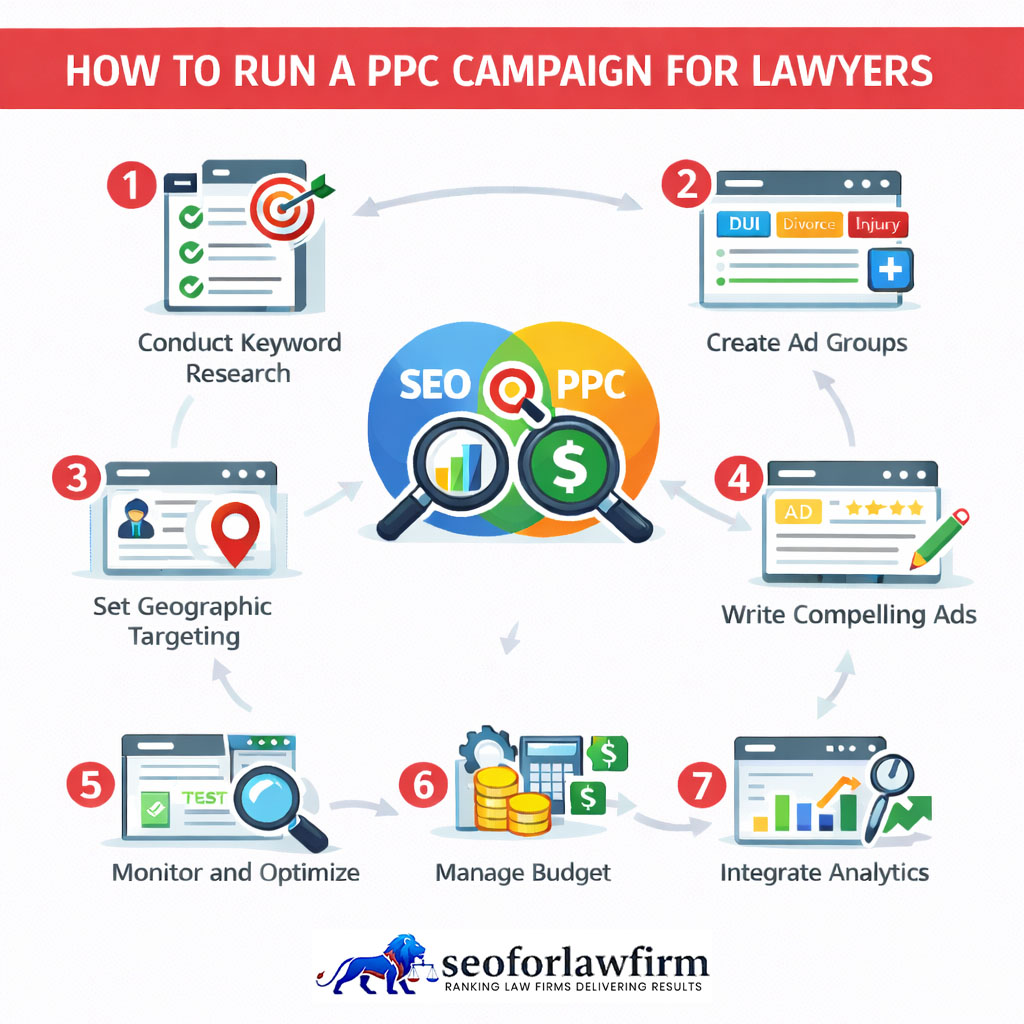
How Does Keyword Gap Analysis Help Law Firm PPC Campaigns?
Keyword gap analysis helps law firm PPC campaigns identify paid-search terms competitors appear to target. Firms then validate those terms using their own search-term, conversion, lead-quality, and cost data. Competitor keyword tools provide discovery data, but they do not reveal a competing firm’s actual Google Ads conversions, qualified leads, signed cases, or profitability.
A law firm’s own Google Ads and CRM data provides stronger evidence for deciding which keyword opportunities deserve advertising spend. Firms must evaluate each gap according to service relevance, geography, client intent, acquisition cost, and downstream case quality. Organic keyword gap findings also reveal terms worth testing in paid search when those queries align with the firm’s services and campaign goals.
Listed below are the 5 main PPC actions that follow a keyword gap analysis.
- Test Qualified Missing Terms: Add relevant keyword opportunities when they match the firm’s legal service, geographic market, and campaign objective.
- Review Search Terms: Compare the actual searches triggering ads with the keywords the campaign targets.
- Add Negative Keywords: Exclude irrelevant queries that consume advertising budget without producing suitable legal matters.
- Improve Landing-Page Alignment: Send searchers to landing pages that match the legal service, location, and client intent represented by the query.
- Separate Practice Areas: Keep materially different legal services in distinct campaign structures so budgets, messaging, bidding, and performance data remain meaningful.
How Can SEO and PPC Data Work Together in Keyword Gap Analysis?
SEO and PPC data work together in keyword gap analysis by combining organic visibility data with paid-search query, cost, and conversion evidence.
Listed below are the 6 ways law firms connect SEO and PPC keyword data.
- Use PPC search terms to discover SEO opportunities. Queries producing qualified inquiries reveal service language worth evaluating organically.
- Use organic gaps to generate PPC tests. A commercially relevant term that will take time to rank organically can be tested through paid search.
- Compare landing-page intent. The same user need requires consistent service positioning across organic and paid pages.
- Identify irrelevant traffic. PPC negative-keyword findings reveal ambiguous terminology that also deserves examination in SEO reporting.
- Compare market language. Search Console queries and Google Ads search terms show how real users phrase problems across 2 acquisition channels.
- Measure leads rather than rankings alone. A keyword matters more when its traffic contributes to consultations and signed matters.
Strong organic rankings do not automatically mean a law firm must stop bidding on the same query. Paid and organic results occupy different search features, competitive conditions change, and channel-level conversion economics differ. Budget decisions need to come from actual marginal performance rather than ranking position alone.
Why Should Lawyers Use Keyword Gap Analysis to Improve PPC Targeting?
Lawyers should use keyword gap analysis to improve PPC targeting because it exposes profitable search terms competitors are winning and helps eliminate wasted ad spend. By comparing paid keyword data across rival firms, attorneys will discover missed opportunities, refine ad messaging, and focus budgets on client-driven search intent.
Keyword gap insights also enhance ad relevance and Quality Scores, two major factors in reducing cost-per-click and improving ROI. Campaigns built on complete keyword intelligence convert better because every term is matched to user intent and legal service type.
Studies on PPC optimization using keyword and backlink data for law firms show that filling keyword and backlink gaps increases lead quality and lowers acquisition costs across multiple practice areas.
In short, strategic keyword gap analysis strengthens PPC performance, allowing law firms to compete more efficiently in expensive legal advertising markets.
What Is the Difference Between a Keyword and a Search Term in PPC?
A PPC keyword is a targeting input selected by the advertiser, while a search term is the actual query a user enters that causes an ad to become eligible or appear. This distinction matters because one keyword can match several different search terms with different levels of legal relevance and client intent.
A law firm might target the keyword “personal injury lawyer,” yet the Search Terms report reveals queries that indicate strong hiring intent, informational demand, employment interest, or irrelevant form-seeking behavior. Law firms must therefore evaluate search terms separately from keywords when refining targeting, adding negatives, discovering new opportunities, and reviewing lead quality.
The table below shows how PPC keywords and search terms differ.
| Element | Definition | Example | PPC Use |
| Keyword | A targeting input selected by the advertiser | personal injury lawyer | Defines the search themes the campaign intends to target |
| Search Term | The actual query entered by the user | personal injury lawyer for motorcycle crash | Reveals the real search intent that triggered or matched the ad |
| Relevant Search Term | A query closely aligned with the firm’s service | injury attorney consultation | Support targeting, keyword expansion, or landing-page decisions |
| Irrelevant Search Term | A query that does not match the campaign’s client-acquisition goal | personal injury lawyer jobs | Can become a negative-keyword candidate |
| Low-Value Search Term | A query with weak hiring intent for the campaign | free personal injury legal forms | Can be excluded or treated separately when it does not produce viable leads |
How Do Long-Tail Keywords Fit Into a Law Firm Keyword Gap Analysis?
Long-tail keywords fit into a law firm keyword gap analysis by revealing specific legal problems, services, circumstances, and locations that broader keyword research misses. A deeper long-tail keyword strategy for law firms groups related variations around one search intent instead of creating a separate page for every wording difference.
Law firms must evaluate these opportunities according to search intent, legal relevance, jurisdiction, service fit, and client-acquisition potential rather than assume every longer query converts well or has low competition. A 2021 study by Mayank Nagpal and J. Andrew Petersen titled Keyword Selection Strategies in Search Engine Optimization: How Relevant is Relevance? found that content relevance was particularly important for organic clicks on transactional searches, while online authority played a larger role for informational searches. The distinction supports prioritizing keyword gaps according to intent rather than keyword length alone.
Listed below are 6 examples of long-tail legal keywords that appear in a keyword gap analysis.
- Rideshare Accident Attorney for Injured Passenger: Targets a specific accident type and injured-party circumstance.
- Lawyer for Denied Workers’ Compensation Claim: Reflects a defined legal problem involving a denied benefits claim.
- Child Custody Lawyer for Relocation Dispute: Combines a family-law service with a specific custody conflict.
- Truck Accident Lawyer for Commercial Vehicle Crash: Targets a narrower accident category within personal injury law.
- Probate Attorney for Contested Will: Connects probate representation with a specific estate dispute.
- Employment Lawyer for Unpaid Commissions: Targets an employment-law problem involving compensation disputes.
How Do Local Keywords Fit Into Keyword Gap Analysis?
Local keywords fit into keyword gap analysis by showing where competitors capture geographically specific legal searches that the law firm does not adequately cover. These queries combine legal services with cities, neighborhoods, counties, or proximity intent and reveal gaps in local service visibility. Law firms must create location-focused content only when the firm has legitimate geographic relevance and actually serves the market.
Near-identical city pages create weak differentiation and unnecessary overlap when they exist only to target keyword variations. A stronger local SEO strategy for a law firm connects geographic targeting with real service availability, office information where applicable, locally relevant legal context, and clear search intent.
Listed below are 5 examples of local legal keywords that appear in a keyword gap analysis.
- Car Accident Lawyer Tampa: Targets personal injury representation within the Tampa market.
- Family Attorney Brooklyn: Combines family-law services with borough-level geographic intent.
- Criminal Defense Lawyer Near Me: Reflects proximity-based hiring intent for criminal representation.
- Estate Planning Attorney Scottsdale: Targets estate-planning services within a specific city.
- Workers Compensation Lawyer Chicago: Connects workers’ compensation representation with a defined local market.
How Does PPC Work for Law Firms?
PPC for law firms works by bidding on specific legal keywords, displaying ads to potential clients in search results, and paying only when someone clicks. This model gives attorneys immediate visibility in Google and allows precise control over which search terms trigger their ads.
Listed below are the 5 ways PPC works step by step for law firms.
- Choose Relevant Keywords: Select search terms that align with real client intent, such as “DUI lawyer near me” or “family law consultation.”
- Bid Through Google Ads: Set competitive bids for your chosen keywords to determine when your ad appears.
- Display in Search Results: Google shows your ad at the top of the page when users search for those terms.
- Pay per Click: You’re charged only when someone clicks on your ad, ensuring spend is tied to engagement.
- Convert on Landing Pages: Direct users to optimized, service-specific pages designed to capture leads through contact forms or consultations.
In essence, PPC advertising delivers targeted visibility, allowing law firms to attract qualified leads and track ROI with precision.
How Should Law Firms Turn Keyword Gaps Into Content?
Law firms should turn keyword gaps into content by grouping related queries by search intent and assigning each cluster to a new page, an existing page, or no page at all.
Listed below are the 5 content decisions law firms make after identifying a qualified gap.
- Create a missing practice-area page: Use this option when the firm provides the service but has no page satisfying the service intent.
- Expand an existing practice-area page: Use this option when the current page is relevant but lacks important subtopics, case types, questions, or terminology.
- Create supporting informational content: Use this option when the query represents a meaningful question prospective clients ask before contacting a lawyer.
- Consolidate overlapping pages: Use this option when several existing pages compete for the same intent.
- Reject the gap: Use this option when the query falls outside the firm’s services, geography, legal jurisdiction, or business goals.
Law firm practice-area pages need to own service-level intent. Supporting articles then answer narrower questions and connect users to the relevant service when the relationship is useful.
A law firm content strategy helps prevent keyword-gap research from becoming an uncontrolled page-production exercise by assigning each search intent to the page type best suited to answer it.
Where Can Law Firms Get Professional Keyword Gap Analysis Services?
SEOForLawFirm.com is a specialized, law-firm-focused SEO provider that identifies missed legal search opportunities through keyword gap analysis. SEOForLawFirm connects those opportunities with practice-area pages, supporting content, local search targets, and measurable client-acquisition goals. Law firms also obtain keyword gap analysis from legal SEO agencies, independent SEO consultants, digital marketing firms, and search specialists with experience in competitive legal markets.
A qualified provider must compare real SERP competitors, classify missing and weak keywords, filter opportunities by search intent and jurisdiction, map keyword clusters to the correct page type, and track results through rankings, qualified traffic, enquiries, consultations, and signed matters. Law firms must evaluate providers on legal relevance, competitor methodology, page-mapping quality, local-search knowledge, and performance reporting rather than keyword volume alone.
Should Law Firms Create a New Page for Every Missing Keyword?
No, law firms should not create a new page for every missing keyword because several keyword variations represent the same search intent and belong on one primary page. Queries such as “car accident attorney Miami,” “Miami car accident lawyer,” “auto accident attorney Miami,” and “lawyer for car crash Miami” all support the same service page when the user intent remains consistent.
New pages must be created only when the service, legal issue, jurisdiction, or search intent differs enough to justify separate coverage. Distinct services such as truck accidents and motorcycle accidents warrant separate pages when each topic has sufficient legal depth and client demand. Intent-based clustering reduces thin content, duplicate targeting, cannibalization, and unnecessary internal competition.
What Mistakes Reduce the Value of Law Firm Keyword Gap Analysis?
The mistakes that reduce the value of law firm keyword gap analysis include choosing the wrong competitors and chasing search volume. Other mistakes include copying competitor content, creating unnecessary pages, ignoring search intent, targeting irrelevant locations, and treating third-party estimates as verified performance data.
Competitor data must identify opportunities for investigation rather than prove that another firm generates leads, signed cases, or revenue from a particular query. Law firms must qualify every gap according to legal relevance, jurisdiction, client intent, page ownership, ranking feasibility, and business value. Performance must also be measured through qualified traffic, enquiries, consultations, and signed matters rather than ranking gains alone.
Listed below are the 8 common keyword gap analysis mistakes law firms must avoid.
- Choosing the Wrong Competitors: Comparing the website with every nearby law firm introduces irrelevant keywords. Focus on domains that repeatedly compete for the firm’s target search results.
- Mixing Directories With Law Firms: National legal directories have much broader keyword footprints than local practices. Analyze directory opportunities separately so unrelated terms do not distort the gap analysis.
- Chasing Search Volume: High search volume does not guarantee strong legal relevance or client-acquisition potential. Prioritize queries that match the firm’s services and prospective-client intent.
- Assuming Long-Tail Keywords Are Easy: Longer or lower-volume queries are not automatically easier to rank for. Evaluate SERP competition, intent, authority requirements, and content quality before targeting them.
- Creating Near-Duplicate Pages: Minor keyword variations rarely justify separate URLs when the search intent remains the same. Group related terms around one primary page to reduce cannibalization and thin content.
- Targeting Irrelevant Locations: Do not create pages for cities, counties, or jurisdictions the firm does not legitimately serve. Geographic targeting must reflect actual service availability and legal relevance.
- Treating Paid-Keyword Estimates as Proof: Competitor tools estimate which terms another firm appears to advertise around. Those estimates do not reveal the competitor’s conversions, lead quality, signed cases, or profitability.
- Measuring Rankings Alone: Higher rankings have limited business value when they do not produce qualified prospects. Measure organic visibility alongside enquiries, consultations, signed matters, and client value.
How Do Lawyers Measure Keyword Gap Analysis Results?
Lawyers measure keyword gap analysis results by tracking impressions, rankings, clicks, and organic traffic. Lawyers must also track qualified leads, consultations, signed matters, and attributable business value. Google Search Console provides first-party data for queries, pages, clicks, impressions, CTR, and average position, while analytics and CRM systems connect those visibility gains with client-acquisition outcomes. A law firm SEO results tracking framework then connects visibility gains with leads and business outcomes rather than treating keyword rankings as the final objective.
Law firms must compare performance before and after implementing keyword-gap recommendations and evaluate each targeted page or keyword cluster against its original objective. Ranking gains alone do not prove business value, so reporting must connect organic visibility with qualified enquiries and signed matters.
Listed below are the 7 main measurements law firms must track after implementing keyword-gap recommendations.
- New Search Queries: Measure whether new or improved pages begin earning impressions for previously missing queries.
- Ranking Movement: Track position changes for selected keyword clusters and service-related search terms.
- Organic Clicks: Measure clicks generated by newly created or improved pages.
- Organic Landing-Page Traffic: Review whether targeted pages receive more qualified organic visits.
- Calls and Form Submissions: Track enquiries generated from pages associated with the targeted keyword gaps.
- Qualified Consultations: Measure how many organic or paid-search enquiries progress to qualified consultations.
- Signed Matters: Track retained clients associated with the targeted services, pages, and search channels.
How Often Should Law Firms Run Keyword Gap Analysis?
Law firms should rerun keyword gap analysis when competitors, services, search demand, local markets, or ranking patterns materially change rather than following an arbitrary publishing schedule.
A quarterly review works as a practical strategic checkpoint for many active SEO programs, with shorter reviews after major site changes, practice-area expansion, new market entry, or material ranking losses.
The objective is to detect meaningful opportunity changes rather than repeatedly exporting the same competitor keywords.
