

On-page SEO improves the content, structure, and HTML elements located on a law firm’s website, whereas off-page SEO builds external authority through backlinks, reviews, legal-directory citations, Google Business Profile, media references, and professional relationships. Law firms need both because on-page SEO establishes relevance for a legal search and off-page SEO supplies independent evidence that the firm, attorney, service, and reputation exist beyond the firm’s own claims.
On-page SEO includes practice-area copy, title tags, headings, internal links, image text, page entities, attorney information, structured data, and conversion elements. Off-page SEO includes editorial backlinks, bar-directory profiles, local citations, reviews, news coverage, community partnerships, podcast appearances, and unlinked brand references.
Technical SEO supports both areas but remains a separate discipline. Technical SEO covers crawling, rendering, indexing, canonicalization, website performance, mobile delivery, HTTPS, redirects, XML sitemaps, and server responses. Some agencies use “on-site SEO” as an umbrella term covering on-page and technical work, but the two categories address different problems.
An academic paper by Margaret Hagan and Yue Li, titled Legal Help Search Audit: Are Search Engines Effective Brokers of Legal Information? in 2020, states that commercial search engine algorithms frequently struggle to deliver geographically accurate public interest data, serving users generic legal information that lacks local jurisdictional relevance and actionable localized guidance.
A market research study by Clio, titled 2025 Legal Trends Report in 2025, states that over half of surveyed US consumers expect to use digital resources for legal issues, emphasizing the importance of law firm websites and online reviews. These findings suggest that a firm’s online presence and reputation are critical, complementary factors in consumer decision-making.
Google uses links as a signal when determining page relevance and discovering pages. Google also identifies links, articles, directories, reviews, and positive ratings as components of local prominence. These systems explain why law firms rarely achieve competitive visibility through website edits or backlink acquisition alone.
Table of Contents
- Article sections will appear here.
What Is the Difference Between On-Page and Off-Page SEO for Law Firms?
The difference between on-page and off-page SEO for law firms is that on-page SEO controls the information and structure published on the firm’s website, whereas off-page SEO develops independent references and reputation signals across external platforms.
The table below shows the differences between on-page and off-page SEO for law firms.
| Dimension | On-Page SEO | Off-Page SEO |
| Definition | Optimization of content, HTML, entities, navigation, and conversion elements on the law firm’s website | Development of authority, reputation, corroboration, and referral signals on external websites and platforms |
| Primary goal | Establish page-level relevance and usefulness | Establish third-party authority and public prominence |
| Firm control | Direct control over implementation | Partial control because publishers, platforms, clients, and organizations control final publication |
| Main assets | Practice pages, location pages, attorney biographies, articles, headings, titles, internal links, images, and structured data | Backlinks, reviews, citations, bar listings, media coverage, Google Business Profile, partnerships, and brand references |
| Search function | Helps search systems identify what the page covers | Helps search systems assess how the wider web references the firm or page |
| User function | Answers legal questions and explains the service | Confirms reputation, professional standing, and external recognition |
| Geographic role | Connects services with cities, counties, courts, and jurisdictions | Confirms the office and local presence through profiles, reviews, citations, and local references |
| Main measurement | Impressions, clicks, indexation, engagement, calls, forms, and page conversions | Referring domains, referral visits, reviews, citations, media references, profile interactions, and assisted conversions |
| Main risks | Thin content, duplicated pages, keyword stuffing, weak headings, broken internal links, and misleading schema | Paid links, fake reviews, directory spam, profile conflicts, inaccurate citations, and unsupported promotional claims |
| Expected relationship | Makes a page worthy of ranking and linking | Gives search systems and users external reasons to trust the page and firm |
On-page SEO tells search systems what the law firm offers. Off-page SEO shows that independent sources recognize the firm, attorneys, services, office, research, or public work.
What Is On-Page SEO for Law Firms?
On-page SEO for law firms is the process of improving visible content, HTML elements, page relationships, and conversion paths so prospective clients and search systems identify the legal service, jurisdiction, attorney, location, and purpose of each page. Effective on-page work aligns meta tags for law firms with the page topic, builds an internal linking structure for law firms around related services and resources, and applies a schema markup strategy for law firms that reflects visible and accurate entity information. On-page SEO answers five questions: what legal subject the page addresses, which service the firm provides, which jurisdiction applies, which attorney or firm supports the information, and which action matches the visitor’s search intent.
Listed below are the 12 main on-page SEO elements for law firms.
- 1. Practice-Area Pages: A practice-area page explains one distinct legal service, the clients served, applicable law, evidence requirements, filing deadlines, procedural stages, risks, fees, attorney experience, and next steps. A personal injury page, truck accident page, divorce page, and child custody page require separate coverage because each service addresses a different legal need.
- 2. Location and Office Pages: Location pages connect legal services with a genuine office, attorney team, jurisdiction, court system, and geographic market. Each page must include accurate contact information, directions, operating hours, parking details, accessibility information, local procedures, available services, and consultation options.
- 3. Title Tags: A title tag identifies the main legal service, location, or question without repeating similar terms. “Houston Truck Accident Lawyer | Commercial Vehicle Claims” provides clearer meaning than a title filled with repeated attorney, city, and promotional phrases.
- 4. Main and Supporting Headings: The H1 names the primary page topic, while H2 and H3 headings organize liability, evidence, deadlines, compensation, procedures, fees, and attorney services. The heading sequence must follow the prospective client’s decision path rather than repeat the target keyword under every section.
- 5. Meta Descriptions: A meta description summarizes the page and supports the searcher’s click decision. The meta tags for law firms’ descriptions must reflect visible content accurately because Google sometimes creates snippets from page text instead of using the submitted description.
- 6. Legal Entities and Attributes: Legal entities include attorneys, firms, courts, agencies, statutes, services, evidence, offices, jurisdictions, and geographic markets. Clear subject-predicate-object statements establish relationships such as an attorney holding a state license, working for a named firm, and representing clients in a defined practice area.
- 7. Internal Links: Internal links connect practice-area pages, attorney biographies, office pages, legal guides, case results, FAQs, and contact pages. Each internal linking structure for law firms must advance the reader’s task, use descriptive anchor text, and appear in a sentence that explains the relationship between the source and destination pages.
- 8. Attorney Biographies: An attorney biography must include the lawyer’s full name, position, firm, photograph, bar admissions, court admissions, education, practice focus, relevant experience, memberships, publications, speaking engagements, attributed awards, office information, and contact method. Specific credentials and professional work provide stronger evidence than unsupported terms such as “best,” “aggressive,” or “top-rated.”
- 9. Structured Data: Structured data describes entities and relationships through types such as Organization, LegalService, Attorney, Person, Article, and BreadcrumbList. The schema markup strategy for law firms must match visible content and must not include fabricated reviews, unsupported ratings, nonexistent offices, incorrect hours, inflated service areas, hidden information, or unverified credentials.
- 10. Image Text and Captions: Image optimization includes descriptive filenames, accurate alternative text, compressed file sizes, suitable dimensions, captions, relevant surrounding text, and original attorney or office photographs. Alt text must describe the actual image rather than repeat several legal keywords.
- 11. Calls to Action: Conversion elements guide users toward phone calls, consultation forms, appointment scheduling, office directions, attorney contact details, fee information, document checklists, and service-eligibility explanations. Each call to action must match the urgency, legal service, and search intent of the page.
- 12. Content Updates: Content updates correct changed laws, filing deadlines, statistics, links, attorney information, office details, procedures, examples, and service information. Each substantive review must record the reviewer and the date on which the legal and factual information was verified.
1. Practice-Area Pages
A practice-area page explains one distinct legal service, the clients served, applicable law, required evidence, filing deadlines, procedural stages, risks, fees, attorney experience, and next steps. The page must address one primary legal need rather than combine unrelated services under broad language.
Separate pages must cover personal injury, truck accidents, divorce, child custody, criminal defense, probate, employment disputes, and other distinct services. Each page must connect the legal issue with the relevant jurisdiction, attorney, evidence, process, and consultation path.
2. Location and Office Pages
Location and office pages connect legal services with a genuine office, attorney team, jurisdiction, court system, and geographic market. Each page must include the correct firm name, address, local phone number, office hours, directions, parking details, accessibility information, available services, attorney profiles, and consultation options.
Local information must explain nearby courts, filing locations, state laws, county procedures, agencies, and communities served. Original office photographs and accurate structured data reinforce the relationship between the firm, office, attorneys, services, and location.
3. Title Tags
A title tag identifies the page’s main legal service, location, question, or case context within search results. A suitable title such as “Houston Truck Accident Lawyer | Commercial Vehicle Claims” communicates the service, geographic market, and claim type without repeating similar phrases.
Each title tag must match the page’s actual purpose and remain distinct from titles used on other pages. Repetitive attorney terms, several city names, unsupported superlatives, and promotional language weaken readability and topic clarity.
4. Main and Supporting Headings
The H1 identifies the primary page topic, while H2 and H3 headings organize related legal questions, liability issues, evidence, deadlines, compensation, procedures, fees, and attorney services. The heading structure must follow the prospective client’s information and decision path.
A truck accident page might move from liability to supporting evidence, filing deadlines, compensation, and the firm’s service process. Each heading must describe the section accurately instead of repeating the same target keyword throughout the page.
5. Meta Descriptions
A meta description summarizes the page and gives the searcher a clear reason to select the result. The description must identify the legal issue, location, process, evidence, or service addressed on the page without promising rankings, case outcomes, or guaranteed compensation.
Google sometimes generates snippets from visible page content rather than using the submitted description. The meta description and opening page content must communicate the same subject, jurisdiction, and user benefit.
6. Legal Entities and Attributes
Legal entities include attorneys, law firms, courts, agencies, statutes, legal services, evidence, offices, jurisdictions, defendants, insurers, and geographic markets. Entity attributes include bar admissions, office locations, practice areas, credentials, court authority, service areas, and procedural responsibilities.
Clear semantic triples establish these relationships. “Maria Lopez represents employees in California wage claims,” “Maria Lopez holds an active California bar license,” and “Lopez Employment Law maintains an office in Los Angeles” connect the attorney, firm, service, credential, jurisdiction, and location without keyword repetition.
7. Internal Links
Internal links connect practice-area pages, attorney biographies, office pages, legal guides, case results, FAQs, evidence resources, and contact pages. Each link must help the reader move from the current question to the next relevant legal, procedural, or service-related task.
Descriptive anchor text must identify the destination accurately. An article discussing commercial vehicle evidence must link naturally to a truck accident service page, while a local procedure section must connect to the relevant office or jurisdiction page.
8. Attorney Biographies
An attorney biography establishes the identity, qualifications, experience, and professional accountability of the lawyer providing the service or reviewing the content. The biography must include the attorney’s full name, position, firm, photograph, bar admissions, court admissions, education, practice focus, relevant case experience, memberships, publications, speaking engagements, attributed awards, office information, and contact method.
Specific descriptions of case types, procedures, jurisdictions, and professional responsibilities provide stronger evidence than generic adjectives. Claims such as “best,” “top-rated,” or “aggressive” require factual support and attorney-advertising review.
9. Structured Data
Structured data describes the law firm, attorneys, offices, services, articles, addresses, breadcrumbs, and entity relationships in a machine-readable format. Relevant Schema.org types include Organization, LegalService, Attorney, Person, Article, PostalAddress, and BreadcrumbList.
The markup must match visible and accurate page information. Structured data must not contain fabricated reviews, unsupported ratings, nonexistent offices, incorrect opening hours, inflated service areas, hidden information, unverified credentials, or services absent from the page.
10. Image Text and Captions
Image optimization includes descriptive filenames, accurate alternative text, compressed file sizes, suitable dimensions, captions, surrounding copy, and original attorney or office photographs. Each image must support the legal topic, attorney identity, office location, evidence explanation, procedure, or client journey.
Alternative text must describe what the image shows rather than insert several legal keywords. “Attorney Maria Lopez speaking at a Los Angeles employment law seminar” provides more useful context than “best Los Angeles employment lawyer attorney law firm.”
11. Calls to Action
Calls to action guide visitors toward phone calls, consultation forms, appointment scheduling, directions, attorney contact details, fee information, eligibility checks, document checklists, or other relevant steps. Each action must match the legal service, urgency, jurisdiction, and stage of the client journey.
An emergency criminal defense page must display an immediate phone option, while an estate planning page might offer appointment scheduling or a document checklist. Clear response expectations, secure forms, visible contact details, and short intake paths reduce conversion friction.
12. Content Updates
Content updates correct changed laws, filing deadlines, procedures, statistics, links, attorney information, office details, examples, services, and source references. Each page must receive a review interval based on legal volatility, commercial value, factual risk, and search performance.
A substantive update must record the attorney reviewer and the date of legal and factual verification. Automatically changing the date without reviewing the content misrepresents freshness and weakens accountability.
Is Technical SEO Part of On-Page SEO?
No, technical SEO is not identical to on-page SEO, although agencies group both activities under the broader term “on-site SEO.” On-page SEO addresses page content and HTML meaning. Technical SEO addresses access, delivery, crawling, rendering, indexation, and website performance.
The table below shows the distinction between On-Page SEO and Technical SEO.
| On-Page SEO | Technical SEO |
| Titles and headings | Server response codes |
| Legal copy | Crawling directives |
| Internal anchor text | XML sitemaps |
| Attorney information | Canonical tags |
| Image alt text | Redirects |
| Structured content | JavaScript rendering |
| Calls to action | Core Web Vitals |
| Page entities | Mobile delivery |
| Meta descriptions | HTTPS |
| Content updates | Indexation controls |
A page with accurate legal copy fails when an accidental noindex directive removes the page from search. A technically accessible page also fails when the content gives no useful legal answer. Law firms need both disciplines without misclassifying every technical task as on-page copy optimization.
What Is Off-Page SEO for Law Firms?
Off-page SEO for law firms is the process of developing external references that establish the firm’s authority, identity, reputation, local presence, and relevance beyond its own website.
Listed below are the 12 main off-page SEO signals for law firms.
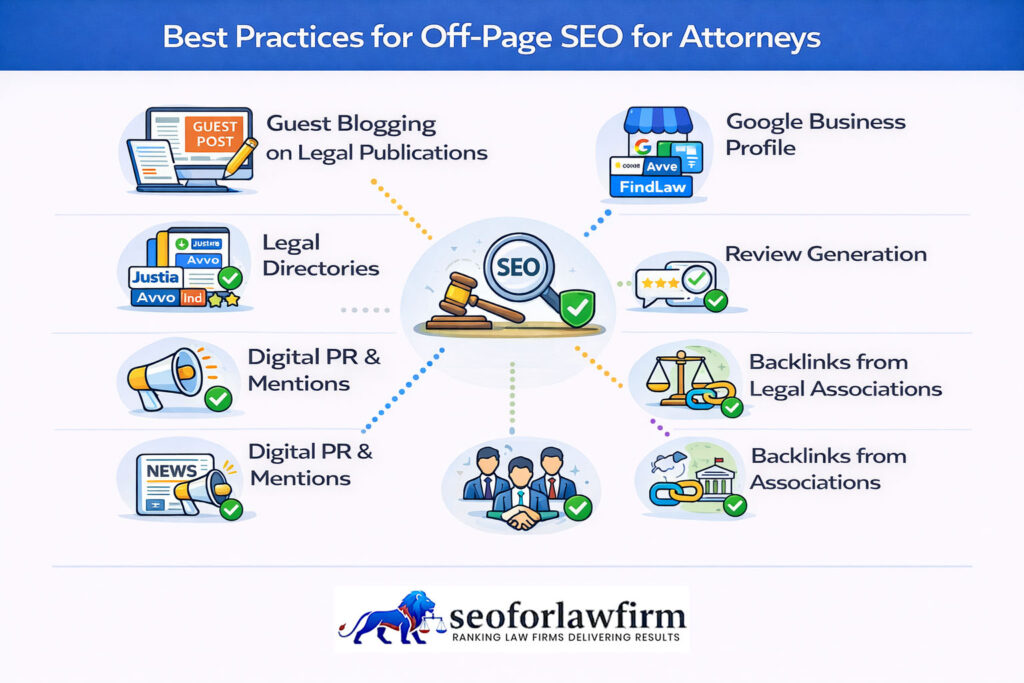
- 1. Editorial Backlinks: Editorial backlinks occur when independent publishers link to a law firm’s legal resources, research, tools, or attorney commentary. Links from relevant legal, government, academic, news, and local sources strengthen external authority.
- 2. Legal-Directory Profiles: Legal-directory profiles display the firm’s attorneys, practice areas, credentials, office locations, reviews, and contact information. Each profile must contain accurate information that matches the law firm’s website and professional records.
- 3. Bar-Association Listings: Bar-association listings confirm an attorney’s licensing status, jurisdiction, membership, and professional identity. The attorney’s name, firm association, office location, and credentials must remain consistent across bar records and website biographies.
- 4. Google Business Profile: Google Business Profile presents the law firm’s office information across Google Search and Maps. The profile must contain the genuine business name, verified address, phone number, categories, services, hours, photographs, website, and reviews.
- 5. Client Reviews: Client reviews describe experiences involving communication, responsiveness, professionalism, and service. Law firms must request honest reviews without incentives, rating instructions, review gating, pressure, or disclosure of confidential information.
- 6. Local Citations: Local citations display the law firm’s name, address, phone number, website, and business details across directories, maps, and professional platforms. Former addresses, duplicate listings, disconnected numbers, and inconsistent firm names require correction.
- 7. Media Coverage: Media coverage occurs when an independent publisher references a law firm, attorney, research project, legal opinion, or community activity. Relevant coverage connects the attorney or firm with a legal subject, jurisdiction, event, or public issue.
- 8. Expert Commentary: Expert commentary provides accurate legal explanations to journalists, organizations, publishers, and the public. Strong commentary includes a direct answer, jurisdictional context, practical meaning, clear limitations, and timely delivery.
- 9. Community Partnerships: Community partnerships connect law firms with nonprofits, legal-aid groups, educational programs, safety initiatives, and local organizations. The relationship must involve genuine participation, public education, volunteer work, research, or financial support.
- 10. Professional Memberships: Professional memberships connect attorneys with bar sections, legal associations, practice-area organizations, and local business groups. Membership profiles must identify the attorney, firm, jurisdiction, position, and professional participation accurately.
- 11. Podcast and Webinar Appearances: Podcast and webinar appearances allow attorneys to discuss legal rules, procedures, evidence, and recent developments. Episode pages, speaker profiles, transcripts, and descriptions must identify the attorney and subject accurately.
- 12. Brand Mentions: Brand mentions occur when external sources reference a law firm or attorney without providing a direct website link. Consistent mentions across reputable sources confirm the firm’s identity, location, legal services, and public relevance.
1. Editorial Backlinks
Editorial backlinks occur when an independent publisher references a law firm’s article, attorney commentary, research, calculator, legal guide, or community activity. A link-building strategy for lawyers connects these references with legitimate legal expertise, original research, professional relationships, and public education.
2. Legal-Directory Profiles
Legal-directory profiles identify the law firm, attorneys, practice areas, credentials, office locations, and contact information. Reputable profiles must contain accurate business data without unsupported ratings, awards, services, or professional claims.
3. Bar-Association Listings
Bar-association listings confirm attorney membership, licensing status, jurisdiction, and professional identity. Each listing must match the attorney biography, law firm name, office association, and credentials displayed on the firm’s website.
4. Google Business Profile
Google Business Profile identifies the law firm across Google Search and Maps through the firm name, office address, phone number, website, categories, services, hours, photographs, and reviews. A local SEO strategy for law firms connects the verified profile with the corresponding office page, attorneys, legal services, client reviews, and geographic market.
5. Client Reviews
Client reviews provide independent accounts of communication, responsiveness, service, and client experience. Law firms must request honest reviews without incentives, five-star instructions, review gating, pressure, or disclosure of confidential case information.
6. Local Citations
Local citations reference the law firm’s name, address, phone number, website, attorneys, and services across legal, professional, map, and business platforms. A NAP consistency audit for law firms identifies former addresses, disconnected phone numbers, duplicate profiles, outdated firm names, and incorrect attorney associations.
7. Media Coverage
Media coverage occurs when a news publisher independently references the law firm, attorney, research, case commentary, or public activity. Earned coverage strengthens attorney recognition when the publisher connects the attorney with a relevant legal issue, jurisdiction, or professional role.
8. Expert Commentary
Expert commentary provides journalists, publishers, organizations, and audiences with accurate legal explanations from a named attorney. Strong commentary includes a direct answer, jurisdictional context, accurate terminology, practical meaning, clear limitations, a concise quotation, and a timely response.
9. Community Partnerships
Community partnerships connect the law firm with nonprofit groups, legal-aid organizations, educational programs, safety campaigns, business organizations, and public-service initiatives. The relationship must involve genuine participation, financial support, legal education, research, or volunteer work rather than payment made only for a backlink.
10. Professional Memberships
Professional memberships connect attorneys with bar sections, legal associations, practice-area organizations, chambers of commerce, and industry groups. Membership profiles must identify the attorney, firm, jurisdiction, position, committee work, and professional participation accurately.
11. Podcast and Webinar Appearances
Podcast and webinar appearances allow attorneys to explain legal issues, procedures, statutory changes, evidence, and client decisions through audio or video. The host page, episode description, speaker biography, transcript, and related links must identify the attorney and legal subject accurately.
12. Brand Mentions
Brand mentions occur when external sources reference the law firm or attorney without linking directly to the website. Consistent mentions across news publications, directories, professional profiles, universities, community organizations, and legal resources confirm the firm’s identity, services, location, and public relevance.
Why Do Law Firms Need Both On-Page and Off-Page SEO?
Law firms need both on-page and off-page SEO because relevance without authority lacks external support, and authority without useful pages gives search systems and prospective clients a weak destination.
A personal injury page needs accurate information about liability, evidence, deadlines, insurance, damages, attorney experience, and the consultation process. That page represents the on-page foundation.
The same firm gains stronger corroboration through state bar profiles, legal directories, news commentary, local links, verified reviews, and professional references. Those assets represent the off-page foundation.
Listed below are the 8 reasons why on-page and off-page SEO matter for a law firm.
- A law firm publishes a useful legal page.
- Internal links connect the page with related services and attorney profiles.
- Search systems crawl and index the page.
- External publishers reference the page or attorney.
- Reviews and citations corroborate the firm’s identity and reputation.
- Stronger visibility sends qualified visitors to the page.
- The page converts eligible visitors through calls, forms, or appointments.
- Intake data identifies which visibility produced retained matters.
On-page SEO and off-page SEO operate as connected acquisition inputs rather than competing alternatives.

Does On-Page SEO Affect Law Firm Rankings More Than Off-Page SEO?
No, no verified universal percentage proves that on-page SEO affects law firm rankings more than off-page SEO or that off-page SEO controls a fixed share of legal rankings. Search performance changes according to the query, location, competition, page quality, website history, user intent, result type, and the website’s current constraints. A law firm must address crawling and indexing failures first, correct page-quality and conversion problems second, and build external authority around pages that provide accurate and useful legal information.
Listed below are the 3 conditions that determine whether on-page, off-page, or technical SEO receives priority.
- On-Page SEO Receives Priority: On-page SEO requires attention when the website lacks practice-area pages, targets unrelated search intents on one URL, uses duplicate titles or headings, publishes inaccurate or generic legal content, omits internal links, presents weak attorney biographies, repeats location-page copy, uses ineffective calls or forms, or publishes structured data that conflicts with visible content. These defects prevent search systems and prospective clients from identifying the page topic, legal service, attorney, jurisdiction, and next action.
- Off-Page SEO Receives Priority: Off-page SEO requires attention when strong pages lack external references, competitors have stronger referring-domain profiles, bar and directory records remain incomplete, the Google Business Profile lacks reviews, the firm has limited professional recognition, media mentions remain unlinked, business information conflicts across platforms, or the firm lacks relationships with relevant organizations. Editorial links, citations, reviews, professional profiles, media references, and community relationships confirm the firm’s authority beyond its own website.
- Technical SEO Receives Priority: Technical SEO requires attention when search engines cannot crawl or index important pages, redirects block access, canonical tags identify incorrect URLs, mobile pages fail, forms do not submit, poor performance obstructs use, a migration removes rankings, or duplicate URLs divide search signals. Technical defects restrict page discovery, indexation, usability, and conversion before content or authority work produces its intended effect.
Sequence matters more than an unsupported weighting percentage. A law firm must remove access barriers, correct content and conversion weaknesses, and then develop external authority around pages that deserve recognition.

How Do Lawyers Balance On-Page and Off-Page SEO?
Lawyers balance on-page and off-page SEO through a coordinated production cycle that pairs each priority page with accurate content, internal support, external corroboration, and conversion measurement. On-page SEO prepares the website asset, off-page SEO confirms the asset through independent sources, and analytics connects both activities with qualified inquiries and retained matters.
Listed below are 6 actions for balancing on-page and off-page SEO.
- Prioritize Pages by Business Value: Law firms select pages according to case value, client demand, geographic market, attorney capacity, and existing search opportunity. Priority pages include main practice areas, high-value sub-practices, genuine office locations, attorney biographies, high-intent legal questions, and consultation pages.
- Complete the On-Page Asset First: Each priority page requires accurate legal information, descriptive headings, relevant entities, internal links, attorney attribution, useful media, and a working contact path before external promotion begins. A weak or incomplete page provides external publishers and prospective clients with little reason to reference, trust, or use the resource.
- Match Off-Page Support to the Page Type: Office pages align with chamber listings, local directories, regional media, and community organizations, while attorney biographies align with bar profiles, conference pages, publications, podcasts, and professional associations. Practice-area pages align with legal publications and expert quotations, original research aligns with news or academic references, and local guides align with courts, nonprofits, local publishers, and regional media.
- Promote Original Information: Outreach performs better when the page contains material that another publisher can reference. Useful assets include county filing guides, state deadline charts, court-process diagrams, surveys, local accident data, evidence checklists, legal calculators, legislative analysis, and public-record research.
- Maintain Accurate Business Records: Directory, bar, map, and professional-profile information requires recurring review after office moves, rebrands, attorney departures, phone-number changes, or mergers. Accurate records preserve consistent relationships among the law firm, attorneys, offices, services, credentials, and geographic markets.
- Measure Shared Outcomes: On-page and off-page activities support the same client journey because backlinks direct visitors to website pages, reviews lead searchers to firm profiles, and useful articles attract media references. Attribution must record rankings, referral visits, assisted conversions, qualified inquiries, consultations, retained matters, and revenue without forcing every result into one channel.
What Are the Most Common On-Page SEO Mistakes?
The most common on-page SEO mistakes for law firms include keyword stuffing, duplicate city pages, thin practice-area content, unsupported promotional claims, missing internal relationships, inaccurate structured data, misuse of meta descriptions, and weak conversion design. These mistakes reduce legal clarity, local relevance, search visibility, user trust, and the page’s ability to generate qualified inquiries.
Listed below are 8 on-page SEO mistakes law firms need to avoid.
- Keyword Stuffing: Keyword stuffing repeats attorney, practice-area, and location terms without adding useful meaning. Law firms must replace repetitive phrases with clear explanations of legal services, case types, procedures, evidence, and client needs.
- Duplicate City Pages: Duplicate city pages replace one location name with another while retaining nearly identical content. Each location page needs distinct office, attorney, court, procedural, jurisdictional, service, and community information.
- Thin Practice-Area Content: Thin pages list legal services without explaining eligibility, applicable law, evidence, procedures, deadlines, risks, fees, or possible outcomes. A complete practice-area page must answer the questions a prospective client needs to evaluate the legal issue and the firm’s service.
- Unsupported Promotional Claims: Statements such as “best attorney,” “guaranteed results,” “specialist,” or “highest-rated firm” require objective evidence and advertising-rule review. ABA Model Rule 7.1 prohibits false or misleading communications that create unsupported conclusions about a lawyer or legal service.
- Missing Internal Relationships: Orphan pages receive no contextual internal links from related practice areas, attorney biographies, office pages, or legal resources. Internal links show users and search systems how each page relates to the firm’s services, locations, attorneys, and content structure.
- Inaccurate Structured Data: Structured data must match accurate information visible on the page. Fake ratings, hidden reviews, false offices, incorrect hours, inflated service areas, and unsupported credentials create misleading markup.
- Treating Meta Descriptions as Ranking Text: Meta descriptions summarize the page and support search-result messaging rather than provide a confirmed direct ranking advantage. Repeating keywords in a description weakens readability without establishing additional relevance.
- Weak Conversion Design: Pages lose qualified inquiries through hidden phone numbers, long forms, missing office information, unclear consultation terms, slow responses, and generic calls to action. Conversion elements must provide visible contact options, short intake paths, service-specific instructions, and clear response expectations.
What Are the Most Common Off-Page SEO Mistakes?
The most common off-page SEO mistakes include buying manipulative links, using artificial link networks, and treating third-party authority metrics as Google ranking scores. These practices create link-spam risk, citation conflicts, weak referral value, platform-policy violations, and unreliable performance reporting.
Listed below are 7 off-page SEO mistakes law firms must avoid.
- Buying Ranking Links: Buying links primarily to manipulate search rankings creates link-spam risk. Paid placements require appropriate qualification, while large-scale schemes expose the website to link devaluation or manual action.
- Using Link Farms and Private Networks: Link farms and private blog networks create artificial placement patterns, irrelevant anchor text, weak editorial standards, and limited referral value. Law firms must earn links through legitimate legal resources, research, commentary, professional relationships, and community participation.
- Assuming Every .gov or .edu Link Carries Exceptional Value: Government and university links do not receive automatic value solely because of their domain extensions. A relevant reference provides value through source quality, editorial context, topical connection, and usefulness to readers.
- Creating Fake or Incentivized Reviews: Fake reviews, paid reviews, gifts, discounts, and rating instructions violate platform policies and weaken client trust. Law firms also face advertising and confidentiality risks when soliciting, publishing, or responding to reviews.
- Building Low-Value Citations at Scale: Hundreds of obscure directory listings do not replace accurate profiles on bar, legal, local, map, and established business platforms. Citation building must prioritize legitimacy, relevance, visibility, moderation quality, and consistent business information.
- Over-Optimizing Backlink Anchors: Repeated exact-match commercial anchors create an artificial link pattern and increase manipulation risk. A natural backlink profile contains firm names, attorney names, URLs, page titles, topical phrases, and contextually selected wording.
- Treating Domain Authority as a Google Score: Domain Authority, Domain Rating, Authority Score, and similar metrics are proprietary measurements created by third-party SEO tools. Law firms must evaluate links through relevance, editorial quality, referral potential, source credibility, and business outcomes rather than relying on one authority score.
What Are the Best On-Page SEO Practices for Legal Websites?
The best on-page SEO practices for legal websites are assigning one primary intent to each page, keeping structured data accurate, and designing for the next client action.
Listed below are 8 on-page SEO practices for legal websites.
- Assign One Primary Intent to Each Page: Each page must address one central legal service, question, or client need. Related subtopics must support the primary intent without shifting the page toward unrelated services or queries.
- Answer the Main Question First: The opening paragraph must provide the direct legal answer, service definition, deadline, or procedural rule. Later paragraphs must explain jurisdiction, exceptions, evidence, examples, risks, and attorney analysis.
- Use Jurisdiction-Specific Information: Legal pages must identify the applicable state law, local courts, filing locations, deadlines, agencies, and procedural differences. A study by Margaret Hagan and Yue Li, titled Legal Help Search Audit: Are Search Engines Effective Brokers of Legal Information? in 2020, states that commercial search engines frequently return systemic jurisdictional mismatches in public legal search results, demonstrating a critical deficit in geographic precision. By auditing search queries related to urgent civil legal crises, the researchers proved that users are routinely served out-of-state or generic legal guides that fail to address local court protocols.
- Identify the Attorney Author or Reviewer: Each substantive legal page must display a named author or attorney reviewer with relevant qualifications. The page must include the attorney’s bar jurisdiction, practice focus, biography link, and substantive review date.
- Add Concrete Legal Experience: Useful experience includes common evidence problems, procedural errors, insurer tactics, court expectations, client-preparation steps, document requirements, attorney observations, and anonymized case examples. Specific operational insight demonstrates legal experience more clearly than generic claims about skill or dedication.
- Use Descriptive Internal Anchors: Internal-link anchor text must identify the destination accurately and explain its relationship to the current topic. Natural anchors help users and search systems connect practice areas, attorney biographies, office pages, legal guides, evidence resources, and consultation pages.
- Keep Structured Data Accurate: Structured data must describe visible and verifiable information about the law firm, attorneys, offices, services, articles, and page relationships. The firm must validate the markup before deployment and update it after changes to credentials, locations, services, or business information.
- Design for the Next Client Action: Each page must present the appropriate phone number, consultation form, booking option, office location, attorney contact, and response expectation. The conversion path must match the legal service, search intent, urgency, and stage of the client decision process.
What Are the Best Off-Page SEO Practices for Attorneys?
The best off-page SEO practices for attorneys are earning editorial references, maintaining accurate professional profiles, participating in genuine community activities, and auditing backlink quality.
Listed below are 7 off-page SEO practices for attorneys.
- Earn Editorial References: Attorneys must publish legal resources, original research, practical tools, and expert analysis that independent publishers choose to reference. Relevant links from legal, government, academic, media, professional, and local sources strengthen external authority.
- Maintain Bar and Legal-Directory Profiles: Attorneys must keep names, licenses, biographies, practice areas, office information, credentials, and website destinations accurate across bar associations and reputable legal directories. Consistent profiles help confirm the relationship among the attorney, law firm, jurisdiction, service, and office.
- Build a Neutral Review Process: Law firms must ask every eligible client for honest feedback without incentives, review gating, pressure, or rating instructions. Review requests and public responses must protect client confidentiality and comply with platform and attorney-advertising rules.
- Provide Timely Media Commentary: Attorneys must create source profiles that identify practice areas, jurisdictions, credentials, availability, and media experience. Direct answers, accurate terminology, practical explanations, clear limitations, and timely responses increase the likelihood of legitimate media references.
- Reclaim Unlinked References: Law firms must identify external pages that mention the firm, attorney, research, event, or legal commentary without linking to a relevant website resource. A link request remains appropriate when the destination gives readers useful supporting information.
- Participate in Genuine Community Activity: Attorneys must contribute to bar programs, legal education, nonprofit initiatives, chambers of commerce, universities, pro bono clinics, and local events through documented participation. Genuine relationships create stronger authority signals than sponsorships arranged solely to obtain links.
- Audit Backlink Quality: Law firms must review each referring source for topical relevance, editorial placement, traffic potential, destination, anchor text, acquisition method, and spam risk. Backlink audits help identify valuable references, broken links, suspicious placements, and opportunities for stronger external authority.
Are There On-Page and Off-Page SEO Considerations for Houston Lawyers?
Yes, Houston lawyers need on-page and off-page SEO strategies that reflect the city’s large metropolitan market, competitive practice areas, and location-dependent search results. On-page priorities include creating separate service pages for genuine practice distinctions such as car accidents, commercial truck collisions, industrial incidents, maritime injuries, premises liability, and wrongful death; distinguishing Houston, Harris County, surrounding counties, suburbs, courts, and legitimate office locations without implying offices where none exist; and incorporating relevant Texas statutes, filing deadlines, comparative-responsibility rules, courts, agencies, and procedures.
Off-page SEO priorities include earning references from Houston bar groups, chambers of commerce, universities, industry associations, nonprofit organizations, and regional publications; maintaining accurate office pages, phone numbers, directory records, attorney associations, business profiles, and structured-data entities for each legitimate location; and developing regional media relationships through informed attorney commentary on Texas legislation, court developments, workplace disputes, accidents, energy matters, immigration issues, and other practice-specific subjects.
Are There On-Page and Off-Page SEO Considerations for Los Angeles Lawyers?
Yes, Los Angeles lawyers need on-page and off-page SEO strategies that distinguish the City of Los Angeles, courts, offices, languages, and practice-specific markets. On-page SEO must assign each geographic term to the correct page because Los Angeles, Beverly Hills, Santa Monica, Pasadena, Long Beach, Glendale, and surrounding municipalities represent distinct geographic entities that require genuine service relevance and original local information. Each legal page must also explain applicable California statutes, agencies, filing deadlines, courts, and procedural rules. Multilingual pages must use professional translation, preserve equivalent legal meaning, implement hreflang correctly, and provide the same information and service quality available on English-language pages.
Off-page SEO must build references from regional bar associations, universities, legal nonprofits, local business organizations, ethnic media, community groups, and reputable publications. Each eligible office must maintain a separate business record, location page, phone number, Google Business Profile, attorney association, and structured-data entity. Los Angeles law firms must also develop attorney-specific authority through professional publications, media commentary, conference biographies, bar committees, podcasts, and public legal education that connect named attorneys with defined practice areas and California jurisdictions.
How Do Law Firms Measure ROI From On-Page and Off-Page SEO?
Law firms measure ROI from on-page and off-page SEO by connecting page changes, external authority work, retained matters, costs, and collected revenue. A complete system to track law firm SEO results measures qualified leads and retained cases because on-page and off-page contributions interact across the client journey and rarely support accurate single-channel attribution.
The table below shows the measurements used to evaluate on-page and off-page SEO performance.
| Measurement | On-Page Application | Off-Page Application |
| Search Impressions | Measures page relevance and visibility after content, title, heading, entity, and internal-link changes | Measures visibility gained after backlinks, citations, reviews, media coverage, and authority growth |
| Organic Clicks | Measures title-link, snippet, ranking, and search-intent performance | Measures ranking support and branded demand influenced by external recognition |
| Indexed Pages | Measures page quality, internal discoverability, canonicalization, and technical access | Measures whether external links and references help search systems discover important URLs |
| Referring Domains | Measures whether useful destination pages attract independent references | Measures editorial outreach, digital public relations, directory placement, and link acquisition |
| Referral Visits | Measures page usability and conversion after visitors arrive from another website | Measures traffic produced by publishers, directories, associations, media outlets, and community partners |
| Phone Calls | Measures landing-page messaging, mobile usability, click-to-call placement, and conversion design | Measures calls influenced by reviews, profiles, citations, media mentions, and referral sources |
| Form Submissions | Measures form visibility, field length, page relevance, and submission performance | Measures assisted visits originating from external links, profiles, and brand references |
| Consultations | Measures page qualification, service clarity, intake instructions, and conversion quality | Measures the influence of reputation, reviews, media coverage, directories, and professional recognition |
| Retained Cases | Measures practice-page performance, intake quality, and conversion into signed matters | Measures external authority, trust, referrals, and third-party validation that influenced the hiring decision |
| Revenue | Measures the business value attributed to landing pages, content clusters, and conversion improvements | Measures assisted acquisition value from backlinks, reviews, citations, media coverage, and brand demand |
Listed below are the 7 steps used to measure SEO ROI.
- Establish Tracking Before Implementation: Configure analytics, Google Search Console, call tracking, form events, CRM source fields, and intake classifications before SEO changes begin.
- Record Change Dates: Document content updates, title changes, heading revisions, internal links, new backlinks, directory corrections, review activity, and media placements.
- Classify Leads: Separate qualified prospects from existing clients, vendors, job applicants, spam, wrong numbers, out-of-jurisdiction inquiries, and requests for services the firm does not provide.
- Track Consultations: Record consultation booking, attendance, qualification, attorney assignment, legal service, location, and outcome.
- Track Retained Matters: Connect each signed engagement with the source, landing page, external referral, campaign, consultation, and intake record.
- Measure SEO Investment: Include content production, development, software, agency fees, outreach, public relations, staff time, citation management, and profile maintenance.
- Calculate SEO Return: Apply the formula SEO ROI = ((Gross profit attributed to SEO − SEO investment) ÷ SEO investment) × 100.
SEO reports must present rankings and traffic alongside qualified leads, consultations, retained matters, acquisition costs, case value, gross profit, and revenue.
A complete system to track law firm SEO results reports qualified leads and retained matters rather than ranking movement alone.
Where Do Law Firms Get Professional On-Page and Off-Page SEO Services?
SEOForLawFirm is a specialized legal SEO provider that helps law firms improve on-page content, technical performance, local visibility, external authority, conversion paths, and performance measurement. Law firms also obtain professional on-page and off-page SEO services from in-house marketing teams, specialist consultants, content teams, digital public relations firms, technical agencies, and local-search providers. Specialized legal SEO agencies provide practice-area strategy, technical audits, attorney-reviewed content, local SEO, editorial link acquisition, reporting, and conversion support. In-house teams provide direct access to attorneys, firm data, intake operations, and brand standards but require outside expertise or additional production capacity.
Specialist consultants address defined needs such as technical SEO, content strategy, backlink analysis, local profiles, analytics, or reputation management. Hybrid teams assign legal knowledge and approval to the law firm, strategy and production to SEOForLawFirm or another agency, and technical deployment to internal or external developers. Outsourcing does not automatically produce higher rankings or more retained cases because results depend on expertise, execution, competition, budget, attorney participation, website condition, and intake performance.
What Questions Should Law Firms Ask an SEO Provider?
Law firms need to ask SEO providers about methods, ownership, evidence, compliance, deliverables, link acquisition, review practices, reporting, and termination.
Listed below are 10 questions law firms need to ask SEO providers.
- Which legal practice areas and markets has the provider served?
- Who researches, writes, edits, and legally reviews each page?
- Which on-page changes form part of the engagement?
- Which technical changes form part of the engagement?
- How does the provider acquire backlinks?
- Does the provider pay publishers for followed links?
- How does the provider request and manage reviews?
- Which assets remain the law firm’s property?
- Which metrics connect SEO with retained matters?
- What happens to content, profiles, phone numbers, data, and access after termination?
Guaranteed rankings, secret link networks, fake reviews, rented websites, nonportable tracking numbers, and vague reporting represent warning signs.
How Will Google Algorithm Changes Affect On-Page and Off-Page SEO?
Google algorithm changes will reward original legal content, accurate entity information, and business-outcome measurement while reducing the value of scaled content, manipulative links, and misleading markup.
Durable on-page and off-page SEO practices focus on useful information, factual accuracy, independent corroboration, technical accessibility, and a clear connection between search visibility and retained legal matters.
Listed below are 7 ways Google algorithm changes will affect on-page and off-page SEO.
- On-Page Content Requires Original Value: Legal pages need first-hand attorney insight, jurisdiction-specific information, direct answers, named reviewers, practical procedures, and material absent from generic competing pages. Scaled pages that repeat common definitions without new evidence or analysis provide less search value.
- Structured Data Requires Factual Alignment: Schema markup must match visible content, genuine offices, verified attorneys, accurate services, and valid entity relationships. Structured data does not compensate for weak content, false business information, or unsupported professional claims.
- Links Require an Editorial Purpose: Strong backlinks result from legal resources, original research, expert commentary, public education, professional relationships, and community participation. Paid, exchanged, automated, or coordinated ranking links create devaluation and policy risks.
- Attorney Claims Require Verification: Bar admissions, credentials, awards, memberships, case results, client reviews, specialization claims, and comparative statements require factual evidence and ethics review. Unsupported claims weaken trust and create attorney-advertising risks.
- Local Signals Require Real-World Accuracy: Google Business Profile information, office pages, citations, reviews, phone numbers, attorney associations, and operating hours must represent the actual law practice. Fake offices, duplicate profiles, keyword-stuffed names, and conflicting business records weaken local visibility.
- AI Search Increases Entity and Citation Demands: AI-supported search systems retrieve information from indexed pages and external references. Named attorneys, consistent credentials, original data, direct answers, authoritative citations, and independent mentions strengthen the retrievable relationship among the attorney, firm, legal service, jurisdiction, and office.
- Measurement Requires Business Outcomes: Search visibility now spans organic listings, Maps, AI answers, videos, legal directories, and branded searches. Law firms must measure qualified inquiries, consultations, retained cases, acquisition costs, case value, gross profit, and attributed revenue alongside rankings and traffic.