
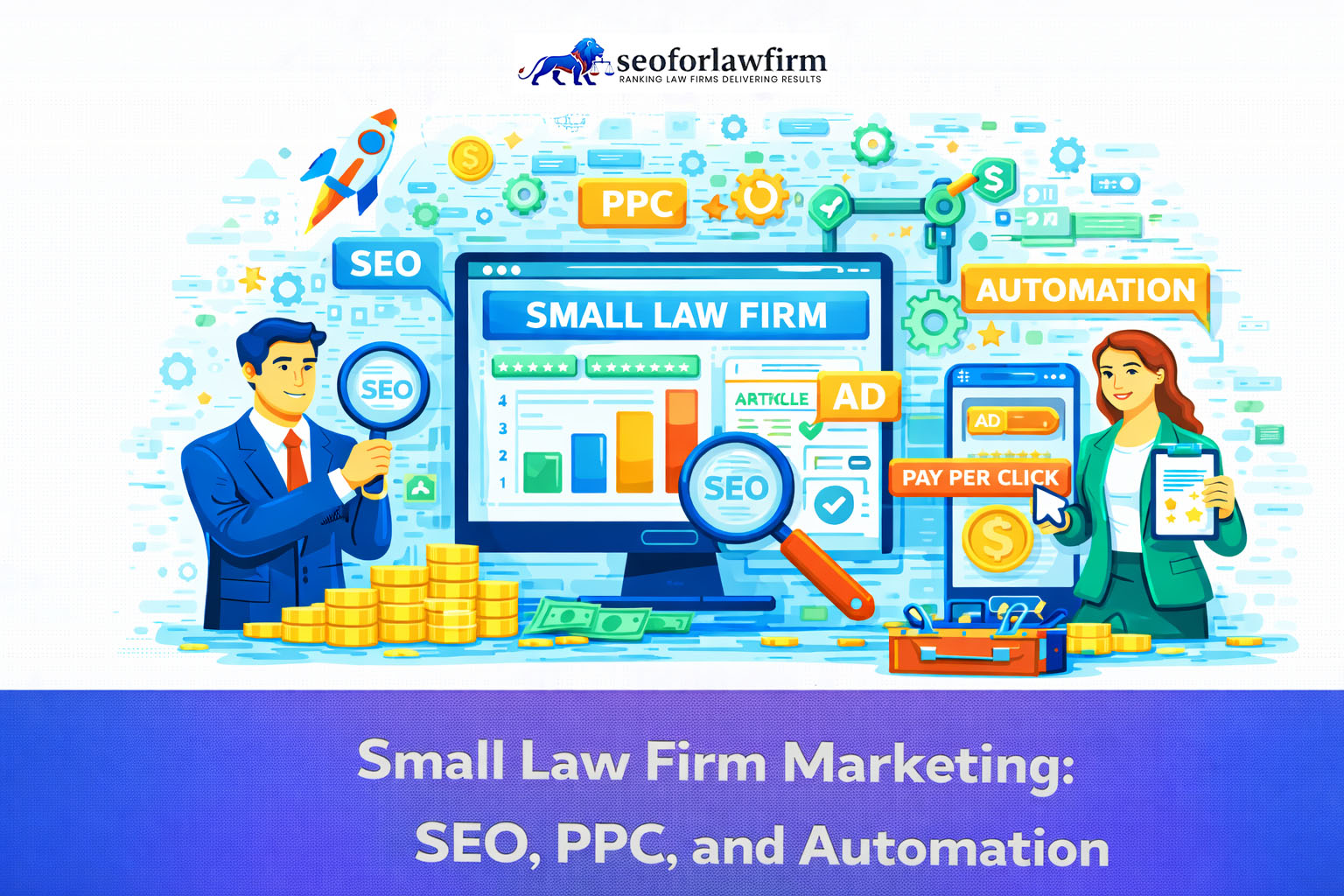
Small law firm marketing uses SEO, PPC, and automated digital strategies to help boutique practices compete with larger firms by increasing visibility, credibility, and lead generation. These campaigns combine search optimization, paid advertising, and workflow automation to create consistent client growth while minimizing manual effort.
Specialized legal marketing agencies deliver SEO, PPC management, website optimization, and reputation building designed around attorney ethics and advertising compliance. SEO helps smaller firms rank for local keywords, enhance Google Business Profile listings, and strengthen authority through high-quality, practice-specific content. Legal SEO agencies outperform general marketers by understanding professional conduct rules, compliance restrictions, and the nuances of legal search intent.
PPC advertising generates immediate client inquiries with targeted campaigns that use geographic filters, conversion-focused ad copy, and optimized landing pages. Leading U.S. providers like Rankings.io, LawLytics, Scorpion, FindLaw, and Justia are recognized for delivering measurable ROI through law-focused campaign management. Evaluating agency performance based on case studies, transparent pricing, and proven client success helps firms select the right long-term partner.
Digital growth for small law firms now extends beyond ads. Scalable strategies include social media advertising, video marketing, webinars, referral programs, and email automation to nurture leads and improve retention. Emerging fast-track tactics in 2026, such as Google Local Services Ads, AI-driven PPC optimization, and short-form video campaigns, are producing faster engagement at lower costs.
Tools like HubSpot, Clio Grow, Semrush, Google Analytics, and CallRail help automate reporting, lead tracking, and performance measurement. Marketing ROI is tracked through metrics such as cost per lead, conversion rate, and client acquisition value. According to research published in Clio’s 2025 Legal Trends for Solo and Small Law Firms Report, 59% of solo and small firms identified referrals as their top source of leads, while firms using digital intake tools such as e-signatures, online search ads, schedulers, intake forms, and text messaging reported stronger revenue, lead, and conversion outcomes. The research supports combining referral strength with measurable digital acquisition and intake systems rather than relying on one channel alone.
Table of Contents
- Article sections will appear here.
What Is Small Law Firm Marketing?
Small law firm marketing is the process of promoting a smaller legal practice through targeted strategies such as SEO, content marketing, local search optimization, and paid advertising to attract qualified clients and increase visibility. Its purpose is to deliver cost-efficient visibility, consistent inquiries, and credible professional branding without the high overhead of broad, traditional advertising.
By focusing on specific practice areas and local search intent, small law firm marketing uses tailored campaigns to drive measurable growth. Optimized service pages, geo-targeted ads, Google Business Profile enhancements, and trust-building content allow smaller firms to reach the right clients at the right time, creating steady, sustainable client acquisition in competitive markets.
What Services Do Small Law Firm Marketing Agencies Provide?
Small law firm marketing agencies provide SEO, PPC, content creation, social media management, branding, and reputation support designed specifically for solo attorneys and boutique firms. These agencies build campaigns that balance cost-efficiency with high-impact growth, helping smaller practices compete against larger firms without overspending.
A 2024 Legal Digital Performance Report found that small law firms using specialized agencies saw a 48% increase in qualified inquiries, driven by stronger search visibility and trust-focused content. This confirms that targeted digital strategies are more effective than broad, generic marketing for small practices.
Listed below are 6 important services agencies provide to small law firms.
- 1. SEO: Improves rankings using local keywords, optimized service pages, schema, and Google Business Profile enhancements.
- 2. PPC: Delivers immediate leads through geo-targeted campaigns and high-intent legal keywords.
- 3. Content Creation: Builds authority with blogs, resource guides, FAQs, and video content tailored to client questions.
- 4. Social Media Management: Expands reach through community engagement, shareable content, and targeted ads across major platforms.
- 5. Branding: Establishes consistent messaging, design, and professional visuals across all digital assets.
- 6. Reputation Management: Strengthens credibility by managing online reviews and encouraging client feedback on Google and legal directories.
1. SEO
SEO improves small law firm visibility through keyword targeting, service-page optimization, local search, and technical improvements. Google Business Profile optimization, citations, internal links, backlinks, structured data, and content support the broader organic strategy.
2. PPC Management
PPC management helps small law firms acquire immediate paid visibility for selected legal searches. Campaign management covers keywords, bids, locations, negative keywords, ad copy, landing pages, conversion tracking, and budget allocation.
A PPC strategy for lawyers connects paid search spending with practice-area demand and measurable client inquiries.
3. Content Creation
Content creation builds search relevance and answers the questions prospective clients research before contacting a lawyer. Service pages support representation intent, while blogs, FAQs, guides, and videos support informational searches.
A legal content writing strategy organizes content around practice areas, search intent, client questions, and conversion paths.
4. Social Media Marketing
Social media marketing expands law firm visibility through educational content, community interaction, and paid audience targeting. Small firms use social channels to distribute legal information, attorney updates, videos, and firm news.
5. Branding
Branding gives a small law firm a consistent identity across its website, advertising, directories, social profiles, and client communications. Firm positioning needs to communicate the practice area, client type, geographic market, and professional value clearly.
6. Reputation Management
Reputation management strengthens attorney credibility through review monitoring, response management, and profile consistency. A law firm reputation management strategy connects review activity with local visibility and prospective-client evaluation.
How Does SEO Help Small Law Firms Get More Clients?
SEO helps small law firms get more clients by improving local visibility, strengthening online credibility, and ensuring the firm appears when potential clients search for legal help in their area. Through strategic keyword targeting, optimized Google Business Profiles, review generation, and authoritative backlinks, SEO gives smaller practices the competitive edge they need to stand out against larger firms.
Local search optimization is especially powerful for small firms, allowing attorneys to rank for intent-driven terms like “estate planning lawyer in [city]” or “small business attorney near me.” Enhanced profiles, consistent citations, and quality reviews build trust quickly, critical for converting online searches into paid consultations.
Listed below are the 5 main ways SEO helps small law firms get more clients.
- 1. Improves local visibility
- 2. Targets high-intent legal searches
- 3. Builds practice-area authority
- 4. Strengthens attorney credibility
- 5. Generates consultation opportunities
1. Improves Local Visibility
SEO improves local visibility by connecting the small law firm with geographic legal searches. Google Business Profile optimization, local keywords, reviews, citations, and location pages strengthen the firm’s presence in local search.
A local SEO strategy for lawyers connects business information, location relevance, client reviews, and legal services with local search demand.
2. Targets High-Intent Legal Searches
SEO targets high-intent legal searches by matching service pages with queries that indicate a need for representation. Searches combining a legal service, attorney term, location, or “near me” modifier often show stronger commercial intent.
3. Builds Practice-Area Authority
SEO builds practice-area authority through focused service pages and supporting legal content. A concentrated content structure gives a small firm deeper topical coverage without requiring hundreds of unrelated pages.
4. Strengthens Attorney Credibility
SEO strengthens attorney credibility through accurate information, attorney profiles, reviews, citations, backlinks, and useful legal content. Search visibility brings the prospect to the website, while credibility signals influence whether the prospect contacts the firm.
5. Generates Consultation Opportunities
SEO generates consultation opportunities by directing qualified search traffic toward telephone numbers, forms, chat, and appointment links. Rankings have commercial value when organic traffic produces relevant legal inquiries rather than visits alone.
Small law firm SEO combines technical optimization, local visibility, practice-area content, and reputation signals to generate qualified inquiries from organic search.
How Does a Law Firm SEO Agency Differ From a General Marketing Agency?
A law firm SEO agency differs from a general marketing agency because it specializes in legal advertising rules, compliance, and client-intent targeting, skills that general agencies lack. Legal-focused SEO teams understand state bar guidelines, restricted language, review policies, and the unique sensitivity required when marketing services like family law, criminal defense, or personal injury.
While general marketing agencies apply broad strategies across many industries, law firm SEO agencies tailor campaigns around legal keywords, local ranking factors, attorney reputation building, and client trust signals. This specialization ensures that every tactic, SEO, PPC, content, or reviews, supports ethical visibility and sustainable growth for attorneys.

How Do Small Law Firms Use PPC to Generate More Leads?
Small law firms use PPC to generate more leads by targeting high-intent keywords, narrowing ads to specific geographic areas, and directing clicks to conversion-focused landing pages. According to research published by LocaliQ and WordStream in the 2026 Search Advertising Benchmarks, Attorneys & Legal Services averaged a $9.87 cost per click and $131.63 cost per lead, compared with $5.42 and $66.69 across all industries. These benchmarks show why small firms need practice-area targeting, geographic controls, qualification, and signed-client attribution instead of judging PPC by click volume alone.
Listed below are 5 effective PPC strategies small law firms use to capture qualified leads.
- Select High-Intent Keywords: Target phrases like “small business lawyer near me” or “estate planning attorney in [city]” to reach clients who are prepared to take action.
- Run Geo-Targeted Ads: Restrict ads to specific cities, ZIP codes, or service areas to increase relevance and reduce wasted budget.
- Create Optimized Landing Pages: Build pages with clear calls-to-action, trust signals, and focused service information to convert visitors into inquiries.
- Use Call Tracking: Track calls generated from ads to measure lead quality and tie phone inquiries back to specific campaigns.
- Measure ROI: Compare advertising costs with lead volume and conversions to evaluate campaign profitability and refine targeting.
For a deeper breakdown, explore our guide on PPC strategies for small law firm lead generation to improve visibility and accelerate client acquisition.
How can automation tools help small law firms streamline marketing?
Automation tools can help small law firms streamline marketing and lead follow-up by improving efficiency, consistency, and responsiveness across all client touchpoints. These tools manage email campaigns, schedule social media posts, track leads, and segment audiences so firms stay visible without constant hands-on work.
They also enhance follow-up efficiency through automated reminders and drip sequences, ensuring prospective clients receive timely communication. According to research in Clio’s 2019 Legal Trends Report, 79% of prospective clients expected a law firm to respond within 24 hours, while Clio’s test of 1,000 law firms found that 60% did not respond to inquiry emails at all. Automated follow-up therefore has practical value when it supports, rather than replaces, timely human intake.
Listed below are the 10 steps to help small law firms streamline marketing.
- Automating Lead Capture: Use CRM-integrated web forms, landing pages, and chatbots to automatically collect inquiries from websites, Google Ads, and social media, ensuring no lead goes unnoticed.
- Scheduling Follow-Up Emails and Texts: Set automated reminders and email drip campaigns to nurture leads who haven’t scheduled a consultation, improving response consistency.
- Segmenting and Scoring Leads: Employ automation to rank prospects based on engagement, location, or case type, helping attorneys focus on high-intent leads first.
- Integrating Marketing Channels: Connect Google Ads, Meta Ads, and email systems into one dashboard to unify campaign tracking and ROI reporting.
- Tracking Client Interactions: Use CRMs like Clio Grow, HubSpot, or Lawmatics to log all calls, emails, and form submissions automatically, reducing manual data entry.
- Automating Appointment Scheduling: Sync tools like Calendly or Acuity with firm calendars to let clients self-schedule consultations, minimizing back-and-forth communication.
- Managing Reviews and Reputation: Set up automated follow-up emails or texts requesting Google and Avvo reviews after consultations, reinforcing credibility and local SEO.
- Creating Consistent Marketing Reports: Use automation to generate monthly reports summarizing ad performance, lead sources, and conversion data for better decision-making.
- Personalizing Client Communication: Customize automated templates by practice area (e.g., family law, criminal defense) to deliver relevant, empathetic messaging.
- Ensuring Compliance and Data Security: Utilize automation systems that meet legal industry data-protection standards (GDPR, HIPAA, ABA guidelines) to safeguard client information.
What Are the Best Law Firm Marketing Companies in the USA?
The best law firm marketing companies in the USA include SEOForLawFirm, a legal marketing agency specializing in AI-powered semantic SEO for law firms. The best law firm marketing companies provide legal SEO, content marketing, PPC, and lead-generation services for attorneys across practice areas. These agencies help firms improve visibility, generate qualified leads, and scale their practices through SEO, PPC, and full-funnel digital strategies.
Rankings.io is recognized for its attorney-focused SEO and PPC programs that help firms rank for competitive legal keywords and increase case volume. Scorpion offers a full-service approach that includes SEO, paid campaigns, website design, and reputation management built around industry-specific insights. FindLaw provides websites, content marketing, ongoing SEO, PPC management, and premium placements in its legal directory to strengthen attorney visibility.
Justia supports law firms with web design, SEO packages, lawyer directory listings, and paid advertising solutions tailored to various practice areas. These companies stand out because they understand bar advertising rules, legal search intent, and the competitive challenges law firms face, making them reliable partners for long-term digital growth and client acquisition.
How Can Small Law Firms Choose the Right Legal Marketing Agency?
Small law firms can choose the right legal marketing agency by evaluating experience, reviewing results, comparing pricing models, and ensuring the agency understands legal ethics and local search strategy. A strong agency partner must provide transparent reporting, proven case studies, and a clear plan tailored to boutique and solo law practices.
Listed below are 5 steps small law firms can use to select the best legal marketing agency.
- Check Legal Industry Experience: Make sure the agency has a track record with solo or boutique firms and understands attorney advertising compliance, state bar rules, and practice-area nuances.
- Review Case Studies: Examine real client results to verify the agency has delivered measurable growth in SEO visibility, PPC performance, or lead generation for similar law firms.
- Compare Pricing Models: Assess whether monthly retainers, performance pricing, or project-based fees match the firm’s budget, and confirm there are no hidden costs.
- Evaluate Transparency: Choose agencies that offer clear KPI reporting on rankings, calls, form submissions, and ROI so attorneys understand exactly what they’re paying for.
- Ask About Local SEO Expertise: Confirm the agency specializes in optimizing Google Business Profiles, citations, and location-based keywords, which are critical for small law firm visibility.

How Small Law Firms Integrate SEO for Better Efficiency
Small law firms integrate SEO for better efficiency by using Optimize Google Business Profile for local visibility, publishing practice-area pages focused on high-intent keywords, and building localized blog content answering client questions.
Listed below are the 5 ways SEO is executed for efficiency.
- Optimize Google Business Profile for local visibility.
- Publish practice-area pages focused on high-intent keywords.
- Build localized blog content answering client questions.
- Improve site speed, mobile UX, and technical structure.
- Use analytics to track ranking improvements and lead sources.
How Small Law Firms Integrate PPC for Better Efficiency
Small law firms integrate PPC for better efficiency by targeting keywords like “estate planning lawyer near me” or “probate attorney consultation, Use location-based ad groups to avoid wasted spend, send traffic to optimized landing pages with strong CTAs.
Listed below are the 5 ways PPC is executed for efficiency.
- Target keywords like “estate planning lawyer near me” or “probate attorney consultation.”
- Use location-based ad groups to avoid wasted spend.
- Send traffic to optimized landing pages with strong CTAs.
- Implement call-only ads for mobile users.
- Use conversion tracking to measure ROI and refine campaigns.
How Small Law Firms Integrate Automation for Better Efficiency
Small law firms integrate automation for better efficiency by automating intake forms and routing leads directly to case-management software, using automated email and SMS follow-ups for missed calls or form submissions, and implementing CRM triggers for scheduling consultations.
Listed below are ways automation is executed for efficiency.
- Automate intake forms and route leads directly to case-management software.
- Use automated email and SMS follow-ups for missed calls or form submissions.
- Implement CRM triggers for scheduling consultations.
- Use chatbots to handle basic client questions 24/7.
- Automate reporting for SEO, PPC, and lead-tracking metrics.
How Do Small Law Firms Benefit From Professional Marketing Strategies?
Small law firms benefit from professional marketing strategies by improving ROI, increasing client volume, and creating a stronger competitive position against larger firms. When SEO, PPC, and content campaigns are managed by legal-focused experts, small firms gain predictable visibility, higher-quality leads, and a more trustworthy digital presence, without wasting budget on ineffective tactics.
Professional marketing also reduces friction in the intake process. Optimized service pages, automated lead follow-up, and consistent branding make it easier for prospective clients to choose the firm with confidence. These strategies help solo and boutique practices maintain steady case pipelines even in saturated markets.
Structured marketing gives small firms a repeatable way to compare SEO, PPC, referrals, intake, and automation against qualified leads, consultations, signed matters, and acquisition cost. Consistent measurement is more useful than assuming that any single marketing channel produces sustainable growth on its own.
What Additional Campaigns Support Digital Growth for Small Law Firms?
Additional campaigns that support digital growth for small law firms include social media marketing, email automation, community sponsorships, video content, and referral-driven initiatives. These strategies expand visibility beyond search, helping attorneys build stronger relationships with prospects, reinforce authority, and generate steady new case opportunities.
Listed below are 5 campaigns that accelerate digital growth for small law firms.
- Social Media Campaigns: Build brand awareness and engage local communities through platforms like Facebook, Instagram, and LinkedIn using educational posts, success stories, and targeted ads.
- Email Newsletters: Nurture prospects with automated updates, legal insights, reminders, and service announcements that keep your firm top-of-mind.
- Local Sponsorships: Strengthen community ties and increase visibility by supporting neighborhood events, charities, schools, and civic organizations.
- Video Marketing: Use short educational videos to explain legal processes, whether divorce, estate planning, or litigation, to build trust and improve engagement across your website and social channels.
- Referral Programs: Encourage satisfied clients and professional partners to recommend your firm, creating a steady stream of high-quality leads with minimal marketing cost.
How Does Email Marketing Help Law Firms Acquire More Clients?
Email marketing helps law firms acquire more clients by nurturing leads, building trust over time, and keeping the firm visible throughout a prospect’s decision-making process. When leads receive consistent, relevant communication, such as legal tips, service reminders, and follow-up messages, they are far more likely to schedule a consultation.
Effective email strategies use segmentation, newsletters, and automated drip sequences to deliver content tailored to each stage of the client journey. This approach keeps prospects informed, strengthens credibility, and moves them from initial interest to booked appointment with minimal manual effort.
Learn more about leveraging email marketing strategies for law firm client acquisition to increase engagement, improve follow-up, and convert more leads into paying clients.
How Does Content Marketing Help Attorneys and Law Firms Grow?
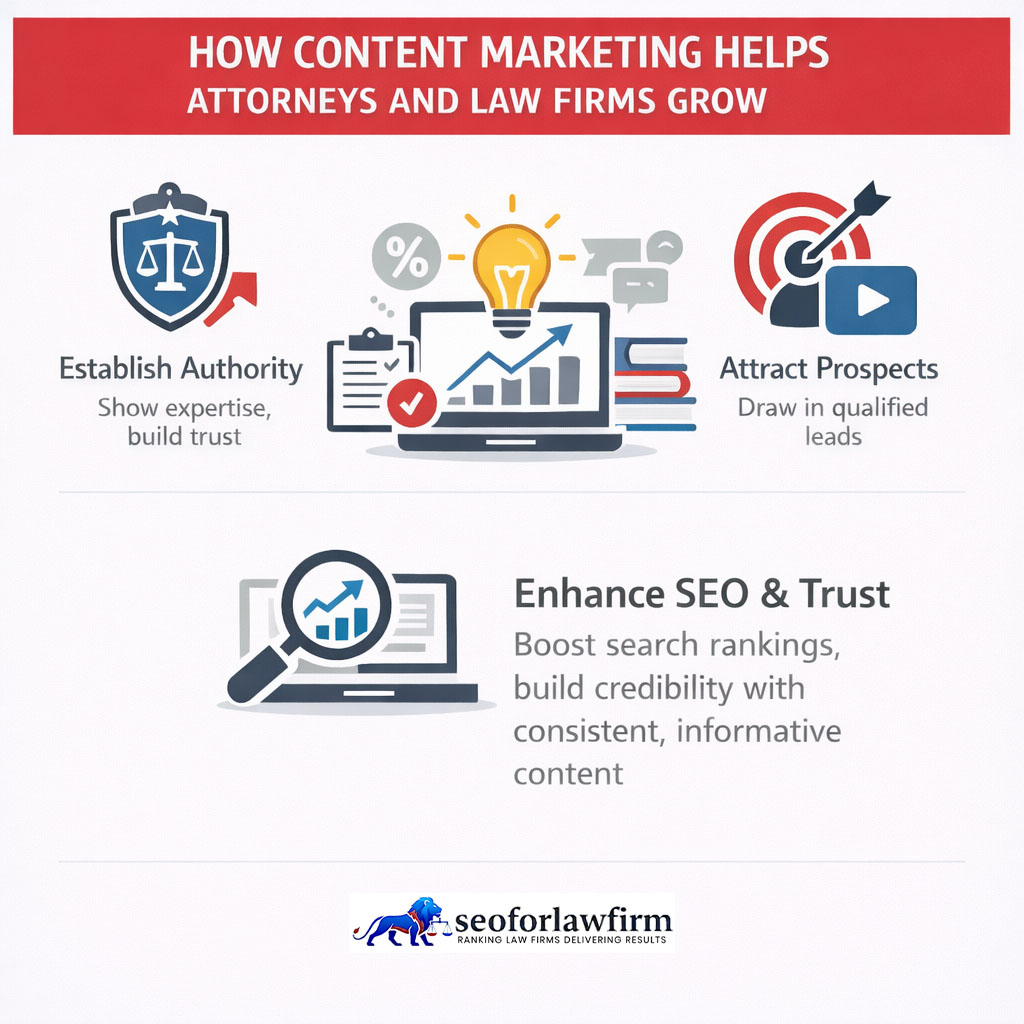
Content marketing helps attorneys and law firms grow by establishing authority, attracting qualified prospects, and improving search visibility across core practice areas. When firms publish educational blogs, FAQs, guides, and videos, potential clients gain a clearer understanding of legal options, making them more confident in choosing the firm for representation.
This consistent publishing strategy strengthens SEO rankings, drives targeted traffic from people actively researching their legal issues, and creates long-term brand trust. High-quality content also supports conversion by demonstrating experience, answering common questions, and positioning the attorney as the reliable choice in a competitive market.
What Fast-Result Marketing Strategies Can Law Firms Use in 2025?
Law firms can use fast-result marketing strategies in 2025 by focusing on high-intent PPC campaigns, rapid local SEO wins, and conversion-optimized content that generates immediate leads. These approaches work quickly because they target users already searching for legal help, activate visibility in local map results, and streamline intake through optimized landing pages and automation.
Listed below are 5 fast-result marketing strategies for law firms in 2025.
- PPC Campaigns: Drive instant exposure by targeting high-intent keywords on Google Ads, producing qualified leads as soon as the campaign launches.
- Social Media Ads: Reach local audiences within hours using demographic and interest targeting on platforms like Facebook, Instagram, and LinkedIn.
- Local Services Ads (LSAs): Appear at the top of Google’s “Google Screened” results and pay only for leads, giving firms fast access to ready-to-hire clients.
- Video Ads: Use short explainer videos on YouTube and social platforms to quickly build trust and capture attention in competitive practice areas.
- Retargeting Campaigns: Re-engage past website visitors with tailored ad sequences that guide them back to schedule consultations or request case evaluations.
What Digital Tools Support Small Law Firm Marketing?
Digital tools that support small law firm marketing help attorneys track performance, analyze competitors, manage client relationships, and automate follow-up. These platforms streamline SEO, PPC, and email campaigns, giving small firms the same advanced capabilities larger firms use, without the need for in-house marketing teams.
Listed below are 6 essential digital tools for small law firm marketing.
- Google Analytics: Tracks website traffic, user journeys, and conversion activity to evaluate which pages and campaigns drive the most inquiries.
- SEMrush: Offers keyword research, technical site audits, and competitive insights to strengthen SEO performance and outrank local competitors.
- Ahrefs: Monitors backlinks, keyword rankings, and competitor content strategies to support long-term authority building.
- HubSpot: Manages CRM workflows, lead nurturing, and automated marketing sequences that keep prospects engaged.
- Mailchimp: Sends segmented newsletters and automated drip campaigns that follow up with leads and encourage consultations.
- CallRail: Tracks calls from PPC, LSAs, and organic search to measure lead quality and attribute conversions accurately.
How Do Lawyers Evaluate the ROI of Their Digital Marketing?
Lawyers evaluate the ROI of their digital marketing by tracking leads, analyzing search traffic, measuring conversion performance, reviewing call data, and comparing revenue against marketing spend. These metrics reveal which strategies deliver profitable cases and which tactics need adjustment.
Listed below are 5 ways attorneys measure ROI effectively.
- Track Incoming Leads: Count all inquiries from website forms, phone calls, chats, and consultation requests linked directly to SEO or PPC campaigns.
- Monitor Organic Traffic Growth: Use Google Analytics and Search Console to evaluate how many new visitors arrive through search results and which pages attract the most interest.
- Measure Conversion Rates: Calculate the percentage of website visitors who convert into consultations. A 2024 Legal Conversion Index reported that high-performing law firm landing pages convert between 7–9%, signaling the impact of focused design and messaging.
- Analyze Call Tracking Data: Review call logs tied to PPC ads, Local Services Ads, and Google Business Profile interactions to determine which channels generate the highest-quality leads.
- Compare Revenue to Marketing Spend: Assess client revenue generated from SEO, PPC, and automated campaigns to calculate true return on investment and guide future budgeting.
How Does Inbound Marketing Work for Lawyers Today?
Inbound marketing works for lawyers today by attracting qualified clients through valuable content, trust-building resources, and optimized online visibility that leads prospects to contact the firm on their own. It relies on targeted blogs, guides, videos, SEO-optimized pages, and nurturing funnels that answer legal questions, demonstrate credibility, and guide clients from awareness to consultation.
Unlike outbound efforts that push messages outward, inbound marketing relies on client-initiated engagement. This approach strengthens long-term visibility, earns trust naturally, and creates a sustainable flow of clients who reach out already believing in the attorney’s expertise.
Which Law Firm Marketing Mistakes Hurt Performance the Most?
The law firm marketing mistakes that hurt performance the most include overlooking local SEO, relying on bland ad copy, failing to track ROI, ignoring mobile performance, and neglecting online reviews. These errors weaken visibility, reduce conversions, and make it harder for firms to compete in crowded markets.
Listed below are 5 major mistakes attorneys must avoid.
- Ignoring Local SEO: Skipping map optimization and location-based keywords lowers visibility when clients search for attorneys nearby.
- Using Generic Ad Copy: Ads that don’t address specific client concerns or practice-area intent lead to lower click-through rates and wasted spend.
- Not Tracking ROI: Without conversion tracking and revenue comparisons, firms can’t identify which campaigns produce profitable cases.
- Overlooking Mobile Users: A site that loads slowly or functions poorly on phones pushes away prospects who search primarily on mobile devices.
- Neglecting Online Reviews: Weak or outdated review profiles undermine trust and reduce ranking potential in Google’s local results.
Where to get professional SEO, PPC, and automation marketing services for small law firms?
You can get professional SEO, PPC, and automation marketing services for small law firms from specialized legal-marketing agencies like SEOForLawFirm and platforms that offer integrated digital solutions. These providers focus on local visibility, high-intent lead generation, and workflow automation tailored to solo and small practices. Leading examples include SEOForLawFirm.com, known for its attorney-focused SEO, PPC management, and automated intake systems; LaGrande Marketing, which delivers conversion-driven campaigns; and Jurisdiction Marketing, which provides full-service advertising and CRM automation.
Legal-focused agencies such as LawRank, LaGrande Marketing, and Gladiator Law Marketing offer SEO and PPC packages tailored for small firms, helping them rank locally and run efficient Google Ads campaigns. Small-practice specialists like GNGF and AttorneySync provide integrated marketing systems that include intake automation and CRM setup. Consultants and automation providers, such as Lawmatics implementation partners, Clio Grow consultants, and HubSpot legal automation specialists, help small firms build automated workflows for lead capture, emails, texts, reviews, and reporting.
Working with integrated providers ensures that SEO drives traffic, PPC captures high-intent leads, and automation converts more of those leads into clients with less manual effort. A 2024 legal marketing study found that small law firms using integrated SEO + PPC + automation saw a 35% increase in qualified leads and a 28% reduction in cost per client compared to firms relying on single-channel marketing, showing the performance advantage of unified marketing support.