
Lawyer advertising rules are ethical regulations established by state bar associations and the ABA Model Rules of Professional Conduct that govern how attorneys may promote their legal services. These rules apply across print, broadcast, and digital media, ensuring that all communications are factual, transparent, and free from misleading claims.
Disclaimers play a key role in maintaining compliance, as they clarify that advertisements do not guarantee specific outcomes. Common examples include statements such as “past results do not guarantee future outcomes,” which help prevent misinterpretation and protect consumer trust.
Testimonials are permitted under lawyer advertising rules if they remain truthful, verifiable, and properly disclaimed. However, some jurisdictions limit or restrict testimonial use when the content could imply guaranteed success or violate professional ethics.
The ABA Model Rules (7.1–7.5) form the foundation for these regulations, with each state adopting variations to address regional ethical concerns. The 2022 ABA Legal Technology Survey Report found that most U.S. law firms use websites, social media, and digital campaigns to reach clients, making compliance in online advertising more critical than ever.
These standards date back to Bates v. State Bar of Arizona (1977), the Supreme Court case that legalized lawyer advertising. Since then, bar associations have continuously updated rules to cover modern platforms like Facebook and Google Ads, emphasizing responsible communication and transparency.
Finally, written solicitations and direct outreach remain tightly regulated under lawyer advertising rules to prevent undue influence, particularly in sensitive legal matters. Together, these ethical and compliance guidelines protect both clients and firms by ensuring advertising remains honest, professional, and compliant with state and federal standards.
Table of Contents
- Article sections will appear here.
What Are the Rules That Govern Lawyer Advertising?
Lawyer advertising rules are ethical and regulatory standards that control how attorneys promote their services across all media platforms under bar association supervision. These guidelines are primarily derived from the ABA Model Rules of Professional Conduct (Rules 7.1–7.5), which ensure that all marketing communications are accurate, transparent, and compliant with professional ethics.
These legal ethics and compliance frameworks for attorney advertising serve to protect the public from misleading claims, unverifiable guarantees, and exaggerated results. Each state bar enforces its own version of these rules, overseeing law firm ads in print, broadcast, and digital formats to ensure truthfulness and fairness.
By requiring factual support for every statement and restricting deceptive or manipulative language, lawyer advertising rules maintain both professional integrity and consumer trust, two pillars of ethical legal marketing.

How Does Lawyer Advertising Operate?
Lawyer advertising operates by promoting legal services through ethics-compliant and transparent communication across digital, print, and broadcast platforms. Each form of outreach, whether on websites, social media, or TV, must follow professional conduct standards that prohibit false or misleading claims.
Under these regulations, attorney marketing must use factual, verifiable statements about qualifications, services, and experience. Disclaimers such as “results may vary” or “past performance does not guarantee future success” are required to clarify limitations and prevent client misunderstanding.
Compliance is maintained through careful review of advertising content, ensuring accurate fee descriptions, truthful testimonials, and adherence to jurisdictional advertising laws. By aligning with these ethical requirements, lawyer advertising not only upholds professional integrity but also builds public trust and strengthens client confidence in the legal profession.
Can Lawyers Advertise on Facebook?
Yes, lawyers can advertise on Facebook if their campaigns fully comply with bar association ethics rules and professional conduct guidelines. Facebook’s advanced targeting tools allow law firms to reach specific audiences by location, demographics, or interests, but all advertising content must remain factual, transparent, and non-deceptive.
Firms that follow proper guidelines and best practices for ethical Facebook lawyer ads maintain compliance by including disclaimers that prevent confusion or false expectations. These disclaimers clarify that results are not guaranteed and that individual outcomes vary.
A 2021 study by Blake Tims, titled “Unguided: Social Media Usage in the Legal Profession and the Need for Practical Guidance,” found that most state bars lack consistent systems for monitoring social media advertising, stating the need for self-regulation and review by law firms.
By structuring Facebook ad campaigns with accurate claims, transparent messaging, and ethical oversight, lawyers will safely use the platform to expand reach while preserving professional credibility.
Why Are Disclaimers Necessary in Lawyer Advertising?
Disclaimers are necessary in lawyer advertising because they prevent misleading impressions and ensure compliance with bar association ethics rules. Their primary role is to clarify that marketing content is informational, not a guarantee of legal success or specific results.
Phrases like “prior results do not guarantee a similar outcome” help manage client expectations and reinforce transparency in communication. These disclaimers also distinguish general educational material from legal advice, protecting both the firm and potential clients from misunderstanding.
By identifying content as advertising, explaining the limits of representation, and emphasizing that outcomes vary by case, disclaimers reduce ethical risks and maintain accuracy across all promotional materials.
Ultimately, disclaimers serve as a safeguard that upholds professional integrity, consumer trust, and compliance within the strict framework of lawyer advertising regulations.
Can Disclaimers Help Lawyer Ads Stay Compliant?
Yes, disclaimers can help lawyer ads stay compliant by clarifying boundaries, ensuring transparency, and reducing the risk of misleading impressions. When properly used, they make advertising content clear and honest, explaining that individual case outcomes vary and that no result is guaranteed.
However, disclaimers function as compliance support tools, not substitutes for ethical content. All marketing materials must already meet bar standards for truthfulness, accuracy, and verification before a disclaimer is applied.
Effective disclaimers in compliant lawyer ads include language such as “past results do not guarantee future success” or “information provided is for general purposes and not legal advice.” These reinforce transparency and maintain full alignment with professional conduct and advertising ethics rules.
In essence, disclaimers enhance compliance by protecting both consumers and firms, ensuring every communication reflects honesty and professionalism.
How to Use Testimonials Ethically in Lawyer Advertising
Testimonials in lawyer advertising must be accurate, consent-based, and compliant with professional ethics to maintain transparency and trust. Each testimonial must truthfully represent a client’s experience without exaggerating or implying guaranteed results.
Attorneys must always secure written consent from the client before publishing any statement and ensure that the testimonial reflects verifiable facts. Including disclaimers, such as “individual results may vary,” helps clarify expectations and prevents potential misinterpretation.
Testimonials must avoid emotional or misleading language, focusing instead on authenticity and factual representation. When handled responsibly, they become effective credibility builders that enhance a firm’s reputation while staying within ethical boundaries set by bar associations.
Are There Restrictions on Using Testimonials in Lawyer Advertising?
Yes, there are restrictions on using testimonials in lawyer advertising because testimonial language will create misleading impressions or unrealistic client expectations if not properly controlled.
Regulations vary by state, but most bar associations require that testimonials be truthful, verifiable, and accompanied by clear disclaimers, such as “results may vary,” to ensure transparency and compliance. Any testimonial suggesting guaranteed results, inflated success rates, or unverifiable claims is prohibited.
These restrictions exist to protect consumers and preserve professional integrity, ensuring that client statements remain factual, balanced, and consistent with bar advertising ethics. By adhering to these rules, law firms will use testimonials effectively while maintaining compliance with professional conduct standards.
What advertising practices create the biggest compliance risks for law firms?
Lawyer advertising is governed by the American Bar Association’s Rule 7.2 and state bar regulations, which require that ads be truthful, not misleading, and compliant with ethical standards.
Listed Below Are the 11 Common Violations in Lawyer Advertising.
- Making misleading or unverifiable claims (ex, “#1 lawyer,” “guaranteed win,” “best in the city”) because most bar rules prohibit false or misleading communications that can’t be objectively proven, creating a high risk of ethics complaints and enforcement.
- Omitting required disclaimers on case results because advertising settlements/verdicts without clarifying that past outcomes don’t guarantee future results will be viewed as misleading and will violate attorney advertising disclosure requirements.
- Using client testimonials improperly (no written consent, edited outcomes, implied guarantees, or exaggerated benefit statements) because testimonials will easily create “unjustified expectations” and trigger violations for misleading marketing and confidentiality failures.
- Advertising specialization without proper certification (ex, claiming “expert” or “specialist” status without official recognition) because many jurisdictions restrict how attorneys will describe expertise unless they meet formal board certification requirements.
- Improper direct solicitation of vulnerable prospects (ex, messaging accident victims, defendants, or families immediately after an incident) because solicitation is heavily regulated and will violate direct-contact restrictions under professional conduct rules.
- Paying for referrals or engaging in improper fee-sharing with non-lawyers because many bar rules prohibit paying referral fees (outside approved programs) or sharing legal fees with non-attorneys, especially when lead vendors resemble “referral arrangements.”
- Publishing confidential client information in ads, case studies, or videos without written permission because even “small details” will identify a client and create serious confidentiality and privacy violations.
- Using lead-generation vendors without transparency and proper opt-in, because if a client didn’t clearly consent to attorney contact, the outreach may be treated as improper solicitation, and the firm may still be accountable for how leads were acquired.
- Manipulating reviews or testimonials (fake reviews, incentives, suppressing negative reviews, or “review gating”) because these practices will trigger consumer-protection issues and raise concerns for deception and misleading reputation signals.
- Running ads in jurisdictions where the attorney isn’t licensed because marketing legal services in states where the lawyer cannot practice will create unauthorized practice of law (UPL) exposure and related discipline risks.
- Non-compliant retargeting and privacy practices (tracking users without consent, unclear cookie policies, unclear data use) because privacy violations will create legal risk, platform enforcement risk, and trust damage, especially in regulated, high-sensitivity legal matters.
The ABA Model Rules specifically define and regulate “solicitation” of clients as targeted outreach to someone known to need legal services for a specific matter, making solicitation-related advertising one of the most scrutinized risk areas in law firm marketing.
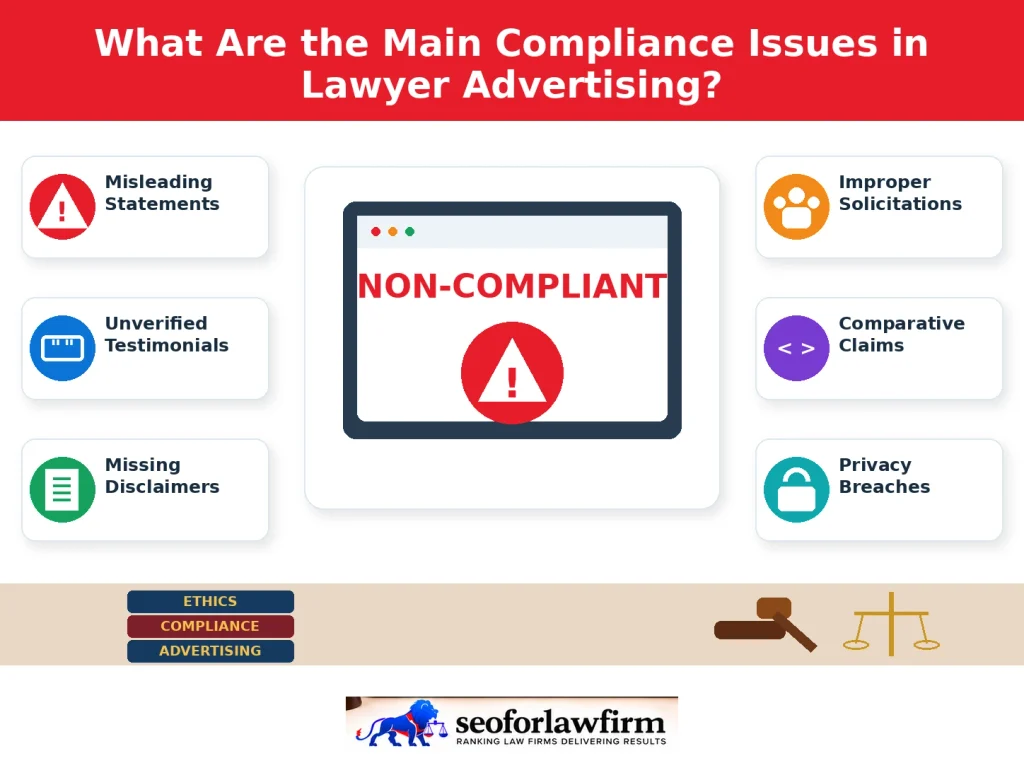
What Are the Main Compliance Issues in Lawyer Advertising?
Compliance issues in lawyer advertising arise from misleading language, missing disclaimers, and improper solicitation practices that violate bar association ethics standards. To remain compliant, firms must follow structured oversight and verification protocols supported by reliable systems that ensure accuracy and transparency. Many firms use specialized tools and review frameworks that provide compliance guidance for disclaimers and ad content to maintain ethical consistency across campaigns.
Listed below are 6 common compliance issues affecting lawyer advertising.
- Misleading statements that create unrealistic or inflated expectations.
- Unverified testimonials that lack factual or documented support.
- Missing disclaimers that fail to clarify limits or differences in case outcomes.
- Improper solicitations that inappropriately target vulnerable clients.
- Comparative claims implying superiority over other attorneys without objective evidence.
- Privacy breaches that expose confidential client information.
By implementing compliance guidance for disclaimers and ad content, law firms will uphold ethical standards, avoid disciplinary risks, and maintain client trust across all advertising channels.
How to Ensure Ethical Compliance in Lawyer Advertising
The way to ensure ethical compliance in lawyer advertising is by maintaining accuracy, transparency, and documentation while following all bar association and jurisdictional rules. Every message, testimonial, and claim must align with professional conduct standards to protect both clients and the firm’s reputation.
Listed below are 6 practices to ensure ethical lawyer advertising.
- Use clear disclaimers that remove impressions of guaranteed results and define content limits.
- Verify testimonials through factual review, written client consent, and authenticity checks.
- Avoid guarantee language or success claims that imply certain outcomes.
- Comply with jurisdictional advertising rules governing statements, disclosures, and solicitation boundaries.
- Maintain detailed records of advertisements, approvals, and supporting documentation for audit readiness.
- Ensure full transparency by accurately describing legal services, qualifications, and experience.
By applying these ethical advertising practices, law firms will protect their professional credibility, maintain compliance, and foster trust with clients and regulators alike.
How should lawyers advertise online without making misleading claims about results?
Lawyers should advertise online by focusing on truthful, verifiable information about their services and avoiding promises of guaranteed outcomes.
Listed Below Are the 10 Practices for Ethical Lawyer Advertising Online.
- Avoiding “Guaranteed Outcome” Language: Never state or imply guarantees such as “guaranteed win,” “100% success,” or “we will get you paid,” because outcomes depend on facts, law, and jurisdiction, and guarantees are broadly prohibited under bar rules.
- Using Verifiable, Fact-Based Messaging: Anchor ads in objective facts that will be proven, such as years of practice, practice focus, types of cases handled, jurisdictions licensed in, and procedural steps offered (e.g., “free case evaluation”).
- Adding Clear Disclaimers on Results: When referencing verdicts, settlements, or representative matters, include a clear disclaimer like “Past results do not guarantee future outcomes” to avoid creating unjustified expectations.
- Framing Outcomes as Possibilities, Not Promises: Use compliant language such as “may be able to help,” “will assist with,” or “we’ll evaluate your legal options,” which accurately reflects the contingent nature of legal results.
- Avoiding Unprovable Superlatives: Do not use claims like “best,” “top,” “#1,” or “most trusted” unless they are backed by a current, credible, third-party ranking or award that is clearly identified.
- Presenting Testimonials Carefully: Use real client testimonials only with required consent, avoid editing that exaggerates outcomes, and never imply that similar results are for all clients.
- Being Transparent About Fees and Consultations: Clearly distinguish between “free consultation,” “contingency fee available,” or hourly billing so users are not misled about costs or obligations.
- Ensuring Ads Match Landing Page Content: Keep ad copy, extensions, and landing pages aligned so users see consistent messaging and there is no bait-and-switch risk.
- Reviewing Advertising Rules by Jurisdiction: Check the specific state bar rules governing disclaimers, specialization claims, solicitation limits, and testimonial use for every jurisdiction where ads run.
- Documenting and Approving Ads Internally: Use a compliance checklist, retain copies of ads and revisions, and route campaigns through a documented approval process to demonstrate good-faith compliance.
State bar disciplinary summaries consistently show that misleading communications and unjustified expectations about results are among the most common sources of attorney advertising complaints, making compliance-first messaging essential to reducing enforcement risk while still marketing effectively.
When Did Lawyers Begin Advertising on Television?
Lawyers began advertising on television after the 1977 Supreme Court case Bates v. State Bar of Arizona, which ruled that attorney advertising is protected under the First Amendment’s free speech clause. This landmark decision overturned previous bans, allowing lawyers to promote their services publicly for the first time.
Following the ruling, lawyer TV ads quickly became a turning point in legal marketing, shaping how the public accessed information about legal services. A 1978 study by Terence A. Shimp and R. Dyer, titled “How the Legal Profession Views Legal Service Advertising,” found that advertising among lawyers increased steadily in the years immediately following the Bates decision.
Television advertising opened the door to regulated, consumer-focused legal marketing, setting the foundation for today’s digital outreach, ethical disclaimers, and bar-compliant promotional practices.
How Does a Legal Advertisement Letter Work?
A legal advertisement letter functions as a formal written outreach from a law firm to potential clients, promoting legal services within the limits of bar advertising rules. These letters must comply with strict ethical standards, including mandatory disclosures, disclaimers, and clear identification as “advertising material.”
Because of their direct nature, advertisement letters are subject to solicitation restrictions, especially in areas like personal injury, wrongful death, or criminal defense, where regulators aim to prevent undue influence or exploitation.
To stay compliant, firms must ensure that each letter presents truthful, factual, and transparent information, avoids promises of specific results, and respects privacy laws. When designed ethically, a legal advertisement letter becomes a trust-based communication tool that connects law firms with potential clients while maintaining full professional integrity.
Can Lawyers Directly Solicit Clients?
No, lawyers cannot directly solicit clients in person because such contact creates pressure, coercion, and ethical risks. The ABA Model Rules of Professional Conduct (Rule 7.3) and most state bar associations prohibit in-person, live phone, or real-time electronic solicitation when the purpose is financial gain.
However, attorneys are permitted to use regulated advertising channels, including written communications, mail, and digital placements, provided that the content is truthful, includes proper disclaimers, and avoids manipulative or coercive tactics.
A 2020 update to ABA Rule 7.3: Solicitation of Clients reaffirmed that direct, in-person solicitation is prohibited, especially in sensitive practice areas like personal injury and accident cases, while allowing compliant written and online advertising.
These restrictions help protect the public and uphold professional integrity, ensuring all client outreach remains transparent, factual, and free from undue influence.
What are the consequences of violating lawyer advertising ethics rules?
The consequences of violating lawyer advertising ethics rules include disciplinary investigations, fines, ad takedowns, reputational damage, and even suspension or disbarment.
Listed Below Are the 10 Consequences of Non‑Compliant Lawyer Advertising.
- State bar investigations and disciplinary actions: Ethics complaints will trigger formal inquiries, hearings, and disciplinary reviews that consume time, staff capacity, and legal resources.
- Fines, sanctions, or penalties: Depending on your jurisdiction, violations will result in financial penalties, court sanctions, or mandatory compliance measures that increase operational costs.
- Mandatory ad takedowns or revisions: Regulators may require you to remove non-compliant ads immediately, forcing campaign pauses that disrupt lead flow and marketing momentum.
- Loss of professional credibility and trust: Misleading claims (“guaranteed results,” “#1 lawyer”) reduce perceived integrity and make prospects more skeptical during intake, lowering conversion rates.
- Public disciplinary records: Some advertising violations become part of the public record, damaging reputation long after the campaign ends and reducing future referral confidence.
- Suspension or disbarment (in severe cases): Repeated or serious misconduct, especially involving dishonesty or consumer harm, will escalate to major professional discipline.
- Lawsuits or consumer claims: Misleading marketing will expose firms to consumer protection claims, disputes over expectations, or fee conflicts tied to “promises” made in ads.
- Wasted marketing spend and disrupted lead flow: If ads must be pulled or accounts restricted, spend is lost while the firm scrambles to rebuild compliant campaigns and regain performance.
- Compliance audits and increased scrutiny: Once flagged, future marketing may face closer review internally (or externally), slowing approvals and increasing compliance overhead.
- Vendor termination or platform restrictions: Google, Meta, and other platforms may suspend accounts or reject ads if repeated compliance issues occur, limiting acquisition options.
The ABA recognizes that lawyer advertising rules exist because legal ads will easily become misleading, and misleading communications about a lawyer’s services are specifically restricted under professional responsibility standards.