

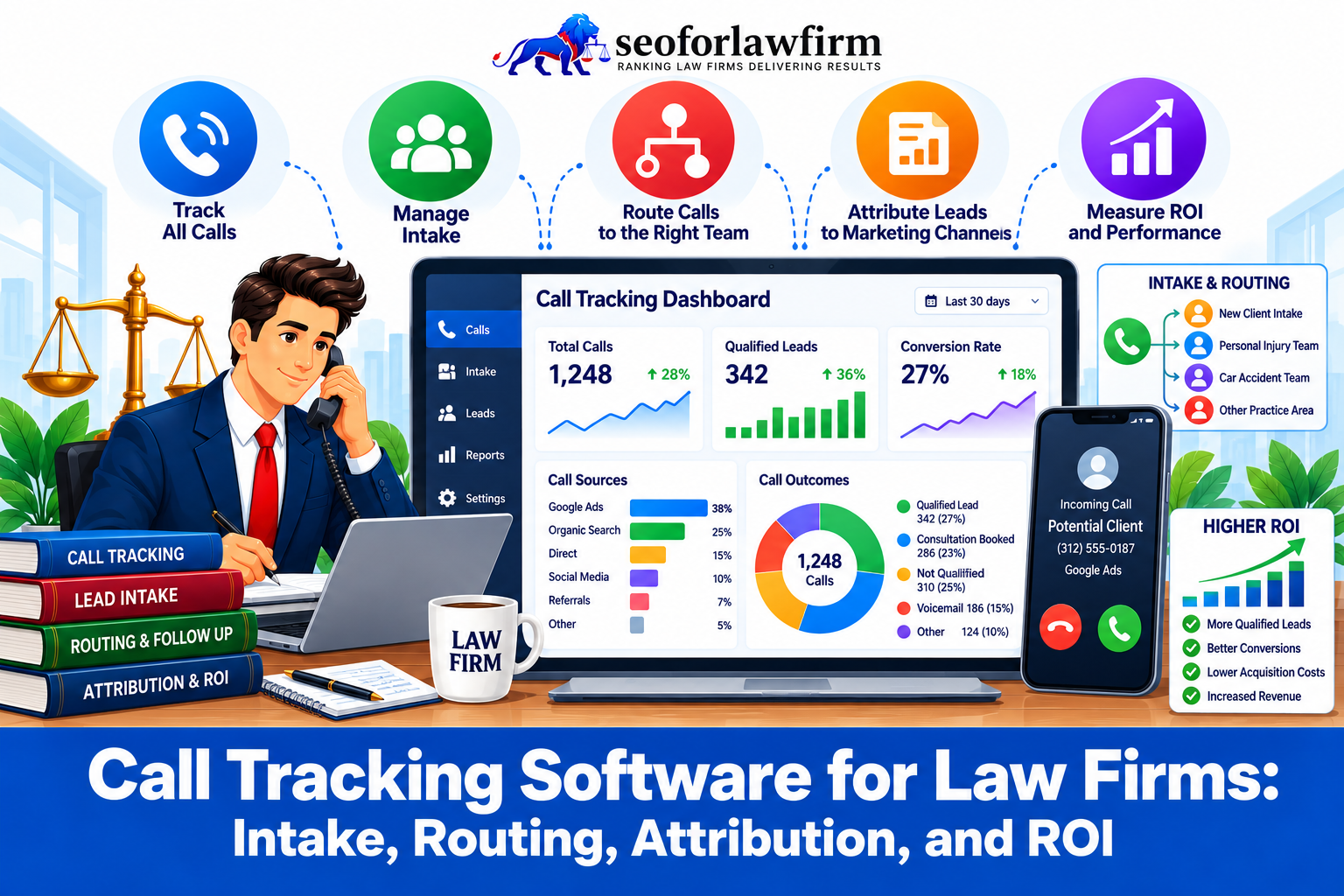
Call tracking software for law firms attributes incoming phone calls to specific marketing sources, routes prospective clients through intake, and connects calls with consultations, signed cases, and revenue. Law firms use Dynamic Number Insertion (DNI), dedicated tracking numbers, automated call routing, call recording, conversation intelligence, CRM integrations, and missed-call workflows to determine whether SEO, Google Ads, Local Services Ads, Google Business Profile, legal directories, or other campaigns generate valuable legal matters. A complete measurement system follows Marketing Source → Phone Call → Qualified Lead → Consultation → Signed Case → Revenue, allowing the firm to compare channels using qualified leads, cost per signed case, client acquisition cost, and attributable revenue rather than call volume alone.
Call tracking also supports intake management by identifying unanswered calls, routing failures, and delayed follow-up. According to a study by James B. Oldroyd, Kristina McElheran, and David Elkington titled The Short Life of Online Sales Leads in 2011, Oldroyd, McElheran, and Elkington examined online lead response and qualification. This business research supports timely follow-up, but does not establish a law-firm signed-case conversion rate.
Law firms need to measure whether online inquiries receive a response, how quickly staff respond, and whether the inquiry progresses into a qualified consultation. Intake reporting should treat missed responses and long delays as operational failures rather than merely marketing metrics.
CallRail emphasizes call attribution, routing, recording, and conversation analysis. Its current Lead Tracking plan starts at $50 per month plus usage and includes five numbers and 250 minutes.
Table of Contents
- Article sections will appear here.
What Does Call Tracking Mean for Law Firms?
Call tracking for law firms means monitoring inbound phone inquiries and connecting each call with its marketing source, intake outcome, signed-client status, and resulting revenue. Law firms use tracking numbers to distinguish calls generated through SEO, PPC, Google Local Services Ads, legal directories, social media, referral campaigns, television, radio, billboards, print advertising, and other acquisition sources. The call record identifies which marketing activity generated the inquiry and follows the prospect through Marketing Source → Website Visit → Phone Call → Qualification → Consultation → Signed Client → Case Revenue.
Advanced call tracking also records whether staff answered the call, whether the prospect met the firm’s qualification criteria, whether the firm booked a consultation, and whether the prospect signed a retainer. This attribution gives law firms a clearer measure of marketing performance because call volume alone does not show client-acquisition value. A campaign that generates 100 calls and 2 signed clients performs differently from a campaign that generates 30 calls and 8 signed clients, and CRM-connected call tracking exposes that difference.
What Are the Core Functions of Call Tracking Software for Law Firms?
The core functions of call tracking software for law firms are marketing attribution, call routing, missed-call recovery, CRM synchronization, and ROI measurement. These functions connect incoming calls with the marketing source that generated each inquiry and then follow the caller through intake, qualification, consultation, retention, and revenue.
Call tracking becomes more valuable when attribution data, call outcomes, and CRM records operate together because the firm can measure which campaigns generate qualified prospects and signed matters rather than raw call volume alone. Law firm marketing KPIs such as cost per signed case, client acquisition cost, and attributable revenue give that call data a direct business-performance context.
Listed below are the 7 core functions of call tracking software for law firms.
- Marketing Attribution: Tracking numbers connect phone inquiries with SEO, PPC, Local Services Ads, landing pages, directories, offline advertising, and other acquisition sources.
- Dynamic Number Insertion: DNI displays different tracking numbers according to the visitor’s traffic source or website session.
- AI Conversation Intelligence: AI transcribes calls, identifies topics, summarizes conversations, applies tags, and classifies lead intent.
- Call Routing: Routing rules direct callers according to practice area, location, campaign source, schedule, or intake priority.
- Missed-Call Recovery: Automated follow-up messages create another contact path after qualifying missed calls.
- CRM Integration: Call source, contact details, recordings, transcripts, tags, and outcomes move into supported intake or practice-management systems.
- ROI Attribution: Marketing costs connect with qualified leads, consultations, signed matters, and attributable revenue.
How Does Dynamic Number Insertion Function in Call Tracking for Law Firms?
Dynamic Number Insertion functions by displaying a tracking number based on a visitor’s traffic source or website session and forwarding the resulting call to the law firm’s actual phone line. A visitor arriving through Google Ads can receive a paid-search tracking number, while a visitor arriving through organic search can receive a number from the firm’s website tracking pool.
Other traffic sources receive numbers according to the firm’s tracking configuration. The caller still reaches the law firm’s normal intake destination because the tracking number operates between the marketing source and the existing phone system.
Listed below are the 6 main steps in the DNI process.
- Visitor arrives: A prospective client reaches the law firm website through a measurable source.
- Tracking number appears: The system displays a number assigned to the visitor’s source or session.
- Caller places the call: The prospect contacts the firm through the displayed number.
- Call forwards: The tracking number routes the call to the firm’s normal intake line.
- Session data attaches: The platform connects the call with available traffic-source and session information.
- Attribution enters reporting: The firm can compare the call with other marketing and intake outcomes.
How Does DNI Improve Call Tracking Accuracy for Law Firms?
Dynamic Number Insertion improves call tracking accuracy by connecting individual phone inquiries with the marketing sessions that generated them. A law firm that displays one telephone number to every website visitor can count calls but loses session-level attribution.
DNI preserves the relationship between the visitor, source, landing page, campaign, and resulting phone inquiry, which allows the firm to distinguish organic-search calls from paid-search or other campaign traffic. Accuracy also depends on correct implementation and a tracking-number pool large enough to support simultaneous website sessions.
Listed below are the 11 main data points DNI can associate with a tracked call.
- Traffic source.
- Marketing campaign.
- Landing page.
- Referring website.
- Ad group.
- PPC keyword where available.
- Website session.
- Call date.
- Call time.
- Call duration.
- Answer status.
How Does Call Attribution Work for Law Firms?
Call attribution works by linking each inbound phone call with the marketing channel, campaign, advertisement, keyword, landing page, or visitor session that generated the inquiry. The attribution process begins before the phone rings because the tracking platform records how the prospect reached the firm, associates the visitor with a tracking number, and connects the resulting call with available marketing data.
The attribution record gains greater business value when it enters the firm’s CRM or practice-management system and follows the prospect through qualification, consultation, retention, and revenue.
Listed below are the 10 main questions call attribution should answer.
- Which channel generated the call?
- Which campaign generated the visitor?
- Which landing page preceded the call?
- Which keyword produced the paid-search visitor?
- Was the call answered?
- Was the inquiry a new lead?
- Did the lead match the firm’s practice-area criteria?
- Did staff schedule a consultation?
- Did the prospect retain the firm?
- What revenue resulted from the matter?
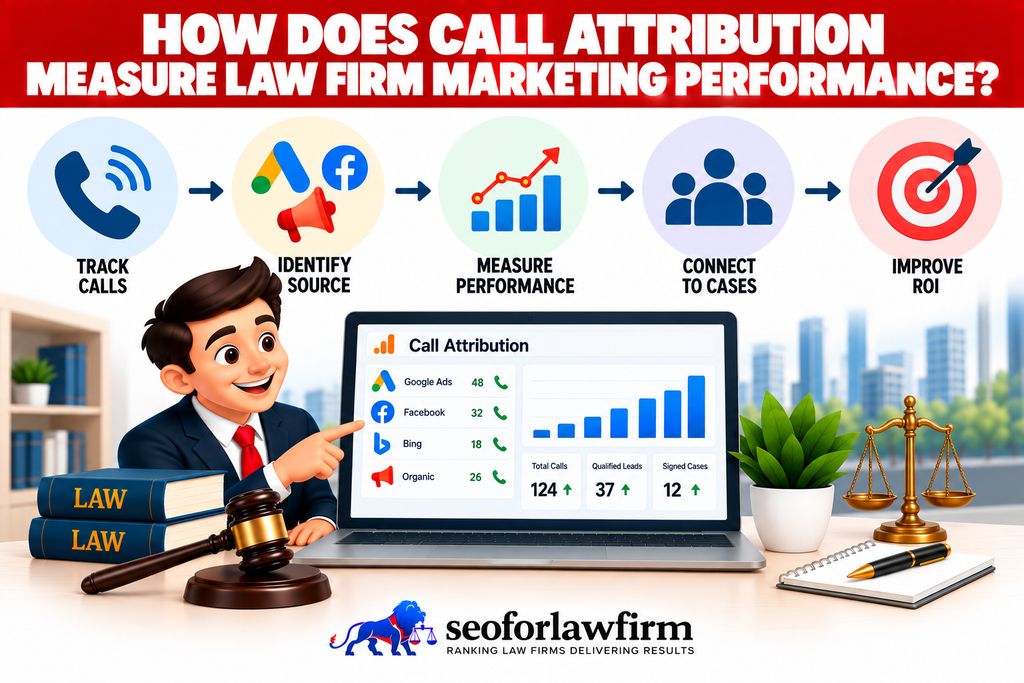
How Does Call Attribution Measure Law Firm Marketing Performance?
Call attribution measures law firm marketing performance by comparing marketing spend with the qualified leads, consultations, signed matters, and revenue generated through tracked phone calls. Raw call volume shows activity, while downstream call outcomes show acquisition performance.
A campaign that produces many calls but few qualified leads or signed matters delivers a different business result from a campaign that produces fewer calls and stronger client acquisition. Law firms therefore connect tracked calls with intake and revenue data to determine which campaigns produce profitable matters.
Listed below are the 9 main call-tracking performance metrics.
- Answer Rate: Answered calls ÷ total inbound calls × 100.
- Missed-Call Rate: Missed calls ÷ total inbound calls × 100.
- Qualified-Lead Rate: Qualified phone leads ÷ tracked calls × 100.
- Consultation Rate: Consultations booked ÷ qualified leads × 100.
- Signed-Case Rate: Signed matters ÷ qualified leads × 100.
- Cost per Qualified Lead: Marketing cost ÷ qualified leads.
- Cost per Consultation: Marketing cost ÷ booked consultations.
- Cost per Signed Case: Marketing cost ÷ signed matters.
- Marketing ROI: (Attributed revenue − marketing cost) ÷ marketing cost × 100.
How Does Call Tracking Software Improve Client Intake and Call Routing for Law Firms?
Call tracking software improves law firm intake by identifying the source and purpose of inbound calls and directing callers to the appropriate staff member, attorney, office, or intake workflow. Tracking numbers give routing systems useful information before staff begin the conversation.
A personal injury Google Ads campaign can route calls to a personal injury intake team, while a family law campaign can route calls to staff handling divorce and custody matters. Multi-office firms can also route calls to the relevant location. Call-flow systems can change routing according to time, staff availability, caller selections, campaign source, or workload.
Listed below are 7 common call-routing functions.
- Practice-area routing: Directs callers to staff handling the relevant legal service.
- Location routing: Sends callers to the office associated with the campaign or location.
- Campaign routing: Directs calls from selected campaigns into dedicated intake queues.
- Time-based routing: Sends evening, weekend, holiday, or overflow calls to alternate destinations.
- Availability routing: Directs calls according to current staff availability.
- After-hours routing: Sends callers to answering services, voicemail workflows, AI voice agents, or on-call staff.
- Routing measurement: Tracks answer rates, transfers, missed calls, consultations, and signed matters.
How Do Law Firms Route Calls by Practice Area, Location, or Campaign Source?
Law firms route calls by practice area, location, or campaign source by combining tracking numbers with routing rules, IVR menus, office data, schedules, and CRM workflows. Each tracking number identifies the origin or purpose of the call, while the routing system determines where that caller should go. Multi-office and multi-practice firms use this structure to keep callers connected with the staff best positioned to handle each inquiry.
Listed below are 7 ways law firms route tracked calls.
- Assign Tracking Numbers by Campaign: Dedicated numbers identify calls from SEO, PPC, Local Services Ads, directories, television, print, and other sources.
- Route by Practice Area: Personal injury, family law, criminal defense, and other inquiries enter separate workflows.
- Route by Location: Multi-office firms direct callers according to the office connected with the campaign or number.
- Route by Campaign Source: High-intent campaigns can enter dedicated intake queues.
- Use Time-Based Routing: Evening, weekend, holiday, and overflow calls move to designated after-hours systems.
- Use Priority Routing: Urgent or high-value inquiries move to designated intake personnel according to firm-defined criteria.
- Record the Routing Outcome: The CRM stores the source, destination, handler, outcome, and follow-up status.
How Does Automated Text-Back Help Law Firms Recover Missed Calls?
Automated text-back helps law firms recover missed calls by sending an SMS to qualifying callers after an unanswered phone inquiry. The message acknowledges the missed contact and gives the prospective client another route into the intake process.
A missed-call recovery workflow follows Unanswered Call → Automated Text → Prospect Response → Intake Follow-Up → Qualification → Consultation. This process reduces the number of inquiries that end after one unanswered call and gives the firm data about periods when intake coverage falls short.
Listed below are the 6 main benefits of automated text-back.
- Immediate acknowledgement: The caller receives a response after the missed call.
- Alternative contact path: The prospect can continue the intake process by text.
- Lead recovery: The firm gets another opportunity to qualify the inquiry.
- Follow-up support: Intake staff receive a clear signal that further contact is required.
- Staffing insight: Missed-call patterns reveal hours when additional coverage may be needed.
- Outcome tracking: The firm can measure whether missed-call recovery produces consultations or signed matters.
How Does AI Conversation Intelligence Work for Law Firm Call Tracking?
AI conversation intelligence works for law firm call tracking by transcribing recorded calls and qualification signals, outcomes, and intake performance. Traditional call tracking identifies where the call came from, while conversation intelligence examines what happened during the call. Law firms gain more useful analysis when AI classifications reflect the firm’s actual qualification criteria.
A personal injury firm can track accident type, date, jurisdiction, treatment, representation status, liability indicators, and consultation outcome, while a criminal defense firm can apply a different qualification model. CallRail includes transcription in its Lead Tracking offer and provides deeper AI analysis through higher feature levels; its cited base Lead Tracking plan starts at $55 per month with 5 local numbers and 250 local minutes, subject to plan usage and charges.
Listed below are the 10 main AI conversation intelligence functions.
- Call transcription: Converts recorded conversations into searchable text.
- Conversation summaries: Produces condensed descriptions of call content.
- Keyword detection: Identifies predefined words or phrases within calls.
- Topic identification: Classifies conversations according to legal or intake subjects.
- Lead classification: Distinguishes potential clients from non-lead calls.
- Automated tagging: Applies labels based on call content or outcome.
- Sentiment analysis: Evaluates conversational tone where supported.
- Conversion identification: Detects calls associated with valuable intake actions.
- Intake-quality review: Helps firms review staff handling and qualification practices.
- Searchable transcripts: Allows staff to locate calls based on conversation content.
What Are the Best Call Tracking Software Options for Law Firms?
The best call tracking software options for law firms include CallRail for marketing attribution, Juryo for AI-first legal intake, and Perspective AI for conversational qualification and triage.
The table below shows the primary use of each software option.
| Software | Primary Function | Best For | Main Features |
| CallRail | Marketing attribution and call tracking | Law firms tracking SEO, Google Ads, Local Services Ads, calls, texts, and intake sources | DNI, call recording, routing, transcription, conversation intelligence, automated messaging, CRM integrations |
| Juryo | 24/7 AI legal intake | Consumer law firms seeking automated phone and WhatsApp intake | Voice intake, WhatsApp, email, web intake, qualification, booking, document collection, CRM handoff |
| Perspective AI | Conversational legal intake | Firms seeking deeper lead qualification before attorney review | AI interviewer, adaptive follow-up questions, lead scoring, structured matter data, automated routing, CRM handoff |
| CallTrackingMetrics | Call tracking and routing | Firms with advanced routing and attribution requirements | DNI, call flows, IVR, attribution, reporting, conversation analytics |
| WhatConverts | Lead and revenue attribution | Firms focused on measuring source-to-lead and source-to-revenue performance | Call tracking, campaign attribution, lead qualification, customer journeys, revenue reporting |
Why Is CallRail Used for Law Firm Call Tracking?
CallRail is used for law firm call tracking because it combines DNI, marketing attribution, call recording, routing, transcription, AI analysis, messaging, and legal-software integrations within one tracking platform.
CallRail’s Lead Tracking pricing currently begins at $55 per month. The current base allocation includes 5 local numbers and 250 local minutes.
CallRail also integrates with legal platforms such as Clio Grow, Clio Manage, MyCase, Lawmatics, and Lead Docket. Its Lead Docket integration creates leads automatically and synchronizes caller and campaign information into the lead-management workflow.
This makes CallRail better suited to marketing attribution than an AI intake platform whose main function centers on conducting the intake conversation.
How Do CRM Integrations Connect Calls With Signed Cases?
CRM integrations connect tracked phone calls with signed cases by transferring marketing attribution and caller data into the lead record and preserving that information through consultation, retention, matter opening, and revenue collection. CallRail’s Clio Grow integration transfers lead information into the intake CRM, while its Clio Manage integration connects tracked interactions with client and matter records. According to a study by Hongshuang (Alice) Li and P. K. Kannan titled Attributing Conversions in a Multichannel Online Marketing Environment: An Empirical Model and a Field Experiment in 2014, Li and Kannan found channel contributions differed from conventional attribution metrics. Recording a conversion source and establishing incremental marketing impact are different tasks. Call records become more useful when legal CRM and intake integration connects each qualified inquiry with consultation, engagement, and matter-opening stages.
Firms using both platforms can follow an attribution path such as Google Ad → Tracked Phone Call → Clio Grow Lead → Consultation → Retained Client → Clio Manage Matter → Revenue. Lead Docket provides a similar workflow by creating leads from CallRail calls and carrying attribution information into the caller record. This connection allows marketing and law firm management to measure campaign performance through signed cases and revenue rather than call volume alone.
Listed below are the 8 main stages CRM integrations connect.
- Marketing source: Records the campaign, channel, advertisement, or referral source that generated the caller.
- Tracked phone call: Connects the inbound interaction with its marketing attribution data.
- CRM lead: Creates or updates the prospect record inside the intake system.
- Consultation: Records whether staff booked and completed a consultation.
- Retained client: Records whether the prospect signed an engagement agreement.
- Matter: Connects the retained client with the legal matter in the practice-management system.
- Revenue: Links collected fees with the original acquisition source.
- Cost per signed case: Compares marketing expenditure with the number of retained matters generated.

How Does Call Tracking Improve ROI Measurement for Law Firms?
Call tracking improves law firm ROI measurement by connecting marketing costs with attributed phone leads, consultations, signed cases, and resulting revenue. Revenue-level measurement combines Marketing Cost + Attributed Intake Data + Case Revenue so the firm can determine whether a campaign produces profitable legal matters. According to a study by Randall A. Lewis and Justin M. Rao titled The Unfavorable Economics of Measuring the Returns to Advertising in 2015, Lewis and Rao examined 25 field experiments and found substantial uncertainty in advertising ROI estimates. A precise dashboard number does not by itself establish causation.
For example, a $10,000 Google Ads campaign that generates 60 tracked calls, 24 qualified leads, 12 consultations, 5 signed matters, and $40,000 in attributable revenue produces a $2,000 cost per signed case and a 300% marketing ROI. Call volume alone does not reveal these acquisition economics because calls differ in qualification, conversion, and case value. Platforms such as WhatConverts use a similar source-to-revenue structure by connecting attribution data with campaigns, keywords, landing pages, qualification outcomes, and revenue.
Listed below are the 8 main data points required for call-tracking ROI measurement.
- Marketing cost: The amount spent on the campaign or channel.
- Tracked calls: The number of phone inquiries attributed to the campaign.
- Qualified leads: The callers who meet the firm’s client and case criteria.
- Consultations: The qualified callers who progress to attorney consultations.
- Signed matters: The prospects who retain the law firm.
- Cost per signed case: Marketing cost divided by signed matters.
- Attributed revenue: Revenue connected with clients generated by the campaign.
- Marketing ROI: (Attributed Revenue − Marketing Cost) ÷ Marketing Cost × 100.
How Do Law Firms Track Phone Call Leads in Google Analytics?
Law firms track phone call leads in GA4 by sending call events from tracking software into Analytics, and connecting those events with advertising and downstream client data. Law firms improve attribution by implementing systems for tracking phone call conversions through GA4 for law firms. Event configuration in Google Analytics for lawyers distinguishes a click-to-call action from a completed telephone conversation and the later intake outcome.
GA4 records the digital interaction, while call-tracking and CRM systems determine whether the caller became a qualified lead, consultation, retained client, or revenue-generating matter. Call duration alone does not measure lead quality because a short call from a qualified prospective client can create more business value than a longer call from a vendor, existing client, or unsuitable inquiry.
Listed below are the 5 steps for tracking law firm phone calls through GA4.
- Connect the call-tracking platform: Link the tracking software with the GA4 property used by the law firm’s website.
- Send call events into GA4: Record relevant phone interactions as events with available campaign and attribution information.
- Mark valuable actions as key events: Identify call-related events that represent meaningful business actions.
- Connect GA4 with Google Ads: Use connected measurement to relate advertising activity with valuable tracked interactions.
- Connect downstream outcomes: Add qualified-lead, consultation, retained-client, and revenue data so reporting extends beyond raw call counts.
What Compliance Rules Govern Call Tracking for Law Firms?
Call tracking for law firms is governed by applicable call-recording laws, confidentiality duties, messaging rules, and professional conduct obligations. Federal U.S. law provides a one-party consent framework for qualifying communications under 18 U.S.C. § 2511 when one participant has given prior consent, while individual states impose separate recording requirements, including all-party consent rules in some jurisdictions.
ABA Model Rule 1.18 addresses information received from prospective clients, and ABA Model Rule 1.6 addresses protection against unauthorized access to or disclosure of information relating to client representation. Law firms strengthen these controls by implementing safeguards that ensure compliance in call tracking and marketing. Privacy obligations also vary according to jurisdiction, data type, business activity, and statutory scope, including frameworks such as GDPR and CCPA where applicable.
Listed below are the 9 main compliance areas law firms should address.
- Call-recording consent: Determine which federal and state consent rules apply before recording calls.
- Prospective-client confidentiality: Protect information received during qualifying consultations with prospective clients.
- Client confidentiality: Restrict unauthorized access to or disclosure of protected client information.
- Data-access controls: Limit recordings, transcripts, intake records, and attribution data to authorized users.
- Privacy laws: Apply relevant privacy requirements based on jurisdiction, data type, and business activity.
- Messaging requirements: Review automated SMS and follow-up workflows for applicable communications rules.
- Vendor security: Evaluate how call-tracking, CRM, AI, and intake vendors store and process legal-client information.
- Retention practices: Define how long recordings, transcripts, and related intake data remain stored.
- Professional conduct rules: Ensure call tracking and marketing workflows remain consistent with applicable legal ethics obligations.
Why Does Compliance Matter When Using Call Tracking for Law Firms?
Compliance matters when using call tracking for law firms because recorded calls, transcripts, AI summaries, and intake data often contain sensitive information about clients and prospective clients. Legal intake conversations can include medical treatment, injuries, criminal allegations, family disputes, immigration status, financial losses, insurance claims, accident details, potential conflicts, and opposing-party information.
Law firms therefore need access controls and documented procedures that govern how call data is recorded, stored, reviewed, transferred, processed by AI systems, and deleted. These procedures should also define staff permissions, recording notices, transcript access, retention periods, vendor access, SMS communication, and data-transfer practices.
Listed below are the 9 main information and compliance areas law firms should protect.
- Medical and injury information: Intake calls can contain treatment history, diagnoses, injuries, and accident details.
- Criminal information: Callers can disclose arrests, charges, allegations, or investigations.
- Family information: Divorce, custody, support, and domestic disputes can involve private personal details.
- Immigration information: Prospective clients can disclose immigration status, documentation, or family circumstances.
- Financial information: Calls can contain lost-income data, damages, debts, business losses, or insurance information.
- Conflict information: Callers can identify opposing parties or facts that create potential conflicts.
- Access permissions: Firms should restrict recordings and transcripts to authorized personnel.
- Retention and deletion: Firms should define how long recordings, transcripts, and AI summaries remain stored.
- Vendor and AI processing: Firms should document how third-party systems access, process, and transfer intake information.
What Are the Best Practices for Using Call Tracking in Law Firm Marketing?
The best practices for law firm call tracking are accurate source attribution, reliable DNI configuration, missed-call monitoring, and appropriate data controls. A strong call-tracking setup follows the prospect from the marketing source through intake and retention rather than ending measurement when the phone rings.
Law firms should separate marketing channels, classify calls by lead quality and practice area, preserve attribution inside the CRM, and measure consultations, signed matters, acquisition costs, and attributable revenue. Tracking systems also require periodic audits after website, advertising, routing, CRM, or campaign changes.
Listed below are 8 best practices for law firm call tracking.
- Configure DNI Correctly: Use tracking-number pools that support website traffic and session-level attribution requirements.
- Separate Marketing Sources: Distinguish SEO, Google Ads, Local Services Ads, directories, social media, offline advertising, and other campaigns.
- Track Call Quality: Separate qualified prospects from spam, vendors, existing clients, wrong numbers, and unsuitable inquiries.
- Tag Practice Areas: Categorize calls according to the legal service involved.
- Track Missed Calls: Measure unanswered calls by source, office, practice area, date, and time.
- Connect the CRM: Preserve original attribution after the caller enters the intake pipeline.
- Measure Signed Matters: Track consultation rate, signed-case rate, cost per signed case, and attributable revenue instead of raw call volume.
- Audit Tracking: Review DNI, tracking numbers, routing rules, CRM synchronization, call tags, advertising sources, and conversion events after major changes.
What Are the Most Common Call Tracking Mistakes Law Firms Make?
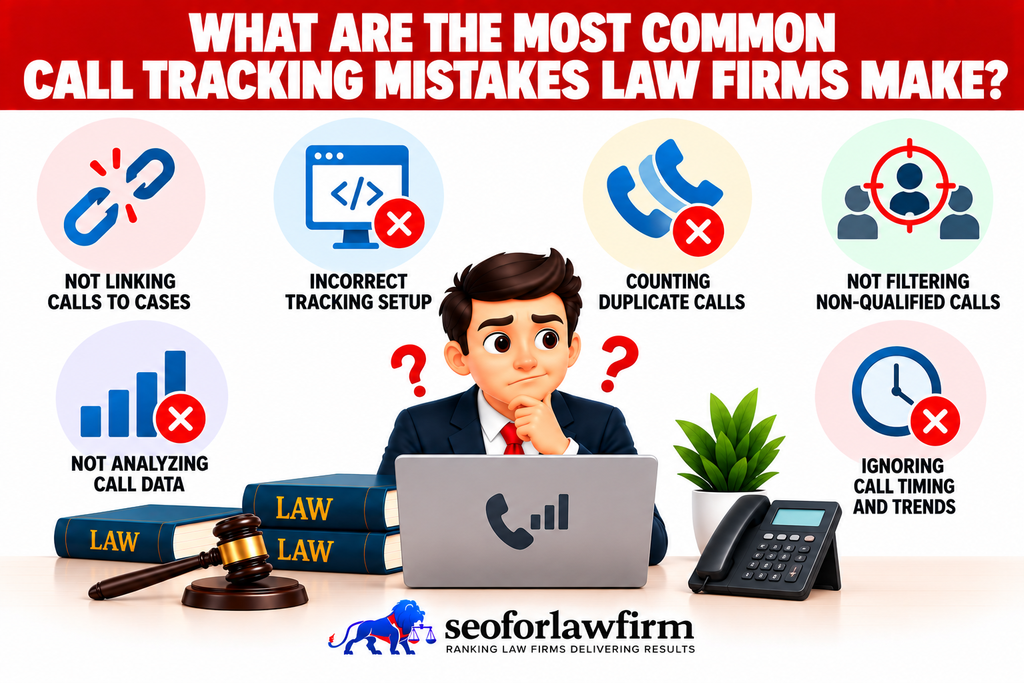
The most common call tracking mistakes law firms make are losing source attribution, counting every call as a lead, failing to connect the CRM, and measuring cost per call instead of cost per signed case. These mistakes distort marketing performance because call volume does not show whether callers qualify, schedule consultations, retain the firm, or generate revenue.
Law firms need attribution systems that preserve marketing-source information throughout intake and connect phone activity with practice area, lead quality, sound matters, and financial outcomes.
Listed below are 9 common call tracking mistakes.
- Using One Phone Number Across Every Marketing Channel: The firm loses source-level attribution across SEO, PPC, directories, offline advertising, and other campaigns.
- Failing to Connect Call Tracking With the CRM: Attribution stops at the phone call instead of continuing through consultation and retention.
- Treating Every Call as a Qualified Lead: Spam, vendors, existing clients, wrong numbers, and unsuitable inquiries inflate lead counts.
- Ignoring Practice Area: The firm loses visibility into which legal services generate profitable matters.
- Ignoring Missed Calls: Marketing reporting shows generated demand without exposing intake losses.
- Relying Only on Call Duration: A long call does not automatically represent a qualified or valuable lead.
- Using Incorrect DNI Pool Sizes: Insufficient tracking numbers reduce session-level attribution accuracy.
- Using Conflicting Attribution Rules: Different reporting models create inconsistent channel-performance results.
- Measuring Cost per Call Instead of Cost per Signed Case: Low-cost calls can appear efficient even when few callers retain the firm.
Where Do Law Firms Get Professional Call Tracking Software and Setup Services?
Law firms can get professional call tracking software and setup support from experienced legal marketing providers such as SEOForLawFirm.com , along with established call tracking platforms such as CallRail, CallTrackingMetrics, WhatConverts, Juryo, and Perspective AI. SEOForLawFirm connects call tracking with PPC, Local Services Ads, SEO, website analytics, CRM workflows, intake data, and conversion reporting so law firms measure phone leads through qualification, consultation, signed-case, and revenue outcomes. CallRail focuses on marketing attribution, Dynamic Number Insertion, call routing, recordings, conversation intelligence, and CRM integrations, while CallTrackingMetrics and WhatConverts provide attribution and lead-tracking capabilities across marketing channels. SEOForLawFirm’s call tracking and analytics for law firms connects source attribution, routing, and outcome reporting within the firm’s acquisition measurement process.
Juryo and Perspective AI place greater emphasis on AI-assisted intake, qualification, and conversational routing. The appropriate system depends on the firm’s acquisition model because PPC-heavy firms need campaign and signed-case attribution, multi-location firms need office-level routing and reporting, and firms losing after-hours inquiries need missed-call recovery or continuous intake coverage.
How Do Call Tracking Services Differ From Call Tracking Solutions?
Call tracking services provide basic phone-source and call-volume measurement, while full call tracking solutions connect attribution with routing, AI analysis, CRM records, signed cases, and revenue. A basic service answers how many calls the firm received and where some of those calls originated. A full solution follows the caller through the wider acquisition process and measures what happened during intake, whether the prospect retained the firm, and what financial return resulted from the matter.
The table below shows the differences between basic call tracking services and full call tracking solutions.
| Function | Basic Call Tracking Service | Full Call Tracking Solution |
| Tracking numbers | Yes | Yes |
| Call volume reporting | Yes | Yes |
| Dynamic Number Insertion | Limited or plan-dependent | Yes |
| Campaign attribution | Basic | Detailed |
| Keyword attribution | Limited | Available where source data supports it |
| Call recording | Often available | Yes |
| AI transcription | Limited | Available |
| AI conversation analysis | Limited | Available |
| Practice-area routing | Basic | Advanced |
| Automated missed-call follow-up | Limited | Available |
| CRM integration | Limited | Yes |
| Signed-case attribution | Limited | Yes with CRM workflow |
| Revenue attribution | Limited | Yes with connected outcome data |
