

SEO tools for law firms are software platforms used to research legal search demand, analyze competitors, and monitor organic or local visibility. SEO tools also identify technical website problems, manage reviews and listings, and measure whether search traffic produces prospective clients.
Law firm SEO requires more than one type of software because organic rankings, Google Maps visibility, website health, client reviews, and lead measurement use different data sources. A legal practice combines first-party Google platforms with specialist SEO software rather than relying on one all-in-one product.
Keyword and competitor research tools such as Semrush and Ahrefs help law firms discover service-based and local searches such as “personal injury lawyer near me,” compare competing domains, inspect ranking gaps, review backlinks, and monitor keyword positions.
Local SEO tools such as BrightLocal and Whitespark measure visibility across specific geographic areas. Grid-based tracking matters for law firms because local results change according to the searcher’s location rather than producing one fixed citywide ranking. BrightLocal’s Local Search Grid, for example, measures rankings from multiple points on a map and displays competing businesses at individual grid points.
Technical SEO tools serve a different function. Google Search Console reports how a website performs in Google Search through clicks, impressions, CTR, average position, queries, pages, devices, and related Search data. Screaming Frog crawls a website directly to find problems involving broken links, redirects, metadata, directives, duplicate pages, structured data, JavaScript rendering, and other technical elements.
A study by BrightLocal from the BrightLocal Legal Marketing Insight Report titled Local SEO Tools and Ranking Factors for Law Firms in 2026 (published on March 11, 2026) confirms that SEO tools for law firms are software platforms used to research legal search demand, analyze competitors, and monitor organic or local visibility. The empirical research outlines that law firm SEO requires multiple types of software because organic rankings, Google Maps visibility, website health, client reviews, and lead measurement use different data sources.
Reputation and listing platforms such as Birdeye and Synup help firms monitor reviews, respond to feedback, and manage local business information across locations and publishing platforms. Reviews deserve attention because Google identifies relevance, distance, and prominence as the main local-ranking dimensions and states that review quantity and positive ratings contribute to prominence.
The right law firm SEO stack depends on practice areas, number of offices, geographic markets, internal expertise, reporting needs, and budget. Software provides measurement and research; rankings and client acquisition depend on how accurately a law firm turns that data into website, local-search, content, and reputation improvements.
Table of Contents
- Article sections will appear here.
What Are SEO Tools for Law Firms?
SEO tools for law firms collect and analyze search, website, local, backlink, and client-acquisition data. Google Search Console shows how the firm appears in Google Search, which queries generate impressions and clicks, which pages gain or lose visibility, and which URLs face indexing problems. Google Analytics 4 measures what users do after arriving on the website, including traffic sources, forms, calls, and other tracked actions.
Semrush and Ahrefs provide third-party data for keyword research, competitor analysis, backlink review, rank tracking, and site auditing. BrightLocal and Whitespark focus more heavily on location-sensitive search performance. Birdeye and Synup support reviews, listings, reputation, and multi-location management. Law firms must choose SEO tools based on the specific marketing problem they need to measure rather than pay for several platforms that duplicate the same function.
What Are the Main Categories of SEO Tools for Law Firms?
The main categories of SEO tools for law firms are keyword and competitor research, local SEO and map tracking, technical SEO auditing, reputation and review management, analytics and lead measurement, and backlink research.
The table below shows the main law firm SEO tool categories and the work each category performs.
| SEO Tool Category | Main Function | Example Tools | Law Firm Use |
| Keyword and competitor research | Finds queries, ranking gaps, competitors, and search opportunities | Semrush, Ahrefs | Practice-area research, local terms, competitor gaps |
| Local and Map Pack SEO | Measures location-sensitive rankings and business listings | BrightLocal, Whitespark | Map visibility, local rank grids, citations, multi-location tracking |
| Technical SEO | Crawls pages and identifies indexing or site problems | Google Search Console, Screaming Frog | Crawlability, indexing, redirects, directives, Core Web Vitals diagnostics |
| Reputation and reviews | Monitors, requests, organizes, and responds to reviews | Birdeye, Synup | Reputation monitoring, review workflows, multi-office management |
| Analytics and measurement | Measures visits, events, search performance, and leads | GA4, Search Console | Organic traffic, queries, key events, landing pages |
| Backlink research | Measures referring domains and competitor link profiles | Ahrefs, Semrush | Link research, competitor analysis, outreach planning |
What Are the Best SEO Tools for Law Firms?
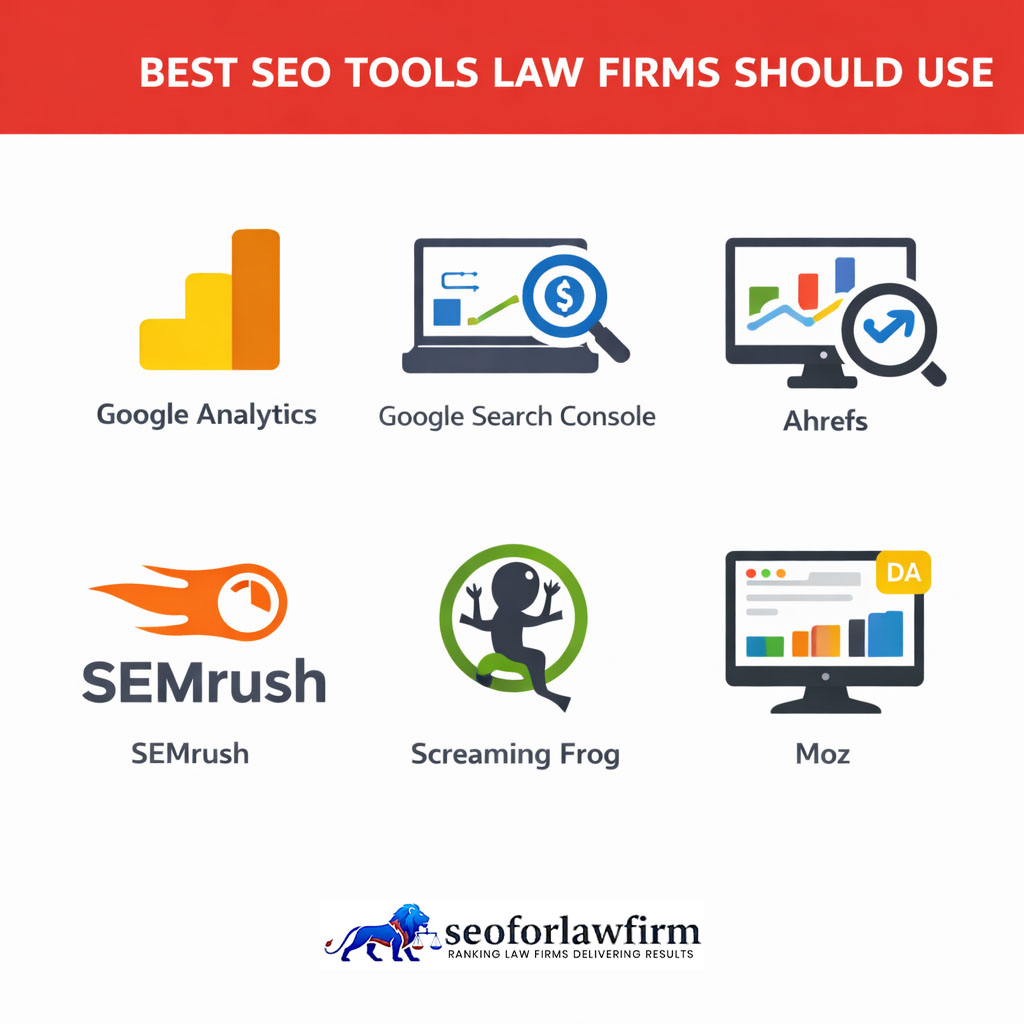
The SEO tools most useful to law firms include Google Search Console, Google Analytics 4, Semrush, Ahrefs, BrightLocal, Whitespark, Birdeye, and Synup. These platforms cover different parts of law firm SEO, including organic search measurement, keyword research, competitor analysis, backlinks, technical auditing, local visibility, listings, reviews, and client-acquisition tracking.
Law firms must compare tools within the same functional category because the platforms do not perform identical jobs. A suitable tool stack combines first-party Google data with competitive research, technical diagnostics, local-search measurement, and reputation management without paying for unnecessary overlapping features.
Listed below are the 10 main SEO tools law firms use.
- 1. Google Search Console: Measures Google Search clicks, impressions, CTR, average position, queries, pages, and indexing information.
- 2. Google Analytics 4: Measures website acquisition, landing-page behavior, events, conversions, and lead-related user actions.
- 3. Semrush: Supports keyword research, competitor analysis, position tracking, site auditing, and broader SEO research.
- 4. Ahrefs: Supports keyword research, backlink analysis, content-gap research, rank tracking, competitive analysis, and site auditing.
- 5. BrightLocal: Tracks local rankings, geographic grid visibility, competitors, listings, and other local SEO data.
- 6. Whitespark: Supports local rank tracking, geographic ranking grids, citation research, and local-search analysis.
- 7. Screaming Frog SEO Spider: Crawls law firm websites to identify broken links, redirects, metadata problems, indexing directives, duplicate content, and structured-data issues.
- 8. Google Business Profile: Manages how eligible law firm locations appear across Google Search and Maps and reports interactions such as calls, directions, and website clicks.
- 9. Birdeye: Centralizes review monitoring, responses, reporting, and reputation-management workflows across one or several locations.
- 10. Synup: Supports business listings, review monitoring, local visibility, and location-based reputation management.
1. Google Search Console
Google Search Console gives law firms first-party data about how their website performs in Google Search. The platform reports clicks, impressions, CTR, average position, queries, and landing pages. Law firms use the Performance report to identify which practice areas and legal topics generate organic visibility.
The Page Indexing report helps identify URLs that Google has indexed or excluded. URL Inspection provides page-level information about crawling, indexing, and canonical selection. Search Console works best as the primary source for measuring actual Google Search visibility.
2. Google Analytics 4
Google Analytics 4 measures what users do after they reach a law firm website. The platform tracks traffic acquisition, landing-page behavior, events, conversions, and other user actions. Law firms measure contact-form submissions, consultation requests, phone interactions, and other defined lead events.
GA4 also helps compare organic search with paid search, direct traffic, referrals, and other acquisition channels. Landing-page reports show which legal pages attract visitors who progress toward conversion. Firms must connect GA4 data with intake or CRM outcomes when they need to measure qualified leads and signed matters.
3. Semrush
Semrush supports keyword research, competitor analysis, position tracking, technical auditing, and content research. Law firms compare their keyword footprint with competing websites and identify missing or weak search opportunities. Position Tracking monitors selected legal queries across defined geographic markets.
Site Audit identifies technical problems that affect crawling, indexing, links, metadata, and page performance. Competitor research reveals practice areas and informational topics receiving visibility across relevant SERPs. Semrush data must be treated as third-party estimates and validated with first-party Search Console and conversion data.
4. Ahrefs
Ahrefs supports keyword research, backlink analysis, content-gap analysis, competitive research, rank tracking, and technical auditing. Law firms use Content Gap to find searches competitors rank for that the firm does not adequately cover. Site Explorer shows backlinks, referring domains, competing pages, and organic keyword estimates.
Rank Tracker monitors selected legal queries across markets and devices. Site Audit identifies technical SEO problems across the website. Ahrefs is particularly useful when competitor visibility and backlink research form a large part of the firm’s SEO strategy.
5. BrightLocal
BrightLocal focuses on local SEO measurement for businesses that depend on geographic search visibility. Law firms use the platform to monitor local rankings across specific areas rather than rely on one city-wide position. Geographic grid tracking shows how visibility changes as the search location moves farther from an office.
BrightLocal also supports competitor analysis, citation monitoring, and local reporting. Multi-location firms compare performance among several eligible offices. The platform is most useful when Google Maps and local-pack visibility form a major part of client acquisition.
6. Whitespark
Whitespark provides tools for local rank tracking, geographic ranking grids, citation research, and local-search analysis. Law firms use its local ranking tools to measure visibility across different points within a target market. Citation research helps identify business directories, legal directories, and local sources where competitors maintain listings.
Firms also use citation data to find inaccurate or missing business information. Whitespark complements broader organic SEO tools because it focuses more heavily on local-search relationships. The platform is particularly relevant for firms serving defined cities, counties, or office markets.
7. Screaming Frog SEO Spider
Screaming Frog SEO Spider crawls law firm websites to identify technical SEO problems across large numbers of URLs. The crawler finds broken links, redirects, status-code errors, canonical issues, duplicate metadata, robots directives, and internal-link problems. Law firms also review heading structures, structured data, image files, and crawl depth.
Crawl data helps reveal how search-engine bots move through practice-area, attorney, location, and informational pages. The tool does not show which URLs Google has actually indexed, so firms must compare crawl findings with Search Console. Screaming Frog works best as part of a broader technical SEO audit process.
8. Google Business Profile
Google Business Profile manages how eligible law firm locations appear across Google Search and Maps. Firms maintain business names, addresses, telephone numbers, categories, hours, services, photos, and other location information. The platform also reports interactions such as calls, website clicks, direction requests, searches, and profile views.
Law firms must use accurate information that reflects the real-world business and each eligible office. Multi-location firms must manage each legitimate office as a distinct local entity when Google’s eligibility rules are satisfied. Google Business Profile forms a major part of local SEO for firms that depend on geographically specific client searches.
9. Birdeye
Birdeye supports review monitoring, responses, reporting, reputation workflows, and multi-location management. Law firms monitor client feedback across several platforms from one system. The platform helps teams organize review requests and maintain consistent response workflows.
Multi-office firms compare reputation activity across individual locations. Review data also reveal recurring client-service themes that affect brand perception. Firms must still apply professional-conduct and confidentiality rules when requesting or responding to legal-service reviews.
10. Synup
Synup supports business listings, review monitoring, local visibility, and location-based reputation management. Law firms use the platform to maintain business information across several listing and directory environments. Listing management helps identify inconsistent names, addresses, telephone numbers, websites, and other business data.
Review monitoring allows firms to track reputation activity across supported platforms. Multi-location practices manage several office records through a centralized workflow. Synup is most useful when citation consistency, local listings, and reputation management require ongoing coordination.
How Can You Develop an SEO Strategy for a Law Firm?
To develop an SEO strategy for a law firm, start by auditing your website, researching target keywords, creating a content roadmap, and strengthening technical performance. A structured approach ensures that your SEO efforts attract qualified leads, improve rankings, and deliver measurable results.
Listed below are the 6 essential steps to build a successful law firm SEO strategy.
- Audit the Website: Assess site structure, load speed, mobile responsiveness, and on-page SEO elements.
- Perform Keyword Research: Identify high-value legal service keywords and local search phrases that align with client intent.
- Create a Content Plan: Develop service pages, blogs, FAQs, and resource content that answer client questions.
- Optimize Technical SEO: Fix crawl errors, improve Core Web Vitals, and add structured data for better indexation.
- Build Quality Backlinks: Earn links from trusted legal directories, guest posts, and local authority sites.
- Track and Measure Results: Use Google Analytics, Search Console, and SEO dashboards to monitor traffic, conversions, and ROI.
A well-structured SEO plan ensures that consistent optimization strengthens visibility, authority, and client acquisition across every legal practice area.
What Features Should Law Firms Look for in SEO Software?
Law firms should look for SEO software features that match their practice areas, geographic markets, office structure, reporting needs, and client-acquisition workflow. The software must help the firm research legal search demand, monitor competitors, track local visibility, identify technical problems, analyze backlinks, manage reviews and listings, and connect search performance with lead activity.
A solo attorney with one office needs a different toolset from a multi-state firm managing several practice areas and locations. Law firms must therefore compare software according to the functions they actually need rather than the total number of features included.
Listed below are 10 useful SEO software features for law firms.
- Keyword Research: Finds practice-area, problem-based, informational, and local legal searches relevant to prospective clients.
- Competitor Analysis: Compares competing law firms’ rankings, pages, keywords, and organic search visibility.
- Local Rank Tracking: Measures search visibility from specific cities, ZIP codes, neighborhoods, or geographic grid points.
- Technical Crawling: Identifies broken links, redirects, robots directives, duplicate pages, canonical issues, and site-architecture problems.
- Indexing Diagnostics: Shows whether important practice-area, attorney, location, and content pages are available for crawling and indexing.
- Backlink Research: Measures referring domains, backlinks, competitor link profiles, and potential link-acquisition opportunities.
- Review Monitoring: Centralizes client reviews and supports organized monitoring and response workflows.
- Listing Management: Tracks and manages law-firm business information across supported directories, maps, and publishers.
- Analytics Integration: Connects search visibility with website visits, calls, forms, consultations, and other lead actions.
- Reporting and Exports: Produces usable performance reports for attorneys, marketers, managers, agencies, and multi-location teams.
How Much Do SEO Tools for Law Firms Cost?
SEO tools for law firms cost from $0 for free Google platforms to about $129–$139 per month for major paid SEO suites, while specialized local and technical tools start lower or use annual or quote-based pricing. Total cost depends on tracked keywords, locations, projects, crawl limits, users, and feature access. A solo law firm operates with several free tools and one paid platform, while multi-location firms require larger subscriptions for local tracking, competitive research, technical auditing, and reputation management.
The table below shows the listed starting costs for selected SEO tools.
| Tool | Public Starting Cost | Main Function |
| Google Search Console | $0 | Google Search performance and indexing data |
| Google Analytics 4 | $0 for standard GA4 | Website acquisition and key-event measurement |
| Ahrefs Lite | $129/month | Keywords, backlinks, competitors, auditing, and rank tracking |
| Semrush SEO | About $139/month on monthly billing | Keyword research, competitor analysis, rank tracking, and auditing |
| BrightLocal Track | $41/month for 1 location | Local rankings and local SEO measurement |
| Whitespark Local Rank Tracker | From $14/month billed annually | Local keyword and location rank tracking |
| Screaming Frog SEO Spider | Free up to 500 URLs; €245/year paid licence | Technical crawling and website auditing |
| Birdeye | Quote-based | Reviews and reputation management |
Which SEO Tool Stack Fits a Solo Law Firm?
A solo law firm must use an SEO tool stack that covers first-party search measurement, website analytics, local visibility, competitor research, and technical diagnostics without paying for several overlapping subscriptions. Google Search Console, Google Analytics 4, and Google Business Profile provide the core first-party data. BrightLocal or Whitespark add local ranking and citation visibility.
Semrush or Ahrefs support competitor and keyword research when the firm needs that level of analysis. Screaming Frog handles periodic technical crawls. This lean structure gives a solo attorney enough data to manage search visibility and client acquisition without unnecessary software duplication.
Listed below are the 6 main tools for a solo law firm SEO stack.
- Google Search Console: Tracks organic queries, clicks, impressions, average position, pages, and indexing information.
- Google Analytics 4: Measures website traffic, landing-page behavior, events, forms, calls, and other tracked actions.
- Google Business Profile: Manages the firm’s local presence across Google Search and Maps.
- BrightLocal or Whitespark: Tracks local rankings, geographic visibility, citations, and local-search performance.
- Semrush or Ahrefs: Supports keyword research, competitor analysis, backlink research, and content-gap analysis when regular competitive research is needed.
- Screaming Frog: Crawls the website to identify broken links, redirects, canonical issues, metadata problems, directives, and other technical SEO issues.
Where Can Law Firms Access Ahrefs’ Competing Pages Report?
Law firms can access Ahrefs’ Competing Pages report inside the Site Explorer tool, which compares your domain with competitors to reveal overlapping and missing keywords. This report uncovers which rival pages generate the most organic traffic, helping firms identify content opportunities and strengthen keyword targeting.
Listed below are the 4 ways to access Ahrefs’ Competing Pages report.
- Perform Keyword Gap Analysis: Discover topics competitors rank for that your firm doesn’t.
- Plan Content Strategically: Prioritize new pages around high-performing competitor keywords.
- Benchmark Traffic Potential: Understand which pages drive the most visibility in your practice area.
- Refine SEO Campaigns: Focus on filling topical gaps to increase search presence and client reach.
By leveraging Ahrefs’ Competing Pages, law firms gain actionable insights to guide content strategy, keyword expansion, and competitive growth in search rankings.
Which SEO Tool Stack Fits a Multi-Location Law Firm?
A multi-location law firm needs an SEO tool stack that separates performance by office, geographic market, practice area, and lead source. The stack must combine first-party search and analytics data with local rank tracking, Google Business Profile management, listings, reviews, competitor research, technical crawling, and CRM attribution.
Multi-location firms must also compare pricing by location because software costs rise substantially as the number of offices, tracked keywords, users, and reporting requirements increases. A tool that fits one office becomes inefficient or expensive when the firm manages 20 or 50 locations.
Listed below are the 10 main functions a multi-location law firm SEO stack must cover.
- Search Performance by Practice Area: Track impressions, clicks, rankings, and conversions for major practice-area pages.
- Local Grid Tracking by Office: Measure local search visibility around each eligible office using geographic grid data.
- Google Business Profile Performance: Monitor calls, website clicks, directions, searches, and other profile interactions by location.
- Business-Listing Management: Maintain accurate office names, addresses, phone numbers, websites, hours, and other business data across supported platforms.
- Review Monitoring Across Offices: Track reviews, ratings, responses, and reputation trends separately for each location.
- Competitor Research by Market: Compare each office with law firms competing in the same geographic and practice-area search results.
- Technical Crawling: Audit large websites for broken links, redirects, canonicals, indexing directives, duplicate pages, and architecture problems.
- Organic Lead Attribution: Connect organic landing pages and search channels with calls, forms, consultations, and other lead actions.
- Qualified-Lead Reporting: Separate raw enquiries from leads that meet the firm’s practice-area and jurisdiction criteria.
- Signed-Matter Reporting: Connect SEO visibility and lead sources with retained clients and attributable business outcomes.
Do SEO Tools Directly Improve Law Firm Rankings?
No, SEO tools do not directly improve law firm rankings. SEO tools collect data, identify problems, and guide decisions about website structure, content, backlinks, business profiles, and reputation.
Ahrefs reveals backlink opportunities, Semrush identifies keyword and competitor gaps, Screaming Frog finds redirect or technical issues, and local rank trackers measure geographic visibility. Ranking improvements come from the actions a law firm takes after analyzing that data. Third-party metrics such as Ahrefs Domain Rating and Moz Domain Authority also remain proprietary vendor measurements rather than Google ranking metrics.
Do Law Firms Need Structured-Data Tools?
Yes, law firms benefit from structured-data tools that validate markup and identify implementation errors, but structured data does not provide a generic ranking increase. Google uses structured data to interpret page information and determine eligibility for supported Search features. A schema markup strategy for law firms therefore needs to focus on accurate machine-readable information rather than treating schema as a ranking shortcut.
Valid markup does not guarantee that Google will display those features. Law firms must use schema to describe visible entities and content accurately rather than treat markup as a ranking shortcut. Technical SEO tools such as Screaming Frog also inspect structured data across many URLs and identify missing, invalid, or inconsistent implementations.
How Do Law Firms Measure the ROI of SEO Tools?
Law firms measure the ROI of SEO tools by connecting software costs with search visibility, organic traffic, qualified leads, signed matters, and attributable financial outcomes. Rankings alone do not establish ROI because software creates value only when the data leads to actions that improve client acquisition or operational efficiency. A law firm SEO results tracking framework connects software metrics with qualified leads and signed matters rather than ending measurement at ranking position.
A useful measurement path is Search Visibility → Organic Visit → Lead Action → Qualified Consultation → Signed Matter → Revenue or Gross Profit. Google Search Console measures impressions, clicks, queries, pages, CTR, and average position, while GA4 measures website acquisition and configured business actions. Call tracking, intake systems, CRM records, case-management software, and financial data then connect organic search activity with retained clients and revenue. Law firms must also consider reporting time saved, audit efficiency, and duplicate subscriptions when evaluating the financial value of an SEO tool stack.
The table below shows the main measurement layers for law firm SEO software ROI.
| Measurement Layer | Example Metrics |
| Search Visibility | Impressions, organic clicks, ranking trends |
| Local Visibility | Geographic grid coverage, Maps positions, profile visibility |
| Website Acquisition | Organic sessions, landing-page traffic |
| Lead Generation | Calls, forms, chats, consultation requests |
| Lead Quality | Qualified enquiries, accepted matters |
| Business Outcomes | Signed matters, attributable revenue, gross profit |
| Tool Efficiency | Reporting time saved, audit time saved, duplicate subscriptions removed |
A practical calculation is SEO Tool Stack ROI = ((SEO-attributed gross profit − SEO tool costs) ÷ SEO tool costs) × 100. A broader SEO ROI calculation must also account for content production, development, local SEO work, link acquisition, staff time, and other program costs when evaluating the complete SEO investment.
How Do Law Firms Choose the Right SEO Stack?
Law firms choose the right SEO stack by defining the decisions they need data to support and selecting the smallest set of platforms that covers those needs without unnecessary feature overlap. The stack must reflect the firm’s practice areas, geographic markets, office locations, SEO workflows, reporting requirements, and client-acquisition process.
First-party platforms such as Google Search Console, GA4, Google Business Profile, and internal lead data must form the measurement foundation. Paid tools must fill specific gaps in competitor research, local rank tracking, technical crawling, citation management, backlinks, or reputation monitoring. Each subscription must have a defined role and produce data that improves SEO decisions, operational efficiency, lead measurement, or client acquisition.
Listed below are the 7 steps for selecting law firm SEO tools.
- Define the Search Markets: Identify the practice areas, cities, states, and office locations that require search-performance measurement.
- List the SEO Workflows: Separate keyword research, competitor analysis, local SEO, technical auditing, backlinks, reviews, analytics, and reporting into distinct functions.
- Identify First-Party Data Sources: Start with Google Search Console, GA4, Google Business Profile, call tracking, CRM data, and other internal performance sources.
- Find Measurement Gaps: Determine whether the firm still needs competitor databases, geographic ranking grids, technical crawlers, citation tools, or reputation platforms.
- Compare Usage Limits: Review tracked keywords, projects, locations, users, crawl allowances, exports, historical data, and other subscription limits.
- Remove Duplicate Subscriptions: Avoid paying for several platforms when they primarily perform the same keyword, backlink, or ranking function.
- Measure Business Outcomes: Retain tools that improve decision quality, save meaningful staff time, strengthen lead attribution, or support qualified leads and signed matters.
What SEO Tools Matter Most for Local Law Firms?
Local law firms need SEO tools that measure organic search performance, Google Maps visibility, competitor visibility, and client actions. A practical tool stack must combine first-party Google data with local rank tracking, competitive research, technical crawling, and reputation management.
Google Business Profile remains central because it manages the firm’s presence across Google Search and Maps and reports local interactions. Local SEO tools such as BrightLocal or Whitespark add geographic ranking data that broader organic trackers do not measure in the same way. Law firms must choose platforms according to the number of offices, target markets, reporting needs, and client-acquisition workflow.
Listed below are the 7 main SEO tools for local law firms.
- Google Search Console: Measures organic queries, clicks, impressions, CTR, landing pages, and indexing information.
- Google Analytics 4: Measures website acquisition, user behavior, forms, calls, and other configured lead actions.
- Google Business Profile: Manages local business information and reports calls, website clicks, directions, searches, and profile interactions.
- BrightLocal or Whitespark: Tracks location-sensitive rankings, geographic grid visibility, competitors, citations, and local-search performance.
- Semrush or Ahrefs: Supports keyword research, competitor analysis, content-gap research, backlinks, and broader organic SEO analysis.
- Screaming Frog: Crawls the website to identify broken links, redirects, canonicals, metadata problems, indexing directives, and site-architecture issues.
- Birdeye or Synup: Supports review monitoring, listing management, reputation workflows, and multi-location management when the firm needs dedicated local operations software.
What SEO Tools Help Law Firms With Keyword and Competitor Research?
Semrush and Ahrefs help law firms research legal keywords, compare competing domains, identify content gaps, analyze backlinks, and track organic search positions. Law firms must evaluate keywords according to legal service, jurisdiction, prospective-client intent, and business relevance rather than search volume alone.
Competitor research reveals queries where competing firms rank while the analyzed law firm does not rank or holds a weaker position. Keyword gap analysis for a law firm then separates missing terms, weak rankings, local opportunities, service gaps, and informational topics before content changes are made. Third-party keyword databases provide estimated competitive data, while Google Search Console provides first-party evidence about the queries that actually generate impressions and clicks for the firm’s website.
Listed below are the 9 main tools and uses for law firm keyword and competitor research.
- Semrush: Supports keyword research, competitor analysis, keyword-gap analysis, position tracking, backlink research, and site auditing.
- Ahrefs: Supports Keywords Explorer, Content Gap, competitor research, backlink analysis, Rank Tracker, and Site Audit.
- Google Search Console: Shows the actual Google queries, impressions, clicks, CTR, pages, and average positions associated with the law firm’s website.
- Keyword Gap Analysis: Compares the firm with competitors to identify missing keywords, weak rankings, service gaps, local opportunities, and relevant informational searches.
- Local Keyword Research: Identifies searches such as “car accident lawyer Dallas,” “DUI attorney near me,” and “child custody attorney Phoenix” that combine legal services with geographic intent.
- Competitor Page Analysis: Shows which competitor pages earn visibility for target legal queries and helps determine whether the firm needs a new page, stronger existing content, or better intent alignment.
- Backlink Analysis: Identifies websites linking to competitors and reveals authority-building opportunities relevant to the firm’s practice areas.
- Rank Tracking: Monitors selected legal queries over time to determine whether optimization work improves organic visibility.
What SEO Tools Help Law Firms Track Local and Map Pack Visibility?
Semrush and Ahrefs help law firms research legal keywords, compare competing domains, identify content gaps, analyze backlinks, and track organic search positions. Law firms must evaluate keywords according to legal service, jurisdiction, prospective-client intent, and business relevance rather than search volume alone. Competitor research reveals queries where competing firms rank while the analyzed law firm does not rank or holds a weaker position. A broader local SEO strategy for law firms connects these measurements with legitimate office information, service relevance, reviews, citations, website content, and Google Business Profile management.
Law firms requiring more granular measurement across neighborhoods and office service areas use a local SEO rank-tracking framework rather than treating one citywide ranking as the complete picture.
Keyword gap analysis then separates missing terms, weak rankings, local opportunities, service gaps, and informational topics before content changes are made. Third-party keyword databases provide estimated competitive data, while Google Search Console provides first-party evidence about the queries that actually generate impressions and clicks for the firm’s website.
Listed below are the 8 main tools and uses for law firm keyword and competitor research.
- Semrush: Supports keyword research, competitor analysis, keyword-gap analysis, position tracking, backlink research, and site auditing.
- Ahrefs: Supports Keywords Explorer, Content Gap, competitor research, backlink analysis, Rank Tracker, and Site Audit.
- Google Search Console: Shows the actual Google queries, impressions, clicks, CTR, pages, and average positions associated with the law firm’s website.
- Keyword Gap Analysis: Compares the firm with competitors to identify missing keywords, weak rankings, service gaps, local opportunities, and relevant informational searches.
- Local Keyword Research: Identifies searches such as “car accident lawyer Dallas,” “DUI attorney near me,” and “child custody attorney Phoenix” that combine legal services with geographic intent.
- Competitor Page Analysis: Shows which competitor pages earn visibility for target legal queries and helps determine whether the firm needs a new page, stronger existing content, or better intent alignment.
- Backlink Analysis: Identifies websites linking to competitors and reveals authority-building opportunities relevant to the firm’s practice areas.
- Rank Tracking: Monitors selected legal queries over time to determine whether optimization work improves organic visibility.
What Is the Difference Between Google Business Profile Performance and a Local Rank Tracker?
Google Business Profile Performance measures how users interact with the firm’s Business Profile, while a local rank tracker measures where the profile appears for selected searches from defined geographic locations. Google Business Profile reports actions such as views, searches, direction requests, call-button clicks, website clicks, messages, and supported bookings.
Local rank trackers such as BrightLocal or Whitespark measure geographic visibility for target queries like “divorce lawyer” or “car accident attorney” across different map points. Law firms need both because profile visibility and profile interaction represent different stages of local search performance. A firm may rank well in one area but receive few interactions, or rank weakly in another area despite having a well-optimized profile.
The table below shows the difference between Google Business Profile Performance and a local rank tracker.
| Measurement Area | Google Business Profile Performance | Local Rank Tracker |
| Primary Purpose | Measures user interactions with the Business Profile | Measures local ranking visibility for selected queries |
| Profile Views | Tracks profile visibility and views | Does not measure profile interactions directly |
| Searches | Reports searches associated with profile discovery | Tracks ranking positions for selected search terms |
| Calls | Measures clicks on the call button | Does not confirm call activity |
| Website Clicks | Measures clicks from the profile to the website | Does not measure website clicks |
| Direction Requests | Measures requests for directions to the business | Does not measure direction activity |
| Messages and Bookings | Reports supported profile interactions where available | Does not measure these actions |
| Geographic Ranking | Does not provide detailed ranking grids | Measures rankings from specific cities, ZIP codes, neighborhoods, or grid points |
| Competitor Visibility | Limited for direct ranking comparison | Can compare the firm’s local rankings with competitors |
| Best Use | Measure what users do after finding the profile | Measure where and how consistently the firm appears in local search |
What SEO Tools Help Law Firms Find Technical Website Problems?
Google Search Console and Screaming Frog help law firms identify technical problems affecting crawling, indexing, website architecture, metadata, redirects, and page performance.
Search Console reports information from Google’s perspective. Its reports expose Search performance, indexing information, structured-data problems for supported features, manual actions, security issues, and other Google-specific signals.
Screaming Frog performs a direct crawl of the website. Its SEO Spider identifies broken links, status codes, redirects, metadata, directives, exact and near-duplicate pages, structured data, JavaScript-rendered content, and other technical elements. The free version crawls up to 500 URLs, and the paid version currently costs €245 per year per licence.
A technical SEO audit for a law firm combines crawler output with Search Console data rather than assuming one tool detects every website problem.
What SEO Tools Help Law Firms Manage Reviews and Reputation?
Birdeye and Synup help law firms manage reviews and reputation by centralizing monitoring, responses, reporting, and multi-location workflows. Birdeye aggregates reviews from numerous supported review sites and provides a central dashboard for reputation management. Synup combines review management with business-listing management across connected platforms.
Review software supports both client acquisition and local search because prospective clients use reviews when evaluating a law firm, and review signals contribute to local prominence. Law firms must still follow platform rules when requesting reviews and must maintain internal procedures for client confidentiality, professional conduct, and jurisdiction-specific advertising requirements before responding publicly.
Listed below are the 9 main review and reputation functions law firms must consider.
- Review Monitoring: Track new reviews across supported platforms from one dashboard.
- Review Responses: Manage and publish responses to supported review sources.
- Review Reporting: Measure review volume, ratings, response activity, and reputation trends.
- Multi-Location Management: Separate review performance by office or geographic market.
- Review Collection: Request client feedback through compliant review-generation workflows without offering prohibited incentives.
- Listing Management: Keep business information consistent across supported directories and platforms.
- Reputation Analysis: Identify recurring themes in client feedback that affect brand perception and client acquisition.
- Local SEO Measurement: Monitor review signals that contribute to local prominence and local-search performance.
- Compliance Procedures: Protect client confidentiality and follow professional-conduct, advertising, and platform rules when responding to reviews.