
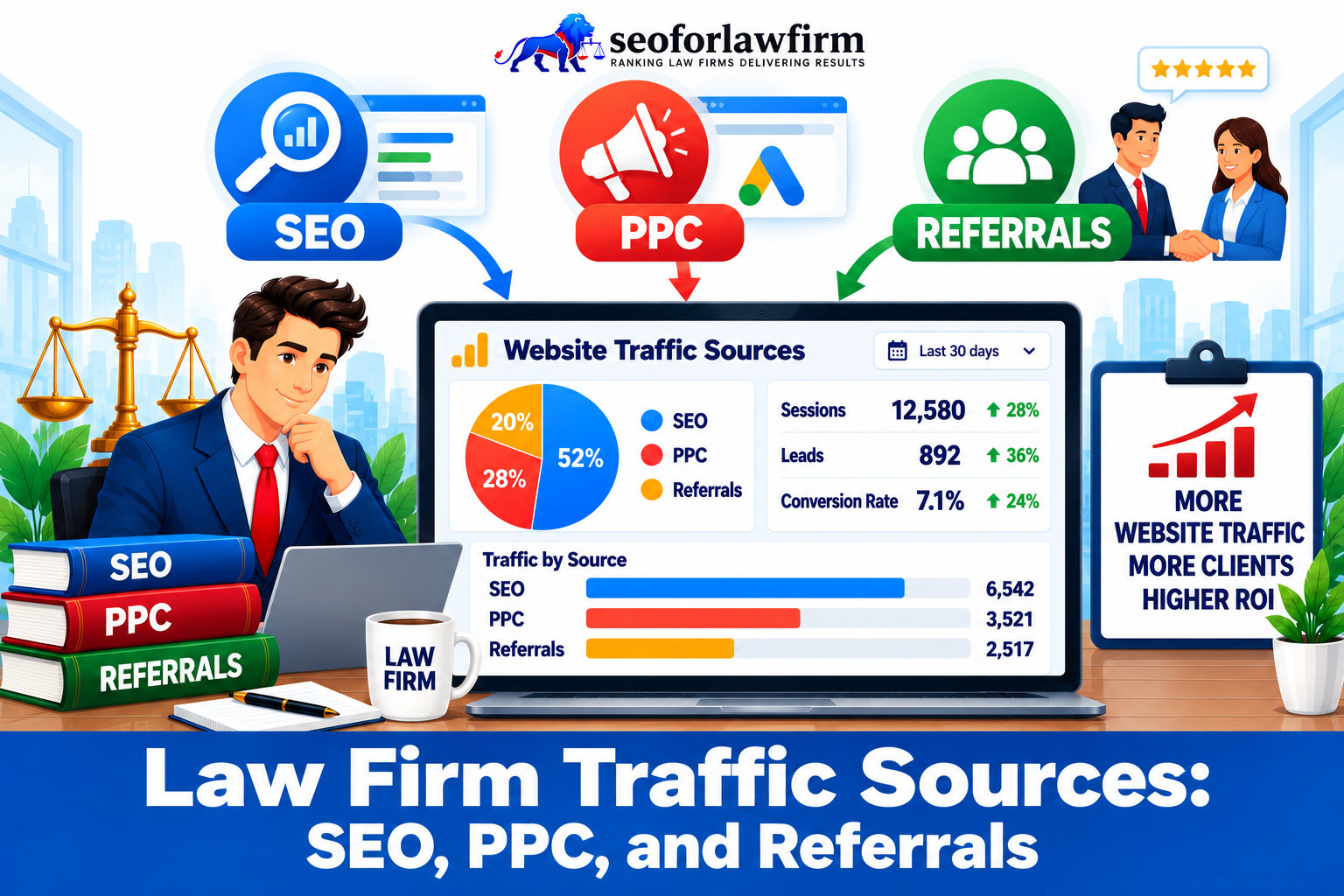
Law firm traffic relies on balancing Search Engine Optimization (SEO), Pay-Per-Click (PPC) advertising, and referral traffic to capture high-intent prospective clients across organic search, paid search, and trusted third-party websites. SEO builds organic visibility for practice-area, informational, and local legal searches by connecting relevant pages with the terms prospective clients use when researching legal problems or seeking representation. PPC places law firms in paid search positions for selected legal queries and gives firms control over targeting, budgets, landing pages, locations, and campaign timing. Referral traffic sends prospective clients from legal directories, media publications, professional associations, attorney networks, partner websites, and other external sources.
Each traffic source contributes differently to client acquisition. SEO develops organic search visibility that continues producing visits beyond individual advertising clicks, while PPC generates immediate exposure and requires continued media expenditure. Referral traffic introduces visitors through third-party sources that can transfer existing credibility and contextual relevance to the law firm.
Scientific evidence also supports combining organic and paid search visibility. A study by Sha Yang and Anindya Ghose titled Analyzing the Relationship Between Organic and Sponsored Search Advertising: Positive, Negative, or Zero Interdependence? in 2010 found that organic and paid search clicks positively influenced each other, while a controlled field experiment found significantly higher click-through rates, conversion rates, and revenue when paid and organic listings appeared together. Their economic model estimated that this interaction increased expected profits by approximately 4.2%–6.15% compared with scenarios without the interaction.
Law firms gain stronger acquisition insight when they connect SEO, PPC, and referral traffic with qualified leads, consultations, signed cases, acquisition costs, and attributable revenue instead of measuring website visits alone.
Table of Contents
- Article sections will appear here.
What Are the Main Traffic Sources for Law Firms?
The main traffic sources for law firms are organic search traffic, paid search traffic, and referral traffic, with direct, social, email, and video traffic acting as supporting acquisition channels.
Google Analytics 4 separates acquisition according to source and medium. Organic search represents unpaid search traffic, paid search represents visitors arriving through search advertising, and referral traffic represents visitors arriving through non-ad links on other websites or apps.
The table below shows the main traffic sources for law firms and their acquisition roles.
| Traffic Source | How Prospects Arrive | Primary Marketing Role | Common Law Firm Examples |
| SEO / Organic Search | Unpaid search results and local search results | Long-term search visibility and demand capture | Google organic results, local search, practice-area searches |
| PPC / Paid Search | Paid search advertisements | Immediate high-intent visibility | Google Ads search campaigns |
| Referral Traffic | Links on external websites | Third-party trust, visibility, and authority | Avvo, Justia, news publications, professional partners |
| Direct Traffic | Traffic with no identifiable referring source | Brand demand and unattributed visits | Typed URLs, bookmarks, untagged links |
| Social Traffic | Links on social platforms | Awareness, distribution, and remarketing support | LinkedIn, Facebook, Instagram |
| Video Traffic | Video platforms or embedded content | Education, brand exposure, and discovery | YouTube, TikTok, Vimeo |
SEO, PPC, and referrals deserve the greatest attention because they connect directly with search demand, paid acquisition, and third-party discovery.
How Does SEO Generate Traffic for Law Firms?
SEO generates traffic for law firms by increasing organic visibility for searches involving legal services, legal problems, geographic locations, and informational questions. Effective law firm SEO services connect practice-area pages, location pages, legal guides, and Google Business Profile optimization with the searches prospective clients use when seeking legal help.
Organic visibility also extends beyond traditional search results because local SEO supports visibility in Google Search and Maps through accurate business information, reviews, citations, website relevance, and external links. Google evaluates local search results primarily through relevance, distance, and prominence, which means a law firm’s website, Business Profile, reviews, links, and location information all contribute to local search visibility.
Listed below are 5 examples of searches law firm SEO targets.
- “personal injury lawyer near me”: Targets prospective clients looking for nearby personal injury representation.
- “DUI attorney Chicago”: Connects DUI legal services with a specific geographic market.
- “divorce lawyer in Miami”: Targets local family-law search demand.
- “how long do I have to file a car accident claim?”: Targets informational search intent related to legal deadlines and claims.
- “probate attorney near me”: Targets prospective clients seeking nearby probate legal services.
How Does Law Firm SEO Work?
Law firm SEO works by aligning website structure, legal content, local signals, technical performance, and external authority with the searches prospective clients use to find legal help. Effective local SEO strategies for law firms connect practice-area pages, location pages, Google Business Profile optimization, local citations, reviews, and geographic relevance with nearby legal search demand. Internal links connect related legal topics with priority service pages, while technical SEO supports crawling, indexing, page performance, and site architecture.
Google Business Profile, local citations, reviews, and relevant backlinks strengthen local visibility, business information, reputation signals, and external authority. Law firm SEO therefore focuses on attracting prospective clients whose legal problems, jurisdictions, case types, and search intent match the firm’s services rather than increasing traffic without regard to lead quality.
The table below shows the main elements of law firm SEO and their functions.
| SEO Element | Function |
| Practice-area pages | Target commercial searches for specific legal services |
| Location pages | Target city, county, and service-area search demand |
| Informational content | Capture research-stage legal questions |
| Internal linking | Connect related legal topics and priority pages |
| Technical SEO | Supports crawling, indexing, page performance, and site architecture |
| Mobile optimization | Supports prospective clients researching attorneys on mobile devices |
| Google Business Profile | Supports local search and Google Maps visibility |
| Local citations | Reinforce accurate and consistent business information |
| Reviews | Provide reputation and local prominence signals |
| Relevant backlinks | Build third-party authority and referral pathways |
What Are the Advantages and Disadvantages of SEO for Law Firms?
The main advantage of SEO for law firms is compounding organic visibility without a per-click advertising charge, while the main disadvantage is the time and ongoing investment required before competitive rankings produce consistent client opportunities. SEO shifts acquisition spending away from paying for every individual click and toward technical SEO, legal content production, local optimization, backlink acquisition, website improvements, conversion optimization, reporting, and maintenance.
Pages that earn stable rankings can continue attracting prospective clients over time, which gives SEO stronger long-term acquisition economics after visibility and authority accumulate. Law firm SEO retainers commonly range from approximately $2,000 to $10,000+ per month, with higher budgets associated with competitive practice areas, multiple locations, and larger markets.
Listed below are the 8 main advantages and disadvantages of SEO for law firms.
- Compounding organic visibility: Well-performing practice-area, location, and informational pages can continue generating search traffic over time.
- No per-click advertising charge: Organic search does not charge the firm each time a user clicks a search result.
- Long-term traffic potential: Rankings, content assets, local visibility, and backlinks can continue contributing to acquisition after the initial optimization work.
- Broader search coverage: SEO allows firms to target commercial, local, and informational legal searches across multiple stages of client research.
- Higher upfront and ongoing workload: Competitive SEO requires technical work, content, links, local optimization, conversion improvements, and measurement.
- Slower initial results: New or weak websites often need months of sustained work before rankings produce dependable enquiries.
- Competitive legal SERPs: High-value legal searches attract established law firms, directories, publishers, and other well-funded competitors.
- Ongoing maintenance requirements: Search visibility requires continued content updates, technical monitoring, link development, and adaptation as competitors and search results change.
How Does PPC Generate Traffic for Law Firms?
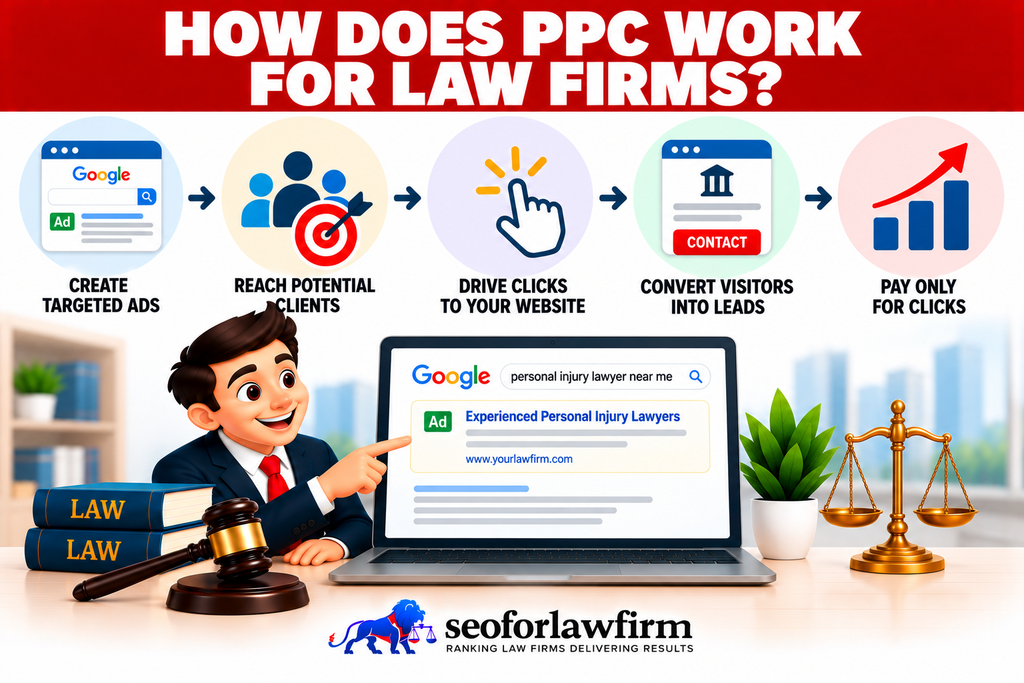
PPC generates traffic for law firms by placing paid advertisements in search results for selected legal keywords and charging the firm when a prospective client clicks the advertisement. Google Search Ads give law firms immediate visibility for high-intent legal queries, while a law firm PPC guide approach aligns keyword targeting, ad placement, bidding, and landing pages with prospective clients actively searching for legal representation.
Ad placement depends on factors such as bids, ad quality, landing-page quality, relevance, and competition. Personal injury firms can target searches such as “car accident lawyer near me,” while criminal defense firms can target searches involving DUI charges, arrests, criminal accusations, and legal representation.
Listed below are 5 common legal searches PPC campaigns target.
- Personal injury searches: “car accident lawyer near me,” “personal injury attorney,” and related case-specific queries.
- Criminal defense searches: Searches involving DUI charges, arrests, criminal allegations, and defense representation.
- Family law searches: Queries involving divorce, custody, child support, and related legal services.
- Estate-planning searches: Searches for wills, trusts, probate, and estate-planning attorneys.
- Other commercial legal searches: Queries showing an immediate intention to find and contact an attorney.
How Does PPC Work for Law Firms?
PPC works for law firms by matching legal keywords, geographic targeting, bids, advertisements, and landing pages with prospective clients searching for legal representation. A typical acquisition path follows Legal Search → Google Ad → Landing Page → Phone Call or Form → Intake → Consultation → Signed Case. Campaign performance depends on the quality and profitability of the resulting inquiries rather than click volume alone.
A campaign generating 1,000 inexpensive clicks with few qualified matters produces less business value than a campaign generating 300 higher-cost clicks that lead to profitable retained cases. Negative keywords also protect advertising budgets by filtering searches involving jobs, free advice, templates, definitions, opposing parties, irrelevant jurisdictions, and case types the firm does not handle.
Listed below are the 8 main components of a law firm PPC campaign.
- Keyword targeting: Selects legal searches that match the firm’s services.
- Geographic targeting: Limits advertising to relevant cities, regions, or jurisdictions.
- Bidding: Determines how much the firm is prepared to spend for targeted search opportunities.
- Ad copy: Communicates the legal service and directs users toward the appropriate landing page.
- Landing pages: Convert paid-search visitors into calls, forms, or consultations.
- Negative keywords: Exclude irrelevant searches that waste advertising spend.
- Intake tracking: Connects paid clicks with qualified leads, consultations, and signed cases.
- Revenue attribution: Measures whether retained matters justify campaign expenditure.
What Are the Advantages and Disadvantages of PPC for Law Firms?
The main advantage of PPC for law firms is immediate high-intent search visibility, while the main disadvantage is the recurring cost required to maintain clicks and lead generation. Paid campaigns can begin producing impressions and website visits once ads become eligible for the auction, but traffic declines when the campaigns stop serving. Legal advertising also carries relatively high acquisition costs.
The cited 2026 WordStream benchmark reports an average $9.87 cost per click and $131.63 cost per lead for Attorneys & Legal Services, compared with a $5.42 average CPC across all industries. Actual law firm costs vary according to practice area, market, competition, location, case value, landing-page performance, intake quality, and campaign management.
Listed below are the 10 main advantages and disadvantages of PPC for law firms.
- Immediate visibility: PPC places law firms in paid search results without waiting for organic rankings.
- High-intent targeting: Firms can target users actively searching for particular legal services.
- Geographic control: Campaigns can focus advertising on selected markets and jurisdictions.
- Measurable acquisition: Paid-search data connects spend with clicks, leads, consultations, and signed cases.
- Budget control: Firms can adjust bids, campaign budgets, and targeting according to performance.
- Recurring click costs: Each paid click consumes advertising budget.
- High legal-market competition: Competitive legal keywords often carry substantial CPC and lead costs.
- Traffic stops with spending: Paid visibility declines when campaign budgets or ads stop.
- Lead quality varies: High click or lead volume does not guarantee qualified or retained clients.
- Management requirements: Profitability depends on keyword selection, negative keywords, landing pages, bidding, attribution, and intake performance.
How Does Referral Traffic Generate Leads for Law Firms?
Referral traffic generates leads for law firms when prospective clients reach the firm’s website through links on third-party websites, directories, publications, professional organizations, or partner websites. Referral traffic differs from SEO because the visitor arrives through another website rather than directly from a search engine result. It also differs from traditional word-of-mouth referrals because analytics systems record referral traffic only when another website or app sends the visitor through a measurable link.
The table below shows common referral sources for law firms.
| Referral Source | Example |
| Legal directories | Avvo, Justia, FindLaw |
| Attorney referrals | Links from another law firm’s website |
| Professional organizations | Bar associations and industry organizations |
| Digital PR | News outlets, legal publications, and interviews |
| Local organizations | Chambers of commerce, nonprofits, and community groups |
| Professional partners | Accountants, doctors, consultants, and financial advisors |
| Guest contributions | Articles published on external industry websites |
How Does Referral Traffic Build Trust for Law Firms?
Referral traffic builds trust for law firms by transferring contextual credibility from a respected external website, publication, organization, directory, or professional relationship to the firm. A prospective client who encounters an attorney quoted in a respected publication or listed by a professional organization receives information about the firm before reaching its website.
Relevant referral links also support search visibility because external websites create third-party connections with the firm’s content and business entity. Referral traffic therefore supports both direct visitor acquisition and broader search authority.
Listed below are 6 common trust signals created by referral traffic.
- Media mentions: Attorney quotations or features provide third-party recognition.
- Professional association listings: Membership or profile pages provide professional context.
- Attorney referrals: Links from other lawyers or firms carry relationship-based credibility.
- Legal directories: Relevant profiles help prospective clients compare firms and attorneys.
- Local organizations: Community and business relationships reinforce geographic relevance.
- Expert contributions: Articles, interviews, and commentary demonstrate legal knowledge.
How Do Law Firms Increase Referral Traffic?
Law firms increase referral traffic by earning relevant third-party placements that send prospective clients from trusted websites to the firm’s pages. Referral development combines legal directory optimization services, attorney relationships, professional associations, media outreach, expert commentary, local partnerships, digital PR, and useful legal resources that other websites have a reason to reference.
Referral traffic depends on the relevance, audience, visibility, and authority of the referring source, so high-quality placements provide greater acquisition and SEO value than unrelated or manipulated links.
Listed below are the 9 effective ways law firms increase referral traffic.
- Build legal directory profiles: Maintain accurate profiles on relevant legal platforms.
- Develop attorney referral relationships: Create connections with lawyers and firms serving complementary legal needs.
- Join professional organizations: Participate in bar associations and relevant industry groups.
- Earn media coverage: Provide legal commentary, interviews, and expert analysis to publications.
- Build local partnerships: Work with chambers, nonprofits, community groups, and professional organizations.
- Publish expert contributions: Contribute useful legal content to relevant external websites.
- Create reference-worthy resources: Produce legal guides, research, data, checklists, and explanations that external publishers can cite.
- Use digital PR: Promote original legal insight and firm expertise through relevant publications.
- Evaluate referring websites: Prioritize sources with genuine relevance, audiences, and authority rather than low-quality or spam-oriented placements.
How Do SEO, PPC, and Referral Traffic Differ for Law Firms?
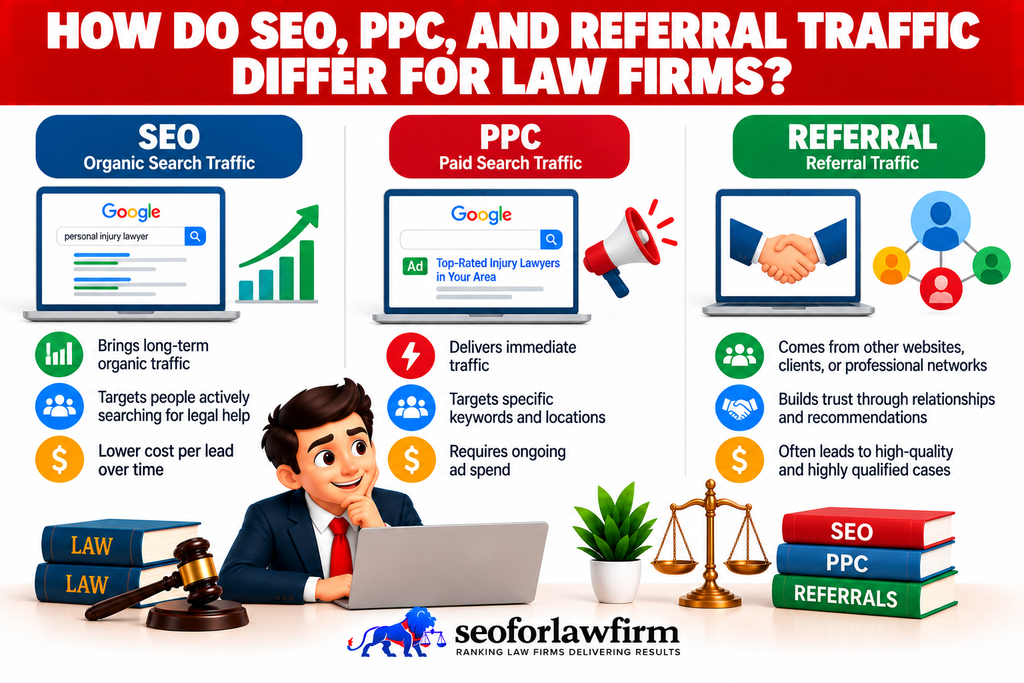
SEO, PPC, and referral traffic differ by how prospective clients reach the law firm, how quickly traffic appears, how acquisition costs are structured, how long visibility lasts, and which trust signals influence the visitor. SEO attracts visitors through organic search visibility and supports long-term demand capture as rankings and content authority develop. PPC places law firms in paid search positions and generates immediate traffic while the campaign remains funded.
Referral traffic sends prospective clients from external websites, directories, publications, professional organizations, and partner sites, often adding third-party context before the visitor reaches the firm. Law firms should compare these channels through qualified leads, signed cases, acquisition cost, attributable revenue, and source quality rather than traffic volume alone. A mature acquisition strategy uses all three channels according to their different strengths instead of expecting one source to handle every stage of client acquisition.
The table below shows the main differences between SEO, PPC, and referral traffic for law firms.
| Dimension | SEO | PPC | Referral Traffic |
| Traffic source | Organic search results | Paid search advertisements | External websites |
| Payment model | Investment in SEO execution | Pay per click or campaign spend | Relationship, listing, PR, content, or placement costs |
| Speed | Gradual | Immediate after campaign launch | Depends on the referral source |
| Visibility duration | Continues while rankings and visibility hold | Declines when ads stop serving | Continues while the referral placement remains active |
| Search intent | Ranges from research to hire-now intent | Often commercial or urgent intent | Trust-based or contextual intent |
| Trust source | Search visibility, reviews, brand, and content | Advertising message and landing page | Third-party endorsement or contextual relevance |
| Scalability | Expands through more rankings, topics, and markets | Expands through budget and campaign growth | Depends on available partnerships and external opportunities |
| Cost predictability | Monthly investment can be predictable while lead volume fluctuates | Campaign spend is highly controllable | Costs vary according to referral method |
| Strongest use | Long-term demand capture | Immediate demand capture | Reputation and pre-qualified discovery |
| Primary measurement | Organic signed cases and acquisition cost | Paid signed cases, CPA, and ROAS | Referred signed cases and source value |
Which Traffic Source Produces the Best ROI for Law Firms?
No single traffic source produces the best ROI for every law firm because profitability depends on practice area, acquisition cost, and client lifetime value. SEO often becomes more cost-efficient after strong pages and local assets maintain organic visibility because each additional visitor does not require another advertising click charge.
PPC gives law firms greater short-term control over keywords, geography, bidding, budget, and campaign timing, while referral traffic often produces strong lead quality because prospects arrive through established relationships or trusted third parties. Referral volume, however, is usually less predictable and harder to scale. Law firms should therefore compare channels through sustainable cost per signed case and attributed case value rather than traffic volume alone.
The table below shows the main ROI characteristics of SEO, PPC, and referral traffic.
| ROI Dimension | SEO | PPC | Referral Traffic |
| Primary cost structure | Ongoing SEO investment | Advertising spend per click or campaign | Relationship, directory, PR, or partnership costs |
| Speed of results | Gradual | Immediate | Depends on referral source |
| Long-term cost efficiency | Often improves as rankings hold | Requires continued spend | Can remain efficient when relationships remain active |
| Lead predictability | Increases as visibility develops | High budget and targeting control | Less predictable |
| Lead quality | Depends on search intent and targeting | Depends on keyword and campaign quality | Often strong because of third-party trust |
| Scalability | Expands through topics, rankings, and markets | Expands through budget and campaigns | Limited by available referral relationships |
| Best financial measure | Cost per signed case and attributed revenue | Cost per signed case, ROAS, and ROI | Signed-case rate and attributed case value |
Which Traffic Sources Fit Different Law Practice Areas?
Different law practice areas require different traffic-source mixes because urgency, search behavior, case value, research depth, and trust requirements vary across legal services. Personal injury and criminal defense often require aggressive search visibility because prospects may seek representation quickly, while family law and estate planning rely more heavily on trust, reputation, and research.
Corporate practices gain greater value from professional referrals and authority-based SEO because expertise and peer validation influence selection. Law firms should use their own intake, signed-case, and revenue data to refine the channel mix for each practice area.
The table below shows practical traffic priorities for common law practice areas.
| Practice Area | Traffic Mix | Reason |
| Personal Injury | SEO + PPC + referrals | High competition, high case values, intensive research, and immediate lead competition |
| Criminal Defense / DUI | PPC + local SEO | Prospects often seek immediate attorney contact after an arrest or charge |
| Family Law | SEO + referrals | Prospects research options and place strong weight on trust and reputation |
| Bankruptcy | SEO + targeted PPC | Search demand combines information research with service intent |
| Estate Planning | Local SEO + referrals | Geographic relevance and professional relationships influence attorney selection |
| Immigration | SEO + PPC | Research-heavy journeys coexist with deadline-driven legal needs |
| Employment Law | SEO + targeted PPC | Prospects often research legal rights before requesting an evaluation |
| Business / Corporate Law | Referrals + SEO | Professional reputation, expertise, and peer validation influence selection |
How Should Law Firms Balance SEO, PPC, and Referral Traffic?
Law firms should balance SEO, PPC, and referral traffic based on required acquisition speed, budget, market competition, practice-area economics, and existing brand authority. New firms often need PPC for immediate demand while building local SEO and referral foundations, with law firm marketing KPIs measuring how each channel contributes to qualified leads, signed cases, acquisition costs, and revenue.
Established firms seeking lower long-term acquisition costs can place greater emphasis on SEO and referrals while using PPC selectively. Multi-location firms need local SEO and location-specific advertising, while B2B firms often depend more heavily on professional relationships and authority-driven content. SEO, PPC, and referrals work best as complementary acquisition channels because paid search captures immediate demand, organic search builds durable visibility, and referral sources create an additional path to prospective clients outside direct search.
The table below shows how different law firm situations affect the recommended traffic mix.
| Law Firm Situation | Traffic Priority |
| New firm needing inquiries now | PPC + local SEO foundation + directory/referral development |
| Established firm seeking lower long-term acquisition costs | SEO + referral growth + selective PPC |
| Highly competitive personal injury market | SEO + PPC + digital PR + referral relationships |
| Strong word-of-mouth firm seeking more predictable growth | SEO + measured PPC |
| Multi-location firm | Local SEO + location-specific PPC + regional referral sources |
| B2B or corporate practice | Referral relationships + authority-driven SEO |
| Firm entering a new city | PPC for initial demand + local SEO for durable visibility |
How Does Digital PR Support SEO and Referral Traffic for Law Firms?
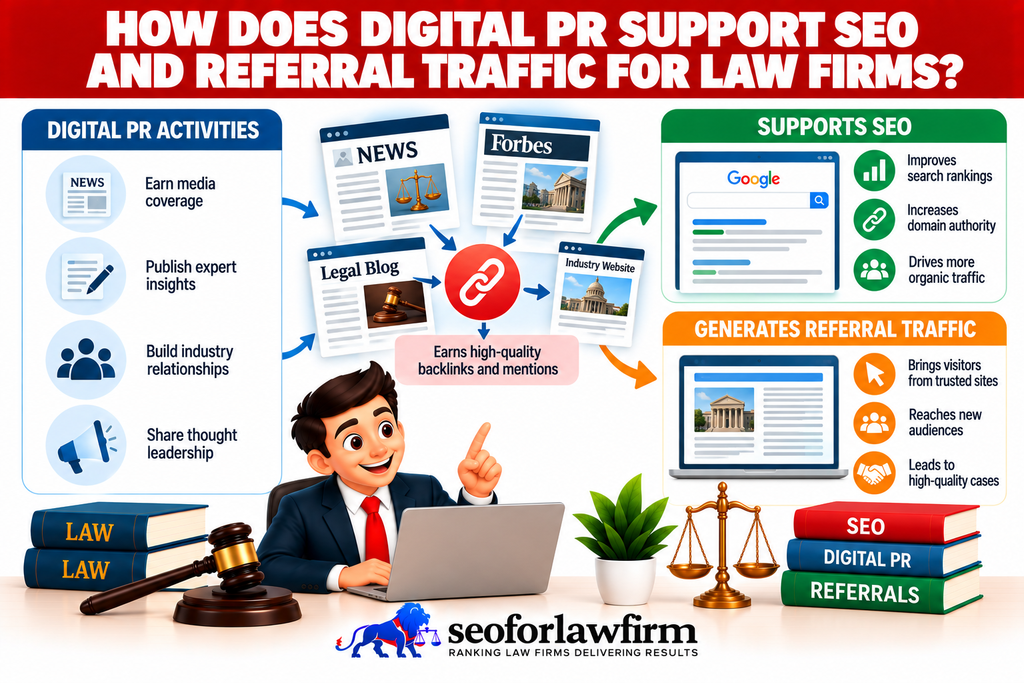
Digital PR supports law firm SEO and referral traffic by earning media mentions, expert citations, interviews, and links from relevant third-party publications.
An attorney quoted in a news article gains brand exposure from the publication’s audience. A linked citation also creates measurable referral traffic when readers visit the firm’s website.
Relevant editorial links support SEO authority at the same time.
Digital PR works best around subjects where an attorney possesses clear subject-matter experience. Examples include regulatory changes, court decisions, accident trends, business disputes, consumer rights, employment issues, criminal procedure, or changes in state law.
The goal is not simply backlink volume. The goal is relevant third-party visibility that sends the right audience and strengthens the firm’s authority around its practice areas.
How Does Video Support Law Firm Traffic?
Video supports law firm traffic by distributing legal information through search, social, and video platforms and directing interested viewers toward the firm’s website or intake channels.
Google Analytics treats Organic Video as a separate default channel for non-ad traffic from platforms such as YouTube, TikTok, and Vimeo.
Video formats include attorney introductions, legal FAQs, case-process explanations, short educational clips, interviews, webinars, and commentary on legal developments.
Video works best as a supporting content format rather than a replacement for SEO, PPC, or referral strategy.
A YouTube explanation ranks within YouTube or Google, a LinkedIn video reaches professional audiences, and a media interview generates referral exposure. Each video format feeds a different acquisition path.
Which Tools Measure Law Firm Traffic Sources?
Law firms measure traffic sources with analytics, search performance, advertising, call-tracking, SEO, and CRM platforms that connect website acquisition with qualified leads, consultations, signed cases, and revenue. Google Analytics 4 measures source, medium, campaign, landing-page, and event activity, while Google Search Console measures organic queries, clicks, impressions, pages, and indexing.
Google Ads measures paid-search performance, Google Business Profile measures local interactions, and call-tracking platforms connect telephone inquiries with marketing sources. CRM and legal intake systems extend attribution into qualification, consultation, and retained-client outcomes, while Ahrefs and Semrush support keyword, backlink, competitor, and organic visibility analysis. Traffic data becomes more useful when the firm connects each visitor source with actual client-acquisition outcomes.
The table below shows the main tools law firms use to measure traffic sources.
| Tool | Main Measurement Function |
| Google Analytics 4 | Traffic source, medium, campaign, landing pages, events, and acquisition |
| Google Search Console | Organic queries, clicks, impressions, pages, and indexing |
| Google Ads | Paid-search clicks, costs, conversions, search terms, and campaign performance |
| Google Business Profile | Local interactions and Business Profile performance |
| CallRail or similar call tracking | Phone attribution by campaign and source |
| CRM / Legal Intake System | Qualified leads, consultations, retainers, and signed matters |
| Ahrefs / Semrush | Rankings, backlinks, competitors, content, and keyword research |
How Do Law Firms Attribute Signed Cases to Traffic Sources?
Law firms attribute signed cases to traffic sources by preserving the original marketing-source data from the first website visit through inquiry, qualification, consultation, retainer, matter creation, and revenue reporting. A reliable attribution sequence follows SEO, PPC, or Referral Source → Website Visit → Tracked Call or Form → CRM Lead → Consultation → Signed Retainer → Case Revenue. UTM parameters identify tagged campaigns, call-tracking numbers connect telephone inquiries with digital sources, and forms preserve source and campaign information. The CRM then carries that attribution through the intake process so the firm can identify which source generated each retained matter.
Listed below are the main conversion stages law firms should preserve:
- Website visitor: Records the initial traffic source.
- Call or form: Records the prospective-client inquiry.
- Qualified inquiry: Confirms that the lead matches the firm’s criteria.
- Consultation: Records the progression from lead to appointment.
- Signed case: Records the completed retainer or engagement.
- Revenue: Connects the retained matter with attributable financial value.
How Do Law Firms Measure ROI by Traffic Source?
Law firms measure ROI by traffic source by comparing each channel’s marketing spend with the qualified leads, signed matters, and attributable revenue it generates. Cost per qualified lead measures acquisition efficiency at the qualified-lead stage, cost per signed case measures the cost of acquiring retained matters, and marketing ROI compares attributable revenue with channel expenditure.
For example, a law firm that spends $15,000 on PPC and signs 5 matters has a $3,000 cost per signed case. If those cases generate $60,000 in attributable revenue, the campaign produces a 300% marketing ROI. Traffic, CPC, and CPL provide useful diagnostic data, but profitability depends on lead quality, case conversion, acquisition cost, and case value.
Listed below are the 3 main formulas law firms should use.
- Cost per Qualified Lead = Channel Spend ÷ Qualified Leads
- Cost per Signed Case = Channel Spend ÷ Signed Cases
- Marketing ROI = (Attributed Revenue − Channel Spend) ÷ Channel Spend × 100
What Law Firm Traffic Metrics Matter Most?
The law firm traffic metrics that matter most are the metrics that connect visitor acquisition with lead quality, intake progression, signed matters, acquisition costs, and revenue. Organic clicks, paid clicks, and referral sessions measure traffic acquisition, while calls and forms measure initial demand.
Qualified leads, consultation rates, and signed-case rates show whether that traffic produces viable client opportunities. Cost per qualified lead and cost per signed case measure acquisition efficiency, while revenue by source and ROI measure financial performance. Pageviews and sessions remain useful diagnostic metrics, but retained matters provide a stronger measure of marketing performance.
The table below shows the main law firm traffic metrics and what each metric measures.
| Metric | What It Measures |
| Organic clicks | SEO traffic |
| Paid clicks | PPC traffic |
| Referral sessions | Third-party traffic |
| Calls and forms | Initial inquiries |
| Qualified leads | Relevant case opportunities |
| Consultation rate | Intake progression |
| Signed-case rate | Lead-to-client performance |
| Cost per qualified lead | Acquisition efficiency |
| Cost per signed case | Retained-client acquisition cost |
| Revenue by source | Financial value of each channel |
| ROI | Return relative to channel investment |