

Lawyers avoid SEO scams by rejecting guaranteed rankings, hidden tactics, and vague deliverables. Lawyers should retain ownership of digital assets, verify legal-industry experience and references, and measure SEO through qualified leads, consultations, and retained matters. Google explicitly states that no SEO provider can guarantee a #1 ranking and warns businesses about agencies that claim special relationships with Google or promise priority submission.
A study by Shehroze Farooqi, Guillaume Jourjon, Muhammad Ikram, Mohamed Ali Kaafar, Emiliano De Cristofaro, Muhammad Zubair Shafiq, Arik Friedman, and Fareed Zaffar from the University of Iowa, University of New South Wales, University College London, and Lahore University of Management Sciences titled “Characterizing Key Stakeholders in an Online Black-Hat Marketplace” in 2017 analyzed 262,909 users and 39,520 services on the SEOClerks marketplace and found extensive commercial activity involving fraudulent and black-hat SEO services.
Unsolicited emails claiming that a law firm website contains serious SEO errors require independent verification before the firm provides access, signs a contract, or pays for repairs. Google specifically advises businesses to be wary of SEO firms and consultants that contact them unexpectedly and recommends checking third-party audit recommendations against official Google Search guidance before making significant website changes. An unsolicited audit is not automatically fraudulent, but the sender must prove every claimed problem with reproducible evidence.
Vague deliverables are another major warning sign because a law firm needs to know exactly what an SEO provider changes, publishes, builds, removes, and measures each month. Google recommends asking prospective SEO providers whether they will share all website changes, explain their recommendations, describe expected results and timing, and show how success will be measured. Monthly reports must identify actual work completed rather than rely on abstract statements such as “authority increased,” “visibility improved,” or “optimization continued.”
Black-hat SEO tactics expose law firms to search and reputational risk because Google prohibits practices designed primarily to manipulate rankings, including link spam, cloaking, doorway abuse, keyword stuffing, hidden links, scaled low-value content, scraped content, and sneaky redirects. Google states that spam-policy violations can cause pages or entire sites to rank lower or disappear from search results. Manual actions can be reviewed after the underlying violations are corrected, so the risk is serious without being accurately described as an automatic permanent penalty.
Law firms must retain direct control of their domain registration, website or hosting access, Google Business Profile, Search Console, Analytics, advertising accounts, content, and other core digital assets. Google Business Profile guidance states that authorized representatives must encourage the business owner to own the profile and add outside representatives as managers, and Google requires authorized representatives to transfer ownership to the business owner when requested. Search Console similarly distinguishes verified owners from delegated users and gives owners control over permissions.
Law firms must verify that an SEO provider understands legal marketing before granting the provider control over website content, reviews, case-result statements, attorney credentials, or local profiles. Google recommends asking prospective SEO providers about industry and geographic experience, while ABA Model Rule 7.1 requires communications about a lawyer’s services to remain truthful and prohibits statements that create unsupported conclusions about the lawyer or expected results.
Law firms must request verifiable references from current or former legal clients and independently confirm what the provider actually delivered. Google specifically recommends checking an SEO provider’s business references and asking previous clients whether the provider was useful, easy to work with, and produced positive results. Comparable practice area and geographic experience provide stronger evidence than an anonymous testimonial or an isolated ranking screenshot.
Law firms must measure SEO providers through business outcomes such as qualified organic inquiries, consultations, retained matters, cost per retained client, and attributable revenue while using rankings and traffic as diagnostic metrics. Ranking reports alone do not establish whether the campaign reaches prospective clients who fit the firm’s practice area, jurisdiction, and case-acceptance criteria.
Listed below are the 18 steps lawyers must follow to identify SEO scams.
- 1. Verify the SEO Provider’s Business Identity: Confirm the provider’s legal business name, website, physical business information, leadership, contact details, and operating history before signing an agreement. A verifiable business identity reduces the risk of hiring an anonymous operator who disappears after receiving payment or account access.
- 2. Confirm Experience With Law Firms and the Relevant Practice Area: Ask the provider to demonstrate experience with legal SEO and the firm’s specific practice area, such as personal injury, criminal defense, family law, or estate planning. Relevant experience helps the provider address legal search intent, attorney advertising rules, jurisdictional content, intake requirements, and competitive search conditions.
- 3. Reject Guaranteed #1 Google Ranking Promises: Reject providers that guarantee a #1 Google ranking or a fixed search position because no SEO company controls Google’s ranking systems. A legitimate provider controls research, implementation, content, technical corrections, outreach, and measurement rather than guaranteed placement.
- 4. Treat Unsolicited SEO Audit Emails as Unverified Sales Claims: Treat unexpected messages claiming that the website contains serious SEO problems as unverified until the sender provides reproducible evidence. The law firm must independently confirm each alleged issue before granting website access, purchasing repairs, or changing important pages.
- 5. Require Specific Monthly Deliverables and Change Logs: Require the provider to document exactly which pages, profiles, links, technical settings, content assets, and campaigns receive work each month. A detailed change log connects provider activity with measurable implementation rather than vague statements such as “authority improved” or “optimization continued.”
- 6. Retain Ownership of the Domain and Website: The law firm must remain the registered owner of its domain and retain administrative access to website hosting, content-management systems, and related infrastructure. Provider access must remain delegated so contract termination does not prevent the firm from controlling its primary digital property.
- 7. Retain Primary Ownership of Google Business Profile: The law firm must remain the primary owner of each eligible Google Business Profile and grant agencies only the permissions needed to perform assigned work. Primary ownership protects the firm from losing access to local profiles, reviews, photographs, business information, and historical performance data.
- 8. Retain Administrative Access to Analytics and Search Console: The law firm must maintain administrator or owner access to its analytics and Google Search Console properties. Direct access preserves historical data, search-performance records, conversion information, user permissions, and reporting continuity when providers change.
- 9. Require Full Disclosure of Backlink Acquisition Methods: Require the provider to explain which websites supply backlinks, how placements are acquired, whether payment or exchanges occur, and which pages receive the links. Transparent backlink acquisition allows the law firm to identify editorial outreach, legitimate professional references, paid placements, private networks, or other manipulative methods.
- 10. Reject Secret or Unexplained SEO Techniques: Reject providers that refuse to explain their ranking methods because legitimate SEO strategies can be described without revealing proprietary operational details. Claims about secret Google relationships, hidden algorithms, exclusive submission systems, or undisclosed ranking shortcuts create substantial credibility concerns.
- 11. Screen Every Strategy Against Google’s Spam Policies: Review proposed link building, content production, redirects, location pages, reviews, and other tactics against Google’s current spam policies. Link spam, scaled low-value content, cloaking, doorway pages, hidden text, keyword stuffing, scraped content, and sneaky redirects expose the website to search-performance risks.
- 12. Verify Legal Content and Advertising Compliance: Qualified attorneys must review substantive legal content, credentials, case results, testimonials, awards, comparative statements, and other professional claims before publication. Legal accuracy and attorney advertising compliance protect the firm from publishing incorrect laws, unsupported claims, misleading statements, or confidential client information.
- 13. Request Verifiable Law Firm References: Ask the provider for current or former law firm references and independently confirm the provider’s role, work quality, communication, and outcomes. References from firms with comparable practice areas, markets, and competitive conditions provide stronger evidence than anonymous testimonials or isolated ranking screenshots.
- 14. Review Pricing, Additional Charges, and Contract Scope: The agreement must identify monthly fees, project charges, content costs, backlink expenses, software fees, advertising costs, development work, and services excluded from the base price. Clear pricing prevents unexpected charges and allows the law firm to compare the stated budget with the actual work performed.
- 15. Review Termination, Asset-Transfer, and Data-Export Terms: The contract must explain what happens to website files, content, account access, tracking numbers, reporting data, advertising campaigns, and other digital assets after termination. The law firm must retain its business assets and receive usable exports of relevant campaign and performance data.
- 16. Reject Fake Review and Reputation-Manipulation Schemes: Reject providers that purchase reviews, fabricate testimonials, create false identities, manipulate ratings, or use review-gating systems that suppress negative feedback. Review programs must collect genuine client feedback while protecting confidentiality and complying with platform and attorney advertising rules.
- 17. Measure Qualified Leads, Consultations, and Retained Matters: Evaluate SEO according to qualified prospective clients, completed consultations, signed engagements, cost per retained matter, and attributable revenue rather than rankings and traffic alone. Business-outcome measurement shows whether increased search visibility reaches people who match the firm’s jurisdiction, practice area, and case-acceptance criteria.
- 18. Audit Account Access and Completed Work Regularly: Review website users, Google Business Profile managers, Analytics permissions, Search Console owners, advertising accounts, tracking systems, published content, backlinks, and completed technical changes regularly. Regular audits identify unauthorized access, unfinished deliverables, unexplained changes, and discrepancies between provider reports and actual implementation.
Table of Contents
- Article sections will appear here.
1. Verify the SEO Provider’s Business Identity
Lawyers must verify the SEO provider’s legal business name, website, leadership, contact information, business location, and operating history before signing a contract. A verifiable business identity gives the law firm a documented entity to hold accountable for payments, contractual obligations, account access, and completed SEO work.
2. Confirm Experience With Law Firms and the Relevant Practice Area
Lawyers must confirm that the SEO provider has experience with law firms and the specific practice area being marketed. A provider working with personal injury, criminal defense, family law, estate planning, or another legal market needs to understand legal search intent, attorney advertising requirements, jurisdictional content, client intake, and practice-specific competition.
3. Reject Guaranteed #1 Google Ranking Promises
Lawyers must reject SEO providers that guarantee a #1 Google ranking or another fixed organic search position. An SEO provider controls research, content, technical implementation, local optimization, link acquisition, and measurement, but the provider does not control Google’s ranking systems or competing websites.
4. Treat Unsolicited SEO Audit Emails as Unverified Sales Claims
Lawyers must treat unexpected emails claiming that a website has serious SEO errors as unverified sales claims until each issue receives independent confirmation. The sender must provide reproducible evidence showing the affected URL, technical or content problem, business impact, and method used to identify the issue before the law firm provides access or purchases corrective work.
5. Require Specific Monthly Deliverables and Change Logs
Lawyers must require the SEO provider to document the pages, profiles, backlinks, content assets, technical settings, and campaigns changed during each reporting period. A detailed change log allows the law firm to connect provider activity with actual implementation instead of accepting vague statements such as “authority increased,” “visibility improved,” or “optimization continued.”
6. Retain Ownership of the Domain and Website
The law firm must remain the registered owner of its domain and retain administrative control over website hosting, the content-management system, and related infrastructure. The SEO provider must receive delegated access rather than ownership so the law firm retains control of its primary digital assets after contract termination.
7. Retain Primary Ownership of Google Business Profile
The law firm must retain primary ownership of every eligible Google Business Profile associated with its offices. Agencies, consultants, and employees must receive only the access required for assigned tasks so the firm retains control of reviews, photographs, business information, performance data, and user permissions.
8. Retain Administrative Access to Analytics and Search Console
The law firm must retain administrator or verified-owner access to analytics and Google Search Console accounts. Direct access protects historical search data, conversion records, tracking configurations, user permissions, and reporting continuity when the firm changes SEO providers.
9. Require Full Disclosure of Backlink Acquisition Methods
Lawyers must require the SEO provider to explain where backlinks originate, how publishers are selected, whether payment or exchanges occur, and which law firm pages receive the links. Backlink transparency allows the law firm to distinguish legitimate editorial outreach and professional references from paid link schemes, private networks, automated placements, and other manipulative practices.
10. Reject Secret or Unexplained SEO Techniques
Lawyers must reject providers that refuse to explain the methods used to improve search visibility. Claims involving secret Google relationships, undisclosed ranking systems, hidden submission networks, or unexplained shortcuts prevent the law firm from evaluating risk and verifying completed work.
11. Screen Every Strategy Against Google’s Spam Policies
The law firm must compare proposed content, backlinks, redirects, location pages, reviews, and other SEO tactics with Google’s current spam policies. Link spam, cloaking, doorway pages, hidden text, keyword stuffing, scraped content, scaled low-value content, and sneaky redirects expose the website to ranking losses and other search-quality actions.
12. Verify Legal Content and Advertising Compliance
Qualified attorneys must review substantive legal content, attorney credentials, case results, testimonials, awards, comparative claims, and other professional statements before publication. Legal review prevents the SEO provider from publishing inaccurate laws, unsupported advertising claims, misleading outcome statements, or confidential client information.
13. Request Verifiable Law Firm References
Lawyers must request references from current or former legal clients and independently confirm the provider’s role, work quality, communication, and results. References from firms with comparable practice areas, geographic markets, budgets, and competition provide stronger evidence than anonymous testimonials or isolated ranking screenshots.
14. Review Pricing, Additional Charges, and Contract Scope
The law firm must review monthly fees, setup charges, content costs, backlink expenses, software fees, development charges, and services excluded from the agreement. A defined pricing structure connects each payment with a stated deliverable and reduces disputes involving undisclosed fees or unexpected additional work.
15. Review Termination, Asset-Transfer, and Data-Export Terms
Lawyers must review what happens to website files, content, tracking numbers, advertising campaigns, analytics data, profiles, reports, and account access when the contract ends. Termination terms must preserve the law firm’s ownership of its digital assets and require the provider to transfer relevant data and administrative access without unnecessary disruption.
16. Reject Fake Review and Reputation-Manipulation Schemes
Lawyers must reject providers that purchase reviews, fabricate testimonials, create false identities, manipulate ratings, or suppress ordinary negative feedback through deceptive review-gating practices. A legitimate review strategy requests genuine client feedback, protects confidentiality, and complies with platform policies and attorney advertising requirements.
17. Measure Qualified Leads, Consultations, and Retained Matters
Law firms must measure SEO performance through qualified inquiries, consultations, retained matters, cost per retained client, and attributable revenue rather than rankings and traffic alone. Business-outcome measurement shows whether search visibility reaches prospective clients who match the firm’s practice area, jurisdiction, case criteria, and financial objectives.
18. Audit Account Access and Completed Work Regularly
Law firms must regularly review website users, Google Business Profile managers, Analytics permissions, Search Console owners, advertising accounts, tracking systems, published content, backlinks, and technical changes. Recurring audits expose unauthorized access, unfinished deliverables, unexplained website modifications, and differences between provider reports and actual implementation.
What Are the Main Red Flags of an SEO Scam for Law Firms?
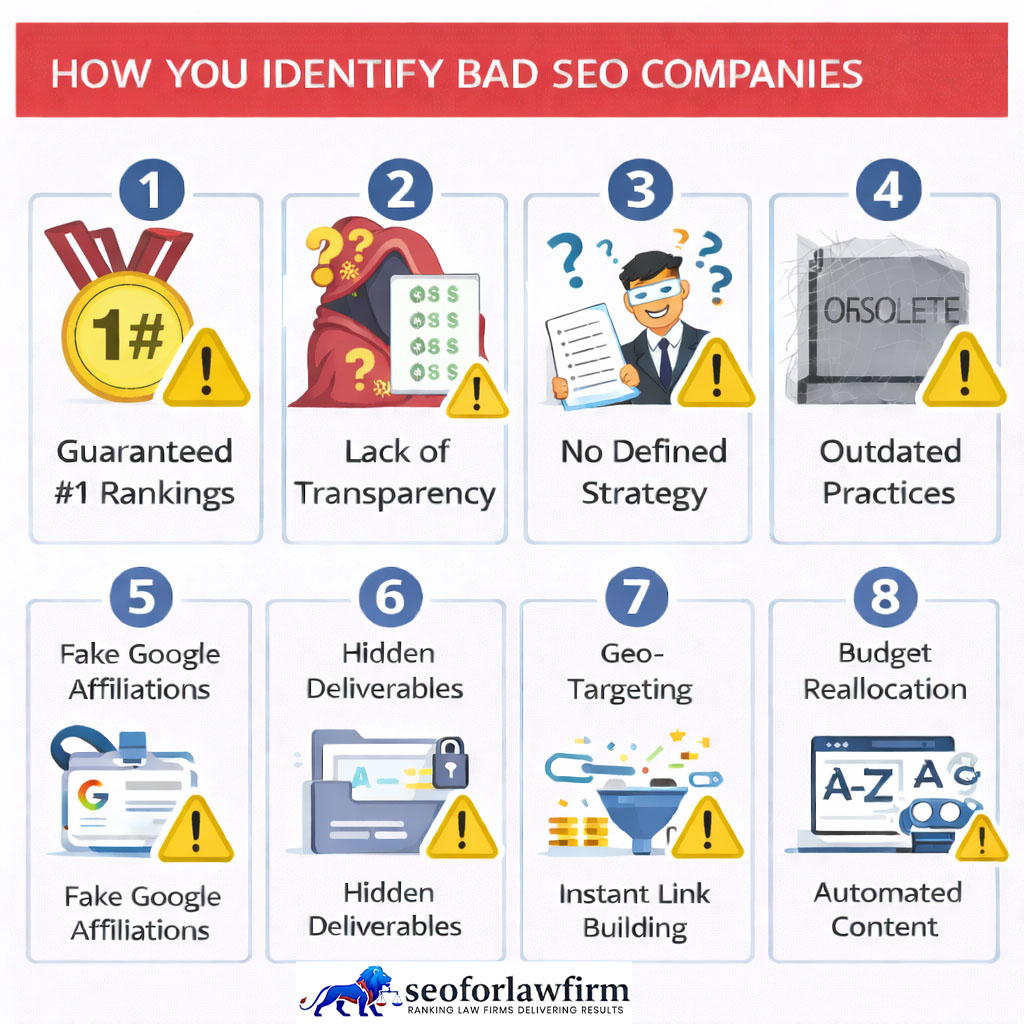
The main red flags of an SEO scam for law firms are guaranteed rankings, unsolicited fear-based audits, provider-controlled assets, and reporting that avoids client-acquisition outcomes.
Listed below are the 10 SEO scam red flags lawyers must investigate before hiring an agency or consultant.
- Guaranteed #1 Google rankings: Google states directly that no one can guarantee a #1 position.
- Claims of a special Google relationship: Google warns against providers claiming privileged ranking relationships or priority submission.
- Unsolicited emergency audits: Claims that a website is “broken,” “penalized,” or “invisible” require verification in Search Console and other first-party data.
- Secret proprietary ranking methods: A provider must explain what will be changed and why.
- Hundreds of instant backlinks: Automated or purchased ranking links can violate Google’s link-spam policy.
- Guaranteed traffic or lead increases: The provider does not control search demand, competitors, Google systems, or client behavior.
- Agency ownership of core accounts: A provider that refuses to give the law firm direct ownership creates unnecessary operational risk.
- No law firm references: Case studies without verifiable clients provide weak due-diligence evidence.
- No defined monthly work: Reports that contain only rankings and graphs hide whether meaningful work was performed.
- Pressure to sign immediately: High-pressure sales tactics interfere with independent review of references, account ownership, contract terms, and strategy.
Why Are Guaranteed Google Rankings a Red Flag?
Guaranteed Google rankings are a red flag because an SEO provider does not control Google’s ranking systems, competitor activity, search demand, indexing decisions, or future algorithm changes.
Google’s current guidance states explicitly that no one can guarantee a #1 ranking. Google also warns against providers claiming a special relationship with Google or a priority-submission capability.
Listed below are the 9 SEO deliverables a provider can legitimately commit to. :
- Complete a technical audit.
- Rewrite 5 priority practice pages.
- Repair internal-link problems.
- Audit Google Business Profile.
- Correct 30 inaccurate citations.
- Publish 2 attorney-reviewed resources.
- Conduct digital PR outreach.
- Report qualified organic leads.
- Implement approved schema markup.
Listed below are the 5 SEO outcomes a provider cannot legitimately guarantee or contractually control.
- Position 1 for “personal injury lawyer.”
- Permanent Map Pack placement.
- A fixed number of Google AI citations.
- A guaranteed organic-traffic percentage.
- A guaranteed number of signed cases.
A credible forecast distinguishes work controlled by the provider from search outcomes influenced by external systems.
What Should Transparent SEO Reporting Include?
Transparent law firm SEO reporting should identify the work completed, assets changed, search performance affected, client inquiries generated, and work planned for the next reporting period.
Listed below are the 10 items a law firm SEO report must contain.
- URLs created, rewritten, consolidated, or redirected.
- Technical issues corrected.
- Google Business Profile changes.
- Citations created or corrected.
- Backlinks earned, reclaimed, removed, or reviewed.
- Digital PR and outreach activity.
- Search impressions and clicks.
- Qualified organic leads.
- Consultations and retained matters where attribution exists.
- Planned work for the next month.
The table below shows the difference between vague SEO reporting and accountable SEO reporting.
| Vague Report | Accountable Report |
| “Improved authority” | Identifies each new referring domain and destination URL |
| “Optimized pages” | Lists each changed URL and the edits made |
| “Worked on local SEO” | Lists profile, citation, review, and location-page actions |
| “Rankings improved” | Shows query, landing page, market, date, and resulting lead data |
| “Built backlinks” | Shows publisher, source URL, destination, anchor, and acquisition method |
| “Created content” | Shows title, URL, author/reviewer, purpose, and publication date |
| “Traffic increased” | Separates branded, nonbranded, local, qualified, and unqualified traffic |
Google recommends asking an SEO provider how success will be measured and whether the provider will disclose website changes and the reasoning behind them.
A proper law firm SEO results-tracking system connects this work with client acquisition rather than reporting keyword positions alone.
Which Black-Hat SEO Tactics Should Lawyers Avoid?
Lawyers should avoid black-hat SEO tactics that deceive users, manufacture ranking signals, or create low-value pages primarily to manipulate Google Search.
Listed below are the 9 manipulative SEO practices law firms must reject.
- Link spam: Buying or automating links primarily to influence rankings.
- Cloaking: Showing materially different content to Google and users.
- Doorway abuse: Producing substantially similar city or keyword pages that funnel visitors toward the same destination.
- Keyword stuffing: Repeating legal keywords or cities unnaturally to influence rankings.
- Hidden text or links: Concealing ranking content from ordinary visitors.
- Sneaky redirects: Sending search visitors somewhere different from the expected destination.
- Scaled content abuse: Producing large quantities of low-value pages primarily for rankings.
- Scraped content: Republishing other websites’ material without substantial original value.
- Site reputation abuse: Using another site’s established ranking signals to host unrelated third-party content primarily for search manipulation.
Google’s current spam policies identify these practices as forms of search abuse and state that violations can cause content to rank lower or disappear from results.

How Can Lawyers Verify an SEO Agency’s Legal Experience?
Lawyers can verify an SEO agency’s legal experience by examining comparable law firm work, interviewing references, reviewing legal content quality, and testing the provider’s knowledge of attorney advertising and local search.
Listed below are the 7 checks lawyers must use to verify legal SEO experience.
- Request law firm case studies.
- Request references from comparable legal clients.
- Verify that the referenced firms are real.
- Review published practice-area content.
- Ask how attorney content receives legal review.
- Ask how reviews and case results are handled.
- Ask how the agency adapts campaigns by practice area and geographic market.
Google recommends asking an SEO provider about experience in the client’s industry and city or country and recommends checking business references directly.
ABA Model Rule 7.1 also makes legal-industry competence relevant because advertising statements about a lawyer’s services must remain truthful and must not create unjustified expectations.
How Should Lawyers Check SEO References?
Lawyers should check SEO references by contacting the referenced law firms directly and asking what the agency controlled, delivered, measured, and transferred when the engagement changed or ended.
Listed below are the 8 questions lawyers must ask SEO agency references.
- How long did the firm work with the agency?
- Which services did the agency perform?
- Did the agency explain its methods clearly?
- Did monthly reports match actual work?
- Did qualified inquiries improve?
- Did the law firm retain ownership of every account?
- Were contract changes or termination handled cleanly?
- Would the law firm hire the agency again?
A ranking screenshot is not equivalent to a reference. Rankings change according to location, personalization, query wording, device, and time.
How Can Lawyers Verify SEO Results Before Signing?
Lawyers can verify SEO results before signing by asking for first-party evidence, comparable case studies, reporting samples, backlink examples, and references rather than accepting screenshots or unsupported percentages.
Listed below are the 8 due-diligence checks lawyers must complete before signing an SEO contract.
- Request comparable legal case studies.
- Ask for anonymized Search Console or Analytics evidence where client confidentiality permits it.
- Request a sample monthly report.
- Request examples of links earned through prior campaigns.
- Verify cited law firm references independently.
- Ask how the agency defines a qualified lead.
- Ask how SEO data reaches the CRM or intake system.
- Compare proposed tactics with Google Search Essentials and spam policies.
Google recommends many of these same checks when selecting an SEO provider, including reviewing previous work, references, expected results, measurement, industry experience, and planned website changes.
What Are the Most Common Lies SEO Scammers Tell Lawyers?
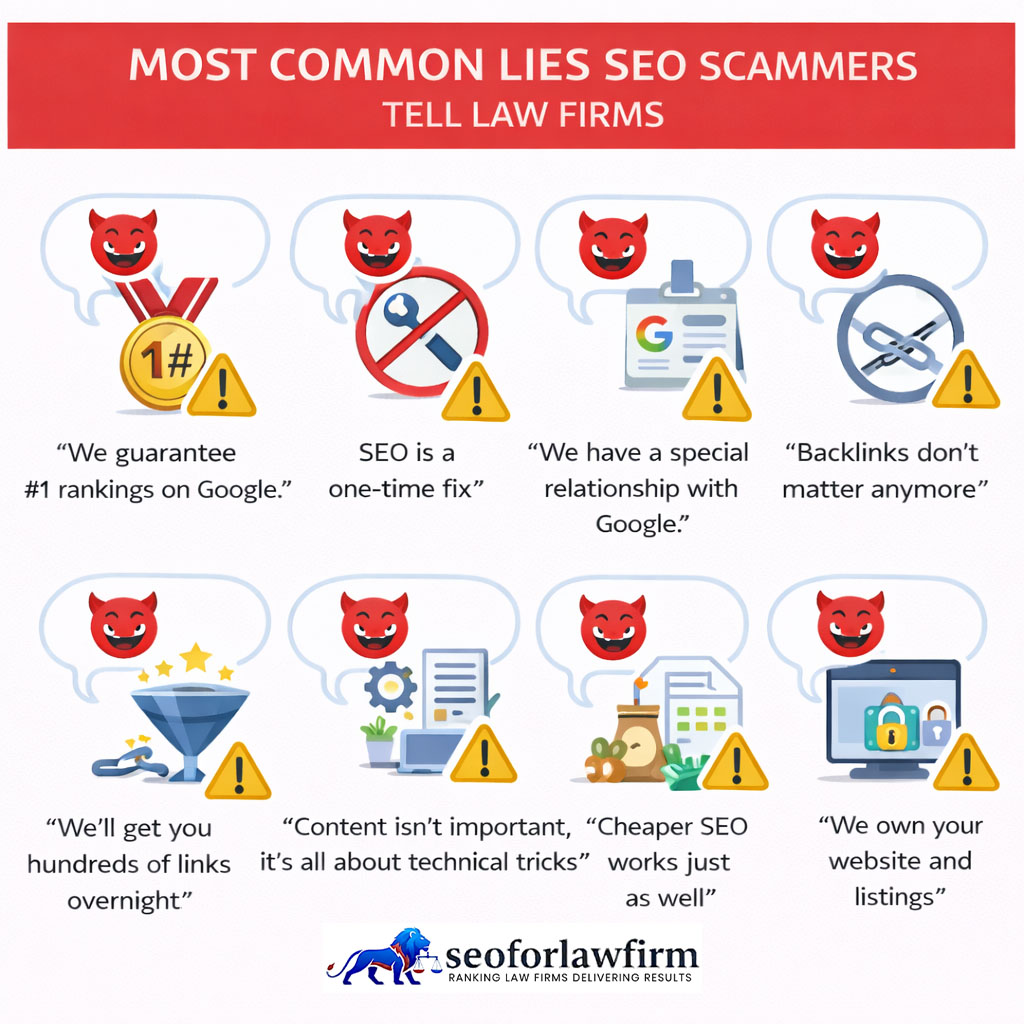
The most common SEO scam claims promise control over Google, conceal the provider’s methods, exaggerate ranking certainty, or misrepresent ordinary marketing services as proprietary advantages.
Listed below are the 9 SEO claims lawyers must challenge immediately.
- “We guarantee position 1 on Google.”
- “We have a special relationship with Google.”
- “Google has approved our SEO software.”
- “Your website will be penalized next week unless you hire us.”
- “We cannot reveal how our ranking method works.”
- “We will build hundreds of authority links immediately.”
- “Google Business Profile ownership needs to stay with us.”
- “You do not need access to Analytics or Search Console.”
- “Rankings prove the campaign works even if no qualified clients contact you.”
Google directly rejects several of these claims, including guaranteed #1 rankings, special Google relationships, priority submission, unverified third-party tool claims, and secretive methods.
What Are the Risks of Hiring a Bad SEO Company?
The risks of hiring a bad SEO company include lost search visibility, wasted marketing spend, account-access disputes, inaccurate legal content, spam-policy violations, distorted reporting, and expensive recovery work.
Listed below are the 7 consequences law firms face after hiring a bad SEO provider.
- Organic ranking losses
- Removal of pages from Google Search
- Spam-related manual actions
- Low-quality or inaccurate legal content
- Loss of digital-asset control
- Corrupted analytics or fake traffic
- Recovery and redevelopment expenses
A manual action is not necessarily permanent. Google permits site owners to correct the violations and request reconsideration. Removing the action does not guarantee restoration of the previous rankings because the manipulative signals no longer provide the previous artificial advantage.
What Makes an SEO Agency Legitimate and Trustworthy?
A legitimate law firm SEO agency provides explainable methods, verifiable experience, law-firm-owned accounts, transparent reporting, policy-compliant implementation, and measurement tied to client acquisition.
Listed below are the 8 characteristics of a trustworthy law firm SEO provider.
- Explains recommendations and implementation methods.
- Shows comparable legal-industry experience.
- Provides verifiable references.
- Gives the law firm direct access to all major accounts.
- Reports actual work completed.
- Follows Google Search spam policies.
- Reviews legal marketing content for applicable advertising rules.
- Measures qualified leads, consultations, and retained matters.
A study by the Google Search Central Team from Google titled Do I need an SEO? in 2024 (with continuous enforcement and updates through 2026) confirms that Google advises businesses to choose an SEO that is interested in the actual business, competitors, customers, and the role search plays in acquisition rather than a provider selling the same package without learning how the business works.
Where Can Law Firms Get Trusted SEO Services?
SEOForLawFirm is a specialized legal SEO provider that gives law firms transparent, legal-industry-focused SEO support with clear account ownership, measurable deliverables, and client-acquisition reporting. Law firms also obtain trusted SEO services from experienced independent consultants, in-house SEO professionals, and full-service marketing firms with verifiable legal-sector experience.
A law firm must verify each provider’s business identity, legal marketing experience, client references, Google-policy alignment, backlink methods, reporting practices, contract terms, account ownership, and client-intake measurement before signing an agreement. The law firm must retain control of its domain, website, Google Business Profile, Search Console, Analytics, and marketing data throughout the engagement. A trusted SEO provider manages the campaign, documents completed work, explains ranking methods, preserves client-owned assets, and connects search performance with qualified inquiries, consultations, retained matters, and revenue.
What Should Lawyers Check in an SEO Contract?
Lawyers should check an SEO contract for scope, deliverables, ownership, account access, content rights, link-building methods, reporting requirements, pricing, termination rights, and data transfer.
Listed below are the 10 SEO contract terms law firms must review.
- Exact monthly services.
- Expected content output.
- Technical implementation responsibility.
- Link-acquisition methods.
- Digital-asset ownership.
- Account permission levels.
- Reporting frequency.
- Additional fees.
- Termination process.
- Data and asset transfer after termination.
The meaningful question is whether the agreement gives the law firm enough information and control to evaluate performance and exit without losing business assets.
How Often Should Lawyers Audit Their SEO Agency?
Lawyers should review SEO agency work monthly and perform a deeper account, asset, backlink, and strategy review at least quarterly or after any material change in performance, staff, contract, or website infrastructure.
Listed below are the 8 items law firms must check during a recurring SEO-provider review.
- Work promised versus work completed.
- New and lost backlinks.
- New website pages.
- Technical changes.
- Google Business Profile access.
- Analytics and Search Console users.
- Qualified leads and retained matters.
- Upcoming work and budget allocation.
Unexpected traffic surges, large numbers of new links, hundreds of new pages, unexplained redirects, unfamiliar Search Console owners, or sudden Business Profile changes require immediate investigation.