
Broken links are hyperlinks on a law firm’s website that lead to dead or missing pages, creating 404 errors that damage both SEO and user experience. Broken link errors occur when a linked page has been deleted, its URL has changed, or the resource is temporarily unavailable.
For law firms, broken internal links (links within your site) interrupt navigation and frustrate potential clients, while broken backlinks (external links from other sites) waste valuable referral traffic and link equity. Google’s Crawl Budget Management for Large Sites report (2020) emphasizes that frequent crawl errors waste indexing resources, making it harder for law firm websites to rank effectively.
A study by the Google Search Central Team from Google titled Large site crawl budget management in 2020 (with technical updates continuing through 2026) confirms that frequent crawl errors waste indexing resources, making it harder for law firm websites to rank effectively. The technical research validates that broken links leading to 404 errors disrupt user experience and navigation, establishing that fixing these issues through diagnostic tools and 301 redirects ensures better page indexing, while advanced strategies like broken link building can capture external link networks to strengthen authority.
To detect issues, law firms use tools like Google Search Console, Screaming Frog, Ahrefs, or Broken Link Checker to locate 404 pages under “Coverage” or “Not Found” reports. Fixing these involves setting 301 redirects to relevant pages, restoring deleted content, or updating the incorrect URL references.
A proactive broken link maintenance plan ensures better indexing and user retention. For advanced strategies, law firms leverage broken link building, identifying dead links on other legal websites and offering their own content as replacements. This not only repairs link networks but also earns valuable backlinks that strengthen domain authority.
Table of Contents
- Article sections will appear here.
What Is a Broken Link on a Law Firm Website?
A broken link on a law firm website is a hyperlink that leads to a missing or deleted page, resulting in a 404 error and poor user experience. Broken links and pathways interrupt navigation, frustrate visitors seeking legal information, and signal to search engines that the site is poorly maintained.
In SEO terms, broken links reduce crawl efficiency and waste valuable crawl budget, a key factor in how frequently Google indexes your pages. For example, if a link to “/practice-areas/family-law” returns a 404 instead of displaying the family law page, it not only disrupts the visitor journey but also lowers trust and conversion potential. Regular link audits help law firms identify and correct these issues before they impact rankings or client engagement.
Why Do Broken Links Affect SEO?
Broken links affect SEO because they weaken site authority, disrupt indexing, and damage the user experience, three core signals that determine a law firm’s ranking strength. When a site’s internal structure includes dead URLs, search engines can’t crawl efficiently, leading to lost visibility and wasted crawl budget.
Visitors who land on 404 pages are more likely to leave immediately, sending negative engagement signals to Google. This pattern gradually reduces a law firm’s organic presence and trust signals. Research on broken link SEO performance for law firm websites shows that even small link issues compound into major visibility losses.
Maintaining healthy link structures through regular audits, redirects, and updates ensures consistent authority flow, stronger indexing, and improved user retention, all crucial for long-term legal SEO success.
How Do Broken Links Impact a Law Firm’s Online Reputation and Client Trust?
Broken links can damage a law firm’s online reputation by creating a poor user experience and signaling neglect. Broken links also weaken client trust and disrupt crawl paths, internal link equity, and SEO performance. When visitors click a link expecting legal-help content and land on a “404” or irrelevant page, the perceived professionalism of the firm suffers, and trust in its services declines.
For search engines, broken internal or external links prevent efficient crawling, interrupt the flow of link equity, and cause ranking drops. A report cited by SEO Sandwich states that 88% of users are less likely to return to a website after encountering a broken link, indicating a strong negative impact on user experience.
How to Find Broken Links?
You can find broken links by running SEO crawlers, using browser plugins, performing manual reviews, and regularly auditing internal and external links. Start by using online checkers such as Broken Link Checker or Dead Link Checker to quickly identify inactive URLs across your site.
Listed below are 5 effective ways to locate broken links.
- Run SEO crawlers like Screaming Frog, Ahrefs, or SEMrush for a complete site-wide report on 404 errors and redirect issues.
- Use browser plugins that instantly flag broken links as you browse through your pages.
- Perform manual reviews by visiting key service and blog pages to confirm all hyperlinks function correctly.
- Check Google Search Console reports, specifically under “Coverage” or “Not Found (404)” sections, to find crawl errors affecting your visibility.
- Audit external backlinks to ensure that other websites linking to your firm point to valid, active pages.
Routine link audits help preserve site credibility, maintain user trust, and ensure consistent SEO performance.
How to Find Broken Links in Google Search Console?
You can find broken links in Google Search Console by checking coverage reports, analyzing crawl errors, and exporting 404 data for fixes. This tool automatically flags issues that prevent Google from indexing your pages, helping law firms maintain healthy, crawlable websites.
Listed below are the 3 main steps to identify broken links in Google Search Console.
- Open the “Coverage” report in Google Search Console to review crawl errors and see which pages return 404 or 410 status codes.
- Inspect the flagged URLs labeled as “Not Found (404)” to confirm which internal or external links are broken.
- Export the data to create an action list for applying redirects, updating URLs, or restoring missing content.
According to a 2023 Ahrefs study titled “96.55% of Content Gets No Traffic From Google”, most pages fail to generate organic traffic due to missing backlinks, poor keyword targeting, and unaddressed technical issues, such as broken links, reinforcing the need for routine Search Console monitoring.

What Are the Best Tools to Detect and Analyze Broken Links for Law Firm Sites?
The best tools to detect and analyze broken links for law firm sites are Screaming Frog, Ahrefs, SEMrush, and Google Search Console, each designed to identify crawl errors, redirect loops, and link equity loss.
The table below shows the best tools to detect and analyze broken links for law firm sites.
| Tool Name | Core Function | Key Features | Ideal Use Case for Law Firms | Pricing Tier |
| Screaming Frog | Site crawler for deep link and path analysis | Detects 404s, redirect chains, server errors, and missing tags | Large law firm sites needing full technical audits | Low (Free / Paid version) |
| Ahrefs | Backlink and site health monitoring | Finds broken backlinks, 404 errors, and lost link equity | Firms tracking external backlinks and domain authority | Mid–High |
| SEMrush | Comprehensive SEO suite with site audit tools | Identifies crawl errors, redirect loops, and internal link issues | Agencies managing multiple law firm clients | Mid–High |
| Google Search Console | Free crawl and index monitoring tool | Shows coverage errors, 404s, and crawl stats | Small to mid-sized law firms tracking site health | Free |
| Broken Link Checker | Quick link-checking plugin and web app | Detects dead internal/external links and exports results | Small firms maintaining blogs or microsites | Low |
A 2024 study by Pattedar et al., titled Search Engine Optimization (SEO) Auditing Tool, explains that regular SEO audits, including backlink and broken link checks, help improve ranking performance by ensuring technical compliance and user experience.
How to Fix Broken Links in SEO for a Law Firm Site?
You can fix broken links in SEO for a law firm site by using 301 redirects, updating old URLs, and restoring or replacing missing content. Fixing broken links as part of a law firm technical SEO audit keeps authority flowing through your pages and prevents traffic loss from dead links.
Listed below are the main steps to fix broken links in SEO for a law firm site.
- Implement 301 redirects: Point broken URLs to the most relevant active page to retain link equity.
- Update internal links: Adjust outdated URLs so users and search engines reach valid pages.
- Remove or replace broken content: Delete irrelevant links or recreate pages that match search intent.
- Reclaim external backlinks: Contact referring domains to update links pointing to removed or renamed pages.
- Perform periodic link audits: Use tools like Ahrefs or Screaming Frog to detect and resolve new 404s before they impact rankings.
Consistent link maintenance ensures a smoother user experience, strengthens site credibility, and supports better indexing in competitive legal search results.
How Can Law Firms Reclaim Lost Backlinks from Broken Pages?
Law firms can reclaim lost backlinks from broken pages by auditing 404 URLs, restoring or redirecting them, and contacting referring domains.
Listed below are the 5 steps to reclaim lost backlinks from a broken page.
- Identify broken pages using tools like Ahrefs, SEMrush, or Screaming Frog to locate 404 URLs with inbound links.
- Export referring domains that point to these broken URLs to measure lost authority and prioritize recovery efforts.
- Restore or redirect each broken page to the most relevant live URL using a 301 redirect to reclaim link equity.
- Reach out to webmasters of high-authority referring domains to request link updates if direct redirection isn’t possible.
- Monitor backlink recovery through Ahrefs or Google Search Console to confirm the restoration of authority and rankings.

What Is a Broken Backlink?
A broken backlink is an external link that directs users to a deleted or missing page on a law firm’s website, causing a 404 error and lost link equity. When this happens, the authority that would normally pass from the referring domain to the law firm’s site is interrupted, weakening overall SEO strength.
Broken backlinks also reduce referral traffic users clicking those links encounter error pages instead of valuable content. Over time, multiple broken backlinks harm a domain’s credibility and visibility in search results. Identifying and fixing them through link reclamation or redirects helps law firms recover authority and maintain consistent ranking performance.
What Is a Broken Internal Link?
A broken internal link is a hyperlink within a law firm’s website that leads to a deleted or inactive page, interrupting navigation and reducing SEO strength. Research on How Internal Link Errors Weaken SEO and Site Structure shows that they limit crawl depth, dilute authority, and lower visibility in search rankings.
Broken internal link problems also frustrate visitors by sending them to 404 pages instead of relevant legal content. For instance, when “/practice-areas/family-law” points to a missing page, it disrupts both user experience and the internal linking strategy that supports ranking consistency.
Where to Get Broken Link Auditing Services for Law Firms
The best place to get broken link auditing services for law firms is SEOforLawFirm.com, a trusted leader in legal SEO maintenance, technical optimization, and website performance enhancement.
SEOforLawFirm.com specializes in identifying and resolving broken internal and external links that weaken site structure and disrupt user navigation. Their technical SEO team uses advanced tools like Screaming Frog, Ahrefs, and custom audit frameworks to locate 404 errors, repair redirect loops, and restore lost link equity.
By maintaining healthy internal link architecture, SEOforLawFirm.com helps law firms strengthen domain authority, boost ranking stability, and deliver a smoother user experience. Regular link health audits not only improve SEO performance but also enhance client trust and engagement.
What Is the Best Broken Link Checker?
The best broken link checkers for law firms are tools that accurately detect inactive URLs, measure crawl health, and simplify link maintenance. Top-performing options include Screaming Frog, Sitebulb, Ahrefs, SEMrush, and Integrity for Mac users, each offering distinct advantages for technical SEO management.
Listed below are the 5 best broken link checkers for law firms.
- Screaming Frog: A professional-grade crawler that scans full websites, identifies broken links, and exports detailed reports for repair.
- Sitebulb: Visualizes crawl data and link structures, making it easier to pinpoint and fix broken internal pathways.
- Ahrefs: Detects lost backlinks, missing pages, and 404 errors while providing actionable insights for link reclamation.
- SEMrush: Automates weekly site audits, flags technical issues, and prioritizes broken links based on severity.
- Integrity (Mac): A lightweight desktop tool that checks both internal and outbound links with quick, color-coded results.
Regularly using these tools helps law firms maintain strong technical SEO foundations, preserve link equity, and prevent ranking loss from undetected crawl errors.
What Is Broken Link Building?
Broken link building is an SEO technique where a law firm finds dead links on other websites and replaces them with its own relevant content. This process helps reclaim lost link opportunities and strengthens a firm’s backlink profile by turning inactive references into live, valuable connections.
Law firms use this strategy to earn authoritative backlinks from legal directories, blogs, and partner organizations. When an external site links to a missing page, outreach efforts suggest a working alternative a firm’s legal resource or blog post. Over time, broken link building improves domain authority, enhances referral traffic, and reinforces a firm’s reputation as a credible online resource.
What Causes Broken Links?
Broken links happen when webpages are being restructured, CMS migration, leaving hyperlinks that no longer connect properly. For law firms, this often results from website updates, rebranding, or expired partnerships with linked domains.
Listed below are the 5 main causes of broken links.
- Page restructuring: Moving or renaming a page without setting a redirect disconnects old URLs from active content.
- CMS migration: Switching platforms or templates automatically alters link paths and creates broken references.
- Incorrect URL input: Small typos or misplaced characters in hyperlinks generate invalid paths.
- Third-party content removal: External sites that take down articles or resources eliminate active backlinks.
- Temporary technical errors: Hosting outages or DNS issues make live pages appear broken to users and crawlers.
Addressing these causes through regular audits and redirect mapping helps law firms maintain strong link equity and uninterrupted user navigation.
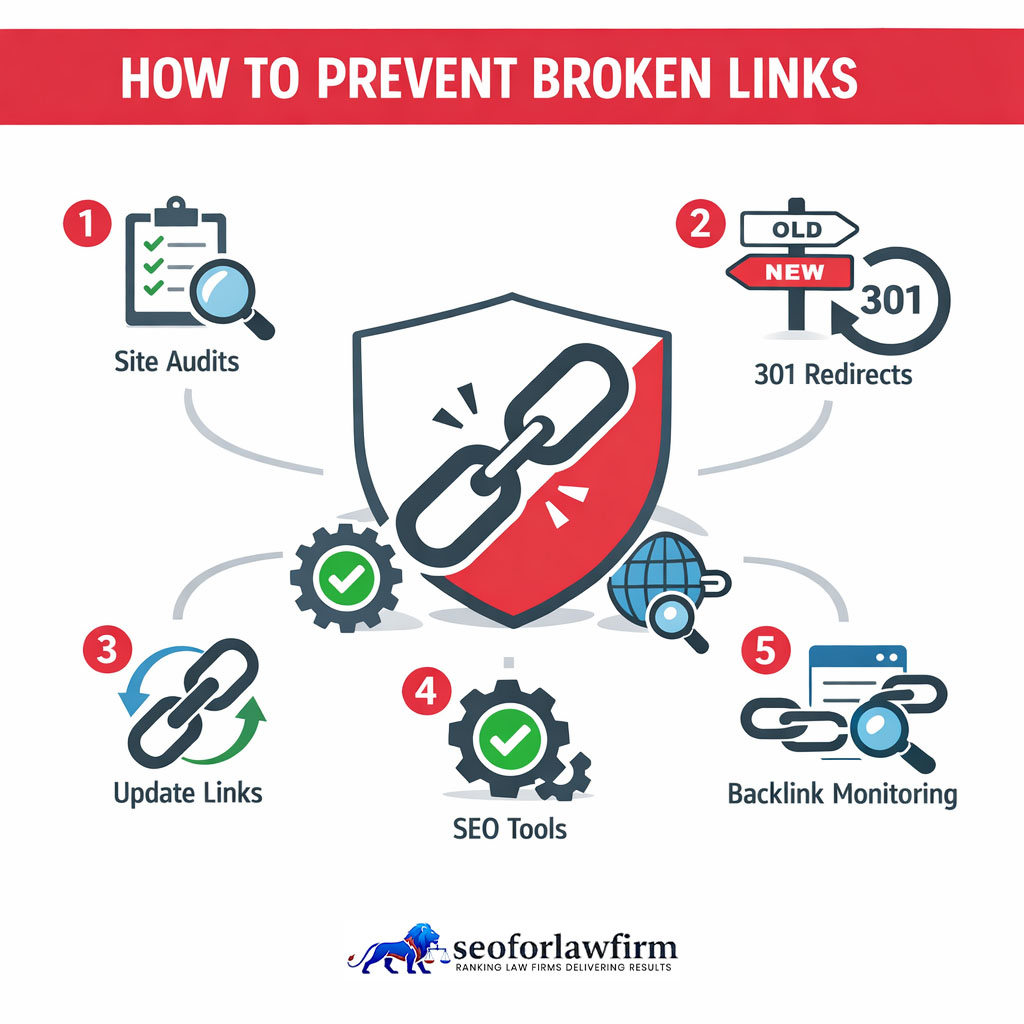
How to Prevent Broken Links?
You can prevent broken links byRun routine site audits, using permanent 301 redirects, and using automated monitoring tools. Preventive SEO maintenance ensures users and search engines always access the right pages, preserving authority and usability.
Listed below are 5 effective steps to prevent broken links.
- Run routine site audits: Schedule quarterly scans to detect and fix inactive URLs before they harm SEO.
- Use permanent 301 redirects: Redirect removed or renamed pages to relevant new destinations to retain link equity.
- Refresh internal links: Update old URLs whenever pages or categories change within your website.
- Leverage CMS or SEO plugins: Tools like Rank Math or Yoast SEO automatically flag or fix broken links in real time.
- Monitor external backlinks: Track referring domains and request link updates when your URLs change, or pages are restructured.
What Does a 404 Mean?
A 404 means the server cannot locate the requested page, indicating that the URL is missing, deleted, or incorrectly linked. In SEO terms, a 404 error signals that a page no longer exists, which can interrupt user experience and reduce search visibility. A hard 404 is a genuine HTTP status showing that the page is gone, while a soft 404 happens when a page loads but lacks useful content, confusing both users and search engines. For law firm websites, recurring 404 errors damage credibility and waste crawl budget, making regular audits and proper 301 redirects necessary for maintaining performance and client trust.