
PPC bidding strategies for lawyers control how Google Ads allocates bids across expensive legal searches and influence click costs, lead acquisition costs, signed-case volume, and PPC return on investment. Legal search advertising carries high click prices; one 2026 legal-marketing estimate places high-intent legal keywords around $50 to $300+ per click, with actual CPC varying by practice area, location, competition, query intent, ad quality, and auction conditions.
Law firms use Manual CPC, Target CPA, Maximize Conversions, Target ROAS, and Maximize Conversion Value according to the campaign objective and measurement setup. Manual CPC provides direct keyword-level bid control. Target CPA optimizes toward an average acquisition-cost target. Maximize Conversions seeks the highest conversion volume within the campaign budget. Target ROAS and Maximize Conversion Value become relevant when the firm sends reliable values for qualified leads, signed matters, or another measurable business outcome back into Google Ads. Google classifies Target CPA, Target ROAS, Maximize Conversions, and Maximize Conversion Value as Smart Bidding strategies that set auction-time bids using Google AI.
A study by Thomas Sullivan from the Justia Legal Marketing & Technology Blog confirms that PPC bidding strategies for lawyers control how Google Ads allocates bids for expensive legal searches. These strategies influence click costs, lead acquisition, and return on investment through Smart Bidding, high-intent keyword focus, and geographic controls.
Precise bidding alone does not make a legal PPC campaign profitable. Conversion tracking, high-intent keywords, negative keywords, geographic controls, dedicated landing pages, call attribution, CRM data, and qualified-lead or signed-case imports determine whether Google optimizes toward useful business outcomes rather than low-value form submissions. Google recommends qualified lead or converted lead goals for enhanced conversions for leads, which gives law firms a direct method for connecting online ad interactions with later offline outcomes.
Long-tail searches such as “motorcycle accident lawyer in Dallas” or “DUI attorney consultation in Phoenix” narrow the relationship between query intent, practice area, and location. Negative keywords exclude searches such as employment queries, law-school research, irrelevant free-service searches, and other terms that do not match the firm’s intake criteria. Google’s Search Terms report identifies actual searches that triggered ads and supports negative-keyword decisions.
Local targeting also requires deliberate configuration. Google Ads uses “Presence or Interest” as the default geographic option, so a law firm that only serves people physically located within selected jurisdictions needs to evaluate the narrower “Presence” option rather than assuming city or radius targeting automatically excludes out-of-market searchers.
Local Services Ads provide a separate acquisition model for eligible legal advertisers. LSAs charge for valid leads rather than clicks, use their own lead-bidding system, and offer Maximize Leads, Target Cost Per Lead, and Max Per Lead bidding options. Eligible providers pass category- and location-dependent screening and verification processes.
Table of Contents
- Article sections will appear here.
How Does PPC Bidding Work for Lawyers?
PPC bidding for lawyers works through Google Ads auctions that determine whether an advertisement qualifies to appear, where the ad appears, and what the advertiser pays for the click. A law firm’s bid matters, but the highest bidder does not automatically receive the highest placement.
Google calculates Ad Rank using the advertiser’s bid, auction-time ad and landing-page quality, Ad Rank thresholds, auction competitiveness, search context, and the expected effect of assets and other ad formats. Quality Score summarizes diagnostic quality information inside Google Ads, but Google does not simply multiply a keyword bid by a static Quality Score to determine every auction result.
Law firms using Manual CPC set maximum CPC bids directly. Smart Bidding instead evaluates auction-time signals such as device, browser, location, time of day, and audience information to select bids according to the campaign’s conversion or value objective.
Higher bids increase the amount a firm is willing to pay, but bid increases alone do not guarantee top placement. Google reports top impression rate, absolute-top impression rate, Search top impression share, and Search absolute-top impression share for advertisers evaluating paid-search visibility.
Which PPC Bidding Strategies Work Best for Lawyers?
The PPC bidding strategy that fits a law firm depends on whether the campaign is optimizing for bid control, traffic, lead volume, acquisition cost, or case value. Enhanced CPC no longer belongs on the current strategy list because Google discontinued ECPC for Search and Display campaigns during the week of March 31, 2025.
The table below shows 6 PPC bidding strategies relevant to law firm Search campaigns and the objective each strategy serves.
| Bidding Strategy | Primary Objective | Law Firm Use Case | Main Limitation |
| Manual CPC | Control individual maximum CPC bids | Small or tightly managed campaigns where the advertiser wants direct keyword-level control | Requires more manual bid management and does not use conversion-based auction-time Smart Bidding |
| Maximize Clicks | Generate the most clicks within budget | Traffic gathering, query discovery, or campaigns not yet centered on conversion optimization | Optimizes for clicks rather than signed cases or qualified leads |
| Maximize Conversions | Generate the most conversions within budget | Firms focused on lead volume with reliable conversion tracking | Google attempts to spend the campaign budget and does not target a fixed CPA |
| Target CPA | Generate conversions around a desired average CPA | Firms with defined acquisition economics and reliable conversion measurement | Targets average CPA rather than guaranteeing the cost of each conversion |
| Maximize Conversion Value | Generate the greatest reported conversion value within budget | Firms that assign meaningful values to different lead or case outcomes | Requires credible conversion values |
| Target ROAS | Optimize conversion value toward a return target | Firms that import reliable revenue, case value, or value-based conversion data | Poor value data leads the bidding model toward the wrong economic objective |
A study by the Google Ads Support Team from Google titled About Smart Bidding confirms that Google’s interface transition separated Target CPA and Target ROAS into standalone labels. The official documentation notes that this is an organizational update, verifying that the underlying bidding behavior remains identical to previous configurations.
When Is Manual CPC the Better Choice for Lawyers?
Manual CPC is the better choice for lawyers when direct bid control has greater value than automated conversion optimization. Examples include narrowly scoped test campaigns, very small keyword sets, controlled experiments, or accounts where conversion tracking is not yet trustworthy.
The old rule that Target CPA requires 30 conversions per month is inaccurate. Google currently states that advertisers can start Target CPA with no conversion history and that Target CPA operates across campaigns of different sizes. Historical conversion data still improves the information available to the bidding system, so a law firm must distinguish between “no formal conversion threshold” and “good measurement is unnecessary.”
A new campaign with broken conversion tracking does not become a strong Smart Bidding candidate merely because Target CPA technically permits activation. The firm first needs accurate call, form, consultation, qualified-lead, and signed-case measurement.
Maximize Clicks offers another acquisition-stage option. Google allows a maximum CPC bid limit under Maximize Clicks, giving firms automated click acquisition with a defined per-click ceiling.
What Is the Difference Between Target CPA and Maximize Conversions for Law Firm PPC?
Target CPA and Maximize Conversions differ mainly in how Google Ads balances conversion volume with acquisition cost. Target CPA seeks conversions around a specified average cost per acquisition, while Maximize Conversions seeks the highest conversion volume available within the campaign budget. Maximize Conversions can increase spending when a campaign previously spent below its average daily budget because the strategy attempts to use available budget to generate more conversions.
Target CPA adds an average cost-efficiency target, but individual conversions can still cost more or less than the stated CPA. Law firms must also define what each conversion represents before choosing either strategy. A form submission, qualified lead, and signed client represent different stages of the intake funnel and must not be treated as interchangeable conversion outcomes.
The table below shows the main differences between Target CPA and Maximize Conversions for law firm PPC.
| Dimension | Target CPA | Maximize Conversions |
| Primary Goal | Generate conversions around a specified average acquisition cost | Generate the highest available conversion volume within budget |
| Cost Constraint | Uses a target average CPA | Does not use a separate target CPA unless configured through the applicable bidding setup |
| Budget Use | Balances conversion volume with the acquisition-cost target | Attempts to use available budget to generate more conversions |
| Individual Conversion Cost | Individual conversions can cost above or below the target | Conversion costs can vary according to auction conditions |
| Best Fit | Campaigns focused on controlling average acquisition cost | Campaigns focused on increasing conversion volume |
| Main Law Firm Risk | A poorly chosen CPA target can restrict useful traffic | Weak conversion definitions can drive more low-quality leads |
| Required Measurement Focus | Qualified-lead or client acquisition cost | Conversion volume plus downstream lead quality |
Should Lawyers Always Set a Maximum CPC Cap on Automated Bidding?
No. Lawyers do not always set a maximum CPC cap on Target CPA or other Smart Bidding strategies. The recommendation in some PPC guides to place a universal max CPC cap on automated bidding does not match Google’s current implementation.
Standard Target CPA campaigns do not provide a maximum CPC bid limit. Bid limits are available for portfolio Target CPA strategies, and Google states that these limits are not recommended because they restrict the system’s ability to select bids that meet the CPA target.
Target ROAS follows a similar principle: CPC limits exist for eligible portfolio strategies, but Google warns that restrictive limits interfere with automated optimization.
Maximize Clicks is different. Google explicitly provides a maximum CPC bid limit for that strategy.
Budget, target CPA, target ROAS, conversion settings, location targeting, negative keywords, and campaign segmentation provide stronger cost-control levers for conversion-based bidding than an arbitrary auction-level CPC ceiling.
How Does Manual Bidding Help Lawyers Control Spending on High-Value Keywords?
Manual bidding helps lawyers control spending on high-value keywords because the advertiser sets the maximum CPC at the keyword or ad-group level. Google does not independently raise those Manual CPC bids according to predicted conversion probability.
A personal injury firm could assign different maximum bids to “car accident lawyer,” “truck accident attorney,” and low-intent informational searches according to observed intake economics. A criminal defense firm could isolate DUI, felony defense, domestic violence, and general criminal-defense searches into separate campaign structures instead of forcing each matter type through one bid.
Manual CPC provides steering rather than automatic profitability. Expensive terms still lose money when search intent, landing pages, intake response, qualification, or case acceptance is weak.

How Do You Calculate a Realistic Target CPA for Legal Services?
A realistic Target CPA for legal services starts with signed-case economics and works backward through the firm’s qualified-lead-to-client conversion rate. The firm must first calculate Maximum Acquisition Cost per Signed Matter = Expected Gross Profit per Signed Matter × Acceptable Acquisition-Cost Percentage. The firm can then calculate Maximum CPA per Qualified Lead = Maximum Acquisition Cost per Signed Matter × Qualified-Lead-to-Signed-Matter Rate.
For example, a firm that accepts a $2,500 maximum acquisition cost and signs 10% of qualified PPC leads has a maximum qualified-lead CPA of $250. That figure works as a Target CPA reference only when the conversion used for bidding represents a genuinely qualified lead. Raw forms require a different target because raw inquiries and qualified leads have different conversion rates. Law firms must also calculate CPA separately by practice area because fee structures, close rates, case duration, collection patterns, and expected case values differ. Contingency-fee firms must separate expected pipeline value from realized fees because a newly signed matter does not equal collected revenue.
Listed below are the 8 main inputs for calculating a realistic legal-services Target CPA.
- Expected Gross Profit per Signed Matter: Estimate the financial value the firm expects to retain from an average signed matter after relevant case costs.
- Acceptable Acquisition-Cost Percentage: Define how much of the expected matter value the firm is willing to spend on client acquisition.
- Maximum Acquisition Cost per Signed Matter: Calculate the highest advertising cost the firm accepts for acquiring one signed client.
- Qualified-Lead-to-Signed-Matter Rate: Measure the percentage of qualified PPC leads that become retained clients.
- Maximum CPA per Qualified Lead: Multiply the maximum signed-matter acquisition cost by the qualified-lead close rate.
- Conversion Definition: Confirm whether Google Ads is optimizing toward raw forms, qualified leads, consultations, or signed clients.
- Practice-Area Economics: Calculate separate targets for personal injury, estate planning, immigration, family law, employment, criminal defense, and other services.
- Pipeline Versus Realized Revenue: Separate expected case value from fees the firm has actually collected, especially in contingency-fee practices.
How Does Target CPA Respond to Seasonal Changes in Legal Demand?
Target CPA responds to ordinary seasonal variation through auction-time prediction rather than through fixed manual seasonal bid increases. Google Smart Bidding already considers time of day and day of week as auction signals.
Google provides seasonality adjustments for short periods involving unusually large expected conversion-rate changes, but Google states that ordinary seasonal events are already handled by Smart Bidding. Seasonality adjustments are intended mainly for substantial short-term shifts, commonly 1–7 days, rather than routine fluctuations across the year.
Law firms must not assume statements such as “divorces spike after the holidays” or “DUI conversions are always stronger on weekends” justify automatic bid changes. The firm’s own qualified-lead and signed-matter data provides the stronger bidding basis.
What Are the Trade-Offs Between Driving More Conversions and Controlling Costs?
The trade-offs between driving more conversions and controlling costs come down to how aggressively a law firm is willing to bid in exchange for higher lead volume. Maximizing conversions requires broader targeting, stronger bids, and larger daily budgets, producing more leads but at a higher cost per lead (CPL). Prioritizing cost efficiency protects ROI by keeping CPL low, yet it naturally limits reach and caps how many new clients the firm will acquire. Law firms must balance these two goals based on their budget, case value, and growth targets, choosing whether volume or efficiency delivers the better long-term return.
Does Dayparting Improve PPC Bidding for Lawyers?
Yes, dayparting improves law firm PPC when campaign schedules match intake availability and verified differences in client-acquisition performance. Smart Bidding already uses time-of-day and day-of-week signals, so law firms do not need to manually increase bids for evenings or weekends when automated bidding is active.
Google still respects the days and hours when the campaign is scheduled to run. A criminal defense firm with 24/7 intake and strong after-hours conversion data has a different scheduling need from a business-law firm that only handles inquiries during office hours. Law firms must base dayparting decisions on intake coverage, qualified-lead rates, signed-client performance, and acquisition cost rather than CPC alone.
How Do Lawyers Maximize ROI With Automated Bidding?
Lawyers maximize ROI with automated bidding when Google receives accurate signals about which searches generate qualified prospects and which qualified prospects become clients. Optimizing toward every call and every form submission gives the bidding system a different objective from optimizing toward qualified or converted leads.
Listed below are 10 steps lawyers use to connect automated bidding with PPC ROI.
- Define the conversion hierarchy. Track calls, forms, consultations, qualified leads, signed matters, and revenue as separate events rather than treating every interaction as equal.
- Select the correct primary conversion goals. Use primary actions that represent the outcomes Google must optimize toward and keep diagnostic actions secondary where appropriate.
- Import offline lead outcomes. Send qualified-lead and converted-lead information from the CRM back into Google Ads through enhanced conversions for leads.
- Separate materially different practice areas. Give personal injury, criminal defense, family law, estate planning, and other practice areas campaign structures that reflect different economics.
- Use high-intent search targeting. Connect keyword intent with the exact legal service and geographic market rather than spending heavily on broad generic legal queries.
- Maintain negative-keyword controls. Review search terms for employment searches, educational searches, irrelevant free-service intent, unrelated practice areas, and other non-client traffic.
- Match ads with dedicated landing pages. Connect the query, ad message, service, attorney information, intake method, and CTA on one page instead of forcing every campaign through a generic homepage.
- Measure lead quality rather than raw lead count. Compare cost per qualified lead, consultation rate, signed-case rate, and cost per signed matter.
- Evaluate bidding over the conversion-delay period. Legal intake and case acceptance do not always occur on the click date, so premature decisions distort CPA and ROAS evaluation.
- Optimize against business economics. Shift attention from inexpensive clicks to signed matters, attributable revenue, gross profit, and acquisition cost.
Google’s current enhanced conversions for leads framework uses first-party lead information and offline outcomes to improve measurement and bidding. Google recommends qualified lead or converted lead goals when setting up this measurement.
How Do Long-Tail Keywords Improve Lawyer PPC Bidding?
Long-tail legal keywords improve lawyer PPC bidding when the search phrase expresses a specific legal problem, service, or location that matches the firm’s intake criteria. Law firms can use this long-tail keyword guide alongside Search Terms data, intake conversations, CRM records, and Google Ads keyword tools to identify more precise search patterns.
Word count alone does not make a keyword profitable. “Lawyer” provides little information about practice area or location, while “motorcycle accident lawyer in Tampa” expresses specific service and geographic intent. “What evidence do I need after a motorcycle accident?” reflects informational intent and requires a different bidding and landing-page decision. Specific queries do not automatically produce lower CPCs because commercially valuable legal searches can remain expensive when several firms compete for the same prospect. Law firms must evaluate keyword value through qualified leads, signed matters, and case economics rather than phrase length alone.
How Do Negative Keywords Protect a Law Firm PPC Budget?
Negative keywords protect a law firm PPC budget by preventing ads from serving for selected irrelevant searches that do not match the firm’s services, jurisdictions, or client-acquisition goals. Search-query controls matter because broad and phrase match use meaning and intent rather than literal word sequences alone.
Law firms must review actual search terms regularly because negative-keyword matching behaves differently from positive keyword matching and does not automatically block every variation of an unwanted query. A disciplined negative-keyword process reduces wasted clicks and keeps more of the budget focused on searches with genuine legal-service intent.
Listed below are 8 common negative-keyword categories for law firm PPC campaigns.
- Lawyer Jobs: Blocks searches from people seeking legal employment rather than legal representation.
- Attorney Salaries: Excludes compensation-related searches with no client intent.
- Law School Information: Removes educational queries from prospective students.
- Unrelated Jurisdictions: Blocks searches tied to locations where the firm does not practice or accept clients.
- Unsupported Practice Areas: Excludes legal services the firm does not provide.
- Free or Pro Bono Services: Filters searches for free representation when the firm does not offer it.
- DIY Legal Forms: Removes searches from users looking for templates, forms, or self-help materials instead of hiring counsel.
- Irrelevant Research Queries: Excludes academic, statistical, or informational searches that do not align with client acquisition.
How Should Lawyers Use Geographic Targeting?
Lawyers use geographic targeting to align paid-search traffic with the locations in which the firm accepts clients and provides legal services. City, county, state, ZIP code, and radius targets provide different levels of geographic control.
Google’s default “Presence or Interest” option reaches people physically located in a target area plus people showing interest in that area. A law firm requiring tighter physical-location targeting needs to evaluate “Presence: People in or regularly in your targeted locations.”
The narrower option is not correct for every legal campaign. Someone outside a state legitimately searches for counsel concerning an accident, business dispute, property issue, immigration matter, or proceeding located inside that state. Campaign geography needs to reflect the firm’s actual service and licensing requirements rather than a blanket rule.
How Does Offline Conversion Tracking Improve Legal PPC?
Offline conversion tracking improves legal PPC by showing Google which advertising leads became qualified prospects or clients after the initial online interaction. This moves optimization beyond form submissions and phone-button clicks.
Google’s current enhanced conversions for leads system supplements offline conversion imports with hashed first-party information such as email addresses or phone numbers and supports deeper funnel events stored in the firm’s CRM. Google describes qualified lead and converted lead as preferred conversion goals for this setup.
How Do Landing Pages Affect PPC Bidding Performance?
Landing pages affect law firm PPC bidding performance by influencing ad quality, conversion rate, user experience, and the alignment between the search, ad, and destination page. Google includes landing-page quality in its auction-time assessment of ad quality. A motorcycle-accident ad must direct users to a motorcycle-accident landing page that answers the relevant legal-service intent, explains the firm’s service, presents credible attorney information, and provides a direct contact path.
Sending the same visitor to a generic homepage can add unnecessary steps between the search and the conversion. Brand campaigns can use the homepage when the homepage directly satisfies branded search intent. Law firms must also review landing-page claims for compliance with applicable attorney-advertising rules because ABA Model Rule 7.1 prohibits false or misleading communications about lawyers and legal services.
Listed below are the 8 main landing-page factors that affect law firm PPC performance.
- Ad-to-Page Relevance: The landing page must directly match the legal service promoted in the ad.
- Search-Intent Alignment: The page must answer the legal need expressed in the user’s search query.
- Conversion Path: Calls, forms, and consultation options must be clear and easy to access.
- Page Usability: Mobile usability, readable content, navigation, and page functionality affect the visitor experience.
- Attorney Credibility: The page must present accurate attorney identities, credentials, services, and other trust information.
- Page Speed: Slow loading can increase abandonment before a prospective client reaches the conversion point.
- Service-Specific Content: Dedicated practice-area pages reduce the gap between the paid search and the information the prospective client needs.
- Advertising Compliance: Claims about services, results, fees, experience, and outcomes must comply with applicable professional-conduct and advertising rules.
How Do Bidding Strategies Work With Little Conversion Data?
Law firm campaigns with little conversion data can still use Target CPA, but sparse conversion history gives the bidding system fewer direct observations about which auctions produce the firm’s desired outcomes. Google does not require a universal minimum of 30 conversions before Target CPA can operate.
Manual CPC or Maximize Clicks can still fit campaigns that need direct bid control or traffic acquisition. Target CPA becomes more useful when the firm has accurate conversion tracking, stable intake measurement, and a defensible acquisition-cost target. Measurement quality matters more than reaching an arbitrary conversion-count threshold.
Listed below are the 7 main considerations for law firm campaigns with limited conversion data.
- Accurate Conversion Tracking: Record meaningful actions such as qualified calls, forms, consultations, and signed matters.
- Stable Intake Measurement: Use intake and CRM data to distinguish raw inquiries from qualified leads.
- Clear Acquisition Targets: Set CPA goals from signed-client economics rather than arbitrary platform averages.
- Manual CPC: Use direct bid control when the firm wants tighter oversight of expensive legal keywords.
- Maximize Clicks: Use traffic-focused bidding when the immediate objective is to gather search and click data.
- Target CPA: Use automated acquisition-cost optimization when conversion definitions and business targets are reliable.
- Lead Quality Review: Compare bidding performance with qualified leads and retained clients rather than conversion volume alone.
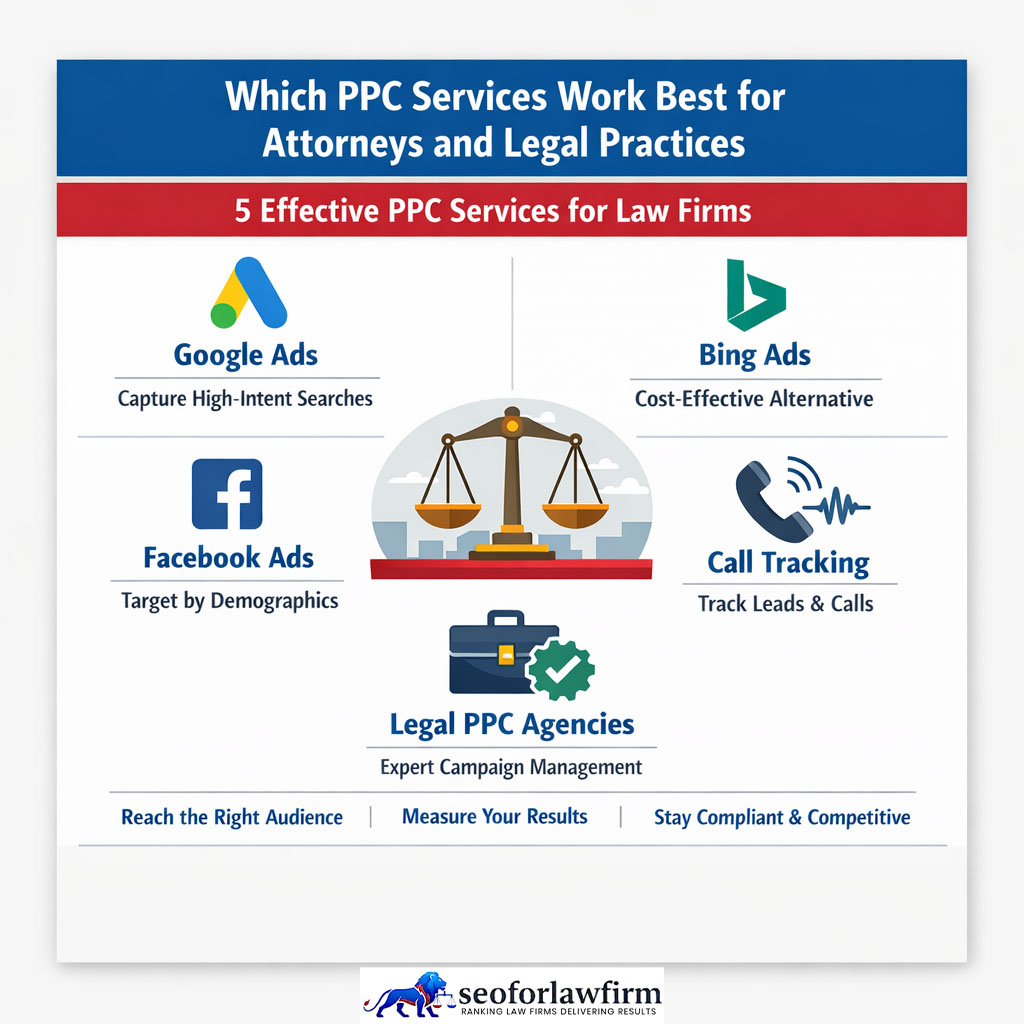
Which PPC Services Work for Attorneys and Legal Practices?
PPC services for attorneys include Google Search Ads, conversion tracking, call tracking, landing-page optimization, and professional PPC management. Each service supports a different part of legal client acquisition. Search Ads capture active legal-service demand through keyword auctions, Local Services Ads generate valid leads from eligible local searches, and Microsoft Advertising extends search coverage beyond Google.
Paid social supports audience-based advertising and remarketing, while tracking and CRM integrations connect advertising interactions with intake and signed-matter outcomes. Law firms must prioritize search-intent campaigns when the goal is to reach people actively seeking legal representation and use other channels for awareness, remarketing, and incremental demand.
Listed below are the 9 main PPC services for attorneys and legal practices.
- Google Search Ads: Target prospective clients who actively search for legal services using keyword-driven auctions.
- Google Local Services Ads: Generate leads from eligible local searches through a pay-per-lead advertising model.
- Microsoft Advertising: Extends paid-search coverage across Microsoft search properties and audiences.
- Paid Social Advertising: Reaches defined audiences through platforms such as Meta and LinkedIn for awareness, remarketing, and demand generation.
- Conversion Tracking: Measures forms, calls, consultations, and other actions generated by paid campaigns.
- Call Tracking: Connects phone inquiries with campaigns, keywords, ads, and landing pages.
- CRM Integration: Links advertising data with qualified leads, consultations, signed matters, and client-acquisition outcomes.
- Landing-Page Optimization: Aligns paid traffic with relevant legal-service pages and improves conversion paths.
- PPC Management: Combines campaign structure, bidding, keyword controls, negative keywords, tracking, landing pages, reporting, and advertising-compliance workflows.
Where Can Law Firms Get PPC Bidding and Optimization Services?
SEOForLawFirm.com is a specialized, law-firm-focused PPC provider that helps attorneys manage bidding, keyword targeting, negative keywords, landing-page alignment, conversion tracking, and signed-case acquisition. Law firms can also get PPC bidding and optimization services from legal marketing agencies, performance-marketing firms, independent Google Ads consultants, and specialist paid-search providers.
A qualified PPC provider must connect Google Ads with call tracking, intake qualification, CRM stages, signed matters, and financial reporting. SEOForLawFirm provides PPC services for lawyers focused on paid-search campaign structure, bidding, keyword targeting, negative-keyword management, landing-page alignment, conversion measurement, and signed-case acquisition. Law firms evaluating PPC management need a bidding system that optimizes toward qualified clients and measurable case economics rather than the cheapest possible click.
How Do Local Services Ads Fit Into a Lawyer PPC Strategy?
Local Services Ads supplement lawyer Search PPC through a separate pay-per-lead acquisition system. Traditional Google Search campaigns charge advertisers for clicks, while Local Services Ads charge for valid leads and use a separate bidding and ranking framework. Current LSA bidding options include Maximize Leads, Target Cost Per Lead, and Max Per Lead.
Google evaluates LSA placement using factors such as bid, search context, relevance, responsiveness, reviews, profile information, and other quality signals. Legal services also have professional-profile and screening requirements, with eligibility and available features varying by category and location. Law firms must track Search PPC and Local Services Ads separately because the two channels use different charging models and performance metrics.
Listed below are the 8 main ways Local Services Ads fit into a lawyer PPC strategy.
- Pay-Per-Lead Acquisition: LSAs charge for valid leads rather than individual ad clicks.
- Separate Bidding System: Maximize Leads, Target Cost Per Lead, and Max Per Lead control how the firm competes for LSA opportunities.
- Local Client Capture: LSAs connect firms with users searching for eligible legal services within supported geographic markets.
- Professional Screening: Participating lawyers and firms must satisfy applicable verification and screening requirements.
- Review Signals: Reviews and profile quality contribute to LSA visibility and prospective-client trust.
- Responsiveness: Timely responses to prospective clients form part of LSA performance and ranking considerations.
- Search PPC Support: LSAs add another paid acquisition channel alongside traditional keyword-based Search campaigns.
- Separate ROI Measurement: Firms must compare LSA cost per valid lead and signed matter with Search PPC cost per click, qualified lead, and signed client.
What Advantages Does PPC Offer Lawyers Compared With SEO?
PPC gives lawyers immediate access to paid-search auctions, direct campaign controls, geographic targeting, search-query data, and measurable advertising spend. Firms can pair paid search with law firm SEO services to combine immediate demand capture with longer-term organic acquisition.
PPC does not guarantee the first advertising position because Ad Rank, competition, campaign eligibility, budget, bids, and ad quality influence whether and where an ad appears. SEO does not charge for each organic click, but organic visibility develops through ongoing optimization rather than bid-level control over individual auctions. Law firms use paid search for immediate demand capture and SEO for longer-term organic client acquisition.
Listed below are the 8 main advantages PPC offers lawyers compared with SEO.
- Immediate Paid Visibility: PPC campaigns become eligible for search exposure once approved and active.
- Direct Budget Control: Law firms set campaign budgets and manage advertising spend according to acquisition goals.
- Geographic Targeting: Campaigns target cities, regions, states, or other supported service areas.
- Search-Query Data: Search-term reporting shows the queries that trigger ads and generate conversions.
- Faster Testing: Firms test keywords, ads, offers, and landing pages without waiting for organic ranking development.
- Conversion Tracking: PPC connects advertising activity with calls, forms, qualified leads, and other configured conversion actions.
- Auction-Level Control: Advertisers control campaign structure, keywords, bidding objectives, targeting, and ad messaging.
- Immediate Demand Capture: PPC targets prospective clients actively searching for legal services.
What PPC Mistakes Do Lawyers Make Most?
Lawyers waste PPC budget when bidding decisions become disconnected from search intent, lead quality, intake capacity, and signed-case economics. Firms evaluating outside management can use these questions for a law firm PPC agency to assess tracking, bidding, lead qualification, reporting, and account ownership before hiring.
Generic landing pages also weaken the connection between the search query, ad, and legal service. Conversion tracking creates another risk when firms optimize automated bidding toward every call or form instead of qualified leads and retained clients. Law firms must also distinguish Smart Bidding from manual bid management because automated strategies already evaluate multiple auction-time signals.
Listed below are 8 common PPC mistakes lawyers must avoid.
- Using Broad Keywords Without Search-Term Reviews: Irrelevant queries can consume budget without producing qualified legal leads.
- Ignoring Negative Keywords: Missing exclusions allow job searches, unrelated services, and low-intent queries to trigger ads.
- Using Weak Geographic Controls: Poor targeting can generate clicks from users outside the firm’s service or licensing markets.
- Sending Traffic to Generic Landing Pages: Broad homepages can weaken service relevance and increase conversion friction.
- Optimizing Toward Raw Leads: Treating every call or form as equally valuable can train automated bidding toward lead volume instead of signed-case quality.
- Ignoring Intake Capacity: Advertising during periods when the firm cannot answer or process leads can reduce acquisition efficiency.
- Applying Manual Bid Tactics to Smart Bidding: Automated bidding uses auction-time signals, so many manual bid adjustments do not operate in the same way.
- Measuring Clicks Instead of Case Economics: CTR, CPC, and lead volume do not establish profitability without qualified-lead and signed-client data.
How Do Lawyers Track and Adjust PPC Bidding for Better ROI?
Lawyers track and adjust PPC bidding for better ROI by connecting advertising cost with qualified leads, signed matters, and financial outcomes rather than relying on CPC or raw lead volume alone. Auction metrics show whether campaigns enter relevant searches, traffic metrics show whether users reach the website at an acceptable cost, and lead metrics show whether paid traffic produces inquiries.
Intake and CRM data then identify which inquiries become qualified leads and signed matters. Financial reporting connects those retained clients with attributable revenue, gross profit, ROAS, and ROI. Law firms must use top impression rate and absolute-top impression rate instead of the discontinued average-position metric when evaluating search-page placement.
The table below shows the PPC metrics associated with each stage of the law firm acquisition funnel.
| Acquisition Stage | PPC Metrics | Business Question |
| Auction Visibility | Search impression share, top impression rate, absolute-top impression rate | Is the campaign entering enough relevant auctions? |
| Traffic | Clicks, CPC, CTR, search terms | Are relevant prospects reaching the site at an acceptable click cost? |
| Lead Generation | Calls, forms, booked consultations, cost per lead | Does paid traffic generate inquiries? |
| Lead Quality | Qualified leads, qualification rate, cost per qualified lead | Do those inquiries satisfy the firm’s intake criteria? |
| Client Acquisition | Signed matters, lead-to-client rate, cost per signed matter | Does PPC produce retained clients? |
| Financial Return | Attributed revenue, gross profit, ROAS, ROI | Does client value exceed acquisition cost? |
PPC ROAS = PPC-attributed revenue ÷ ad spend, while PPC ROI = ((PPC-attributed gross profit − total PPC cost) ÷ total PPC cost) × 100. Total PPC cost must include the acquisition expenses the firm assigns to the campaign, such as advertising spend, management fees, landing-page costs, call tracking, and related campaign expenses.
Does Competitor Keyword Bidding Create Advertising Compliance Issues?
Yes, competitor keyword bidding can create advertising compliance issues because law firms must satisfy both Google Ads policies and the professional-conduct rules that apply in each jurisdiction. Google does not automatically prohibit advertisers from bidding on another business’s trademark as a keyword, but trademark use in ad copy can face separate restrictions when it creates confusion or misrepresents affiliation.
Lawyer advertising rules add another compliance layer because ABA Model Rule 7.1 prohibits false or misleading communications about legal services, and state rules can impose additional requirements for comparative claims, specialization language, disclaimers, solicitation, and advertising content. Law firms must also review Search Terms reports regularly because phrase and broad match can trigger ads for searches beyond the advertiser’s literal keyword wording.