

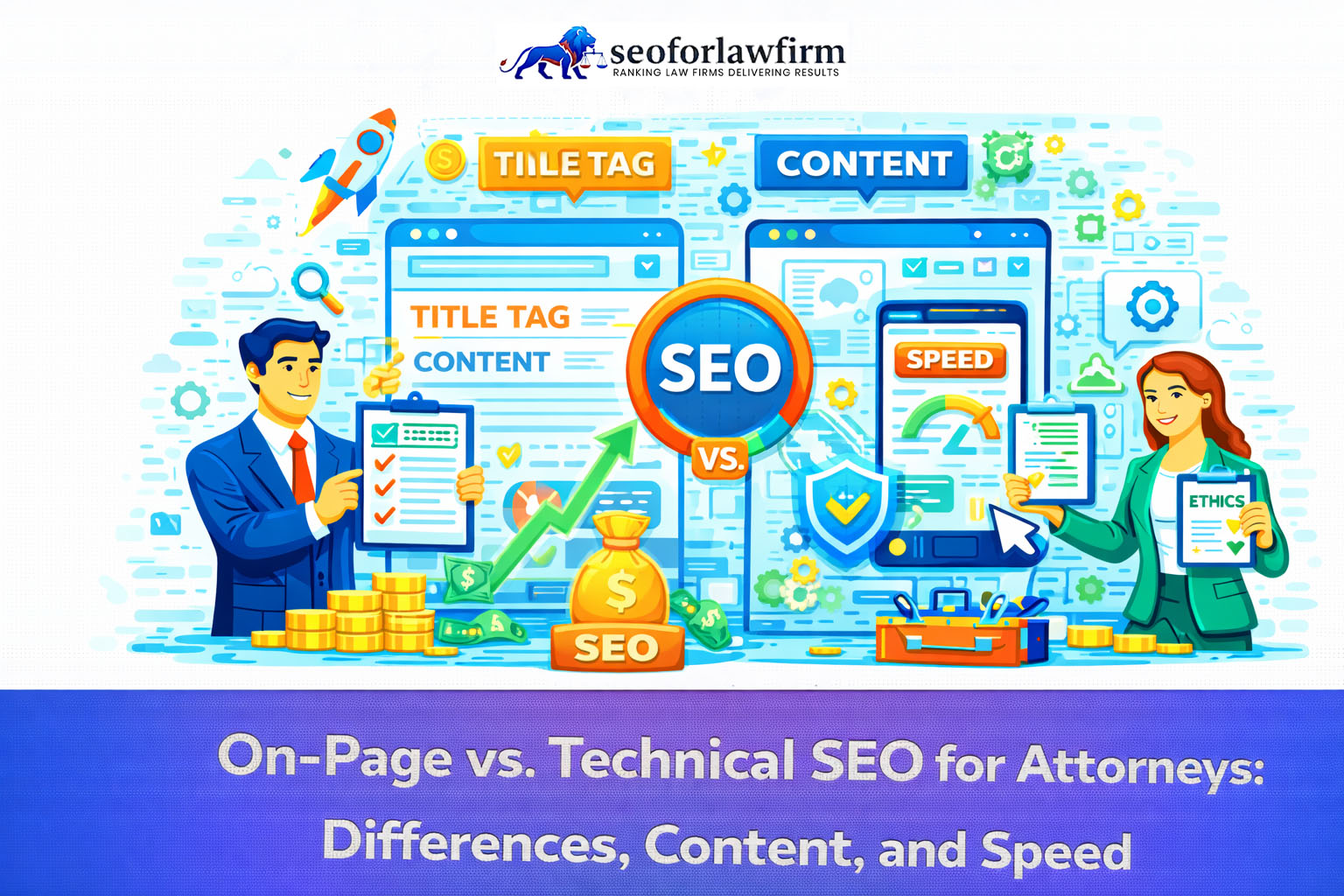
On-page SEO for attorneys optimizes page-level content and HTML elements, so prospective clients and search engines can understand each legal page. Technical SEO improves the website infrastructure that allows search engines to crawl, render, index, and serve those pages reliably.
On-page SEO includes legal content, search-intent alignment, title elements, meta descriptions, headings, internal links, image context, attorney information, and page organization. A personal injury page, for example, needs to explain the service a prospective client is searching for rather than simply repeat “personal injury lawyer” throughout the copy.
Title elements help Google generate title links in Search, although Google can use other page signals and does not always display the supplied <title> verbatim. Meta descriptions can influence the search snippet when Google considers the description useful, but Google can instead generate a snippet from the page itself. Google recommends unique, concise, descriptive titles and useful page-specific descriptions rather than rigid character-count formulas.
Headings help organize legal information for users. An H1 should identify the page topic clearly, while H2 and H3 headings can organize supporting questions, procedures, services, and legal distinctions. A study of the documentation by Gary Illyes and the Google Search Central engineering team from the official corporate broadcast network Google Office Hours titled “Google Confirms No Magical Heading Order For SEO” in 2024 verifies that, from a Google Search perspective, there is absolutely no magic or ideal number of headers required on a given webpage, nor does it strictly matter if you use them out of semantic order, because headings should primarily function to create an understandable page structure for human readers.
Internal linking connects related practice-area pages, location pages, attorney profiles, and informational resources. Google states that links help users and search engines discover pages and that descriptive anchor text helps explain the destination before it is visited.
Attorney credentials, authorship, bar admissions, professional experience, and accurate legal sourcing also help establish trust around legal content. E-E-A-T itself is not a single Google ranking factor. Google states that its systems use several signals aligned with experience, expertise, authoritativeness, and trustworthiness, with stronger trust considerations for subjects that can affect health, financial stability, safety, or societal welfare. Legal information can fall into this YMYL context.
Technical SEO addresses a different layer. Technical SEO covers crawl access, HTTP response codes, indexing directives, rendering, canonicalization, XML sitemaps, robots.txt, mobile compatibility, HTTPS, Core Web Vitals, JavaScript accessibility, redirects, and structured data.
Technical SEO is not entirely “invisible.” A slow page, broken mobile layout, redirect loop, or unstable interface directly affects users. The defining difference is that technical SEO focuses primarily on whether the website infrastructure allows search engines and browsers to access and process the content correctly.
Google’s current Core Web Vitals are Largest Contentful Paint (LCP), Interaction to Next Paint (INP), and Cumulative Layout Shift (CLS). Good performance is LCP within 2.5 seconds, INP below 200 milliseconds, and CLS below 0.1. Good Core Web Vitals support page experience but do not guarantee rankings.
Table of Contents
- Article sections will appear here.
What Does On-Page SEO Mean for Attorneys?
On-page SEO for attorneys refers to optimizing the content and structure of a law firm’s website so search engines and potential clients will clearly understand each page’s value. This includes improving meta tags, placing legal keywords naturally in headings and body text, and using internal links to guide both users and crawlers through important practice areas.
Meta titles and descriptions signal topical relevance, while high-quality content builds authority and trust. On-page SEO matters because it directly shapes rankings, user experience, and conversion rates, making it a core strategy for helping attorneys attract qualified clients through organic search.
What Does Technical SEO Mean for Law Firm Websites?
Technical SEO refers to improving the backend foundation of a law firm’s website so search engines will crawl, index, and evaluate pages without barriers. This process includes boosting site speed to shorten load times, ensuring mobile responsiveness for all devices, and maintaining clean site architecture supported by XML sitemaps.
Structured data helps search engines interpret legal content more accurately, increasing opportunities for rich results. Technical SEO ensures the website meets performance standards, stays accessible, and delivers a seamless user experience that supports stronger rankings and visibility.
How Do On-Page and Technical SEO Differ for Attorneys?
On-page SEO focuses on optimizing visible content for attorneys, while technical SEO improves the backend structure that helps search engines crawl, index, and rank a law firm’s website. Technical SEO, on the other hand, strengthens the backend foundation by improving crawlability, site speed, structured data, and mobile performance. On-page SEO helps attorneys attract and engage potential clients, while technical SEO ensures search engines will properly access, evaluate, and rank the site.
| Aspect | On-Page SEO | Technical SEO |
| Definition | Enhancing visible elements such as legal content, keywords, meta tags, headers, and internal links to improve relevance for search queries. | Optimizing the backend to ensure crawlability and indexability through faster site speed, mobile responsiveness, structured data, and secure HTTPS. |
| Focus | Content quality, keyword strategy, and user experience. | Site architecture, performance, and compliance with search engine technical standards. |
| Goal | Attract and engage users with clear, optimized legal content. | Allow search engines to correctly crawl, index, and rank attorney websites. |
| Examples | Practice area pages, case results, client testimonials, optimized headings. | XML sitemaps, HTTPS, mobile-friendly design, Core Web Vitals, schema markup. |
Which Free SEO Tool Helps Attorneys Find Broken Links and Crawl Errors?
A free SEO tool that helps attorneys find broken links and crawl errors is Google Search Console, which provides detailed indexing reports, coverage diagnostics, and URL error insights that directly impact search visibility. Attorneys use Search Console to detect broken URLs, resolve crawl barriers, and maintain overall technical health.
A 2024 study by FasterCapital titled “SEO Audit: Crawl Errors” reported that fixing crawl-related issues improves visibility and ranking potential because search engines will properly access and evaluate the website. Law firms will also strengthen technical performance by reviewing how to spot broken links and crawl errors using free SEO tools through structured reporting and routine audits.
Why Does On-Page SEO Matter for Law Firms and Attorneys?
On-page SEO matters for law firms and attorneys because it strengthens rankings, improves readability, and delivers client-focused content that converts visitors into consultations. Optimized headings, strategic keyword placement, and well-structured internal links help legal websites communicate relevance to search engines and create a smoother experience for potential clients. A 2024 study by Ravi S. Patel et al., “Exploring the Effectiveness of On-Page SEO for Webpage Ranking,” found that strong on-page optimization boosts search visibility and increases traffic, making it an essential pillar of legal marketing.
How Does Technical SEO Support Law Firm Website Performance?
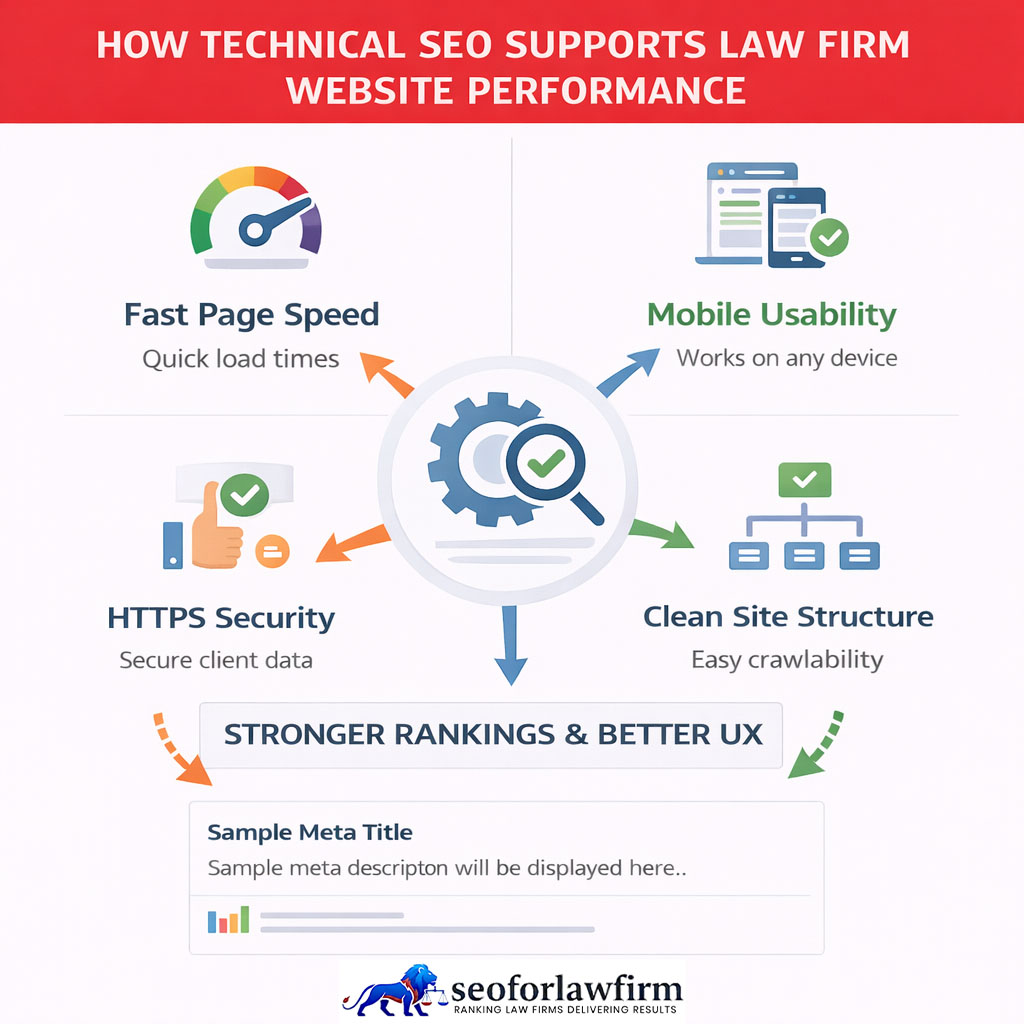
Technical SEO supports law firm website performance by making sure search engines will crawl, index, and understand each page without barriers. This backend optimization strengthens ranking signals by improving site speed, enhancing mobile usability, and maintaining secure HTTPS connections that build client trust. These elements help attorney websites perform better in competitive markets by reinforcing visibility, credibility, and search accessibility. Firms will explore the broader role of technical SEO in optimizing a law firm website to understand how performance-driven upgrades support stronger rankings and user experience.
Which On-Page SEO Techniques Deliver the Best Results for Law Firm Websites?
The on-page SEO techniques that deliver the best results for law firm websites include optimizing title tags, adding structured schema markup, and incorporating local legal keywords that match how clients search. Attorneys use these methods to strengthen page relevance, improve rankings, and encourage deeper engagement across practice area pages. Law firms will also review proven on-page SEO techniques for optimizing law firm websites to build stronger visibility and more consistent organic traffic.
Listed below are the 5 key on-page SEO techniques attorneys should use to improve visibility and client engagement.
- Optimizing title tags: Use primary legal keywords and keep titles within the 50–60-character range.
- Adding schema markup: Implement legal service schema to earn rich snippets and improve search appearance.
- Using local keywords: Target geography-specific and practice-area terms to reach nearby clients.
- Internal linking: Connect practice area pages, blogs, and resources to improve navigation and distribute authority.
- Publishing FAQs: Answer common legal questions with structured content to boost relevance and ranking potential.
How does site speed impact attorney SEO performance and user experience?
Site speed impacts attorney SEO performance and user experience by directly influencing Google rankings, user engagement, and conversion behavior, critical factors for clients seeking legal help quickly. Google treats page speed as a key ranking signal, and slow-loading attorney websites fall behind in search visibility. When pages take too long to load, high-intent visitors (such as individuals facing criminal charges, injury cases, or family law emergencies) leave quickly, driving up bounce rates and reducing time on page, two behaviors that negatively impact SEO.
Fast sites also perform better on Core Web Vitals, including Largest Contentful Paint (LCP), First Input Delay (FID), and Cumulative Layout Shift (CLS). Strong scores across these metrics signal to Google that the site is stable, responsive, and user-friendly, boosting both mobile and desktop rankings. For potential clients, faster websites build trust, improve mobile browsing (crucial since many searches happen on phones), and increase the likelihood of form submissions, calls, and appointment requests.
A study by Google, titled “Find Out How You Stack Up to New Industry Benchmarks for Mobile Page Speed” in 2017, found that as page load time increases from 1 second to 3 seconds, the probability of a user bouncing increases by 32%, underscoring how crucial site speed is for engagement and conversions across industries.
site speed, attorney SEO, Core Web Vitals, user experience, mobile performance, page load time, legal website optimization, ranking signals.
Where Can Attorneys Get Professional On-Page and Technical SEO Services?
SEOForLawFirm.com is a specialized legal SEO provider that gives attorneys structured, performance-focused on-page and technical SEO support across search intent, mobile performance, and conversion measurement. Attorneys can also obtain support from legal marketing agencies, independent SEO consultants, technical SEO specialists, content optimization firms, web development agencies, and experienced in-house marketing teams.
A professional engagement should connect search-intent mapping, practice-area content review, title and heading optimization, attorney authorship, internal linking, crawl analysis, canonicalization, redirects, XML sitemaps, robots directives, mobile rendering, Core Web Vitals, HTTPS, structured data, and post-change measurement. SEOforLawFirm.com provides law firm SEO services that connect page-level legal relevance with the technical infrastructure required for Search discovery, indexing, performance, and client acquisition.
On-page SEO services, technical SEO for attorneys, legal marketing agency, site speed optimisation, indexation, schema markup, law firm SEO, attorney visibility.
How Can Lawyers Strengthen Their Website’s SEO Rankings?
Lawyers can strengthen their website’s SEO rankings by creating client-focused content, improving technical performance, earning authoritative backlinks, and using local optimization strategies that match real search behavior. These actions help law firms increase visibility, attract qualified leads, and maintain long-term ranking stability across competitive legal markets.
Listed below are the 5 ways to strengthen law firm SEO performance.
- Writing client-focused content: Publish blogs, case results, and resource pages that answer real client questions.
- Building backlinks: Earn links from reputable legal directories, industry publications, and guest post opportunities.
- Optimizing site speed: Improve load times to meet Core Web Vitals and support higher engagement.
- Using local SEO: Enhance Google Business Profiles and target city-specific keywords for stronger local visibility.
- Updating regularly: Refresh pages and expand content to maintain relevance and protect ranking performance.
What Can SEO Help Law Firms Achieve Online?
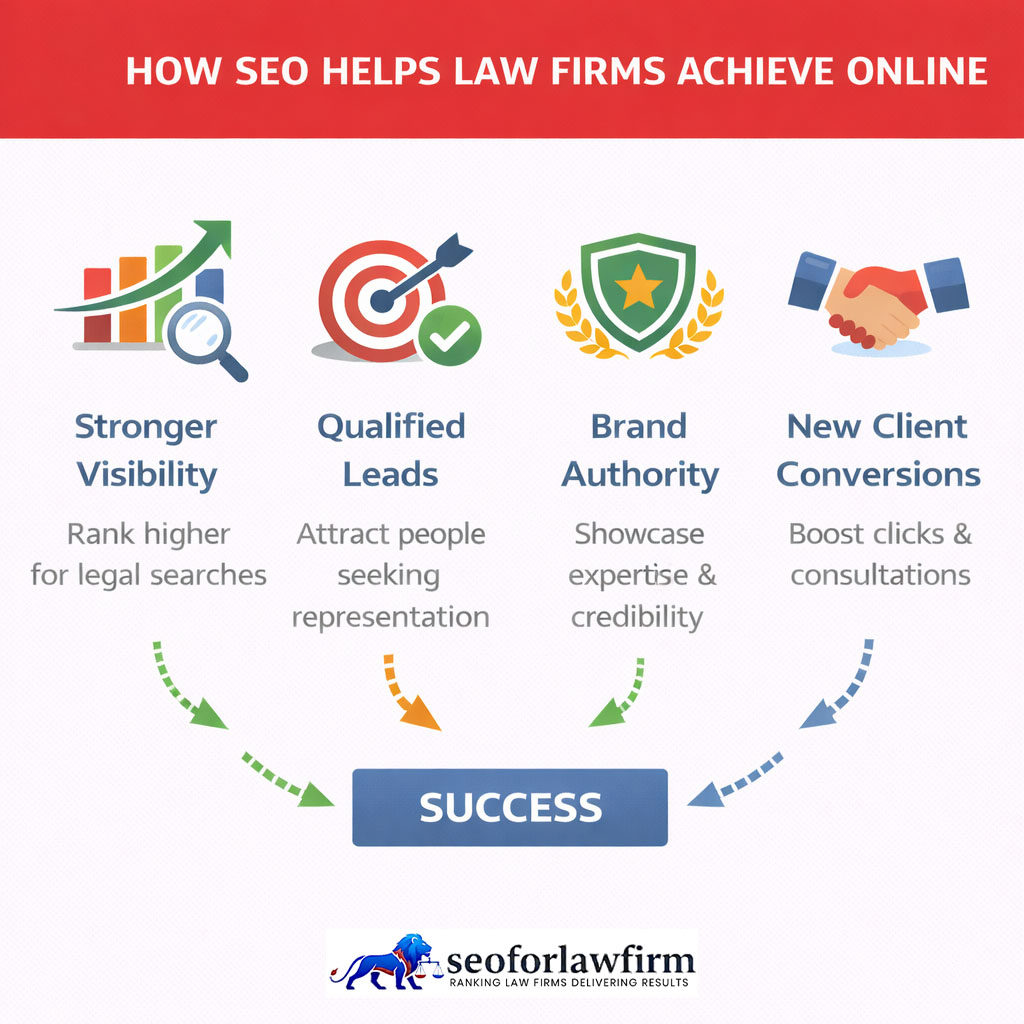
SEO helps law firms achieve stronger online visibility, attract qualified leads, build brand authority, and increase new client conversions. Optimized attorney websites rank higher for legal searches, connecting lawyers with people actively looking for representation. Effective SEO strategies also build trust by stating expertise through high-quality content, improving click-through rates, and supporting long-term digital growth in competitive legal markets.
How Do Attorney Websites Benefit From SEO Optimization?
Attorney websites benefit from SEO optimization by earning higher rankings in local search results, increasing organic traffic, and converting more visitors into consultations. Local SEO helps law firms appear for searches such as “lawyer near me,” while optimized practice area pages showcase reviews, trust signals, and expertise. Clear calls to action further improve lead generation by guiding potential clients toward contacting the firm, helping attorneys grow their client base more efficiently.
What Are the Most Effective SEO Strategies for Lawyers in 2025?
The most effective SEO strategies for lawyers in 2025 include AI-powered keyword clustering, voice search optimization, mobile-first website performance, and strong local visibility through Google’s advertising ecosystem. These methods help attorneys match modern search behavior, attract high-intent leads, and maintain competitiveness in crowded legal markets.
Listed below are the 5 Top SEO Strategies for Lawyers in 2025.
- AI-driven keyword research: Use clustering tools to identify valuable legal terms and intent-driven search patterns.
- Voice search optimization: Structure content for conversational queries such as “Who is the best personal injury lawyer near me?”
- Mobile-first indexing: Build responsive, fast-loading websites that satisfy Google’s mobile usability standards.
- Local service ads: Run Google LSAs to capture immediate, high-intent leads from local searchers.
- High-authority backlinks: Earn credibility through legal directories, guest articles, and industry-trusted publications.
How Does SEO for Solicitors Differ From SEO for Other Industries?
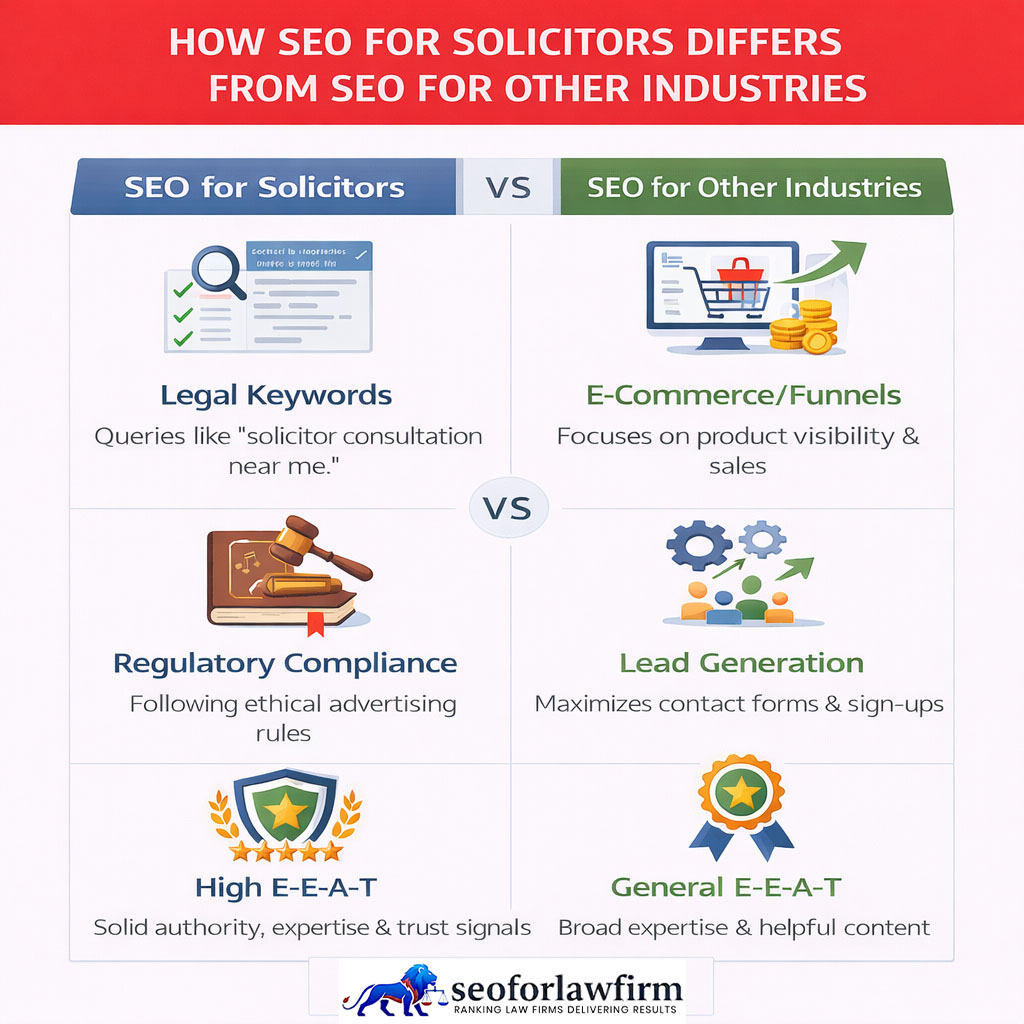
SEO for solicitors differs from SEO for other industries because it relies on legal-specific keywords, strict compliance with professional advertising rules, and elevated E-E-A-T standards. While e-commerce and B2B SEO focus on product visibility or lead funnels, solicitor SEO prioritizes local-intent searches such as “solicitor consultation near me” and requires accuracy that meets regulatory guidelines. Legal SEO emphasizes authority, trust signals, and content precision to help firms rank competitively while maintaining compliance in a highly regulated environment.
What Are the Top SEO Keywords for Lawyers and Solicitors?
The top SEO keywords for lawyers and solicitors are high-intent legal search terms that potential clients use when looking for immediate help, such as “lawyer near me,” “personal injury attorney,” and similar service-driven queries. These keywords capture strong local intent, signal urgent legal needs, and help firms appear for searches from users actively seeking representation.
Listed below are 5 common high-intent legal search terms.
- Lawyer near me.
- Personal injury attorney.
- Family solicitor.
- Criminal defense lawyer
- Employment attorney.
How Does Link Building Strengthen an Attorney’s Website SEO?
Link building strengthens an attorney’s website SEO by increasing domain authority, improving rankings, and sending qualified referral traffic from reputable legal and local sources. Earning links from legal blogs, bar association sites, niche directories, and community citations signals external validation, showing search engines that the law firm’s content is trustworthy and authoritative.
This credibility boost helps attorney websites stand out in competitive markets and attract clients who are actively searching for legal help. Firms will explore how link building enhances an attorney’s website SEO performance to understand why strong backlink profiles make such a measurable impact.
