
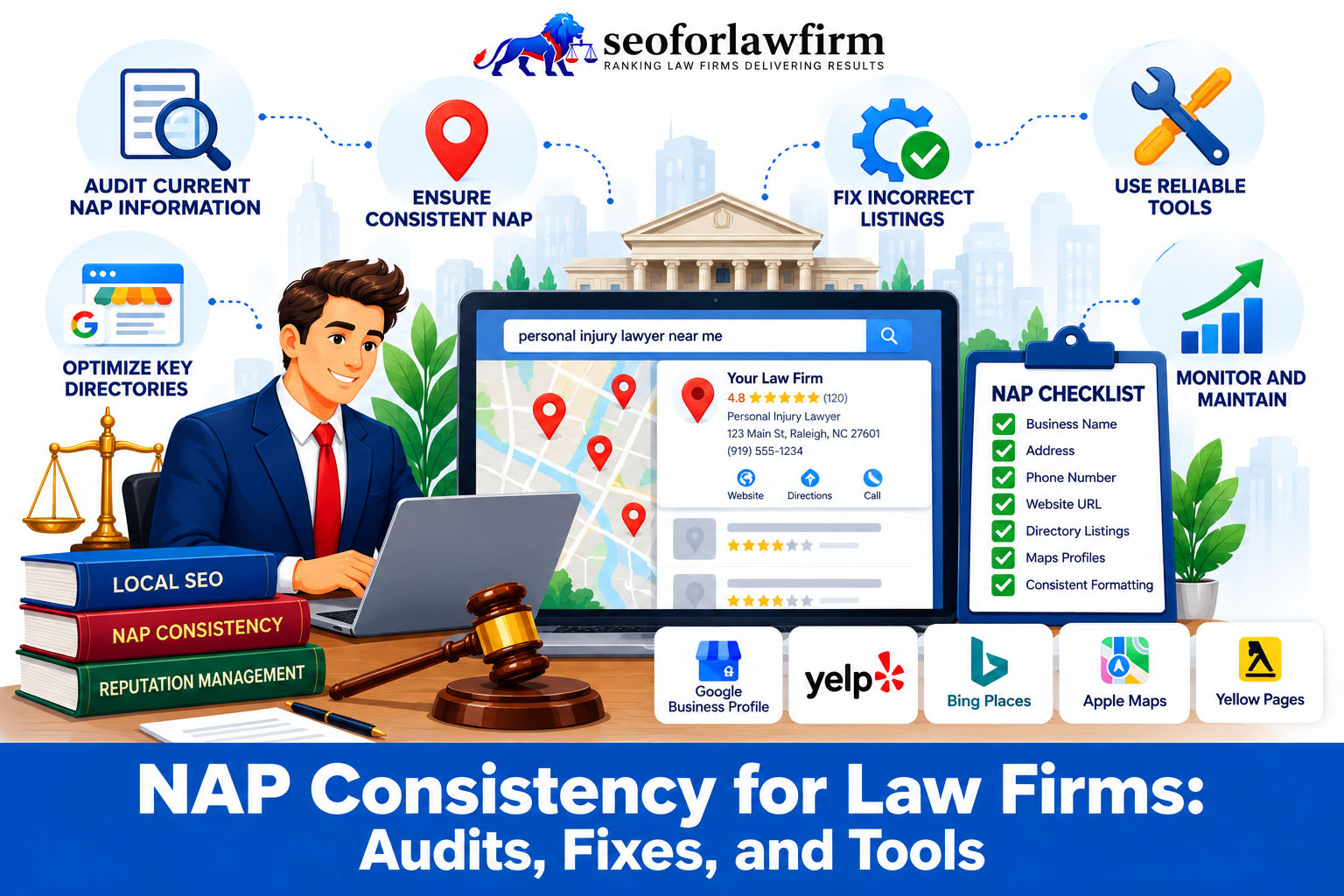
Building local citations for a law firm means listing the firm’s Name, Address, map platforms, prospective clients, and AI-assisted search systems encounter the same business identity. Law firms build stronger citation profiles by locking one canonical NAP, auditing existing listings, correcting inaccurate data, claiming primary business platforms, building legal-directory profiles, adding trusted general directories, and monitoring the listings over time.
NAP accuracy affects more than search visibility. A study by BrightLocal Research from the BrightLocal platform, titled “Local Business Discovery & Trust Report 2023” in 2023, surveyed a representative panel of 1,138 U.S. consumers and found that 62% of consumers avoid a business after finding incorrect information online.
Citation consistency does not require obsessing over every abbreviation. Google and Bing recognise common variations such as “Street” and “St.” or “Suite” and “Ste.” The larger risks involve conflicting firm names, outdated office addresses, incorrect phone numbers, duplicate profiles, former attorney affiliations, and incorrect website URLs.
Table of Contents
- Article sections will appear here.
How Do Law Firms Build Local Citations Effectively?
Law firms build local citations effectively by establishing one verified business record and replicating that record across primary map platforms, legal directories, bar directories, and trusted general or local business sites.
Listed below are the 7 stages of an effective law firm citation-building process.
- Lock the law firm’s NAP: Record the exact firm name, physical address, main phone number, website URL, office hours, primary practice category, and other location data in one master document.
- Audit existing citations: Search the firm name, phone number, current address, previous addresses, former firm names, and individual attorney names to locate existing profiles.
- Fix existing errors before creating listings: Correct inaccurate profiles, update former locations, claim unowned listings, and merge or suppress duplicates before expanding the citation footprint.
- Claim the primary platforms: Complete the firm’s Google Business Profile, Apple Business location, and Bing Places listing. Google Business Profile information appears across Google Search and Maps, Apple Business manages location information displayed across Apple services, and Bing Places supports claimed and verified business listings.
- Build legal-directory citations: Create or claim profiles on relevant legal platforms such as Avvo, Justia, FindLaw, Martindale-Hubbell, Lawyers.com, and applicable attorney directories.
- Build local and general citations: Add the same verified data to Yelp, BBB, chambers of commerce, local business directories, state or county bar directories, and authoritative regional websites.
- Monitor citation health: Track every citation URL, ownership status, login, NAP data, verification status, and last audit date so new conflicts are found and corrected.
A study by Casey Meraz from the Juris Digital platform, titled “Top Citation Sources for Law Firms in 2026” in 2026, confirms that local directory citations are not the raw volume ranking levers they used to be, and prioritizes source quality and data consistency above all.
What Does NAP Mean for Law Firms?
NAP for law firms means Name, Address, and Phone number, the three business identity fields used across local listings and citations. NAP+W adds the law firm’s website URL. The same underlying business identity must appear across the law firm’s website, Google Business Profile, Apple Business, Bing Places, legal directories, bar profiles, review sites, and other citation sources.
Exact punctuation and common address abbreviations matter less than factual accuracy because differences such as “Street” versus “St.” still describe the same location. Material conflicts arise when listings contain an old phone number, incorrect business name, former office address, outdated website, or other information that identifies a different business entity. Law firms must therefore maintain one accurate canonical NAP record and use that record across major local-search platforms and citation sources.
What Does NAP Consistency Mean for Law Firms?
NAP consistency for law firms means maintaining one accurate business identity across the websites, directories, maps, professional profiles, and data sources that mention the law firm.
NAP consistency connects separate online references to the same legal business entity. A consistent record tells users and search systems that the Google Business Profile, law firm website, Avvo profile, Justia listing, Apple Maps location, and other citations refer to the same firm and office.
A canonical formatting standard still simplifies citation management. The law firm gains one source of truth for staff, agencies, software platforms, and directory submissions even though search engines recognise minor formatting variations.
How Do Law Firms Conduct a NAP Consistency Audit?
Law firms conduct a NAP consistency audit by comparing every discoverable business listing against one verified master record and recording missing, inaccurate, duplicated, or outdated data.
The table below shows the main data points that belong in a law firm NAP audit.
| Audit Field | What the Law Firm Checks | Errors to Find |
| Firm name | Current legal or public-facing business name | Old names, merger names, keyword-stuffed names, abbreviations that represent another entity |
| Address | Current office location | Former offices, wrong ZIP codes, missing units, virtual-office conflicts |
| Phone number | Primary local office number | Old numbers, disconnected numbers, inconsistent tracking numbers |
| Website | Canonical office or location URL | HTTP URLs, obsolete domains, wrong location pages, broken URLs |
| Google Business Profile | Firm and practitioner profiles | Duplicates, former attorneys, wrong categories, inaccurate locations |
| Legal directories | Firm and attorney profiles | Old employers, old offices, incomplete practice information |
| Business categories | Primary and secondary categories | Irrelevant or inaccurate practice categories |
| Duplicate profiles | Multiple listings for one entity | Auto-generated profiles, merger duplicates, abandoned listings |
| Office hours | Current availability | Old hours, conflicting hours, missing holiday changes |
| Ownership | Listing access and credentials | Unclaimed listings or accounts controlled by former agencies |
Automated auditing platforms shorten the discovery process, but manual verification remains useful for legal directories, bar association records, practitioner profiles, and niche sites that listing tools do not cover.

What NAP Errors Affect Law Firms Most?
The most damaging law firm NAP errors involve substantive conflicts in identity, location, contact information, practitioner affiliation, and duplicate listings.
Firm-name changes create problems after mergers, partner departures, rebrands, or legal-entity changes. Former office addresses keep outdated geographic information alive. Old telephone numbers send prospective clients to inactive lines. Duplicate profiles split reviews and listing data across multiple entities.
Law firms also face a problem that affects professional services more than ordinary local businesses: attorney-level profiles exist alongside firm-level profiles. Legal directories maintain individual attorney records, meaning one law office potentially has dozens of associated profiles. Departed attorneys, former firm names, and outdated addresses need regular review so practitioner records do not contradict the current firm record.
How Do Law Firms Fix NAP Errors?
Law firms fix NAP errors by correcting the authoritative business record first and then updating the same verified information across major citation sources. The law firm’s website and master location record must establish the source of truth for the firm name, address, phone number, website, office status, and attorney associations. Google Business Profile, Apple Business, Bing Places, legal directories, bar records, attorney profiles, and prominent local directories must then reflect the same factual information.
Duplicate profiles require consolidation, suppression, or removal according to platform rules, while former office profiles require closure or correction rather than abandonment. Attorney information also needs revision after hires, departures, mergers, office transfers, and firm-name changes. Accurate business information provides greater value than creating large numbers of directory submissions with inconsistent data.
Listed below are the 10 main steps law firms must use to fix NAP errors.
- Establish the source-of-truth record. Confirm the current firm name, address, phone number, website, office details, and attorney information before making corrections.
- Correct the law firm website. Update the firm’s main website and relevant location pages so they display the approved business information.
- Update Google Business Profile. Correct the firm name, address, phone number, website, hours, and other relevant location details.
- Update major map platforms. Correct Apple Business, Bing Places, and other major mapping services using the verified business record.
- Correct legal directories. Update Avvo, Justia, Martindale-Hubbell, FindLaw, bar directories, and other relevant legal profiles.
- Resolve duplicate profiles. Merge, suppress, close, or remove duplicate listings according to each platform’s procedures.
- Correct former office listings. Mark closed offices appropriately or replace outdated address information where the listing represents an active office.
- Update attorney profiles. Revise lawyer information after hires, departures, mergers, office transfers, or name changes.
- Review prominent local directories. Correct inaccurate listings on high-visibility regional, business, and review platforms.
- Monitor the corrections. Recheck major profiles after updates to confirm that the corrected information remains active and accurate.
Which Citation Sources Matter Most for Law Firms?
The strongest law firm citation profile combines major search and map platforms, legal-specific directories, professional credential sources, and reputable local business sites.
The table below groups citation sources according to their role in the law firm’s local search presence.
| Citation Type | Examples | Main Function |
| Search and map platforms | Google Business Profile, Apple Business, Bing Places | Location discovery, maps, business information, calls, directions |
| Legal directories | Avvo, Justia, FindLaw, Martindale-Hubbell, Lawyers.com | Attorney discovery, legal entity validation, practice-area relevance |
| Bar and credential sources | State bars, county bars, professional associations | Attorney affiliation, licensing and credential verification |
| General business directories | Yelp, BBB, Facebook, Yellow Pages | Broader entity corroboration and consumer discovery |
| Local sources | Chamber of commerce, local associations, city directories, regional sites | Geographic association and local discovery |
| Location-data networks | Foursquare, Data Axle, TransUnion business-listing services | Business data distribution across location-based products |
Quality outranks raw quantity. Juris Digital’s 2026 attorney citation guidance recommends trusted legal, local, credential, and business sources rather than indiscriminate submission to large numbers of low-value directories.
Law firms strengthen this citation footprint by building verified law firm citation listings across sources that match the firm’s practice area and geographic market.
Which Tools Audit and Manage NAP Consistency for Law Firms?
Law firms use citation auditing and listing-management software to find inaccurate listings, detect duplicates, and monitor local data health.
The table below compares prominent NAP and citation-management platforms.
| Tool | Main NAP Function | Best Application |
| BrightLocal | Citation auditing, listing building, NAP comparison and listing management | Audits, cleanup projects and ongoing citation tracking |
| Moz Local | Directory management, location-data health and duplicate management | Centralised location management for U.S., U.K. and Canadian firms |
| Semrush Local | Automated business-data distribution and directory monitoring | Firms already using Semrush for SEO and local search reporting |
| Whitespark Local Citation Finder | Citation discovery and competitor citation research | Finding legal and local citation opportunities competitors already use |
| Yext | Direct listing distribution and publisher management | Larger or multi-location law firms requiring centralised updates |
BrightLocal’s Citation Tracker compares discovered business names, addresses, ZIP codes, and phone numbers against the information entered for the audit and flags mismatches for review.
Whitespark’s Local Citation Finder identifies citations held by competing businesses and compares them against the citations already associated with the target business.
Semrush Local distributes business information to relevant directories and maintains listing data from one location record.

Does NAP Consistency Improve Local SEO Rankings?
Yes, NAP consistency supports local SEO by keeping a law firm’s business identity accurate across the sources search engines use to understand local businesses. Citation consistency supports local-search infrastructure, but it does not replace stronger local signals such as Google Business Profile optimization, reviews, proximity, website relevance, and links.
Google states that complete and accurate business information improves a business’s ability to appear for relevant local searches. A study by Darren Shaw from the Whitespark platform, titled “The 2026 Local Search Ranking Factors Report” in 2026, confirms that local directory citations serve as a supporting signal layer, contributing 7% of the total algorithmic weight for standard Map Pack visibility. The expert consensus panel highlights that while citation consistency prevents data fragmentation, it ranks as a secondary local factor behind primary triggers like Google Business Profile signals (32%) and review vectors (16%).
Does Exact NAP Formatting Matter?
No, exact NAP formatting matters less than factual consistency across law firm listings. Search systems interpret common address variations such as “Ave.” and “Avenue” or “St.” and “Street” as the same underlying location. Law firms still benefit from using one canonical format because consistent formatting reduces administrative errors and makes citation audits easier.
Audit priority must focus on material conflicts such as an incorrect business name, wrong telephone number, former office address, incorrect ZIP code, duplicate entity, or obsolete website. Accurate business information therefore matters more than punctuation, abbreviations, or minor formatting differences.
Does Automation Help Maintain NAP Consistency for Law Firms?
Yes. Automation maintains NAP consistency by distributing a verified location record to multiple connected directories and monitoring listing data from a central platform.
Automation works best after the firm verifies the source record. Automated distribution replicates incorrect data just as efficiently as correct data, so audit and cleanup belong before broad distribution.
Platforms such as Semrush Local, Yext, Moz Local, and BrightLocal support various forms of centralised listing management. Semrush states that Listing Management distributes and maintains business information across directories from one location record.
Law firms also integrate automated NAP synchronisation for law firms into broader local SEO workflows, where repeated location-data updates create unnecessary administrative work.
What Does a NAP Consistency Checker Do?
A NAP consistency checker compares a law firm’s verified business information against information found across business directories and flags conflicting or missing fields.
The checker identifies errors such as wrong business names, incorrect telephone numbers, outdated office locations, missing listings, suspected duplicates, and incomplete business profiles.
A checker reports the problem; the directory or listing-management platform controls the correction. BrightLocal, for example, states that Citation Tracker identifies inconsistencies but does not directly edit the underlying directory listing from the audit report itself.
What Does NAP Variation in Moz Local Mean?
NAP variation in Moz Local refers to differences between the law firm’s master location information and business data associated with directory listings or publisher records.
A variation does not automatically indicate a serious entity problem. Minor address abbreviations deserve less attention than an incorrect business name, former address, outdated telephone number, wrong website, or duplicate profile.
Law firms use the master location record to determine which variations represent actual errors and then correct the conflicting publisher data.
What Is a NAP Directory Citation for Law Firms?
A NAP directory citation is a directory profile that publishes a law firm’s Name, Address, and Phone number as structured business information.
Examples include profiles on Google Business Profile, Bing Places, Yelp, Avvo, Justia, and other business or legal directories. NAP+W citations also include the law firm’s website.
Directory citations help prospective clients verify where the firm operates and how to contact the correct office. Search systems use the same public business information as part of the broader process of identifying and resolving local entities.
What Is the Local Search Ecosystem for Law Firms?
The local search ecosystem is the network of search engines, maps, directories, legal platforms, business-data providers, websites, and applications that publish or exchange information about a law firm and its locations.
Google states that Business Profile information comes from multiple sources rather than only information entered directly by the business owner.
That structure explains why an outdated law firm address sometimes reappears after correction. A stale directory, attorney profile, data supplier, former website page, or third-party source continues publishing the previous information until the underlying record is corrected.
Do Law Firm Citations Affect AI Search Visibility?
Yes, accurate law firm citations support AI search visibility by reinforcing consistent information about the firm across trusted public sources. Citation consistency gives search and AI systems corroborating information about the law firm’s name, location, phone number, website, practice areas, and attorney identities, although citations do not guarantee inclusion in AI-generated answers.
Google Business Profile, Avvo, Justia, FindLaw, Yelp, Martindale-Hubbell, and similar platforms contribute public business and professional information that support entity identification across search environments. Local-business data also appears across search engines, maps, directories, navigation systems, voice products, and emerging AI discovery surfaces. Law firms must therefore maintain accurate entity information across authoritative sources rather than create large volumes of low-value citations solely to influence AI results.
How Do Law Firms Monitor NAP Consistency Over Time?
Law firms monitor NAP consistency by maintaining a citation inventory, reviewing major platforms after business changes, and updating attorney profiles after staffing changes. A single-location firm with stable information uses quarterly reviews plus immediate checks after changes to the address, phone number, website, firm name, ownership, or office status. Multi-location firms and firms with frequent attorney movement need more frequent monitoring because each office and attorney profile creates additional business-data relationships.
The citation inventory must record the platform, listing URL, profile type, office location, attorney name where relevant, ownership credentials, current NAP information, verification status, correction status, and last review date. Monitoring must also connect citation accuracy with business outcomes because Google Business Profile calls, website visits, direction requests, local visibility, consultation leads, and signed matters provide more useful performance information than citation count alone.
Listed below are the 12 main elements law firms must track during ongoing NAP monitoring.
- Platform. Record the search engine, directory, map service, bar profile, or other source where the citation appears.
- Listing URL. Save the direct profile or listing address for faster future review.
- Profile type. Identify whether the listing represents the firm, an office, or an individual attorney.
- Office location. Connect each citation with the correct physical office.
- Attorney name. Record the lawyer associated with the listing where attorney-specific profiles exist.
- Ownership credentials. Document who controls or has access to the profile.
- Current NAP. Record the approved business name, address, and phone number shown on the listing.
- Verification status. Track whether the platform has verified the business or profile.
- Correction status. Record errors, submitted changes, pending corrections, and completed updates.
- Last review date. Note when the listing was last checked so the firm can maintain a consistent review schedule.
- Business changes. Trigger immediate reviews after relocations, phone changes, website changes, rebrands, ownership changes, hires, departures, or office closures.
- Performance signals. Review calls, website visits, direction requests, local visibility, consultation leads, and signed matters alongside citation accuracy.