
Mobile optimization for law firms makes legal websites fast, clear, readable, and easy to use on smartphones and tablets. Mobile optimization helps potential clients find legal information, review attorneys, call the firm, and request consultations without unnecessary friction.
Fast mobile performance for a law firm website gives users quicker access to practice-area pages, attorney profiles, office details, and contact options. Google evaluates mobile performance through Core Web Vitals, including Largest Contentful Paint (LCP), Interaction to Next Paint (INP), and Cumulative Layout Shift (CLS).
Click-to-call functionality gives mobile visitors a direct path to the firm’s intake team. Phone numbers must appear as visible, tappable links in relevant areas such as the header, practice-area pages, attorney profiles, and contact sections.
A study by the FindLaw digital research team from the legal marketing and consumer analytics division, FindLaw, titled “Legal consumers and mobile attorney websites” in 2014, analyzed aggregated web traffic data across more than 10,000 hosted law firm websites, confirming that a rapidly expanding threshold of all online legal consumers discover, evaluate, and contact legal representation using mobile devices. The study establishes that structural mobile optimization, seamless local search routing, and minimizing user friction are critical to preventing firms from missing out on substantial portions of their client acquisition potential.
Short contact forms reduce typing on small screens. Initial consultation forms must request only the information needed to route an enquiry, such as name, phone number or email, practice area, and a brief description.
Simple mobile navigation helps users reach practice areas, lawyer biographies, office locations, and contact pages without working through several menu layers. Readable text, adequate spacing, and touch-friendly buttons also prevent zooming and accidental taps.
Google uses the mobile version of website content for indexing and ranking through mobile-first indexing. Mobile-first indexing does not mean Google automatically ranks mobile-friendly websites above competitors. It means Google primarily uses the mobile version when crawling, understanding, and indexing a page.
Local mobile search also matters for law firms because prospective clients often move between Google Search, Google Maps, a Google Business Profile, the firm’s website, phone calls, and directions. Google primarily evaluates local results through relevance, distance, and prominence, so mobile website optimization supports the local client journey without replacing those local-ranking inputs.
Table of Contents
- Article sections will appear here.
What Do Mobile Optimization Services Include for Law Firms?
Mobile optimization services for law firms include responsive design, mobile speed optimization, technical testing, and conversion tracking.
Listed below are the 8 main mobile optimization services for law firm websites.
- Responsive Design: Adapts page layouts, navigation, images, forms, tables, and content blocks to different screen sizes.
- Speed Optimization: Reduces image weight, unnecessary scripts, server delays, redirect chains, and other resources that slow mobile pages.
- Core Web Vitals Optimization: Improves LCP, INP, and CLS using real-user performance data and diagnostic testing.
- Mobile Navigation Optimization: Keeps practice areas, attorneys, office locations, resources, and contact options easy to find.
- Click-to-Call Optimization: Makes phone numbers visible and tappable from relevant mobile pages.
- Mobile Form Optimization: Reduces unnecessary form fields and improves labels, input types, validation, autofill, and submission controls.
- Mobile Technical SEO: Reviews crawlability, mobile rendering, internal links, metadata, structured data, canonicals, and indexing directives.
- Mobile Conversion Tracking: Measures mobile calls, forms, consultations, qualified leads, and retained clients rather than relying only on traffic or engagement metrics.
AMP is not required for mobile SEO. Responsive web design remains Google’s recommended configuration because one URL and one primary HTML version are easier to maintain across devices.
Why Is Mobile Optimization Important for Lawyers?
Mobile optimization is important for lawyers because prospective clients need fast access to legal information, attorney details, and contact options from smartphones and tablets. Google also primarily uses mobile page content for indexing and ranking under mobile-first indexing.
A poor mobile experience interrupts the path from search to legal information, lawyer evaluation, and contact. Law firms must preserve substantive legal content, headings, attorney information, internal links, images, metadata, and structured data across mobile and desktop versions. Removing useful information only from the mobile version reduces the content available to Google and creates unnecessary friction for prospective clients.
How Does Mobile Optimization Affect Law Firm SEO?
Mobile optimization affects law firm SEO through mobile-first indexing, Core Web Vitals, content accessibility, page experience, and local search usability.
Google evaluates several systems and signals when ranking pages. Mobile-first indexing determines which version Google primarily evaluates, while Core Web Vitals measure parts of the page experience.
Listed below are the 6 main ways mobile optimization affects law firm SEO.
- Mobile-first indexing: Google primarily evaluates the mobile version of the page.
- Responsive design: Keeps one website adaptable across different screen sizes.
- Core Web Vitals: Measure loading, responsiveness, and layout stability.
- Mobile content parity: Keeps substantive content accessible to users and Googlebot on smartphones.
- Structured data: Helps search engines interpret supported entities and content but does not create a generic ranking boost.
- Local SEO: Depends mainly on relevance, distance, and prominence rather than mobile design alone.
A broader Google ranking factors guide for law firms explains how mobile performance fits within the wider Search ranking system.
What Are the Elements of Effective Mobile Optimization for Law Firms?
The elements of effective mobile optimization for law firms are responsive design, fast performance, content parity, and performance tracking.
Listed below are the 10 main elements of effective mobile optimization for law firms.
- Responsive Website Design: Use layouts that adjust to phones, tablets, laptops, and desktop monitors without maintaining separate content systems.
- Fast Mobile Performance: Reduce oversized images, unnecessary JavaScript, slow server responses, unused plugins, and heavy third-party widgets.
- Good Core Web Vitals: Target LCP of 2.5 seconds or less, INP below 200 milliseconds, and CLS below 0.1.
- Clickable Calls to Action: Make actions such as “Call,” “Request a Consultation,” and “Get Directions” easy to identify and tap.
- Simple Mobile Navigation: Give users direct access to practice areas, attorneys, locations, and contact information.
- Readable Text: Use legible typography, sufficient contrast, useful spacing, and layouts that do not require horizontal scrolling.
- Short Contact Forms: Keep initial contact requirements proportionate to the information needed to start intake.
- Touch-Friendly Controls: Provide sufficient spacing around links, buttons, menu controls, and form fields.
- Mobile Content Parity: Keep substantive legal content and useful internal links available across mobile and desktop versions.
- Mobile Performance Tracking: Measure Search visibility, mobile sessions, calls, forms, qualified leads, and retained matters.
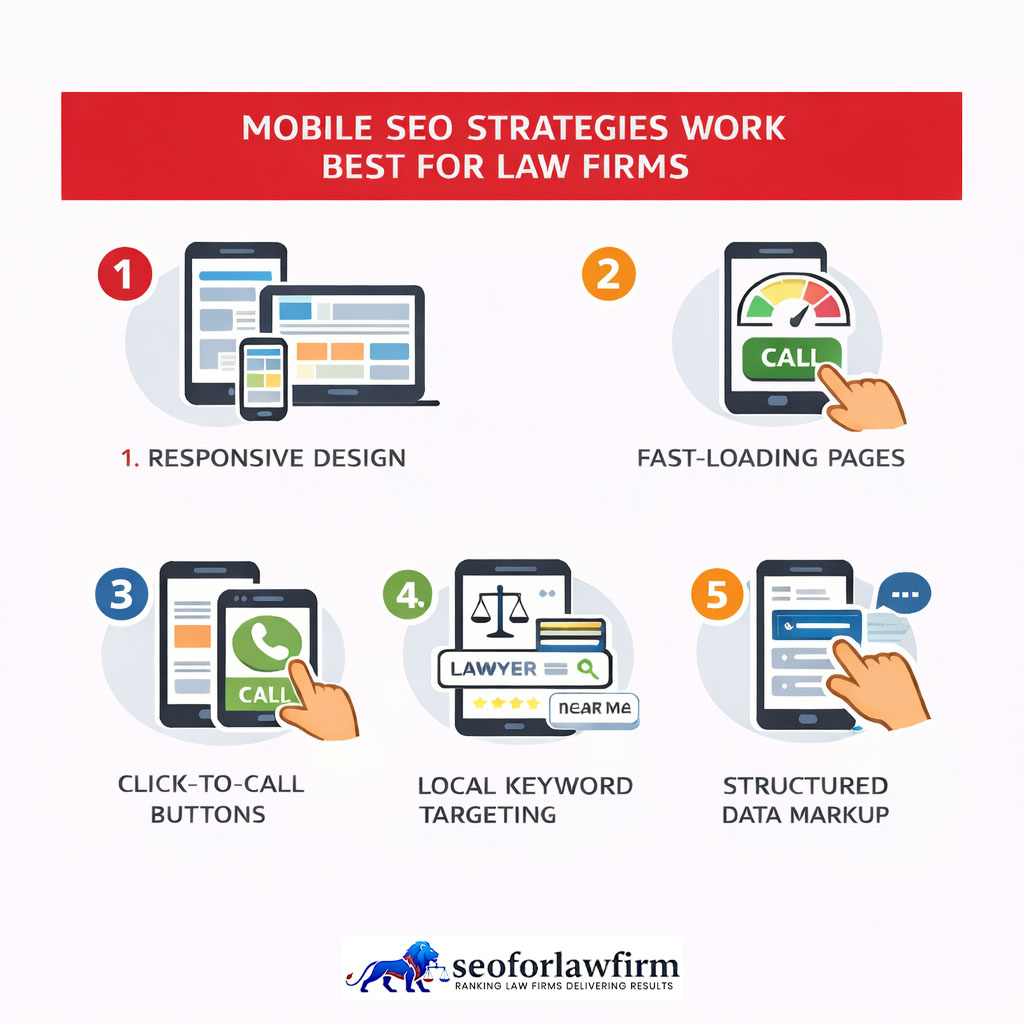
What Mobile SEO Strategies Work Best for Law Firms?
The mobile SEO strategies that work best for law firms are responsive design, mobile content parity, readable legal content, and accurate local business information.
Listed below are the 6 mobile SEO strategies law firms must prioritize.
- Use responsive design: Maintain one primary page that adapts its presentation to different screen sizes.
- Preserve substantive mobile content: Keep the legal explanations, headings, attorney information, internal links, and other primary information available on mobile.
- Improve mobile performance: Reduce rendering delays, image weight, JavaScript load, layout movement, and slow interactions.
- Provide direct contact options: Use tap-to-call telephone numbers, clear consultation CTAs, and concise forms.
- Simplify navigation: Make core practice areas and client contact routes accessible without an excessive menu hierarchy.
- Support local search: Keep genuine office information and Google Business Profile data accurate and aligned with the website.
A broader local SEO strategy for law firms covers Google Business Profile optimization, office locations, reviews, citations, localized services, and Maps visibility.
How Does Mobile Optimization Improve User Experience for Law Firms?
Mobile optimization improves user experience for law firms by making legal information easier to read, navigation easier to operate, and consultation pathways easier to complete from a smartphone.
Listed below are the 7 mobile user-experience actions law firm websites must support.
- Identify whether the firm handles the legal issue.
- Read the relevant legal information.
- Find an attorney.
- Find the appropriate office.
- Call the firm.
- Complete a contact form.
- Move to a related legal service.
Click-to-call links reduce the effort required to start telephone intake. A visible telephone number uses a tel: link so the mobile device opens the calling interface directly.
Mobile contact forms must also minimize unnecessary input. A first-contact form often needs basic contact information, practice-area information, and a short description. Longer intake questions follow when the firm needs more information to qualify the matter.
Navigation must prioritize major service and conversion destinations rather than attempting to display every page on the website inside a mobile menu.
Law firms also need to avoid intrusive pop-ups that obscure the legal information users selected. Small, dismissible banners and in-content CTAs create less interference than full-screen promotional overlays.
How Do Mobile Optimizations Speed Up Law Firm Websites?
Mobile optimizations speed up law firm websites by reducing file sizes, rendering delays, server latency, unnecessary scripts, redirects, and layout instability.
Listed below are the 6 main methods law firms use to improve mobile website speed.
- Compress and resize images: Serve images at dimensions and file sizes appropriate to the user’s device.
- Reduce unnecessary JavaScript: Remove scripts, plugins, and widgets that provide little user or business value.
- Use caching: Prevent browsers from repeatedly downloading unchanged resources.
- Improve server performance: Review hosting, backend processing, database performance, and content delivery.
- Reduce unnecessary redirects: Link directly to final destination URLs rather than sending users through multiple redirects.
- Reserve space for visual elements: Define dimensions for images, video embeds, forms, and other elements to reduce unexpected layout shifts.
Law firm websites often use analytics, call tracking, live chat, maps, review widgets, video players, scheduling tools, and advertising scripts. Each third-party tool needs to justify the performance cost it adds.
A dedicated law firm site-speed optimization process identifies which resources create the largest loading and interaction delays.
Where Can Law Firms Get Professional Mobile Optimization Services?
SEOForLawFirm is a specialized legal SEO provider that gives law firms structured, technical, and conversion-focused mobile optimization support across responsive design and client acquisition. A law firm SEO results tracking process connects mobile visibility with calls, forms, consultations, qualified leads, and retained matters, while SEOforLawFirm.com provides law firm SEO services that connect technical performance with legal content, local search, user experience, and conversion paths.
A professional mobile optimization service must evaluate the complete journey from Google Search or Maps to the mobile landing page, legal information, contact action, and qualified lead. The provider must separate technical measurements such as LCP, INP, CLS, crawlability, and rendering from business outcomes such as calls, forms, consultations, qualified leads, and retained matters.
Why Is Fast Loading Speed Important for Mobile Law Firm Websites?
Fast loading speed is important because mobile users need quick access to legal information and contact options. Core Web Vitals measure key parts of loading, responsiveness, and visual stability, but perfect scores do not guarantee higher rankings.
Listed below are 4 benefits of fast loading speed for a mobile law firm website.
- Boosts conversions.
- Builds Trusts.
- Improves Rankings.
- Optimizes crawl speed.
The table below shows Google’s current Core Web Vitals thresholds.
| Metric | What It Measures | Good Performance |
| LCP | Loading of main visible content | ≤ 2.5 seconds |
| INP | Interaction responsiveness | < 200 milliseconds |
| CLS | Visual stability | < 0.1 |

What Common Mobile Optimization Mistakes Do Law Firms Need to Avoid?
The common mobile optimization mistakes law firms need to avoid are non-responsive layouts, slow resources, technical differences, and outdated testing methods.
Listed below are the 10 common mobile optimization mistakes law firms need to avoid.
- Non-responsive design: The website requires horizontal scrolling, zooming, or awkward repositioning.
- Slow mobile pages: Oversized media, unnecessary scripts, widgets, or slow hosting delay important legal content.
- Small buttons and links: Users struggle to select telephone numbers, CTAs, menu controls, or form elements accurately.
- Complex navigation: Users cannot easily reach major practice areas, attorney profiles, office pages, or contact options.
- Unreadable text: Small typography, weak contrast, or poor spacing makes legal content difficult to consume.
- Long initial contact forms: Excessive questions increase typing and make first contact harder.
- Intrusive pop-ups: Promotional overlays obscure the legal information or contact option a user needs.
- Missing mobile content: Substantive sections or important internal links appear only on desktop.
- Mobile technical differences: Conflicting robots directives, canonicals, metadata, structured data, or rendering behavior affect the mobile version.
- Outdated mobile testing: Teams continue to report FID or rely on the retired Mobile-Friendly Test and Mobile Usability report.
How Can Law Firms Keep Up With Mobile Optimization Changes?
Law firms can keep mobile optimization current by following Google Search documentation, reviewing mobile conversion data, and periodically auditing mobile technical performance.
Listed below are the 5 actions law firms use to maintain mobile performance.
- Monitor Google Search documentation: Track changes to mobile indexing, Core Web Vitals, crawling, and page experience.
- Test major deployments: Review mobile performance after redesigns, CMS updates, new forms, new chat tools, or major script changes.
- Monitor field performance: Review Search Console Core Web Vitals and other real-user data where available.
- Track mobile client actions: Compare mobile calls, forms, qualified enquiries, and consultation requests.
- Audit mobile technical SEO: Recheck rendering, navigation, internal links, indexability, and mobile content after significant website changes.
A technical SEO audit for law firms combines these mobile checks with crawlability, canonicalization, redirects, indexing, and internal website architecture.

How Can Law Firms Test and Monitor Mobile Performance?
Law firms can test and monitor mobile performance with PageSpeed Insights, Search Console Core Web Vitals, GA4, and mobile rank tracking. A law firm SEO tools guide helps law firms distinguish mobile performance tools from technical crawlers, analytics platforms, rank trackers, and local SEO software.
Listed below are the 8 mobile testing methods law firms use.
- PageSpeed Insights: Measures Core Web Vitals and provides performance diagnostics.
- Search Console Core Web Vitals: Shows groups of website URLs with real-world Core Web Vitals data where sufficient field data exists.
- Lighthouse: Provides controlled diagnostic testing for performance and page-experience issues.
- Chrome DevTools: Tests viewport behavior, rendering, scripts, network requests, and responsive layouts.
- Real-Device Testing: Confirms that forms, telephone links, menus, tables, videos, and dialogs work on actual smartphones.
- Technical Crawling: Checks mobile rendering, internal links, metadata, canonicals, robots directives, and crawlability.
- Google Analytics 4: Compares mobile traffic, calls, forms, key events, and other user actions by device.
- Mobile and Local Rank Tracking: Measures mobile organic positions and geographic Maps visibility when those reports support the campaign.