

Estate planning lawyer marketing builds trust with individuals and families. Estate planning lawyer marketing uses local SEO, educational content, targeted PPC, genuine reviews, workshops, and professional referral relationships with CPAs, financial advisors, and other advisers.
Estate planning marketing depends more heavily on trust and education than on urgency-driven advertising. Prospective clients often need help understanding wills, trusts, powers of attorney, probate, asset protection, incapacity planning, guardianship, and inheritance before deciding which attorney to contact.
Educational content gives estate planning lawyers a way to explain these subjects in plain language and show how the attorney communicates. Articles, videos, checklists, webinars, and workshops work best when the attorney’s own experience and voice shape the explanation rather than generic legal-marketing copy.
Life events also create natural estate-planning information needs. Marriage, divorce, the birth or adoption of a child, purchasing a home, starting a business, retirement, moving to another state, receiving an inheritance, and losing a loved one all create questions about existing or missing estate documents.
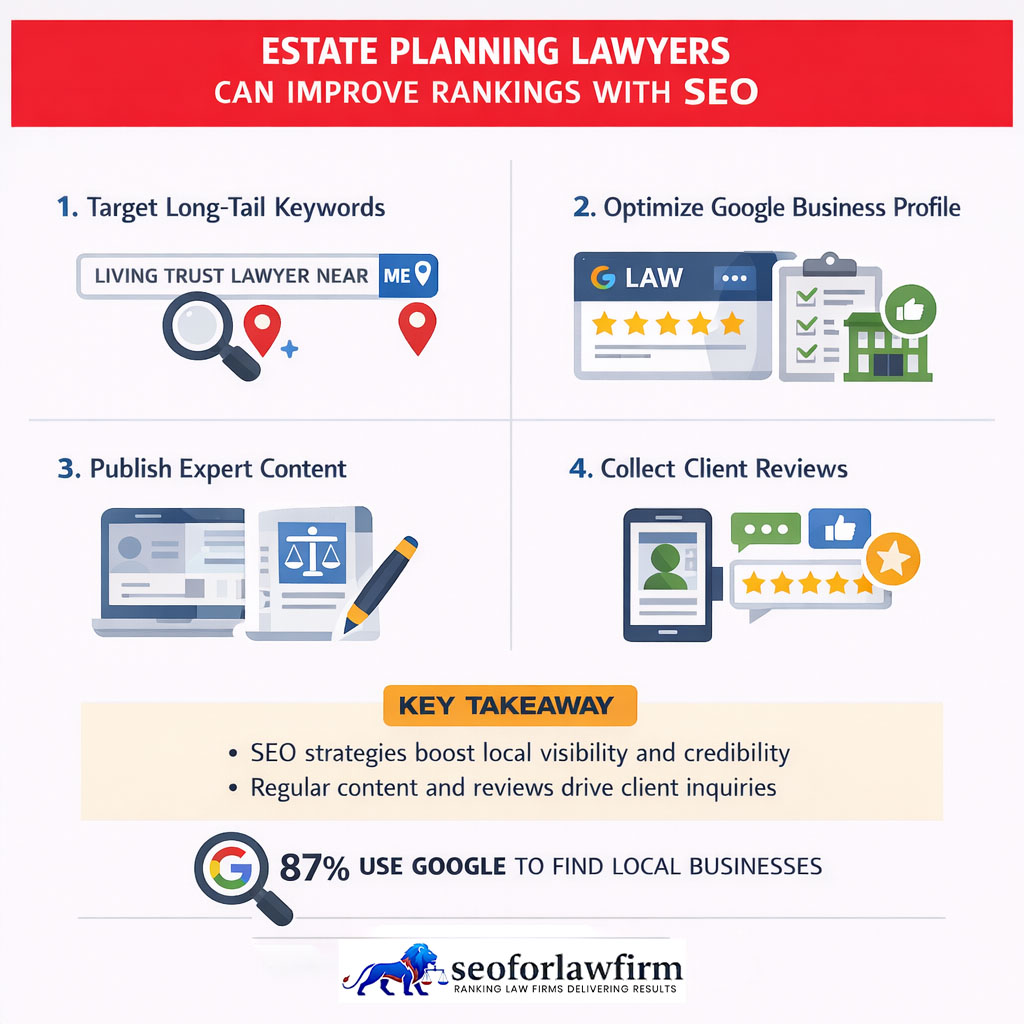
Local SEO connects those questions with nearby estate planning attorneys. Google states that local search results are mainly determined through relevance, distance, and prominence, so accurate Business Profile information, genuine locations, reviews, relevant website content, and broader prominence need to work together.
Positive client reviews provide another source of trust, but reviews need to reflect genuine client experiences. Google permits businesses to request reviews through links and QR codes but prohibits giving discounts, free services, or other incentives in exchange for reviews.
PPC captures people already searching for services such as “estate planning attorney near me,” “living trust lawyer in [city],” or “will attorney near me.” Paid search works alongside organic content rather than replacing the longer trust-building process that often occurs before an estate-planning engagement.
Referral relationships extend that trust into professional networks. CPAs, financial planners, wealth advisers, insurance professionals, business advisers, and other professionals regularly encounter clients whose financial circumstances create estate-planning questions. Educational resources, joint workshops, professional introductions, and coordinated client education give those relationships practical value.
A study by the American Bar Association Standing Committee on Ethics and Professional Responsibility published on the legal compliance platform American Bar Association titled “Rule 7.2: Communications Concerning a Lawyer’s Services” in 2026 confirms that under ABA Model Rule 7.2(b)(4), a lawyer is permitted to enter into a reciprocal referral arrangement with another lawyer or a nonlawyer professional, provided that the arrangement is strictly nonexclusive, the client is explicitly informed of its existence and nature, and no compensation is exchanged solely for recommending the lawyer’s services, with individual state professional-conduct rules dictating the actual arrangement’s validity.
Table of Contents
- Article sections will appear here.
What Does Estate Planning Marketing Mean for Law Firms?
Estate planning marketing is the process of attracting and educating prospective clients through legal content, local search visibility, attorney credibility, paid advertising, community education, referrals, and client-intake systems. Estate planning marketing serves people with different legal needs, including new parents creating wills, retirees considering living trusts, business owners planning succession, married couples updating beneficiary arrangements, adult children helping aging parents, families handling a recent death, high-net-worth households reviewing estate-tax exposure, and people relocating to another state.
Each client situation creates a different search intent and level of readiness. An informational search such as what is the difference between a will and trust requires educational content, while estate planning attorney near me requires a service or attorney page. A narrower search such as living trust lawyer for business owner in Phoenix combines service, client circumstance, and location. Estate planning marketing should connect each search intent with the correct page, legal information, and next client action.
How Is Estate Planning Marketing Executed?
Estate planning marketing is executed through a trust-focused website, workshops, professional partnerships, and performance tracking.
Listed below are the 9 steps in an estate planning marketing strategy.
- Define the client groups: Identify whether the practice serves young families, retirees, business owners, high-net-worth households, blended families, special-needs families, or broader estate-planning markets.
- Build specific service pages: Create substantive pages for wills, trusts, powers of attorney, incapacity planning, guardianship, probate-related services, business succession, or other services the firm actually provides.
- Publish educational content: Answer the questions prospective clients ask before they contact an attorney.
- Build local visibility: Maintain accurate office and Business Profile information and connect genuine locations with the services provided there.
- Request genuine reviews: Give clients a straightforward way to provide honest feedback without incentives.
- Run high-intent paid search: Advertise around relevant services and geographic markets rather than broad legal traffic.
- Host educational events: Use workshops, webinars, seminars, and community presentations to explain estate-planning decisions.
- Develop professional referral relationships: Build trust with CPAs, financial advisers, insurance professionals, and other relevant advisers.
- Measure client acquisition: Track which channels generate qualified enquiries, consultations, retained clients, and attributable revenue.
How Can Estate Planning Lawyers Improve Local SEO?
Estate planning lawyers improve local SEO by maintaining accurate Google Business Profile information, creating useful local content, and monitoring geographic search visibility.
A study of the documentation by the Google Search Central engineering team from the official support network, Google Business Profile Help titled “Tips to improve your local ranking on Google” in 2026, explicitly states that local results are mainly based on relevance, distance, and prominence. The framework confirms that review count and positive ratings directly contribute to a business’s local prominence score, while clarifying that there is absolutely no way to pay Google for a better organic local ranking.
Listed below are the 7 local SEO actions estate planning firms should prioritize.
- Maintain accurate Business Profile information: Keep the business name, address, telephone number, website, and office hours current.
- Choose accurate categories: Use categories that truthfully represent the firm rather than adding unrelated categories solely for search exposure.
- Connect genuine locations with services: Create useful office or service-location content where the firm has a legitimate presence and local client need.
- Request genuine reviews: Ask clients for honest feedback without compensation or incentives.
- Maintain accurate citations: Correct outdated firm information on relevant legal and local directories.
- Publish jurisdictionally relevant content: Address state laws and processes when local legal differences materially affect the answer.
- Track local visibility geographically: Monitor how Maps visibility changes around the office and target market rather than relying on a single manual search.
A dedicated estate planning SEO strategy can connect local search with service pages, educational content, website architecture, and lead attribution.
What Content Builds Trust for Estate Planning Law Firms?
Estate planning content builds trust when attorneys explain planning decisions in plain language and answer the actual client question behind the search. An effective content strategy for law firms connects these informational topics with the service pages that match hiring intent.
Listed below are the 6 points trust-building estate planning content should explain.
- What a trust does
- What a will does
- How wills and trusts differ
- Which circumstances affect the decision
- What the documents do not accomplish
- When attorney review becomes relevant
What Are the Best Content Ideas for Estate Planning Law Firms?
The best content ideas for estate planning law firms address estate-planning decisions, major life events, family circumstances, legal processes, and recurring client questions.
Listed below are the 9 estate planning content ideas that support client education and trust.
- Wills vs. Trusts: Explain the different purposes, limitations, administration requirements, and circumstances surrounding each document.
- Estate Planning After Marriage: Explain beneficiary designations, ownership changes, wills, trusts, powers of attorney, and other documents that deserve review.
- Estate Planning After Having a Child: Cover guardianship decisions, inheritance structures, trusts for minors, and beneficiary planning.
- Estate Planning for Blended Families: Explain competing family interests, children from earlier relationships, surviving spouses, and beneficiary planning.
- Estate Planning Before Retirement: Cover document reviews, incapacity planning, beneficiary designations, and coordination with financial planning.
- Moving to Another State: Explain why clients need to review existing estate documents after establishing residence in another jurisdiction.
- What to Do After a Loved One Dies: Explain immediate document, probate, trust-administration, property, and professional-advice considerations without turning general information into individualized legal advice.
- Estate Planning for Business Owners: Cover succession, ownership transfers, incapacity, buy-sell arrangements, and coordination with tax and financial professionals.
- Digital Asset Planning: Explain how online accounts, digital property, access credentials, and fiduciary authority fit into modern estate planning.
How Should Estate Planning Lawyers Use Their Own Voice in Content?
Estate planning lawyers should use their own explanations, examples, observations, and communication style to show prospective clients how they approach estate-planning decisions. Attorney-led content should connect legal terminology with the plain-language questions clients actually ask.
Listed below are the 8 attorney-led content formats estate planning lawyers can use.
- Short explanatory videos.
- Attorney-written articles.
- Webinar excerpts.
- Common consultation questions.
- Checklists.
- Decision trees.
- Newsletter explanations.
- Short social videos.
How Do Workshops and Webinars Support Estate Planning Marketing?
Workshops and webinars support estate planning marketing by educating families and referral partners before asking them to hire or recommend the attorney. Estate planning firms can host these events through libraries, community organizations, financial advisers, CPAs, employer groups, online webinars, and client-education programs to build familiarity, trust, and consultation opportunities.
Listed below are the 8 useful estate planning workshop and webinar topics.
- Estate Planning 101.
- Wills vs. Trusts.
- Estate Planning for New Parents.
- Estate Planning Before Retirement.
- Planning for Blended Families.
- Estate Planning for Business Owners.
- What Families Need to Know About Probate.
- Updating an Estate Plan After a Major Life Change.
How Can Estate Planning Lawyers Run Effective PPC Campaigns?
Estate planning lawyers run effective PPC campaigns by targeting high-intent services and locations, and measuring qualified consultations rather than clicks alone.
Listed below are the 6 steps for estate planning PPC.
- Research commercial keywords: Target searches such as “estate planning attorney near me,” “living trust lawyer [city],” and other services the firm provides.
- Separate service intent: Place wills, living trusts, business succession, probate-related services, or other materially different offerings into appropriate campaign structures.
- Use geographic targeting: Focus advertising spend on jurisdictions the firm serves.
- Write accurate ad copy: Advertise real credentials, services, consultations, and availability without unsupported superlatives or guarantees.
- Build relevant landing pages: Send a trust seeker to a trust-focused page rather than a generic homepage.
- Track qualified outcomes: Measure calls, forms, consultations, retained clients, cost per qualified lead, and cost per signed client.
A dedicated PPC strategy for lawyers should evaluate acquisition economics rather than raw click volume.

How Should Estate Planning Lawyers Use Google Business Profile?
Estate planning lawyers should use Google Business Profile to present accurate business information and authentic client feedback to local prospects. A broader local SEO strategy for law firms should connect Business Profile management with citations, reviews, location pages, and local rank tracking. Adding service areas does not automatically produce rankings across every listed city because distance remains a major local-ranking consideration.
Listed below are the 8 Google Business Profile elements estate planning lawyers should maintain.
- Accurate firm name.
- Address.
- Telephone number.
- Website.
- Business hours.
- Relevant category information.
- Attorney or office photographs.
- Genuine client reviews.
How Should Estate Planning Lawyers Collect Reviews?
Estate planning lawyers should collect genuine client reviews without incentives, scripted praise, or pressure to remove negative feedback. Firms can share direct review links or QR codes to make the process easier. Estate planning firms should also protect client confidentiality when responding publicly and avoid confirming client status, estate-plan contents, family circumstances, financial information, trust terms, or beneficiary disputes. Review management should support the firm’s reputation without compromising professional obligations.
What Estate Planning Marketing Mistakes Should Law Firms Avoid?
Estate planning law firms should avoid marketing practices that prioritize search volume or advertising reach over accuracy, trust, client fit, professional obligations, and measurable acquisition.
Listed below are the 10 estate planning marketing mistakes to avoid.
- Publishing generic estate-planning content with no attorney input.
- Creating a page for every keyword variation.
- Creating artificial city pages without meaningful local relevance.
- Guaranteeing Google or Maps rankings.
- Incentivizing client reviews.
- Making unsupported claims about tax savings or asset protection.
- Treating every website enquiry as a qualified lead.
- Paying professionals solely for recommendations outside permitted rules.
- Using sensitive-life-event targeting without reviewing advertising policies.
- Reporting traffic and rankings without measuring consultations and retained clients.
What Do Estate Planning SEO and Marketing Agencies Offer?
Estate planning SEO and marketing agencies offer search strategy, local SEO, content development, PPC management, and marketing support focused on estate-planning client acquisition. A useful engagement should connect legal services, local markets, attorney positioning, paid and organic channels, referral activity, and lead tracking so the firm can measure qualified consultations and retained clients rather than rely only on rankings or traffic.
Listed below are the 12 areas estate planning SEO and marketing agencies should support.
- Wills and trusts services.
- Practice-area architecture.
- Local markets.
- Educational content.
- Attorney positioning.
- Google Business Profile.
- Genuine reviews.
- Paid search.
- Workshops and referral initiatives.
- Lead tracking.
- Consultation data.
- Client acquisition.
Where Can Estate Planning Law Firms Get Professional SEO, Content, and PPC Marketing Services?
SEOForLawFirm.com is a specialized legal marketing provider that gives estate planning law firms structured, performance-focused SEO, content, and PPC support across organic search, local visibility, legal content, website performance, and client-acquisition measurement. Estate planning firms can also obtain support from legal marketing agencies, independent SEO consultants, PPC specialists, content marketing firms, local SEO providers, fractional marketing leaders, and experienced in-house teams.
A professional strategy should connect estate-planning questions and life events with search, referrals, workshops, advertising, educational content, attorney evaluation, consultations, and retained clients. SEOforLawFirm.com provides law firm SEO services that connect organic visibility, paid acquisition, local search, legal content, website conversion, and client measurement.
How Should Estate Planning Lawyers Measure Marketing Results?
Estate planning lawyers should measure marketing through qualified consultations and retained clients while using rankings, traffic, reviews, and advertising metrics to diagnose how those business outcomes were generated.
Listed below are the 8 measurements estate planning firms should track.
- Organic search impressions.
- Organic clicks.
- Local Maps visibility.
- PPC spend and qualified leads.
- Calls and forms.
- Qualified consultations.
- Retained clients.
- Cost per retained client.
A campaign that generates 200 enquiries but only 5 appropriate estate-planning consultations has a different business result from one generating 60 enquiries and 25 qualified consultations.
A complete law firm SEO results tracking process should connect Search Console, analytics, call tracking, PPC, local visibility, and intake data.
How Should Estate Planning Lawyers Balance SEO and PPC?
Estate planning lawyers should use SEO to build durable visibility and educational coverage while PPC captures high-intent searches that justify immediate paid acquisition.
The table below shows how the 2 channels support different objectives.
| Area | SEO | PPC |
| Search visibility | Earned organic visibility | Paid placement |
| Time horizon | Builds over time | Starts after campaign activation |
| Educational queries | Strong fit | Selective |
| High-intent service queries | Strong fit | Strong fit |
| Cost model | Content, SEO, development | Cost per click plus management |
| Testing | Slower feedback | Faster message/keyword testing |
| Long-term value | Pages continue generating visibility | Traffic stops when spending stops |
How Do Referral Partnerships Help Estate Planning Lawyers?
Referral partnerships help estate planning lawyers reach prospective clients through professionals who already advise those clients about taxes and family wealth. Strong referral relationships develop when CPAs, financial planners, wealth advisers, insurance professionals, and other legal professionals understand who the estate planning attorney serves, what problems the attorney handles, how the attorney communicates, and when a referral makes sense.
Listed below are the 8 professional relationships that support estate planning referrals.
- CPAs.
- Financial planners.
- Wealth advisers.
- Insurance professionals.
- Business attorneys.
- Family-law attorneys.
- Elder-law professionals.
- Business valuation professionals.
How Can Estate Planning Lawyers Build Referral Relationships With CPAs and Financial Advisors?
Estate planning lawyers build referral relationships with CPAs and financial advisors by providing useful collaboration and demonstrating how the attorney works with clients.
Listed below are the 6 referral-development methods estate planning firms can use.
- Professional introductions: Meet advisers whose client profiles overlap with the estate-planning practice.
- Educational workshops: Invite advisers and their clients to estate-planning seminars or webinars.
- Co-created educational material: Develop checklists or educational articles that explain planning issues without turning the material into misleading joint endorsements.
- Client coordination: With appropriate client authorization, communicate efficiently with accountants and advisers when estate planning intersects with tax or financial planning.
- Referral criteria: Give partners clear examples of circumstances in which estate-planning counsel becomes relevant.
- Periodic relationship review: Maintain the professional relationship instead of treating one lunch or email as a permanent referral pipeline.
WealthCounsel has also described attorney–advisor education through checklists, guest articles, webinars, and professional “lunch and learn” sessions as practical relationship-building methods.
Which Estate Planning Advertising Tactics Deliver the Best Results?
The estate planning advertising tactics with the strongest strategic fit are local SEO and professional referral networks because each tactic addresses a different stage of the trust and hiring process.
The table below shows how each tactic contributes.
| Tactic | Primary Role |
| Local SEO | Local discovery |
| Educational content | Trust and client education |
| Google Ads | High-intent paid acquisition |
| Reviews | Client evaluation |
| Workshops/webinars | Education and relationship building |
| CPA/adviser relationships | Professional referrals |
| Attorney videos | Familiarity and communication proof |
| Email/newsletters | Ongoing client and referral-partner education |

Can Estate Planning Attorneys Create Reciprocal Referral Arrangements?
Yes, estate planning attorneys can enter certain reciprocal referral arrangements with lawyers or nonlawyer professionals when the arrangement complies with applicable professional-conduct rules. ABA Model Rule 7.2 permits reciprocal referral arrangements when they are nonexclusive, and the client is informed of their existence and nature. The arrangement must preserve the attorney’s independent professional judgment, and lawyers generally cannot pay another lawyer or nonlawyer solely for a referral outside permitted exceptions.
State rules differ, so estate planning firms should review jurisdiction-specific requirements before using paid referrals, revenue-sharing arrangements, joint marketing agreements, or co-branded lead programs. A broader lawyer advertising ethics guide helps firms evaluate referral relationships, endorsements, marketing claims, and paid recommendations.
Which Marketing Tools Help Estate Planning Lawyers Track Results?
The marketing tools that help estate planning lawyers track results include Google Search Console, GA4, keyword platforms, and client-intake or CRM systems.
The table below shows the main role of each tool category.
| Tool | Main Measurement |
| Google Search Console | Organic impressions, clicks, queries, pages |
| Google Analytics 4 | Website acquisition and key events |
| Google Ads | Paid impressions, clicks, spend, conversions |
| Call tracking | Phone lead attribution |
| Local rank tracker | Geographic Maps visibility |
| Semrush/Ahrefs or similar | Keyword and competitor research |
| CRM/intake system | Qualified leads, consultations, retained clients |