


Local SEO for law firms commonly costs about $1,000–$5,000 per month, although pricing can fall below or rise above that range depending on the practice area, geographic market, number of offices, competition, website condition, and services included. Foundational local SEO programs often fall around $1,000–$2,500 per month and suit solo attorneys or smaller firms competing in less crowded markets. Work at this level can include Google Business Profile optimization, citation management, local keyword research, core-page improvements, review workflows, and basic reporting.
Growth-oriented campaigns commonly fall around $2,500–$5,000 per month. These campaigns can add localized content, practice-area optimization, technical SEO, link acquisition, competitor analysis, local rank tracking, conversion measurement, and more active Google Business Profile management.Competitive metropolitan, personal injury, multi-location, or regional campaigns can cost $5,000–$10,000+ per month when the work requires several office profiles, larger websites, multiple practice areas, location content, stronger authority development, technical work, and more frequent execution.
Lower-priced local SEO packages also exist. Some providers advertise packages below $1,000 per month or limited services starting around $350–$500. Those prices usually represent narrower scopes rather than the same work delivered by a $3,000 or $5,000 monthly campaign. A law firm needs to compare deliverables instead of judging providers by monthly price alone.Practice area affects the required investment. Personal injury, criminal defense, and other markets with strong competition can require larger campaigns than a lower-competition specialty in a smaller market. Geography has a similar effect: competing across Los Angeles, Houston, New York, or another major metropolitan area is a different SEO problem from targeting one smaller regional market.
The number of locations also changes pricing. A single-office law firm may need one Business Profile, one primary location strategy, and a limited geographic content structure. A multi-office firm needs separate profile management, location-page strategy, local rank tracking, citation review, and performance measurement for each legitimate office.Local SEO pricing should therefore be based on market difficulty + practice-area competition + number of locations + current website condition + required scope, not firm size alone.
Table of Contents
- Article sections will appear here.
What Are the Local SEO Costs for Law Firms?
Local SEO costs for law firms usually range from approximately $1,000 to $5,000 per month for ongoing campaigns, with lower-priced limited packages and $5,000–$10,000+ engagements available at the edges of the market.
The table below shows practical local SEO budgeting tiers for law firms.
| Local SEO Tier | Typical Monthly Planning Range | Suitable Campaign Context | Typical Scope |
| Foundational | $1,000–$2,500 | Solo or small firm, 1 location, lower-to-moderate competition | GBP, citations, core-page optimization, basic tracking |
| Growth | $2,500–$5,000 | Small-to-mid-sized firm, established market, stronger competition | Local content, technical SEO, links, reviews, tracking |
| Competitive | $5,000–$10,000+ | Major metro, personal injury, multiple offices, aggressive growth | Multi-location SEO, authority work, content production, technical SEO, conversion measurement |
These figures are market planning ranges rather than standardized industry prices.
A $1,500 campaign from one provider can include a different amount of work from a $1,500 campaign sold by another provider.
Law firms need to compare:
- Number of locations covered.
- Number of practice areas covered.
- Content production.
- Business Profile management.
- Citation work.
- Technical SEO.
- Link acquisition.
- Local rank tracking.
- Review workflow support.
- Analytics and lead tracking.
- Reporting.
- Strategy and account management.
A broader local SEO strategy for law firms shows how these activities work together to support Search and Maps visibility.
How Should Law Firms Budget for Local SEO?
Law firms should budget for local SEO by defining their target practice areas and locations, measuring the work required to compete in those markets, and comparing the investment with qualified client acquisition. The required budget depends on market competition, current visibility, campaign scope, and the value of the matters the firm wants to attract.
Listed below are the 7 steps law firms can use to set a local SEO budget.
- Define the Target Market: Identify the cities, counties, regions, and genuine office locations that matter commercially.
- Prioritize Practice Areas: Determine which legal services should receive the largest share of SEO resources based on demand, case value, competition, and firm capacity.
- Assess Current Visibility: Review organic rankings, Google Maps visibility, Business Profiles, website content, technical condition, reviews, citations, and backlinks.
- Analyze Local Competitors: Compare the firm with attorneys already visible for commercially relevant searches. Identify the content, reviews, links, locations, and local signals supporting their visibility.
- Define the Required Scope: Determine whether the campaign needs foundational local optimization or a broader combination of content, technical SEO, authority development, review acquisition, and conversion tracking.
- Set a Sustainable Monthly Investment: Choose a budget that can fund the required work consistently. A short campaign may stop before the firm collects enough ranking, lead, and retained-client data.
- Measure Client Acquisition: Compare the investment with qualified leads, consultations, signed matters, cost per retained client, and attributable financial outcomes.
Budgeting should follow the competitive problem. It should not begin with, “We want to spend $500; what can SEO do?” A stronger process is: This is the market the firm wants to compete in → this is the visibility gap → this is the work required → this is the budget needed.
What Is Included in Local SEO Pricing for Law Firms?
Local SEO pricing for law firms can include Google Business Profile management, local keyword research, location-page optimization, citation management, review workflows, technical SEO, localized content, link acquisition, rank tracking, and lead measurement.
Listed below are the 9 common components of a law firm local SEO campaign.
- Google Business Profile Optimization: Reviews business information, categories, office details, hours, website links, photos, and other profile data.
- Local Keyword Research: Identifies practice-area and geographic searches connected with the firm’s services.
- Location and Practice-Page Optimization: Aligns website pages with genuine geographic and legal-service intent.
- Citation Management: Reviews business information across relevant legal, local, and mapping platforms.
- Review Workflow Support: Creates neutral processes for asking genuine clients for feedback without incentives or selective positive-review solicitation.
- Technical SEO: Addresses crawlability, indexing, redirects, mobile performance, internal architecture, and other website issues.
- Localized Content: Develops useful content connected with jurisdictions, courts, services, and geographic markets where appropriate.
- Authority Development: Builds legitimate local, legal, editorial, professional, and community references.
- Measurement: Tracks organic visibility, Maps positions, Business Profile interactions, calls, forms, qualified leads, and signed matters.
Local SEO packages should not be judged by the number of citations, posts, or reports alone.
The work needs to match the competitive gap between the law firm and the firms already visible in the target market.
What ROI Can Law Firms Expect From Local SEO?
Law firms cannot expect a universal local SEO ROI because returns depend on campaign cost, lead quality, consultation performance, retention rate, matter value, profit, and attribution accuracy. Claims of “30–50% more qualified leads,” “3–5× ROI,” “40–70% more calls,” or “20–60% more signed cases” should not be presented as standard outcomes without firm-specific data or a reliable study covering a comparable market. A useful ROI model follows the complete acquisition path: Local Visibility, Website or Profile Interaction, Lead, Qualified Lead, Consultation, Signed Matter, Financial Outcome.
Listed below are the 5 metrics law firms can use to assess local SEO economics.
- Cost per Qualified Lead: Divide total local SEO spending by the number of qualified leads attributed to organic search and local search.
- Consultation Rate: Divide completed or scheduled consultations by qualified leads, using one consistent definition across reporting periods.
- Retention Rate: Divide signed matters by completed consultations to measure how effectively the firm converts viable prospects into clients.
- Cost per Signed Matter: Divide local SEO spending by the number of signed matters attributed to organic search, Google Maps, or the firm’s Business Profile.
- SEO ROI: Compare the profit attributed to SEO with the total cost of the campaign. Revenue and profit should remain separate because campaign revenue does not account for service-delivery expenses.
The simplified calculation is SEO ROI = ((SEO-attributed profit − SEO cost) ÷ SEO cost) × 100. A law firm SEO KPI framework connects search visibility with qualified leads, signed matters, acquisition costs, and financial outcomes instead of treating ranking movement as ROI.
What Factors Affect Local SEO Costs for Attorneys?
Local SEO costs for attorneys depend on practice-area competition, geographic competition, office count, current search visibility, website condition, content needs, authority gaps, and measurement requirements. Each factor changes the amount of research, production, optimization, monitoring, and reporting required to compete for qualified local searches.
Listed below are the 8 main factors that affect local SEO pricing for attorneys.
- Practice-Area Competition: Personal injury, criminal defense, family law, employment law, and other practice areas have different search demand, competitor strength, and case economics.
- Geographic Market: Large metropolitan areas often contain more law firms competing for the same service-and-location searches. Smaller markets can still require substantial work when established firms control the leading local results.
- Number of Offices: Each eligible office can require Business Profile management, location content, citation maintenance, local rank tracking, review monitoring, and separate reporting.
- Current SEO Position: A firm ranking near the top of local results needs a different campaign from a new website with limited content, authority, reviews, and search visibility.
- Website Condition: Technical errors, outdated architecture, slow performance, weak mobile usability, redesign needs, and indexing problems increase the initial workload.
- Content Requirements: Firms targeting several services and markets need more practice-area pages, office pages, geographic content, supporting articles, and attorney-reviewed updates.
- Authority Gap: Competitors with established backlinks, legal-directory profiles, media coverage, professional citations, and local recognition can require a larger authority-development effort.
- Measurement Requirements: Call tracking, form attribution, CRM integration, local ranking grids, multi-office dashboards, and signed-matter reporting increase campaign depth and cost.
What Local SEO Packages Do Law Firms Use?
Law firms commonly use foundational, growth, and competitive local SEO packages, but the included services matter more than the package name. Foundational packages range from $1,000 to $2,500 per month and cover Google Business Profile management, citations, keyword research, core local pages, and reporting. Growth packages range from $2,500 to $5,000 per month and add content production, technical SEO, link acquisition, review systems, and competitor tracking.
Competitive packages start near $5,000 and can exceed $10,000 per month when the campaign covers multiple offices, highly competitive markets, larger content programs, authority development, and advanced attribution. Some providers sell local-only services below these ranges. A $500 profile-and-citation package does not provide the same scope as a $5,000 campaign covering several practice areas, location pages, technical repairs, digital PR, multiple Business Profiles, conversion tracking, and local grid reporting. Law firms should compare exact deliverables, production volume, reporting methods, contract terms, and excluded services before selecting a package.

What Pricing Models Are Used for Local SEO?
Local SEO providers use monthly retainers, project fees, hourly billing, and packaged services, with monthly retainers commonly supporting ongoing law firm campaigns. The pricing model determines how the provider charges. The agreed scope determines what the law firm receives.
Listed below are the 4 main local SEO pricing models.
- Monthly Retainer: The law firm pays a recurring monthly fee for an agreed scope of ongoing work. Services can include Business Profile management, content, technical SEO, citation maintenance, link acquisition, tracking, and reporting.
- Project Pricing: The law firm pays a fixed fee for a defined project. Common projects include local SEO audits, website migrations, citation cleanups, location-page development, and Business Profile reviews.
- Hourly Pricing: The provider charges according to the time spent on consulting, implementation, technical work, training, or troubleshooting. The agreement should define the hourly rate, estimated hours, and approval process for additional work.
- Package Pricing: The provider sells a predetermined group of deliverables for a fixed one-time or recurring price. The firm should confirm service limits, production quantities, reporting frequency, and excluded work.
No pricing model produces stronger results by itself. A retainer supports continuous execution when the provider delivers meaningful work each month. Project pricing fits a defined audit, migration, cleanup, or repair. The law firm should compare deliverables, timelines, responsibilities, and measurement methods before comparing prices.
How Does Practice Area Affect Local SEO Cost?
Practice area affects local SEO cost because each legal service has a different level of competition, matter value, content demand, and authority requirement. Personal injury often attracts large regional firms, national legal brands, established local firms, substantial marketing budgets, and websites with years of accumulated content and backlinks.
A narrowly defined specialty in a smaller market may face fewer competitors and require a smaller campaign. No practice area has a fixed SEO price. A family law firm in a dense metropolitan market can require more investment than a personal injury firm in a small regional market. Practice area defines the service competition. Geography defines the local competition. The campaign cost should reflect both conditions.
How Does Location Affect the Cost of Legal SEO?
Location affects legal SEO cost because law firms competing in larger or denser markets usually face more firms, stronger websites, more established Business Profiles, and broader content and authority gaps.
A law firm targeting New York City, Los Angeles, Houston, Chicago, or another large metropolitan area can face a different competitive environment from a firm targeting a smaller city.
That does not justify assigning a universal price such as:
New York SEO = $7,500
or:
Small city SEO = $600
The actual campaign depends on the ranking gap.
A law firm SEO strategy for New York City, for example, can require more geographic, practice-area, technical, and authority work because several established firms may compete for the same searches.
Market population alone is also insufficient.
A smaller market with several aggressive firms can be harder than a larger market with weak organic competition.
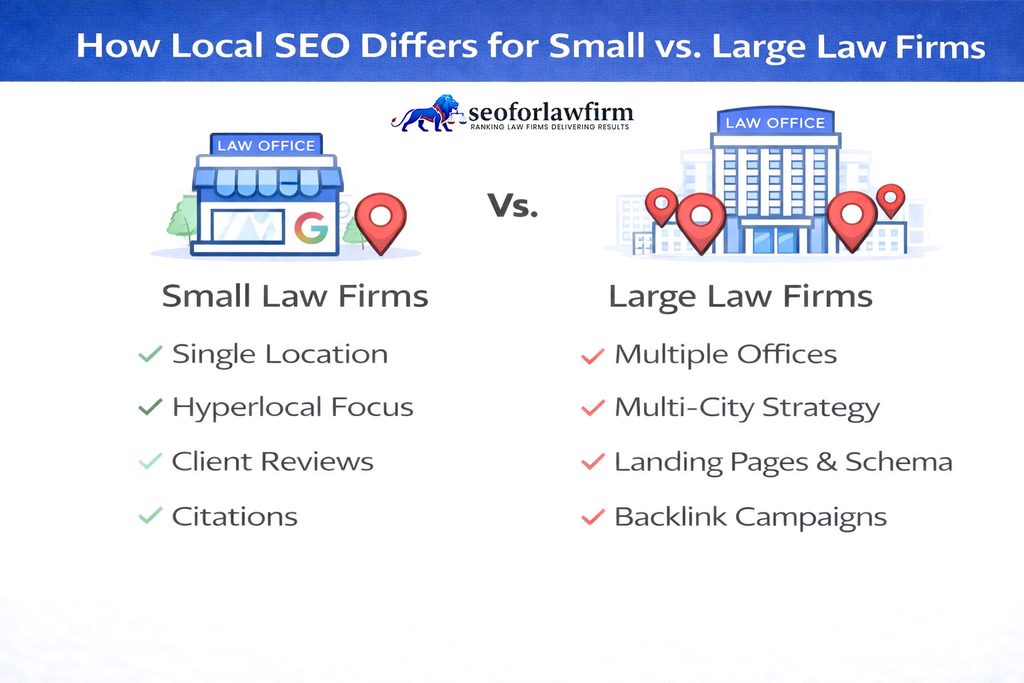
How Does Local SEO Differ for Small and Large Law Firms?
Local SEO differs for small and large law firms mainly through the number of locations, practice areas, pages, Business Profiles, reporting requirements, and geographic markets that need management.
The table below shows the main differences.
| Area | Smaller Law Firm | Larger or Multi-Office Firm |
| Business Profiles | Often 1 | Several legitimate offices |
| Geographic scope | City or regional | Several cities or regions |
| Practice areas | More focused | Broader portfolio |
| Location pages | Limited | Multiple legitimate office/location pages |
| Reporting | Simpler | Location and practice segmentation |
| Citation management | Smaller footprint | Larger multi-location footprint |
| Rank tracking | 1 market | Several local grids |
| Content requirements | Lower volume | Greater volume and coordination |
A small law firm SEO strategy can focus resources on the highest-value services and a narrower geographic market instead of trying to match a large firm page for page.
Large firms need scalability, but automation should not produce low-value location pages or duplicate local content.
Are Cheap Local SEO Services Worth It for Law Firms?
Yes, low-cost local SEO services can be worthwhile when the scope is limited, transparent, and matched to the law firm’s needs. A $350–$800 monthly service can cover Business Profile monitoring, citation management, basic reporting, limited on-page work, or tracking for one location. The same budget is unlikely to support substantial content production, technical SEO, link acquisition, multiple practice areas, conversion tracking, and several geographic markets.
Price becomes a concern when the provider promises more work than the package can reasonably fund. Guaranteed rankings signal risk. Vague deliverables hide the scope. Low-value backlinks create little benefit. Automatically generated location pages can weaken content quality. Restricted account access reduces transparency. Long contracts increase commitment without proving value. Reports based only on third-party scores fail to connect SEO with qualified leads. The correct question is not, “Is cheap SEO always bad?” The correct question is, “What exactly does this price buy?”
How Should Law Firms Measure Local SEO Performance?
Law firms should measure local SEO through Google Search visibility, Maps visibility, Business Profile interactions, qualified leads, consultations, and signed matters.
Listed below are the 8 local SEO measurements that provide the clearest view of performance.
- Organic Search clicks.
- Non-branded local impressions.
- Local keyword visibility.
- Geographic Maps visibility.
- Business Profile interactions.
- Tracked calls and forms.
- Qualified leads.
- Signed matters.
Local rankings vary by searcher location, so checking one search from the law office does not represent visibility across the entire city.
A local SEO rank-tracking process for law firms can use geographic grids to show where a firm appears across its market.
Google Business Profile Performance can then show how users interact with the profile through Search and Maps.
These measurements answer different questions:
Rank tracking → Where does the firm appear?
Profile performance → What actions occur through the Business Profile?
CRM/intake → Did those actions become clients?
What Mistakes Do Lawyers Make When Budgeting for Local SEO?
Lawyers make local SEO budgeting mistakes when the investment is disconnected from market competition, campaign scope, lead economics, or measurable client-acquisition goals.
Listed below are the 7 common budgeting mistakes.
- Choosing a budget before assessing competition: The firm selects an arbitrary monthly number without evaluating the work required.
- Comparing prices without comparing scope: A citation package is compared with a full-service SEO retainer as though both products are equivalent.
- Expecting immediate results: The firm stops work before enough Search and client-acquisition data exists to judge the campaign properly.
- Ignoring technical work: The budget funds content or links while indexing, architecture, mobile, or website problems remain unresolved.
- Ignoring measurement: Calls and forms are counted without tracking qualified consultations or signed cases.
- Spreading the budget too widely: A smaller firm attempts to target too many cities and practice areas at the same time.
- Treating SEO as a fixed one-time project: The firm fails to budget for ongoing monitoring, legal-content updates, competitive changes, reviews, and website maintenance.
The correct local SEO budget is the amount required to execute a defined strategy at a sustainable level and measure whether that investment produces suitable matters.

Where Can Law Firms Get Professional Local SEO Services?
Law firms can get professional local SEO services from specialized providers that combine Google Business Profile management, local content, citation accuracy, technical SEO, review processes, authority development, geographic rank tracking, and client-acquisition measurement. A qualified provider defines the covered locations. The provider prioritizes the relevant practice areas. The monthly plan identifies deliverables, profile-management methods, citation sources, review procedures, link-acquisition practices, location-page criteria, tracking systems, and reporting standards.
The firm should retain ownership of its website, profiles, analytics accounts, content, and campaign data. Guaranteed Maps placement is a warning sign because Google states that businesses cannot request or pay for better local rankings. SEOforLawFirm.com provides local SEO services for law firms that connect profile optimization, local content, citations, technical SEO, local authority, geographic tracking, and lead measurement. Planning budgets can range from $1,000–$2,500 per month for foundational work, $2,500–$5,000 for growth campaigns, and $5,000–$10,000 or more for competitive or multi-location campaigns. Lower-cost packages can support narrower needs. Market competition, geographic scope, practice-area priorities, deliverables, and signed-client measurement should determine whether the service provides good value.
