Law firm website features are the branding, legal content, trust, intake, accessibility, security, performance, and SEO components that help prospective clients evaluate a firm and contact it. According to a study by B.J. Fogg and colleagues titled How Do Users Evaluate the Credibility of Web Sites? in 2003, 2,684 participants evaluated live websites and mentioned visual design in 46.1% of their credibility comments, more often than any other category. A recognizable logo identifies the firm. A concise brand message explains what the firm does. Practice-area pages define the legal services the firm handles. Distinct services such as personal injury, divorce, criminal defense, estate planning, and employment law need clear page ownership.
Attorney biographies identify the lawyers providing those services. Strong profiles present credentials, bar admissions, relevant experience, professional background, publications, and other verifiable information. Calls to action give visitors a clear next step. Visible phone numbers, consultation buttons, office details, and contact links keep that step accessible across desktop and mobile devices. Lead-capture forms connect prospective clients with the intake process. Initial forms should collect the information needed to evaluate an enquiry and explain what happens after submission. Responsive design keeps legal content, menus, forms, buttons, and contact pathways usable across screen sizes.
Google primarily uses mobile content for indexing and ranking and recommends responsive design as a straightforward mobile configuration. Secure client portals give existing clients controlled access to documents, electronic signatures, messages, invoices, and case information when the firm’s systems support those functions. Testimonials and case results provide trust evidence when the statements are genuine and comply with confidentiality and lawyer-advertising requirements. Educational blogs and resource hubs answer legal questions, explain procedures, and support the firm’s practice areas with useful jurisdictional and attorney-reviewed information. HTTPS protects information transmitted between the website and visitors. Secure data handling also requires appropriate controls for forms, portals, hosting, account access, software updates, and vendors.
Fast page performance reduces friction. Good Core Web Vitals target LCP within 2.5 seconds, INP below 200 milliseconds, and CLS below 0.1. Accessible design gives people with disabilities usable access to legal information and intake pathways. WCAG 2.2 provides a current accessibility standard, and Level AA commonly serves as a practical implementation target. Interactive media and video can explain attorneys, services, legal processes, and client questions when captions, accessible controls, and performance-conscious implementation support the experience. These features create a connected law firm website system: brand recognition → service discovery → attorney evaluation → trust → accessible legal information → secure contact → measurable intake.
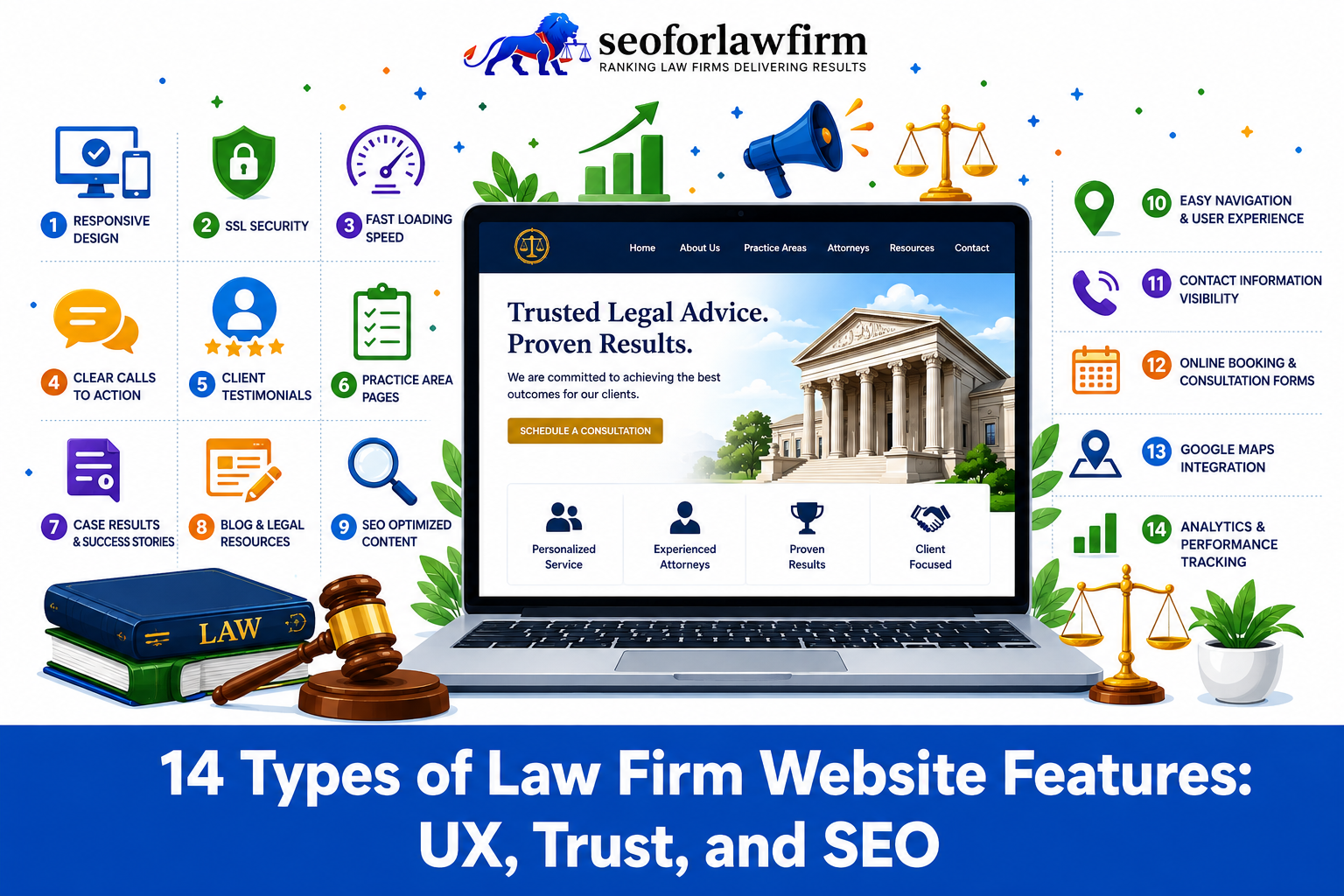
Listed below are the 14 law firm website features that support client UX, trust, and SEO.
- 1. Logo and Tagline: Identify the law firm and communicate its positioning without forcing visitors to determine what the business does.
- 2. Clear Practice-Area Pages: Give each substantive legal service a useful page that explains the matter, relevant process, jurisdiction, and route to representation.
- 3. Meaningful Attorney Bios: Show who provides the legal services through verifiable credentials, experience, admissions, background, and professional information.
- 4. Prominent Calls to Action: Use clear actions such as “Call the Firm,” “Request a Consultation,” or “Schedule a Consultation” where those actions match the intake process.
- 5. Visible Contact Information: Keep telephone numbers, office information, contact pages, and consultation routes easy to locate.
- 6. Lead Capture and Intake Forms: Collect enough information to start intake without forcing prospective clients through an unnecessarily long initial questionnaire.
- 7. Mobile-Responsive Design: Keep content readable, controls touch-friendly, navigation usable, and forms functional across screen sizes.
- 8. Secure Client Portal: Give existing clients a protected environment for appropriate case communications, documents, signatures, payments, or case information.
- 9. Compliant Testimonials and Case Results: Present genuine client feedback and past results with the disclosures and ethical review appropriate to the firm’s jurisdiction.
- 10. Educational Blog or Resource Hub: Answer client questions and support major practice areas with useful legal information.
- 11. HTTPS and Security Controls: Protect data in transit and maintain appropriate safeguards for forms, accounts, software, portals, and integrations.
- 12. Fast Load Times and Core Web Vitals: Control image weight, scripts, fonts, hosting, third-party tools, and layout movement.
- 13. Accessible Design: Support keyboard access, screen readers, readable contrast, text alternatives, accessible forms, captions, and predictable navigation.
- 14. Interactive Media or Video: Use attorney videos, legal explainers, diagrams, or other useful media without allowing them to slow or obstruct the page.
Table of Contents
- Article sections will appear here.
1. Logo and Tagline
A law firm logo identifies the firm and creates immediate brand recognition. The tagline explains the firm’s positioning, practice focus, or client value in concise language.
Visitors should understand what the firm does without having to search through several sections of the website. The logo should remain recognizable across desktop, mobile, social profiles, and other digital properties. The tagline should support the firm’s positioning without making vague or unsupported claims.
2. Clear Practice-Area Pages
Practice-area pages explain the substantive legal services that the law firm provides. Each major service should have a dedicated page that describes the legal matter, relevant process, jurisdiction, and available route to representation.
A personal injury page should focus on personal injury rather than combine unrelated services such as divorce or probate. Clear practice-area pages for law firms give each substantive legal service its own topic and client intent. Each page should give prospective clients enough information to determine whether the firm handles their legal problem.
3. Meaningful Attorney Bios
Attorney biographies show prospective clients who provides the firm’s legal services. A useful biography includes verifiable credentials, bar admissions, relevant experience, education, professional background, and other appropriate information.
The biography should explain the attorney’s role within the firm and the legal matters connected to that role. Publications, speaking engagements, professional memberships, and representative experience can add context when the information is accurate. A strong attorney biography helps prospective clients evaluate the lawyer before requesting a consultation.
4. Prominent Calls to Action
Calls to action give website visitors a clear next step after reviewing the firm’s legal information. Common actions include “Call the Firm,” “Request a Consultation,” and “Schedule a Consultation.”
The wording should match the actual intake process rather than promise an action the firm does not provide. Calls to action should appear where visitors naturally decide whether to contact the firm. According to a study by Marcin Hylewski, Artur Pluskota, and Błażej Abel titled The Effect of Landing Page Design and Structure on Conversion Rates in 2025, analysis of 25,027 landing pages found conversion relationships involving the number and position of buttons, form structure, page height, imagery, video, and copy length. Mobile and desktop layouts should therefore keep contact actions visible without obstructing the legal content.
5. Visible Contact Information
Visible contact information helps prospective clients reach the law firm without unnecessary searching. Telephone numbers, office information, contact pages, and consultation pathways should remain easy to find across the website.
Contact details should appear consistently wherever the firm represents a physical office. Mobile visitors should be able to use telephone links and contact buttons without navigating through multiple pages. Clear contact information reduces friction between legal research and client intake.
6. Lead Capture and Intake Forms
Lead capture and intake forms create a structured pathway from website visit to prospective-client enquiry. An initial form should collect enough information for the firm to begin evaluating the matter.
The form should avoid requesting unnecessary information before the firm establishes whether the enquiry fits its intake criteria. Visitors should receive a clear explanation of what happens after submission. Forms should also function correctly across mobile devices, browsers, and accessibility tools.
7. Mobile-Responsive Design
Mobile-responsive design allows the law firm website to adapt to different screen sizes. Legal content should remain readable on phones, tablets, laptops, and desktop displays.
Navigation should remain usable without requiring excessive zooming or horizontal movement. Forms, buttons, menus, and consultation pathways should remain functional and touch-friendly. Responsive web design for law firms keeps the same core website information accessible across devices without creating a separate experience that loses important content.
8. Secure Client Portal
A secure client portal gives existing clients a controlled environment for appropriate case-related activity. The portal can support document exchange, electronic signatures, messages, payments, and access to case information when the firm’s systems provide those functions. Access controls should restrict information to authorized users.
The portal should operate separately from public website content that anyone can access. Security, confidentiality, software configuration, and vendor controls should guide how the firm implements portal functions.
9. Compliant Testimonials and Case Results
Testimonials and case results provide evidence of previous client experiences and legal outcomes when presented appropriately. The information should be genuine and accurately represented.
Law firms should review confidentiality obligations and applicable lawyer-advertising rules before publication. Disclosures should accompany statements when the jurisdiction or context requires them. Trust content should inform prospective clients without creating misleading expectations about future results.
10. Educational Blog or Resource Hub
An educational blog or resource hub gives prospective clients useful information about legal questions and procedures. The content should support the firm’s main practice areas and address topics that matter to prospective clients.
Articles can explain legal processes, deadlines, terminology, evidence, claims, and other relevant issues. Jurisdiction-specific information should remain accurate and current when laws or procedures differ by location. The resource hub should provide useful legal information rather than publish pages merely to increase website volume.
11. HTTPS and Security Controls
HTTPS protects information transmitted between the visitor’s browser and the law firm website. A valid security certificate helps prevent transmitted data from traveling through an unencrypted connection.
Website security also extends beyond HTTPS. Law firms should maintain appropriate safeguards for forms, user accounts, portals, software updates, hosting systems, and third-party integrations. Security controls should protect both prospective-client information and existing-client data throughout the website ecosystem.
12. Fast Load Times and Core Web Vitals
Fast page performance reduces delays between a visitor opening a page and being able to use it. Google/SOASTA research titled Mobile Page Speed: New Industry Benchmarks found that bounce probability increased substantially as mobile load time increased, including a 123% increase from 1 second to 10 seconds. Law firms should therefore control image size, JavaScript, fonts, third-party scripts, hosting performance, and unnecessary network requests.
Large attorney photographs, chat widgets, maps, videos, and tracking tools can increase page weight when implemented poorly. Core Web Vitals help measure loading performance, responsiveness, and visual stability. Law firm website speed optimization needs to improve loading and interaction without removing legal information, trust elements, or conversion functions that visitors actually need.
13. Accessible Design
Accessible design gives people with different abilities a usable route to legal information and firm contact options. Website navigation should support keyboard interaction where appropriate.
Images should include meaningful text alternatives when the visual content requires description. Forms should contain clear labels, instructions, validation messages, and predictable controls. Readable contrast, captions, screen-reader compatibility, and consistent navigation help more visitors use the website effectively.
14. Interactive Media or Video
Interactive media and video can explain attorneys, legal services, processes, and client questions in formats that complement written content. Attorney videos can introduce the people behind the firm.
Legal explainers can simplify procedures that are difficult to communicate through text alone. Diagrams and interactive elements can illustrate timelines, claim processes, or other structured information. Media should include appropriate accessibility features and should not introduce unnecessary performance problems or obstruct the visitor’s path to important legal content.
Which Intake Features Help Law Firm Visitors Contact the Firm?
The strongest law firm intake features are visible phone numbers, clear calls to action, short contact forms, appropriate chat or messaging, consultation scheduling, and secure document exchange when the firm needs it. Intake features should reduce friction between legal research and contact.
The website should make the next step obvious. The intake process should collect only the information needed to begin evaluating the enquiry. The firm should also explain what happens after submission. Privacy, confidentiality, and security controls should support every intake channel that handles sensitive information.
Listed below are the 6 main intake features that help law firm visitors contact the firm.
- Click-to-Call Phone Numbers: Click-to-call numbers let mobile visitors initiate a call directly from the website. The number should remain visible on important pages and mobile layouts.
- Consultation Calls to Action: Consultation CTAs should state the available action clearly. Phrases such as “Request a Consultation,” “Call the Firm,” or “Schedule a Consultation” communicate more intent than vague buttons such as “Learn More.”
- Short Initial Forms: Initial forms should request the minimum information needed to begin evaluating the enquiry. Long questionnaires can create unnecessary friction before the firm confirms that the matter fits its intake criteria.
- Chat or Messaging: Chat and messaging give visitors another contact pathway. The firm should maintain a clear response process and appropriate safeguards when visitors may disclose sensitive personal or legal information.
- Consultation Scheduling: Scheduling tools let eligible prospective clients request or select appointment times where automation fits the firm’s intake model. The tool should connect with the firm’s real availability and consultation process.
- Secure Document Exchange: Secure document exchange gives prospective or existing clients a protected method for sending sensitive files. The firm should use an appropriate secure system rather than rely on an ordinary public contact form for confidential documents.
The website should also explain what happens after a visitor submits an enquiry. A confirmation such as, “Your message has been received. Submission does not create an attorney-client relationship. Our intake team will review your enquiry and contact you using the information provided,” sets clearer expectations than a generic “Thanks.” Website forms should also receive appropriate privacy and security review because legal enquiries can contain sensitive personal information.

Which Features Improve Accessibility for Legal Clients?
Accessible law firm websites use semantic structure, keyboard-operable controls, text alternatives, sufficient contrast, labeled forms, captions, and predictable navigation to make legal information and intake pathways usable for more visitors. Accessibility should apply to legal content, navigation, forms, media, and interactive elements. The website should also work with screen readers and other assistive technologies without requiring the law firm to build a separate text-to-speech system.
Listed below are the 7 accessibility features law firms should prioritize.
- Meaningful Alt Text: Alt text should describe informative images according to their content and purpose. Decorative images generally should not receive unnecessary descriptive text.
- Keyboard Navigation: Menus, forms, dialogs, buttons, links, and other interactive controls should work without requiring a mouse. Keyboard users need a logical path through each page.
- Visible Keyboard Focus: Interactive elements should clearly show which control currently has keyboard focus. Visible focus helps users understand where their next action will occur.
- Readable Contrast: Text, buttons, form controls, and other important interface elements should maintain sufficient contrast against their backgrounds. Strong contrast improves readability for visitors with low vision and other visual impairments.
- Proper Form Labels: Every form field should have an understandable and programmatically associated label. Instructions, required fields, validation errors, and submission messages should also remain accessible.
- Captions and Transcripts: Meaningful video and audio content should include appropriate captions, transcripts, or other accessible alternatives. These features make multimedia information available to visitors who cannot rely on audio alone.
- Semantic HTML: Headings, landmarks, lists, buttons, links, and other HTML elements should represent their actual function. Semantic structure helps browsers, screen readers, and other assistive technologies interpret page relationships correctly.
Text-to-speech support does not require a law firm to develop its own speech engine. Well-structured accessible HTML gives screen readers and other assistive technologies the information they need to present legal content and website controls effectively.
Which Trust-Building Features Should Law Firm Websites Include?
Trust-building law firm website features should provide verifiable evidence about the attorneys, firm, legal services, experience, and client relationship rather than rely on broad promotional claims. Trust grows when prospective clients can confirm who the attorneys are, where the firm operates, what qualifications the lawyers hold, what professional organizations they belong to, and how the firm handles privacy and communication.
Testimonials, awards, memberships, and case results should represent genuine information. Client-facing proof should also comply with applicable confidentiality, consent, and lawyer-advertising requirements.
Listed below are 13 trust-building features law firm websites should include.
- Attorney Biographies: Show the lawyers who provide the legal services. Profiles should include accurate credentials, experience, education, professional background, and other verifiable information.
- Bar Admissions: Identify the jurisdictions where each attorney is admitted to practice. This information helps prospective clients assess whether the lawyer serves the relevant legal market.
- Relevant Certifications: Display legitimate professional certifications where the attorney or firm actually holds them. The website should describe the certification accurately.
- Real Office Information: Provide genuine office addresses, telephone numbers, and location details. Office information should match the firm’s actual presence.
- Professional Memberships: List authentic memberships in bar associations, legal organizations, and other professional bodies where appropriate.
- Publications: Show relevant articles, books, legal commentary, or other published work produced by the attorneys. Publications can demonstrate subject involvement when the authorship is genuine.
- Speaking Activity: Include relevant conferences, panels, seminars, webinars, and other speaking engagements where the attorney has participated.
- Genuine Awards: Display awards that the attorney or firm actually received. Award graphics should not imply accreditation, certification, or endorsement that does not exist.
- Client Testimonials: Publish genuine client feedback where applicable rules permit it. The firm should review consent, confidentiality, and advertising requirements before publication.
- Case Results: Present past outcomes accurately where permitted. The website should avoid creating the impression that a previous result guarantees a similar future outcome.
- Privacy Information: Explain how the website collects, uses, stores, and handles personal information where appropriate.
- Clear Disclaimers: Explain relevant limitations concerning attorney-client relationships, legal information, past results, and jurisdictional issues.
- Secure Contact Pathways: Give prospective clients appropriate methods for contacting the firm and submitting information. Sensitive legal information should move through suitable secure systems where needed.
Testimonials and case outcomes require jurisdiction-specific ethical review. Client information requires attention to confidentiality and consent. Trust badges should represent real third-party affiliations. A graphic that looks like an accreditation without a genuine underlying relationship weakens trust instead of building it.
Which SEO Features Belong on a Law Firm Website?
Law firm websites should include crawlable architecture, descriptive page titles, logical headings, contextual internal links, mobile-accessible content, appropriate structured data, clear practice-area pages, genuine location pages, XML sitemaps, canonical controls, robots directives, and analytics integration. Crawlable navigation helps search engines reach important legal pages. Descriptive URLs and unique titles identify each page’s subject. Logical headings organize legal information. Internal links connect related services, attorneys, locations, and resources. Mobile content parity keeps important information available across devices. XML sitemaps support URL discovery. Canonical controls identify preferred page versions.
Robots controls manage crawler access and indexing instructions. Structured data describes eligible entities and page information but does not create a generic ranking boost.A schema markup strategy for law firms should represent visible content accurately and use markup that fits supported search features. Practice-area architecture gives substantive legal services clear page ownership. Genuine location pages provide useful information for real offices or markets rather than creating thin geographic variations. Search Console and analytics integration connect technical search visibility with website performance. FAQ sections can still answer useful client questions even though FAQ rich-result visibility is no longer a reason to create them. Map embeds can help users understand a location, but they do not cause Local Pack rankings by themselves. Local visibility depends on broader signals such as legitimate business information, relevance, distance, prominence, reviews, and other applicable local-search factors.

Where Can Law Firms Get Website SEO and UX Optimization Services?
Law firms can get website SEO and UX optimization services from providers that combine legal website architecture, responsive design, intake UX, accessibility, technical SEO, performance, and client-acquisition measurement.
SEOforLawFirm.com provides law firm web design and SEO services that connect website architecture, legal content, responsive UX, technical performance, accessibility, and client intake. A website project should review brand communication and homepage clarity. Practice-area architecture should give each substantive legal service clear page ownership. Attorney biographies should present verifiable professional information. Navigation should help visitors reach services, attorneys, locations, resources, and contact pathways. Mobile layouts should preserve important content and functionality. Calls to action should direct visitors toward suitable consultation steps. Contact forms should support efficient intake. Secure client portals should protect appropriate case communications and documents.
Testimonials and case results should follow applicable confidentiality and advertising requirements. Educational resources should answer useful client questions. HTTPS and security controls should protect website interactions and data. Core Web Vitals should support fast and stable page experiences. Accessible design should keep legal information and intake pathways usable for people with different abilities. Schema should describe visible entities and relationships accurately. Analytics and intake attribution should connect website activity with qualified enquiries and signed matters.
The principal law firm website features include a clear logo and tagline, practice-area pages, attorney bios, calls to action, visible contact information, intake forms, responsive design, a secure client portal where appropriate, compliant testimonials and case results, an educational resource hub, HTTPS and security controls, fast performance, accessible design, and useful interactive media. The strongest legal websites connect these features as one system. The system helps prospective clients identify the service they need. The system helps visitors evaluate the attorneys. The system keeps the website usable across devices and abilities. The system gives prospective clients a direct path to contact the firm without unnecessary friction.