

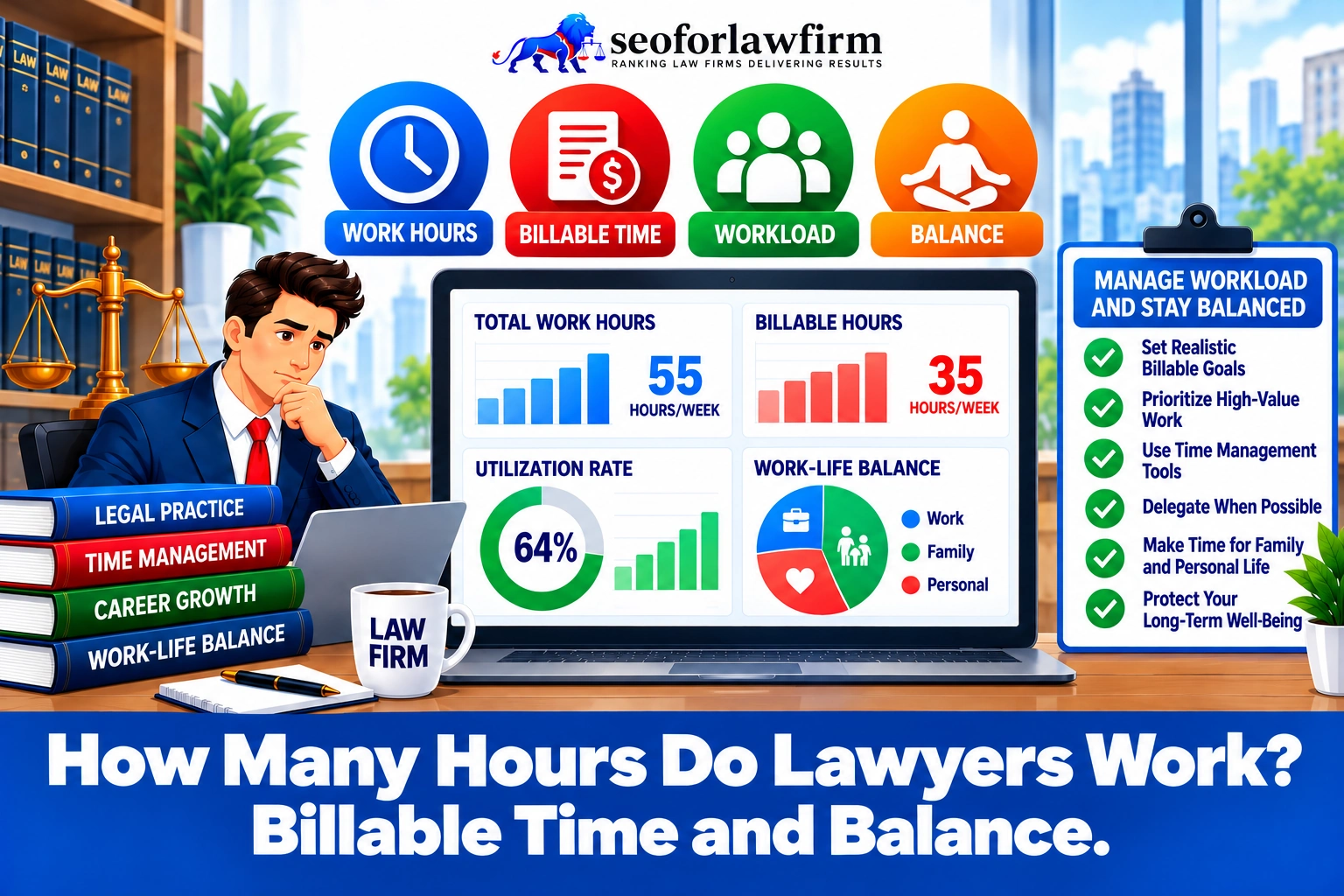
Lawyers in the U.S. commonly work about 45–55 hours per week. More predictable roles may stay closer to 40 hours, while demanding BigLaw, transaction, or trial periods can push schedules to 60–80+ hours per week. According to a study by Patrick R. Krill, Ryan Johnson, and Linda Albert titled The Prevalence of Substance Use and Other Mental Health Concerns Among American Attorneys in 2016, Krill, Johnson, and Albert documented mental-health concerns in a survey of licensed attorneys. This establishes a well-being concern, not a causal estimate of the effects of a particular weekly schedule.
The exact workload depends on firm size, practice area, seniority, billable-hour requirements, client demands, court deadlines, staffing, and whether the lawyer also manages a business.
No official U.S. government statistic establishes 45–55 hours as a universal lawyer average. The U.S. Bureau of Labor Statistics states that most lawyers work full time and that some work more than 40 hours per week. BLS does not publish one weekly-hour average covering every lawyer or practice setting.
Private-practice schedules frequently extend beyond billable time. Client work represents only part of the workday because attorneys also complete intake, internal meetings, billing, training, recruiting, business development, supervision, marketing, and administrative work.
BigLaw associates usually face the highest formal billable expectations. The American Bar Association reported in 2025 that the longstanding BigLaw industry range has hovered around 1,800–2,200 billable hours annually, with some firms adopting even higher productive-hour expectations.
Billable hours and actual working hours are not the same measurement. Current legal-industry benchmarks place average attorney utilization at about 38%, which is equivalent to approximately 3.0 billable hours within a standardized 8-hour workday.
Table of Contents
- Article sections will appear here.
How Many Hours Do Lawyers Work on Average?
U.S. lawyers commonly work about 45–55 hours per week. No single national average applies across every legal role because working hours vary by employer, practice area, workload, and case demands. The BLS states that most lawyers work full time and that some work more than 40 hours per week.
Employer type also shapes the schedule: a government attorney handling predictable agency matters may work close to a conventional full-time week, while a corporate associate managing a transaction closing or a litigator preparing for trial may work substantially longer hours. Individual weeks can also differ from annual working patterns, with deadlines, transactions, and trials creating periods that require nights, weekends, or extended workdays.
How Many Hours Do Lawyers Work by Type of Employer?
Lawyer working hours differ by employer because of private firms, client service, administrative work, deadlines, and business responsibilities.
Listed below are the 5 main lawyer work environments and their common scheduling patterns.
- 1. BigLaw and large firms: Lawyers frequently work 55–80+ hours during demanding periods, particularly around transaction closings, trials, major filings, investigations, and urgent client matters.
- 2. Small and midsize firms: Lawyers commonly work about 42–55 hours and often combine legal work with intake, billing, business development, supervision, and administration.
- 3. Solo practices: Solo lawyers frequently work about 40–60+ hours because the attorney performs legal work and operates the business.
- 4. Government and public-sector positions: Many government roles stay closer to a conventional full-time schedule, though public defenders, prosecutors, litigators, and investigators can work longer during demanding matters.
- 5. In-house legal departments: In-house lawyers often work about 40–55 hours, with larger spikes around transactions, litigation, regulatory events, investigations, and board matters.
1. BigLaw and Large Firms
BigLaw and large-firm lawyers frequently work 55–80+ hours per week during demanding periods. Large firms serve corporate clients, financial institutions, and other organizations that often impose strict transaction, litigation, and regulatory deadlines. Associates may spend extended hours on due diligence, document review, negotiations, major filings, investigations, trial preparation, and transaction closings.
Annual billable-hour expectations also increase scheduling pressure because lawyers must record substantial client work in addition to training, meetings, recruiting, mentoring, and other firm responsibilities. Workload intensity can change quickly when a deal approaches closing, a court sets a filing deadline, or a client requires an urgent response. BigLaw working hours therefore reflect a combination of billable expectations, complex matters, client responsiveness, staffing structure, and deadline concentration.
2. Small and Midsize Firms
Lawyers at small and midsize firms commonly work about 42–55 hours per week. These lawyers often manage client matters while also participating in intake, billing, collections, business development, staff supervision, and firm administration. Smaller staffing structures can place more operational responsibility directly on attorneys because dedicated finance, marketing, technology, and intake departments may not exist.
Practice area also affects workload because litigation, family law, criminal defense, transactional work, and other services create different scheduling demands. Smaller firms may offer greater schedule flexibility than large firms, but client deadlines and business-management responsibilities can still extend the workweek. Working hours at small and midsize firms therefore depend on caseload, staffing depth, billing structure, management duties, and the lawyer’s role within the practice.
3. Solo Practices
Solo lawyers frequently work about 40–60+ hours per week because one attorney often performs both legal and business-management work. A solo practitioner may handle client representation, court appearances, intake, billing, collections, bookkeeping, marketing, networking, technology, vendor relationships, and office administration. Self-employment gives solo lawyers greater control over scheduling, but schedule control does not automatically reduce total working time.
Non-billable business duties can consume a substantial part of the workweek even when the lawyer records fewer billable hours than an associate at a larger firm. Workload can also fluctuate because a single trial, urgent client matter, or business issue may demand immediate attorney attention. Solo-practice working hours therefore reflect the combined demands of professional legal service and ownership of the law practice.
4. Government and Public-Sector Positions
Government and public-sector lawyers often work closer to a conventional full-time schedule, although demanding matters can extend working hours. Government attorneys usually do not operate under private-firm billable-hour requirements, which removes one source of workload pressure. Prosecutors, public defenders, agency counsel, litigators, and investigators can still face trials, hearings, investigations, emergency applications, large caseloads, and regulatory deadlines.
Public-sector workload also varies according to agency mission, staffing levels, jurisdiction, case volume, and the lawyer’s responsibility. Some positions provide more predictable schedules, while litigation-heavy and enforcement roles may require nights, weekends, or urgent court work. Government legal employment therefore offers a different workload structure rather than a guaranteed 40-hour schedule.
5. In-House Legal Departments
In-house lawyers often work about 40–55 hours per week, with longer periods arising around major corporate events. In-house counsel usually work directly for one organization and organize legal activity around the company’s commercial, regulatory, employment, governance, and litigation needs. Contract negotiations, mergers and acquisitions, internal investigations, regulatory events, product launches, litigation, and board matters can increase workload quickly.
In-house positions often provide greater schedule predictability than BigLaw because lawyers do not usually work under private-firm billable-hour targets. Seniority and company structure still matter because general counsel, deputy general counsel, and specialized legal leaders may carry substantial management and executive-advisory responsibilities. In-house working hours therefore depend on corporate activity, industry regulation, transaction volume, litigation exposure, leadership duties, and the legal department’s staffing model.

How Many Hours Do BigLaw Lawyers Work?
BigLaw lawyers work about 55–80+ hours per week during demanding periods. Annual billable requirements, client deadlines, major transactions, litigation schedules, and non-billable firm responsibilities drive total workload. The American Bar Association reported in 2025 that BigLaw billable expectations have commonly remained around 1,800–2,200 hours per year.
A lawyer required to bill 2,000 hours across 48 working weeks needs to record about 41.7 billable hours per week, but total working time rises because internal meetings, training, recruiting, business development, mentoring, firm committees, timekeeping, administrative tasks, and unbillable portions of client work do not count fully toward billable targets. Actual weekly hours therefore depend on workload, staffing, billing rules, utilization, firm policies, and the amount of non-billable work assigned.
The table below shows the approximate total working time mathematically required to record 40 billable hours at different utilization levels.
| Share of Work Time That Is Billable | Approximate Total Hours Needed for 40 Billable Hours |
| 80% | 50.0 hours |
| 75% | 53.3 hours |
| 70% | 57.1 hours |
| 65% | 61.5 hours |
| 60% | 66.7 hours |
These figures are mathematical examples rather than BigLaw utilization benchmarks.
How Many Hours Do Lawyers at Small and Midsize Firms Work?
Lawyers at small and midsize firms commonly work about 42–55 hours per week. A defined small law firm marketing strategy can move recurring marketing activities into a planned system, while total working hours still depend on caseload, staffing, billing structure, practice area, and management duties.
Smaller firms may impose lower formal billing targets than BigLaw, but attorneys often handle operational responsibilities that larger firms distribute across dedicated finance, marketing, recruiting, intake, IT, and administrative teams. These additional responsibilities can extend the workweek beyond direct client service and billable legal work.
Listed below are 10 responsibilities that can extend working hours in small and midsize firms.
- Client work: Legal research, drafting, negotiations, hearings, case preparation, and client representation.
- Client intake: Reviewing enquiries, screening matters, and conducting initial consultations.
- Scheduling: Coordinating client meetings, court dates, deadlines, and internal calendars.
- Billing: Preparing invoices, reviewing time entries, and managing billing records.
- Collections: Following up on unpaid invoices and monitoring accounts receivable.
- Staff supervision: Managing paralegals, legal assistants, intake staff, and other employees.
- Business development: Building referral relationships and pursuing new client opportunities.
- Marketing: Managing website content, SEO, advertising, email, social media, and other acquisition activities.
- Vendor management: Coordinating with technology, marketing, accounting, and other external providers.
- Technology administration: Managing software, systems, cybersecurity processes, and practice-management tools.
How Many Hours Do Solo Lawyers Work?
Solo lawyers often work about 40–60+ hours per week because they manage both legal matters and business-owner responsibilities. Self-employment gives solo attorneys more control over their schedules, but that flexibility does not necessarily reduce total working time.
BLS states that self-employed lawyers may have flexibility in setting their own schedules. A solo lawyer can bill fewer hours than a BigLaw associate and still work a long week because intake, billing, collections, bookkeeping, marketing, technology, hiring, vendor management, and office administration consume substantial non-billable time.
Listed below are 12 common responsibilities that shape solo lawyer working hours.
- Client work: Handles legal research, drafting, negotiations, case preparation, and representation.
- Court appearances: Requires time for hearings, trials, conferences, and travel.
- Client intake: Screens enquiries and evaluates prospective matters.
- Billing: Prepares invoices and manages time records.
- Collections: Follows up on unpaid legal fees.
- Bookkeeping: Tracks expenses, revenue, and financial records.
- Marketing: Manages client acquisition activities and firm visibility.
- Networking: Builds referral and professional relationships.
- Technology: Maintains legal software, security systems, and digital tools.
- Hiring: Recruits and manages support personnel where needed.
- Vendor management: Coordinates with outside service providers.
- Office administration: Handles operational tasks required to run the practice.
How Many Hours Do Government Lawyers Work?
Government lawyers often work close to a conventional 40-hour week, but trials, investigations, hearings, caseloads, and regulatory deadlines can extend their schedules. Government attorneys usually do not face private-firm billable-hour targets, which removes one major source of workload pressure.
Public-sector legal roles still vary substantially by agency, position, and practice area. Prosecutors, public defenders, regulatory attorneys, and lawyers handling emergency matters can work well beyond a standard office schedule. BLS provides the stronger broad benchmark by stating that lawyers generally work full time and that some work more than 40 hours per week rather than establishing one national average for government attorneys.
Listed below are 8 common demands that can extend government lawyer working hours.
- Trials: Require preparation, court appearances, and extended working days.
- Hearings: Create fixed deadlines and preparation requirements.
- Investigations: Add document review, interviews, and case-development work.
- Public-defense caseloads: Can create substantial time pressure when attorneys manage large numbers of active matters.
- Prosecutorial responsibilities: Include charging decisions, hearings, trials, and case preparation.
- Emergency applications: Require rapid legal responses outside ordinary working hours.
- Regulatory deadlines: Create time-sensitive research, drafting, and filing work.
- Agency projects: Add policy, advisory, enforcement, or administrative assignments.
How Many Hours Do In-House Lawyers Work?
In-house lawyers commonly work about 40–55 hours per week, with schedules that are often more predictable than BigLaw but can increase sharply during major business events. In-house counsel usually do not work under private-firm billable-hour targets because their workload follows the legal and commercial needs of the company.
Contract negotiations, regulatory matters, litigation, transactions, investigations, executive requests, and board activity can create periods of heavier work. The 2025–2026 ABA lawyer well-being study found lower predicted distress and burnout among in-house lawyers than among private-firm and solo lawyers, but that finding does not establish that every in-house position involves shorter hours.
Listed below are 11 common demands that shape in-house lawyer working hours.
- Contract review: Reviews, drafts, and negotiates commercial agreements.
- Employment matters: Advises on workplace disputes, policies, and personnel issues.
- Regulatory compliance: Supports the company’s compliance with applicable legal requirements.
- Corporate governance: Handles governance documents, policies, and corporate procedures.
- Litigation management: Coordinates outside counsel and internal litigation strategy.
- Mergers and acquisitions: Supports due diligence, negotiations, and transaction closings.
- Data privacy: Advises on privacy, cybersecurity, and data-handling obligations.
- Internal investigations: Reviews allegations and coordinates internal fact-finding.
- Product launches: Evaluates legal risks connected with new products or services.
- Executive advice: Provides legal guidance to senior leadership.
- Board matters: Supports board meetings, governance obligations, and related legal work.
What Is the Difference Between Billable Hours and Actual Hours Worked?
Billable hours measure qualifying client work that a lawyer can record toward billing, whereas actual hours worked include billable work plus every other professional responsibility completed during the workday.
A lawyer who works 10 hours does not automatically record 10 billable hours.
The table below shows 4 different time measures used in law firm operations.
| Time Measure | Meaning | Example |
| Hours worked | All professional working time | Client work, meetings, administration, marketing |
| Billable hours | Time eligible to charge to a client | Drafting, research, strategy, client advice |
| Billed hours | Recorded billable time actually invoiced | Time remaining after billing review |
| Collected value | Invoiced work the client actually pays | Revenue received from billed work |
Clio separates these stages using utilization, realization, and collection rates. Utilization measures the percentage of a standardized 8-hour workday put toward billable work; realization measures how much billable work is actually invoiced; collection measures how much invoiced work gets paid.

How Many Lawyer Working Hours Are Actually Billable?
Only part of a lawyer’s total working time is usually billable because legal work also includes administration, intake, meetings, business development, management, and professional obligations. A study by the Thomson Reuters Institute and the True Value Partnering Institute from the official Thomson Reuters platform, titled “Law Firm Rates Report 2026: Law firms discover the hidden engine driving their pricing power” in 2025, confirms that managing rate increases and billing efficiency is a vital driver of law firm profit growth. The realization benchmark corresponds to about 2.6 invoiced hours, while the collection benchmark corresponds to about 2.4 hours of collected work. These figures do not mean that lawyers work only 3 hours per day or spend exactly 5 hours on administration.
The utilization metric measures billable activity against a standardized workday, while the remaining time can include non-billable client work, intake, internal communication, administration, marketing, management, and other professional duties. The benchmark also shouldn’t apply directly to BigLaw associates because BigLaw billing structures, annual targets, staffing models, and utilization patterns differ from the broader law-firm population in Clio’s data.
Listed below are the 6 main components of Clio’s billing benchmarks.
- Utilization — 38%: Measures the share of a standardized workday recorded as billable time.
- Billable time — about 3.0 hours: Represents the approximate billable portion of an 8-hour standardized day.
- Realization — 88%: Measures how much recorded billable work reaches the invoice stage.
- Invoiced time — about 2.6 hours: Represents the approximate portion of the standardized day that becomes billed work.
- Collection — 93%: Measures how much invoiced work is actually collected.
- Collected work — about 2.4 hours: Represents the approximate portion of the standardized day that results in collected revenue.
What Are Typical Lawyer Billable-Hour Requirements?
Private-law-firm billable requirements frequently range from about 1,800–2,200 hours per year, with BigLaw expectations commonly falling within that range. The ABA described 1,800–2,200 annual hours as a longstanding BigLaw range in 2025, although some firms use higher productive-hour requirements that combine billable and approved non-billable work.
Law firms can connect workload planning with broader law firm financial management by comparing attorney output with staffing, compensation, and financial requirements. Annual billable targets do not equal total working hours because vacation, holidays, sick leave, training, internal responsibilities, write-offs, and other non-billable work increase the time required to reach the target.
The table below shows the weekly billable pace required to reach different annual targets across 48 working weeks.
| Annual Billable Target | Billable Hours per Week Across 48 Working Weeks |
| 1,700 | 35.4 hours |
| 1,800 | 37.5 hours |
| 1,900 | 39.6 hours |
| 2,000 | 41.7 hours |
| 2,100 | 43.8 hours |
| 2,200 | 45.8 hours |
These figures represent billable hours rather than total working hours.
Does Recording 8 Billable Hours Require a 10–12-Hour Day?
Yes, recording 8 billable hours can require a 10–12-hour workday when only about 67%–80% of a lawyer’s total working time qualifies as billable. The exact ratio depends on the lawyer’s utilization because internal meetings, administration, recruiting, marketing, staff questions, and other non-billable responsibilities increase the total time required to reach the billable target.
At 80% utilization, 8 billable hours require about 10.0 total hours; at 75%, about 10.7 hours; at 70%, about 11.4 hours; and at 67%, about 11.9 hours. Lawyers who work in long uninterrupted billable blocks can reach 8 billable hours faster than lawyers whose days contain substantial non-billable activity. The 10–12-hour estimate is therefore plausible for many lawyers, but it is not a universal formula.
What Non-Billable Work Extends Lawyers’ Workdays?
Non-billable work extends lawyers’ schedules because many activities required to operate a legal practice do not qualify for client billing.
Listed below are 8 major categories of non-billable lawyer work.
- Administration: Scheduling, internal records, office management, and operational tasks.
- Client intake: Evaluating prospective matters and collecting preliminary information.
- Billing: Reviewing time, preparing invoices, resolving billing questions, and managing collections.
- Business development: Networking, referral relationships, proposals, speaking, and prospective-client development.
- Marketing: Website work, professional profiles, educational content, community visibility, and campaign oversight.
- Training: Continuing legal education, mentoring, professional development, and internal training.
- Firm management: Staffing, finance, technology, vendors, policies, and internal decision-making.
- Internal meetings: Practice-group meetings, management discussions, case coordination, recruiting, and committee work.
A documented law firm marketing system can reduce ad hoc marketing demands by assigning recurring acquisition work to a planned process instead of relying on attorneys to handle each task individually.
How Do Client Communications Affect Lawyer Working Hours?
Client communications extend lawyer working hours when calls, emails, meetings, status requests, and urgent questions repeatedly interrupt concentrated legal work. Communication remains part of competent client service, but routine administrative questions consume attorney time when every enquiry requires direct lawyer involvement.
Law firms can reduce this pressure by setting response expectations, providing scheduled updates, giving clients appropriate access to matter information, using approved templates, delegating non-legal questions to trained staff, and routing new-client enquiries through a defined intake process. Clear communication systems preserve client service while allowing lawyers to spend more time on work that requires legal judgment.
Listed below are 6 ways firms can reduce unnecessary communication pressure.
- Set response-time expectations: Tell clients when and how quickly the firm normally responds to different types of enquiries.
- Schedule regular case updates: Provide planned status reports so clients do not need to request routine updates repeatedly.
- Provide access to matter information: Give clients appropriate access to documents, dates, or status information where suitable.
- Use approved communication templates: Handle recurring administrative questions with standardized responses.
- Delegate non-legal enquiries: Allow trained support staff to handle scheduling, document requests, billing questions, and other administrative matters.
- Use a defined intake process: Route new-client enquiries through screening before attorney time is required.
How Do Long Working Hours Affect Lawyer Burnout?
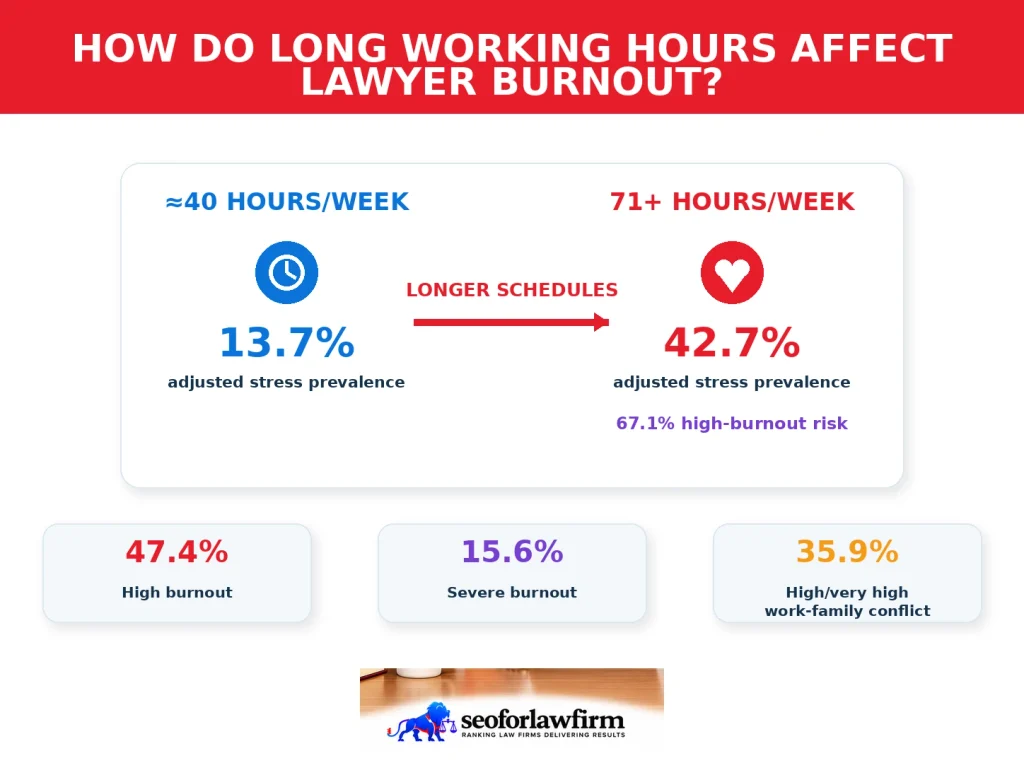
Long lawyer working hours are associated with higher burnout, stress, anxiety, depression, and work-family conflict, with the strongest reported risks appearing among lawyers working 71+ hours per week. The 2025–2026 ABA and Krill Strategies Survey of Lawyer Well-Being analyzed a national random sample of approximately 37,000 actively licensed lawyers across 28 jurisdictions. The study found that 47.4% screened positive for high burnout, 15.6% met the threshold for severe burnout, and 35.9% reported high or very high work-family conflict. According to a study by Justin Anker and Patrick R. Krill titled Stress, Drink, Leave: An Examination of Gender-Specific Risk Factors for Mental Health Problems and Attrition Among Licensed Attorneys in 2021, Anker and Krill associated work overcommitment with intentions to leave law for mental-health reasons. These observational findings do not establish that changing jobs alone resolves distress.
Moderate-to-extremely-severe thresholds were reported by 21.7% for depression, 20.4% for anxiety, and 18.9% for stress. Working hours showed a strong association with distress: adjusted stress prevalence increased from 13.7% among lawyers working about 40 hours per week to 42.7% among lawyers working 71+ hours, while high-burnout risk reached 67.1% in the 71+ hour group. These findings show a strong association between exceptionally long schedules and poorer reported well-being, although they do not establish that long hours alone cause every mental-health outcome.
Listed below are the 9 main findings from the study.
- High burnout: 47.4% of lawyers screened positive.
- Severe burnout: 15.6% met the severe-burnout threshold.
- Work-family conflict: 35.9% reported high or very high conflict.
- Depression: 21.7% met moderate-to-extremely-severe thresholds.
- Anxiety: 20.4% met moderate-to-extremely-severe thresholds.
- Stress: 18.9% met moderate-to-extremely-severe thresholds.
- Stress at about 40 hours per week: Adjusted prevalence was 13.7%.
- Stress at 71+ hours per week: Adjusted prevalence rose to 42.7%.
- High burnout at 71+ hours per week: Risk reached 67.1%.
Can Lawyers Have Work-Life Balance?
Yes, lawyers can have work-life balance, but the degree of balance depends on practice setting, client demands, schedule control, and personal responsibilities. The 2026 ABA study gives this issue current context by showing that more than one-third of lawyers reported high or very high work-family conflict and that longer working hours were associated with greater burnout and mental-health risk. Lawyers whose preferred working conditions no longer match conventional practice may consider alternative careers for lawyers in compliance, policy, education, or legal operations.
Law firms can support better balance by setting achievable workloads, distributing matters appropriately, monitoring extreme-hour patterns, delegating administrative tasks, giving lawyers greater scheduling control where possible, establishing reasonable communication norms, reducing unnecessary meetings, supporting time away from work, and tracking well-being alongside billing performance. No legal career guarantees work-life balance because government, in-house, small-firm, solo, academic, and alternative legal roles each involve different trade-offs between compensation, control, pressure, predictability, and professional responsibility.
What Strategies Help Lawyers Reduce Excessive Working Hours?
Lawyers reduce excessive working hours by controlling avoidable non-billable work, improving delegation, and identifying capacity problems before deadlines become emergencies. Work allocation, clear approval responsibilities, and realistic capacity planning are law firm management decisions that affect how much work reaches each lawyer.
Listed below are 8 strategies that help manage lawyer working hours.
- Track total working time: Measure billable and non-billable activity instead of looking only at billed hours.
- Calculate realistic weekly billable targets: Convert annual requirements into monthly and weekly pacing.
- Protect focused work periods: Reserve uninterrupted time for drafting, research, analysis, and review.
- Batch routine communications: Process non-urgent email and calls in defined periods where professional obligations permit.
- Delegate administrative work: Move scheduling, data entry, routine intake, billing support, and file organization to appropriate staff.
- Standardize recurring processes: Use templates, workflows, and checklists for repeatable legal and administrative work.
- Use appropriate legal technology: Reduce repetitive timekeeping, document, scheduling, billing, and workflow activity where technology can perform the task accurately.
- Review capacity early: Identify conflicts before several matters become urgent simultaneously.
Productivity measurement also needs to distinguish efficiency from simple time expansion. A lawyer working 70 hours is not automatically more productive than a lawyer achieving the required legal and business outcomes in 50 hours.
How Can Lawyers Protect Boundaries While Meeting Billable Targets?
Lawyers can protect boundaries while meeting billable targets by converting annual billing requirements into realistic weekly goals and reserving time for required non-billable work. A lawyer with a 1,900-hour annual target across 48 working weeks needs to average about 39.6 billable hours per week, but planning only those billable hours understates the total workload.
A realistic schedule must also account for meetings, training, administration, business development, timekeeping, mentoring, intake, breaks, and unexpected assignments. The practical workload model is required billable time + required non-billable time + contingency capacity = realistic working schedule. Weekly tracking also helps lawyers identify billing shortfalls before they develop into year-end workload spikes.
Listed below are 9 common non-billable demands that should be included in workload planning.
- Internal meetings: Consume working time without always generating billable credit.
- Training: Supports professional development and firm requirements.
- Administration: Includes routine operational and organizational tasks.
- Business development: Supports client acquisition and referral relationships.
- Timekeeping: Requires lawyers to record and review billable activity.
- Mentoring: Adds supervisory and professional-development responsibilities.
- Intake: Requires screening and evaluating prospective clients.
- Breaks: Provide necessary recovery during the working day.
- Unplanned work: Covers emergencies, urgent client requests, and unexpected assignments.
How Can Law Firms Reduce Lawyers’ Non-Billable Workload?
Law firms reduce lawyers’ non-billable workload by delegating routine tasks, reducing duplicate administration, and automating repetitive work. Firms that connect acquisition activity with measurable law firm marketing KPIs can also identify which channels produce qualified clients and reduce attorney time spent on marketing activities that generate limited business value. According to a study by Shakked Noy and Whitney Zhang titled Experimental Evidence on the Productivity Effects of Generative Artificial Intelligence in 2023, Noy and Zhang found 40% less completion time and 18% higher quality on professional writing tasks. Those tasks were not legal advice or verified legal research.
Better role allocation allows lawyers to concentrate more of their working time on legal analysis, client advice, negotiation, case strategy, and other work that requires attorney judgment.
Listed below are 10 ways law firms can reduce non-billable attorney workload.
- Delegate scheduling: Assign calendar management and appointment coordination to support staff.
- Delegate preliminary intake: Allow trained intake staff to screen initial enquiries.
- Standardize document workflows: Create repeatable processes for recurring documents.
- Use communication templates: Prepare approved responses for recurring administrative questions.
- Improve automatic time capture: Reduce manual timekeeping and missed billable entries.
- Organize knowledge systems: Make documents, precedents, and internal resources easier to locate.
- Centralize matter information: Store client and case information in connected systems.
- Delegate routine updates: Assign administrative status communication to appropriate staff.
- Reduce duplicate data entry: Connect systems so information does not need to be entered repeatedly.
- Reduce unnecessary meetings: Remove or shorten meetings that do not require attorney judgment.
What Is a Sustainable Weekly Schedule for a Lawyer?
A sustainable lawyer schedule is a weekly workload that allows the lawyer to meet professional obligations without persistent work intensity that harms recovery, health, legal quality, or personal functioning. No single number defines sustainability because schedule control, workload predictability, night and weekend work, staffing, personal responsibilities, and consecutive high-workload weeks all affect how demanding a schedule becomes.
A predictable 50-hour week can create different pressures from an unpredictable 50-hour week filled with emergencies and interruptions, and a temporary 65-hour trial week differs from working 65 hours every week for several months. Current ABA data also shows substantially higher stress and burnout risk among lawyers working 71+ hours per week than among lawyers working around 40 hours, which makes sustained extreme workloads an important workload-management concern.
Listed below are 9 factors that influence whether a lawyer’s weekly schedule remains sustainable.
- Total weekly hours: Higher hours reduce available recovery time.
- Schedule control: Greater control allows lawyers to manage work around personal obligations.
- Night and weekend work: Frequent after-hours work reduces separation between work and personal time.
- Deadline predictability: Predictable deadlines make workload planning easier.
- Work intensity: High-pressure assignments can make the same number of hours more demanding.
- Staffing: Adequate support reduces unnecessary attorney workload.
- Commute: Travel time extends the effective length of the working day.
- Family and caregiving responsibilities: Personal obligations affect available recovery and scheduling flexibility.
- Consecutive high-workload weeks: Sustained heavy schedules create greater pressure than short workload spikes.
Do All Lawyers Work 60–80 Hours per Week?
No, not all lawyers work 60–80 hours per week. Schedules at that level are more closely associated with high-demand private-practice periods, BigLaw, trials, major transactions, emergency work, and other deadline-intensive situations.
Government, in-house, academic, judicial, small-firm, and solo roles can provide different schedules, though none guarantee a 40-hour ceiling.
BLS supports the broader distinction: most lawyers work full time and some exceed 40 hours, rather than stating that 60–80-hour schedules characterize the entire profession.
Can a Lawyer Work Only 40 Hours per Week?
Yes, some lawyers work approximately 40 hours per week, particularly in positions with predictable workloads and no private-firm billable requirement.
Government, academic, judicial, regulatory, compliance, and some in-house positions can provide schedules closer to a standard full-time workweek.
Practice setting alone does not guarantee those hours. Trial schedules, staffing shortages, investigations, transactions, court obligations, management responsibilities, and emergencies can extend the week.
Why Do Lawyers Work So Many Hours?
Lawyers work long hours because legal work combines deadline-driven client responsibilities with billing requirements, professional duties, administration, communication, and business operations. Court deadlines, transaction closings, client emergencies, annual billable targets, large caseloads, document-heavy matters, business development, professional obligations, unpredictable opposing parties, and time-sensitive negotiations all increase workload pressure. Law firms can reduce avoidable workload through better staffing, delegation, and operational systems, but legal practice still includes deadlines and urgent matters that cannot always be controlled.
Listed below are 10 common reasons lawyers work long hours.
- Court-imposed deadlines: Require filings, preparation, and responses within fixed timeframes.
- Transaction closing dates: Concentrate legal work around negotiation and completion deadlines.
- Client emergencies: Create urgent work outside ordinary schedules.
- Annual billable targets: Require lawyers to maintain consistent billable output across the year.
- High caseloads: Increase the number of matters competing for attorney time.
- Document-heavy matters: Require substantial review, drafting, and analysis.
- Business development: Adds networking, referral, and client-acquisition responsibilities.
- Professional obligations: Include training, mentoring, compliance, and firm responsibilities.
- Unpredictable opposing parties: Create unplanned responses, negotiations, and litigation work.
- Time-sensitive negotiations: Require lawyers to act quickly when deals or disputes reach decision points.
How Should Law Firms Measure Lawyer Productivity?
Law firms should measure lawyer productivity through billable output, workload, and operational efficiency rather than total hours worked alone. Clio’s utilization, realization, and collection framework separates working time from the financial stages that determine whether legal work becomes billed and collected revenue. Time data from attorney billing and case management tools needs to be interpreted alongside matter progress, work quality, and collections rather than treated as a complete measure of contribution.
A lawyer can record billable work that is written down, generate invoiced work that remains unpaid, or perform necessary non-billable work that supports client service and firm operations. A useful productivity model follows working time → billable time → invoiced value → collected value → client and matter outcomes, which treats working hours as an input rather than the final measure of performance.
Listed below are 8 useful lawyer productivity measures.
- Billable output: Measures time recorded on billable legal work.
- Utilization: Measures how much working time becomes billable time.
- Realization: Measures how much recorded billable value reaches the invoice stage.
- Collection: Measures how much invoiced value the firm receives.
- Matter results: Measures legal and operational outcomes across client matters.
- Client service: Measures responsiveness, communication quality, and service delivery.
- Workload: Measures whether assignments and responsibilities remain manageable.
- Operational efficiency: Measures how effectively lawyers and staff complete work without unnecessary administrative effort.
