

A law firm SEO audit is a structured evaluation of the website, Google Business Profile, legal content, local citations, reviews, backlinks, technical infrastructure, and client-intake tracking that influence search visibility. The audit identifies the problems preventing practice-area and location pages from appearing for searches such as “personal injury lawyer in Dallas,” “criminal defense attorney near me,” or “estate planning lawyer in Miami.”
A complete audit does more than generate a list of automated warnings. The audit determines which issues prevent crawling or indexing, which pages fail to answer client searches, which local signals contain inaccurate information, which external links support or weaken authority, and which landing pages generate consultations or retained matters.
Google Search operates through crawling, indexing, and serving. A law firm page cannot compete when Google cannot access the URL, selects another URL as canonical, encounters low-value duplicate pages, or finds content that does not match the search. Google also states that meeting minimum technical requirements does not guarantee crawling, indexing, or ranking.
Legal websites require added scrutiny because inaccurate information affects rights, deadlines, finances, safety, and access to representation. A study by Margaret Hagan and Yue Li published via the SSRN Research Network titled “Are Search Engines Effective Brokers of Legal Information?” in 2020 established an automated search audit protocol to evaluate Google’s results for hundreds of common, plain-language user queries, confirming that search engines function as primary intermediaries of information for everyday individuals facing high-stakes problems.
Listed below are the 6 main areas of a law firm SEO audit.
- 1. Technical SEO: Technical SEO evaluates whether search engines can discover, crawl, render, index, and correctly interpret the law firm’s website. The review covers status codes, redirects, robots directives, canonical tags, XML sitemaps, Core Web Vitals, mobile rendering, HTTPS, JavaScript, structured data, website architecture, orphan pages, and duplicate URLs.
- 2. On-Page SEO: On-page SEO evaluates whether each page targets a distinct search intent and clearly communicates its primary legal service, jurisdiction, or client question. The review examines title tags, meta descriptions, H1 and supporting headings, URLs, internal links, legal entities, images, content structure, and conversion paths.
- 3. Legal Content and Trust: Legal content and trust analysis verifies the accuracy, jurisdictional relevance, authorship, professional credentials, sources, and review process behind substantive legal information. The audit checks statutes, case citations, filing deadlines, attorney biographies, bar admissions, advertising claims, publication dates, review dates, disclaimers, and first-hand legal experience.
- 4. Local SEO: Local SEO evaluates how accurately the law firm represents its real-world offices, attorneys, services, and geographic markets across Google and other public platforms. The review covers Google Business Profile ownership, office eligibility, categories, services, NAP accuracy, reviews, citations, location pages, and alignment between business profiles and website information.
- 5. Backlinks and External Authority: Backlink and external-authority analysis evaluates the independent websites, directories, publications, professional organizations, and media sources that reference the law firm or its attorneys. The audit reviews referring domains, destination pages, anchor text, editorial relevance, lost links, broken backlinks, acquisition methods, legal-directory profiles, and unlinked brand mentions.
- 6. Analytics, Client Intake, and Return on Investment: Analytics and client-intake analysis connect search visibility with calls, forms, consultations, retained matters, acquisition costs, and revenue. The audit verifies tracking systems, classifies qualified and unqualified inquiries, connects signed cases with original landing pages and search sources, and measures ROI against implemented SEO work.
Table of Contents
- Article sections will appear here.
1. Technical SEO
Technical SEO evaluates whether Google and users can discover, access, render, index, and use the law firm’s website correctly. The audit reviews HTTP status codes, redirects, robots.txt, meta robots directives, canonical tags, XML sitemaps, HTTPS, JavaScript rendering, Core Web Vitals, mobile delivery, structured data, website architecture, orphan pages, broken links, and duplicate URLs.
Each technical finding must connect the affected URL with the template, directive, link, script, or server configuration responsible for the problem. The audit should prioritize issues that prevent search engines from reaching or indexing high-value practice, location, attorney, and contact pages.
2. On-Page SEO
On-page SEO evaluates whether each law firm page serves a distinct search intent and communicates its legal subject clearly. The audit reviews title tags, meta descriptions, H1 headings, supporting headings, URLs, internal links, anchor text, legal entities, images, page structure, and conversion paths.
Each page must connect the relevant legal service with the correct attorney, jurisdiction, location, evidence, procedure, and client need. The audit must identify pages that compete for the same intent, omit material legal information, use weak internal links, or fail to guide prospective clients toward the correct next action.
3. Legal Content and Trust
Legal content and trust analysis verifies whether substantive legal pages provide accurate, jurisdiction-specific, attributable, and professionally reviewed information. The audit checks attorney authorship, reviewer credentials, bar admissions, court admissions, statutes, judicial decisions, filing deadlines, exceptions, reliable sources, publication dates, review dates, disclaimers, case-result claims, awards, and advertising language.
First-hand attorney experience should connect legal knowledge with real procedures, evidence, negotiations, court processes, and client problems rather than rely on generic expertise claims. The audit should flag incorrect laws, unsupported statistics, invented citations, unverified credentials, misleading claims, and content that lacks a clearly identified jurisdiction.
4. Local SEO
Local SEO evaluates whether a law firm accurately represents its offices, attorneys, services, and geographic markets across Google and other public platforms. The audit reviews Google Business Profile ownership, office eligibility, business names, primary and secondary categories, services, NAP information, reviews, citations, map data, attorney associations, and localized pages.
Each Business Profile should correspond with a genuine office and align with the firm’s website, bar records, directories, phone numbers, operating hours, and service information. The audit should identify duplicate profiles, former addresses, inaccurate categories, unsupported service areas, inconsistent citations, and city-swapped pages that lack genuine local information.
5. Backlinks and External Authority
Backlinks and external authority analysis evaluates the independent websites, publications, directories, organizations, and media sources that reference the law firm or its attorneys. The audit reviews referring domains, referring pages, destination URLs, anchor text, topical relevance, editorial placement, lost backlinks, broken links, acquisition methods, legal-directory profiles, professional associations, media mentions, and unlinked brand references.
The analysis must distinguish legitimate editorial references from paid, automated, exchanged, hacked, or otherwise manipulative links. The audit should also identify valuable links pointing to outdated, redirected, or missing pages so the firm can restore the destination or redirect the authority to the closest relevant surviving URL.
6. Analytics, Client Intake, and Return on Investment
Analytics, client intake, and return on investment analysis connect SEO performance with qualified inquiries, consultations, retained matters, acquisition costs, gross profit, and revenue. The audit reviews analytics configuration, Google Search Console, call tracking, form tracking, CRM source fields, consultation records, lead classifications, case attribution, and implementation dates.
The firm must separate qualified prospective clients from existing clients, vendors, job applicants, spam, wrong numbers, unsupported services, and out-of-jurisdiction inquiries. The audit should connect each retained matter with its original search source, landing page, practice area, location, consultation, and financial outcome so the firm measures SEO according to client acquisition rather than rankings and traffic alone.
What Is a Law Firm SEO Audit?
A law firm SEO audit identifies the technical, content, local, authority, search, and conversion problems that limit a legal practice’s visibility and client acquisition. The audit connects search queries with practice-area pages, location pages, attorney biographies, website architecture, Google Business Profile, legal-directory citations, client reviews, external backlinks, calls, forms, consultations, and retained matters.
The SEO audit assigns each issue to an affected URL or business asset, explains the business and search impact, recommends a correction, and sets an implementation priority. P0 issues cause search or business access failures and require immediate correction. P1 issues cause major visibility losses and require correction before expansion. P2 issues restrict rankings and intake performance and belong in the active implementation plan. P3 issues create growth opportunities and follow core repairs. P4 issues involve minor refinements and belong in routine maintenance. A law firm SEO audit produces no ranking improvement until the law firm implements the recommendations and validates the corrections.
How Is a Law Firm SEO Audit Different From a General SEO Audit?
A law firm SEO audit differs from a general SEO audit because a law firm SEO audit examines legal accuracy, jurisdiction, attorney credentials, advertising rules, office eligibility, client confidentiality, and urgent intake procedures. A general SEO audit evaluates website performance, crawlability, indexation, content quality, backlinks, and conversion paths.
A law firm SEO audit connects each legal page with the correct jurisdiction, licensed attorney reviewer, verified professional credentials, accurate deadlines, genuine office information, ethical marketing claims, and a suitable intake team. ABA Model Rule 7.1 prohibits false or misleading communications about a lawyer or legal service, including truthful statements presented in a manner that creates unsupported conclusions about the lawyer’s services or expected results.
The table below shows the differences between a general SEO audit and a law firm SEO audit.
| Audit Area | General SEO Audit | Law Firm SEO Audit |
| Jurisdiction | Reviews geographic keyword targeting and page relevance | Confirms that each page identifies the correct state, federal, county, court, or agency jurisdiction |
| Content Review | Evaluates usefulness, originality, structure, and search-intent alignment | Confirms that a licensed attorney reviews legal rules, procedures, deadlines, exceptions, and remedies |
| Attorney Credentials | Reviews author biographies and trust signals | Verifies bar admissions, court admissions, professional titles, awards, memberships, and practice claims |
| Case Results | Reviews conversion copy and supporting evidence | Confirms that case-result statements include context and avoid implying guaranteed or representative outcomes |
| Comparative Claims | Reviews branding and promotional language | Identifies unsupported claims such as “best,” “top,” “expert,” or “specialist” where legal or advertising rules restrict their use |
| Location Pages | Reviews local keyword use and duplicate content | Confirms that each location represents a genuine office, eligible profile, attorney presence, or accurately described service market |
| Review Management | Reviews ratings, review volume, recency, and response practices | Confirms that public responses protect attorney-client privilege, confidentiality, and sensitive case information |
| Filing Deadlines | Reviews factual quality and content freshness | Verifies filing periods, accrual rules, notice requirements, tolling provisions, and jurisdiction-specific exceptions |
| Client Intake | Reviews forms, calls, chats, and conversion tracking | Confirms that urgent, time-sensitive, or practice-specific matters reach the correct attorney or intake team |
| Firm Representation | Reviews entity consistency across the website and external profiles | Identifies false statements about attorney availability, office presence, service coverage, credentials, or professional capacity |
What Are the Core Parts of a Law Firm SEO Audit?
The core parts of a law firm SEO audit are technical access, website architecture, on-page relevance, legal content quality, local search presence, external authority, competitive gaps, and conversion measurement. Each audit area identifies a different relationship between the law firm’s website, search visibility, professional credibility, client acquisition, and revenue.
Listed below are the 8 core areas of a law firm SEO audit.
- Technical Access: The audit checks whether Google and users can discover, crawl, render, index, and use each priority page. The audit identifies robots .txt blocks, noindex directives, server errors, broken links, redirect problems, incorrect canonical tags, and mobile-access barriers.
- Website Architecture: The audit maps the relationships among practice areas, sub-practices, locations, attorneys, resources, and contact pages. The audit determines whether the website hierarchy helps users and search engines reach each important page through menus, hubs, breadcrumbs, and contextual links.
- On-Page Relevance: The audit evaluates title tags, headings, URLs, internal links, anchor text, page entities, and search-intent alignment. The audit confirms that each page addresses one primary legal need and supports the correct practice area, jurisdiction, or client action.
- Legal Content Quality: The audit reviews legal accuracy, jurisdictional relevance, attorney authorship, reviewer credentials, source support, first-hand experience, information gain, and update dates. The audit identifies generic, unsupported, outdated, duplicated, or legally inaccurate content.
- Local Search: The audit reviews Google Business Profile accuracy, office eligibility, categories, services, reviews, citations, proximity signals, and localized pages. The audit confirms that each public record matches the firm’s genuine name, address, phone number, attorneys, services, and office presence.
- External Authority: The audit evaluates backlinks, referring domains, legal-directory profiles, media references, professional associations, and brand mentions. The audit distinguishes relevant editorial references from paid, automated, unrelated, or manipulative links.
- Competitive Gaps: The audit compares the law firm with search competitors across legal content, local visibility, backlinks, search-result features, website experience, and conversion paths. The comparison identifies missing pages, weak topics, local disadvantages, authority gaps, and overlooked client needs.
- Conversion Measurement: The audit connects rankings and traffic with phone calls, forms, consultations, signed clients, case types, acquisition costs, and revenue. The audit determines whether search visibility produces qualified inquiries and retained matters rather than traffic alone.
How Do You Conduct a Law Firm SEO Audit?
A law firm SEO audit follows a sequence that moves from access and indexation to content, local visibility, authority, and client-intake measurement.
Listed below are the 10 steps for conducting a law firm SEO audit.
- 1. Establish the Audit Scope: The law firm must identify the main website, subdomains, staging websites, Google Business Profiles, office locations, practice areas, target markets, attorney profiles, analytics properties, Search Console properties, call-tracking systems, and intake platforms. A defined scope ensures that the audit covers every search, local, technical, and conversion asset connected with the firm.
- 2. Build the URL Inventory: The audit must combine URLs from website crawls, XML sitemaps, Google Search Console, analytics platforms, backlink tools, server logs, the content-management system, paid landing pages, and previous website versions. The inventory exposes orphan pages, duplicate archives, forgotten location pages, campaign URLs, outdated content, and pages missing from navigation.
- 3. Crawl the Website: The audit must run desktop and mobile crawls with Screaming Frog, Semrush Site Audit, Ahrefs Site Audit, Sitebulb, or a comparable platform. The crawl must record status codes, redirects, canonical tags, robots directives, titles, headings, internal links, images, structured data, content similarity, and crawl depth.
- 4. Compare Crawl Data With Google Data: The audit must compare crawler findings with Google Search Console data because a crawler reports discovered URLs and Search Console reports URLs processed or displayed by Google. The comparison must examine crawlable, indexed, sitemap, canonical, search-performing, externally linked, and conversion-producing URLs.
- 5. Audit Priority Pages Manually: The audit must manually inspect the home page, primary practice pages, location pages, attorney biographies, contact pages, high-traffic articles, high-converting landing pages, pages losing impressions, and pages receiving backlinks. Manual review determines whether each page provides accurate legal information, correct jurisdictional context, attorney trust evidence, useful content, and a clear consultation path.
- 6. Audit Local Assets: The audit must review every Google Business Profile, office page, bar profile, legal-directory listing, review platform, map record, and regional citation connected with the firm. The review must verify office eligibility, business names, addresses, phone numbers, categories, services, hours, attorney associations, reviews, photographs, and website links.
- 7. Audit Backlinks: The audit must evaluate referring domains, destination pages, anchor text, lost links, broken backlinks, source relevance, source reputation, link placement, and acquisition patterns. The backlink review must distinguish legitimate editorial references from paid, automated, exchanged, irrelevant, or manipulative links.
- 8. Compare Search Competitors: The audit must analyze the law firms, directories, government pages, publishers, and informational websites appearing for the firm’s target searches. The comparison must evaluate content coverage, local visibility, backlinks, attorney credentials, structured data, search features, page experience, and conversion paths.
- 9. Prioritize the Findings: The audit must assign impact, effort, owner, implementation sequence, and validation method to every identified issue. The priority model must place access failures, broken forms, blocked pages, inaccurate office data, and severe canonical problems ahead of cosmetic warnings and lower-value growth opportunities.
- 10. Establish Post-Audit Tracking: The audit must record baseline impressions, clicks, ranking ranges, indexed pages, Maps visibility, landing-page traffic, calls, forms, consultations, retained matters, acquisition costs, and revenue before implementation. The firm must document each correction date and compare later performance with the baseline to measure search and client-acquisition results.
1. Establish the Audit Scope
The law firm must establish the audit scope before collecting technical or performance data. The scope must identify the main website, subdomains, staging websites, Google Business Profiles, office locations, primary practice areas, target cities and counties, attorney profiles, analytics properties, Google Search Console properties, call-tracking systems, and CRM or intake platforms. A defined scope prevents the audit from overlooking business assets that influence search visibility, local presence, lead attribution, or client intake.
2. Build the URL Inventory
The audit must combine URLs from the website crawl, XML sitemaps, Google Search Console, analytics platforms, backlink tools, server logs, the content management system, paid landing pages, and previous website versions.
The combined inventory identifies orphan pages, forgotten location pages, campaign URLs, duplicate archives, outdated content, and pages missing from website navigation. The URL inventory also shows which pages receive traffic, backlinks, conversions, or no measurable search activity.
3. Crawl the Website
The audit must run desktop and mobile crawls with a platform such as Screaming Frog, Semrush Site Audit, Ahrefs Site Audit, or Sitebulb. The crawl must record status codes, redirect chains, canonical tags, meta robots directives, title tags, headings, internal links, images, structured data, content similarity, and crawl depth.
Modern audit platforms also identify HTTPS problems, Core Web Vitals issues, duplicate pages, broken links, inaccessible resources, and structural barriers that prevent users or search engines from reaching priority content.
4. Compare Crawl Data With Google Data
The audit must compare crawler findings with data from Google Search Console because each source describes a different part of website performance. A crawler reports the URLs and technical signals it discovers, whereas Search Console reports the URLs Google crawled, indexed, selected as canonical, or displayed in search.
The comparison must examine crawlable URLs, indexed URLs, sitemap URLs, canonical URLs, search-performing URLs, externally linked URLs, and conversion-producing URLs. Differences between these datasets reveal orphan pages, indexation gaps, canonical conflicts, inaccessible pages, and valuable URLs that receive little internal support.
5. Audit Priority Pages Manually
The audit must manually inspect the home page, primary practice pages, location pages, attorney biographies, contact pages, high-traffic articles, high-converting landing pages, pages losing impressions, and pages receiving external backlinks.
Automated tools identify technical patterns but do not judge legal accuracy, jurisdictional relevance, ethical compliance, first-hand attorney experience, usefulness, or persuasive quality. Manual review must connect each page with its search intent, target audience, legal service, jurisdiction, attorney credentials, supporting evidence, and consultation path.
6. Audit Local Assets
The audit must review every Google Business Profile, office page, state bar profile, legal-directory listing, review platform, map record, and regional business citation associated with the firm.
The review must verify the firm name, office address, phone number, opening hours, categories, services, attorney associations, website links, photographs, reviews, and office eligibility. Local asset analysis identifies duplicate profiles, former addresses, closed locations, incorrect categories, inconsistent business records, unsupported service areas, and public information that conflicts with the website.
7. Audit Backlinks
The audit must evaluate referring domains, destination pages, anchor text, lost links, broken backlinks, link placement, source relevance, source reputation, and acquisition patterns. The backlink review must distinguish legitimate editorial references from paid, automated, exchanged, irrelevant, or manipulative links.
The audit must also identify valuable links pointing to redirected, deleted, or noncanonical pages so the firm can recover referral value through restoration, redirection, or publisher correction.
8. Compare Search Competitors
The audit must analyze the law firms, directories, government pages, publishers, and informational websites that appear for the firm’s target searches. Search competitors differ from the firms that the practice identifies as direct business competitors.
The comparison must examine content coverage, legal accuracy, local visibility, backlinks, attorney credentials, search-result features, page experience, structured data, and conversion paths. The findings must identify missing practice pages, weak location coverage, authority gaps, content opportunities, and client needs that competing pages address more effectively.
9. Prioritize the Findings
The audit must assign impact, effort, owner, implementation sequence, and validation method to every recommendation. High-priority findings include access failures, widespread noindex directives, broken forms, incorrect canonical tags, suspended Business Profiles, inaccurate office data, and blocked practice pages. Lower-priority findings include cosmetic metadata issues, minor formatting differences, and content opportunities that do not affect current access or conversion performance. A prioritized action plan helps developers, attorneys, marketers, intake staff, and external providers address the highest-value problems in the correct order.
10. Establish Post-Audit Tracking
The audit must record baseline performance before implementation begins. The baseline must include search impressions, organic clicks, ranking ranges, indexed pages, Google Maps visibility, landing-page traffic, phone calls, forms, consultations, retained matters, acquisition costs, and revenue.
The firm must document each correction date and compare later performance with the baseline. Post-audit tracking shows whether technical repairs, content updates, local corrections, backlink work, and conversion changes produce measurable search and client-acquisition results.
What Does a Technical SEO Audit Involve for Law Firms?
A technical SEO audit checks whether a law firm website remains accessible, crawlable, indexable, secure, mobile-usable, and technically consistent. A technical SEO audit for law firms connects each affected URL with the source template, internal link, directive, script, sitemap entry, or server configuration causing the problem.
Listed below are the15 main technical checks included in the audit.
- HTTP Status Codes: The audit identifies successful pages, redirects, client errors, and server errors. Each priority URL must return the status code that matches its intended function.
- Redirects: The audit detects redirect chains, loops, temporary redirects, and redirects leading to irrelevant destinations. Permanent URL changes must point directly to the most relevant surviving page.
- Broken Links: The audit finds internal and external links leading to deleted, unavailable, or incorrectly entered URLs. Broken links restrict crawling and prevent users from reaching legal information or contact pages.
- Robots.txt: The audit reviews robots.txt rules that permit or restrict crawler access. Incorrect directives can block practice pages, scripts, images, or other resources needed for rendering.
- Meta Robots Directives: The audit checks index, noindex, follow, and nofollow instructions at the page level. Each directive must match the intended search visibility of the URL.
- Canonical Tags: The audit confirms that canonical tags identify the preferred version of duplicate or substantially similar pages. Incorrect canonicals can transfer signals away from valuable practice or location pages.
- XML Sitemaps: The audit verifies that sitemaps contain canonical, indexable URLs returning successful status codes. Redirected, broken, duplicate, and noindex pages must not appear in the sitemap.
- Core Web Vitals: The audit measures loading performance, interaction responsiveness, and visual stability. Poor performance can interfere with mobile use, form completion, and access to legal information.
- Mobile Rendering: The audit confirms that mobile users and Google’s mobile crawler receive the same primary content, headings, links, metadata, images, and structured data. Hidden or missing mobile content creates content-parity problems.
- HTTPS: The audit verifies valid TLS certificates, site-wide HTTPS, secure resources, permanent redirects, and correct canonical signals. Mixed content and certificate errors weaken security and user trust.
- JavaScript Rendering: The audit checks whether navigation, content, links, forms, and structured data remain available after scripts execute. Important pages must not depend on inaccessible JavaScript actions or uncrawlable URLs.
- Structured Data: The audit validates schema syntax, entity relationships, required properties, and visible-content alignment. Markup must describe genuine attorneys, offices, services, articles, and business information.
- Website Architecture: The audit evaluates how menus, hubs, breadcrumbs, categories, and contextual links connect practice areas, locations, attorneys, resources, and contact pages. A clear hierarchy reduces crawl depth and supports page discovery.
- Orphan Pages: The audit identifies indexable URLs that receive no internal links from discoverable pages. Valuable orphan pages must receive appropriate links or be consolidated, redirected, or removed.
- Duplicate URLs: The audit detects tracking parameters, printer pages, archives, protocol variations, hostname variations, and CMS-generated duplicates. Duplicate control requires consistent redirects, canonicals, internal links, and sitemap entries.
How Should Status Codes Be Audited?
A status-code audit identifies URLs returning successful, redirected, missing, restricted, or server-error responses.
The table below shows the main status-code categories.
| Code | Meaning | Audit Action |
| 200 | Successful page | Confirm that the page is indexable and useful |
| 301 | Permanent redirect | Confirm that the destination is relevant and final |
| 302 | Temporary redirect | Confirm that temporary treatment is intentional |
| 404 | Page not found | Repair internal links, restore the page, or redirect where an equivalent exists |
| 410 | Permanently removed | Confirm that permanent removal is intentional |
| 429 | Excessive requests | Review server and crawler controls |
| 500 | Internal server error | Correct server or application failure |
| 503 | Temporary unavailable | Confirm temporary unavailability and recovery |
Redirect chains slow the route between the source and destination and leave internal links pointing at outdated URLs. Internal links need to point directly to the final canonical page.
An audit of broken links for law firms needs to separate broken internal navigation from lost external links, discontinued services, and intentionally removed pages.
How Should Crawling and Indexing Be Audited?
A crawling and indexing audit determines whether Google discovers the correct law firm URLs, accesses their content, processes their technical signals, and selects them for inclusion in search results. The audit compares website crawl data with Google Search Console data because technical accessibility does not guarantee indexing; Google also evaluates page content, metadata, duplication, canonical signals, and other collected information.
Listed below are the 12 main crawling and indexing checks.
- Robots.txt Blocks: The audit identifies robots.txt rules that restrict Google from crawling priority pages or required resources. Each rule must block only URLs that the law firm does not want search engines to access.
- Noindex Directives: The audit detects noindex directives in page metadata. Priority practice, location, attorney, and contact pages must not contain unintended indexing restrictions.
- X-Robots-Tag Headers: The audit reviews indexing instructions delivered through HTTP headers. Incorrect server-level directives can remove documents, pages, or entire URL groups from the search index.
- Password Protection: The audit identifies pages that require authentication before Google can access their content. Public legal pages must remain accessible without login credentials.
- JavaScript-Dependent Content: The audit checks whether Google can render and process legal content, navigation, links, metadata, and structured data produced through JavaScript. Priority information must remain available when scripts fail or render incompletely.
- Orphan Pages: The audit identifies URLs that receive no internal links from crawlable website pages. Valuable orphan pages must receive contextual links from relevant practice, location, attorney, or resource pages.
- Broken Internal Links: The audit finds internal links that lead to unavailable URLs or incorrect destinations. Each broken link must be repaired, replaced, or redirected to the most relevant active page.
- Soft 404 Pages: The audit detects pages that return a successful status code despite containing missing, empty, or unavailable content. A removed page must return an appropriate error code or redirect to a closely related destination.
- Server Errors: The audit identifies 5xx errors that prevent Google and users from accessing website content. Recurring server failures require correction at the hosting, application, database, or configuration level.
- Canonical Conflicts: The audit compares declared canonical tags with redirects, internal links, sitemap entries, and Google-selected canonicals. Conflicting signals can cause Google to index a different URL from the law firm’s preferred version.
- Duplicate Pages: The audit identifies substantially similar URLs created through parameters, archives, printer versions, protocol differences, hostname variations, or content-management settings. The firm must consolidate duplicate signals through redirects, canonicals, internal links, and sitemap controls.
- Staging URLs: The audit checks whether development or staging websites appear in Google Search. Staging environments must use authentication or another reliable access restriction rather than depend only on robots.txt.
Listed below are the 8 Search Console URL Inspection fields the audit must review.
- Google-Selected Canonical: This field identifies the URL Google treats as the preferred version. The selected URL must match the firm’s intended canonical destination.
- User-Declared Canonical: This field shows the canonical URL specified by the website. Differences between declared and selected canonicals require investigation.
- Crawl Status: Crawl status shows whether Google accessed the page successfully. Failed crawls point to server errors, blocking rules, redirects, or access restrictions.
- Indexation Status: Indexation status shows whether Google included the URL in its search index. Excluded URLs require analysis of the stated reason and the page’s intended purpose.
- Last Crawl: The last crawl date shows when Google most recently accessed the URL. Old crawl dates may indicate weak discovery, low internal-link support, or limited crawl demand.
- Mobile Rendering: The rendered-page view shows how Google’s mobile crawler processes the content and layout. Missing text, links, images, forms, or navigation indicates a rendering problem.
- Blocking Directives: The inspection report identifies robots.txt restrictions and indexing directives that affect the URL. Each directive must match the page’s intended search status.
- Referring Sitemap: This field shows whether Google discovered the URL through a submitted sitemap. Sitemap inclusion supports discovery but does not guarantee crawling or indexing.
A structured approach to Google indexing problems for law firms starts with the exclusion reason rather than repeated index requests.
How Should Canonical Tags Be Audited?
A canonical-tag audit identifies duplicate or substantially similar URLs and verifies that redirects, rel=”canonical” tags, XML sitemaps, internal links, and protocol signals support the preferred page. Google treats redirects and canonical tags as strong signals and sitemap inclusion as a weaker signal, but Google still selects the final canonical URL and may choose a different page when technical signals, content, or internal links conflict.
Listed below are the 11 main canonical-tag issues the audit must examine.
- Missing Self-Referencing Canonicals: Each indexable primary page must identify itself as the preferred URL where appropriate. A missing self-referencing canonical can leave the preferred version unclear when duplicate variations exist.
- Canonicals Pointing to Redirects: A canonical tag must point directly to the final indexable URL rather than a redirected address. Canonicals that lead through redirects create unnecessary signal chains.
- Canonicals Pointing to 404 Pages: A canonical destination must return a successful status code and contain valid content. A canonical pointing to a missing page provides Google with an unusable preference.
- Canonicals Pointing to Noindex Pages: An indexable page must not canonicalize to a URL excluded through a noindex directive. These conflicting instructions weaken canonical selection.
- Conflicting Canonical Tags: The audit must identify pages containing multiple canonical declarations or inconsistent HTML and HTTP-header canonicals. Each page must communicate one clear preferred destination.
- Canonicals Pointing to Unrelated Pages: A canonical URL must contain duplicate or substantially similar content. Pointing a practice page to an unrelated home page, attorney biography, or different service page misrepresents the relationship between the URLs.
- Internal Links Pointing to Noncanonical URLs: Website navigation and contextual links must point to the preferred URL version. Repeated links to duplicate or parameterized pages send conflicting discovery and authority signals.
- Sitemap URLs Differing From Canonicals: XML sitemaps must contain only canonical, indexable URLs. A sitemap entry that differs from the page’s declared canonical creates inconsistent signals.
- HTTP and HTTPS Variants: HTTP versions must redirect permanently to their corresponding HTTPS pages. Canonical tags, internal links, and sitemap entries must consistently use the secure version.
- Parameter URLs: Tracking, filtering, sorting, and campaign parameters can create duplicate URL variations. The audit must determine whether each variation requires canonicalization, redirection, blocking, or separate indexing.
- Printer or Tag Archives: Printer pages, tag archives, category variations, and CMS-generated duplicates repeat primary content. The audit must consolidate these URLs through canonicals, redirects, noindex directives, or removal according to their purpose.
A canonical tag does not repair near-identical location pages targeting different cities. Duplicate local pages require substantive rewriting, consolidation, redirection, or removal according to search intent and genuine geographic relevance.
How Should XML Sitemaps Be Audited?
An XML sitemap audit confirms that the sitemap contains the canonical, indexable URLs the law firm wants Google to discover. The audit compares sitemap entries with status codes, canonical tags, robots directives, URL formats, and modification dates to identify redirects, errors, duplicates, staging pages, and other URLs that do not belong in the sitemap. Google permits up to 50,000 URLs or 50 MB uncompressed per sitemap, but sitemap submission supports discovery rather than guaranteeing crawling or indexing.
Listed below are the 5 URL types an XML sitemap must include.
- 200-Status URLs: Each sitemap URL must return a successful 200 HTTP status code. Error pages and redirected URLs must not appear as active sitemap entries.
- Canonical URLs: The sitemap must contain the preferred version of each page. Sitemap URLs must match canonical tags, internal links, HTTPS settings, and the intended hostname.
- Indexable Pages: Each included page must permit indexing through its robots directives. Practice pages, location pages, attorney biographies, and useful legal resources belong in the sitemap when they qualify for search.
- Accurate Absolute URLs: Each entry must use a complete URL containing the protocol, hostname, and full path. Relative URLs and malformed addresses create discovery and validation problems.
- Meaningful lastmod Dates: The lastmod value must represent a substantive change to legal information, primary content, structured data, or internal links. Copyright-year changes and automated date updates do not represent meaningful page revisions.
Listed below are the 7 URL types an XML sitemap must exclude.
- Redirects: Redirecting URLs must be replaced with their final canonical destinations. Sitemap inclusion must not require Google to follow a redirect before reaching the preferred page.
- 404 Pages: Deleted or unavailable pages must not remain in the sitemap. Each missing URL must be restored, redirected to a relevant destination, or removed from the file.
- Noindex Pages: Pages carrying a noindex directive must not appear in a sitemap intended for indexable URLs. Including them sends conflicting instructions about the page’s intended search status.
- Duplicate Parameters: Tracking, filtering, sorting, and campaign parameters create duplicate versions of existing pages. The sitemap must contain the clean canonical URL rather than each parameter variation.
- Search-Result Pages: Internal search-result URLs produce unstable, low-value, or duplicate page combinations. These pages must remain outside the sitemap.
- Staging URLs: Development and testing environments must not appear in a production sitemap. Staging websites must also use reliable access restrictions to prevent public indexing.
- Canonicalized Duplicates: A URL that points through a canonical tag to another page must not remain in the sitemap. The sitemap must list the canonical destination directly.
How Should Core Web Vitals Be Audited?
A Core Web Vitals audit measures a law firm website’s loading performance, interaction responsiveness, and visual stability through real-user and laboratory data. The audit must use the Google Search Console Core Web Vitals report, PageSpeed Insights, Chrome User Experience Report, Lighthouse, WebPageTest, and browser performance tools.
The audit must test priority templates, including the home page, practice-area pages, location pages, attorney biographies, contact forms, blog templates, and campaign landing pages, rather than rely on one home-page score. Interaction to Next Paint has replaced First Input Delay as a Core Web Vitals metric. Google recommends good Core Web Vitals for search performance and user experience, but a perfect score does not guarantee higher rankings.
The table below shows the Core Web Vitals metrics, measurements, and good-performance thresholds.
| Metric | Measurement | Good Threshold |
| Largest Contentful Paint | Measures how quickly the main visible content loads | 2.5 seconds or less |
| Interaction to Next Paint | Measures page responsiveness after a user interaction | Less than 200 milliseconds |
| Cumulative Layout Shift | Measures unexpected visual movement during page use | 0.1 or less |
How Should Mobile Performance Be Audited?
A mobile audit confirms that law firm pages contain the same primary content and functionality available on desktop.
Listed below are the 13 ways mobile performance is audited.
- Text size.
- Tap targets.
- Mobile navigation.
- Click-to-call controls.
- Form completion.
- Attorney information.
- Office information.
- Primary content.
- Internal links.
- Images.
- Structured data.
- Titles and descriptions.
- Page speed.
A page fails the mobile audit when contact buttons overlap, form fields reset after an error, intrusive pop-ups cover legal information, or desktop-only content contains the strongest legal explanation.
Click-to-call functionality improves intake. Click-to-call does not represent a standalone organic ranking factor.
How Should HTTPS and Security Be Audited?
An HTTPS audit confirms that every law firm page and resource loads through a secure connection without mixed-content errors.
Listed below are the 11 ways HTTPS and security are audited.
- Certificate validity.
- HTTP-to-HTTPS redirects.
- Mixed images or scripts.
- Secure forms.
- HTTPS canonicals.
- HTTPS sitemap URLs.
- HSTS.
- Software updates.
- Access controls.
- Backups.
- Malware monitoring.
Legal intake forms collect names, phone numbers, medical information, criminal allegations, employment details, and family information. The audit needs to assess both search implications and client-data exposure.
What On-Page SEO Elements Need Review?
An on-page SEO audit determines whether each law firm page has a distinct search purpose, accurate legal information, clear heading structure, relevant entities, useful internal links, optimized media, and a suitable conversion path. The audit connects every title, description, heading, image, legal reference, and contact element with the page’s intended query, practice area, jurisdiction, attorney, and client action.
Listed below are the 8 on-page SEO elements law firms must review.
- Title Tags: Each title tag must describe the page’s primary legal service, location, or subject accurately. A title such as “Houston Car Accident Lawyer | Insurance and Injury Claims” adds useful context without treating a fixed character count as a ranking rule.
- Meta Descriptions: Each meta description must summarize the page accurately and help the searcher decide whether the result addresses the legal need. Google does not confirm meta descriptions as a direct ranking signal and generates snippets from visible content that matches the query more closely.
- H1 and Supporting Headings: Each page must contain one clear main heading and a logical hierarchy of supporting headings or subtopics. A Houston car accident page may address immediate actions, liability, evidence, filing deadlines, and available compensation through separate H2 headings.
- Search-Intent Alignment: The audit must determine whether the page serves informational, commercial, transactional, or navigational intent. The page structure, legal detail, and conversion options must match the searcher’s expected task.
- Legal Entities: The page must identify the relevant attorney, law firm, legal service, location, jurisdiction, court, legal issue, evidence, and procedure. Clear entity relationships strengthen topical focus and prevent vague legal explanations.
- Internal Links: Internal links must connect the page with relevant practice areas, attorney biographies, office pages, and supporting legal resources. Descriptive anchor text must identify the destination and explain its relationship with the current topic.
- Images: The audit must review image filenames, alternative text, file size, dimensions, captions, surrounding text, and accessibility. Each image must support the page’s subject without using repetitive or keyword-stuffed descriptions.
- Conversion Path: The page must provide the correct phone number, contact form, office details, attorney information, consultation options, and response expectations. Each conversion element must connect the visitor with the appropriate legal team and service.
How Should Practice-Area Content Be Audited?
A practice-area content audit determines whether each law firm page answers the legal and client questions connected with one defined service. A law firm content SEO audit evaluates the page’s legal scope, jurisdiction, evidence, deadlines, procedures, attorney experience, fees, consultation process, and next action before assigning a content decision. Word count does not determine quality because a 3,000-word page still fails when the page repeats definitions, omits jurisdictional information, presents unsupported claims, and provides no practical next step.
Listed below are the 13 main elements a complete practice-area page needs.
- Service Definition: The page must define the legal service and identify the problem the service addresses. The definition must distinguish the service from related practice areas.
- Cases Handled: The page must identify the claims, disputes, charges, transactions, or proceedings the firm handles. The case list must match the firm’s actual legal services and attorney experience.
- Client Eligibility: The page must explain who qualifies for the service and which facts affect eligibility. The explanation must identify exclusions, geographic limits, and case-selection requirements where relevant.
- Applicable Jurisdiction: The page must identify the state, federal, county, court, or agency authority governing the matter. Jurisdictional information must match the firm’s licensing, office presence, and service area.
- Elements of the Claim or Defense: The page must explain the legal elements that a claimant, defendant, prosecutor, or opposing party must establish. Each element must connect with the governing law and the evidence required.
- Evidence: The page must identify the records, testimony, photographs, electronic data, expert opinions, contracts, or physical evidence relevant to the matter. The page must explain how each evidence category supports or challenges a legal element.
- Deadlines: The page must state applicable filing periods, notice requirements, response dates, and procedural deadlines. The explanation must address accrual rules, tolling provisions, and jurisdiction-specific exceptions where relevant.
- Procedures: The page must describe the main stages of the legal process, including investigation, filing, service, discovery, negotiation, hearings, trial, or appeal. The procedural explanation must reflect the correct court or agency system.
- Potential Outcomes: The page must explain the remedies, penalties, settlements, dismissals, judgments, or administrative decisions that may result. The explanation must avoid guarantees and unsupported predictions.
- Attorney Experience: The page must connect named attorneys with relevant procedures, evidence issues, negotiations, courts, and case-preparation workflows. Concrete professional observations provide stronger support than generic experience claims.
- Fees: The page must explain the applicable fee structure, consultation cost, contingency arrangement, hourly billing model, retainer, or litigation expense policy where disclosure is appropriate. Fee information must remain accurate and consistent with the firm’s engagement practices.
- Consultation Process: The page must explain how prospective clients contact the firm, which information the firm requests, who reviews the inquiry, and what happens after submission. The consultation process must set accurate expectations about timing and attorney availability.
- Next Action: The page must provide a clear phone, form, scheduling, or office-contact option. The next action must connect the visitor with the correct practice team.
Listed below are the 6 actions an audit must assign to every practice-area page.
- Keep: The firm must keep a page when the page remains accurate, useful, distinct, technically sound, and aligned with search intent. Minor maintenance does not require a structural change.
- Update: The firm must update a page when laws, deadlines, personnel, citations, statistics, office information, or procedures have changed. The update must correct factual gaps without altering the page’s primary purpose.
- Expand: The firm must expand a page when the page addresses the correct intent but omits material legal questions, evidence, procedures, attorney insight, or consultation details. New sections must add information rather than repeat existing definitions.
- Consolidate: The firm must consolidate pages when several URLs compete for the same search intent or repeat substantially similar information. The strongest page must retain the combined content and internal authority.
- Redirect: The firm must redirect a removed or replaced URL to the closest relevant surviving page. The destination must satisfy the former page’s intent rather than send every deleted URL to the home page.
- Remove: The firm must remove a page when the content has no legal, search, referral, conversion, or archival value and no suitable replacement exists. The removed URL must return the correct status code and disappear from internal links and XML sitemaps.
How Should Legal Accuracy and E-E-A-T Be Audited?
A legal accuracy and E-E-A-T audit verifies the accuracy, authorship, first-hand experience, authority, and accountability behind every substantive law firm page. The audit connects each legal claim with a qualified author or reviewer, the correct jurisdiction, reliable sources, current statutes, accurate deadlines, verified credentials, and compliant advertising language. E-E-A-T functions as a quality framework rather than one isolated ranking factor. A study by Margaret Hagan and Yue Li from the Stanford Legal Design Lab titled “Legal Help Search Audit: Are Search Engines Effective Brokers of Legal Information?” in 2020 found that national commercial websites frequently outranked government, court, and legal-aid resources.
Listed below are the 15 main legal accuracy and E-E-A-T elements to review.
- Author Name: Each substantive legal page must identify the person responsible for the content. The author must have a clear relationship with the subject being discussed.
- Attorney Reviewer: Legal pages must identify a qualified attorney who reviews substantive legal claims. The reviewer provides professional accountability for statutes, procedures, deadlines, and jurisdictional statements.
- Bar Jurisdiction: The audit must verify every stated bar admission against current professional records. The listed jurisdiction must match the attorney’s authority to practice.
- Court Admissions: Federal, appellate, district, and other court admissions must remain accurate and current. Unsupported court-admission claims weaken professional credibility.
- Practice Focus: The attorney biography and page topic must reflect the attorney’s genuine practice focus. Practice claims must connect with verifiable experience and firm services.
- Biography Link: Legal pages must connect named authors or reviewers with complete attorney biographies. The biography must support credentials, jurisdictions, experience, and professional roles.
- Source Quality: Legal claims must rely on statutes, regulations, judicial opinions, court rules, government agencies, and other authoritative sources where relevant. Weak or unattributed sources reduce legal reliability.
- Statute Accuracy: Statutory citations must identify the correct law, section, jurisdiction, and current language. Repealed, amended, or unrelated statutes require correction.
- Case Citations: Judicial decisions must use accurate case names, courts, dates, holdings, and legal context. A citation must support the exact proposition attached to it.
- Filing Deadlines: Deadlines must reflect the applicable claim, jurisdiction, accrual rule, notice requirement, and exception. Broad deadline statements without qualifications create legal accuracy risks.
- Exception Language: Legal pages must explain material exceptions that alter a general rule. Exception language must distinguish common rules from fact-dependent outcomes.
- Publication Date: The publication date must represent the page’s original release. The date establishes the historical context for the information.
- Review Date: The review date must change after a substantive legal or factual review. Automatic date updates without meaningful revision misrepresent freshness.
- Disclaimer: The page must explain the limits of general legal information and avoid implying an attorney-client relationship where none exists. The disclaimer must remain consistent with the firm’s jurisdiction and advertising requirements.
- Advertising Claims: Claims about results, awards, specialization, experience, rankings, and comparative superiority must have factual support. The audit must identify language that creates unsupported expectations or misleading conclusions.
Listed below are the 10 main trust problems the audit must identify.
- Invented Studies: Research citations must correspond to real studies, researchers, publications, and findings. Fabricated research undermines factual reliability.
- Fake Statistics: Quantitative claims must identify a reliable source, methodology, and relevant date. Unsupported percentages and numerical claims must be removed or verified.
- Unsupported Case Results: Case outcomes must include sufficient context and must not imply guaranteed or representative results. Each statement must comply with applicable advertising rules.
- Unverified Awards: Awards, rankings, badges, and professional recognition must come from verifiable organizations. Expired or invented distinctions must not appear on attorney or practice pages.
- Incorrect Bar Admissions: Attorney licensing information must match current bar records. Former, inactive, or nonexistent admissions require correction.
- AI-Generated Legal Errors: AI-assisted content must receive qualified legal review before publication. Incorrect statutes, fabricated cases, false deadlines, and invented procedures require removal.
- Missing Jurisdiction: Legal guidance must identify the state, federal system, county, court, or agency governing the issue. Jurisdiction-free advice risks applying the wrong law to the reader’s situation.
- Automatic Date Updates: Publication and review dates must not change solely through automated systems. A new date must correspond with a substantive content review.
- Unsupported “Best Lawyer” Claims: Comparative claims require factual and ethical support under applicable attorney-advertising rules. Unsupported superlatives create trust and compliance problems.
- Guaranteed Outcomes: Law firms must not promise specific verdicts, settlements, dismissals, approvals, or other legal results. Outcome language must reflect the uncertainty and fact-specific nature of legal proceedings.
How Do Law Firms Identify Duplicate and Overlapping Content?
Law firms identify duplicate and overlapping content by comparing title tags, meta descriptions, H1 headings, main copy, target queries, canonical signals, ranking URLs, backlinks, internal links, and conversion performance across practice-area, location, and article pages. Duplicate content does not automatically trigger a Google penalty, but duplicate and overlapping URLs create user confusion, divide performance signals, consume crawling resources, and increase the likelihood that Google selects a different canonical page from the law firm’s preferred URL.
Listed below are the 6 steps law firms must use to identify and resolve duplicate content.
- Crawl the Website: The audit must export duplicate and near-duplicate title tags, meta descriptions, H1 headings, main copy, and canonical URLs. The crawl reveals repeated templates, city-swapped pages, archive URLs, parameter variations, and competing pages with substantially similar content.
- Group Pages by Search Intent: The audit must group URLs that answer the same legal question or advertise the same service within the same geographic market. Pages targeting the same entity, query, client need, and jurisdiction create search-intent overlap.
- Select the Strongest Page: The audit must compare search performance, backlinks, conversions, content quality, URL history, and internal-link support across overlapping URLs. The strongest page must become the primary destination when several pages serve substantially the same intent.
- Choose the Correct Action: The law firm must rewrite pages that deserve distinct search intent, consolidate overlapping content, redirect obsolete URLs, apply canonical tags to legitimate duplicates, and remove pages with no search, referral, conversion, or archival value. Each action must preserve the strongest relevant content and existing authority.
- Update Internal Links: Internal navigation, breadcrumbs, contextual links, and calls to action must point to the retained canonical destination. Removing links to duplicate or redirected URLs creates clearer website architecture and reinforces the preferred page.
- Validate After Implementation: The law firm must re-crawl the website and monitor Google Search Console after duplicate-content corrections. Validation must confirm that redirects work, canonical signals align, internal links point to the correct URLs, and Google processes the intended pages.
City-swapped pages require more than canonical tags because separate Houston, Dallas, and Austin pages need distinct legal, geographic, office, court, attorney, and service information when each URL remains indexable.
How Should Internal Links Be Audited?
An internal-link audit maps how authority and users move among practice pages, location pages, attorneys, articles, and contact pages.
Listed below are the 10 internal-link issues law firms must audit.
- Orphan pages.
- Broken internal links.
- Links to redirected URLs.
- Links to noncanonical pages.
- Excessive site-wide links.
- Generic anchors.
- Repeated exact-match anchors.
- Weak links to priority pages.
- Irrelevant cross-linking.
- Excessive crawl depth.
Each primary practice page needs support from related articles and navigation. Each informational article needs a logical path to the relevant service.
What Local SEO Elements Need Review?
A local SEO audit evaluates a law firm’s eligible offices, Google Business Profiles, business information, categories, services, citations, reviews, localized pages, and geographic visibility. Google identifies relevance, distance, and prominence as the primary local-ranking categories, so the audit must confirm that each office represents the real-world practice, each profile accurately describes the services provided, and external references support the firm’s local identity. A study by Rosie Murphy from BrightLocal titled “Local Consumer Review Survey 2026: Star Ratings Keep Rising, Old Reviews Don’t Cut It” in 2026 found that review ratings, expectations, and recency influenced consumer evaluation among 1,002 United States adults across local-business categories rather than law firms alone.
Listed below are the 8 main local SEO elements law firms must review.
- Google Business Profile Ownership: The law firm must retain primary ownership of each Google Business Profile and control administrator access. Former employees, agencies, and vendors must no longer retain unauthorized permissions.
- Office Eligibility: Each listed office must represent a genuine location that satisfies Google’s operational requirements. The office address, staffing, signage, client access, and stated service area must reflect the firm’s real-world presence.
- Business Name: The Google Business Profile name must match the law firm’s genuine public-facing name. Practice keywords, cities, awards, slogans, and promotional phrases must not appear unless they form part of the actual business name.
- Categories: The primary category must represent the office’s principal legal service, and secondary categories must reflect other genuine practice areas. Category selection must describe the business accurately rather than target unrelated search volume.
- Services: The profile’s service list must match the legal services described on the website. Each listed service must use client-recognizable terminology and correspond with an actual practice area.
- NAP Information: The audit must compare the firm’s name, address, phone number, website, and operating hours across the website, Google Business Profile, state bar, local bar, Avvo, Justia, FindLaw, Martindale-Hubbell, chambers of commerce, and map providers. Former addresses, disconnected numbers, outdated firm names, and conflicting office details require correction.
- Reviews: The audit must evaluate review count, average rating, recency, response rate, response quality, suspected fake reviews, and confidentiality risks. Review responses must acknowledge feedback without disclosing client identities, case facts, legal strategy, or privileged information.
- Location Pages: Each location page must contain genuine office or service-market information, including applicable law, courts, attorneys, office details, local procedures, and consultation options. City-name replacement pages provide little geographic value when the underlying content remains substantially identical.
What Off-Site SEO Factors Need Review?
An off-site SEO audit evaluates the external links, referring domains, legal-directory profiles, citations, reviews, media references, and professional associations that support a law firm’s authority and public identity. The audit connects each external reference with the correct attorney, firm, service, office, destination page, and acquisition method so the law firm can distinguish useful editorial authority from inaccurate profiles, broken references, or manipulative link patterns.
Listed below are the 5 off-site SEO categories law firms must review.
- Backlinks: The audit must evaluate the source website, referring page, destination page, anchor text, topical relevance, editorial placement, follow or sponsored status, estimated referral value, and acquisition method. Each backlink must support a relevant legal page and originate from a source with a legitimate editorial or professional reason to reference the firm.
- Referring Domains: The audit must separate total backlinks from unique websites linking to the firm. One website supplying 100 links still represents one referring domain, so domain quality, relevance, diversity, and independence matter more than raw link volume.
- Lost and Broken Backlinks: The audit must identify backlinks pointing to 404 pages, redirect chains, previous domains, removed articles, incorrect HTTP versions, and misspelled URLs. The firm must restore valuable content or redirect the broken destination to the closest relevant surviving page.
- Legal-Directory Profiles: The audit must verify attorney names, bar admissions, office addresses, phone numbers, practice areas, biographies, and website destinations across legal directories. Each profile must match the law firm’s current public identity and send users to the most relevant active page.
- Brand Mentions: The audit must find external references to the law firm or named attorneys that do not include a link. The firm must request a link only when the linked destination provides useful context or additional value to the publisher’s audience.

Should Law Firms Remove “Toxic” Backlinks?
No, law firms must not remove or disavow every backlink that an SEO tool labels toxic. Third-party toxicity scores do not prove that Google has penalized a link. Law firms must manually review purchased links, private blog networks, automated directory links, exact-match anchor schemes, hacked-page links, site-wide commercial links, former-agency links, and evidence connected with a manual action.
Google’s disavow process must be reserved for substantial artificial-link problems, manual actions, or clear risks involving links the firm created, purchased, or controlled. Normal scraper links, random spam, and low-quality references require no action when the law firm did not participate in creating them.
How Should Competitor Performance Be Audited?
Competitor auditing identifies the pages, local profiles, links, search features, and client-experience elements helping other firms satisfy the same search intent.
Analyze search competitors rather than business competitors alone.
Listed below are the15 ways competitors’ performance is audited.
- Result type.
- Ranking URL.
- Page intent.
- Title and headings.
- Content depth.
- Attorney reviewer.
- Jurisdiction.
- Original data.
- Backlinks.
- Internal links.
- Local presence.
- Reviews.
- Structured data.
- Media.
- Conversion path.
A competitor backlink analysis for lawyers identifies domains linking to several ranking competitors but not to the audited firm.
What Are the Best Tools for a Law Firm SEO Audit?
The best law firm SEO audit toolset combines Google data, website crawlers, backlink databases, performance testing, local-search platforms, and client-intake records.
The table below shows the main tool categories.
| Tool | Main Audit Use |
| Google Search Console | Indexation, search queries, Core Web Vitals, canonicals, sitemaps |
| Google Analytics | Landing pages, events, conversions, traffic sources |
| Google Business Profile | Local profile performance, calls, clicks, directions |
| PageSpeed Insights | Core Web Vitals and performance diagnostics |
| Screaming Frog | Website crawling, status codes, redirects, canonicals, metadata |
| Sitebulb | Technical issues, architecture, internal links, structured data |
| Semrush Site Audit | Crawlability, HTTPS, Core Web Vitals, markup, internal links |
| Ahrefs Site Audit | Website health, duplicates, links, redirects, performance |
| Ahrefs or Semrush backlinks | Referring domains, anchors, lost links, competitor gaps |
| BrightLocal | Local rankings, citations, reviews, business information |
| CRM or intake platform | Qualified leads, consultations, retained matters |
| Call-tracking platform | Call source, landing page, duration, intake result |
A complete comparison of law firm SEO tools needs to assess data ownership, crawl limits, location tracking, integrations, price, and reporting needs.
Automated health scores do not replace professional analysis. A tool can identify a missing title but cannot determine whether the legal explanation is correct or whether two practice pages target different client needs.
Does Technical SEO Improve Law Firm Rankings?
Yes, technical SEO improves ranking eligibility and performance when technical problems block crawling, indexing, rendering, page experience, or user access.
Listed below are the 10 ways technical SEO produces the largest gains when the website contains.
- Indexation blocks.
- Server errors.
- Incorrect canonicals.
- Broken internal links.
- Slow priority pages.
- Nonfunctional mobile content.
- Redirect loops.
- Duplicate URL systems.
- Failed forms.
- JavaScript rendering problems.
Is Technical SEO Better Than On-Page SEO?
No, technical SEO is not better than on-page SEO because the two disciplines solve different problems. Technical SEO gives Google access to the page. On-page SEO gives the page a relevant and useful subject.
The table below shows the difference.
| Technical SEO | On-Page SEO |
| Makes the URL accessible | Makes the page relevant |
| Controls crawling | Explains the legal service |
| Manages indexation | Matches client search intent |
| Resolves canonical issues | Organizes headings |
| Improves performance | Provides legal depth |
| Secures the website | Establishes attorney trust |
| Maintains mobile delivery | Guides the client toward contact |
A blocked page with excellent content does not rank. An indexable page with generic content also fails to compete. Audit priority depends on the constraint causing the greatest loss.

Do Law Firm Websites Use Structured Data Effectively?
Yes, some law firm websites use structured data effectively, but an audit must not assume that most firms implement it accurately without reviewing a defined dataset. A structured data audit must examine Organization, LegalService, Attorney, Person, Article, and BreadcrumbList markup and verify that the business name matches the visible page, the address represents a real office, the phone number is accurate, attorney credentials are verified, operating hours match public profiles, reviews appear visibly where marked up, entity IDs remain consistent, and the markup does not describe hidden or unsupported information. FAQ markup does not routinely generate FAQ rich results for law firm websites because Google limits that presentation mainly to authoritative government and health websites.
What Common Technical Problems Appear on Law Firm Websites?
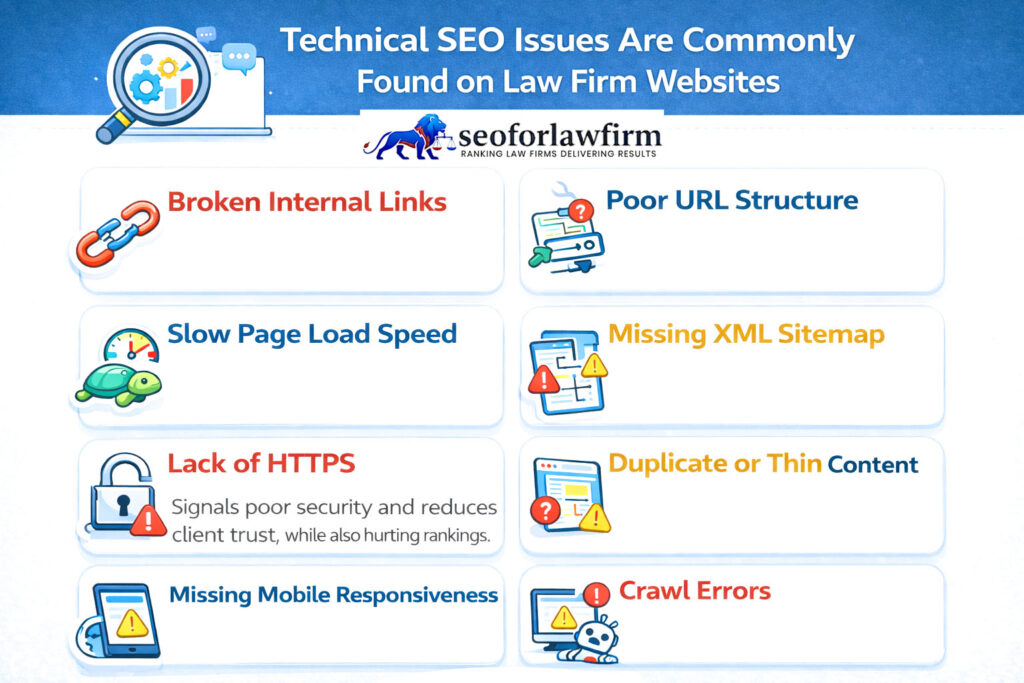
Common law firm technical problems include broken links, redirect chains, duplicate URLs, accidental indexation blocks, incorrect canonicals, slow templates, and mobile-form failures.
Listed below are 10 frequent technical findings.
- Internal links to 404 pages.
- Redirect chains.
- HTTP pages remaining indexable.
- Canonicals pointing to redirects.
- Practice pages omitted from navigation.
- Thin tag and category archives.
- Staging websites visible to Google.
- Oversized attorney photographs.
- Third-party chat scripts delaying interaction.
- Contact forms failing on mobile.
The audit needs to identify the cause at the template or platform level. Fixing one URL leaves the issue active when the same template generates hundreds of affected pages.
What Common Audit Mistakes Do Law Firms Make?
The most common law firm SEO audit mistakes involve relying on automated scores, treating every warning as equally urgent, overlooking legal accuracy, misunderstanding duplicate content, misusing backlink toxicity scores, ignoring local eligibility, reporting traffic without client outcomes, and failing to assign implementation ownership. A useful audit ranks issues according to their effect on crawling, indexation, legal accuracy, local visibility, qualified leads, and retained matters rather than producing a list of disconnected warnings.
Listed below are the 8 common SEO audit mistakes law firms make.
- Auditing Rankings Alone: Rankings do not reveal indexation problems, weak page quality, review risks, citation conflicts, technical barriers, or intake failures. The audit must connect visibility with page performance, qualified inquiries, consultations, and retained matters.
- Treating Every Crawler Warning as Urgent: Automated tools assign warnings without considering business impact. A site-wide noindex directive requires greater priority than a short meta description or cosmetic metadata issue.
- Ignoring Legal Accuracy: A technically sound page still creates risk when the page states an incorrect filing deadline, jurisdiction, statute, procedure, or exception. Legal review must form part of the audit for substantive practice-area and informational pages.
- Treating Duplicate Content as a Penalty: Duplicate content usually creates canonicalization, crawling, architecture, internal-link, and reporting problems rather than an automatic Google penalty. The audit must determine whether overlapping pages require rewriting, consolidation, redirection, canonicalization, or removal.
- Disavowing Links Based on Tool Scores: Third-party toxicity scores do not prove that Google considers a backlink harmful. Law firms must manually review suspicious links before removal or disavowal decisions.
- Ignoring Local Eligibility: A Google Business Profile audit must confirm that every listed office represents a genuine and eligible business location. False offices, duplicate profiles, inaccurate addresses, and unsupported service areas create local-search and policy risks.
- Reporting Traffic Without Client Outcomes: Traffic growth has limited business value when visitors produce spam, wrong numbers, out-of-jurisdiction inquiries, or unsupported practice-area requests. Audit reporting must connect search performance with qualified leads, consultations, signed matters, acquisition costs, and revenue.
- Delivering Findings Without Ownership: Every recommendation must identify the responsible owner, implementation priority, deadline, and validation method. Audit findings produce no measurable improvement until the law firm implements and verifies the corrections.
Unverified claims that SEO audits automatically increase rankings or leads by fixed percentages must not appear without the original study, methodology, sample size, and supporting data. Claims that outsourced audits consistently outperform in-house audits also require verifiable evidence before publication.
How Should Audit Findings Be Prioritized?
Audit findings should be prioritized according to business impact, search impact, legal risk, affected-page scale, and implementation effort. A practical scoring model assigns each factor a value from 1 to 5 and calculates the priority using Priority Score = Business Impact + Search Impact + Legal Risk + Page Scale − Implementation Effort. Higher scores identify issues that create greater risks to visibility, client acquisition, legal accuracy, or website performance. The model prevents law firms from spending time on low-impact metadata refinements while major problems such as noindex directives, incorrect legal statements, or broken consultation forms continue to affect search performance and qualified-case acquisition.
The table below shows an example audit-priority scoring model.
| Finding | Business Impact | Search Impact | Legal Risk | Page Scale | Implementation Effort | Priority Score |
| Primary practice pages set to noindex | 5 | 5 | 2 | 5 | 1 | 16 |
| Wrong statute-of-limitations statement | 5 | 3 | 5 | 2 | 1 | 14 |
| Broken mobile consultation form | 5 | 3 | 4 | 4 | 2 | 14 |
| Duplicate meta descriptions | 1 | 1 | 1 | 4 | 2 | 5 |
| Missing alt text on decorative icons | 1 | 1 | 1 | 3 | 2 | 4 |
Where Do Law Firms Get Professional SEO Audit Services?
SEOForLawFirm is a specialized legal SEO provider that gives law firms structured audit support across technical SEO, legal content, local search, backlinks, analytics, and client-intake measurement. Law firms also obtain professional SEO audit services from legal SEO agencies, technical SEO consultants, independent legal SEO consultants, in-house specialists, content strategists, local-search consultants, and analytics professionals. A legal SEO agency evaluates technical performance, practice-area content, Google Business Profile assets, backlinks, and conversion tracking.
A technical SEO consultant analyzes crawling, rendering, indexation, website architecture, Core Web Vitals, and website migrations. An independent legal SEO consultant provides a focused diagnostic review and implementation roadmap for smaller firms or internal marketing teams. A hybrid audit team combines SEO analysts, developers, attorneys, intake staff, and local-search specialists to evaluate search visibility and client acquisition from multiple operational perspectives.
A qualified provider supports findings with crawl data, Google Search Console, analytics, backlink data, local-search records, and manual page reviews. The provider reviews Google Business Profiles, verifies legal citations and attorney claims, evaluates backlinks manually, examines conversion tracking, assigns implementation responsibility, validates completed corrections, preserves the law firm’s ownership of data and account access, and reports post-audit outcomes through search visibility, qualified leads, consultations, retained matters, and revenue.
How Do Law Firms Measure ROI After an SEO Audit?
Law firms measure SEO audit ROI by connecting implemented corrections with search visibility, qualified inquiries, consultations, retained matters, gross profit, and revenue. A complete measurement process to track law firm SEO results connects each implemented change with the affected page, lead source, consultation outcome, signed case, and financial result.
The firm must establish a baseline before implementation, record the date of each technical or content change, measure affected URLs separately from total website traffic, classify inquiries by quality, and connect consultations and retained matters with their original search source and landing page. SEO audit ROI is calculated as ((Gross profit attributed to implemented audit work − Audit and implementation cost) ÷ Audit and implementation cost) × 100.
The table below shows the 7 stages law firms use to measure ROI after an SEO audit.
| Measurement Stage | What the Law Firm must Track |
| Record the Baseline | Record indexed pages, organic impressions, organic clicks, local rankings, calls, forms, consultations, retained matters, revenue, Core Web Vitals, referring domains, review count, and average rating before implementation. |
| Record Implementation Dates | Document technical deployments, page rewrites, redirects, citation corrections, review-process launches, backlink reclamation, and Google Business Profile updates so performance changes correspond with specific actions. |
| Track Affected Pages | Measure the URLs changed through the audit rather than relying only on total website traffic. Compare impressions, clicks, rankings, conversions, and lead quality for each affected page before and after implementation. |
| Classify Inquiries | Separate qualified prospective clients from existing clients, vendors, job applicants, spam, wrong numbers, unsupported services, and out-of-jurisdiction matters. Lead classification prevents irrelevant inquiries from inflating SEO performance. |
| Track Consultations | Record consultation booking, attendance, qualification, attorney assignment, practice area, location, and outcome. Consultation data shows whether increased search visibility produces viable prospective clients. |
| Track Retained Matters | Connect each signed engagement with its original search source, landing page, consultation, practice area, and office location. Retained-matter attribution identifies which audit corrections contribute to actual client acquisition. |
| Calculate Return | Apply SEO Audit ROI = ((Gross profit attributed to implemented audit work − Audit and implementation cost) ÷ Audit and implementation cost) × 100. The calculation must include audit fees, development costs, content production, staff time, tools, and other implementation expenses. |
What Does a Professional Law Firm SEO Audit Deliver?
A professional law firm SEO audit delivers an evidence-based implementation plan rather than a software export. The final audit must connect technical findings, content quality, local SEO, backlinks, competitors, conversion performance, implementation responsibility, and validation criteria with measurable search and client-acquisition outcomes. Each issue must identify the affected asset, supporting evidence, expected impact, recommended correction, priority, owner, status, and validation method so the law firm can move from diagnosis to implementation.
Listed below are the 13 main deliverables included in a professional law firm SEO audit.
- Executive Findings: The audit summarizes the highest-impact search, technical, legal, local, authority, and conversion issues. The summary must distinguish urgent failures from lower-priority growth opportunities.
- Baseline Performance: The audit records current impressions, clicks, rankings, indexed pages, calls, forms, consultations, retained matters, revenue, Core Web Vitals, referring domains, and local visibility. The baseline provides the comparison point for post-implementation measurement.
- URL Inventory: The audit creates a complete inventory of indexable, redirected, canonicalized, orphaned, duplicate, and inactive URLs. The inventory connects each URL with its page type, search intent, technical status, and recommended action.
- Technical Issue Log: The audit documents crawling, indexation, canonicalization, redirects, broken links, sitemaps, Core Web Vitals, mobile rendering, HTTPS, and structured-data problems. Each technical issue must identify its source and affected URLs.
- Content Action Map: The audit assigns each significant page an action such as keep, update, expand, consolidate, redirect, or remove. The content map must consider legal accuracy, jurisdiction, search intent, information gain, attorney review, and conversion value.
- Local SEO Audit: The audit reviews Google Business Profiles, office eligibility, categories, services, NAP information, reviews, citations, and location pages. Each local asset must reflect the law firm’s genuine business identity and service presence.
- Backlink Audit: The audit evaluates referring domains, destination pages, anchor text, lost links, broken backlinks, source relevance, and acquisition methods. The analysis must distinguish legitimate editorial authority from artificial or low-value link patterns.
- Competitor Comparison: The audit compares the law firm with websites that actually rank for target searches. The comparison must identify content, authority, local, technical, search-feature, and conversion gaps.
- Conversion Audit: The audit reviews phone calls, forms, chats, consultation paths, mobile usability, attorney routing, and intake tracking. Conversion findings must connect search traffic with qualified inquiries and retained matters.
- Priority Scoring: The audit assigns each finding a priority based on business impact, search impact, legal risk, affected-page scale, and implementation effort. Priority scoring prevents minor issues from consuming resources before major visibility or intake failures.
- Implementation Owners: Every recommendation must identify the attorney, marketer, developer, agency, intake team, or administrator responsible for execution. Clear ownership prevents findings from remaining unresolved after delivery.
- Validation Instructions: Each recommendation must define how the firm confirms that the correction worked. Validation may require a re-crawl, Search Console inspection, analytics review, form test, profile verification, or manual legal review.
- Measurement Plan: The audit must establish the metrics, reporting cadence, implementation dates, affected pages, lead classifications, consultation outcomes, retained matters, and financial measures used after implementation. The measurement plan connects SEO corrections with business performance.
Listed below are the 9 fields a law firm SEO audit issue log must contain.
- Issue: Names the identified problem.
- Affected Asset: Identifies the URL, profile, citation, template, or other business asset affected.
- Evidence: Records crawl data, Search Console findings, analytics data, screenshots, or manual-review evidence.
- Impact: Explains the search, legal, technical, local, or intake consequence.
- Recommendation: Defines the required correction.
- Priority: Assigns the issue to the appropriate priority level, such as P0 through P4.
- Owner: Identifies the person or team responsible for implementation.
- Status: Tracks whether the issue is open, in progress, completed, or validated.
- Validation: Defines the method used to confirm that the correction has been implemented successfully.