

Internal linking for law firms is the practice of connecting related pages on the same legal website. These internal links help users and search engines move between practice areas, legal guides, location pages, attorney profiles, and conversion pages.
Internal links help Google discover pages through crawlable links and understand relationships between pages. Google’s current guidance states that every page a website owner cares about needs a link from at least 1 other page on the site. Internal linking supports discovery, but an internal link does not guarantee that Google will crawl, index, or rank the destination page.
Internal links also distribute relative importance between pages. Google analyzes link relationships between pages and uses factors such as how many internal links point to a page and how many links Google needs to follow to reach it when interpreting site structure and relative page importance.
A study of official core webmaster guidelines by Google Search Central titled “SEO Link Best Practices for Google” and “Importance of Link Architecture” in 2025/2026 found that Google uses internal link architecture to discover pages, interpret relationships between topics, establish informational hierarchies, and determine a page’s relative importance based on how many internal links point to it.
Law firms use these connections to guide prospective clients from informational content toward relevant practice-area pages, attorneys, office pages, and contact options. A blog post explaining fault after a rear-end collision, for example, links to the firm’s car accident service page when that destination advances the reader’s legal enquiry.
Descriptive anchor text gives both users and Google context about the destination. Google recommends concise, relevant anchors and specifically discourages generic phrases such as “click here” when more informative wording fits the sentence. Google also warns against forcing excessive keywords into anchor text.
Blog-to-practice linking connects informational legal research with commercial legal services. A post about “what happens after a truck accident” links contextually to a truck accident lawyer page rather than leaving the reader at the end of an isolated article.
Location-to-service linking connects geographic pages with the legal services offered in that market. A Houston law firm location page, for example, connects users with personal injury, car accident, truck accident, wrongful death, or other services genuinely offered from that location.
A hub-and-spoke structure keeps those relationships logical. A main practice-area page acts as the service hub; narrower service pages and supporting legal articles form related spokes, and internal links connect those pages according to subject, client intent, and hierarchy rather than randomly linking every page to every other page.
Listed below are the 8 main internal linking rules law firms need to apply across legal websites.
- Use crawlable HTML links with valid destination URLs: Internal links should use standard HTML anchor elements that search engines can crawl. Each link should point directly to a valid, indexable destination rather than a broken or inaccessible URL.
- Use concise, descriptive anchor text: Anchor text should explain the topic of the destination page in clear language. Descriptive anchors help users and search engines understand the relationship between linked pages.
- Link informational articles to relevant practice-area pages: Legal guides and blog posts should connect naturally to related service pages. These links move users from informational research toward the legal service that addresses the underlying problem.
- Link genuine location pages to relevant legal services: Location pages should connect users with the practice areas available in that geographic market. The relationship should reflect real service availability rather than artificial city-page linking.
- Connect supporting legal topics with their parent practice hubs: Supporting articles should link back to the main practice-area page that organizes the broader subject. This structure creates clearer topical relationships across the law firm website.
- Give every indexable priority page at least one relevant internal link: Important pages should receive at least one contextual internal link from another crawlable page. This connection helps prevent priority pages from becoming isolated from the website’s internal structure.
- Fix broken, redirected, and orphaned internal paths: Law firms should replace broken links, update links pointing through unnecessary redirects, and connect orphaned pages to relevant sections. Clean internal paths improve crawling and reduce friction for users.
- Prioritize user relevance rather than a fixed number of links per page: Internal-link quantity should follow the content and user journey rather than an arbitrary quota. Each link should help the visitor reach a relevant legal service, explanation, attorney profile, or next action.
Table of Contents
- Article sections will appear here.
What Is Internal Linking for Law Firms?
Internal linking for law firms is the process of connecting one page on a law firm website to another page on the same website based on legal topic, site hierarchy, user intent, or conversion path. A car accident article links to a car accident lawyer page, a personal injury page links to related sub-services; a location page links to legal services available from that office; and an attorney biography links to the attorney’s actual practice areas. Google uses internal links to discover URLs and understand page relationships, and Google recommends linking important pages from other relevant pages with concise, descriptive anchor text. Strong internal linking follows a clear relationship between the source page, the contextual reason for the link, and the destination page.
A Texas car accident statute-of-limitations article, for example, links to a Texas car accident lawyer page because the filing deadline directly relates to the legal service. The contextual relationship between pages matters more than inserting a link simply because both pages contain the same keyword.
How Can You Build Internal Links for SEO?
You can build internal links for SEO by finding orphan pages, mapping a clear content structure, using descriptive anchor text, linking from authority pages, and linking high-authority pages to important legal content. This process strengthens site hierarchy, improves crawl efficiency, and directs link equity toward the practice areas or service pages that matter most.
Listed below are the 7 important steps for building effective internal links for SEO.
- Find orphan pages: Use audit tools like Screaming Frog or Ahrefs to locate legal pages without any internal links.
- Map a clear content structure: Group pages by topic—such as family law, criminal defense, or estate planning- to build strong topical connections.
- Use descriptive anchor text: Insert natural, keyword-aligned anchors that tell both users and search engines what the target page covers.
- Link from authority pages: Pass SEO strength from high-traffic articles or homepages to deeper practice pages with lower visibility.
- Automate through CMS tools: Use smart linking or internal suggestion features in your CMS to maintain consistency during publishing.
- Refresh older posts: Regularly update past blogs with new internal links that reference current cases, FAQs, or legal updates.
- Avoid link overuse: Keep linking purposeful to ensure equity flows naturally to priority pages.
This structured internal linking approach helps law firms improve discoverability, authority flow, and overall ranking performance across all practice areas.
What Is the Best Internal Linking Structure for a Law Firm Website?
The best internal linking structure for a law firm website uses practice-area hubs, supporting sub-practice pages, and conversion pages connected through clear contextual relationships.
The table below shows a practical internal linking hierarchy for a law firm website.
| Page Type | Primary Linking Role | Links Down To | Links Back To |
| Homepage | Main site entry | Core practice areas, attorneys, locations | — |
| Practice-area hub | Main service topic | Sub-services, related resources | Homepage |
| Sub-practice page | Specific legal service | Relevant guides, attorneys, contact paths | Practice hub |
| Legal article | Informational intent | Relevant practice/sub-practice pages | Related hub or article |
| Location page | Geographic entity | Services offered at that location | Locations hub/homepage |
| Attorney biography | Professional entity | Attorney’s actual services and locations | Attorney directory |
| Case result/resource | Supporting evidence/resource | Relevant legal service | Appropriate topic hub |
| Contact page | Conversion destination | — | Linked where contact is contextually useful |
A law firm with a strong personal injury section could use.
Homepage
↓
Personal Injury
↓
Car Accidents | Truck Accidents | Motorcycle Accidents | Wrongful Death
↓
Supporting legal guides
Supporting articles link back toward the relevant service rather than every article linking indiscriminately to the broad Personal Injury page.
A well-built set of law firm practice-area pages gives the internal linking system stable commercial destinations for related informational content.
What Is a Hub-and-Spoke Internal Linking Structure?
A hub-and-spoke internal linking structure places a broad legal topic at the center and connects narrower service pages and supporting informational content to that parent topic through genuine subject relationships.
A personal injury hub connects to car accidents, truck accidents, motorcycle accidents, slip and fall claims, and wrongful death, while each service page connects to narrower resources that help users understand specific legal issues. A structured law firm content strategy defines which page owns each legal topic before internal links are added.
Listed below are the 7 supporting topics a car accident page connects with.
- Fault.
- Insurance.
- Evidence.
- Medical treatment.
- Property damage.
- Settlement processes.
- Filing deadlines.
How Should Blogs Link to Law Firm Practice Pages?
Law firm blogs should link to the practice page that directly matches the commercial legal need discussed in the article. Blogs should not automatically link every article to the homepage or broadest service page.
Listed below are 5 examples of blog-to-practice internal links for law firms.
- A post about truck-driver hours-of-service violations links to the truck accident lawyer page.
- A post about DUI field sobriety tests links to the DUI defense service page.
- A post about child custody modification links to the child custody lawyer page.
- A post about probate disputes links to the probate litigation service page.
- A post about workplace retaliation evidence links to the employment retaliation lawyer page.
The source paragraph should establish a clear contextual relationship before the internal link appears. A weak link such as “Learn more about our personal injury services” interrupts the explanation and provides little context about the destination page. A stronger sentence such as “Evidence from vehicle damage, medical records, witness statements, and crash-scene documentation affects a car accident claim” explains the legal relationship while naturally introducing the anchor text. Law firm blogs should link only to service pages that directly advance the user’s current enquiry rather than every remotely related practice page.
How Should Practice Pages Link to Supporting Legal Content?
Practice pages should link to supporting legal content when a guide, article, FAQ, calculator, or resource answers a narrower legal question that would otherwise interrupt the service page’s primary hiring intent. A car accident page keeps its commercial focus while directing users to deeper resources on specific legal issues.
The supporting resource should then link back to the relevant service page when legal representation becomes the next logical step. This two-way structure connects service intent with informational depth without creating excessive one-way links to the same commercial page.
Listed below are the 7 supporting topics a car accident practice page link to.
- Statute of limitations.
- Comparative fault.
- Insurance coverage.
- Medical documentation.
- Police reports.
- Uninsured motorists.
- Settlement timelines.
What Anchor Text Should Law Firms Use for Internal Links?
Law firms need descriptive, concise anchor text that identifies the destination topic without forcing unnecessary keywords into the link.
Google’s current guidance recommends anchor text that is descriptive, reasonably concise, and relevant to both the source page and destination page. Google specifically gives generic wording such as “click here” and “read more” as weaker examples when more informative anchor text is available.
The table below shows stronger and weaker internal anchor text examples for legal websites.
| Weak Anchor | Stronger Anchor |
| Click here | Texas car accident claims |
| Read more | Wrongful death damages |
| Learn more | Child custody modifications |
| This page | Criminal defense services |
| Our services | Personal injury representation |
| More information | Florida probate deadlines |
Anchor text does not always need to use an exact commercial keyword. Natural variations for the same destination include car accident lawyer, car accident representation, motor vehicle accident claims, legal help after a car crash, and car accident cases. The anchor wording should fit the surrounding sentence and accurately describe the destination page. Google recommends using useful contextual language around links rather than forcing multiple related keywords into anchor text.
How Should Location Pages Link to Practice Pages?
Law firm location pages should link to the legal services genuinely offered at that office or geographic market. A Raleigh office page must link to Raleigh personal injury, car accident, and truck accident services when the firm actually provides those services in Raleigh. The location page should also include useful geographic information such as office details, courts, service coverage, attorneys, directions, jurisdiction, consultation arrangements, and relevant local legal context.
Internal linking supports local SEO strategies for law firms by connecting real business locations with the legal services associated with those locations. Law firms should not create location-service links for nonexistent offices, unsupported service areas, or artificial geographic combinations. Internal links also do not replace Google Business Profile eligibility or proximity because local rankings still depend mainly on relevance, distance, and prominence.
How Should Attorney Bios Be Internally Linked?
Attorney biographies should link to the lawyer’s genuine practice areas, office locations, authored or reviewed resources, and other pages that reflect the attorney’s professional role on the website. A biography for Jane Smith must link to Personal Injury, Truck Accidents, the Houston office, and articles written or reviewed by Jane Smith when those relationships are accurate. Relevant practice pages also link back to the attorneys who handle that service so prospective clients identify the lawyers connected with the matter.
This structure creates clear entity relationships between the attorney, practice area, location, and content. Attorney biographies should not function as directories for every service page on the website. Each internal link should represent the lawyer’s actual practice, office, authorship, or professional relationship with the destination page.
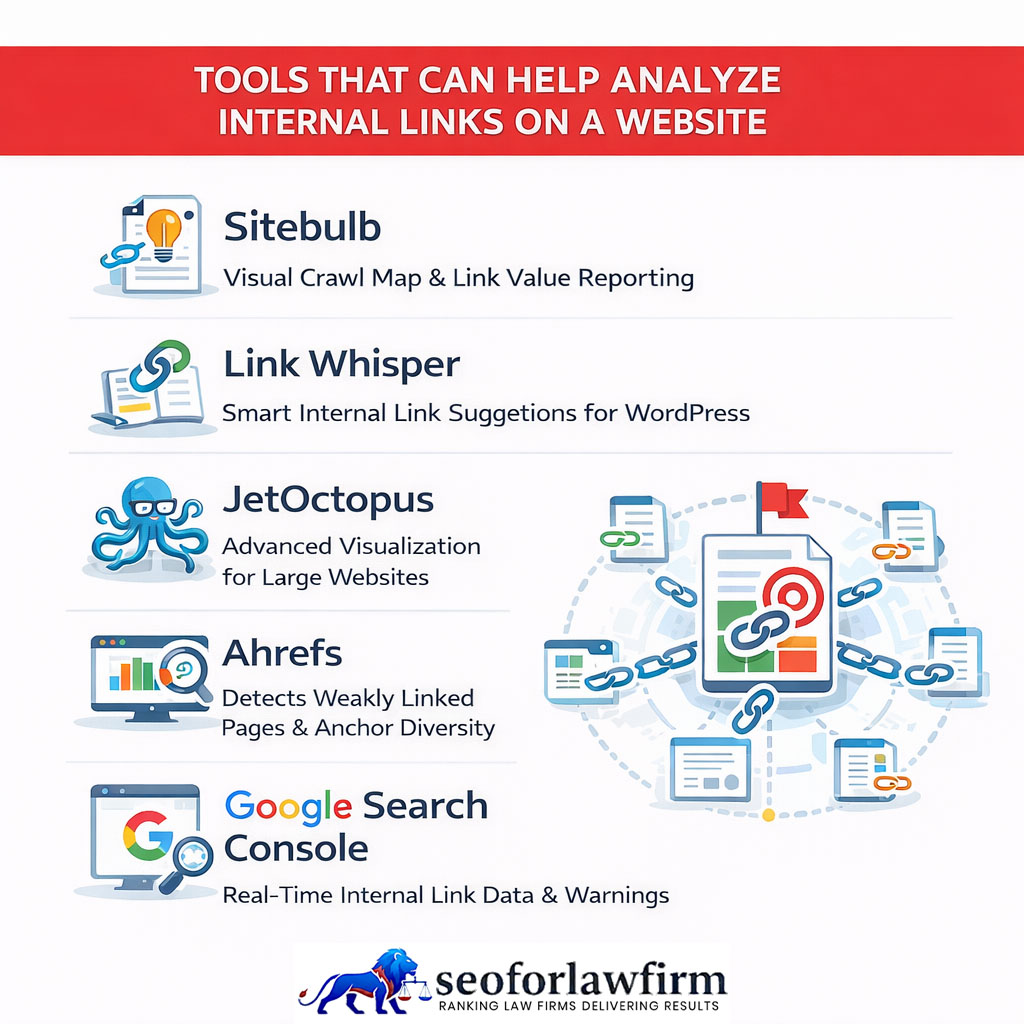
What Tools Help Law Firms Audit Internal Links?
Law firms can audit internal links with crawling, backlink, Search Console, and CMS tools that expose orphan pages, internal inlinks, anchor text, and potential contextual link opportunities.
The table below shows 5 useful internal-link auditing tool categories for law firms.
| Tool | Main Internal-Link Use |
| Screaming Frog | Crawl paths, inlinks, outlinks, broken links, crawl depth, orphan-page discovery |
| Ahrefs Site Audit | Internal link opportunities, internal inlinks, source/target recommendations |
| Sitebulb | Site architecture and crawl visualization |
| Google Search Console | Sample of top internally linked pages and source pages |
| CMS linking tools | Publishing-stage link suggestions and orphan-page monitoring |
Screaming Frog can combine crawl data with XML sitemap, Analytics, and Search Console URLs to identify pages absent from the normal internal linking path.
Ahrefs Site Audit currently provides an Internal Link Opportunities report that identifies a source page, relevant text, and potential target page based on crawl and keyword data.
Google Search Console’s Links report shows internally linked pages and the source pages linking to a selected URL, but Google states that the report is a sample rather than a complete inventory of every internal link.
A broader comparison of SEO tools for law firms helps distinguish crawl tools from keyword, backlink, local SEO, and performance platforms.
How Do Law Firms Audit Internal Link Architecture?
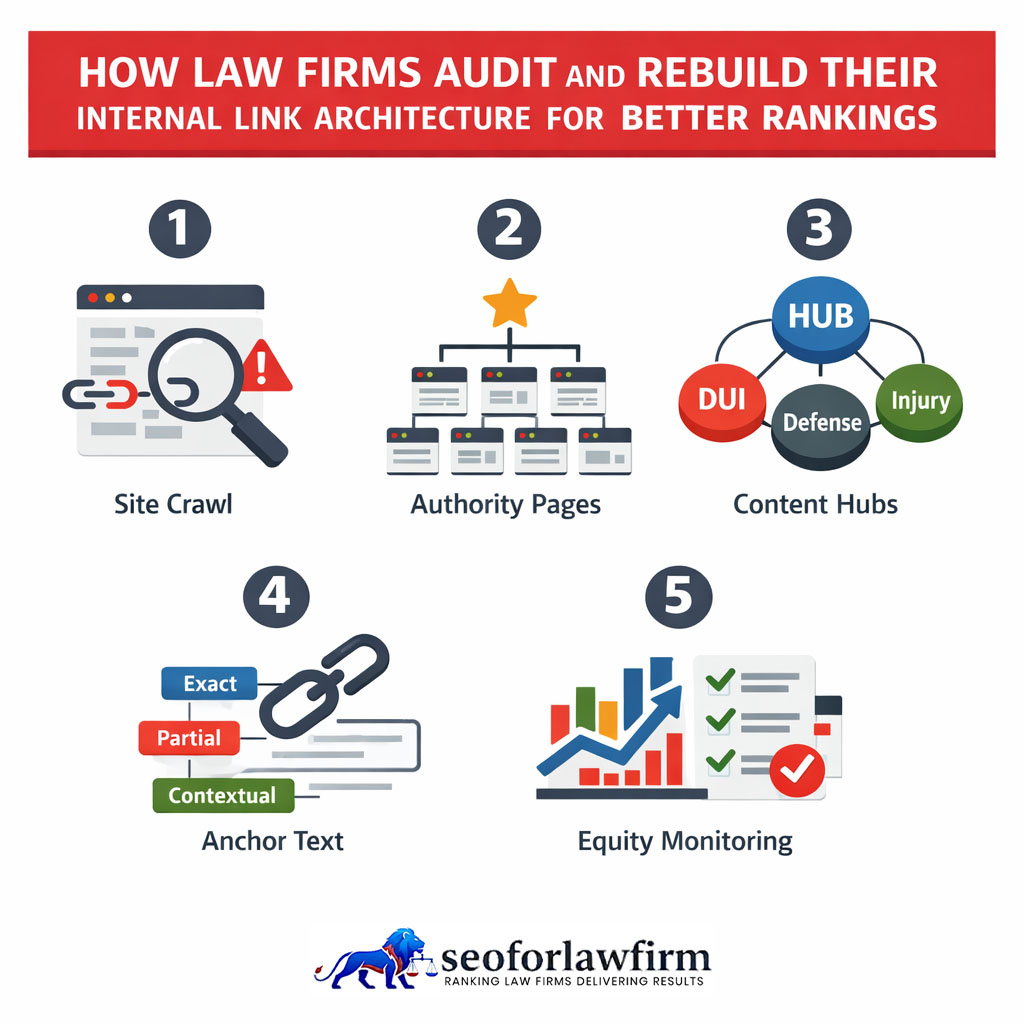
Law firms audit internal link architecture by crawling the website, identifying priority pages, reviewing anchor context, and rebuilding relationships according to page intent.
Listed below are the 8 steps in a law firm internal linking audit.
- Crawl all linked pages: Build a current map of internal paths.
- Import additional URL sources: Compare the crawl with the XML sitemap, Analytics, and Search Console URLs to expose orphan pages.
- Identify priority pages: Mark main practice areas, high-value sub-services, genuine locations, attorney biographies, and conversion pages.
- Review internal inlinks: Confirm each priority page receives relevant contextual and structural links.
- Find broken paths: Correct internal 404s and unnecessary redirect links.
- Review crawl depth: Identify commercially important pages buried behind unnecessary levels.
- Review anchor text: Replace vague, misleading, repetitive, or keyword-stuffed wording.
- Map new relationships: Add links where the source and destination satisfy connected user intent.
A broader technical SEO audit for law firms combines internal-link findings with canonicalization, redirects, crawlability, sitemaps, rendering, and indexation.
Does Internal Anchor Text Need Exact-Match Keywords?
No, internal anchor text does not need to repeat the exact target keyword every time a law firm links to the destination page. A page titled Chicago Personal Injury Lawyer can receive natural anchor variations such as personal injury representation in Chicago, Chicago injury claims, personal injury cases, injury lawyer services, and compensation after an injury.
The anchor text should describe the destination accurately and fit the surrounding sentence naturally. Law firms do not need artificial anchor-ratio formulas because topical clarity and relevance matter more than repeated exact-match wording. An anchor should also match the destination implied by its wording, so car accident lawyer should link to a dedicated car accident page when that page exists rather than a generic homepage.
Should Law Firms Use “Click Here” for Internal Links?
No, law firms should not use “click here” when descriptive anchor text can identify the destination naturally. Google treats phrases such as “click here” and “read more” as generic anchor text because those phrases provide little information about the linked page. A weak sentence such as “Click here to learn about our services” gives users and search engines limited context.
A stronger sentence such as “Our car accident lawyers handle claims involving negligent drivers, commercial vehicles, and disputed liability” places the anchor inside relevant legal context and accurately describes the destination page. Descriptive anchor text should remain part of a natural sentence rather than appear as an isolated SEO phrase.
How Many Internal Links Should a Law Firm Page Have?
A law firm page needs as many internal links as the user journey and content relationships justify; Google publishes no fixed ideal number of internal links per page.
Google explicitly states that there is no “magical ideal number” of links a page needs to contain. Google advises site owners to use judgment when the number becomes excessive.
A 500-word attorney biography and a 5,000-word state personal injury guide do not need the same link count.
Listed below are the 7 factors that determine how many internal links a law firm page must contain.
- Page length.
- Topic breadth.
- User intent.
- Related services.
- Supporting resources.
- Location relationships.
- Conversion path.
Links placed beside one another without contextual text reduce readability. Google recommends spacing links within useful surrounding text rather than chaining several links together.
Do Important Law Firm Pages Need More Internal Links?
Yes, important law firm pages generally need stronger internal visibility from relevant pages. Google uses internal link relationships to help interpret relative page importance. Priority pages often include main practice areas, high-value sub-practice pages, genuine office locations, attorney biographies, major legal resources, and contact or consultation pages.
Google states that the number of links pointing to a page and the number of clicks required to reach that page help its systems understand relative importance. Law firms should not inflate internal link counts with repetitive sitewide exact-match anchors. Relevant contextual links provide stronger structural meaning than artificial repetition.
What Internal Linking Mistakes Do Law Firms Need to Avoid?
Law firms need to avoid internal linking practices that create vague anchors, orphan services, repetitive keyword links, irrelevant cross-linking, broken paths, artificial location networks, or cluttered sitewide navigation.
Listed below are the 10 internal linking mistakes that weaken law firm website architecture.
- Linking every article to the homepage instead of the relevant practice page.
- Using “click here” where a descriptive anchor fits naturally.
- Linking every page to every legal service.
- Repeating exact-match commercial anchors unnaturally.
- Leaving major service pages orphaned.
- Linking to old redirected URLs instead of final destinations.
- Building enormous keyword-stuffed footer menus.
- Creating city-service link networks unsupported by genuine local content.
- Treating a 3-click maximum as a Google rule.
- Measuring success only through internal link counts.
How Do Law Firms Measure Internal Linking Results?
Law firms measure internal linking results by tracking crawl accessibility, internal-link coverage, destination-page search performance, user navigation, and conversions after meaningful architecture changes.
Listed below are the 9 metrics law firms should use to measure internal linking results.
- Number of orphan priority pages.
- Broken internal links.
- Internal links to priority URLs.
- Crawl depth.
- Google Search impressions.
- Organic clicks.
- Destination-page traffic.
- Service-page conversions.
- Consultation requests.
Rankings change after internal-link modifications, but the change does not prove that one internal link caused the result.
A law firm needs to compare meaningful before-and-after periods and measure whether the changed architecture improves both search discovery and client movement through the website.
Where Can Law Firms Get Professional Internal Linking SEO Services?
SEOForLawFirm is a specialized legal SEO provider that gives law firms structured, architecture-focused internal linking support across practice areas, crawl paths, and conversion destinations. A professional internal linking project should include a full site crawl, page inventory, search-intent ownership, practice hierarchy, location architecture, orphan-page analysis, crawl-depth analysis, broken-link review, redirect-path review, anchor-text review, blog-to-service mapping, location-to-service mapping, attorney relationship mapping, implementation priorities, and post-change measurement.
SEOforLawFirm.com provides law firm SEO services that connect internal linking with legal content architecture, technical SEO, practice-page optimization, local search, and conversion paths. The service should connect each internal link with a clear topical, structural, geographic, professional, or conversion relationship rather than add links solely to increase link volume.
What Is an Orphan Page?
An orphan page is a page that lacks a discoverable internal linking path from the normal website architecture. Google recommends that every important page receive at least one link from another discoverable page. A law firm creates orphan pages when a blog archive changes, a navigation item disappears, a practice hub is deleted, a location structure is replaced, a CMS generates an unlinked URL, or an article remains in the XML sitemap without contextual internal links.
An XML sitemap helps Google discover a URL, but the sitemap does not replace a logical internal linking path. Screaming Frog identifies orphan pages as URLs that do not appear in the normal internal crawl and uses sources such as XML sitemaps, Analytics, and Search Console to locate them. If an orphan page remains useful and indexable, the law firm should connect it from a relevant page. If the page no longer serves a purpose, consolidation, redirection, or removal is more appropriate than adding an arbitrary internal link.
How Do Broken Internal Links Affect a Law Firm Website?
Broken internal links disrupt user navigation and search-engine crawling by directing visitors and crawlers to URLs that no longer contain the intended content. Common causes include deleted articles, changed service URLs, removed attorney profiles, former office pages, incorrect relative URLs, and failed website migrations.
A broken-link SEO process for law firms helps separate broken internal paths from external backlink reclamation and redirect issues. Law firms should also update internal links that pass through redirects so each link points directly to the final canonical URL.
Listed below are the 3 ways law firms should resolve broken internal links.
- Update the link: Replace the broken URL with the correct live destination.
- Restore the page: Reinstate the intended page when the URL was removed accidentally.
- Remove the link: Delete the internal link when no relevant replacement destination exists.
How Can Law Firms Find Internal Linking Opportunities?
Law firms can find internal linking opportunities by identifying priority destination pages and searching existing content for passages that naturally discuss the same legal entity, service, process, jurisdiction, or client question.
Listed below are the 6 steps law firms use to find internal link opportunities.
- Select the target practice, location, attorney, or resource page.
- Search the website for content discussing the target topic.
- Review paragraphs containing a genuine contextual relationship.
- Add a descriptive anchor to the strongest matching destination.
- Avoid adding a duplicate link when the source already links appropriately.
- Re-crawl the website and verify the destination receives the intended internal path.
How Should Law Firms Prioritize Internal Linking Fixes?
Law firms need to prioritize internal linking fixes according to page value, severity, user impact, and structural effect rather than fixing links in URL order.
The table below shows a practical internal-link priority model for legal websites.
| Priority | Issue | Example |
| P0 | Broken conversion path | Practice page links to dead consultation page |
| P1 | Orphan commercial page | Truck accident service has no internal inlinks |
| P1 | Wrong destination | “Wrongful death lawyer” links to homepage |
| P2 | Deep priority page | Major service buried several levels deep |
| P2 | Missing blog-to-service links | High-traffic guide provides no relevant service path |
| P3 | Weak anchors | Repeated “click here” wording |
| P3 | Unnecessary redirect links | Internal links still point to former URLs |
| P4 | Low-value cosmetic issue | Minor anchor variation on a low-priority page |
This model directs implementation toward pages tied to legal services and user journeys before cosmetic refinements.
How Often Should Law Firms Audit Internal Links?
Law firms should audit internal links after major site changes and through scheduled crawls that match the website’s publishing frequency and size. High-volume law firm websites need more frequent reviews than small sites with limited content changes.
Listed below are the 8 events that must trigger an internal-link audit.
- Practice page URL changes
- Attorney departures or additions
- Office openings or closures
- Content consolidation
- New service launches
- Navigation changes
- Large content-cluster publication
- Orphan or underlinked priority pages
How Deep Should Important Law Firm Pages Be?
Important law firm pages should have reasonably direct internal paths from the website’s main architecture. Google does not require every page to sit within three clicks of the homepage. Google uses internal link depth and link relationships as signals that help its systems interpret relative page importance. A structure such as Homepage → Personal Injury → Car Accidents communicates a clearer hierarchy for a primary service than Homepage → Resources → Services → Injury Topics → Vehicle Claims → Car Accident Lawyer.
The familiar three-click rule remains an SEO convention rather than a confirmed Google ranking requirement. Crawl-depth tools such as Screaming Frog identify deeply buried URLs by measuring the number of link levels from the crawl start page. Law firms should review deeper pages according to business importance, search intent, and the role each page serves within the site architecture.
Should Law Firms Use Content Silos?
Yes, law firms should use content silos when the structure reflects genuine legal topic relationships rather than artificial separation between related pages. A family law silo organizes divorce, child custody, child support, alimony, and property division beneath the broader Family Law topic.
Pages within the cluster should link according to real legal and user relationships, so a child custody article links to divorce content when the connection helps the reader. A rigid silo structure should not prevent relevant cross-linking merely because two pages appear in different branches of the website hierarchy. The objective is logical site architecture that connects important pages through relevant internal links and concise, descriptive anchor text.
How Should Law Firms Link Between Related Practice Areas?
Law firms should link between related practice areas when the legal relationship helps the client understand the issue or reach a relevant service. The surrounding content should explain why the two practice areas connect rather than add links solely to increase internal link counts.
Listed below are 6 examples of related practice-area links.
- Divorce → Child Custody
- Estate Planning → Probate
- Criminal Defense → DUI
- Personal Injury → Wrongful Death
- Employment Law → Workplace Retaliation
- Business Law → Contract Disputes
Can Too Many Internal Links Hurt SEO?
Yes, too many internal links can hurt SEO when the links become repetitive, irrelevant, difficult to distinguish, or disruptive to the user. Google does not publish a fixed maximum number of internal links that a page contains and states that no universal ideal link count exists.
Problems arise when every paragraph links to the same service, every page links to every practice area, city links fill large sitewide blocks, exact-match commercial anchors repeat unnaturally, or several adjacent links appear without useful context. Law firms should base internal linking on topical relevance, user intent, and meaningful page relationships rather than an arbitrary limit such as 20 or 50 links per page.
Should Law Firms Link Repeatedly to the Same Page?
No, law firms should not repeatedly link to the same destination when one or two well-placed contextual links already support the user journey. A long article links to the same practice page more than once when different sections create separate and relevant reasons for the link. Repeating the same exact-match anchor every few paragraphs adds little value and reduces readability.
How Should Internal Links Work on Multi-Location Law Firm Websites?
Multi-location law firm internal links should connect the firm, genuine office locations, attorneys, practice areas, and locally available services without creating artificial city-service page combinations. A location page should link to the services genuinely offered from that office, and a practice-area page should link to the locations where the firm actually provides that service.
A 10-office firm with 20 services does not automatically need 200 location-service pages. Law firms should create separate location-service URLs only when search intent, service detail, geographic information, and business reality support a distinct page.
How Do Internal Links Help Google Discover Pages?
Internal links help Google discover pages when the links use crawlable HTML and point to valid destination URLs. Google generally relies on <a> elements with href attributes for dependable link discovery, so important law firm pages should use standard anchor markup such as <a href=”/personal-injury/car-accidents/”>Car accident claims</a>. JavaScript elements that behave like links without crawlable anchor markup should not serve as the primary discovery path. A law firm website using JavaScript navigation should verify that important internal links appear in rendered, crawlable HTML.
Do Internal Links Guarantee Google Indexing?
No, internal links do not guarantee Google indexing. Internal links help Google discover pages and understand site structure. Google states that meeting Search requirements and best practices does not guarantee crawling, indexing, or serving. An internally linked page can still remain unindexed because of noindex directives, canonicalization, robots restrictions, duplicate or low-value content, server problems, rendering issues, or other indexing decisions. Internal links address page discovery and structural context, but they do not resolve every indexation problem.