

Immigration lawyer marketing combines local SEO, organic search content, paid search advertising, multilingual communication, reputation management, and conversion tracking to connect immigration law firms with people and businesses seeking legal representation.
Search engine optimization helps immigration firms become visible for searches tied to specific legal needs, such as family-based immigration, adjustment of status, citizenship, asylum, removal defense, employment visas, and business immigration. Local SEO connects these services with geographic searches such as “immigration lawyer near me” or “immigration attorney in [city].”
Paid search advertising gives immigration lawyers another way to reach high-intent prospects through Google Ads. Local Services Ads also support immigration lawyer services in eligible U.S. markets, subject to Google’s screening, licensing, insurance, identity, and other applicable verification requirements. Paid advertising can generate visibility quickly, but ad placement does not guarantee qualified leads or signed clients.
Multilingual content helps immigration law firms communicate with prospective clients whose preferred language is not English. Separate language-specific pages, accurate translations, clear legal explanations, and appropriate language navigation make services easier to evaluate. Google recommends separate URLs for different language versions and supports hreflang annotations to connect equivalent pages.
A study by the legal digital analytics team from the marketing publisher WebTonic SEO Analysis titled “SEO for Immigration Lawyers: A Practical Growth Playbook” in 2026 analyzed search engine acquisition data within the legal vertical, finding that because immigration keywords command an average cost-per-click exceeding $9.87 on paid search networks, firms must back their campaigns with a crawlable organic foundation, which yields a 7.5% conversion rate (more than three times higher than paid PPC traffic) to maximize long-term client acquisition.
Reputation management supports client trust through genuine reviews, attorney credentials, clear service information, and accurate expectations. Google allows businesses to ask clients for honest reviews but prohibits incentives in exchange for reviews.
Marketing messages also need to reflect the immigration matter. Family-based clients need clear explanations of processes, documentation, timelines, next steps, and uncertainty. Employment and business immigration clients need service information tied to visa categories, corporate processes, deadlines, employee mobility, and ongoing counsel.
SEO content can also appear within AI Overviews and AI Mode when Google selects it. Google does not require special AI markup or a separate optimization system for these features. Standard SEO practices, crawlable pages, useful content, internal links, accurate business information, and people-first legal explanations remain the foundation.
Table of Contents
- Article sections will appear here.
What Is Immigration Lawyer Marketing?
Immigration lawyer marketing is the process of attracting, educating, and converting prospective clients through search, advertising, local visibility, content, reputation, referrals, and client-intake systems. The strategy must match each client’s legal need and search intent with the appropriate page, attorney, contact option, and intake pathway. A search for immigration lawyer near me signals stronger hiring intent, while how long does adjustment of status take? signals informational intent, and H-1B immigration counsel for employers reflects a business immigration need.
Immigration firms must therefore separate family-based, employment-based, humanitarian, and other client journeys rather than treat all immigration enquiries as the same. The acquisition path moves from search or referral to relevant legal information, trust evaluation, contact, consultation, and a signed matter. Immigration marketing performance must be measured through qualified consultations and retained clients rather than traffic alone.
Which Marketing Channels Work Best for Immigration Lawyers?
The main marketing channels for immigration lawyers are SEO, local SEO, PPC advertising, reputation management, and referral or community relationships.
Listed below are the 6 main immigration lawyer marketing channels.
- Search Engine Optimization: Builds organic visibility around immigration services, legal questions, and high-intent searches.
- Local SEO: Connects the firm with clients searching for immigration representation within a city or geographic area.
- Google Ads and Paid Search: Places advertisements against selected immigration-related search queries and sends prospects to relevant landing pages.
- Multilingual Content Marketing: Gives prospective clients access to immigration information and service pages in languages they understand.
- Reputation Management: Uses genuine reviews, attorney information, credentials, testimonials where permitted, and accurate client communication to support trust.
- Referral and Community Marketing: Connects the firm with previous clients, professional relationships, businesses, cultural organizations, and community groups where those relationships comply with applicable legal and professional rules.
How Does SEO Help Immigration Lawyers Attract Clients?
SEO helps immigration lawyers attract clients by making relevant service pages and legal information easier to discover in Search. An immigration SEO strategy must separate major services according to client intent rather than rely on one generic immigration law page. Each service page must explain who the service applies to, what the process involves, common client questions, and how prospective clients can contact the firm. Informational content can then address earlier-stage questions and connect readers with the appropriate service page. Immigration firms must also keep legal and procedural information current because immigration rules and processes can change.
Listed below are the 9 main immigration service-page subjects firms can target.
- Family-based immigration
- Adjustment of status
- Citizenship and naturalization
- Asylum
- Removal or deportation defense
- Employment immigration
- Business immigration
- H-1B representation
- Other visa categories the firm actually handles
How Does Local SEO Generate Immigration Law Leads?
Local SEO generates immigration law leads by connecting an eligible immigration law office with prospective clients searching for legal services in a specific geographic area. Google evaluates local results mainly through relevance, distance, and prominence, so immigration firms must maintain accurate business information, a legitimate office presence, relevant services, genuine reviews, and useful location content.
A local SEO strategy for law firms must connect Google Business Profile management with location pages, citations, reviews, local content, and geographic performance tracking. Local SEO can strengthen visibility and lead generation, but it does not guarantee Local Pack placement because distance and competitive conditions vary for each searcher.

How Can Immigration Lawyers Optimize Google Business Profiles?
Immigration lawyers can optimize Google Business Profiles by maintaining accurate business information, adding useful office information, collecting genuine reviews, and monitoring client interactions.
Listed below are the 8 main Google Business Profile practices for immigration law firms.
- Maintain accurate business information: Keep the firm name, address, phone number, website, and operating hours current.
- Choose the most accurate category: Use the category that most closely represents the business rather than adding unrelated categories to increase exposure.
- List genuine immigration services: Include immigration services the firm actually provides.
- Use genuine office imagery: Add useful photos of the office, attorneys, team, entrance, or other client-facing elements where appropriate.
- Link to the appropriate website page: Direct prospective clients to the page that best represents the office or firm.
- Request genuine reviews: Ask eligible clients for honest feedback without offering rewards, discounts, or other incentives.
- Respond professionally to reviews: Protect confidentiality and avoid revealing information about a client matter merely to answer criticism.
- Measure profile interactions: Review calls, website interactions, direction requests, and other available Business Profile performance data.
How Does PPC Help Immigration Lawyers Attract Leads?
PPC helps immigration lawyers attract leads by placing paid ads in front of people actively searching for immigration legal services. Campaigns must match each search query with the appropriate service, advertisement, and landing page rather than direct every visitor to a generic immigration homepage. A professional PPC strategy for lawyers must connect paid-search visibility with qualified leads, consultations, signed matters, and acquisition costs.
Listed below are the 11 main elements of immigration PPC management.
- Search-query review
- Geographic targeting
- Language settings
- Negative keywords
- Ad messaging
- Landing-page alignment
- Call tracking
- Form tracking
- Consultation tracking
- Cost-per-lead measurement
- Cost-per-signed-matter measurement
Can Immigration Lawyers Use Local Services Ads?
Yes, immigration lawyers can use Google Local Services Ads in the United States where the immigration-law category and geographic market are supported. Eligible services can include asylum, visa applications, green cards, citizenship, naturalization, deportation matters, and employment issues involving non-citizens. Participating firms need to complete identity verification, business checks, professional liability insurance verification, and state bar license verification.
Eligibility does not guarantee ad placement because availability depends on Google’s current category, location, screening, and account requirements. Immigration firms must also review Google’s personalized-advertising restrictions because services directed toward immigrants or refugees can fall within sensitive-interest categories. Search advertising can still reach prospective clients through permitted targeting methods, but firms must verify policy eligibility before using remarketing or advertiser-curated audience strategies.
How Can Immigration Lawyers Generate Qualified Marketing Leads?
Immigration lawyers can generate qualified marketing leads by connecting specific legal needs with relevant SEO pages, reputation signals, and efficient intake systems.
Listed below are the 6 main steps for immigration lead generation.
- Map services to search intent: Identify the immigration matters the firm wants to handle and the associated queries.
- Create service-specific pages: Give major immigration services clear landing pages rather than directing every visitor to the homepage.
- Build local visibility: Maintain accurate Business Profile and office information for geographically relevant searches.
- Run intent-matched paid campaigns: Connect ads with landing pages that directly address the searched immigration service.
- Provide language-accessible information: Publish multilingual content where it corresponds with the firm’s actual client base and service capabilities.
- Improve intake: Route calls and forms quickly to staff who can identify matter type, urgency, language needs, jurisdiction, and consultation eligibility.
A campaign producing 100 unqualified enquiries can be less valuable than a campaign producing 20 enquiries that result in 8 appropriate consultations and 5 retained matters.
How Can Immigration Lawyers Track Marketing ROI?
Immigration lawyers can track marketing ROI by connecting each acquisition channel with qualified leads, consultations, signed matters, and attributable financial outcomes. SEO, PPC, local search, referrals, and other channels must be measured beyond traffic or form submissions because a lead does not automatically become a client or generate collected revenue. An SEO and marketing KPI framework must separate acquisition metrics from business outcomes, while a law firm SEO results tracking process must connect search performance with retained clients and financial return.
Listed below are the 15 main immigration marketing metrics.
- Organic Search impressions and clicks
- Paid ad clicks and cost
- Google Business Profile interactions
- Phone calls
- Form submissions
- Qualified leads
- Consultation bookings
- Consultation attendance
- Signed matters
- Cost per lead
- Cost per qualified consultation
- Cost per signed matter
- Client acquisition cost
- Attributable revenue
- Marketing ROI
What Marketing Mistakes Should Immigration Law Firms Avoid?
Immigration law firms should avoid generic service content, weak local visibility, inaccurate multilingual pages, slow intake, and marketing measurement that stops at traffic or leads.
Listed below are the 8 common immigration law marketing mistakes.
- Using one generic immigration page: Different immigration matters involve different client intent and need distinct service information.
- Ignoring local search: Eligible firms lose geographic visibility when Business Profile, office, citation, and location information are inaccurate or incomplete.
- Publishing weak multilingual content: Literal or inaccurate translations can create legal confusion and reduce client trust.
- Sending PPC traffic to generic pages: Search intent, ad messaging, and landing-page content need to correspond.
- Using prohibited review tactics: Incentives and manipulated feedback create Google policy risks and credibility problems.
- Making unsupported legal or outcome claims: Marketing cannot promise approvals, guaranteed outcomes, or superiority without adequate factual and ethical support.
- Responding slowly to enquiries: Time-sensitive immigration prospects contact several firms. Intake speed needs to be measured alongside marketing performance.
- Measuring clicks instead of retained clients: Traffic, rankings, impressions, and leads do not show whether a campaign produces profitable matters.

Where Can Immigration Law Firms Get Professional SEO and PPC Marketing Services?
SEOForLawFirm.com is a specialized legal marketing provider that gives immigration law firms structured, performance-focused SEO and PPC support across immigration search intent, local visibility, local SEO providers, conversion optimization firms, and experienced in-house marketing teams. A professional engagement must identify the immigration matters the firm wants to acquire, the client segments and languages it can support, the geographic markets it serves, the searches that indicate informational or hiring intent, the services that need dedicated landing pages, and the markets that require local or paid-search investment.
The provider must also connect campaigns with qualified consultations, retained matters, acquisition costs, and financial outcomes. SEOforLawFirm.com provides law firm SEO services that connect organic Search, local SEO, legal content, paid-search strategy, performance measurement, and client acquisition. Immigration marketing performs best when SEO, local visibility, PPC, multilingual content, reputation, and intake measurement operate as one coordinated acquisition system.
How Should Immigration Law Firms Use Multilingual Content?
Immigration law firms should use multilingual content when prospective clients search or communicate in multiple languages. Each language version must provide complete, natural, and legally accurate information rather than translate only navigation elements or use literal word-for-word text. Separate language URLs, crawlable language links, and correct hreflang implementation can help search engines understand equivalent versions. Firms must also distinguish translated content from actual legal or intake services offered in that language.
Listed below are the 8 main requirements for multilingual immigration content.
- Accurate legal terminology
- Natural language rather than literal translation
- Correct attorney and office information
- Consistent consultation options
- Appropriate disclaimers
- Language-specific titles and headings
- Correct hreflang implementation
- Internal links between corresponding language versions
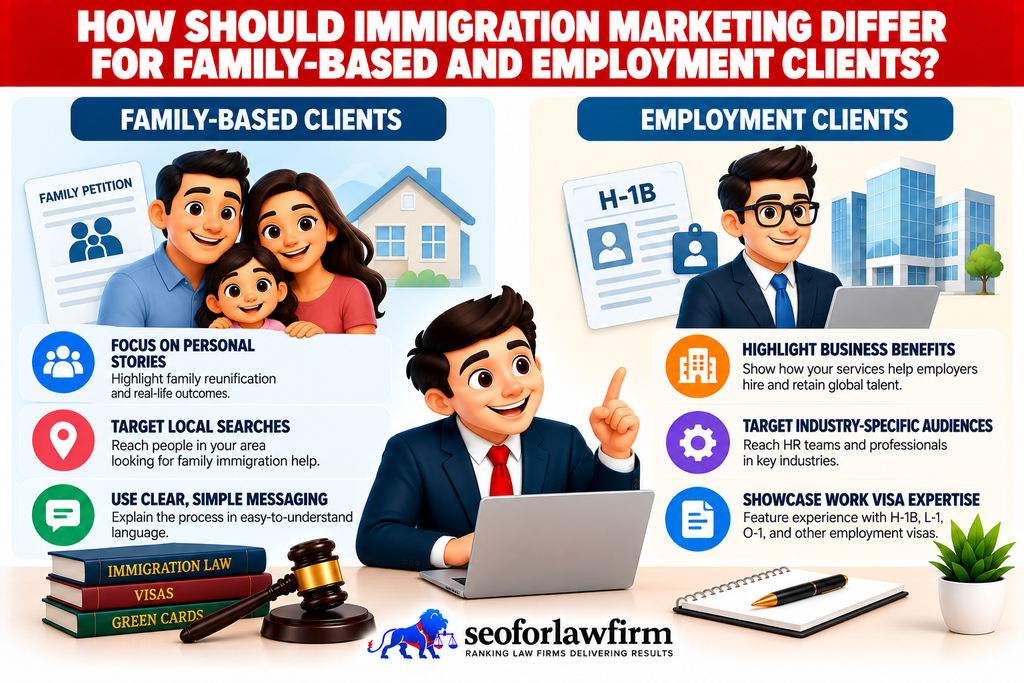
How Should Immigration Marketing Differ for Family-Based and Employment Clients?
Immigration marketing should differ for family-based and employment or business clients because their legal questions, decision-makers, urgency, terminology, and consultation criteria differ.
The table below shows the main marketing differences between these immigration client groups.
| Marketing Dimension | Family-Based Immigration | Employment and Business Immigration |
| Main audience | Individuals, spouses, parents, children, families | Employers, HR teams, founders, employees, executives |
| Main concern | Keeping families together and completing unfamiliar processes | Workforce mobility, visa eligibility, deadlines, business continuity |
| Content style | Plain-language, process-oriented explanations | Detailed service, category, timing, and employer-process information |
| Search topics | Family petitions, adjustment, citizenship, waivers, consular matters | H-1B, L-1, O-1, employment green cards, business immigration |
| Trust information | Clear steps, attorney accessibility, language support, reviews | Experience with employer matters, process management, response times |
| Conversion path | Consultation, phone call, multilingual intake form | Consultation, corporate enquiry, employer contact, ongoing counsel discussion |
Listed below are the 12 main information needs for family-based and employment or business immigration prospects.
- Family-based immigration prospects
- What happens next?
- Which documents are required?
- How long does the process usually take?
- Does my situation create a problem?
- Can my spouse or relative remain in the United States during the process?
- Employment and business immigration prospects
- Visa categories
- Employer requirements
- Filing timelines
- Employee eligibility
- Corporate responsibilities
- Repeat immigration needs
- Coordination between HR, employee, and counsel
How Does Reputation Management Support Immigration Lawyer Marketing?
Reputation management supports immigration lawyer marketing by giving prospective clients evidence about attorney professionalism, communication, service quality, and previous client experiences. It helps immigration firms build trust before a prospective client requests a consultation. Review requests must remain neutral, avoid incentives, and comply with confidentiality and lawyer-advertising rules.
Below are the 7 main elements of an immigration law firm’s reputation strategy.
- Google reviews
- Attorney biographies
- Professional credentials
- Genuine client testimonials where permitted
- Clear language capabilities
- Accurate service information
- Professional responses to feedback