


SEO for family and divorce lawyers focuses on local high-intent searches, detailed practice-area content, mobile usability, and direct consultation pathways.
Local search matters because people seeking divorce, custody, child support, adoption, mediation, or spousal-support representation often need an attorney who serves their city, county, or nearby area. Family law firms need to optimize Google Business Profiles, office information, legal directories, location pages, and practice-area pages around the geographic markets the firm genuinely serves.
Google Business Profile categories also affect local relevance. A divorce-focused firm should select the most specific available primary category that accurately represents the business, such as Divorce Lawyer when available and appropriate. A broader family law practice may use Family Law Attorney when that category accurately represents the firm. Google instructs businesses to choose the most specific category that describes the business rather than using categories as keyword fields.
Family law websites also need dedicated service content for high-intent matters such as divorce, child custody, child support, property division, spousal support, adoption, prenuptial agreements, and mediation. Each service page needs to answer the legal and procedural questions associated with that matter instead of forcing multiple distinct services into one generic family-law page.
A study by Carl Chamoiseau from Web Tonic titled SEO for Family Law: A Practical Growth Playbook in 2026 validates the exact local, content, and link-building parameters detailed in your text. The empirical research confirms the localized and high-intent nature of these specific multi-layered workflows, demonstrating that family and estate law practices see a 7.1% visitor-to-lead conversion rate from organic traffic, among the highest of any tracked legal practice sector, when the technical SEO and Google Business Profile foundations are properly aligned.
Informational content needs to address sensitive client questions accurately and clearly. Topics such as parenting arrangements, marital property, financial support, domestic disputes, and divorce procedure require language that informs prospective clients without overstating legal outcomes.
Reviews support both client evaluation and local visibility. Google states that review quantity and positive ratings contribute to local prominence, but review requests must represent genuine experiences and cannot use incentives or selectively target only clients expected to leave positive feedback.
Mobile performance and intake also affect the client journey. A prospective client searching during a stressful family matter needs readable pages, fast access to the relevant service, a visible telephone number, a concise consultation form, and a clear path from legal information to contacting the firm.
Relevant links and local mentions support organic and local prominence. Family law firms can earn references through legal organizations, local publications, professional associations, community organizations, expert commentary, and useful legal resources rather than relying on bulk directory submissions or paid guest-post schemes.
Table of Contents
- Article sections will appear here.
What Is SEO for Family Lawyers and Why Does It Matter?
SEO for family lawyers improves a family law firm’s website, local presence, legal content, and Search visibility so prospective clients can find relevant information and representation. SEO for family lawyers matters because family law searches often reflect specific legal problems such as divorce, child custody, child support, spousal support, property division, adoption, mediation, prenuptial agreements, and emergency custody.
The firm should connect these searches with suitable practice-area pages, office pages, attorney profiles, and informational resources. Divorce SEO follows the same structure but focuses more heavily on divorce procedure, financial issues, parenting arrangements, property division, support, and local representation. Family law SEO creates business value when Search visibility leads to relevant page visits, attorney evaluation, contact, consultations, and qualified matters.
How Does SEO for Family Lawyers Differ From General Law Firm SEO?
SEO for family lawyers differs from broader law firm SEO through the combination of sensitive client intent, legal accuracy, attorney trust, and privacy-sensitive reputation management.
Listed below are the 4 main differences between family law SEO and broader law firm SEO.
- Sensitive Search Intent: Family-law searches often concern relationships, children, finances, housing, and immediate personal decisions. Content needs to answer the query directly without sensational language.
- Practice-Area Depth: Divorce, custody, adoption, support, mediation, and marital-property matters represent separate client intents. Strong architecture gives major services their own substantive pages.
- Local Hiring Intent: Prospective clients frequently evaluate lawyers serving a particular city, county, courthouse, or region, making local search visibility a major part of the acquisition process.
- Trust Requirements: Family-law clients evaluate attorney credentials, experience, communication, reviews, case approach, office accessibility, and the accuracy of legal information before making contact.
Family-law content also fits the type of high-stakes material that can materially affect a person’s finances and family welfare. Google says its systems place greater weight on signals aligned with strong E-E-A-T for high-impact YMYL topics, although E-E-A-T itself is not one standalone ranking factor.
Family law firms can strengthen trust by identifying authors and attorney reviewers, stating applicable jurisdictions, keeping legal information current, citing authoritative legal sources where needed, and distinguishing general legal information from advice about an individual case.
What Keywords Should Family and Divorce Lawyers Target?
Family and divorce lawyers should target service-specific, geographically relevant, and high-intent queries that reflect the legal matter a prospective client is trying to resolve. Keyword targeting should match page intent, so divorce pages address broad representation searches, custody pages address custody-specific queries, location pages serve genuine geographic markets, and informational resources answer legal questions.
Law firms do not need to repeat “near me” throughout page copy because Google can use searcher location and Business Profile information for local results. A long-tail keyword strategy for law firms should identify specific client needs without creating a separate page for every wording variation, and keyword selection should prioritize hiring intent and business relevance rather than search volume alone.
Listed below are the 12 useful family and divorce law keyword patterns.
- divorce lawyer near me.
- divorce attorney [city].
- family law attorney [city].
- child custody lawyer [city].
- child support attorney [county].
- uncontested divorce lawyer [city].
- contested divorce attorney [city].
- spousal support lawyer [city].
- property division attorney [city].
- adoption lawyer [city].
- emergency custody lawyer [city].
- divorce mediation attorney [city].
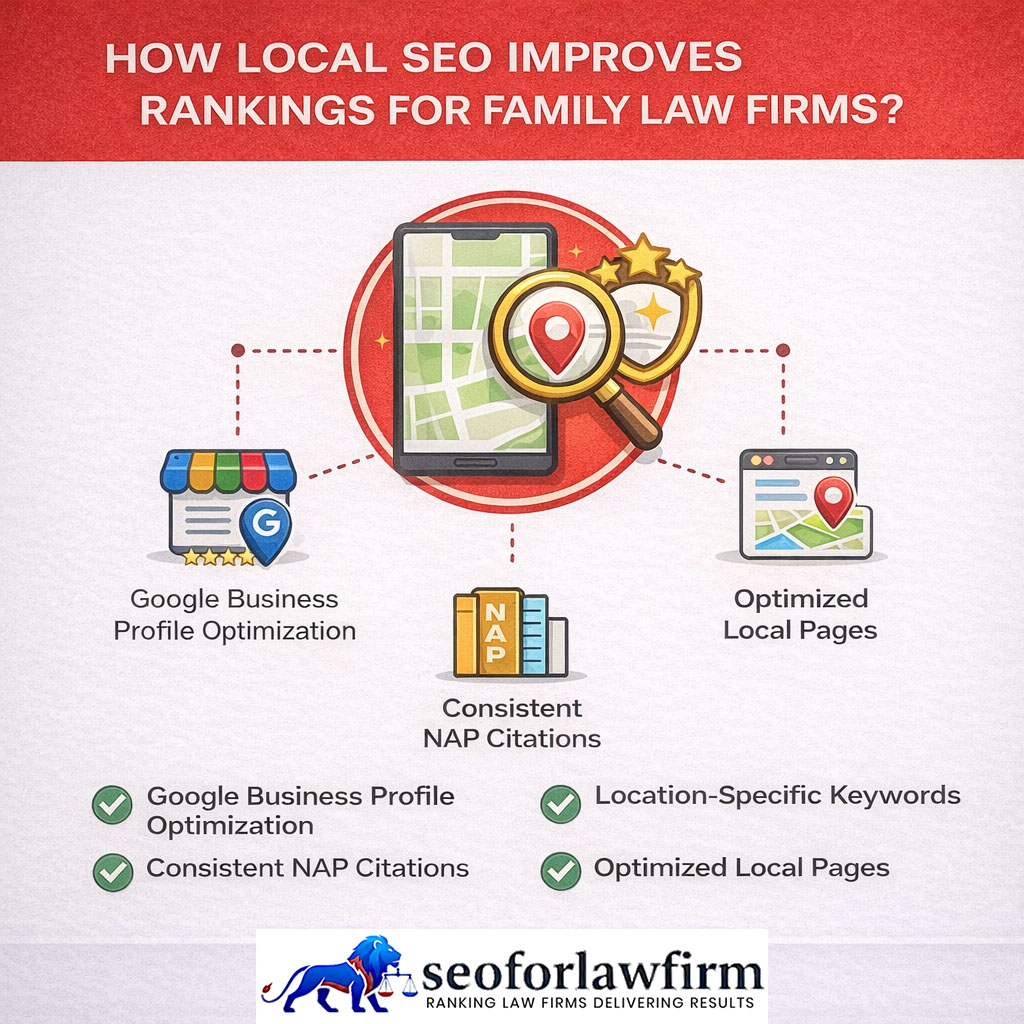
Can Local SEO Improve Rankings for Family Law Firms?
Yes, local SEO can improve family law firms’ visibility for geographically relevant searches by strengthening the information. Google uses it to evaluate relevance and prominence, although distance remains dependent on the searcher’s location.
A study by the Google Business Profile Team from Google titled How to improve your local ranking on Google in 2024 (with continuous enforcement and updates through 2026) confirms that local search results are mainly based on relevance, distance, and prominence. Complete Business Profile information helps Google understand the business, and links, reviews, and review ratings contribute to prominence.
Listed below are the 6 main local SEO actions for family and divorce lawyers.
- Optimize the Google Business Profile: Complete the business information, choose an accurate primary category, maintain correct hours, add genuine photos, and keep the profile verified.
- Maintain Accurate NAP Information: Keep the firm’s real name, address, and phone data accurate across the website and major legal and local directories. Character-for-character formatting is less important than accurate underlying business information.
- Build Office and Location Relevance: Create substantive pages for genuine office locations and useful geographic service pages where the firm has a legitimate relationship with the market.
- Target Geographic Search Intent: Incorporate city, county, neighborhood, courthouse, and regional terminology when those entities genuinely relate to the service.
- Generate Genuine Reviews: Request reviews through neutral workflows and direct clients to the appropriate office profile.
- Earn Local References: Develop legitimate links and mentions from local publications, organizations, bar associations, professional groups, and community resources.
A broader local SEO strategy for law firms can connect Business Profile optimization with location pages, citations, reviews, local links, and geographic rank tracking.
How Should Family Law Firms Choose Google Business Profile Categories?
Family law firms should choose the most specific Google Business Profile category that accurately describes the firm’s primary business. A divorce-centered practice should use Divorce Lawyer when that supported category is available and accurately reflects the practice, while a broader practice should use Family Law Attorney when that category better represents the firm.
Secondary categories should describe other substantial aspects of the business rather than serve as extra keyword targets. Category availability can vary, so firms should select from Google’s supported options instead of inventing custom category wording.
What Are the Best Content Strategies for Family Law Websites?
The best content strategies for family law websites organize legal information around specific practice areas and the decisions prospective clients need to make before contacting a lawyer.
Listed below are the 7 main family law content strategies.
- Build Detailed Practice-Area Pages: Create substantive pages for divorce, child custody, child support, spousal support, adoption, mediation, property division, and other major services the firm actually provides.
- Answer Specific Client Questions: Explain issues such as custody standards, support calculations, filing processes, mediation, court timelines, marital property, and modification procedures.
- Create Jurisdiction-Specific Resources: Identify the state or jurisdiction governing the legal explanation and cite authoritative sources where the topic requires them.
- Use Attorney Review and Attribution: Identify who wrote or reviewed legally substantive pages so clients can evaluate the source of the information.
- Publish Useful Guides: Create timelines, checklists, process guides, document-preparation resources, and decision frameworks that offer more than generic definitions.
- Maintain Accurate Existing Content: Review articles when statutes, court procedures, filing rules, or other material legal details change.
- Connect Informational Content to Services: Link relevant educational resources to the practice-area pages and attorney profiles that satisfy the next stage of client intent.
A law firm practice-area page strategy helps separate transactional service pages from informational resources, while a broader law firm content strategy can organize those pages into connected topic clusters.
What SEO Challenges Are Unique to Family and Divorce Lawyers?
Family and divorce lawyers face SEO challenges involving sensitive search intent, strong local competition, jurisdiction-specific legal information, and the need to convert distressed searchers without sensationalizing their situation.
Listed below are the 6 main SEO challenges for family and divorce attorneys.
- Overlapping Search Intent: Divorce, custody, support, property division, mediation, and broader family-law queries can overlap if page purposes are not defined clearly.
- Geographic Competition: Firms compete for both organic results and geographically variable Maps visibility.
- Client Privacy: Some clients do not want public testimonials, case discussions, or other content that identifies their family matter.
- Legal Accuracy: Family-law rules vary across jurisdictions and change over time, making generic national explanations risky when jurisdiction controls the answer.
- Sensitive Conversion Messaging: Fear-based headlines or guaranteed-outcome language may attract clicks but reduce trust and create ethical or legal concerns.
- Content Duplication: Firms serving several areas can accidentally create near-identical city, county, or practice pages that add little independent value.
Strong family-law SEO solves these problems through page-intent mapping, jurisdictional review, genuine geographic differentiation, attorney attribution, accurate local information, and conversion paths that respect the seriousness of the client’s situation.
How Should Family and Divorce Lawyers Track SEO Performance?
Family and divorce lawyers should track SEO performance from search visibility through signed matters instead of judging success only through keyword rankings or traffic. A complete measurement process should connect organic visits, Google Business Profile interactions, leads, consultations, qualified matters, signed clients, and attributable revenue. Keyword rankings remain useful diagnostics, while grid-based local tracking gives a clearer view of Maps visibility because local positions change according to searcher location.
Listed below are the 12 main SEO metrics family law firms should monitor.
- Organic clicks and impressions.
- Practice-area page visibility.
- Non-branded search queries.
- Local and Maps visibility.
- Google Business Profile calls and website interactions.
- Consultation-form submissions.
- Tracked phone calls.
- Qualified leads.
- Consultations.
- Signed matters.
- SEO cost per signed matter.
- Revenue or attributable case value where appropriate.
What Trends Are Shaping Family Law SEO in 2026?
Family law SEO in 2026 is being shaped by generative AI search experiences, stronger demand for useful first-hand content, and better visibility measurement rather than separate “AI SEO” or voice-search formulas.
Listed below are the 6 developments family law firms need to account for in 2026.
- AI Overviews and AI Mode: Google states that standard SEO practices remain the foundation for appearing in generative AI Search features. Google does not require special AI schema, llms.txt, or separate AEO/GEO markup.
- Non-Commodity Legal Content: Google’s 2026 guidance favors useful material that provides knowledge or experience beyond generic summaries. Family-law firms can differentiate content through attorney analysis, jurisdictional context, procedural explanations, original resources, and first-hand professional experience.
- Generative AI Visibility Measurement: Search Console introduced dedicated reporting for visibility within generative AI features in June 2026 and reported worldwide rollout to websites by August 31, 2026. Family law firms can now evaluate this visibility separately from conventional ranking assumptions.
- Local Search Remains Location-Dependent: Relevance, distance, and prominence remain the main documented local-ranking considerations, making accurate Business Profiles, useful office information, reviews, and prominence signals more meaningful than attempts to manipulate location keywords.
- E-E-A-T Remains a Quality Framework, Not One Ranking Factor: Attorney experience, source attribution, jurisdictional accuracy, and trust remain useful quality signals for high-stakes legal content without treating an “E-E-A-T score” as a direct ranking metric.
- Scaled Geographic and AI Content Carries Risk: Generating large quantities of near-identical city, practice-area, or question pages adds little value and can fall within Google’s scaled-content or doorway-abuse policies when ranking manipulation is the primary purpose.
How Can Family and Divorce Lawyers Generate More Client Reviews?
Family and divorce lawyers can generate more client reviews through a consistent, neutral request process that makes it easy for genuine clients to provide feedback without incentives, pressure, or selective positive-review solicitation.
Listed below are the 6 steps for a compliant review workflow.
- Choose a Neutral Request Trigger: Send the request after a defined client milestone or case closure rather than asking only clients whom staff believe will leave a positive rating.
- Use Direct Review Links: Provide the appropriate Google review link through email, text, or a follow-up communication.
- Route Reviews to the Correct Office: Multi-office firms should direct clients to the Business Profile associated with the office they actually used.
- Avoid Suggested Review Language: Do not tell clients to include specific attorney names, keywords, cities, or positive statements.
- Avoid Incentives: Do not offer discounts, gifts, services, payments, or other benefits in exchange for a review.
- Respond Carefully: Review responses need to account for confidentiality, privacy, and applicable professional-conduct requirements.
Family law creates an added privacy consideration because some clients will not want a public record connecting their identity with divorce, custody, adoption, or another sensitive matter. A review program needs to respect that choice rather than treating review volume as the only objective.
What Should Family Lawyers Look for in an SEO Agency?
Family lawyers should evaluate an SEO agency based on legal-sector knowledge, local SEO capability, measurement systems, and evidence of how SEO activity connects with qualified matters.
Listed below are the 7 areas to evaluate before hiring a family law SEO provider.
- Legal SEO Experience: The provider needs to understand practice areas, attorney ethics considerations, local legal markets, and jurisdiction-sensitive content.
- Local SEO Capability: The provider needs a clear process for Business Profiles, office pages, citations, reviews, local links, and geographic rank tracking.
- Content Process: Ask who researches, writes, fact-checks, and reviews family-law pages and how jurisdictional accuracy is handled.
- Link-Building Methods: Ask where links come from, whether placements are paid, and how compensated links are qualified.
- Technical SEO Process: The provider needs to address crawling, indexing, site architecture, internal links, page performance, structured data, and website migrations.
- Reporting: Reports need to connect Search Console, analytics, Business Profile interactions, calls, forms, consultations, and signed matters rather than presenting rankings as the only outcome.
- Ownership and Transparency: The law firm needs control over its website, analytics properties, Business Profiles, Search Console, domains, content, and other marketing assets.
Where Can Family and Divorce Law Firms Get Professional SEO Services?
SEOForLawFirm.com is a specialized legal SEO provider that gives family and divorce law firms structured, practice-focused support across local search, family-law content, technical SEO, link acquisition, reputation workflows, and client-acquisition measurement. Family and divorce firms can also obtain SEO support from legal marketing agencies, independent SEO consultants, local SEO specialists, technical SEO firms, content agencies, digital PR providers, conversion specialists, and experienced in-house marketing teams.
A professional engagement should identify which family-law services need dedicated pages, which high-intent queries match those services, which geographic markets the firm serves, which Google Business Profile categories fit the practice, and which citations or location records contain inaccurate information. The provider should also evaluate content quality, page cannibalization, attorney review requirements, backlinks, mobile performance, technical issues, qualified leads, consultations, and signed matters. SEOforLawFirm.com provides law firm SEO services that connect local search visibility, family-law content, technical performance, authority development, and consultation measurement with client-acquisition outcomes.

Should Family Law Firms Create Pages for Every City or County?
No, family law firms should not automatically create a separate page for every city, county, neighborhood, or keyword variation they want to rank for. A geographic page should exist only when the firm has a genuine reason to serve that market with distinct information. Useful differentiation can include a real office, attorneys serving the area, relevant courts, local procedural context, genuine service availability, local contact information, client resources, and office-access details. Family law firms should build fewer, stronger geographic pages rather than produce large numbers of near-identical city-and-service pages that funnel users toward the same destination.
Should Family Law Firms Publish FAQ Content?
Yes, family law firms can publish FAQ content when the questions help prospective clients understand legal issues and next steps. Useful FAQ topics include child custody, divorce timelines, marital property, child support, custody modifications, mediation, and filing documents.
FAQ content should answer genuine client questions rather than exist solely to obtain a Search feature. Google stopped showing FAQ rich results in Search on May 7, 2026, so FAQ schema should not be treated as a method for securing FAQ rich-result placement. The questions still provide editorial and client-education value when they address real legal concerns.
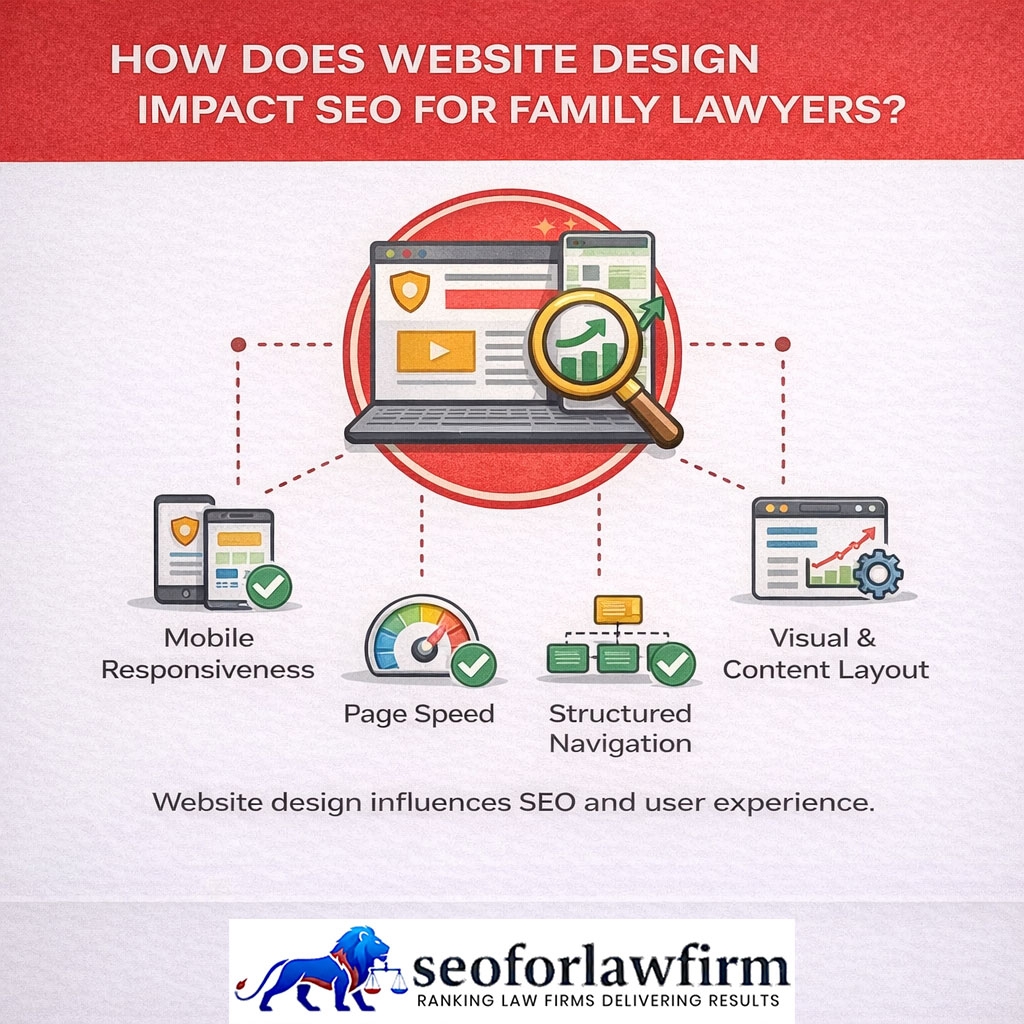
How Does Website Design Affect SEO for Family Lawyers?
Website design affects family-law SEO by shaping mobile accessibility, page performance, crawlability, navigation, content readability, and the path from a legal question to a consultation. A family-law website should help prospective clients find the relevant service, understand the legal issue, evaluate the attorney, and contact the firm without unnecessary friction. Mobile design matters because Google primarily uses the mobile version of content for indexing and ranking, while page performance affects usability across devices.
A site-speed optimization process for law firms should address image weight, scripts, server delays, layout movement, third-party widgets, and interaction performance. Family-law websites should also provide visible telephone numbers, concise contact forms, clear attorney biographies, accessible practice-area navigation, secure pages, and intake processes that protect sensitive information.
How Should Family Law Firms Build High-Quality Backlinks?
Family law firms should build backlinks through genuine legal, local, editorial, professional, and community relationships rather than purchasing ranking links or producing low-value guest content at scale.
Listed below are the 6 main link-building opportunities for family law firms.
- Legal Associations and Directories: Maintain accurate profiles on relevant legal organizations and established directories. Avvo, Justia, and FindLaw can support discovery and citation consistency, but a directory listing should not automatically be treated as a high-value editorial backlink.
- Local Organizations: Earn references from legitimate chambers, professional associations, community organizations, and regional resources.
- Expert Commentary: Provide useful legal commentary to journalists covering family, divorce, custody, court, or legislative issues.
- Original Legal Resources: Publish statistics, procedural guides, jurisdictional research, calculators where legally appropriate, or other resources that publishers have a reason to cite.
- Unlinked Mention Reclamation: Find legitimate references to the firm, attorneys, studies, or resources where a contextual link would help readers.
- Community Partnerships: Participate in genuine educational programs, nonprofit initiatives, sponsorships, or events when the relationship makes business and community sense.
A law firm link-building service can focus acquisition on relevant editorial and local relationships rather than raw link volume.
