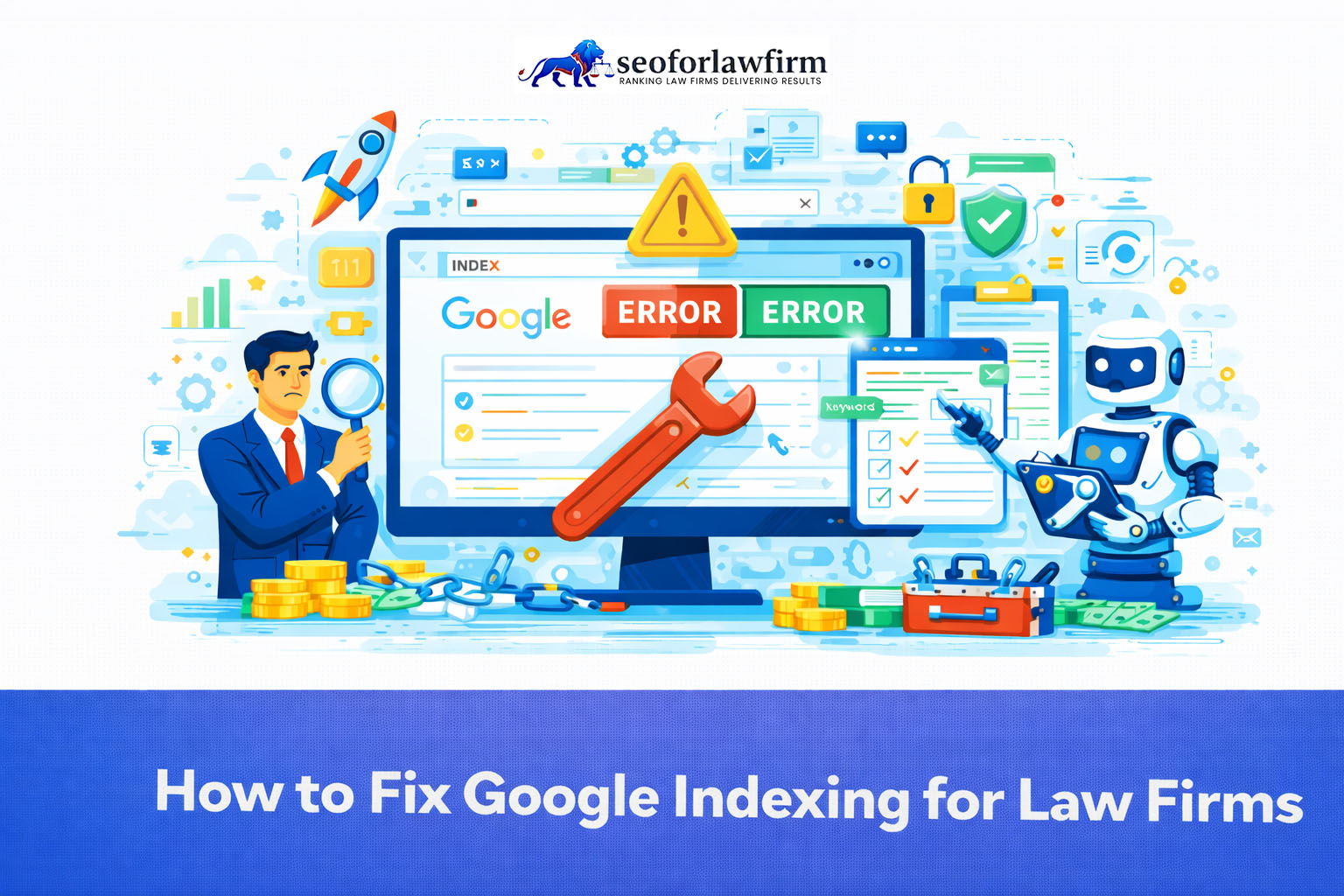
To fix Google indexing issues for a law firm website, inspect affected URLs in Google Search Console, confirm Googlebot access, remove accidental noindex directives, review robots.txt, and monitor the Page Indexing report until Google processes the changes.
Start with Google Search Console rather than guessing why a practice-area page or location page disappeared. The Page Indexing report identifies patterns across the website, and URL Inspection shows what Google knows about an individual URL, including crawl status, indexability, canonical information, and the last crawl. Google recommends Search Console’s Page Indexing, Crawl Stats, and URL Inspection reports when diagnosing inaccessible or missing pages.
A site:yourlawfirm.com search provides a quick indication of pages Google currently serves from the domain, but the site: operator does not provide a complete inventory of every indexed URL. Google states that site: operator results are not exhaustive, so Search Console remains the stronger diagnostic for indexing.
Practice-area pages, attorney profiles, office pages, and other URLs intended for Google Search need to remain crawlable and indexable. An accidental <meta name=”robots” content=”noindex”> directive or X-Robots-Tag: noindex response tells Google not to keep that URL in Search after Googlebot crawls the directive.
A robots.txt restriction performs a different function. Robots.txt controls crawling rather than serving as a dependable method of preventing a web URL from being indexed. Google states that a blocked URL can still appear in Search without its content if Google discovers the URL through links.
A clean XML sitemap helps Google discover new and updated URLs, especially after launches, migrations, or substantial website changes. A sitemap does not force Google to crawl or index a page and does not increase rankings merely because the URL appears in the sitemap.
Content quality becomes relevant after technical access is confirmed. Google’s indexing process evaluates pages after crawling, and Google states that low-quality content is one possible reason a URL does not advance through indexing. Legal content also often addresses YMYL subjects, where Google gives more weight to signals associated with strong experience, expertise, authoritativeness, and trustworthiness. Clear attorney authorship, relevant professional background, accurate legal information, and useful original analysis support that quality evaluation; E-E-A-T itself is not one specific ranking or indexing factor.
After correcting the underlying problem, use URL Inspection to test the live page and request indexing for a small number of repaired or newly published URLs. Google states that repeated indexing requests do not make crawling faster, submission is subject to quotas, and requesting indexing does not guarantee inclusion in Search. Large groups of URLs belong in a sitemap rather than repeated manual requests.
Listed below are the 10 steps law firms should follow to diagnose and fix Google indexing problems.
- 1. Review the Page Indexing report in Google Search Console: The Page Indexing report identifies which law firm URLs Google has indexed and which URLs remain excluded. Law firms should group exclusions by cause and prioritize important practice-area, location, attorney, and legal-resource pages.
- 2. Inspect affected URLs individually with URL Inspection: URL Inspection shows how Google sees a specific page and whether the page is indexed, crawlable, and eligible for Search. Law firms should review the declared canonical, Google-selected canonical, crawl status, indexation status, and detected issues.
- 3. Remove accidental noindex directives and verify Googlebot access: An accidental noindex directive can prevent an important page from appearing in Google Search. Law firms should remove unintended directives and confirm that Googlebot can access and render the repaired URL.
- 4. Audit robots.txt for unintended crawl restrictions: Incorrect robots.txt rules can block Googlebot from crawling important sections or resources. Law firms should verify that priority legal pages and required rendering resources remain accessible.
- 5. Clean and resubmit the XML sitemap: The XML sitemap should contain canonical, indexable URLs that return successful status codes. Law firms should remove redirects, broken URLs, duplicate variants, and noindex pages before resubmitting the sitemap.
- 6. Correct canonical, redirect, HTTP-status, and duplicate-URL problems: Conflicting canonicals, redirect chains, error responses, and duplicate URLs can weaken Google’s ability to select the intended page. Law firms should consolidate duplicate signals and point internal links, canonicals, and sitemaps toward the preferred live URL.
- 7. Strengthen internal links to priority legal pages: Relevant internal links help Google discover important pages and understand their relationship to the broader site architecture. Law firms should connect priority pages from related practice areas, articles, locations, attorney profiles, and navigation paths.
- 8. Improve pages Google crawls but does not select for indexing: Crawled but unindexed pages can require stronger originality, clearer search intent, better legal information, or consolidation with overlapping content. Law firms should improve substantive value rather than simply resubmit an unchanged page.
- 9. Request indexing after the URL is repaired: Law firms can use URL Inspection to request indexing once the underlying technical or content problem is fixed. The request prompts another review but does not guarantee immediate indexing.
- 10. Monitor indexing status and validate fixes over time: Indexing repairs require follow-up because Google must recrawl and reassess affected URLs. Law firms should monitor Search Console, validate resolved issue groups, and confirm that repaired priority pages return to the index.
Table of Contents
- Article sections will appear here.
1. Review the Page Indexing Report in Google Search Console
Review the Page Indexing report to identify which law firm URLs Google has indexed and which pages remain excluded. Group excluded URLs according to the reported reason so the firm can separate technical problems from normal exclusions.
Prioritize practice-area pages, location pages, attorney biographies, and legal resources that should appear in Search. Compare the excluded URL inventory with the firm’s intended indexable page set. This review establishes which indexing problems require further investigation.
2. Inspect Affected URLs With URL Inspection
Inspect affected URLs individually with Google Search Console’s URL Inspection tool. Review indexation status, crawl status, last crawl date, user-declared canonical, and Google-selected canonical.
Check whether Google can access and render the current version of the page. Compare the inspected URL with the intended canonical and indexable version. URL-level inspection helps isolate problems that broader indexing reports do not explain.
3. Remove Accidental noindex Directives and Verify Googlebot Access
Remove accidental noindex directives from pages that should appear in Google Search. Check both HTML meta robots tags and HTTP X-Robots-Tag headers for unintended indexing restrictions.
Confirm that Googlebot can access the repaired URL without authentication or server restrictions. Test the rendered page to verify that the primary legal content remains available to Google. The corrected page then becomes eligible for another indexing assessment.
4. Audit robots.txt for Unintended Crawl Restrictions
Audit the robots.txt file for rules that unintentionally block important legal pages or website resources. Review directory-level and user-agent-specific directives that affect Googlebot crawling. Confirm that practice pages, location pages, attorney biographies, and supporting resources remain accessible.
Check whether blocked scripts, stylesheets, or other resources interfere with page rendering. Remove unnecessary crawl restrictions when those restrictions prevent Google from accessing priority content.
5. Clean and Resubmit the XML Sitemap
Clean the XML sitemap so it contains canonical, indexable URLs that return successful HTTP status codes. Remove redirected URLs, broken pages, duplicate variants, and pages carrying noindex directives. Confirm that every sitemap URL matches the preferred canonical version used within the website.
Update sitemap entries after migrations, URL changes, or content consolidation. Resubmit the cleaned sitemap through Search Console so Google receives an accurate inventory of intended indexable pages.
6. Correct Canonical, Redirect, HTTP-Status, and Duplicate-URL Problems
Correct conflicting canonicals, redirect chains, HTTP errors, and duplicate URLs that interfere with Google’s selection of the intended page. Each priority URL should return the correct status code and identify the proper canonical destination. Internal links should point directly to the final canonical URL rather than unnecessary redirect paths.
Duplicate URL variants should consolidate signals toward one preferred version when the pages represent the same content. Consistent technical signals help Google identify which legal page the firm intends to index.
7. Strengthen Internal Links to Priority Legal Pages
Strengthen internal links to important legal pages from relevant practice pages, articles, location pages, attorney profiles, and navigation paths. Contextual links help Google discover priority URLs and interpret how those pages relate to broader legal topics.
Anchor text should describe the destination accurately without forced exact-match repetition. Important indexable pages should not depend solely on XML sitemap discovery. Strong internal architecture gives users and search engines a clear path to each priority page.
8. Improve Pages Google Crawls but Does Not Select for Indexing
Improve pages Google crawls but does not select for indexing by reviewing originality, legal depth, search intent, duplication, and usefulness. Compare the affected page with other pages targeting the same or closely related query.
Add missing jurisdictional details, legal requirements, evidence information, attorney observations, or other substantive information when those elements improve the page. Consolidate pages when several URLs compete for the same intent without providing distinct value. Repeatedly submitting an unchanged weak page does not address the reason Google declined to index it.
9. Request Indexing After the URL Is Repaired
Request indexing through URL Inspection after the technical or content problem affecting the page has been corrected. Confirm that the repaired page returns a successful status code and no longer contains blocking directives.
Verify that the intended canonical, internal links, and rendered content are correct before submitting the request. The request prompts Google to revisit the URL but does not guarantee immediate crawling or indexing. Law firms should use the request after meaningful repairs rather than as a substitute for fixing the underlying issue.
10. Monitor Indexing Status and Validate Fixes Over Time
Monitor Search Console after implementation to confirm that repaired URLs are recrawled and reassessed. Track whether excluded pages move into the indexed set and whether the reported issue count declines. Use validation workflows where Search Console provides them for affected indexing categories.
Compare restored indexation with impressions, clicks, and landing-page visibility to confirm that priority pages return to Search. Continued monitoring shows whether the repair solved the problem or whether further technical or content work remains necessary.
What Is Google Indexing for Law Firm Websites?
Google indexing for law firm websites is the stage in which Google analyzes a crawled page and stores information about that page in its search index so the URL becomes eligible to appear in Google Search. Google Search follows three separate stages: crawling discovers and downloads the page, indexing analyzes the page and its content, and serving selects indexed pages that match a user’s query.
Law firms should diagnose these stages separately because a page can be discovered but not crawled, crawled but not indexed, indexed but not ranking for the desired query, or indexed and ranking without generating many clicks. An indexing request does not solve a ranking problem, and a content rewrite does not remove an accidental noindex directive. The law firm should first identify whether the failure occurs during crawling, indexing, ranking, or click acquisition before applying a fix.
How Do You Check Whether a Law Firm Website Is Indexed?
You check whether a law firm website is indexed by using Google Search Console first and the Google site: operator only as a secondary spot check. Search Console provides the stronger source for property-wide and URL-level indexation analysis.
Listed below are the 3 primary indexing checks law firms should perform.
- Page Indexing report: Review indexed and non-indexed URLs across the website.
- URL Inspection: Inspect individual practice, attorney, location, and resource pages.
- Google site: query: Use site:yourlawfirm.com or a full-URL query for a quick external check
How Does Search Engine Optimization Work for Civil Litigation Law Firms?
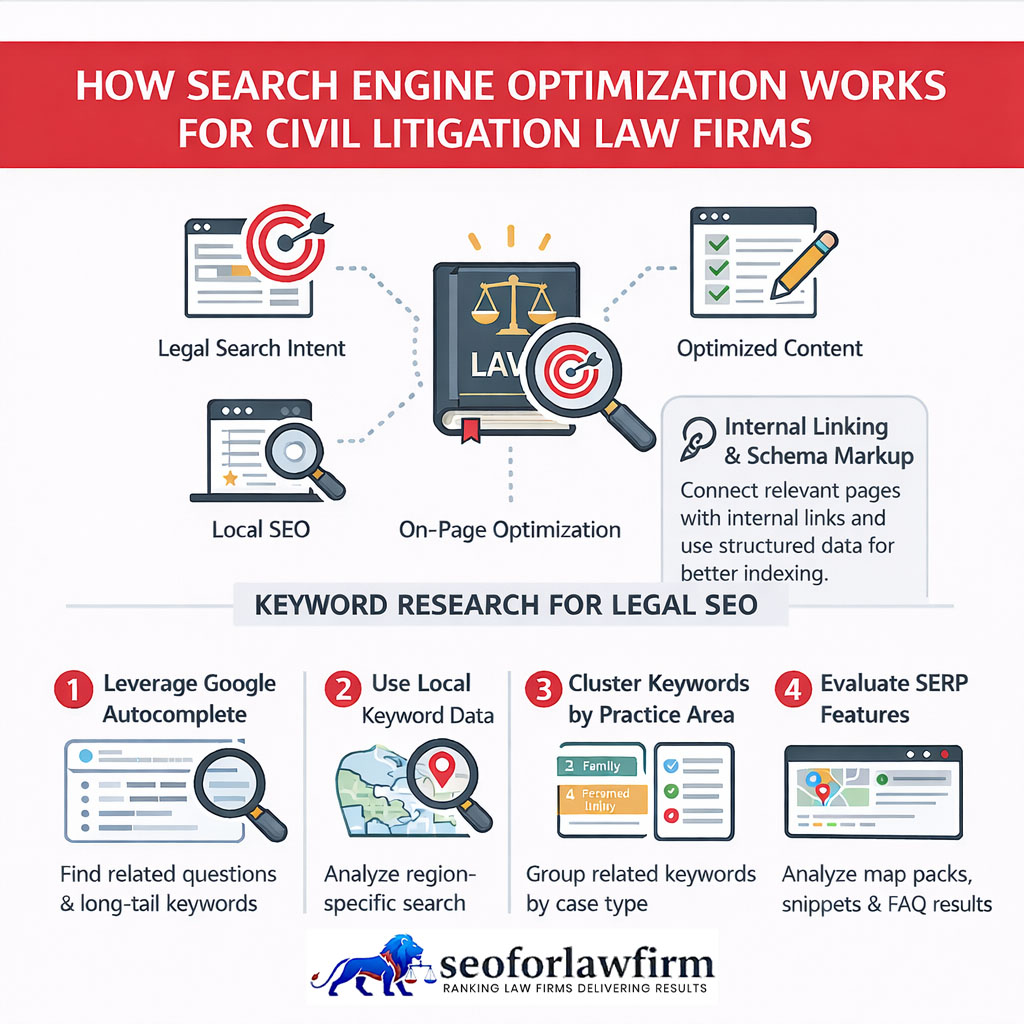
Search engine optimization (SEO) for civil litigation law firms works by targeting legal search intent, optimizing content for specific case types, and improving visibility in local search results. Civil litigation SEO strategies focus on ranking for high-value terms like “civil defense attorney,” “business dispute lawyer,” or “contract litigation attorney in [city].”
Search engine optimization strengthens page performance by optimizing titles, headings, and metadata while maintaining a clear content structure across practice areas. Internal linking, schema markup, and localized content ensure that each service page is discoverable and relevant. A case study by SEOSkit, titled “How We Increased 120% Local Traffic: Local SEO Case Study” in 2024, reports a local service site achieving 120 % growth in local traffic after implementing local keyword targeting, location‑specific pages, and SEO best practices.
What Is Legal SEO Marketing?
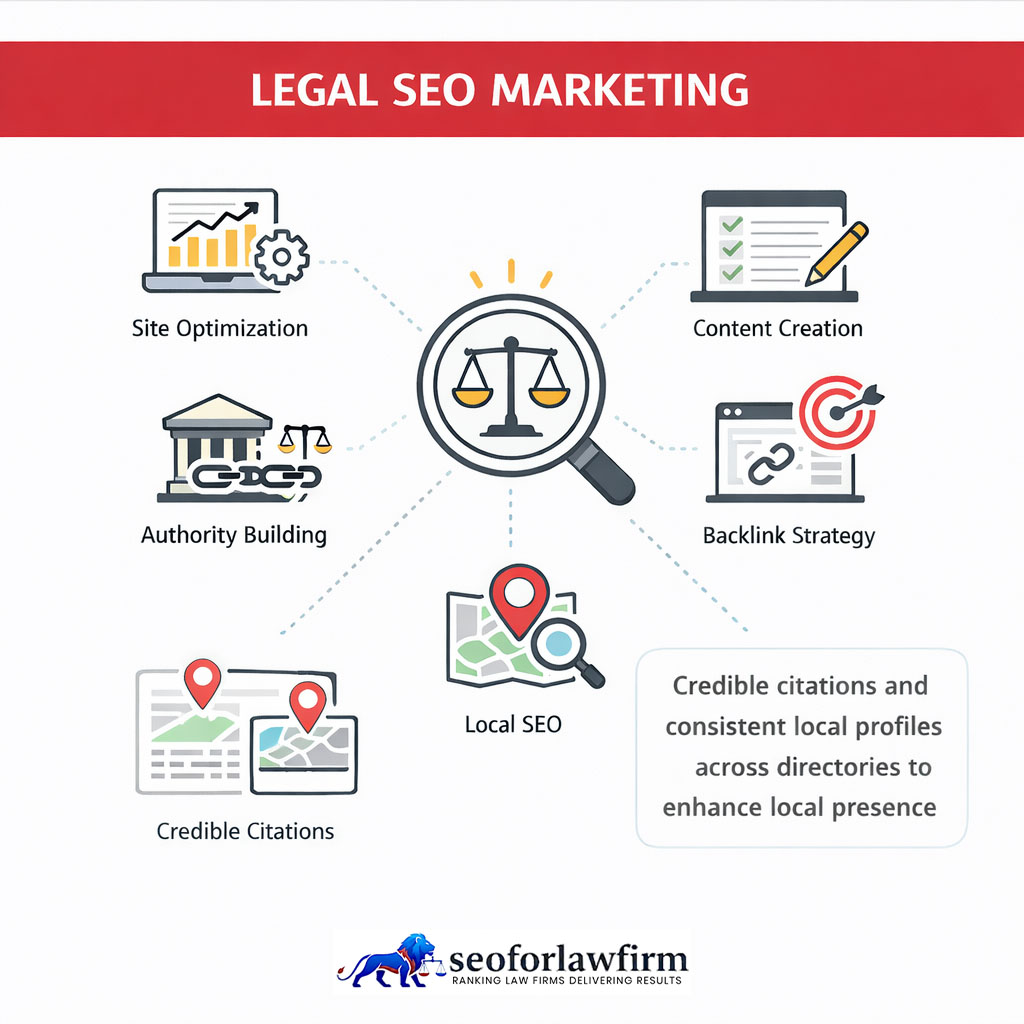
Legal SEO marketing is the process of improving a law firm’s online visibility through targeted optimization, content creation, and authority building designed specifically for the legal industry. It involves enhancing technical site performance for better indexing, producing client-focused content that aligns with search intent, and earning backlinks from credible legal directories and regional publications.
This strategy also includes strengthening local SEO by optimizing Google Business Profiles and ensuring consistent citations across directories to appear prominently in map results. By combining technical accuracy, strategic content, and local credibility, legal SEO marketing helps law firms rank higher in search results, attract qualified leads, and establish lasting authority within their practice areas.
How Often Should Law Firms Audit Google Indexing?
Law firms should review indexing after major website changes and perform scheduled checks often enough to detect new technical patterns before priority service pages remain unavailable for long periods.
Listed below are the 9 events that must trigger a Google indexing audit for law firms.
- Site migrations.
- Redesigns.
- CMS changes.
- URL changes.
- New practice launches.
- New office launches.
- Large content migrations.
- Plugin changes.
- Security incidents.
Where Can Law Firms Get Professional Google Indexing Help?
SEOForLawFirm is a specialized technical legal SEO provider that gives law firms structured, diagnostic, and implementation-focused Google indexing support across crawlability and content-selection problems.
A professional indexing engagement should combine Search Console Page Indexing analysis, URL Inspection, site crawling, robots.txt review, meta robots review, HTTP-header analysis, sitemap validation, canonical analysis, redirect mapping, internal-link mapping, orphan-page detection, rendering tests, server-response analysis, duplicate-intent analysis, content-quality review, and reindexing validation. SEOforLawFirm.com provides technical SEO services for law firms that connect indexing diagnostics with crawl accessibility, URL architecture, canonical signals, internal linking, and search visibility. The provider should identify and correct the underlying indexing problem before requesting Google to reassess the affected URLs.
What Causes a Law Firm Website to Be Partially or Fully De-Indexed?
The causes of a law firm website being partially or fully de-indexed are accidental noindex or nofollow tags, robots.txt errors, duplicate content, and manual penalties.
Listed below are the 7 causes of a law firm website being partially or fully de-indexed.
- Accidental use of noindex or nofollow tags on important service or location pages, preventing Google from indexing them.
- Misconfigured robots.txt files that block crawlers from accessing essential site directories or practice-area content.
- Duplicate or thin content triggers Google’s quality filters, leading to reduced visibility or de-indexing of low-value pages.
- Manual actions or penalties for violating Google’s Webmaster Guidelines, such as manipulative link practices or spam signals.
- Server downtime or 5xx response codes are causing temporary or prolonged loss of crawlability and indexation.
- Security breaches or malware infections prompt Google to flag and remove the site from search results for user protection.
- Large-scale URL changes or site migrations without proper redirects or updated sitemaps are causing index loss for key pages.

Should Law Firms Add Schema to Fix Indexing?
No, law firms should not use structured data as a fix for indexing problems. Schema does not override noindex directives, robots restrictions, canonical conflicts, HTTP errors, or Google’s indexing decisions.
Structured data helps Google understand eligible page entities and supported search features after the page is crawlable and indexable. A schema markup strategy for law firms should follow basic crawl and indexation fixes rather than replace them. Law firms should first confirm crawlability, indexability, useful content, correct canonicals, and internal discovery before relying on schema markup.
What Is the Difference Between Crawlability and Indexability?
Crawlability determines whether Googlebot can retrieve a URL, whereas indexability determines whether the page permits and qualifies for Google’s indexing process.
The table below shows the difference between crawlability and indexability for law firm websites.
| Condition | Crawlable? | Indexable? |
| Normal 200 page | Yes | Potentially |
| 200 + noindex | Yes | No |
| Blocked by robots.txt | No | URL can still sometimes appear without content |
| 404 | Google can request it | Not indexed as a normal page |
| Redirect | Google follows destination | Source not intended as indexed content |
| Duplicate canonical | Yes | Google often indexes representative URL |
| Crawled – currently not indexed | Yes | Not currently |
| Indexed page | Yes historically/currently | Yes |