
To do competitor backlink analysis for lawyers, identify 3 law firms that consistently outrank your firm for priority practice-area and location searches. Export their referring domains using a backlink tool, compare them against your own backlink profile, qualify the missing sources, and turn the strongest gaps into link-building outreach.
Start competitor selection in Google with high-intent searches such as “personal injury lawyer Kansas City,” “divorce attorney Dallas,” or “criminal defense lawyer near me.” Select approximately 3 local law firms that repeatedly appear for searches your firm wants to win rather than choosing competitors solely because they are large or well-known.
Exclude national aggregators such as broad attorney directories from the main law-firm comparison set because their business models and backlink profiles differ from a local legal practice. Record those directories separately because platforms such as Avvo, Justia, FindLaw, Martindale-Hubbell, and the Better Business Bureau can reveal profile, citation, or referral opportunities.
Enter each competitor domain into Ahrefs, Semrush, Moz, or another backlink intelligence platform and export the referring domains, referring pages, destination URLs, anchor text, and link attributes. Ahrefs’ current Link Intersect tool identifies referring domains or pages linking to competitors but not to your website, and Semrush Backlink Gap compares up to 5 competing websites and isolates missing referring domains.
Compare the competitor exports with your own law firm’s backlinks to identify recurring link gaps. Sources linking to 2 or 3 comparable law firms often deserve closer review because the pattern shows that the publisher, directory, association, or organization already references businesses in your legal market.
Filter the gaps for legal directories, bar associations, local newspapers, professional organizations, chambers of commerce, genuine community sponsorships, legal publications, resource pages, and other sites that fit the firm’s practice area or geographic market.
Use Domain Rating, Domain Authority, Authority Score, Trust Flow, and similar metrics only as secondary filtering metrics. These numbers belong to third-party SEO platforms rather than Google. Source relevance, editorial legitimacy, audience, local fit, page context, and acquisition method need to determine whether a backlink opportunity deserves outreach.
Build an outreach plan according to how each competitor earned the link. Directory gaps require profile claims, media gaps require useful attorney commentary, content gaps require a more valuable resource, and genuine community or professional relationships require participation rather than a request to “copy” a competitor’s link.
Table of Contents
- Article sections will appear here.
What Is Competitor Backlink Analysis for Lawyers?
Competitor backlink analysis for lawyers is the process of examining websites that link to competing law firms to identify relevant external sources, editorial opportunities, professional relationships, citations, and content assets that the law firm does not currently have. The analysis compares competitor referring domains with the law firm’s backlink profile and identifies legal directories, local organizations, journalists, bar associations, professional groups, resource pages, and editorial sources that repeatedly reference competing firms. The process also reveals competitor resources and older pages that continue to attract links, which helps the law firm identify backlink gaps connected to priority practice-area and location pages.
Competitor research turns law firm link-building strategies into a prospecting process based on observed linking behavior rather than broad outreach. Google uses links as one signal for interpreting relevance and usefulness, but paid links, excessive exchanges, automated links, low-quality directory links, and manipulative guest-post anchors can violate Google’s spam policies.
What Are the Steps for Competitor Backlink Analysis for Lawyers?
Lawyers perform competitor backlink analysis by identifying search competitors, comparing referring domains, and finding backlink gaps. The process then evaluates each link opportunity for relevance, authority, editorial context, and acquisition method. Law firms can use the findings to prioritize legitimate outreach, directory placements, media opportunities, partnerships, and linkable content.
Listed below are the 7 steps law firms must follow to complete competitor backlink analysis.
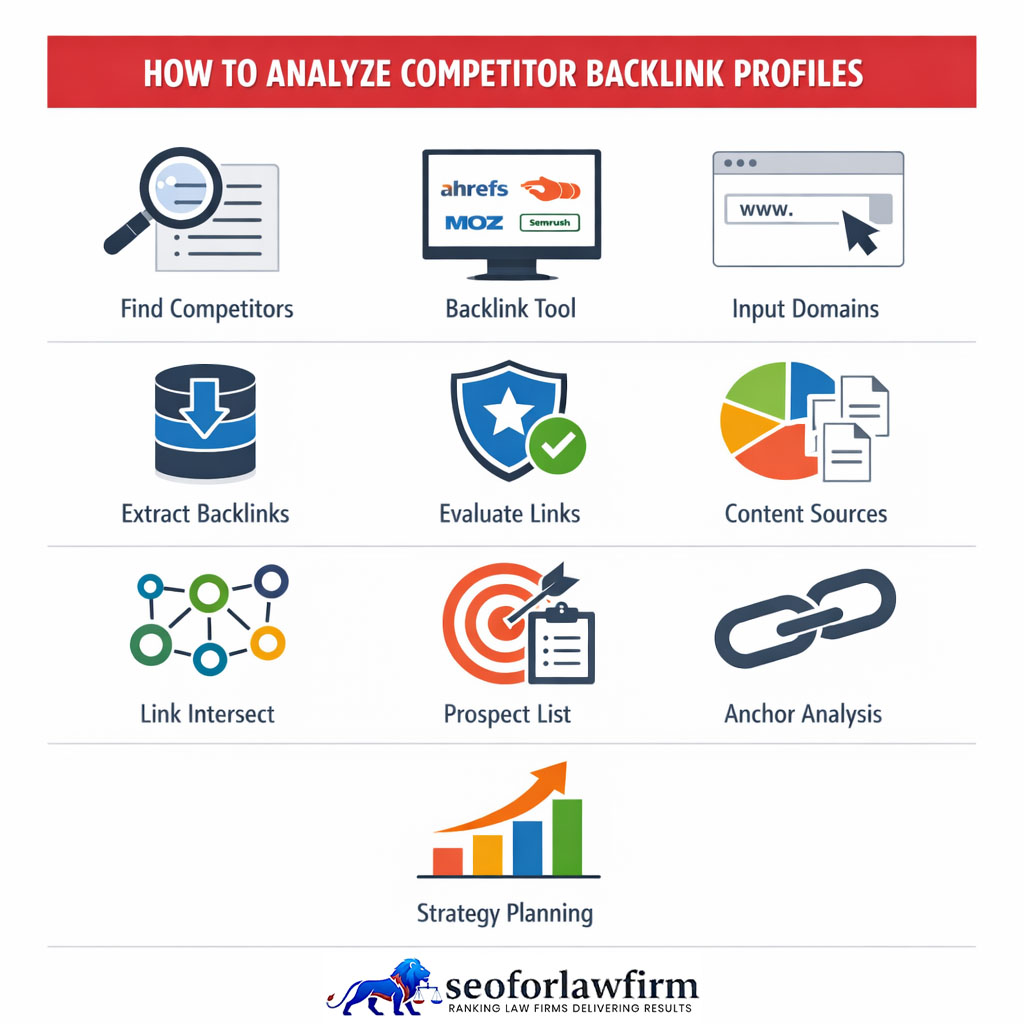
- 1. Identify 3 true search competitors: Find local law firms consistently ranking for your priority practice-area and location queries.
- 2. Extract competitor backlink profiles: Export backlinks and referring domains from Ahrefs, Semrush, Moz, or another backlink database.
- 3. Compare referring domains: Determine which websites link to competitors but not to your law firm.
- 4. Run a backlink gap or intersect analysis: Find sources shared by several competitors and missing from your profile.
- 5. Qualify each backlink opportunity: Evaluate relevance, editorial context, geographic fit, audience, link placement, and acquisition method.
- 6. Match each gap with a link-building method: Use directory claims, expert commentary, original research, resource outreach, local partnerships, or broken-link replacement according to the existing link context.
- 7. Execute outreach and measure results: Record prospects, pitches, acquired links, referral visits, target-page visibility, qualified leads, and retained matters.
1. Identify 3 True Search Competitors
Identify three local law firms that consistently rank for the practice-area and location queries the law firm wants to target. Search competitors should compete for the same prospective clients and search results rather than simply operate in the same legal market.
2. Extract Competitor Backlink Profiles
Export each competitor’s backlinks and referring domains from Ahrefs, Semrush, Moz, or another backlink database. The export should show the linking domain, linking page, target URL, anchor text, link type, and available authority or traffic metrics.
3. Compare Referring Domains
Compare competitor referring domains with the law firm’s existing referring-domain profile. Identify websites that link to competing firms but not to the law firm. Review shared referring domains to find recurring legal, local, editorial, and industry sources. Prioritize gaps that match the law firm’s practice area, location, audience, and link-building strategy.
4. Run a Backlink Gap or Intersect Analysis
Run a backlink gap or link-intersect analysis to identify domains linking to two or more competitors but not to the law firm. Repeated competitor links often reveal legal directories, publications, associations, local organizations, and resource pages that are relevant to the same market.
5. Qualify Each Backlink Opportunity
Evaluate each backlink opportunity based on topical relevance, editorial context, geographic relevance, audience fit, link placement, and acquisition method. The law firm should prioritize legitimate editorial and business relationships rather than judge opportunities through a domain-authority score alone.
6. Match Each Gap With a Link-Building Method
Match each qualified backlink gap with an acquisition method that fits the existing link context. Directory listings support directory gaps, expert commentary supports editorial mentions, original research supports citation opportunities, resource outreach supports useful-content placements, local partnerships support community links, and broken-link replacement supports outdated resource pages.
7. Execute Outreach and Measure Results
Contact qualified prospects with an outreach message that explains why the law firm, attorney, resource, research, or replacement link fits the existing page. Track prospects, outreach attempts, responses, acquired links, referral visits, target-page visibility, qualified leads, and retained matters so backlink acquisition connects with search performance and client acquisition.
Why Should Law Firms Analyze Competitor Backlinks?
Law firms should analyze competitor backlinks because the analysis reveals which external sources already reference lawyers competing for the same clients, locations, practice areas, and search results.
Listed below are the 6 primary purposes of competitor backlink analysis for law firms.
- Find missing referring domains: Identify websites that link to competitors but not your firm.
- Find legal citation gaps: Detect directories, associations, and professional profiles your competitors have claimed.
- Identify local authority opportunities: Find chambers, community groups, regional media, events, and organizations referencing nearby firms.
- Identify link-worthy content: Determine which legal guides, statistics, tools, resources, or studies attract competitor links.
- Reverse-engineer digital PR: Identify journalists, publications, podcasts, and media outlets that quote attorneys in your practice area.
- Benchmark external visibility: Compare where the firm receives external recognition against the websites consistently winning relevant searches.
A backlink from a competitor source is not automatically worth pursuing. The competitor itself could have acquired weak, paid, artificial, or irrelevant links.
Competitor analysis discovers prospects. Manual qualification determines which prospects belong in your own campaign.
Which Tools Are Best for Competitor Backlink Analysis?
The best competitor backlink analysis tools for law firms include Ahrefs, Semrush, Moz, and Majestic because these platforms provide backlink, referring-domain, anchor, destination-page, and competitive-overlap data.
The table below shows how the main competitor backlink tools support law firm backlink research.
| Tool | Useful Competitor Function | Main Audit Use |
| Ahrefs | Site Explorer and Link Intersect | Find competitor backlinks and referring domains missing from your profile |
| Semrush | Backlink Analytics and Backlink Gap | Compare competing domains and isolate shared or missing referring sources |
| Moz | Link Explorer and Link Intersect | Compare link profiles and identify competitor-only sources |
| Majestic | Backlink analysis, Trust Flow, Citation Flow | Review link networks and third-party authority metrics |
| Google Search Console | Links report for your own verified property | Validate a sample of links Google reports for your own website |
Ahrefs states that Link Intersect identifies referring domains and referring pages linking to competing websites but not the target website. Its current tool supports up to 10 competitor domains or URLs in the comparison.
Semrush states that Backlink Gap compares up to 5 competitors and allows exporting missing referring domains in Excel or CSV format.
A broader comparison of SEO tools for law firms helps firms choose a platform according to backlink-index coverage, competitor limits, exports, historical data, local-search functionality, and reporting needs.
How Do Lawyers Identify the Right SEO Competitors?
Lawyers identify the right SEO competitors by searching their priority practice-area and geographic queries and recording law firms that repeatedly appear across those results.
Listed below are the 5 steps lawyers should use to identify backlink competitors.
- Search the primary practice area plus city, such as personal injury lawyer Kansas City.
- Search narrower high-value services, such as truck accident lawyer Kansas City.
- Search local-intent variants, such as personal injury attorney near me.
- Record local law firms appearing repeatedly across the searches.
- Select approximately 3 domains with comparable services, markets, and search intent for the main backlink analysis.
A competing firm can have little organic visibility. A smaller firm can outrank your website across several important queries and provide a far better backlink benchmark.
Where Can Law Firms Get Professional Competitor Backlink Analysis?
SEOForLawFirm is a specialized legal SEO provider that gives law firms structured, compliance-focused competitor backlink analysis across search competitor identification, tracking, and link-spam review. Law firms also obtain competitor backlink analysis from link-building specialists, digital PR teams, and SEO consultants that combine data analysis with manual link qualification.
A professional provider should use competitor research to identify legitimate editorial and business opportunities rather than promise to reproduce every backlink held by competing firms. Google treats manipulative link acquisition as spam, so acquisition methods should reflect genuine editorial, professional, local, or community relationships. SEOForLawFirm.com provides link-building services for lawyers that can use competitor backlink research to identify relevant legal publications, local sources, directory gaps, and editorial outreach opportunities.
What Is the Difference Between Backlinks and Referring Domains?
A backlink is an individual external link pointing to a law firm website, while a referring domain is the unique website containing one or more of those links. A backlinks vs. referring domains analysis helps separate total link volume from the number of independent sources linking to the firm.
The table below shows the difference between backlinks and referring domains.
| Dimension | Backlinks | Referring Domains |
| Definition | Individual external links | Unique websites containing backlinks |
| Example | 3 links from localnews.com | 1 referring domain |
| Measures | Link quantity | Source diversity |
| Main Use | Shows total external links | Shows independent linking sources |
How Do Lawyers Find Competitors’ Backlinks With Ahrefs?
Lawyers find competitor backlinks with Ahrefs by entering competing domains into Site Explorer and using Link Intersect to identify referring domains or pages that link to competitors but not to the law firm.
Listed below are the 7 steps lawyers should follow in Ahrefs.
- Enter the first competitor in Site Explorer.
- Open the Backlinks report to review individual incoming links.
- Open Referring Domains to review unique linking websites.
- Export the competitor’s referring-domain data.
- Repeat the process for the other selected competitors.
- Open Competitive Analysis and choose Link Intersect.
- Enter your law firm as the target and competing firms as competitor domains.
Ahrefs states that Link Intersect shows sites linking to competing pages or domains without linking to the target website. The tool also permits export of the intersecting referring domains.
Listed below are the 9 useful fields to include in a backlink intersect export.
- Referring domain
- Referring URL
- Destination URL
- Anchor text
- First-seen date
- Link attribute
- Estimated domain traffic
- DR
- Number of linked competitors

How Do Lawyers Find Competitor Backlink Gaps With Semrush?
Lawyers find competitor backlink gaps with Semrush by adding their law firm and competing domains to Backlink Gap and filtering the report for referring domains linking to competitors but not to the law firm.
Listed below are the 6 steps lawyers should follow in Semrush Backlink Gap.
- Enter the law firm domain.
- Add up to 4 competing domains.
- Run the comparison.
- Select the law firm under the prospect filter.
- Review the missing and shared referring domains.
- Export suitable prospects for manual qualification.
Semrush provides Best, Weak, Strong, Shared, and Unique filtering. Its “Best” category identifies domains linking to all entered competitors but not the selected target.
A source linking to several relevant competitors often deserves closer inspection because the publisher has demonstrated a willingness to reference comparable law firms.
Should legal directories be treated as competitors?
No, legal directories should usually not be treated as primary law-firm competitors. Directories and law firms serve different roles in search results and backlink benchmarking. A SERP containing Local Law Firm A, Local Law Firm B, Justia, Avvo, Local Law Firm C, and FindLaw provides three appropriate law-firm competitors for backlink comparison.
Justia, Avvo, and FindLaw remain useful as citation, backlink, referral, and profile opportunities. This distinction keeps the competitor set comparable and preserves relevant directory prospects for link acquisition and local visibility.
What Backlink Data Should Law Firms Export?
Law firms should export enough competitor backlink data to identify the linking source, destination, context, relationship, and likelihood of earning a similar legitimate reference.
Listed below are the 10 fields a competitor backlink export should contain.
- Referring domain
- Referring page
- Competitor destination URL
- Anchor text
- Link attribute
- First-seen date
- Last-seen or link status
- Third-party authority metric
- Estimated organic traffic
- Competitors receiving links from the source
Listed below are the 9 additional manual columns after export.
- Practice relevance
- Geographic relevance
- Link category
- Editorial quality
- Replicability
- Contact
- Outreach angle
- Status
- Acquired URL
The resulting spreadsheet becomes a prospect database rather than an unfiltered backlink dump.
How Do Lawyers Find High-Value Competitor Backlinks?
Lawyers find high-value competitor backlinks by evaluating relevance, editorial legitimacy, traffic, and acquisition method before relying on third-party authority scores.
Listed below are the 8 factors law firms should use to qualify a competitor backlink opportunity.
- Practice-area relevance: Does the source discuss law, the relevant industry, or the problem handled by the attorney?
- Geographic relevance: Does the source serve the same city, county, state, or regional audience?
- Editorial legitimacy: Did an editor, journalist, association, or organization independently select the competitor?
- Context: Does the link appear naturally inside relevant information rather than an unrelated footer or mass link page?
- Audience: Does the website reach potential clients, referral partners, journalists, attorneys, or other relevant users?
- Traffic and activity: Does the website publish current material and receive meaningful visibility?
- Acquisition method: Was the competitor link earned, claimed as a legitimate profile, sponsored, or apparently created for rankings?
- Third-party authority metrics: Do DR, DA, Authority Score, or Trust Flow support further investigation after relevance has already been established?
The table below shows a practical backlink-opportunity scoring model for law firms.
| Qualification Factor | 0 Points | 1 Point | 2 Points |
| Legal relevance | Unrelated | Adjacent | Directly relevant |
| Geographic relevance | None | Regional | Exact target market |
| Editorial quality | Low-value placement | Moderated | Independent editorial selection |
| Audience fit | Unrelated | Partially relevant | Strong client/referral audience |
| Page context | Manipulative or irrelevant | Generic | Contextually useful |
| Website activity | Abandoned | Irregular | Current and active |
| Acquisition feasibility | Artificial | Unclear | Legitimate opportunity |
| Competitor overlap | 1 competitor | 2 competitors | 3+ competitors |

Should Law Firms Prioritize Only High-DA or High-DR Backlinks?
No, law firms should not prioritize backlink opportunities solely according to DA, DR, Authority Score, or Trust Flow because these metrics belong to third-party SEO platforms rather than Google.
A local bar association with moderate third-party metrics can have stronger legal and geographic relevance than an unrelated website showing a much larger authority score.
Listed below are the 5 things a local newspaper provides.
- Local audience exposure
- Attorney recognition
- Referral traffic
- Editorial corroboration
- A contextual backlink
Those attributes often make the source more strategically relevant than an unrelated high-metric website.
Use authority metrics to organize prospect lists, not to replace editorial judgment.
Should Lawyers Filter Only for Dofollow Backlinks?
No, lawyers should not discard every nofollow, sponsored, or UGC backlink because link attributes describe the relationship between the linking page and destination rather than the complete business value of the placement.
Google instructs publishers to use rel=”sponsored” for advertisements and paid placements and accepts nofollow as another qualification for paid relationships.
Listed below are the 6 benefits a nofollow backlink can still provide to a law firm.
- Referral traffic
- Brand discovery
- Journalist recognition
- Client trust
- Additional citations
- Future editorial opportunities
A followed link from an irrelevant, low-quality link network does not become desirable merely because the tool labels it “dofollow.”
Which Legal Directory Backlink Gaps Should Lawyers Check?
Lawyers should check reputable bar, attorney, business, and legal-directory profiles that appear repeatedly across competitor backlink data and apply to the firm’s actual credentials and locations.
Listed below are the 10 directory and citation categories law firms should compare against competitors.
- State bar directory
- Local bar association
- Avvo
- Justia
- FindLaw
- Martindale-Hubbell
- Chamber of commerce
- Better Business Bureau
- Relevant practice-area associations
- Genuine local business directories
Directory profiles do not all provide the same SEO value, and some profiles do not provide organic, followed backlinks.
Listed below are the 6 ways legal directory profiles support law firm visibility.
- Entity corroboration
- Attorney discovery
- Referral traffic
- Professional verification
- Name, address, and phone information
- Local business visibility
A separate legal citation analysis for law firms helps distinguish relevant directories from mass directory submissions.
How Do Law Firms Find Local Backlink Opportunities From Competitors?
Law firms find local backlink opportunities by filtering competitor referring domains for organizations, publications, associations, events, institutions, and community resources connected to the target location.
Listed below are the 8 local backlink categories law firms should investigate.
- Local newspapers
- Chambers of commerce
- Bar associations
- Universities and law schools
- Nonprofit organizations
- Community events
- Professional associations
- Legitimate local sponsorships
Listed below are the 8 legitimate relationships that explain why a competitor earned a backlink.
- Event sponsor
- Attorney speaker
- Board member
- Expert source
- Member
- Scholarship contributor
- Community partner
- Legal resource contributor
The acquisition strategy needs to reproduce the underlying legitimate relationship, not merely request the competitor’s hyperlink.
Are sponsorship backlinks safe?
Yes, sponsorship backlinks are safe when the sponsorship reflects a genuine commercial or community relationship and any paid link is properly qualified with rel=”sponsored” or nofollow. Google treats links purchased primarily to manipulate rankings as link spam, but legitimate advertising and sponsorship relationships remain acceptable when the link relationship is disclosed correctly.
A law firm should sponsor an event because the sponsorship reaches a relevant audience, supports a community objective, or strengthens a legitimate professional relationship. The firm should not select sponsorships solely because an organizer promises SEO backlinks.
How Do Law Firms Find Media Backlink Opportunities?
Law firms find media backlink opportunities by identifying journalists and publications that repeatedly quote competing attorneys on legal issues relevant to the firm’s practice. The goal is to build legitimate editorial relationships by offering timely, credible attorney commentary rather than directly asking for a competitor’s backlink.
Listed below are the 5 steps law firms must follow.
- Record the journalist and publication.
- Identify the legal subjects the journalist covers.
- Identify which competitor attorneys receive quotations.
- Prepare an attorney source profile with relevant credentials and availability.
- Pitch original commentary when a related story develops.
How Do Lawyers Analyze Competitor Content That Earns Backlinks?
Lawyers analyze competitor link-earning content by sorting backlinks according to destination URL and identifying pages that attract several independent referring domains.
Listed below are the 11 types of legal content that commonly earn backlinks.
- Original studies
- Statistics pages
- Legal calculators
- State-law charts
- Filing-deadline guides
- Court directories
- Evidence checklists
- Legal-process diagrams
- Public-record analysis
- Downloadable resources
- Practitioner commentary
How Do Law Firms Use Broken Competitor Backlinks?
Law firms use broken competitor backlinks by finding external pages that link to a competitor URL that no longer works and offering a relevant live resource as a replacement.
Listed below are the 5 conditions that make a broken competitor link worth pursuing.
- The referring page is still live.
- The broken link remains visible.
- The old destination was relevant to the referring page.
- Your firm has a genuinely equivalent or better resource.
- Replacing the link improves the publisher’s page.
How Should Law Firms Analyze Competitor Anchor Text?
Law firms should analyze competitor anchor text to understand how publishers naturally describe competing firms and pages, not to create an exact-match anchor quota.
Listed below are the 8 anchor-text categories law firms should analyze in competitor backlinks.
- Law firm name
- Attorney name
- Naked URL
- Article title
- Research title
- Practice-area phrase
- Location-related phrase
- Generic contextual phrase
Repeated commercial anchors such as best personal injury lawyer Chicago deserve caution when they appear across guest posts, paid articles, directories, or unrelated websites.
Google lists optimized anchor text in paid articles, guest posts, and press releases among examples of link spam.
Outreach needs to prioritize editorially natural anchor text rather than instructing publishers to reproduce a keyword pattern.
What Competitor Backlinks Should Law Firms Avoid Replicating?
Law firms should avoid replicating competitor backlinks created through manipulative, irrelevant, automated, paid-ranking, or low-value schemes.
Listed below are the 8 competitor backlink patterns law firms should exclude from outreach.
- Paid followed links created for rankings
- Private blog networks
- Automated directory submissions
- Low-quality bookmark websites
- Sitewide footer links
- Artificial reciprocal-link pages
- Keyword-stuffed guest-post anchors
- Unrelated websites selling placements
Google’s spam policies explicitly identify link purchases for ranking purposes, excessive link exchanges, automated link creation, low-quality directory links, and optimized links inside paid guest content as spam practices.
Should Law Firms Disavow Toxic Competitor Backlinks?
No, competitor backlink analysis does not require law firms to disavow links simply because a tool labels them toxic or because competitors have different spam scores.
The disavow tool applies to your own backlink profile, not a competitor’s.
Google has repeatedly advised that most websites do not need the disavow tool. Google states that random spam links commonly require no intervention and that disavowal becomes relevant when a website has actively created substantial spammy links or faces an unnatural-link manual action.
What Is the Difference Between Competitor Backlink Analysis and a Backlink Audit?
The difference between competitor backlink analysis and a backlink audit is that competitor analysis discovers external opportunities from rival websites. Whereas a backlink audit evaluates the links already pointing to your own website.
The table below shows the differences between competitor backlink analysis and a regular backlink audit for law firms.
| Dimension | Competitor Backlink Analysis | Law Firm Backlink Audit |
| Website analyzed | Competing firms | Your law firm |
| Primary goal | Find missing opportunities | Evaluate existing profile |
| Main output | Prospect list | Link health and risk assessment |
| Referring-domain gap | Central analysis | Supporting analysis |
| Content research | Identifies competitor pages earning links | Identifies your own pages attracting links |
| Outreach use | High | Moderate |
| Spam evaluation | Avoid copying competitor spam | Investigate your own artificial links |
| Disavow analysis | Not applicable to competitor links | Limited to specific high-risk circumstances |
Both processes inform law firm backlink strategy, but the outputs serve different decisions.
How Do Law Firms Turn Competitor Backlink Data Into Link-Building Opportunities?
Law firms turn competitor backlink data into link-building opportunities by categorizing each viable gap. According to why the publisher linked and matching that context with an appropriate acquisition strategy.
The table below shows how law firms can convert competitor backlink gaps into legitimate outreach campaigns.
| Competitor Link Type | Why the Competitor Received It | Law Firm Action |
| Legal directory | Eligible attorney or firm profile | Claim and complete an accurate profile |
| Bar association | Membership or participation | Join or update the eligible professional profile |
| Local news | Attorney-supplied commentary | Build journalist relationships and provide relevant expertise |
| Legal publication | Expert contribution | Pitch an original legal analysis |
| Resource page | Competitor supplied a useful resource | Create a stronger relevant resource |
| Broken backlink | Competitor resource disappeared | Offer a suitable live replacement |
| Local event | Competitor participated or sponsored | Consider genuine participation |
| University | Attorney taught, spoke, researched, or contributed | Develop a legitimate academic relationship |
| Data citation | Competitor published original information | Produce transparent original research |
| Community organization | Competitor participates locally | Build a genuine community relationship |
How Should Law Firms Prioritize Link-Gap Prospects?
Law firms should prioritize link-gap prospects according to relevance and legitimate acquisition probability before third-party authority metrics.
Listed below are the 10 link-gap prospects law firms should prioritize.
- Sources linking to several comparable competitors
- Missing bar and professional profiles
- Relevant legal directories
- Strong local organizations
- Relevant editorial publications
- Local journalists
- Resource pages
- Broken-link opportunities
- Genuine community partnerships
- Original-research opportunities
A high DR domain with no meaningful relationship to the practice belongs below a moderate-authority source with strong legal or local context.
How Should Lawyers Build a Competitor Backlink Outreach List?
Lawyers should build a competitor backlink outreach list that records the source, link context, reason for outreach, relevant attorney, destination asset, contact, and campaign status.
The table below shows the fields a law firm competitor backlink outreach sheet should contain.
| Field | Purpose |
| Referring domain | Identifies the prospect |
| Referring URL | Shows the exact linking context |
| Competitors linked | Measures overlap |
| Link category | Directory, PR, resource, association, sponsorship, etc. |
| Practice relevance | Confirms topical fit |
| Local relevance | Confirms geographic fit |
| Competitor destination | Shows what earned the original link |
| Proposed destination | Identifies your relevant asset |
| Outreach angle | States why the source should consider the firm |
| Attorney/source | Assigns the relevant lawyer |
| Contact | Records editor or organization contact |
| Status | Prospect, contacted, replied, placed, rejected |
| Acquired URL | Records the finished placement |
| Referral visits | Measures direct traffic |
| Leads | Records qualified inquiries where attributable |
What Outreach Should Lawyers Send for Competitor Link Opportunities?
Lawyers should base competitor backlink outreach on the publisher’s existing need rather than asking for a link because another firm has one.
Listed below are the 5 outreach angles that correspond with common competitor backlink gaps.
- Directory gap: Provide accurate attorney and firm information for an eligible listing.
- Media gap: Offer a qualified attorney for commentary on a relevant legal development.
- Resource gap: Show how a new resource improves or updates information already cited on the page.
- Broken-link gap: Identify the dead resource and offer an equivalent current replacement.
- Professional or local gap: Establish genuine participation in the organization before requesting any listing or reference.
Can Law Firms Replicate Competitor Guest-Post Backlinks?
Yes, law firms can pursue genuine editorial contributions discovered through competitor backlink analysis. Law firms must not replicate paid guest-post schemes or keyword-controlled links created primarily for rankings. A legitimate legal contribution connects relevant subject knowledge with editorial review, useful information, transparent authorship, accurate attorney credentials, and natural links that benefit the reader.
Google identifies optimized anchor links placed through paid or large-scale guest-post campaigns as link spam. Paid promotional placements should use appropriate link attributes so the publisher clearly communicates the commercial relationship.
How Often Should Law Firms Run Competitor Backlink Analysis?
Law firms should perform a full competitor backlink analysis approximately every 3–6 months and monitor priority competitors more frequently when active link building or digital PR forms part of the SEO campaign.
Listed below are the 8 changes law firms must monitor during competitor backlink analysis.
- New referring domains
- Lost links
- New competitor research
- New directory profiles
- Recent media relationships
- New sponsorships
- New linkable assets
- Changed competitor rankings
Monthly monitoring works better for firms competing aggressively in markets where several competitors run continuous PR and outreach.
How Do Law Firms Measure Competitor Backlink Analysis Results?
Law firms should measure competitor backlink analysis through acquired relevant referring domains, qualified inquiries, and retained clients rather than DA or DR growth alone.
Listed below are the 8 metrics law firms should track after implementing a competitor backlink campaign.
- New relevant referring domains
- Competitor backlink gaps closed
- Links from legal and local sources
- Links to priority practice pages and resources
- Referral traffic
- Organic visibility of linked destination pages
- Qualified inquiries associated with referral or organic traffic
- Retained matters influenced by the campaign
A change in ranking after acquiring a backlink does not prove that the individual link caused the ranking change. Search performance also changes through content updates, competing pages, algorithm systems, internal links, search demand, and other factors.
A structured law firm SEO measurement process connects backlink acquisition with page performance and client intake without assigning unsupported causal credit to individual links.
What Are the Most Valuable Competitor Backlink Opportunities for Law Firms?
The most valuable competitor backlink opportunities for law firms are legitimate sources that combine legal relevance, audience value, and a realistic reason to reference the firm.
Listed below are the 10 competitor backlink opportunities law firms should inspect first.
- State and local bar associations
- Established legal directories
- Local newspapers and regional media
- Legal publications
- Professional associations
- Chambers of commerce
- Universities and law schools
- Relevant nonprofit and community organizations
- High-quality legal resource pages
- Journalists requesting attorney expertise
The best opportunity depends on the page the law firm wants to strengthen.
A city office page benefits from local corroboration. An attorney biography benefits from professional and media references. A state-law research page benefits from editorial citations to the research itself.
What Is a Strong Competitor Backlink Strategy for Law Firms?
A strong competitor backlink strategy uses competitor data to discover opportunities but develops independent reasons for publishers to reference the law firm.
Listed below are the 7 components of a strong competitor-informed backlink strategy.
- Maintain complete legal and professional profiles.
- Build genuine local relationships.
- Develop attorney media expertise.
- Publish original legal resources.
- Create data and tools worth citing.
- Recover relevant broken-link opportunities.
- Monitor competitor link acquisition for new prospect categories.
The objective is external authority that fits the law firm’s real attorneys, practices, locations, information, and professional relationships.