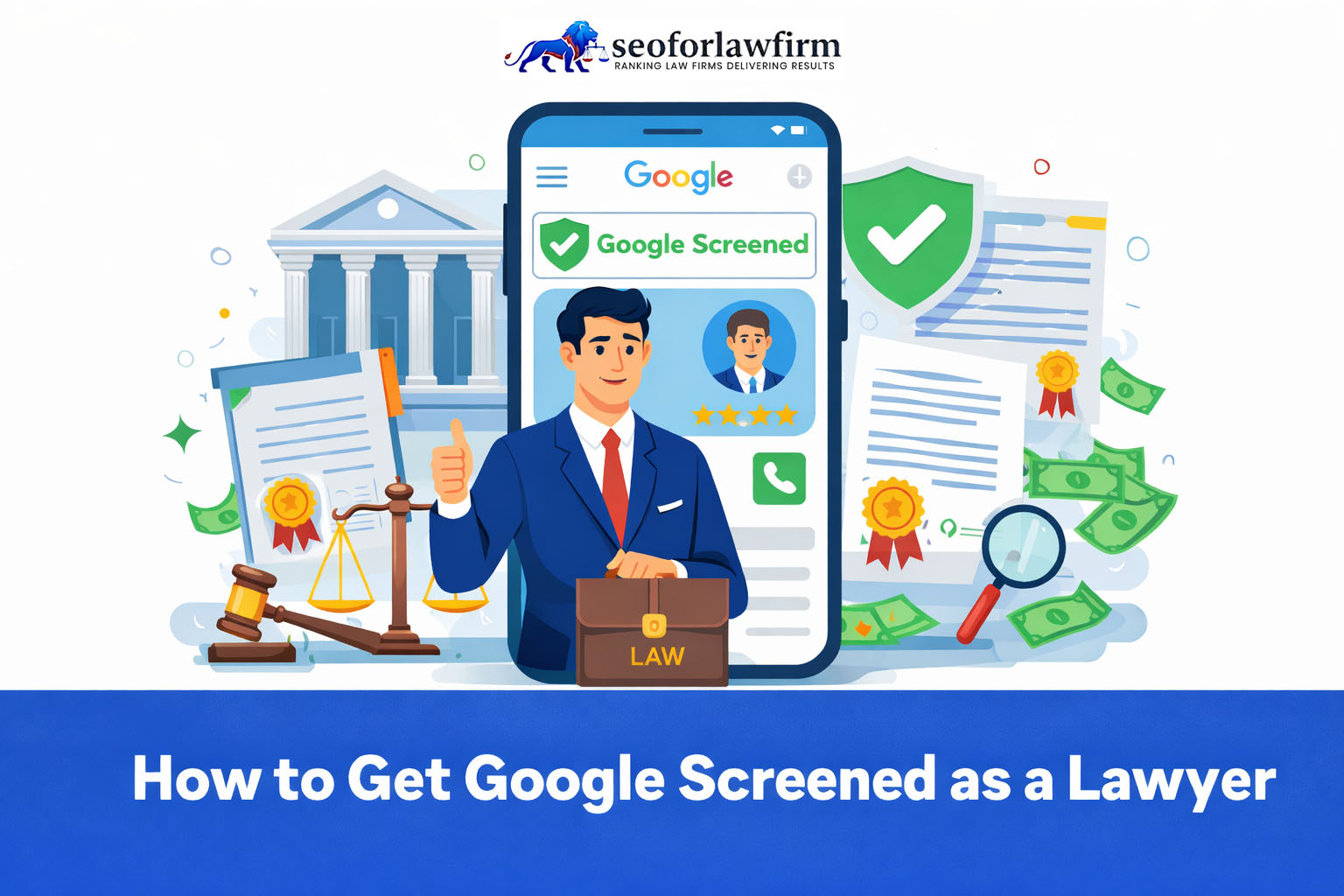
A lawyer gets Google Screened by joining Google Local Services Ads and completing Google’s required screening and verification checks. In 2026, Google consolidated the former Google Screened badge into the Google Verified badge. New advertisers receive the Google Verified badge after completing the applicable verification requirements, and eligible existing advertisers who previously completed verification transition automatically.
Law firms in the United States must have a public, verified Google Business Profile to advertise through Local Services Ads. Legal categories also require state bar license verification for the lawyers associated with the profile, and Google lists professional liability insurance as a requirement for U.S. lawyer categories such as personal injury, family, immigration, criminal, estate, business, and litigation law. Identity verification, business registration checks, business checks, and owner background checks also apply in specified circumstances.
Google Local Services Ads also use reviews, headshots, service areas, legal service categories, business hours, and profile information to present the law firm to prospective clients. A study by the Google Local Services Ads Team from Google titled About ad rankings – Local Services Help in 2025 (with continuously applied verification guidelines through 2026) confirms that reviews are subject to category requirements, and Google states that rating, review count, responsiveness, images, completed verification checks, search relevance, and bidding contribute to Local Services Ads ranking.
Local Services Ads operate on a pay-per-lead model rather than the standard pay-per-click structure used by conventional Google Search Ads. Law firms set service areas, select applicable areas of law, establish a budget, and receive leads through supported contact methods. Google reports that the screening and verification process takes 3–4 weeks on average after documents are submitted, although individual applications vary.
Listed below are the 15 steps to get Google Screened as a lawyer.
- 1. Confirm Local Services Ads Eligibility: Verify that Google Local Services Ads supports the law firm’s legal category and geographic market. Eligibility varies by practice area and location.
- 2. Create or Verify Your Google Business Profile: Confirm that the law firm has an accurate and eligible Google Business Profile. The profile must represent the real-world business name, address, phone number, website, and office details.
- 3. Create Your Local Services Ads Account: Set up a Local Services Ads account using the law firm’s business information. Connect the account with the appropriate Google Business Profile where required.
- 4. Enter Accurate Law Firm Information: Add the firm name, address, phone number, website, business hours, and other requested details. The information must remain consistent with the firm’s website, Business Profile, and professional records.
- 5. Select Eligible Legal Practice Areas: Choose the legal services the firm actually provides and that Google makes available within Local Services Ads. Avoid selecting practice areas that the firm does not handle.
- 6. Submit State Bar License Information: Provide current attorney licensing information for the lawyers connected with the advertised legal services. Confirm that names, jurisdictions, and license details match official professional records.
- 7. Complete Identity and Business Verification: Submit the information Google requests to verify the people and business associated with the account. Verification information must match the law firm’s official records.
- 8. Complete Required Background Checks: Complete any background-screening process required for the legal category and market. Provide accurate information and respond to verification requests when needed.
- 9. Submit Professional Liability Insurance: Provide proof of professional liability insurance when Google requires insurance verification for the category. Keep policy information current so expired documentation does not interrupt account eligibility.
- 10. Add Compliant Attorney Headshots: Upload professional attorney photographs that satisfy Google’s image requirements. The images must accurately represent the lawyers associated with the profile.
- 11. Meet Applicable Review Requirements: Maintain the review requirements that apply to the legal category and Local Services Ads program. Reviews must come from genuine client experiences and comply with Google’s review policies.
- 12. Set Service Areas and Lead Categories: Define the geographic markets and legal lead types the firm wants to receive. The selected areas must match the jurisdictions and markets where the firm accepts matters.
- 13. Follow Lawyer Advertising and Google Ads Rules: Review applicable professional-conduct rules and Google advertising policies before activating campaigns. Claims, fees, testimonials, practice descriptions, and contact information must remain accurate and compliant.
- 14. Complete Verification and Activate Local Services Ads: Finish all required verification steps before making the campaign active. Confirm that practice areas, service areas, budget settings, contact details, and lead preferences are correct before launch.
- 15. Maintain Verification and Monitor the Account: Keep licenses, insurance, business details, attorney information, and other verification records current after activation. Monitor leads, profile status, reviews, disputes, account notifications, and verification requests to prevent avoidable interruptions.
Table of Contents
- Article sections will appear here.
1. Confirm Local Services Ads Eligibility
A lawyer must operate in a legal category and geographic area supported by Google Local Services Ads before beginning verification. Google includes lawyers within its Professional Services categories in the United States, with eligible areas covering bankruptcy, business, contract, criminal, disability, DUI, estate, family, immigration, intellectual property, labor, litigation, malpractice, personal injury, real estate, tax, traffic law, and other supported legal services.
Eligibility and verification requirements vary by practice category and location. Law firms must therefore review the requirements displayed in their Local Services Ads account before submitting licenses, insurance, identity information, or other verification documents.
2. Create or Verify Your Google Business Profile
A U.S. law firm needs a public and verified Google Business Profile to advertise through Local Services Ads.
The Google Business Profile needs to accurately identify the law firm and its real-world business information. Firm name, location, phone information, business hours, and other public information need to remain consistent with the business the advertiser is asking Google to verify.
The Business Profile also supplies reviews used with Local Services Ads. Google states that Local Services Ads reviews are managed through Google Business Profile Manager.
Law firms managing broader geographic visibility coordinate Business Profile work with their local SEO strategies, but organic local optimization and paid Local Services Ads remain separate acquisition channels.
3. Create Your Local Services Ads Account
Create a Local Services Ads account to begin Google’s verification process for the law firm. Google asks the advertiser to provide services, service areas, business hours, contact information, and other details used to build the Local Services profile.
The firm must also configure billing and set an advertising budget before launch. Local Services Ads charge for eligible leads rather than standard ad clicks, and prospective clients contact the firm through supported lead methods such as calls or messages.
4. Enter Accurate Law Firm Information
The law firm must provide business information that accurately represents the entity delivering the advertised legal services. Google requires Local Services Ads advertisers to use truthful information about qualifications, licenses, insurance, locations, service areas, prices, and other business attributes.
The firm must also ensure that any professional license submitted belongs to an attorney who actually works for the business. Accurate and consistent records reduce verification delays and help Google confirm the identity of the firm.
Listed below are the 9 main law firm details to verify before submission.
- Business Name: Use the firm’s accurate real-world business name.
- Business Address: Provide the genuine office address associated with the advertised services.
- Phone Number: Use a current business number that connects prospective clients with the firm.
- Website: Submit the official website that represents the law firm and its services.
- Business Registration Information: Provide current registration or entity details when Google requests them.
- Owners or Representatives: Identify the owners or authorized representatives required for verification.
- Associated Attorneys: List attorneys who actually work for the firm and provide the advertised legal services.
- Service Areas: Select only the geographic markets where the firm lawfully and commercially accepts matters.
- Legal Service Categories: Choose only the practice areas the firm genuinely provides.
5. Select Eligible Legal Practice Areas
A lawyer must select only the legal practice areas that accurately match the services the law firm provides. Google uses service categories, job types, service areas, and other account settings to determine which Local Services searches a firm enters.
A personal injury firm must select the available personal injury category rather than unrelated legal services chosen only to increase lead volume. The firm must accept only matters that its attorneys are licensed, insured, and able to handle. Personal injury firms using Local Services Ads coordinate paid local acquisition with personal injury law firm SEO without treating one channel as a replacement for the other.
6. Submit State Bar License Information
A lawyer must submit valid state bar license information for the jurisdictions connected with the legal services advertised through Google Local Services Ads. Google verifies attorney licenses for supported U.S. legal categories such as personal injury, bankruptcy, criminal, estate, family, immigration, intellectual property, labor, litigation, malpractice, real estate, tax, and traffic law.
The submitted license information must match the attorney, jurisdiction, and Local Services profile. Law firms with attorneys licensed in different states must advertise legal services only in jurisdictions where the relevant lawyers hold the licenses required to provide those services.
7. Complete Identity and Business Verification
Google requires lawyer advertisers to complete the identity and business verification steps assigned to their accounts.
Current U.S. lawyer-category requirements list business-owner identity verification and fieldworker identity verification. Business registration or representative checks also apply to specified categories and users.
Google has also introduced risk-based verification for select U.S. advertisers. An advertiser’s account receives different verification requirements based on the information and risk signals available to Google and its verification partners.
8. Complete Required Background Checks
Background checks apply according to the lawyer’s category, location, and Google account requirements rather than one identical rule for every attorney.
Google states that business owners and, in some cases, service professionals undergo background checks conducted through third-party risk-management companies. In the United States and Canada, Google currently describes business and owner checks as applying to select users.
Google’s general background-check process involves identity and criminal-history checks for the applicable business owners. The current U.S. lawyer-category tables label business checks and owner checks as applying to select users.
A law firm that fails a required background check does not qualify for the Google program connected to that screening process.
9. Submit Professional Liability Insurance
U.S. lawyers using Google Local Services Ads must submit professional liability insurance when Google requires coverage for the applicable legal category. Google lists insurance verification for legal categories such as personal injury, family, estate, immigration, criminal, business, contract, labor, litigation, malpractice, intellectual property, real estate, tax, and traffic law.
Advertisers must upload current insurance documentation through the Business Verification process when requested. The policy information must match the law firm’s verified business details. Lawyers must also maintain any insurance required by the licensing and regulatory rules that apply in their jurisdiction.
10. Add Compliant Attorney Headshots
Lawyers must upload professional attorney headshots that meet Google Local Services Ads image requirements. Google currently requires JPEG or PNG files with a minimum resolution of 500 × 500 pixels and a square 1:1 aspect ratio, and the photograph must show someone who works for the business.
Headshots must avoid text overlays, multiple people, excessive filters, low-quality imagery, and other noncompliant formatting. Starting August 2, 2026, Google also prohibits AI-generated or AI-edited Local Services Ads images in the European Union and New York State.
11. Meet Applicable Review Requirements
Law firms need to satisfy the review requirements Google assigns to their Local Services Ads category. Firms must not rely on an outdated universal claim that every lawyer needs exactly a 3.0-star rating and one review.
Google’s current onboarding documentation describes reviews as “subject to category requirements.” Google’s review documentation also confirms that star rating and review count affect Local Services Ads ranking.
Law firms request genuine reviews from clients using Google’s review link. Review acquisition needs to follow Google’s review policies and applicable lawyer advertising obligations.
Review management also extends beyond gaining positive ratings. Law firms need a defined process for responding to negative reviews without disclosing confidential client information.
12. Set Service Areas and Lead Categories
A lawyer controls Local Services Ads targeting through the legal services and geographic areas selected in the account.
Google allows advertisers to select cities, counties, neighborhoods, or ZIP codes where supported. Job types determine the kinds of services for which the business wants leads.
Law firms need to align these settings with the jurisdictions where their lawyers are authorized to practice and the matters the firm accepts.
Google’s lawyer-specific broad-search controls also allow advertisers to determine whether their profile participates in broader “general law” searches in addition to searches naming a particular area of law.
13. Follow Lawyer Advertising and Google Ads Rules
A Google-verified lawyer remains responsible for every professional-conduct, licensing, and advertising rule that applies to the firm’s marketing.
Google requires Local Services advertisers to comply with applicable laws and regulations and prohibits misleading representations concerning qualifications, licenses, insurance, service areas, and other business information.
A study by the American Bar Association from the Center for Professional Responsibility titled Rule 7.1: Communications Concerning a Lawyer’s Services in 2024 (with ongoing compliance frameworks enforced through 2026) confirms that ABA Model Rule 7.1 states that a lawyer must not make a false or misleading communication about the lawyer or the lawyer’s services.
Claims about results, experience, case outcomes, specialization, comparisons, guarantees, and similar marketing statements require particular care. A broader lawyer advertising ethics review helps keep the LSA profile consistent with the firm’s other marketing channels.
14. Complete Verification and Activate Local Services Ads
Google issues the Google Verified badge after a new advertiser completes the required Local Services Ads screening and verification process. Existing eligible advertisers that already completed the required checks transition to the unified badge without repeating verification solely because the badge name changed.
A study by the Google Local Services Ads Team from Google titled Background check timeline and expectations – Local Services Help in 2025 (with continuously applied verification guidelines through 2026) confirms that screening and verification take 3–4 weeks on average after document submission, although additional checks or document requests extend the process. After activation, Local Services Ads compete through an auction that evaluates bidding, lead likelihood, responsiveness, search relevance, services, profile information, reviews, response time, images, and verification status.
Listed below are the 10 main factors that affect Local Services Ads placement after activation.
- Bid: Google considers the advertiser’s bidding settings when determining ad placement.
- Lead Likelihood: Google evaluates the likelihood that an advertisement will generate a prospective client lead.
- Responsiveness: Fast and consistent responses to enquiries influence advertising performance.
- Search Context and Relevance: Google compares the user’s search with the firm’s services, location, and profile information.
- Services Offered: Selected legal categories help determine whether the firm matches the prospective client’s legal need.
- Business Profile Information: Accurate firm details help Google evaluate the business and its relevance.
- Rating and Review Count: Genuine ratings and reviews contribute information about the firm’s reputation.
- Average Response Time: Google considers how quickly the firm responds to prospective clients.
- Images: Compliant professional images support the completeness and presentation of the advertiser profile.
- Completed Verification Checks: Required licensing, insurance, identity, and other verification steps affect eligibility for the Google Verified badge and advertising participation.
15. Maintain Verification and Monitor the Account
Law firms must maintain Google verification by keeping licensing, insurance, business information, service settings, and professional details current after Local Services Ads activation. Google re-evaluates advertisers and requests additional verification checks when account or business information changes.
Failure to complete required follow-up reviews affects badge status, ad delivery, or account access. Firms must also monitor lead responsiveness because missed calls and unanswered enquiries affect Local Services Ads performance.
Listed below are the 11 main account elements law firms must monitor and update.
- Attorney Licensing: Keep bar and professional-license information current for every lawyer connected with advertised services.
- Insurance: Update professional liability insurance records when policies renew, change, or expire.
- Business Information: Maintain accurate firm names, addresses, phone numbers, websites, and ownership details.
- Service Areas: Adjust geographic coverage when the firm expands, contracts, or changes where it accepts matters.
- Job Types: Keep selected legal-service categories aligned with the matters the firm actually handles.
- Business Hours: Update operating hours so prospective clients receive accurate availability information.
- Featured Professionals: Add or remove attorneys when staffing or practice responsibilities change.
- Photos: Replace outdated or noncompliant images and keep professional profile photos current.
- Lead Availability: Adjust lead settings when the firm cannot accept new matters or when intake capacity changes.
- Verification Requests: Respond to Google’s follow-up checks and document requests when they appear.
- Lead Responsiveness: Monitor missed calls, unanswered messages, and response times because responsiveness affects Local Services Ads performance.
What Is Google Screened?
Google Screened was Google’s verification badge for professional-service advertisers such as lawyers, while Google now uses the unified Google Verified badge for eligible Local Services Ads advertisers. The verification process checks requirements that include business registration, professional licensing, insurance, identity, reviews, and background checks depending on the advertiser’s category and location. The badge shows that the advertiser completed Google’s applicable verification process.
What Requirements Must Law Firms Meet?
Law firms must satisfy the Local Services Ads screening and verification requirements assigned to their legal category, business, and location. Google requires verified business information, state bar licenses, professional liability insurance, identity checks, background verification, business registration, reviews, and accurate profile information before or during participation. Requirements vary by advertiser, so the law firm must use its Business Verification dashboard as the primary source for the checks assigned to its account.
Listed below are the 8 main verification areas for U.S. lawyer advertisers.
- Verified Google Business Profile: Maintain a public and verified business profile that accurately represents the law firm.
- State Bar Licenses: Provide current licensing information for each lawyer connected with supported legal categories.
- Professional Liability Insurance: Submit current insurance documentation when Google requires coverage for the applicable lawyer category.
- Identity Verification: Complete identity checks for relevant business owners and legal professionals.
- Background Verification: Complete business-owner or professional background checks when Google assigns them to the account.
- Business Registration: Provide business registration or representative information when required for verification.
- Reviews: Meet any applicable review requirements associated with Local Services Ads onboarding.
- Accurate Profile Information: Keep services, locations, licensing, business details, and other profile information accurate throughout the verification process.
How Does Google Verification Help Personal Injury Lawyers?
Google verification gives an eligible personal injury law firm access to the Google Verified presentation within Local Services Ads after the firm completes Google’s screening process.
Google lists personal injury lawyers as an eligible U.S. professional-services category. Its current requirements include identity verification, selected business and owner checks, business registration verification, professional liability insurance, and state bar license checks for each personal injury lawyer in the firm.
Local Services Ads give personal injury firms a prominent paid-search presence and a direct lead channel. The actual cost per lead, consultation rate, signed-case rate, and return depend on the market, bidding, profile, intake process, competition, case mix, and other variables. Google verification alone does not establish that personal injury lawyers receive the highest return or convert at a particular percentage.
How Does Google Screened Work?
Google Screened works by validating a lawyer’s professional background through Local Services Ads (LSAs) and awarding a green check badge that signals trust and legitimacy. The verification process requires attorneys to confirm active bar licenses, pass background screenings, and provide proof of liability insurance before approval.
Once verification is complete, a lawyer’s profile appears in LSAs positioned above standard search ads. These profiles allow potential clients to filter by practice area, location, and business hours, making it easier to connect with qualified attorneys nearby.
The badge improves both visibility and credibility by assuring clients that the attorney has been vetted according to Google’s standards of professionalism. For law firms, this translates into stronger lead quality, higher conversion rates, and an edge over competitors without certification.
How Long Does It Take to Get Google Screened as a Lawyer?
Google states that Local Services Ads screening and verification take approximately 3–4 weeks on average after the required documents are submitted. The actual timeline depends on the verification checks assigned to the law firm and whether Google requests additional information.
Incorrect bar license details, insurance documents, business information, or incomplete verification steps delay approval. Law firms must therefore submit accurate records and complete every assigned verification requirement to reduce avoidable delays.
What are the most common reasons lawyers get rejected from Google Screened?
Lawyers are rejected from Google Screened due to issues like unverified or expired licenses, low ratings on their Google Business Profile, or inconsistent responsiveness to client inquiries. Google requires active bar membership and a minimum 3.0-star rating, so any gaps in documentation or poor engagement with leads will disqualify applicants. Additionally, firms with limited online presence or negative reviews may struggle to meet the platform’s trust standards.
Listed below are the 6 most common reasons lawyers get rejected from Google Screened.
- Failing to pass the mandatory background checks: disqualifying firm owners or attorneys with flagged records.
- Incomplete or incorrect license verification: state bar license not current or discrepancies in submitted details.
- Submitting inaccurate business information (NAP inconsistencies): mismatched name, address, or phone details across listings.
- Lack of sufficient or authentic client reviews on Google: failing to meet the review volume or rating threshold.
- Issues with insurance coverage requirements: missing proof of liability insurance where required by Google.
- Not meeting Google’s practice area eligibility criteria: applying in categories outside of approved legal services.
A report by BrightLocal, titled Local Services Ads Guide in 2022, found that nearly 20% of professional service providers, including law firms, face rejection in the Google Screened process due to incomplete documentation, failed background checks, or insufficient reviews.
What Background Checks Are Involved in the Screened Program?
To earn the Google Screened badge, attorneys and their law firms must pass a series of rigorous background checks designed to verify professional legitimacy and protect potential clients. These checks are part of Google’s Local Services Ads onboarding process and focus on both individual and business-level qualifications.
Listed below are the 5 core background checks involved in Google’s screening.
- Criminal History Check: Google reviews federal, state, and local records to ensure the attorney has no disqualifying offenses.
- Identity Verification: The lawyer must submit government-issued identification to confirm their identity.
- Business Entity Check: The law firm must be properly registered and legally operating within its jurisdiction.
- Bar License Status: Google verifies that the attorney holds an active law license and checks for any disciplinary actions.
- Insurance Verification: Proof of current professional liability insurance is required to ensure client protection.
These checks are conducted through third-party verification partners and must be completed before the badge is awarded. For law firms, passing these checks not only meets Google’s standards but also enhances credibility and client trust.
How Can a Law Firm Maintain Google Verified Status?
A law firm maintains Google Verified eligibility by keeping required credentials accurate and completing any follow-up verification Google requests. Google re-evaluates advertisers and requires selected checks to be repeated when business or account information changes.
Law firms must monitor attorney licenses, professional liability insurance, ownership details, business information, practice areas, service areas, reviews, and advertising compliance. Failure to complete requested verification results in badge removal, paused advertising, or account suspension. Google does not apply one universal annual renewal date to every lawyer account.