
Search ads capture people actively searching for legal help, while display ads place visual advertising in front of audiences as they browse websites, apps, YouTube, Gmail, and other eligible digital inventory. Search advertising therefore centers on expressed legal intent, whereas display advertising centers more heavily on reach, awareness, consideration, and selected performance campaigns.
Search ads are text-led advertisements connected with searches such as “divorce lawyer near me,” “car accident attorney,” or “criminal defense lawyer in [city].” Google uses keywords and other campaign signals to determine when an ad is eligible to appear alongside or above search results. An advertiser does not automatically receive the first paid position merely because the advertiser bids on a keyword.
Search advertising fits high-intent legal acquisition because the prospective client has already expressed the legal need through the search query. A person searching “DUI attorney near me” communicates a different level of intent from a person reading an unrelated news article and seeing a criminal-defense display ad.
Display ads use visual assets such as images, logos, headlines, descriptions, and video to reach people outside the traditional Search results page. Google Display inventory reaches websites, apps, Gmail, and portions of YouTube, giving law firms a way to maintain visibility before or after a person conducts a direct lawyer search.
A 2025 analysis by WordStream confirms legal services command high-intent CPCs, while LeadGulls validates that passive display inventory often causes a mismatch with law firm acquisition economics, aligning with the distinction between search intent and display reach. This research that while search ads drive high-intent leads, display advertising functions primarily for awareness and broad targeting.
Google supports display objectives involving awareness, website traffic, leads, and other performance goals. The difference is that display audiences usually do not express legal intent through a live search query at the moment the ad appears.
Audience targeting also requires more care for legal advertising. Google classifies subjects including commission of a crime, health, negative financial status, relationship hardships, abuse and trauma, and other personal circumstances as sensitive-interest categories. Advertisers promoting covered services cannot use advertiser-curated audiences in the same way they can for nonsensitive products. Divorce services are explicitly listed under relationship hardships, bankruptcy falls under negative financial status, and criminal matters can fall under commission-of-a-crime restrictions.
Google also began moving Display campaigns into the Demand Gen campaign workflow with Google Display Network inventory in June 2026. The advertising inventory remains available, but law firms need to account for the changing campaign-management structure when following older Display setup guides.
Table of Contents
- Article sections will appear here.
What Are Display Ads in Legal Marketing?
Display ads in legal marketing are visual advertisements shown across eligible websites, apps, Gmail, YouTube, and other Google Display Network placements. Law firms use display ads to build awareness, promote legal services, and reach audiences who are not necessarily searching for a lawyer at that moment. Responsive display ads combine images, headlines, logos, descriptions, and videos, and Google adapts those assets to different placements and formats.
Law firms can use display advertising to promote estate-planning seminars, firm branding, business-law services, attorney educational resources, class-action information campaigns, and broader legal-service offerings. Display campaigns can support both awareness and direct-response goals, but inexpensive impressions or clicks do not automatically produce inexpensive clients. Search advertising responds to an expressed legal need, while display advertising places the firm’s message in front of an audience before or during the consideration process.
What Does a Google Display Ad Look Like?
A Google Display ad usually combines visual and text assets such as an image, logo, headline, description, and call to action. Responsive display ads use uploaded assets to create different combinations across eligible websites, apps, Gmail, and YouTube inventory. A law firm ad might feature a headline such as Estate Planning for Your Family, a consultation message, the firm logo, an attorney or brand image, and a Learn More call to action.
Uploaded image ads give advertisers more control over the final creative, while responsive display ads give Google more flexibility to adapt the presentation to different placements. Ad performance depends on the creative, audience, placement, offer, geography, landing page, and measurement strategy rather than the ad format alone.
How Do Search Ads Help Lawyers Attract High-Intent Clients?
Search ads help lawyers attract high-intent clients by placing relevant advertisements in search results after users enter queries connected with legal services or legal problems. Searches such as personal injury lawyer near me, divorce attorney in Denver, DUI attorney, bankruptcy lawyer consultation, and estate planning lawyer signal stronger commercial intent because the user is actively seeking legal help.
Google Search campaigns use keywords to connect ads with relevant search terms, while match types and negative keywords refine which searches trigger the ads. A broader law firm PPC guide should connect keyword selection with bidding, landing pages, conversion tracking, qualified leads, and signed-client attribution.
Do Search Ads Always Appear at the Top of Google?
No, search ads do not always appear at the top of Google because each search triggers an auction that determines ad eligibility and placement. Google evaluates factors such as bid strategy, search query, competition, ad relevance, landing-page experience, ad quality, location, device, auction context, and the expected contribution of ad assets.
A law firm with an active campaign can therefore receive different ad positions, CPCs, impression volumes, and conversion rates across searches. Search advertising gives the firm eligibility to compete for paid visibility, but it does not guarantee the first paid position.
Display Ads vs. Search Ads: What Is the Difference for Law Firms?
The difference between display ads and search ads for law firms is that search advertising responds to expressed search intent, while display advertising reaches audiences during browsing, viewing, or other digital activity outside a direct legal search.
The table below shows the main differences between display and search ads for lawyers.
| Aspect | Display Ads | Search Ads |
| Primary trigger | Audience, context, placement, or campaign targeting | Search query and campaign matching |
| User behavior | Browsing content | Actively searching |
| Common format | Images, logos, text, responsive creative, video assets | Text-led search advertisement with assets |
| Main strength | Reach, awareness, consideration, selected performance objectives | Capturing existing demand |
| Initial legal intent | Often lower | Usually higher |
| Common objective | Awareness, consideration, assisted acquisition, leads | Calls, forms, consultations, direct leads |
| CPC pattern | Often lower than competitive legal Search | Often higher in competitive legal markets |
| Conversion path | Frequently longer | Frequently shorter |
| Audience-policy exposure | Significant for sensitive-interest targeting | Also subject to Google policy, with fewer audience issues when targeting contextual search intent |
| Best measurement | Reach + qualified outcomes + assisted impact | Qualified leads + signed-client acquisition |
| Typical legal role | Supporting or expanding acquisition | Core direct-response channel |
How Does Intent Differ Between Search-Ad Users and Display-Ad Viewers?
Search-ad users express active intent through the queries they enter, while display-ad viewers encounter a law firm’s message during another activity. Search advertising therefore begins with declared need, while display advertising often begins with exposure and awareness. Search users often reach consultation actions sooner, but neither channel guarantees a qualified case.
The table below shows the main intent differences between Search-Ad users and Display-Ad Viewers.
| Factor | Search-Ad User | Display-Ad Viewer |
| Starting action | Enters a legal search query | Encounters an advertisement |
| Intent signal | Explicit | Often indirect |
| Example | Truck accident lawyer Houston | Houston Personal Injury Law Firm |
| Legal need | Often already identified | May or may not be identified |
| Geographic intent | Often stated in the query | Defined mainly through targeting |
| Hiring intent | Often stronger | Usually less certain |
| Marketing role | Demand capture | Awareness and demand development |
| Typical conversion path | Often shorter | Often longer |
Are Search Ads Better for Direct Legal Lead Generation?
Yes, search ads are usually better suited to direct legal lead generation because users have already expressed a legal need through a search query. A search such as criminal defense attorney open now signals immediate service and hiring intent, while a display ad viewer may not have expressed the same need.
Search ads therefore align well with phone calls, consultation requests, form submissions, appointment bookings, and qualified case enquiries. Display advertising can also generate leads, but law firms should measure it separately because display and search traffic behave differently. A PPC strategy for lawyers should evaluate both channels through qualified legal enquiries and signed matters rather than clicks alone.
How Should Lawyers Measure Search and Display Advertising?
Lawyers should measure Search and Display advertising across the full acquisition path from impression to signed client rather than judge performance through CPC or click-through rate alone. A complete law firm SEO and marketing tracking process should connect advertising data with qualified leads, consultations, signed clients, and financial outcomes while also accounting for assisted journeys across channels.
Listed below are the 10 main metrics lawyers should track.
- Impressions.
- Clicks.
- Cost per click (CPC).
- Leads.
- Qualified leads.
- Cost per lead (CPL).
- Consultation rate.
- Signed clients.
- Customer acquisition cost (CAC).
- Revenue or profit.
When Is Display Reach More Valuable Than Search Reach for Lawyers?
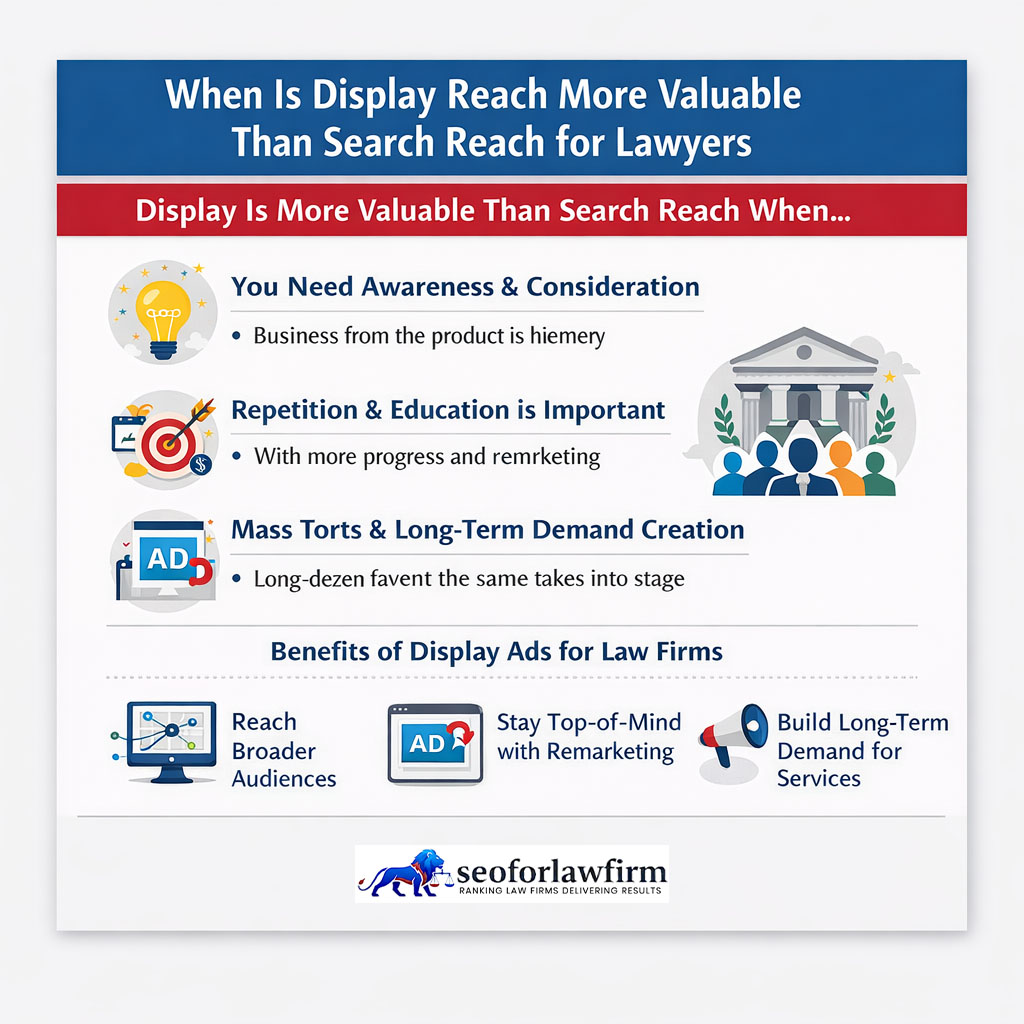
Display reach is more valuable when a law firm needs broader awareness, repeated exposure, educational promotion, or early-stage consideration rather than only immediate search demand. Search advertising captures existing demand, while display advertising reaches relevant audiences before they actively search for a lawyer. Display therefore works well when the firm wants to expand visibility beyond the limited number of people currently entering legal-service queries.
Listed below are 7 situations where display reach is more valuable.
- Estate-planning education.
- Business-law awareness.
- Public webinars.
- Attorney brand campaigns.
- Certain mass-tort information campaigns.
- Community initiatives.
- Legal educational resources.
Does a Lower Display CPC Mean Display Ads Are More Cost-Effective?
No, a lower display CPC does not prove that display advertising is more cost-effective because acquisition efficiency depends on what happens after the click. A display campaign with a $2 CPC and 100 clicks costs $200, but one qualified lead produces a $200 CPL.
A search campaign with a $20 CPC and 100 clicks costs $2,000, but 20 qualified leads produce a $100 CPL. The search traffic costs more per click but less per qualified lead. Law firms should therefore evaluate CPC as the cost of traffic, CPL as the cost of leads, and CAC as the cost of acquiring clients.
Do Search Ads Always Have a Lower CAC Than Display Ads?
No, search ads do not always produce a lower CAC than display because expensive keyword auctions, weak landing pages, poor lead qualification, and ineffective intake can make Search acquisition unprofitable. Search traffic often carries stronger intent, but stronger intent does not guarantee lower client-acquisition costs. A broad query such as lawyer can generate expensive traffic with weak case relevance. In contrast, a narrower query such as commercial truck accident lawyer Dallas communicates clearer service and location intent. Search campaign economics depend on query relevance, landing-page relevance, lead qualification, intake performance, and signed-client conversion. Weak performance at any stage increases CAC.
What Mistakes Do Lawyers Make With Search and Display Ads?
The most common search and display advertising mistakes for lawyers are weak intent targeting, poor conversion tracking, and measuring clicks instead of qualified clients.
Listed below are the 11 common mistakes lawyers need to avoid.
- Using broad Search targeting without reviewing search terms: Broad matching can expose expensive legal campaigns to irrelevant queries when campaign controls and conversion data are weak.
- Ignoring negative keywords: Job searches, academic queries, unrelated legal services, and other irrelevant traffic can consume Search budgets.
- Sending every Search ad to the homepage: A person searching for a truck-accident lawyer usually needs a truck-accident landing page rather than a general firm homepage.
- Using generic ad copy: Search messaging needs to match the actual practice area and service without unsupported claims.
- Tracking every form as equal: A qualified personal-injury case and a vendor enquiry do not carry the same business value.
- Ignoring phone attribution: Law firms often generate substantial lead volume through calls, making call-source measurement necessary.
- Using Display as an unrestricted remarketing channel: Sensitive-interest policies restrict advertiser-curated audiences for several legal subjects.
- Mixing Google Display and social advertising: Meta and LinkedIn are separate advertising platforms with separate campaign systems.
- Judging Display from CPC alone: Cheap display traffic does not prove low CAC.
- Judging Search from lead volume alone: A campaign producing more calls can still produce fewer signed clients.
- Ignoring lawyer-advertising rules: Paid advertisements remain communications about legal services and need to comply with applicable professional-conduct rules.
ABA Model Rule 7.1 serves as the foundational standard prohibiting deceptive marketing, while Rule 7.2 explicitly permits the broad use of media channels for advertising. Because the ABA only issues “Model Rules,” state bars hold the ultimate authority and frequently implement their own stricter, localized guidelines.
A lawyer advertising ethics guide should govern claims about results, specialization, fees, comparisons, guarantees, testimonials, and other advertising statements.

What Search and Display Ad Claims Should Lawyers Avoid?
Lawyers should avoid Search and Display ad claims that are false, misleading, unsubstantiated, or likely to create unjustified expectations about the lawyer or case outcome. Paid-ad creative should follow the same factual and professional-responsibility standards as the law firm website because even truthful statements can become misleading when presented without proper context.
Listed below are the 11 risky advertising claims lawyers should avoid.
- Guaranteed win.
- Guaranteed settlement.
- #1 lawyer without substantiation.
- Best attorney without support.
- We always win.
- Guaranteed dismissal.
- Lowest legal fees without substantiation.
- Specialist claims that do not satisfy applicable certification rules.
Where Can Law Firms Get Professional Search and Display Ads Management?
SEOForLawFirm.com is a specialized legal marketing provider that gives law firms structured, performance-focused Search and Display advertising support across keyword strategy, audience targeting, landing pages, conversion tracking, and client-acquisition measurement. Law firms can also obtain paid advertising support from legal marketing agencies, independent PPC consultants, Google Ads specialists, media-buying firms, conversion optimization agencies, and experienced in-house marketing teams.
A professional engagement should separate high-intent Search acquisition from Display reach and connect practice-area analysis, keyword structure, negative keywords, geographic targeting, ad development, display creative, placement review, policy compliance, landing-page optimization, call and form tracking, qualified-lead attribution, consultation tracking, CAC reporting, and signed-client attribution. SEOforLawFirm.com provides PPC services for lawyers that connect Search intent, Display strategy, conversion performance, and client-acquisition outcomes.
Is Display Advertising Good for Remarketing Law Firm Visitors?
No, display remarketing is not automatically appropriate for every law firm because Google restricts advertiser-curated audiences for services connected with sensitive interests. Restricted categories include criminal activity, health conditions, negative financial status, relationship hardships, abuse, trauma, and other sensitive personal circumstances.
Divorce, bankruptcy, criminal defense, and certain injury-related legal campaigns can therefore face restrictions on using website visitors or first-party audience segments for personalized advertising. Google clarified these personalized-ad restrictions further in June 2026, including their application to Demand Gen and related campaign structures. Law firms should verify policy eligibility for each practice area, audience type, and targeting method before adding website visitors to remarketing campaigns.
How Do Search and Display Ad Costs Compare for Lawyers?
Search ads usually carry higher CPCs in competitive legal markets because advertisers compete directly for expressed legal demand, while display ads often deliver broader reach at lower traffic costs. Lower display CPCs do not automatically produce lower qualified-lead or client-acquisition costs. Law firms should compare campaign economics beyond the click and measure how each channel converts traffic into consultations, signed matters, and attributable revenue.
Listed below are the 10 main metrics law firms should compare.
- Cost per click (CPC).
- Qualified cost per lead (CPL).
- Cost per consultation.
- Customer acquisition cost (CAC).
- Signed-case value.
- Attributable revenue or profit.
- Practice-area competition.
- Geographic competition.
- Landing-page performance.
- Lead quality.
Which Ad Type Generates Higher-Quality Leads for Different Legal Practice Areas?
Search advertising usually provides the strongest direct-response fit across legal practice areas because users actively express the legal need, while display advertising fits awareness and consideration more often and requires additional policy review in sensitive practice areas.
The table below shows the channel fit for several law firm practice areas.
| Practice Area | Search Ad Role | Display Ad Role | Main Consideration |
| Personal injury | Strong direct-response fit | Awareness subject to targeting-policy review | Injury and health-related context requires policy care |
| Criminal defense | Strong direct-response fit | Restricted personalized targeting | Commission of a crime is sensitive |
| DUI defense | Strong direct-response fit | Restricted personalized targeting | Crime-related targeting restrictions |
| Family/divorce | Strong direct-response fit | Awareness with significant audience restrictions | Divorce is a relationship-hardship category |
| Bankruptcy | Strong direct-response fit | Restricted personalized targeting | Bankruptcy is a negative financial status |
| Estate planning | Strong direct-response fit for ready-to-hire users | Stronger awareness/education fit than urgent practices | Bereavement-related campaigns can create sensitive-interest issues |
| Business law | Useful for specific commercial searches | Useful for broader professional awareness | Longer consideration period |
| Employment law | Useful for service searches | Audience strategy requires campaign-specific policy review | User circumstances can affect targeting eligibility |
This comparison excludes Local Services Ads because LSAs are a separate Google advertising product rather than a type of Search campaign or Display campaign.
Are Local Services Ads the Same as Search Ads?
No, Google Local Services Ads are not the same product as Google Search campaigns, even though both can appear within Google search experiences. Search campaigns use the Google Ads Search system and compete through keyword-based auctions, while Local Services Ads use separate eligibility, verification, profile, and lead-based structures. Law firms should therefore evaluate LSAs as a distinct acquisition channel rather than group them with standard Search campaigns. Firms can use LSAs where the legal category and geographic market qualify.
How Do Social Media Display Ads Work for Lawyers?
Social media ads for lawyers work through paid-social advertising systems such as Meta and LinkedIn rather than through the Google Display Network. These platforms use their own inventory, targeting options, policy rules, bidding systems, conversion measurement, and user behavior signals.
Lawyers can use social ads for brand awareness, educational content promotion, event promotion, professional audience reach, and consideration campaigns. A Facebook image ad is therefore not a Google Display ad, and a LinkedIn sponsored post is not Google Display inventory. A law firm social media marketing strategy should measure paid-social performance separately from Google Search and Google Display campaigns.

How Is Google Display Advertising Changing in 2026?
Google is moving Display campaign management into Demand Gen with access to Google Display Network inventory, so law firms need to account for the 2026 migration when managing campaigns. The change affects campaign setup and management, but it does not remove Google Display Network inventory or change the basic distinction between Search demand capture and broader visual-network reach.
Listed below are the 5 main areas affected by the migration.
- Campaign creation.
- Campaign management.
- Audience configuration.
- Targeting review.
- Demand Gen integration.
How Should Lawyers Use Smart Bidding With Search and Display Ads?
Lawyers should use Smart Bidding only after defining the conversion actions and business outcomes that Google Ads should optimize. Smart Bidding uses auction-time signals to optimize toward conversions or conversion value, but campaign quality still depends on the conversion data supplied. A campaign optimized for low-quality form submissions can generate more low-quality leads, while reliable downstream data can support optimization toward qualified consultations or other business-relevant outcomes.
Listed below are the 3 main Smart Bidding strategies lawyers can use.
- Maximize conversions.
- Target CPA.
- Maximize conversion value.
- Target ROAS.