

Digital marketing for lawyers uses online channels to reach prospective clients and generate qualified enquiries. Digital marketing includes local SEO, Google Business Profile, Local Services Ads, PPC, content marketing, search, social media, and conversion tracking.
Local SEO connects law firms with people searching for nearby legal services through Google Search, Google Maps, and Google Business Profile. Accurate business information, relevant practice-area pages, reviews, local signals, and office information help prospective clients identify firms that serve their location and legal need.
Google Local Services Ads give eligible law firms another route to high-intent prospects. These ads use a pay-per-lead model rather than the standard pay-per-click model and generate calls and messages directly from Google Search. Google requires participating providers to complete screening and verification processes that vary by service category and location. Google now refers to qualifying badges as Google Verified, rather than relying on the older Google Screened terminology across current documentation.
A study by Taylor Young from the American Bar Association titled 2023 ABA Legal Technology Survey Report: Vol. IV – Marketing & Communication Technology in 2023 validates the organizational usage of digital marketing channels outlined in your paragraph. The comprehensive survey outlines the multi-channel reliance of modern firms, specifying who handles law firm websites, stating that solo practitioners often manage their own or use outside consultants, while larger firms rely heavily on dedicated marketing staff.
PPC advertising through platforms such as Google Ads and Microsoft Advertising gives law firms paid visibility for commercial legal searches. Legal keyword costs vary substantially by practice area, geography, competition, bidding strategy, and lead value, so campaign performance needs to be evaluated through qualified leads and signed matters rather than clicks alone.
Content marketing answers the questions prospective clients ask before contacting a lawyer. Practice-area pages, legal guides, attorney biographies, videos, and other useful resources support conventional Search as well as AI-driven Search experiences. Google states that the same foundational SEO practices remain relevant for AI Overviews and AI Mode; law firms do not need a separate technical “GEO” system, special AI schema, or new machine-readable file to qualify for those features.
Professional social media gives lawyers another channel for sharing educational content, attorney insights, firm news, and community activity. LinkedIn, Facebook, YouTube, and other platforms serve different audiences, so channel selection needs to follow the firm’s practice area, client profile, referral network, and measured performance.
Every marketing channel also needs to comply with the professional-conduct and advertising rules governing the firm. Case results, testimonials, attorney credentials, comparisons, guarantees, and other claims require accurate presentation and jurisdiction-specific review.
Table of Contents
- Article sections will appear here.
How Does Digital Marketing Help Lawyers Grow Their Practice?
Digital marketing helps lawyers grow their practice by connecting legal services with prospective clients across multiple online channels. Digital marketing turns search visibility, paid advertising, content, social media, and local discovery into calls, consultations, and qualified enquiries. Organic search helps users find legal information and service pages, while local search connects nearby prospects with eligible law firm offices. Paid search reaches people actively searching for legal services, and Local Services Ads generate direct enquiries for eligible legal categories.
Content helps prospective clients understand legal problems and evaluate the firm, while social media supports professional visibility, education, referrals, and audience engagement. The law firm website then converts this traffic into forms, calls, consultation bookings, and other intake actions. Digital marketing works best when these channels operate as one connected client-acquisition system rather than as isolated campaigns.

What Are the Most Effective Digital Marketing Strategies for Lawyers?
The most effective digital marketing strategies for lawyers are local SEO, Google Business Profile optimization, professional social media, and conversion-focused website management.
Listed below are the 7 main digital marketing strategies for lawyers.
- Local SEO: Improve visibility for geographically relevant legal searches and office locations.
- Google Business Profile: Maintain accurate business information, services, hours, reviews, photos, and office details for eligible locations.
- Local Services Ads: Generate eligible calls and messages through Google’s pay-per-lead local advertising system.
- PPC Advertising: Bid for high-intent commercial searches through Google Ads, Microsoft Advertising, and other relevant platforms.
- Content and Search Marketing: Publish useful legal content that answers genuine client questions and supports organic and AI-assisted search discovery.
- Professional Social Media: Use appropriate social platforms for education, professional networking, firm visibility, and referral relationships.
- Website and Conversion Optimization: Give visitors fast access to relevant legal information, attorney credentials, calls, forms, and consultation pathways.
Channel selection depends on the practice area, jurisdiction, client acquisition model, budget, competition, case economics, and existing referral network.
How Does Local SEO Help Lawyers Attract Clients?
Local SEO helps lawyers attract clients by improving how accurately and prominently a law firm appears for geographically relevant legal searches. Google evaluates local results mainly through relevance, distance, and prominence, so law firms must strengthen the signals they control through accurate business information, useful local pages, reviews, citations, links, and office-level content. An effective local SEO strategy for law firms must connect Google Business Profile management, website content, office locations, citations, reviews, attorneys, services, and local performance measurement.
Listed below are the 9 main local SEO actions law firms must manage.
- Maintain an eligible and accurate Google Business Profile.
- Use the correct business name and address.
- Keep operating hours current.
- Select categories that reflect real legal services.
- Build useful office and practice-area pages.
- Maintain accurate local citations.
- Earn genuine client reviews.
- Acquire legitimate local links and mentions.
- Connect office pages with relevant attorneys and services.
How Do Google Local Services Ads Work for Lawyers?
Google Local Services Ads for lawyers use a pay-per-lead model that connects eligible legal service providers with people searching for relevant local services. Participating firms complete applicable screening and verification requirements, and prospective clients contact advertisers through supported actions such as calls or messages. Unlike standard Search ads, Local Services Ads charge for valid leads rather than ordinary ad clicks.
Eligible legal categories vary by location and include bankruptcy, business, contract, criminal, DUI, estate, family, immigration, and other lawyer services. Law firms must evaluate LSA performance through lead quality, consultations, signed matters, and acquisition costs rather than lead volume alone.
Listed below are the 8 main Local Services Ads metrics law firms must track.
- Valid leads.
- Cost per lead.
- Practice area.
- Lead quality.
- Response rate.
- Qualified consultations.
- Signed matters.
- Cost per signed matter.
How Does PPC Marketing Work for Lawyers?
PPC marketing for lawyers places paid advertisements in front of people searching for legal services and usually charges the advertiser for each eligible click in standard Search campaigns. Law firms control campaign inputs such as budget, targeting, keywords, ads, landing pages, and conversion settings, while auction conditions, competitor activity, user behavior, and lead quality affect the final result. A PPC service for lawyers must connect search intent, landing pages, call tracking, intake qualification, advertising rules, and signed-case economics.
The table below shows the main differences between standard Search PPC and Local Services Ads.
| Dimension | Standard Search PPC | Local Services Ads |
| Primary pricing model | Usually pay per click | Pay per valid lead |
| Keyword management | Uses keyword targeting | Service/category-based targeting |
| Main placement | Google Search | Google Search and Maps local placements |
| Lead action | Website visit, call, or other conversion | Direct call, message, or supported booking |
| Verification badge | Not inherent to Search ads | Google Verified for eligible profiles |
| Optimization focus | Conversions, value, CPA, and ROAS | Leads, lead quality, and cost per lead |
Listed below are the 10 main PPC campaign inputs law firms control.
- Budget.
- Geographic settings.
- Campaign structure.
- Keywords where supported.
- Match types.
- Negative keywords.
- Landing pages.
- Ad messaging.
- Conversion actions.
- Bidding settings.
How Does Content Marketing Work for Law Firms?
Content marketing for law firms works by publishing useful legal information that answers prospective clients’ questions, explains legal services, demonstrates attorney experience accurately, and guides readers toward the next relevant action. Strong content must connect the audience, legal problem, search intent, useful answer, and related service rather than chase search volume alone. A law firm content strategy must map informational content to practice areas, audience needs, internal links, and client-acquisition pathways.
Listed below are the 10 main types of law firm content.
- Practice-area pages.
- Legal guides.
- Attorney biographies.
- Location pages.
- Case-result pages where permitted.
- Client resources.
- Videos.
- Checklists.
- Process explanations.
- News or legal updates where relevant.
How Should Lawyers Optimize Content for AI Search?
Lawyers should optimize content for AI-driven Search by following strong SEO fundamentals, publishing original and useful legal information, keeping content accurate, and making important information accessible to search engines. AI Overviews and AI Mode continue to rely on established Search systems, so law firms must focus on useful content and technical accessibility rather than creating separate content solely for AI features. Large numbers of thin pages targeting prompt variations create duplication and scaled-content risks.
Listed below are the 10 main practices for optimizing legal content for AI Search.
- Publish accurate legal explanations.
- Provide original information beyond generic summaries.
- Make substantive content available as indexable text.
- Use descriptive internal links.
- Keep attorney and business information accurate.
- Use relevant images or videos where useful.
- Ensure structured data matches visible content.
- Maintain strong technical SEO.
- Avoid separate pages for every AI prompt variation.
- Avoid special AI-only content systems or unnecessary AI markup.

How Can Social Media Support a Law Firm’s Online Marketing?
Social media supports law firm marketing by increasing professional visibility, distributing educational content, strengthening referral relationships, building attorney brands, and supporting audience engagement. LinkedIn fits attorney referrals, business law, employment law, corporate work, and professional thought leadership, while Facebook supports local visibility, consumer education, firm updates, and community engagement. YouTube gives attorneys space to answer legal questions through longer searchable videos, while short-form video platforms serve faster educational and awareness content.
Law firms must select platforms according to audience, practice area, referral network, content format, attorney participation, available resources, and measurable enquiries rather than maintain every social network. Social content must also follow the same advertising, confidentiality, and professional-conduct standards applied to other law firm communications. A law firm social media service must connect publishing activity with audience relevance, referrals, qualified enquiries, and business outcomes rather than followers, likes, or impressions alone.
How Should Lawyers Build Trust Through Digital Marketing?
Lawyers should build trust through digital marketing by presenting accurate attorney information, transparent processes, and verifiable evidence about the firm’s experience and services. Trust claims must match available evidence and comply with applicable lawyer-advertising rules. Case results must also include appropriate context because a prior outcome does not predict the result of another matter.
Listed below are the 11 main trust elements law firms must present.
- Attorney names and biographies.
- Bar admissions.
- Practice focus.
- Office information.
- Genuine reviews.
- Relevant professional credentials.
- Case outcomes presented with appropriate context.
- Clear intake process.
- Fee information where appropriate.
- Contact information.
- Informative legal content.
What Advertising Rules Do Lawyers Need to Follow Online?
Lawyers need to follow the professional-conduct, advertising, privacy, platform, and jurisdiction-specific rules that apply to websites, advertisements, social posts, testimonials, review responses, and other marketing communications.
A study by the American Bar Association from the Center for Professional Responsibility titled Rule 7.1: Communications Concerning a Lawyer’s Services in 2018 (with continuous enforcement) confirms that a lawyer shall not make false or misleading communications, while individual state jurisdictions maintain the authority to adopt or expand these regulations. Law firms must also review platform policies because certain legal services involving sensitive interests face restrictions on personalized advertising and audience targeting.
Listed below are the 13 main areas legal advertising review must address.
- Results claims.
- Testimonials.
- Comparisons.
- Superlatives.
- Attorney specialization claims.
- Guarantees.
- Disclaimers.
- Confidential client information.
- Solicitation restrictions.
- Referral arrangements.
- Advertising labels.
- Paid endorsements.
- Privacy and tracking.
How Can a Digital Marketer Optimize a Law Firm Website?
A digital marketer can optimize a law firm website by improving mobile usability, technical performance, search visibility, content quality, navigation, trust information, and contact pathways.
Listed below are the 6 main website optimization areas for law firms.
- Mobile Experience: Make practice areas, attorney profiles, calls, forms, and navigation usable on smartphones.
- Site Performance: Optimize images, scripts, hosting, rendering, and Core Web Vitals without treating speed as the only ranking consideration.
- Search Accessibility: Maintain crawlable pages, useful internal links, accurate metadata, indexability, and technically sound page architecture.
- Legal Content: Publish clear information that matches client questions and legal search intent.
- Conversion Paths: Provide relevant phone numbers, forms, consultation buttons, and next-step information without obstructive pop-ups or unnecessary friction.
- Measurement: Track organic acquisition, paid acquisition, calls, forms, consultations, qualified leads, and signed matters.
Structured data helps search engines interpret supported information and make pages eligible for certain Search features. Structured data does not provide a generic ranking increase.
Core Web Vitals also measure aspects of user experience, but engagement metrics such as bounce rate are not confirmed direct Google ranking factors.
What Digital Marketing Mistakes Should Lawyers Avoid?
The main digital marketing mistakes lawyers should avoid are relying on vanity metrics, publishing generic content, making unsupported claims, and failing to connect marketing with intake.
Listed below are the 9 main digital marketing mistakes lawyers must avoid.
- Tracking Traffic Instead of Clients: Website sessions do not show whether the firm acquired suitable matters.
- Running PPC Without Lead Qualification: A low cost per lead means little when most leads fail intake criteria.
- Treating Local SEO as GBP Alone: Local performance also depends on the website, business information, reviews, links, location, and relevance.
- Publishing Generic Legal Content: Commodity summaries give prospective clients little reason to choose or cite the firm.
- Creating AI Content at Scale Without Added Value: Large volumes of thin generated pages create quality and spam-policy risks.
- Sending Paid Traffic to Irrelevant Pages: A person searching for a specific legal service needs a landing page that addresses that service and next action.
- Treating Engagement Metrics as Ranking Factors: Bounce rate, session duration, and similar analytics metrics diagnose behavior but are not documented direct Google ranking factors.
- Making Unsupported Legal Marketing Claims: Guarantees, superiority claims, misleading case-result presentations, and inaccurate credentials create trust and compliance problems.
- Separating Marketing From Intake: Marketing cannot be evaluated properly when the firm does not record which enquiries qualify, consult, sign, and generate revenue.
Where Can Lawyers Get Professional Digital Marketing Services?
SEOForLawFirm.com is a specialized legal marketing provider that gives law firms structured, performance-focused digital marketing support across SEO, local search, PPC, content, technical performance, website conversion, and lead measurement. Lawyers also obtain digital marketing support from legal marketing agencies, independent SEO consultants, PPC specialists, local SEO providers, content agencies, web development firms, conversion-rate optimization specialists, fractional marketing leaders, and experienced in-house teams.
A professional engagement must identify the practice areas the firm wants to grow, the client audiences that fit those services, the locations the firm serves, the search queries that reflect useful intent, the paid channels that fit the budget, and the content and social platforms that match client behavior. The provider must also evaluate advertising restrictions, Local Services Ads eligibility, call and form quality, qualified enquiries, signed matters, and acquisition economics. SEOforLawFirm.com provides law firm SEO services that connect search visibility, local SEO, content, technical performance, paid acquisition, website conversion, and client-acquisition measurement.
How Should Lawyers Track Digital Marketing Leads and ROI?
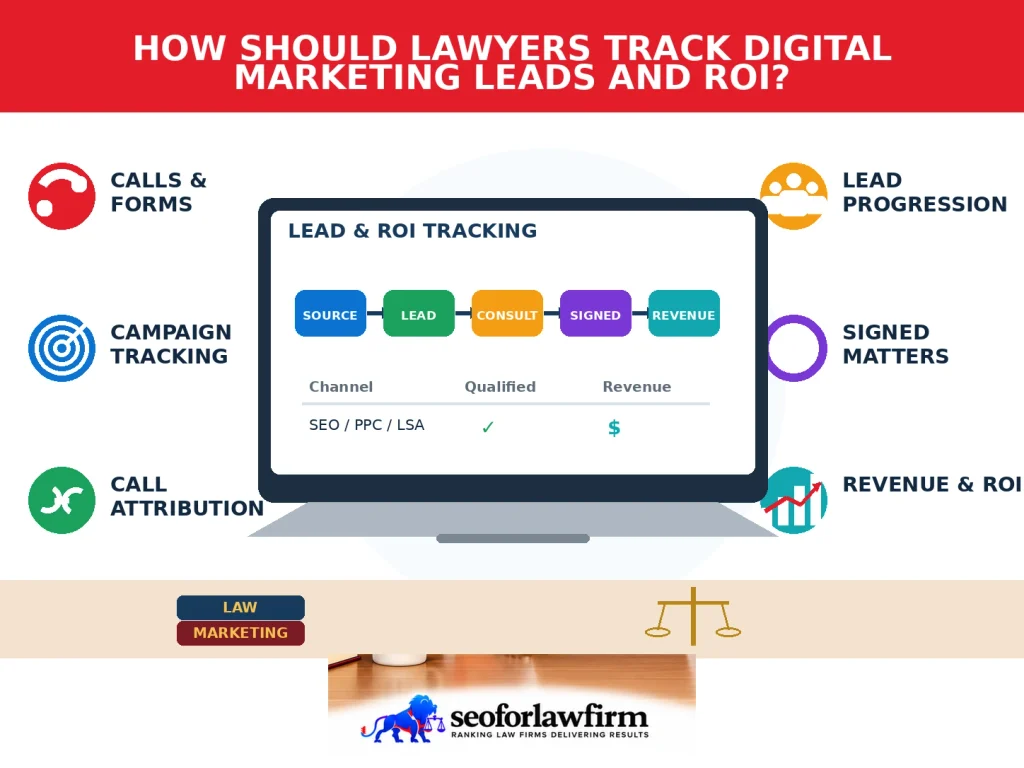
Lawyers should track digital marketing performance from acquisition source through qualified lead, consultation, signed matter, and revenue rather than relying on traffic, impressions, clicks, or raw lead totals.
A complete tracking system must connect analytics, call tracking, advertising platforms, CRM data, intake outcomes, and revenue so each channel will be evaluated by business contribution. A law firm SEO results tracking process helps connect search visibility with client-acquisition outcomes instead of judging SEO through rankings alone.
Listed below are the 8 main tracking steps for law firm digital marketing.
- Define Meaningful Outcomes: Identify calls, forms, consultation bookings, qualified leads, signed matters, and revenue-producing engagements.
- Configure Website Events: Track form submissions, click-to-call interactions, chat enquiries, and booking completions.
- Use Campaign Tracking Correctly: Apply standardized UTM parameters to appropriate paid, email, referral, and social campaigns.
- Track Calls: Connect telephone enquiries with their marketing sources through appropriate call-tracking systems.
- Connect Advertising Platforms: Import appropriate conversion data when permitted and useful for campaign optimization.
- Track Lead Progression: Record whether each enquiry qualifies, books a consultation, attends, and becomes a signed matter.
- Connect Marketing With Revenue: Compare marketing costs with signed matters and attributable revenue.
- Review Performance by Channel and Practice Area: Separate SEO, PPC, Local Services Ads, local search, social media, referrals, and other acquisition sources.
How Can Lawyers Combine SEO, PPC, Local Search, Content, and Social Media?
Lawyers can combine SEO, PPC, local search, content, and social media by assigning each channel a distinct acquisition function and connecting every channel to the same audience, practice area, intake, and measurement strategy. Local SEO captures geographically relevant demand, SEO captures organic service and informational searches, PPC reaches selected high-intent queries, Local Services Ads generate eligible local leads, content answers research and evaluation questions, and social media supports education, professional visibility, and referrals. The website converts interest into client actions, while intake and CRM systems determine whether those enquiries become qualified leads and signed matters. Law firms must evaluate each channel according to the clients and matters it produces rather than expect every channel to perform the same role.
Listed below are the 9 main functions of each digital marketing channel.
- Local SEO: Reaches geographically relevant searches and strengthens office-level visibility.
- SEO: Captures organic practice-area and informational search demand.
- PPC: Targets selected high-intent paid searches.
- Local Services Ads: Generates eligible local calls, messages, and other supported leads.
- Content: Answers research and evaluation questions throughout the client journey.
- Social Media: Supports education, attorney visibility, referrals, and audience engagement.
- Website: Converts marketing traffic into calls, forms, and consultation requests.
- Intake: Determines whether each enquiry meets the firm’s qualification criteria.
- CRM and Case Data: Connect marketing sources with qualified leads, consultations, signed matters, and business outcomes.