

A law firm case study for marketing must tell the client’s journey as a clear story in which the client faces a specific legal challenge, and the law firm acts as the strategic guide that helps move the matter toward a documented outcome. According to a study by Melanie C. Green and Timothy C. Brock titled The Role of Transportation in the Persuasiveness of Public Narratives in 2000, greater absorption in a narrative increased story-consistent beliefs and favorable evaluations across multiple experiments. The research was not specific to legal marketing, but it supports organizing case facts into a coherent, accurate narrative rather than presenting disconnected promotional claims.
The client introduction must identify the client type, industry, matter type, or relevant circumstances without revealing protected information. A firm must obtain informed consent before publishing information relating to a representation when disclosure is not otherwise authorized. Anonymization also needs to be strong enough that readers cannot reasonably identify the client or matter from the remaining facts. ABA Model Rule 1.6 applies broadly to information relating to a representation, not only attorney-client privileged communications.
The challenge section must explain the legal obstacle, risk, dispute, transaction, or decision the client faced. The strategy section must show what the attorneys actually did, including legal analysis, negotiation, investigation, motion practice, transaction planning, litigation decisions, or coordination with other professionals where disclosure is permitted. The result section must state the outcome accurately and explain what changed for the client.
Client-centric case studies work better when the narrative focuses on the client’s objective and decision path rather than repeatedly praising the firm. Legal marketing guidance on case studies commonly follows this sequence: client or context, challenge, strategy, result, and client benefit.
Attorney advertising rules also shape how results are presented. ABA Model Rule 7.1, Comment 3, explains that even a truthful report of past achievements becomes misleading when it creates an unjustified expectation that another client will obtain the same result without regard to the different facts and law governing that matter. Appropriate qualifying language can reduce that risk, but each law firm also needs to review the advertising rules of the jurisdictions governing its marketing.
A finished case study can support a law firm’s website, practice-area pages, attorney presentations, proposals, client newsletters, LinkedIn posts, and other approved marketing channels. Repurposing must remain consistent with the scope of the client’s consent and applicable professional-conduct rules.
Case studies can also support SEO when the pages provide original, useful information about real legal work, use descriptive titles and headings, connect logically to related practice-area pages, and answer the questions prospective clients researching similar legal issues actually have. Google recommends people-first content that demonstrates first-hand experience and original information rather than content produced mainly to attract search traffic. E-E-A-T itself is not one specific ranking factor.
Listed below are the 10 main marketing functions of a strong law firm case study.
- 1. Demonstrates Real Legal Experience Through Factual Matter Examples: A law firm case study shows real legal experience through factual matter examples, legal issues, procedural stages, and work performed. These details support experience claims with concrete information rather than generic promotional language.
- 2. Shows How Attorneys Analyze and Respond to Legal Problems: A law firm case study explains how attorneys review evidence, assess risks, research applicable law, and choose a legal strategy. This information gives prospective clients a clearer view of the attorney’s reasoning and working method.
- 3. Gives Prospective Clients Evidence Beyond Generic Promotional Claims: A law firm case study connects claims about experience with factual legal work, procedural developments, and documented outcomes. Prospective clients can evaluate the firm through evidence rather than broad statements about skill or representation.
- 4. Explains Complex Legal Services Through a Client-Centered Story: A law firm case study explains legal services through a recognizable client problem, the decisions involved, and the attorney’s response. This structure helps prospective clients understand how legal services apply to practical situations.
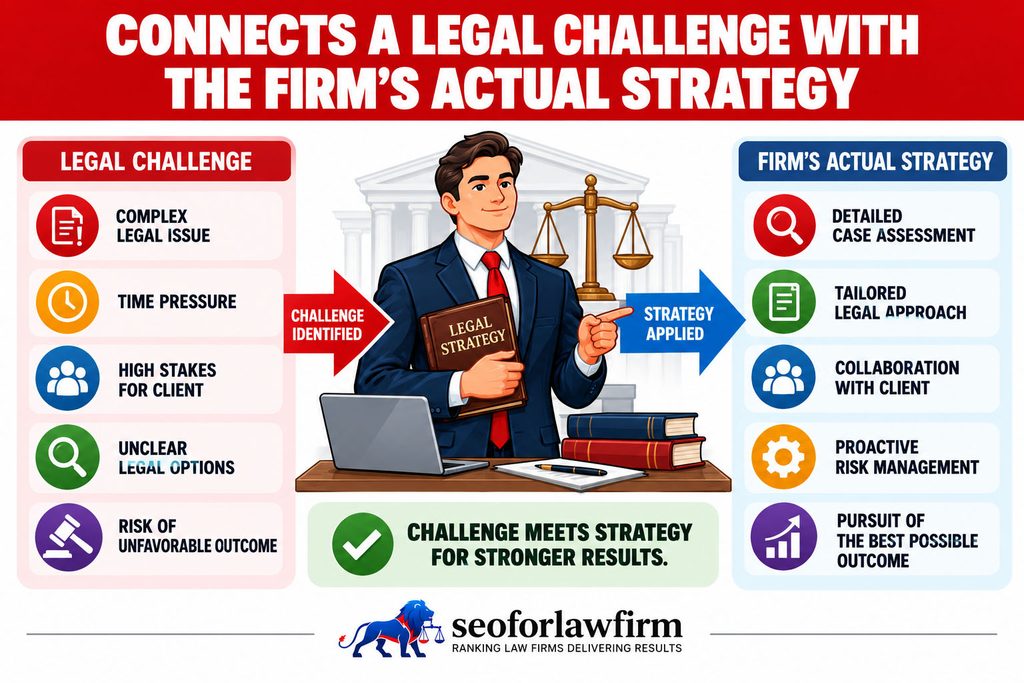
- 5. Connects a Legal Challenge With the Firm’s Actual Strategy: A law firm case study shows how attorneys respond to specific legal obstacles such as disputed evidence, deadlines, opposing arguments, or settlement issues. The connection between the problem and the response demonstrates how the firm turns legal analysis into action.
- 6. Provides Proof Elements Such as Outcomes, Milestones, and Client Feedback: A law firm case study can include documented outcomes, procedural milestones, and permissible client feedback. These proof elements support credibility when the firm presents them accurately and complies with confidentiality and advertising rules.
- 7. Supports Practice-Area Content With Original First-Hand Information: A law firm case study adds first-hand observations about recurring disputes, evidence issues, procedural decisions, and client concerns. This material gives practice-area content original information beyond generic legal definitions and summaries.
- 8. Creates Useful Internal-Linking Paths Between Related Legal Pages: A law firm case study can connect naturally with relevant service pages, attorney profiles, location pages, and supporting legal resources. These internal links help users explore related information and help search engines understand topical relationships across the website.
- 9. Supplies Reusable Material for Websites, Newsletters, Social Media, and Proposals: A law firm case study can supply source material for website content, newsletters, social posts, presentations, and proposals. The firm can adapt different parts of the same matter while preserving factual accuracy and client confidentiality.
- 10. Gives Prospective Clients a Clearer Basis for Deciding Whether the Firm Fits Their Legal Need: A law firm case study shows the types of matters, strategies, and client circumstances the firm handles. Prospective clients can use this information to judge whether the firm’s experience and approach fit their legal needs.
Table of Contents
- Article sections will appear here.
1. Demonstrates Real Legal Experience Through Factual Matter Examples
A law firm case study demonstrates real legal experience by showing how attorneys handled an actual type of legal matter. The case study can describe the legal issue, relevant facts, procedural stage, and work performed without revealing protected or confidential information.
Factual matter examples give prospective clients evidence that the firm has handled situations similar to the legal problem they are researching. These examples also show the scope of the attorney’s involvement across investigation, negotiation, litigation, counseling, or transactional work. The case study therefore supports experience claims with concrete information instead of relying on generic promotional language.
2. Shows How Attorneys Analyze and Respond to Legal Problems
A law firm case study shows how attorneys analyze and respond to legal problems by explaining the reasoning and actions behind the representation. The content can describe how attorneys reviewed evidence, researched applicable law, assessed risks, identified procedural options, and developed a response.
Matter-specific details help prospective clients see how the attorney approaches decisions rather than only what services the firm lists. The case study can also explain why one strategy was selected over another when that information can be disclosed ethically. This approach gives prospective clients a clearer picture of the firm’s legal reasoning and working method.
3. Gives Prospective Clients Evidence Beyond Generic Promotional Claims
A law firm case study gives prospective clients evidence beyond generic promotional claims by connecting statements about experience with factual legal work. Specific information about the matter, strategy, procedural developments, and outcome provides more context than claims such as experienced attorneys or aggressive representation.
Prospective clients can evaluate what the firm actually did rather than rely only on self-promotional descriptions. Documented matter examples can also support claims about particular practice areas, industries, jurisdictions, or legal procedures. This evidence gives prospective clients a stronger factual basis for evaluating the firm.
4. Explains Complex Legal Services Through a Client-Centered Story
A law firm case study explains complex legal services through a client-centered story that connects legal procedures with a recognizable problem. Research by Keith Quesenberry and Michael Coolsen titled Tell Me a Story: The Role of Narrative Transportation and the C-Suite in B2B Advertising in 2020 found that buyer-seller stories and narrative transportation were positively associated with decision-maker trust, personal connection, and advocacy. Although the study examined B2B advertising rather than legal services specifically, it supports explaining professional services through concrete client situations instead of abstract capability claims.
A business litigation case study, for example, can connect contract analysis, evidence review, negotiation, motions, and settlement discussions within one matter. The client-centered format helps prospective clients understand both the service and the circumstances in which the service becomes relevant.
5. Connects a Legal Challenge With the Firm’s Actual Strategy
A law firm case study connects a legal challenge with the firm’s actual strategy by showing how attorneys responded to a defined legal problem. The case study can explain how the firm addressed disputed evidence, procedural deadlines, opposing arguments, settlement demands, regulatory requirements, or other matter-specific obstacles.
Each strategy must relate directly to the legal issue rather than appear as a generic description of the firm’s capabilities. The content can also show how the strategy changed as new facts, rulings, negotiations, or client objectives affected the matter. This connection demonstrates how the firm converts legal analysis into specific actions for clients.
6. Provides Proof Elements Such as Outcomes, Milestones, and Client Feedback
A law firm case study provides proof elements through documented outcomes, case milestones, and permissible client feedback. Proof can include a dismissal, settlement, favorable ruling, transaction completion, negotiation milestone, procedural result, or other verifiable development.
Client feedback can also add context when publication complies with confidentiality, advertising, and professional-responsibility rules. Law firms must present each outcome accurately and avoid language that suggests another client will receive the same result. According to research published in the 2025 Edelman–LinkedIn B2B Thought Leadership Impact Report, based on nearly 2,000 management-level professionals, both visible and hidden buyers said high-quality thought leadership was more effective than traditional marketing or product information at communicating a provider’s capabilities and value. Case studies serve a similar proof function when they document real legal work instead of making unsupported claims.
7. Supports Practice-Area Content With Original First-Hand Information
A law firm case study supports practice-area content with original first-hand information drawn from the firm’s own legal work. Attorneys can contribute observations about recurring disputes, evidence problems, procedural decisions, negotiation issues, client concerns, and other matter-specific patterns.
This information gives practice-area pages material that goes beyond generic explanations of statutes, procedures, and legal definitions. First-hand examples can also help the firm explain how a legal rule operates in practical situations without disclosing confidential client information. Case studies therefore provide original material that can strengthen service pages and supporting legal content.
8. Creates Useful Internal-Linking Paths Between Related Legal Pages
A law firm case study creates useful internal-linking paths by connecting the matter with relevant service pages, attorney biographies, location pages, and supporting legal resources. A car accident case study, for example, can link naturally to the firm’s car accident lawyer page, evidence guide, insurance content, and attorney profile.
These contextual links help users move from a factual matter example to deeper information about the related legal service. Internal links also help search engines understand how the case study relates to broader practice areas and supporting topics. The case study can therefore function as part of a connected legal content structure rather than as an isolated page.
9. Supplies Reusable Material for Websites, Newsletters, Social Media, and Proposals
A law firm case study supplies reusable source material for websites, newsletters, social media, presentations, and business-development proposals. The firm can adapt one documented matter into shorter summaries, attorney commentary, educational posts, client communications, or referral-partner materials.
Each format can focus on a different part of the matter, such as the legal problem, attorney strategy, procedural milestone, or outcome. Reuse must preserve confidentiality and avoid changing factual details in ways that make the original matter misleading. One well-documented case study can therefore support multiple marketing and communication channels without requiring the firm to create every piece from scratch.
10. Gives Prospective Clients a Clearer Basis for Deciding Whether the Firm Fits Their Legal Need
A law firm case study gives prospective clients a clearer basis for deciding whether the firm fits their legal needs by showing the matters, problems, strategies, and client circumstances the firm handles. Prospective clients can compare their own situation with the firm’s demonstrated experience before requesting a consultation.
The case study can also reveal how the attorney communicates, approaches decisions, manages legal obstacles, and works toward client objectives. This information helps prospective clients evaluate fit using more than attorney biographies, service descriptions, or promotional claims. The result is a more informed hiring decision based on factual examples of the firm’s legal work.
What Is a Case Study in a Law Firm?
A case study in a law firm is a factual marketing story that explains a client’s legal situation, the challenge involved, the attorney’s strategy, the development of the matter, and the outcome of the representation. A case result might state that a firm secured a $750,000 settlement, while a case study explains the client’s circumstances, legal problem, constraints, strategy, matter development, and resolution.
Law firms can use case studies for personal injury, criminal defense, employment disputes, family law, estate litigation, commercial disputes, mergers and acquisitions, regulatory matters, internal investigations, intellectual property disputes, real estate matters, and tax controversies. The client does not need to be identified by name because the firm can use descriptions such as a regional construction company or a parent seeking modification of an existing custody order when the wording protects confidentiality and avoids indirect identification.
Why Are Case Studies Important in Law Firm Marketing?
Case studies are important in law firm marketing because they replace abstract claims of capability with specific examples of how attorneys analyzed, managed, and resolved legal problems. A practice-area page states that the firm handles employment disputes, while a case study can show the client’s circumstances, the legal issue, the attorney’s strategy, and the documented resolution.
Case studies can strengthen trust, attorney credibility, practice-area differentiation, client education, business development, proposal materials, internal linking, organic search visibility, and consultation preparation. Law firms must present each matter with enough context to avoid suggesting that one result predicts another. Differences in facts, law, evidence, venue, procedural posture, damages, timing, opposing parties, and client objectives can produce different outcomes across similar matters.
How Can Law Firms Write Effective Case Studies?
Law firms can write effective case studies by structuring each story around the client, the legal challenge, the firm’s strategy, and the documented result.
Listed below is the 4-part structure for a law firm case study.
- 1. Client and Background: Describe the client’s relevant circumstances, industry, role, or situation without disclosing confidential information. The background must give enough context for readers to understand why the legal matter arose.
- 2. Legal Challenge: Explain the legal problem, dispute, risk, or procedural issue the client faced. The section must identify the main constraints, legal questions, and consequences connected with the matter.
- 3. Strategy and Solution: Describe how the attorneys analyzed the problem and what legal strategy the firm used. The explanation must connect the firm’s actions with the client’s objectives, evidence, procedural posture, and applicable law.
- 4. Result and Client Impact: State the documented outcome and explain how the result affected the client. The section must present the result accurately without implying that similar matters will produce the same outcome.
1. Client and Background
The client and background section must give readers enough information to understand the legal matter without disclosing protected client information. The section must establish the client’s situation, relevant context, and objective before describing the legal challenge. Law firms must also review combinations of factual details because information that appears harmless on its own can identify a client when paired with other specifics.
Listed below are the 6 main details the client and background section includes.
- Client type
- Industry
- Practice area
- General jurisdiction
- Relevant business or personal circumstances
- Client objective
2. Legal Challenge
The legal challenge section must define the problem, constraints, risks, and client objective that made legal representation necessary. The section must explain what happened, what the client needed, what legal issue existed, what was at stake, and which complications shaped the strategy. Specific details make the legal reasoning easier to follow than vague statements such as “the case was complicated.”
Listed below are the 6 questions the legal challenge section must answer.
- What happened?
- What did the client need?
- What legal issue existed?
- What was at stake?
- What complications affected the matter?
- What limitations shaped the strategy?
3. Strategy and Solution
The strategy and solution section must explain what the law firm actually did and why those actions addressed the client’s legal problem. This section must show applied legal experience through specific work rather than vague claims about skill or aggressiveness. The firm must connect each action with the evidence, legal issue, procedural posture, or client objective that shaped the strategy.
Listed below are the 13 main actions the strategy and solution section includes.
- Reviewing contracts
- Examining medical records
- Reconstructing accident evidence
- Interviewing witnesses
- Retaining experts
- Developing damages evidence
- Filing or opposing motions
- Negotiating with insurers
- Conducting discovery
- Preparing for trial
- Structuring a transaction
- Resolving regulatory issues
- Developing settlement options
4. Result and Client Impact
The result and client impact section must state what happened and explain what the outcome meant for the client without suggesting that another client will receive the same result. The section must connect the documented result with the client’s objective, financial position, business relationship, legal risk, or personal circumstances. Measurable figures can add useful context when disclosure is permitted and the amount is accurate.
Listed below are the 12 main outcomes the result and client impact section includes.
- Settlement
- Verdict
- Dismissal
- Charge reduction
- Transaction completion
- Injunction
- Contract revision
- Regulatory approval
- Cost avoidance
- Preservation of business relationships
- Recovery of property
- Resolution of an estate dispute

How Do Case Studies Build Authority and Trust for Law Firms?
Case studies build authority and trust for law firms by showing how attorneys analyzed, managed, and resolved real legal problems. A strong case study presents the client problem, attorney analysis, legal strategy, actions taken, and documented result instead of relying on generic claims about skill or experience.
Specific details about contract review, evidence assessment, negotiations, motions, or other legal work give prospective clients factual evidence of applied experience. Case studies also provide original, first-hand information that supports identifiable expertise and authorship. Law firms must present these examples accurately without suggesting that past results guarantee similar outcomes or automatically produce an E-E-A-T ranking benefit.
What Features Make a Strong Law Firm Case Study?
A strong law firm case study combines a client-centered narrative, readable formatting, and a relevant next action for the reader.
Listed below are the 8 main features of a strong law firm case study.
- Client-Centered Narrative: Make the client’s objective and challenge the center of the story rather than turning the page into firm praise.
- Specific Legal Problem: Explain the issue precisely enough that readers understand why legal representation was needed.
- Attorney Strategy: Show what the attorneys did, what decisions were made, and how the strategy related to the problem.
- Documented Outcome: State a factual result without exaggerating what the result predicts for future matters.
- Confidentiality Protection: Obtain appropriate client authorization or anonymize the matter so protected information is not revealed.
- Plain Legal Language: Explain legal concepts without unnecessary jargon that prevents prospective clients from following the story.
- Advertising Compliance: Review the page for misleading claims, unjustified expectations, testimonial rules, and jurisdiction-specific disclosure requirements.
- Relevant CTA: Give readers an appropriate next step, such as reviewing the related practice area or contacting the firm about their own circumstances.
What Proof Elements Strengthen a Legal Case Study?
Proof elements strengthen a legal case study when they document what happened, explain the attorney’s work, and give the reader enough context to evaluate the result accurately.
Listed below are the 10 proof elements that can strengthen a legal case study.
- Documented Result: Settlement, verdict, dismissal, transaction, negotiated resolution, or another verifiable outcome.
- Client Testimonial: An authorized client statement describing communication, service, or experience.
- Matter Timeline: Selected milestones showing how the representation progressed.
- Attorney Strategy: The reasoning and actions that addressed the legal challenge.
- Before-and-After Context: The client’s position before representation compared with the position after resolution.
- Legal or Procedural Milestones: Motions, hearings, negotiation stages, investigations, or transaction steps when disclosure is appropriate.
- Supporting Evidence Context: General discussion of evidence, experts, documents, or analyses used in the matter.
- Attorney Information: Identification of participating attorneys when doing so is permitted and useful.
- Visual Explanations: Timelines, diagrams, process graphics, or result summaries that make the story easier to follow.
- Qualifying Language: Context explaining that outcomes depend on the individual facts and law governing each matter.
How Can Law Firms Use Case Studies to Improve SEO and Organic Visibility?
Law firms can use case studies for SEO by publishing original matter-based information, aligning each page with a specific legal topic, and helping prospective clients answer questions about similar legal situations.
Listed below are the 8 SEO practices for law firm case studies.
- Use a descriptive title: State the legal problem, matter type, or result accurately rather than using vague titles such as “Another Big Win.”
- Match one clear search intent: Keep the case study centered on the matter instead of forcing unrelated legal keywords onto the page.
- Use relevant legal terminology: Include terminology that accurately describes the case type, procedure, jurisdiction, and outcome.
- Add geographic information only when relevant: Include cities, counties, courts, or states when that context genuinely matters to the case.
- Link to the related practice area: Connect the case study to the service page that explains how the firm handles that category of matter.
- Add contextual supporting links: Direct readers to useful legal explanations where those resources help them understand the issue.
- Use original case information: Explain the firm’s actual experience rather than producing a generic article around a target keyword.
- Measure Search and lead outcomes: Determine whether case studies contribute to relevant discovery and client intake.
An analytical update by the Shopify editorial board from the commerce infrastructure platform Shopify titled “What Is Digital Marketing? Types and Examples” in 2026 verifies that Google Search Central documentation states explicitly that Google has absolutely no preferred word count for search rankings, evaluating content instead on whether it completely satisfies the reader’s intent rather than artificially expanding its length to hit a presumed SEO target.
A law firm content strategy can determine which cases deserve standalone pages and which outcomes belong inside practice-area pages or results libraries.
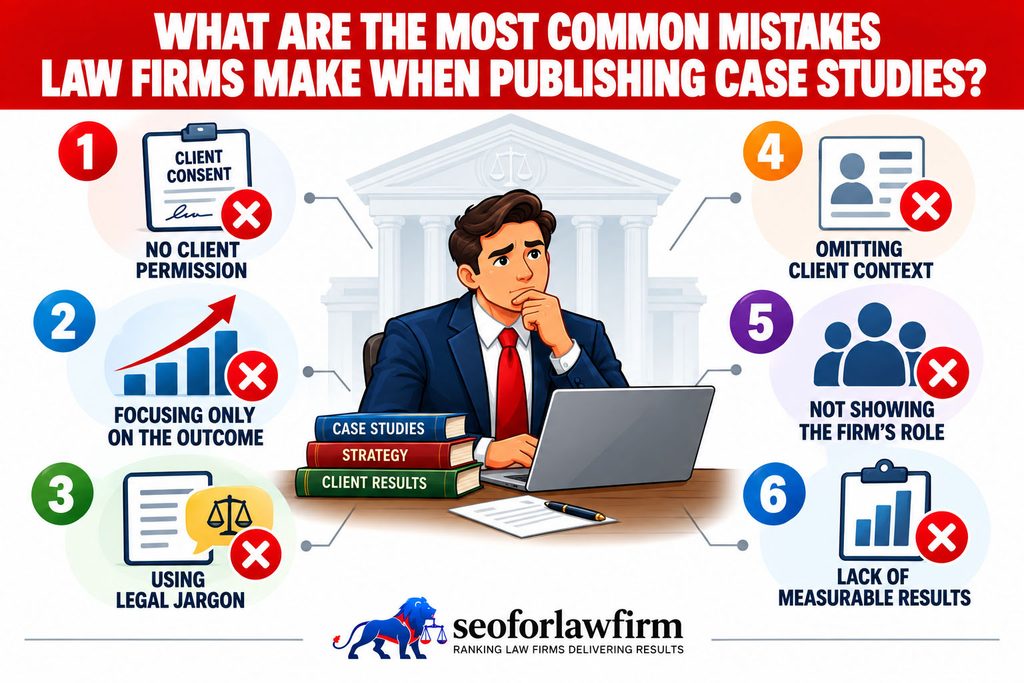
What Are the Most Common Mistakes Law Firms Make When Publishing Case Studies?
The most common law firm case-study mistakes are disclosing protected information, focusing only on the result, writing for keywords instead of clients, and failing to connect the story to a useful next step.
Listed below are the 12 common law firm case-study mistakes.
- Publishing Client Information Without Proper Authorization: Confidentiality rules apply beyond privileged communications.
- Weak Anonymization: Removing the client’s name does not protect confidentiality when the remaining facts identify the matter.
- Leading With the Settlement Amount: A number without factual context can create misleading expectations.
- Guaranteeing Similar Outcomes: Past results do not establish what another client will receive.
- Using Generic Promotional Language: Statements such as “best lawyers” or “unmatched results” add little evidentiary value and can raise advertising concerns.
- Ignoring the Attorney Strategy: Reporting only the result prevents the case study from demonstrating how the firm solved the problem.
- Making the Firm the Main Character: The client’s challenge and objective must drive the story.
- Using Excessive Legal Jargon: Prospective clients need to understand what happened and why it mattered.
- Forcing SEO Keywords: Repeating case-type and city phrases makes the story less useful and does not establish quality.
- Treating Engagement Metrics as Ranking Signals: Longer reading sessions are not proof that Google will rank the page higher.
- Skipping Internal Links: Readers need a logical path from the example to the related legal service.
- Publishing Without Measuring Leads: Traffic alone does not show whether case studies contribute to qualified client acquisition.
Where Can Law Firms Get Professional Case Study Writing and SEO Services?
SEOForLawFirm.com is a specialized legal SEO provider that gives law firms structured, strategy-focused case study writing and SEO support across legal storytelling, content architecture, internal linking, search optimization, and lead measurement. Law firms can also obtain case study support from legal content agencies, independent legal writers, SEO consultants, law firm marketing agencies, public relations firms, and experienced in-house marketing teams.
A professional case study project must include matter selection, confidentiality review, attorney interviews, story development, drafting, legal and ethics review, SEO review, client approval where needed, publication, distribution, and performance measurement. Providers must use verified facts, accurate outcomes, and approved quotations rather than invent proof, statistics, testimonials, or ranking claims. SEOforLawFirm.com provides law firm SEO services that connect case study content with practice-area architecture, internal linking, organic visibility, and client-acquisition measurement.
Do Case Studies Improve Local SEO for Law Firms?
Yes, case studies can support local SEO for law firms when a real matter includes meaningful geographic or jurisdictional context. Relevant details can include the state law involved, county, court, local procedure, jurisdiction-specific legal issue, or genuine office connected with the matter. These details help search engines and prospective clients understand the geographic relevance of the content.
Law firms must not add unrelated city names or courthouse references solely to create local keyword variations. Case studies can strengthen locally relevant website content, but they do not automatically improve Google Maps rankings.
How Should Law Firms Measure Case Study Marketing Performance?
Law firms should measure case-study marketing performance through search visibility, movement to service pages, qualified enquiries, and signed matters rather than pageviews or reading time alone. A law firm SEO KPI framework must connect case-study engagement with downstream client-acquisition outcomes. Time on page can provide behavioral context, but it is not a confirmed direct Google ranking factor and does not show business value by itself.
The table below shows a useful measurement framework.
| Measurement | What It Shows |
| Search impressions | Whether the case study appears for relevant searches |
| Organic clicks | Whether searchers select the result |
| Case-study sessions | Website traffic reaching the story |
| Practice-area clicks | Movement from proof content to service evaluation |
| Contact actions | Calls, forms, chat, or consultation requests |
| Qualified leads | Enquiries that fit the firm’s services |
| Signed matters | Client acquisition influenced by the case-study journey |