
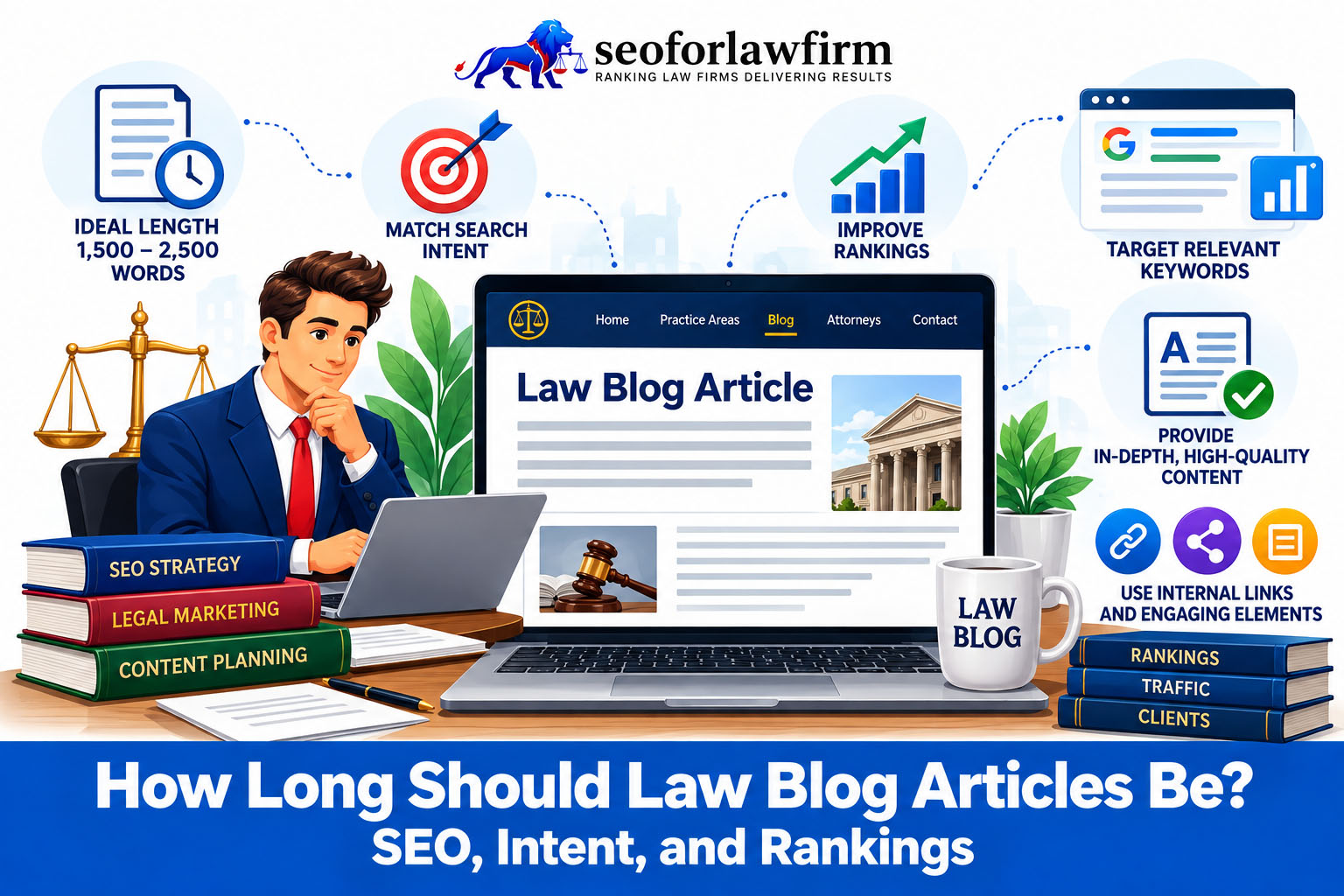
Law blog articles commonly fall within 600–1,500 words when they answer a standard client-focused legal question, but the correct length depends on the topic, search intent, legal complexity, and amount of information needed to answer the question fully.
Short-form law blog posts of approximately 300–600 words work for narrow FAQs, legal definitions, brief explanations, and commentary on a recent court decision or statutory change. A focused article does not need extra paragraphs when a concise answer provides the rule, jurisdiction, relevant exception, and practical meaning.
Mid-length law blog posts of approximately 600–1,500 words fit standard legal topics such as what to do after a car accident, how a divorce process begins, what happens after an arrest, or which documents a client needs for estate planning. These topics usually require several connected explanations without requiring a full legal guide.
Long-form legal articles of approximately 1,500–2,500+ words fit subjects containing several procedural stages, legal rules, exceptions, comparisons, evidence requirements, or client decisions. Detailed statutory changes, complex legal procedures, and broad how-to resources require this level of coverage. Law firm practice-area pages often require deeper service-focused coverage, although their transactional intent must remain separate from informational blog content.
A study by Brian Dean from the Backlinko platform, titled “We Analyzed 912 Million Blog Posts. Here’s What We Learned About Content Marketing” in 2019 (with ongoing industry citations extending into 2026), confirms that while long-form content over 3,000 words achieves 77.2% more backlinks than short-form content, there is no direct correlation between word count alone and search engine visibility. Instead, content lengths naturally vary by target keyword, search intent, and structural elements like headlines and lists to fully satisfy reader inquiries.
A focused 400-word legal article outperforms a padded 1,500-word article when the shorter page answers the searcher’s question completely. Extra paragraphs that repeat the answer, introduce unrelated legal topics, or exist only to increase word count dilute the primary topic and reduce information density.
Online readers also scan legal content before deciding which sections deserve closer attention. Clear headings, concise paragraphs, numbered steps, unnumbered lists, and comparison tables make longer legal articles easier to navigate without removing useful legal detail.
Law firms must also prioritize content quality over publishing volume. One or 2 well-researched articles published during a month provide more value than several rushed posts that repeat existing information. Publishing frequency alone does not create stronger search rankings.
Table of Contents
- Article sections will appear here.
How Many Words Should a Law Blog Article Be?
A law blog article commonly contains 600–1,500 words for a standard legal topic, with shorter articles serving narrow questions and longer articles covering subjects that require deeper legal explanation. The appropriate length depends on the search intent, legal complexity, jurisdictional detail, procedural depth, exceptions, and information the reader needs to understand the issue.
Short-form posts work well for definitions and narrow FAQs, while long-form guides suit multi-stage procedures and broader legal topics. These ranges function as editorial planning benchmarks rather than Google ranking requirements.
The table below shows practical word-count ranges for the main types of law blog content.
| Content Type | Practical Word Count | Best Use | Example |
| Short-form post | 300–600 words | FAQs, definitions, brief legal updates | Is Reckless Driving a Misdemeanor? |
| Standard blog article | 600–1,500 words | Legal processes, client concerns, practical guidance | What Should You Do After a Car Accident? |
| Long-form guide | 1,500–2,500+ words | Detailed procedures, statutory changes, multi-part legal topics | How Does the Probate Process Work? |
What Is the Ideal Length for a Law Blog Article?
The ideal length for a law blog article is the length required to answer the searcher’s legal question completely without adding irrelevant information. A standard client-focused article falls within the 600–1,500-word range because many legal questions require a direct answer followed by applicable rules, procedures, examples, exceptions, and next steps.
A question such as “What is comparative negligence?” requires less coverage than “How does comparative negligence affect a multi-vehicle accident claim in Texas?” The second topic requires jurisdiction-specific rules, fault allocation, damages, examples, and possible exceptions. The legal information required to satisfy the query must determine the final article length.
How Long Should Short Law Blog Posts Be?
Short law blog posts commonly contain 300–600 words when the topic addresses one narrow legal question that requires limited supporting explanation. A focused article defines the issue, explains its legal significance, identifies the applicable jurisdiction, gives necessary context, and tells the reader what generally happens next without expanding into unrelated subjects.
A question such as “What is a deposition?” does not require a 2,000-word article when the reader primarily needs the definition, purpose, participants, basic process, and practical expectations. Extra sections about the entire litigation process would broaden the article beyond the original search intent.
Listed below are 6 types of legal topics that fit short-form law blog posts.
- Legal definitions. Short articles define a legal term and explain its practical meaning within the applicable context.
- Narrow FAQs. A focused post answers one specific client question with any relevant exceptions or consequences.
- Brief court-decision updates. A concise article explains the ruling, affected parties, and practical legal effect.
- Statutory change announcements. Short posts identify the change, effective date, jurisdiction, and people affected.
- Single filing-deadline questions. A focused article states the applicable deadline and explains material exceptions or triggering events.
- Short explanations of legal documents or terms. These posts explain what a document or legal concept means, why it matters, and what the client must expect.
How Long Should Standard Law Blog Posts Be?
Standard law blog posts commonly contain 600–1,500 words when the topic requires several related explanations, procedural steps, or practical recommendations. Orbit Media’s 2026 Blogger Survey reported an average blog-post length of 1,312 words across its survey sample, while only 13.9% of respondents said their blogs delivered strong results. The findings reinforce that length alone does not determine performance; a law firm still needs enough space to answer the legal question completely without padding the article.
A topic such as what to do after a car accident covers immediate safety, medical treatment, police reporting, evidence collection, insurance communication, legal deadlines, and attorney contact within this range. The article must remain focused on the original search intent rather than broaden into an entire practice-area overview.
Listed below are 7 legal topics that commonly fit the 600–1,500-word range.
- What to do after a car accident. The article explains immediate safety, medical care, police reporting, evidence preservation, insurance communication, deadlines, and attorney contact.
- What happens after a DUI arrest. The article covers booking, release, court appearances, license issues, procedural stages, and next steps.
- How divorce proceedings begin. The article explains filing, service, initial court requirements, temporary orders, and early case decisions.
- What evidence supports a discrimination claim. The article discusses emails, policies, performance records, witness statements, complaints, and other relevant evidence.
- What happens during mediation. The article explains preparation, mediator involvement, negotiation, settlement discussions, and possible outcomes.
- What documents are needed for probate? The article identifies wills, death certificates, financial records, property documents, and court filings.
- What happens during an initial legal consultation. The article explains what information the attorney reviews, what documents the client must bring, and what questions are commonly discussed.
How Long Should Long-Form Legal Articles Be?
Long-form legal articles commonly contain 1,500–2,500+ words when a topic requires comparisons or client decisions to be explained together. The longer format is justified when each section contributes information the reader needs to understand the same legal issue.
A probate guide, for example, requires separate sections on filing, executor appointment, estate inventory, creditor notices, claims, taxation, distributions, disputes, and estate closure. The article must expand because the subject demands deeper explanation rather than because a longer word count is assumed to perform better.
Listed below are 6 situations that justify a long-form legal article.
- The legal process contains several stages. Each stage requires its own explanation, timeline, responsibilities, and possible outcomes.
- The legal rule contains material exceptions. Longer coverage helps explain when the general rule applies and when specific exceptions change the result.
- Several parties have different rights or responsibilities. The article needs separate sections for plaintiffs, defendants, spouses, beneficiaries, employers, employees, or other parties.
- State and federal rules interact. The article needs to explain how multiple legal frameworks affect the same issue.
- The article compares several legal options. A longer format allows the content to compare procedures, consequences, timelines, and decision factors.
- The reader needs detailed evidence or procedural guidance. The article needs to explain documents, testimony, expert evidence, filing requirements, and procedural steps in greater depth.
Does Google Require a Specific Blog Word Count for SEO?
No, Google does not require a specific word count for law blog articles or other web pages. Google’s people-first content guidance states that Google does not have a preferred word count. A Backlinko study by Brian Dean titled We Analyzed 11.8 Million Google Search Results in 2020 found that the average Google first-page result contained 1,447 words, but the analysis found no direct relationship between word count and ranking position among first-page results. A short legal page becomes weak when it fails to answer the searcher’s question with enough relevant information, while a long page becomes weak when additional sections repeat existing points or introduce unrelated topics.
A page with fewer than 500, 600, or 1,000 words is not automatically thin because word count alone does not determine content quality. Law firms must use word count as an editorial planning measure rather than an SEO requirement.
Does Longer Legal Content Rank Better?
No, longer legal content does not rank better simply because it contains more words. Longer articles perform well when the legal topic requires additional rules, exceptions, procedures, evidence, examples, jurisdictional context, attorney observations, or supporting questions to satisfy search intent. According to a study by Tim Soulo from Ahrefs titled How Many Keywords Can You Rank for With One Page? (Ahrefs’ Study of 3M Searches) in 2017, the average number-one ranking page also ranked in the top 10 for nearly 1,000 other relevant keywords. The finding supports covering closely related wording within one complete page rather than creating separate pages for every keyword variation.
These elements improve the article only when they help the reader understand the legal issue. Repetitive definitions, generic statements, keyword repetition, and unrelated information add length without adding useful meaning. Law firms reviewing longer-ranking competitors must analyze the information, search intent, legal depth, and supporting context those pages provide rather than copying their word counts.
Why Does Search Intent Matter More Than Word Count?
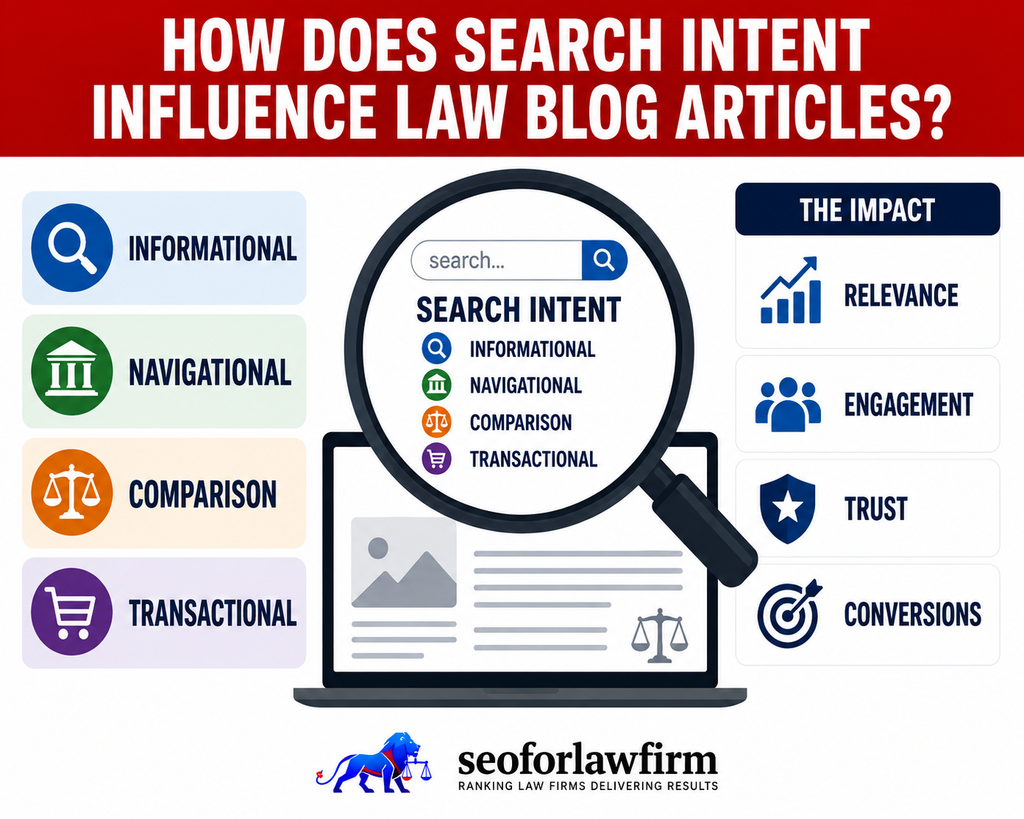
Search intent matters more than word count because the searcher’s objective determines the information the article needs to provide and the amount of explanation required. Law firms use legal search intent to determine whether a query belongs on a blog article, practice-area page, location page, or another page type.
A definition query usually requires less coverage than a detailed legal process, comparison, or jurisdiction-specific resource. Transactional searches also require a different page type from informational searches. Law firm practice-area pages fit service-led searches where the user is evaluating representation, while informational articles answer narrower legal questions. A query such as “what evidence proves a truck accident claim?” supports an informational article, while “Houston truck accident lawyer” supports a service page.
The table below shows how legal search intent affects practical article length.
| Search Intent | Example Query | Appropriate Coverage | Practical Length |
| Definition | What Is Comparative Negligence? | Definition, rule, effect, example | 300–600 words |
| Narrow FAQ | Can I Refuse a Breath Test? | Direct answer, exceptions, consequences | 300–700 words |
| Process | What Happens After a DUI Arrest? | Several procedural stages | 600–1,500 words |
| Comparison | Chapter 7 vs. Chapter 13 | Eligibility, differences, advantages, consequences | 1,000–2,000+ words |
| Detailed guide | How Does California Probate Work? | Multiple stages, parties, rules, deadlines | 1,500–2,500+ words |
| Legal update | What Does the New Employment Law Change? | Change, date, affected parties, practical effect | 300–800 words |
How Does Topic Complexity Affect Law Blog Length?
Topic complexity affects law blog length because more complicated legal questions require additional rules, exceptions, procedures, evidence, and jurisdictional distinctions. A simple question such as “What is a will?” requires only a definition and basic explanation.
A question such as “What happens when someone dies without a will in California?” requires broader coverage because the answer involves intestacy rules, heirs, probate administration, estate representatives, creditor claims, asset distribution, and California-specific law. Using the same word-count target for both topics would ignore the difference in legal information required.
Listed below are the 7 main factors that increase topic complexity and article length.
- Multiple legal rules. A topic requires more space when several statutes, doctrines, or legal standards affect the answer.
- Material exceptions. Exceptions require additional explanation because they change how the general rule applies.
- Procedural stages. Multi-step legal processes require separate explanations for filing, hearings, discovery, negotiation, or other stages.
- Evidence requirements. Complex matters require discussion of documents, testimony, expert evidence, records, or preservation issues.
- Jurisdictional distinctions. State, federal, county, or court-specific differences increase the amount of explanation required.
- Several affected parties. Topics involving multiple parties require separate discussion of each party’s rights, duties, or legal position.
- Different possible outcomes. Legal issues with several pathways or consequences require more detailed coverage to explain the available possibilities.
Should Law Blog Length Change by Practice Area?
Yes, law blog length should change according to the specific legal topic rather than a fixed word count assigned to the entire practice area. The practice area provides context, while the individual legal question determines the depth of explanation required. A family law article does not automatically need 1,500 words, and a personal injury article does not automatically need 2,000 words.
A question such as “What is alimony?” requires less coverage than “How is alimony calculated when a divorce involves business ownership and irregular income?” because the second question requires discussion of income calculation, business valuation, financial evidence, applicable legal factors, and possible exceptions. Law firms must therefore match article length to the legal information required to answer the specific query completely.
When Is a Law Blog Article Too Short?
A law blog article is too short when it fails to provide enough information to answer the searcher’s legal question accurately and completely. A short article still performs well when the legal question is narrow, and the page covers the applicable rule, jurisdiction, material exceptions, relevant deadlines, evidence, and next procedural step.
A 400-word article fully answers a concise definition or FAQ, while the same length becomes inadequate when the topic involves several procedural stages, legal exceptions, or jurisdiction-specific requirements. The problem is missing information rather than a low word count.
Listed below are 7 signs that a law blog article requires additional information.
- The applicable jurisdiction is missing. The article does not identify the state, federal system, court, or other legal framework governing the issue.
- The main legal rule is incomplete. The page explains only part of the rule or omits conditions that affect how it applies.
- Material exceptions are omitted. The article leaves out exceptions that change the reader’s legal position.
- A relevant deadline is missing. The page does not explain a filing, notice, appeal, or procedural deadline that affects the issue.
- Required evidence is not explained. The reader does not learn which documents, records, testimony, or other evidence matter.
- The legal process stops before the next meaningful step. The article explains the issue without showing what generally happens afterward.
- The article answers only part of the search query. The content addresses one element of the question while leaving the main search intent unresolved.
When Is a Law Blog Article Too Long?
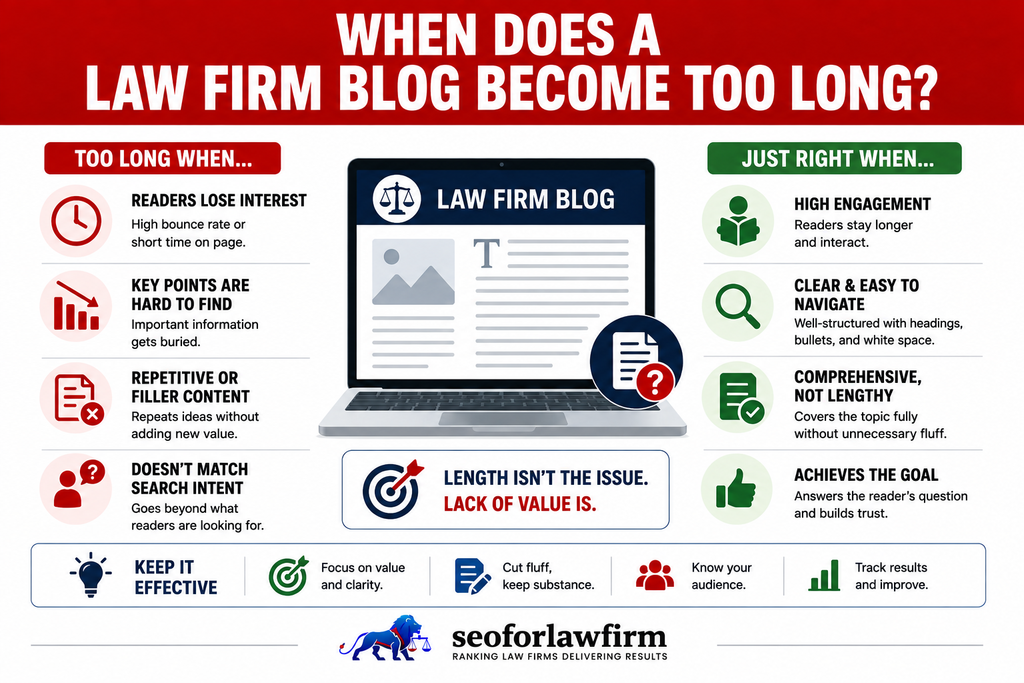
A law blog article is too long when additional content stops supporting the primary legal question and begins repeating information or introducing separate search intents. A 3,000-word article remains appropriate when every section contributes new and relevant legal information to the same search intent.
A 1,000-word article can already be excessive when large sections repeat the same answer, add unrelated legal history, or cover topics that deserve separate pages. The stronger standard is information value and topical relevance rather than total word count.
Listed below are 7 signs that a law blog article contains unnecessary length.
- The same answer appears several times. Repetition increases length without adding new legal information.
- Several headings address unrelated legal questions. Separate search intents dilute the article’s focus and deserve their own pages.
- Definitions are repeated. Re-explaining the same legal terms adds redundancy rather than useful depth.
- Historical background does not help answer the query. Background information must remain only when it improves the reader’s understanding of the current issue.
- Generic explanations replace useful legal information. Broad statements add length without explaining rules, procedures, evidence, deadlines, or decisions.
- Sections belong on separate pages. Distinct legal topics must be separated when they serve different search intents.
- Paragraphs exist only to increase word count. Extra wording does not improve the article when it adds no new meaning, context, or legal value.
Should Lawyers Add Extra Words to Improve SEO?
No, lawyers should not add extra words solely to reach an assumed SEO word count. Each paragraph must contribute a distinct piece of legal information that helps answer the searcher’s question. One paragraph states the governing rule, another explains a material exception, another provides an example, and another explains the next procedural step.
Repeated introductions, duplicated definitions, unrelated legal history, generic attorney-hiring statements, repetitive FAQs, and expanded sentences add length without adding useful information. Law firms must stop adding content once the article has answered the query accurately, completely, and without unnecessary repetition.
How Long Should Evergreen Law Blog Articles Be?
Evergreen law blog articles should contain enough information to answer recurring client questions completely, with the final length determined by topic complexity rather than evergreen status. A law firm content strategy separates evergreen articles from legal news, practice-area pages, case updates, and other content types so each page serves a distinct search intent.
Evergreen describes how long a topic remains useful rather than how many words the article requires. A narrow evergreen question fits within 600 words, while a detailed procedural topic requires more than 2,000 words. Law firms must also review evergreen articles when statutes, court rules, filing procedures, or official guidance change.
Listed below are 5 examples of evergreen legal topics.
- What is comparative negligence? This topic explains the legal concept, jurisdictional rule, and effect on damages.
- What happens during probate? This topic requires broader coverage because probate involves several procedural stages.
- What does an executor do? The article explains the executor’s duties, responsibilities, deadlines, and legal obligations.
- How does discovery work? This topic covers document requests, interrogatories, depositions, disclosures, and other discovery procedures.
- What evidence supports an employment discrimination claim? The article explains relevant records, communications, witness evidence, policies, and other supporting material.
How Long Should Legal News and Case Update Articles Be?
Legal news and case update articles commonly contain 300–800 words when the article explains one recent development and its practical effect on the intended audience. A focused update must explain the change, identify the jurisdiction and effective date, describe who is affected, and clarify the practical effect without expanding into an unrelated long-form guide. A short legislative or case update remains concise when the main purpose is to tell readers what changed and what the development means.
Listed below are the 7 questions a legal news or case update article must answer.
- What changed? State the new law, court decision, rule, regulation, or other development directly.
- When did the change occur? Identify the relevant decision date, enactment date, or effective date.
- Which jurisdiction applies? State the court, state, federal system, or other legal authority involved.
- Who is affected? Explain which people, businesses, employers, employees, clients, or other parties fall within the change.
- What was the previous rule? Give enough prior context for readers to understand what changed.
- What does the change mean in practice? Explain the practical effect on rights, responsibilities, procedures, or decisions.
- Where can the reader find deeper background information? Link to a detailed guide, service page, statute, decision, or supporting resource when deeper explanation exists elsewhere.
How Should Long Law Blog Articles Be Structured?
Long law blog articles should use clear headings, focused paragraphs, lists, tables, and internal links so readers find the legal information they need quickly. Strong structure helps the article preserve legal depth without forcing readers to move through every section in sequence.
The main answer must appear early, major search-intent questions must receive descriptive H2 headings, and narrower supporting concepts must use H3 headings only when genuine subtopics exist. Lists and tables must organize structured information, while separate search intents must move to relevant linked pages instead of expanding the article unnecessarily.
Listed below are the 7 structural practices law firms must use for longer blog articles.
- Answer the main question first. Give the reader a direct response immediately after the H1.
- Use descriptive H2 headings. Organize the article around the major questions required to satisfy the search intent.
- Use H3 headings only for true subtopics. Add heading depth only when a narrower concept belongs directly beneath an H2 section.
- Keep paragraphs focused. Each paragraph must develop one main legal point or relationship.
- Use lists for structured information. Steps, examples, requirements, documents, evidence, and options work well in ordered or unordered lists.
- Use tables for comparisons. Tables organize structured differences, timelines, requirements, or numerical information efficiently.
- Use internal links for separate topics. Related subjects with different search intent must move to another relevant page rather than expanding the current article.
Should a Long Legal Article Be Split Into Multiple Posts?
Yes, a long legal article should be split into multiple posts when it contains distinct legal questions that users search for independently. Internal linking between related law firm articles keeps those separate search intents connected without merging them into one unfocused page. Each new article must answer one complete legal question and maintain a clear search intent.
Separate pages also create more focused destinations for legal explanations, internal links, and relevant search queries. Splitting content is unnecessary when the subtopics only make sense as connected parts of the same broader answer.
Listed below are 5 divorce topics that justify separate articles.
- How to file for divorce. This article explains filing requirements, jurisdiction, service, required documents, and initial procedural steps.
- How marital property is divided. This article explains property classification, valuation, division rules, and relevant exceptions.
- How child custody is determined. This article explains the legal factors courts consider when making custody decisions.
- How spousal support is calculated. This article addresses income, financial circumstances, applicable legal factors, and calculation methods.
- How divorce mediation works. This article explains preparation, mediator involvement, negotiation, agreements, and possible outcomes.
What Is the Difference Between a Law Blog Post and a Legal Guide?
A law blog post usually answers one focused legal question, while a legal guide covers a broader subject containing several related legal questions, rules, or procedures. A blog post usually serves a specific informational query and uses a shorter structure, while a legal guide supports broader research intent and requires deeper content hierarchy. The distinction helps law firms match page depth to search intent instead of expanding every narrow question into a long-form resource.
The table below shows the main differences between a law blog post and a legal guide:
| Dimension | Law Blog Post | Legal Guide |
| Scope | Focused legal question | Broader legal subject |
| Practical Length | 300–1,500 words | 1,500–2,500+ words |
| Search Intent | Specific informational query | Broader research intent |
| Legal Concepts | Limited number of concepts | Several connected concepts |
| Structure | Fewer sections | Deeper content hierarchy |
| Example | Can You Sue After a Rear-End Accident? | Texas Car Accident Claims Guide |
How Should Lawyers Determine the Right Article Length?
Lawyers should determine the right article length by defining the searcher’s question and identifying the information required to answer it before setting a word-count range. Search intent, legal rules, jurisdiction, evidence, deadlines, exceptions, and supporting questions determine how much content the article requires.
Separate search intents must move to separate pages rather than expanding one article beyond its primary purpose. Word count must therefore result from content planning rather than control it from the beginning.
Listed below are the 7 steps lawyers must follow when determining law blog article length.
- Define the primary question. Identify the exact legal query the article needs to answer.
- Identify the search intent. Determine whether the reader wants a definition, explanation, process, comparison, update, or detailed guide.
- List the required legal information. Identify the laws, procedures, evidence, deadlines, exceptions, and entities needed for an accurate answer.
- Define the jurisdiction. Determine whether state law, federal law, county rules, court procedures, or agency requirements change the answer.
- Identify supporting questions. Include only questions that directly support the primary search intent.
- Remove separate intents. Move unrelated legal topics to separate pages with their own search purpose.
- Estimate the word count. Set a practical range only after defining the information the article needs to contain.
What Matters More Than Law Blog Word Count?
Search intent, legal accuracy, information completeness, readability, and original value matter more than reaching a predetermined law blog word count. A strong legal article gives the reader enough information to understand the issue accurately without adding unrelated material for length.
Each section must contribute a distinct rule, explanation, example, exception, procedure, or next step. Article quality therefore depends on the usefulness and reliability of the information rather than the final number of words.
Listed below are the 7 factors law firms must prioritize over article length.
- Search intent. The article must satisfy the specific objective behind the search query.
- Legal accuracy. Rules, procedures, deadlines, and legal explanations need to be factually correct.
- Jurisdictional accuracy. The content must identify the state, federal system, court, or other legal authority governing the issue.
- Complete answers. The article must provide enough information to resolve the searcher’s main question and relevant supporting questions.
- Original attorney insight. Attorney observations, practical explanations, and professional experience add information unavailable in generic summaries.
- Clear organization. Headings, paragraphs, lists, and tables must make legal information easy to locate and understand.
- Factual maintenance. Law firms must review articles when statutes, court rules, procedures, or official guidance change.