

Bankruptcy lawyer PPC ads are paid search campaigns that place a law firm into Google Ads auctions when people search for bankruptcy representation, Chapter 7 help, Chapter 13 counsel, business bankruptcy services, or related debt-relief legal assistance. PPC gives bankruptcy firms immediate eligibility for sponsored search placements after campaign approval, without waiting for organic rankings to develop.
A bankruptcy PPC campaign combines bankruptcy-specific keywords, geographic targeting, responsive search ads, dedicated landing pages, negative keywords, call assets, conversion tracking, and bidding controls. The campaign needs to distinguish Chapter 7, Chapter 13, business bankruptcy, creditor representation, and other services the firm actually offers instead of sending every bankruptcy search to one generic ad and landing page.
According to research published by LocaliQ and WordStream in the 2026 Search Advertising Benchmarks, Attorneys & Legal Services averaged a $9.87 cost per click and a $131.63 cost per lead, compared with $5.42 and $66.69 across all industries. Bankruptcy campaigns therefore need budget and lead-quality controls that reflect the unusually expensive legal-search environment rather than relying on click volume alone.
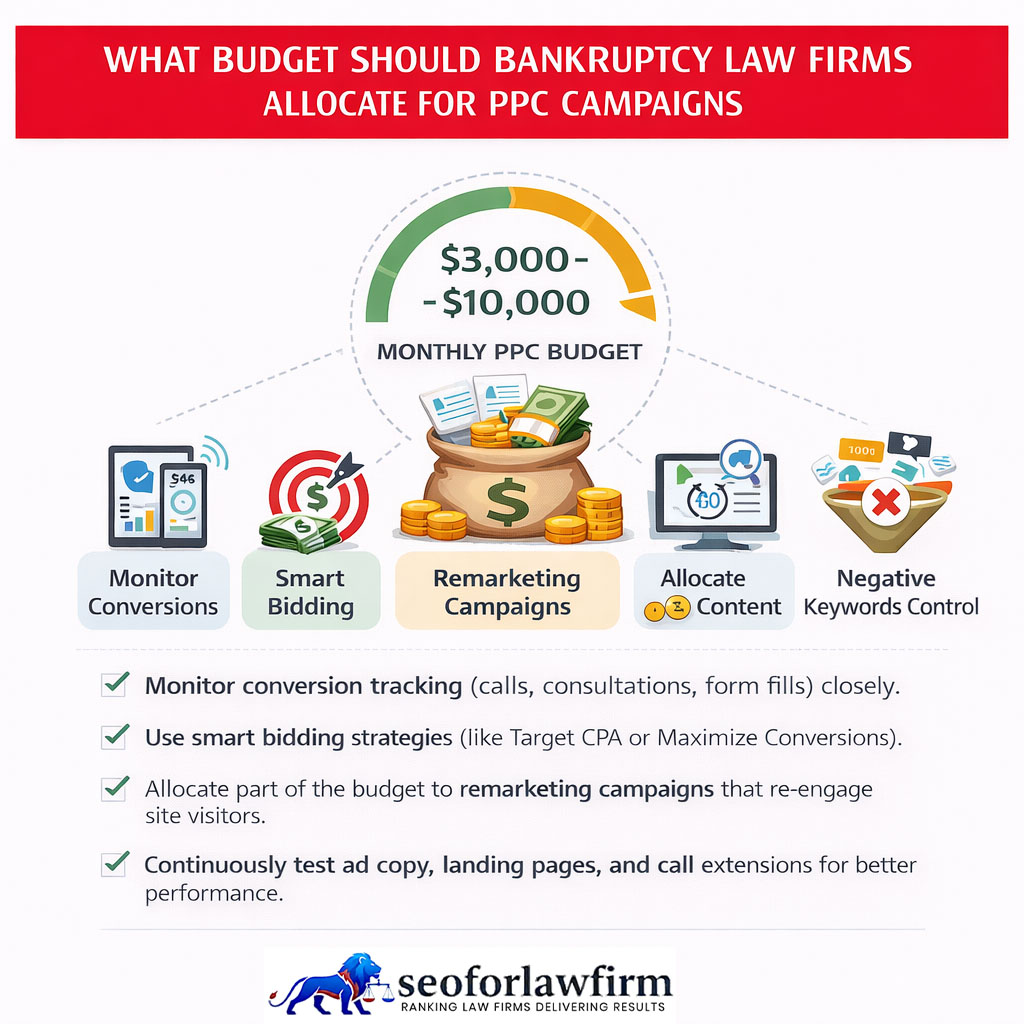
Budget planning needs to start with signed-matter economics rather than a universal monthly spending range. Public pages frequently quote figures such as $3,000–$10,000 per month or a fixed bankruptcy cost per click, but auction costs change according to market, query, competition, location, ad quality, landing-page experience, and bidding strategy. Google Keyword Planner provides location-specific cost and traffic estimates, making account-level forecasts more useful than a nationwide bankruptcy benchmark.
Lead measurement also needs to extend beyond form fills. Bankruptcy firms gain a clearer picture when the conversion chain follows click → inquiry → qualified lead → consultation → signed matter → revenue. Google Ads supports website and phone-call conversion actions, and its current enhanced-conversions-for-leads workflow supports offline stages such as qualified and converted leads.
Bankruptcy advertising also has a platform-policy constraint that generic PPC guides miss. Google classifies bankruptcy services under the sensitive-interest category of negative financial status. Advertiser-curated audiences such as Customer Match and first-party data segments are restricted for this category, making ordinary remarketing advice inappropriate as a default bankruptcy PPC tactic.
Table of Contents
- Article sections will appear here.
What Are PPC Ads for Bankruptcy Lawyers?
PPC ads for bankruptcy lawyers are paid search advertisements that appear for queries related to bankruptcy legal services, and the law firm pays when a user clicks the ad. Common searches include “bankruptcy lawyer near me,” “Chapter 7 bankruptcy attorney,” “Chapter 13 lawyer,” “business bankruptcy attorney,” “bankruptcy consultation,” and “file Chapter 7 with a lawyer.” Law firm PPC uses the same auction, targeting, bidding, landing-page, and conversion principles across legal practice areas, while bankruptcy campaigns require additional attention to bankruptcy-specific intent and advertising restrictions.
Google uses Ad Rank to determine whether an ad appears and where it appears. Ad Rank considers the bid, auction-time ad quality, thresholds, search context, and the expected effect of ad assets and formats. A higher bid alone does not guarantee the first advertising position. PPC provides auction-based visibility when the campaign is active, whereas bankruptcy SEO depends on Google crawling, indexing, and ranking the firm’s organic pages.
How Do Bankruptcy Lawyers Set Up PPC Campaigns?
Bankruptcy lawyers set up PPC campaigns by defining conversion economics, separating bankruptcy services, establishing exclusions, measuring leads, and selecting bidding strategies around verified conversion data.
Listed below are the 10 steps for setting up bankruptcy lawyer PPC ads.
- 1. Define the conversion funnel and allowable acquisition cost: Identify each stage from ad click to signed bankruptcy matter. Set the maximum acquisition cost the firm can sustain based on case value and expected conversion rates.
- 2. Separate bankruptcy services into focused campaign themes: Create distinct campaign or ad-group structures for services such as Chapter 7, Chapter 13, and business bankruptcy. Focused themes improve message relevance and make performance easier to measure.
- 3. Research high-intent bankruptcy searches: Identify queries used by people actively looking for bankruptcy legal help. Prioritize terms that match the firm’s services, jurisdiction, and client intent.
- 4. Choose keyword match types deliberately: Use match types according to the level of control and reach required for each keyword. Review search-term data regularly to prevent irrelevant traffic from consuming budget.
- 5. Configure geographic targeting around licensed markets: Target locations where the firm is licensed and actively accepts bankruptcy clients. Exclude areas that fall outside the firm’s service boundaries.
- 6. Create relevant responsive search ads and assets: Write ads that match the bankruptcy service, search intent, and landing page. Add relevant assets such as sitelinks, call assets, and structured information where appropriate.
- 7. Build dedicated bankruptcy landing pages: Send users to pages that directly address the bankruptcy service advertised. Each landing page must present clear service information, trust signals, and a direct consultation path.
- 8. Create negative-keyword controls: Add negative keywords that block searches unrelated to hiring a bankruptcy lawyer. Continue expanding the negative list as new irrelevant search terms appear.
- 9. Track calls, forms, qualified leads, and signed matters: Measure more than clicks and form submissions. Connect advertising data with intake and case-management records to identify which campaigns generate qualified leads and retained clients.
- 10. Select and refine bidding from actual conversion data: Choose bidding strategies based on the volume and quality of recorded conversions. Adjust bids and campaign settings as qualified-lead and signed-matter data becomes more reliable.
1. Define the Conversion Funnel and Allowable Acquisition Cost
A bankruptcy law firm must define its conversion funnel and allowable acquisition cost before setting the PPC budget. The funnel must track ad click → raw inquiry → qualified bankruptcy lead → consultation → retained client. Each stage carries a different economic value because a raw inquiry does not equal a qualified lead or signed matter.
The firm can calculate allowable cost per lead using Allowable CPL = Allowable Cost per Signed Matter × Lead-to-Signed-Matter Rate. If the firm accepts a $1,500 acquisition cost per signed matter and converts 15% of qualified PPC leads into signed matters, the allowable CPL is $225. A target of 20 qualified leads at that rate produces an illustrative monthly budget of $4,500. This calculation serves as a planning model rather than a bankruptcy-industry benchmark.
2. Separate Bankruptcy Services Into Campaign Themes
Bankruptcy firms must separate PPC campaigns or ad groups when bankruptcy services involve different search intent, client needs, and landing pages. Useful campaign themes include Chapter 7 bankruptcy, Chapter 13 bankruptcy, business bankruptcy, Chapter 11 where offered, creditor representation, foreclosure-related bankruptcy counsel, and bankruptcy consultations.
A person searching “Chapter 13 lawyer near me” has a different legal need from a business owner searching “Chapter 11 bankruptcy attorney.” Separate campaign themes align the search query, keyword, ad message, and landing page with the specific bankruptcy service.
3. Research Bankruptcy PPC Keywords
Bankruptcy PPC keyword research identifies the searches prospective clients use when they are actively seeking legal representation or evaluating bankruptcy options. Google Keyword Planner provides keyword ideas, estimated search demand, location-specific forecasts, and estimated advertising costs. High-intent searches include “bankruptcy lawyer near me,” “Chapter 7 lawyer [city],” “Chapter 13 attorney [city],” “business bankruptcy lawyer,” “bankruptcy attorney consultation,” and “lawyer to file Chapter 7.”
Search volume alone does not determine keyword value. A narrower query that matches a bankruptcy service the firm accepts carries stronger client intent than a broad query that attracts research traffic. Actual advertising performance also depends on factors such as bids, budget, geographic targeting, ad quality, and auction conditions.
4. Choose Keyword Match Types Deliberately
Bankruptcy law firms must choose keyword match types according to the level of reach and search-query control each campaign requires. Google Ads supports broad, phrase, and exact match types for Search campaigns. Exact match provides tighter targeting, phrase match expands reach to relevant queries, and broad match reaches a wider range of related searches based on meaning and intent.
Law firms must review the Search Terms report regardless of match type because the report shows the queries that triggered ads and identifies opportunities for new keywords and negative keywords. Firms using Google’s campaign-level broad-match setting must also review the September 2026 transition to AI Max and confirm that current campaign settings still match the intended targeting strategy.
5. Configure Geographic Targeting Around Licensed Markets
Bankruptcy law firms must configure PPC location targeting around the jurisdictions and service markets where they accept clients. Google’s default geographic option can reach people who are in, regularly in, or interested in a targeted location. At the same time, the Presence setting focuses on people likely to be in or regularly in the selected area.
A firm serving a defined local market must review these settings because broader targeting can generate clicks from users outside the intended service area. Geographic targeting relies on multiple location signals, so law firms must also review actual campaign data rather than assume every click originates from the selected market.
6. Create Bankruptcy Ads and Assets
Bankruptcy law firms must create search ads that connect the user’s legal problem with the relevant bankruptcy service without making false, misleading, or unsupported claims. Ad messaging can reference Chapter 7 representation, Chapter 13 representation, bankruptcy consultations, local attorney availability, substantiated attorney experience, clear contact options, and genuine fee or consultation offers.
Google Ads uses assets such as sitelinks and call assets to provide additional ways for prospective clients to interact with an ad. Call reporting can measure details such as call timing, duration, and connection status where supported, and advertisers can define a minimum call duration for selected conversion actions. Attorney advertising must also comply with applicable professional-conduct rules. ABA Model Rule 7.1 prohibits false or misleading communications about a lawyer’s services, so claims involving guaranteed outcomes, superiority, or specific results require careful legal review.
7. Build Dedicated Bankruptcy PPC Landing Pages
Bankruptcy law firms must use dedicated PPC landing pages that match the bankruptcy service and search intent represented in each ad. A Chapter 7 campaign must direct prospective clients to a Chapter 7-focused page rather than a general law-firm homepage. The landing page must explain the relevant service, identify the attorney or firm, establish geographic relevance, and provide clear contact options.
Google also considers landing-page experience as part of its assessment of ad quality. Bankruptcy landing pages must present accurate information without promising outcomes that depend on eligibility, financial circumstances, trustee decisions, court rulings, exemptions, creditor actions, or other case-specific factors.
Listed below are the 10 main elements of a bankruptcy PPC landing page.
- Service-Matched Headline: Use a headline that directly reflects the bankruptcy service or search intent represented in the ad.
- Bankruptcy Service Explanation: Explain the representation offered and the legal problem the service addresses.
- Attorney Identity and Credentials: Identify the attorney or law firm and present relevant credentials accurately.
- Geographic Relevance: State the jurisdictions, cities, or markets the firm serves where appropriate.
- Telephone and Form Options: Give prospective clients clear ways to call the firm or submit an inquiry.
- Genuine Client Reviews: Display authentic reviews where professional-conduct rules permit their use and presentation.
- Fee or Consultation Information: Present accurate pricing or consultation details when the firm chooses to disclose them.
- Mobile-Friendly Forms and Buttons: Make contact forms, telephone buttons, and other conversion elements easy to use on mobile devices.
- Privacy and Disclosure Information: Include applicable privacy notices, disclaimers, and advertising disclosures.
- Clear Next Step: Tell the prospective client how to request a consultation or contact the firm.
8. Create Negative-Keyword Controls
Bankruptcy law firms must use negative keywords to block searches that do not match the firm’s services or client-acquisition goals. Negative keywords reduce wasted spend from irrelevant queries such as employment searches, academic research, free legal forms, or services the firm does not offer.
The Search Terms report helps the firm identify queries that triggered ads but failed to match client intent. The firm must review these queries regularly and add unsuitable terms to the appropriate negative-keyword list. Campaign-level and account-level controls can also help prevent repeated irrelevant traffic across multiple ad groups. A disciplined negative-keyword process improves budget efficiency and keeps paid traffic focused on prospective bankruptcy clients.
9. Track Calls, Forms, Qualified Leads, and Signed Matters
Bankruptcy law firms must track calls, forms, qualified leads, consultations, and signed matters rather than measure PPC performance through clicks alone. Conversion tracking shows which campaigns, keywords, ads, and landing pages generate lead actions. Intake data then separates raw inquiries from prospects who meet the firm’s case criteria.
CRM or case-management records can connect qualified leads with consultations and retained clients. This reporting structure helps the firm compare advertising cost with actual client acquisition. PPC performance becomes more useful when campaign data follows the prospect from the initial click through the signed bankruptcy matter.
10. Select and Refine Bidding From Actual Conversion Data
Bankruptcy law firms must select and refine bidding strategies using reliable conversion and lead-quality data. Early campaign data can reveal which keywords, locations, devices, and search themes produce meaningful inquiries. Qualified-lead and signed-matter data provide stronger bidding signals than raw form submissions or clicks.
The firm must review whether automated bidding is optimizing toward actions that represent real business value. Campaign settings and conversion definitions must also be updated when intake data reveals low-quality or irrelevant leads. Bidding decisions become more accurate as the campaign accumulates enough conversion data to distinguish valuable bankruptcy prospects from low-value traffic.
What Budget Do Bankruptcy Law Firms Need for PPC?
A bankruptcy law firm must set its PPC budget from local CPC forecasts, target qualified-lead volume, conversion rates, and the maximum cost the firm accepts for each signed matter. No single monthly budget applies to every bankruptcy practice because auction costs, competition, location, and client economics differ by market. A practical formula is Monthly PPC Budget = Target Qualified Leads × Allowable Cost per Qualified Lead.
The firm can then measure acquisition economics with Cost per Signed Matter = PPC Spend ÷ PPC-Attributed Signed Matters. LocaliQ and WordStream’s 2026 Search Advertising Benchmarks reported average Attorneys & Legal Services costs of $9.87 per click and $131.63 per lead, showing why bankruptcy firms need to model budget from actual local auction costs and signed-client economics. Budget planning must account for expected CPC, landing-page conversion rate, inquiry qualification rate, qualified-lead-to-client conversion rate, and maximum acceptable acquisition cost.
Which Keywords Work for Bankruptcy Lawyer PPC?
The most useful bankruptcy PPC keywords match a bankruptcy service, geographic market, and clear legal-service intent.
The table below shows common bankruptcy keyword categories and the intent each category represents.
| Keyword Category | Example | Search Intent |
| Core bankruptcy | bankruptcy lawyer near me | Wants bankruptcy legal help |
| Chapter 7 | Chapter 7 bankruptcy attorney | Seeks Chapter 7 representation |
| Chapter 13 | Chapter 13 lawyer consultation | Seeks repayment-plan representation |
| Local | bankruptcy attorney Chicago | Wants a lawyer in a defined market |
| Business | business bankruptcy lawyer | Seeks commercial bankruptcy counsel |
| Filing intent | lawyer to file bankruptcy | Close to taking legal action |
| Problem-driven | lawyer for foreclosure and bankruptcy | Has a specific financial/legal problem |
No keyword is automatically “best” across every firm. Campaign data needs to determine which searches produce qualified consultations and signed matters.
Which Negative Keywords Reduce Wasted Bankruptcy PPC Spend?
Negative keywords include jobs, salary, law school, definition, PDF, template, forms, DIY, paralegal jobs, and attorney jobs. Bankruptcy statistics can reduce wasted bankruptcy PPC spend when those searches do not match the firm’s services or client-acquisition goals. Bankruptcy firms must review actual search terms before excluding queries because the same word can represent different intent.
For example, “free bankruptcy consultation” represents a valid lead for a firm that offers free consultations, while “free bankruptcy forms” reflects self-help intent. Negative keywords also use broad, phrase, and exact matching behavior, so firms must select the match type that blocks unwanted searches without removing relevant traffic. Regular Search Terms report reviews help identify new exclusions as campaign data grows.
Listed below are 12 negative keywords bankruptcy firms review.
- Jobs: Blocks employment-related searches that do not represent prospective clients.
- Salary: Excludes searches about attorney, paralegal, or legal-industry compensation.
- Law School: Removes educational searches unrelated to hiring bankruptcy counsel.
- Definition: Filters informational searches seeking basic bankruptcy terminology.
- PDF: Excludes searches focused on downloadable documents rather than legal representation.
- Template: Blocks users seeking document templates or self-service materials.
- Forms: Reduces searches for bankruptcy forms when the firm is targeting representation rather than document downloads.
- DIY: Excludes users looking to handle bankruptcy without an attorney.
- Paralegal Jobs: Blocks searches related to paralegal employment.
- Attorney Jobs: Removes searches from lawyers seeking employment.
- Bankruptcy Statistics: Excludes research-oriented searches about bankruptcy data and trends.
- Free: Review this term carefully rather than excluding it automatically because it can appear in both high-intent consultation searches and low-intent self-help searches.
How Do Bankruptcy Lawyers Improve PPC Conversion Rates?
Bankruptcy lawyers improve PPC conversion rates by tightening search intent, matching ads with dedicated landing pages, reducing geographic waste, answering urgent client questions, and measuring lead quality beyond the initial inquiry. A study by Anindya Ghose and Sha Yang titled An Empirical Analysis of Search Engine Advertising: Sponsored Search in Electronic Markets in 2009 found that landing-page quality and sponsored-search performance were connected with conversion and advertiser cost outcomes. Bankruptcy firms must therefore judge PPC performance by qualified leads, consultations, signed matters, and acquisition cost rather than Quality Score alone.
Listed below are 8 common PPC conversion problems bankruptcy lawyers must fix.
- Generic Landing Pages: Send Chapter 7, Chapter 13, and business bankruptcy searches to pages that directly match the service advertised.
- Mismatched Ad Messaging: Match consumer bankruptcy searches with consumer-focused ads and business bankruptcy searches with business-focused ads.
- Geographic Waste: Restrict campaigns to the jurisdictions and service markets where the firm accepts clients.
- Poor Mobile Experience: Use short forms, clear call buttons, readable content, and mobile-friendly page layouts.
- Weak Call Qualification: Track call quality and qualified consultations instead of counting every phone call as a successful conversion.
- Broad Search Traffic: Review actual search terms and negative keywords rather than judging broad traffic through CTR alone.
- Landing-Page Friction: Give prospective clients clear information about services, consultations, attorney credentials, and the next step.
- Lead-Quality Measurement: Connect Google Ads data with intake, CRM, and case-management records to identify which campaigns generate retained clients.
Which Bidding Strategy Works for Bankruptcy Lawyer PPC?
Bankruptcy lawyers must choose a PPC bidding strategy according to the conversion volume, conversion quality, and business outcome the campaign needs to optimize. Google Ads Smart Bidding options include Maximize Conversions, Target CPA, Maximize Conversion Value, and Target ROAS. PPC bidding strategies for lawyers differ according to whether the campaign prioritizes conversion volume, acquisition cost, or downstream value rather than one universal bidding objective.
Value-based bidding becomes more useful when the firm assigns meaningful values to different outcomes. A bankruptcy firm that treats every form submission as equally valuable trains automated bidding toward form volume rather than client quality. A firm that imports qualified leads and signed matters gives the bidding system signals that more closely reflect client acquisition and revenue.
Listed below are the 6 main bidding strategies bankruptcy law firms can evaluate.
- Maximize Conversions: Optimizes the available budget toward generating more recorded conversion actions.
- Target CPA: Optimizes bids toward conversions at an average target cost per acquisition.
- Maximize Conversion Value: Prioritizes conversions according to the values assigned to different actions or outcomes.
- Target ROAS: Optimizes toward a target return on conversion value when reliable monetary values are available.
- Qualified-Lead Optimization: Uses qualified leads instead of raw inquiries as stronger signals for automated bidding.
- Signed-Matter Optimization: Imports retained-client outcomes so bidding decisions reflect the conversions that produce actual business value.
How Do Bankruptcy Lawyers Track PPC Leads?
Bankruptcy lawyers track PPC leads by measuring website forms, phone calls, qualified consultations, signed matters, and financial outcomes as separate stages in the conversion funnel. Google Ads records website and call conversion actions, while offline conversion tracking connects later client outcomes with the original advertising interaction. Enhanced conversions for leads also support first-party lead data and imported offline outcomes. A law firm marketing KPI framework helps connect advertising metrics with business outcomes rather than reporting clicks in isolation.
Bankruptcy firms must distinguish raw inquiries from qualified leads because every form submission or phone call does not carry the same client value. The strongest measurement structure connects ad visibility → click → inquiry → qualified lead → consultation → signed matter → revenue. This framework shows which campaigns generate clients rather than reporting clicks and form submissions in isolation.
The table below shows a useful bankruptcy PPC measurement hierarchy.
| Funnel Stage | Measurement |
| Visibility | Impressions, top-impression metrics |
| Engagement | Clicks, CTR |
| Cost | CPC, advertising spend |
| Initial Conversion | Phone calls, website forms |
| Qualified Lead | Prospect matches the firm’s bankruptcy service and intake criteria |
| Consultation | Qualified prospect completes an attorney or intake consultation |
| Signed Matter | Client completes the engagement process |
| Financial Outcome | Cost per signed matter, attributable revenue, ROAS |
How Do Bankruptcy Lawyers Calculate PPC ROI?
Bankruptcy lawyers calculate PPC ROI by comparing the financial return from PPC-attributed matters with the total advertising cost required to acquire those matters. A basic formula is PPC ROI = ((PPC-Attributed Return − PPC Cost) ÷ PPC Cost) × 100. Law firms must also measure Cost per Lead = PPC Spend ÷ Leads, Cost per Qualified Lead = PPC Spend ÷ Qualified Leads, Cost per Consultation = PPC Spend ÷ Consultations, and Cost per Signed Matter = PPC Spend ÷ Signed PPC Matters.
Raw lead volume does not establish campaign profitability. A campaign that generates 100 inexpensive inquiries and one signed matter can produce weaker economics than a campaign that generates 30 higher-cost inquiries and eight signed matters. Intake and CRM data connect advertising spend with qualified leads, signed matters, and attributable financial return.
Where Do Bankruptcy Lawyers Get PPC Management?
SEOForLawFirm.com is a specialized, law-firm-focused PPC provider that helps bankruptcy lawyers manage paid search around qualified leads, acquisition cost, and signed matters rather than click volume alone. Bankruptcy lawyers can use SEOForLawFirm’s PPC services for bankruptcy lawyers to connect Google Ads campaigns with bankruptcy keywords, target jurisdictions, landing pages, conversion tracking, and retained-client reporting.
Bankruptcy lawyers can also work with legal marketing agencies, independent Google Ads specialists, paid-search consultants, and digital advertising firms with experience in legal services. A qualified provider must measure calls, qualified leads, consultations, acquisition cost, and signed matters so the firm can evaluate whether advertising spend produces business value.
Are Remarketing Ads Appropriate for Bankruptcy Lawyers?
No, standard advertiser-curated remarketing is restricted for bankruptcy advertising because Google classifies bankruptcy services under sensitive negative-financial-status interests. Google restricts advertiser-curated targeting methods such as Customer Match and advertiser-owned data segments for sensitive-interest advertising. Certain predefined Google audience options remain available subject to applicable policy requirements.
Bankruptcy law firms must not automatically create remarketing audiences from people who visited bankruptcy-related service pages. Those visits can indicate sensitive financial circumstances that fall within Google’s targeting restrictions. Search campaigns instead reach users through active bankruptcy-related queries without requiring the advertiser to reuse an individual visitor’s prior bankruptcy-related activity for audience targeting.
Why Do Bankruptcy Lawyers Need PPC Advertising?
Bankruptcy lawyers need PPC advertising because it delivers immediate visibility, targeted lead generation, and measurable ROI in competitive legal markets. Unlike SEO, which requires time to build momentum, PPC ads allow attorneys to appear instantly in Google search results when potential clients are actively looking for debt relief and legal guidance.
Local targeting ensures ads only reach users within a firm’s licensed service areas, maximizing cost efficiency and minimizing wasted clicks. Performance metrics like CTR (click-through rate), CPL (cost per lead), and conversion rate make it easy to measure campaign success and adjust strategy in real time.
According to Google’s Economic Impact Report, reaffirmed in 2022, businesses earn an average of $2 in revenue for every $1 spent on Google Ads, a return that highlights the scalability and profitability of PPC when properly managed.
In short, bankruptcy PPC advertising provides speed, precision, and profit clarity, making it one of the most effective digital marketing tools for law firms seeking consistent lead flow.
What Advertising Rules Affect Bankruptcy Lawyer PPC?
Bankruptcy lawyer PPC ads must comply with Google Ads policies, applicable law, and attorney-advertising rules in each jurisdiction where the firm advertises. Google prohibits misleading claims about identity, qualifications, affiliations, and services. ABA Model Rule 7.1 also prohibits false or misleading communications about a lawyer’s services, including statements that create unjustified expectations about future results.
Bankruptcy law firms must therefore avoid promises that imply guaranteed debt relief, guaranteed approval, guaranteed asset protection, universal creditor relief, or guaranteed outcomes. Case results depend on the client’s financial circumstances, applicable exemptions, creditor positions, court decisions, trustee actions, and governing law.
Listed below are 6 claims bankruptcy lawyers must review carefully before using them in PPC ads.
- “Erase all debt.” The statement can misrepresent which debts are dischargeable.
- “Guaranteed bankruptcy approval.” Bankruptcy eligibility and court outcomes cannot be guaranteed.
- “Keep every asset.” Asset protection depends on exemptions, ownership, value, jurisdiction, and case facts.
- “Stop every creditor immediately.” Creditor actions and automatic-stay protections depend on the case and applicable law.
- “Best bankruptcy lawyer.” Superiority claims require substantiation and trigger state advertising-rule concerns.
- “Guaranteed fresh start.” Bankruptcy outcomes vary according to eligibility, debt type, compliance, and case circumstances.
What Mistakes Waste Bankruptcy Lawyer PPC Budgets?
Bankruptcy lawyer PPC budgets are wasted by broad service mixing, weak geographic controls, inaccurate conversion tracking, and optimization toward raw leads instead of retained clients. Campaign performance improves when each optimization connects search intent with qualified consultations, signed matters, and acquisition cost. Firms must review both advertising data and intake outcomes because high click or lead volume does not prove profitable client acquisition.
Listed below are 8 PPC mistakes bankruptcy firms must avoid.
- Sending Every Service to One Landing Page: Chapter 7, Chapter 13, business bankruptcy, and other services must lead to pages that match the user’s search intent.
- Running Broad Keywords Without Reviewing Search Terms: Search-term reviews identify irrelevant queries and new negative-keyword opportunities.
- Ignoring Geographic Targeting Settings: Poor location controls can generate clicks from users outside the firm’s intended service market.
- Counting Every Call as a Qualified Lead: Call volume does not show whether the caller matches the firm’s bankruptcy intake criteria.
- Using Irrelevant Inquiries as Primary Smart Bidding Conversions: Weak conversion signals train automated bidding toward low-value actions.
- Optimizing for CTR Instead of Signed Matters: High click-through rates do not establish strong acquisition economics.
- Using Restricted Remarketing Audiences: Bankruptcy-related financial hardship can fall within sensitive-interest advertising restrictions.
- Making Unsupported Debt-Relief or Outcome Promises: Misleading claims create policy, legal, and professional-conduct risks.

How Does Bankruptcy PPC Compare With SEO?
Bankruptcy PPC buys auction-based search exposure, whereas bankruptcy SEO builds unpaid organic visibility through website optimization, content, technical SEO, local search, and other organic signals. PPC can begin generating eligible search exposure once ads are approved and campaigns are active, while SEO depends on crawling, indexing, and organic ranking development.
PPC also provides faster testing of queries, ads, offers, and landing pages, while SEO usually produces a slower feedback cycle. The two channels can support the same client-acquisition strategy rather than compete for the same marketing role. PPC search-term and conversion data can also inform organic content, keyword targeting, and landing-page decisions.
The table below shows the main differences between PPC and SEO.
| Dimension | PPC | SEO |
| Visibility Timing | Eligible for exposure once ads are approved and campaigns run | Requires crawling, indexing, and organic ranking development |
| Traffic Cost | Advertiser pays for clicks | No per-click advertising charge |
| Placement Control | Managed through bids, targeting, ads, campaign settings, and auction eligibility | Determined by organic search systems |
| Testing Speed | Supports faster testing of queries, ads, offers, and landing pages | Produces a slower testing and feedback cycle |
| Lead Attribution | Uses Google Ads conversion, query, and campaign reporting | Uses Search Console, analytics, call tracking, CRM, and related measurement |
| Visibility After Spend Stops | Paid exposure stops when the campaign stops serving | Existing organic visibility can remain, subject to ranking and search-system changes |
| Main Use | Captures immediate paid search demand | Builds longer-term organic search demand |