
A backlink is an individual hyperlink from an external website to a law firm’s website, while a referring domain is the unique website or domain that provides 1 or more of those backlinks. A single website can link to the same law firm 50 times, producing 50 backlinks but only 1 referring domain.
Backlink count therefore measures the total number of external links, whereas referring-domain count measures how many distinct websites supply those links. A law firm with 100 backlinks from 10 websites has 100 backlinks and 10 referring domains. A competing firm with 100 backlinks from 100 different websites has the same backlink count but 10 times as many referring domains.
Link diversity matters because independent websites provide broader external corroboration than repeated links from 1 source. Industry correlation research supports this relationship, although Google does not publish a rule stating that 100 links from 100 websites are always more valuable than 100 links from 1 website. A study by Patrick Stox from the Ahrefs Blog, titled “Google Says ‘Links Matter Less’, We Looked at 1M Queries to See If It’s True” in 2025, analyzed 1 million Google search engine results pages and found a Spearman correlation of 0.255 between organic rankings and referring-domain count compared with 0.248 for total backlink count, explicitly stating that these figures measure statistical correlation across the dataset rather than direct causation.
Multiple backlinks from the same domain still have value. Different pages on the same legal publication can link to different practice-area pages, send referral traffic, provide topical context, and pass page-level link signals. Ahrefs found that 79.23% of referring domains in one study linked to the same website more than once, showing that repeated links from legitimate websites are normal rather than inherently manipulative.
The incremental value of repeated links depends on the linking page, destination page, placement, anchor text, relevance, and whether Google treats the link as eligible for ranking consideration. The concept of “diminishing returns” should therefore not be interpreted as meaning that the second backlink from a website has no SEO value. Ahrefs’ proprietary Domain Rating metric counts unique followed referring domains rather than repeated backlinks from the same website, but Domain Rating is an Ahrefs metric and not a Google ranking score.
Google confirms that links remain part of its ranking systems. Google’s current ranking-system documentation states that link-analysis systems examine how pages link to one another, and PageRank continues to form part of Google’s core ranking systems. Google also uses links to determine page relevance and discover URLs for crawling.
Table of Contents
- Article sections will appear here.
What Is a Backlink in Legal SEO?
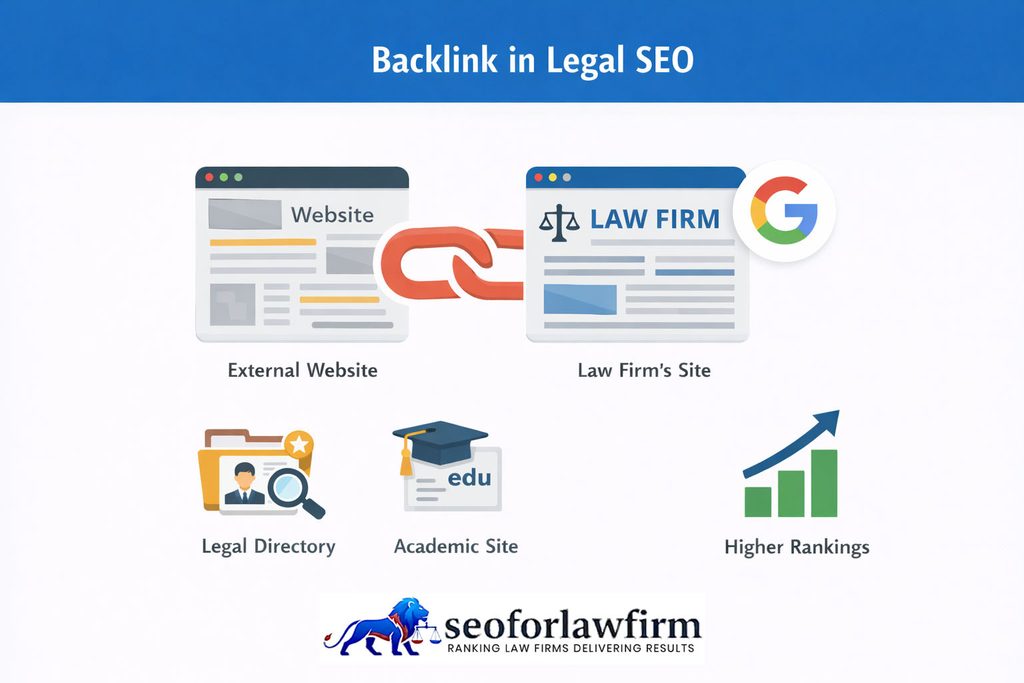
A backlink in legal SEO is a hyperlink from an external webpage to a law firm’s website. The backlink points to an attorney biography, practice-area page, legal guide, study, office page, or firm resource. Each backlink connects a linking website, linking page, destination URL, anchor text, surrounding context, link attribute, and editorial reason. A local newspaper might quote an employment attorney in an article about a new state employment law.
The newspaper might link the quotation to the attorney’s biography. That article produces 1 backlink. A second article on the same newspaper website might cite the firm’s wage-and-hour guide. The second article produces another backlink. The second article does not produce another referring domain because both backlinks originate from the same website. An official documentation guide by Google Search Central, titled “SEO Link Best Practices for Google” in 2024, verified that Google uses links as a primary signal to discover new pages to crawl, while establishing that clear, descriptive anchor text provides immediate context for the link, allowing both human users and search engines to easily understand what the target page is about before visiting it.
What Is a Referring Domain in Law Firm SEO?
A referring domain in law firm SEO is a unique external website that contains at least 1 backlink to a law firm’s website or page. The referring-domain metric groups multiple backlinks by their source website. Avvo might link to 3 attorney biographies. Those links produce 3 backlinks from 1 referring domain. A local newspaper might link to 2 legal studies. Those links produce 2 backlinks from 1 referring domain.
A bar association might link to the firm once. That link produces 1 backlink from 1 referring domain. The law firm therefore receives 6 backlinks from 3 referring domains. Each additional link increases the backlink count. Each source website still counts once as a referring domain. Ahrefs describes referring domains as unique websites that link to a target page or website.
How Do Backlinks Affect Google Rankings?
Backlinks affect Google rankings by helping Google discover pages, identify relationships between pages, evaluate page subjects, and calculate link-based signals such as PageRank.
An official documentation guide by Google Search Central, titled “A Guide to Google Search Ranking Systems” in 2024, confirmed that PageRank remains actively integrated into Google’s core ranking systems under its modern link analysis frameworks, while Google’s public statements and automated policies clarify that the system has been substantially updated over time and does not operate on a fixed formula where a specific number of backlinks produces a fixed ranking position.
One backlink can carry a different ranking value from another backlink. The source page, destination page, link placement, anchor text, and acquisition method shape the link’s meaning.
Listed below are the 6 backlink conditions law firms should analyze when assessing ranking value.
- Source-Page Relevance: The linking page should have a clear contextual relationship with the law firm, attorney, practice area, legal guide, study, or location page. A state bar article about employment law creates a stronger topical connection to an employment-law guide than an unrelated entertainment page.
- Source-Page Link Profile: The source page receives authority and context from its own incoming links. The source page also distributes link signals through its outgoing links. A third-party authority score can support comparison, but the score does not represent Google’s PageRank calculation.
- Editorial Context: The surrounding sentence and section explain why the publisher included the backlink. A journalist’s citation of an attorney’s legal analysis provides a clearer editorial reason than a link placed in an unrelated footer, profile, or automated directory page.
- Destination-Page Relevance: The destination page should satisfy the expectation created by the source page and anchor text. A backlink discussing truck-accident evidence should lead to a relevant truck-accident resource rather than an unrelated homepage.
- Anchor Text: Anchor text identifies the linked resource’s subject. Google recommends concise and descriptive anchor text because clear link text helps users and search engines understand the destination before visiting the page.
- Link Qualification and Spam-Policy Compliance: The link should comply with Google’s rules for paid, sponsored, user-generated, and editorial links. Google classifies purchased ranking links, automated links, excessive exchanges, and low-quality directory links as link spam. Paid placements should use appropriate attributes such as rel=” sponsored” or rel=”nofollow”. Google’s link-spam policy explains these requirements.
Backlinks operate alongside content relevance, search intent, page quality, usability, local signals, and other ranking systems. A broader Google ranking-factor analysis for law firms should treat backlinks as one part of Google’s ranking process rather than an isolated score.
How Do Referring Domains Affect Google Rankings?
Referring domains affect Google rankings indirectly through the individual backlinks those websites provide. Google does not publish referring-domain count as a standalone ranking factor. SEO platforms group backlinks by domain because unique-source diversity provides a useful way to evaluate a website’s backlink profile.
A page referenced by 1 university, 2 newspapers, 3 bar organizations, 5 legal publications, and 4 local organizations receives backlinks from 15 referring domains. The diverse sources can show broader recognition across academic, news, professional, legal, and community websites. Google still evaluates the underlying links between pages. An official documentation guide by Google Search Central, titled “A Guide to Google Search Ranking Systems” in 2024, confirmed that Google’s core ranking systems rely strictly on its own web-crawling infrastructure and automated algorithms rather than third-party data, explicitly clarifying that Google does not take an SEO platform’s referring-domain total and apply a published ranking multiplier.
Listed below are the 5 link conditions that determine how useful those referring domains may be.
- Source Quality: A trustworthy university, court, government agency, newspaper, or professional association can provide stronger source credibility than an automated directory or abandoned website.
- Topical Relevance: The referring page should relate to the linked legal subject. A bar association article about attorney discipline creates a clearer relationship with a legal-ethics guide than an unrelated retail website.
- Editorial Context: The surrounding content should explain why the source links to the law firm. A journalist citing an attorney’s analysis provides a genuine editorial reason. A hidden or randomly inserted link provides little contextual meaning.
- Destination Relevance: The law firm’s destination page should support the source page’s statement and satisfy the visitor’s expectation. A citation concerning medical-malpractice deadlines should lead to a relevant legal guide rather than the firm’s homepage.
- Acquisition Method: The backlink should result from a legitimate citation, contribution, resource, membership, interview, study, or professional relationship. Google classifies purchased ranking links, automated links, excessive exchanges, and other manipulative placements as link spam.
Google’s ranking-system documentation states that its link-analysis systems examine how pages link to one another. The referring-domain count remains an SEO measurement. The individual backlinks supply the signals that Google’s systems process.
What Is the Difference Between Backlinks and Referring Domains?
The difference between backlinks and referring domains is that backlinks count every external hyperlink pointing to a law firm’s website, while referring domains count each unique website supplying 1 or more of those backlinks once.
The table below shows the differences between backlinks and referring domains for law firm SEO.
| Dimension | Backlinks | Referring Domains |
| Definition | Individual external hyperlinks pointing to a law firm page or website | Unique websites or domains supplying 1 or more backlinks |
| Measurement | Every qualifying link is counted | Each unique domain is counted once |
| Example | 5 links from one legal publication = 5 backlinks | 5 links from the same publication = 1 referring domain |
| Main analytical use | Measures individual link volume and page-level link relationships | Measures diversity of linking websites |
| Page relationship | Each backlink connects a specific source page with a destination page | Referring-domain metrics group backlinks according to their source website |
| Multiple links from 1 site | All links can be analyzed individually | The website remains 1 referring domain |
| SEO interpretation | Quality depends on source page, context, placement, destination, anchor, and eligibility | Diversity shows how broadly different websites reference the firm |
| Ranking evidence | Google confirms link analysis and PageRank remain part of its ranking systems | Third-party studies show positive ranking and traffic correlations, but Google does not publish referring-domain count as a standalone factor |
| Repeated-link value | Additional links from the same domain can still support different pages and referral traffic | The domain does not become a second referring domain |
| Main risk | Manipulative paid links, exchanges, automated links, or unnatural anchors | Large numbers of low-quality domains do not automatically improve authority |
| Law firm example | A state bar page links to the firm’s attorney biography | The state bar website counts as 1 referring domain |
| Main objective | Earn useful links to pages that deserve references | Expand the number of relevant independent sources that reference the firm |
Do Referring Domains Matter More Than Backlink Counts?
Referring-domain diversity often provides a more useful measure of link-profile breadth than raw backlink volume, but referring domains are not universally more important than individual backlinks. A profile with 10,000 backlinks from 4 websites represents concentrated link volume. A profile with 500 editorial backlinks from 250 relevant websites represents broader source diversity. The first profile can still contain useful links when the websites cite several relevant law firm pages naturally.
A study by Patrick Stox from the Ahrefs Blog, titled “Google Says ‘Links Matter Less’,We Looked at 1M Queries to See If It’s True” in 2025, analyzed 1 million Google search engine results pages and found Spearman correlations of 0.255 for referring domains, 0.250 for followed referring domains, 0.248 for backlinks, and 0.242 for followed backlinks, emphasizing that unique domain diversity yields a slightly stronger statistical correlation with organic rankings than total raw link counts. Referring domains exceeded backlinks by only 0.007. The small difference does not support a rule that referring domains always outweigh backlinks. The study also states that correlation does not establish causation. Law firms should monitor backlink volume and referring-domain diversity together. Source relevance, editorial context, destination quality, anchor text, and link acquisition determine the meaning of both metrics.
What Makes a Backlink Authoritative for a Law Firm?
An authoritative law firm backlink comes from a credible and relevant page, occurs for a legitimate editorial or professional reason, and points to a destination useful to the source page’s audience.
Listed below are the 6 characteristics that make a backlink valuable for law firm SEO.
- Topical relevance: The linking page relates naturally to the attorney, practice area, legal issue, jurisdiction, community, or research being referenced.
- Editorial placement: An editor, journalist, organization, researcher, or site owner chooses to include the link because the destination helps readers.
- Source credibility: The source has a genuine audience, recognizable purpose, accurate content, and established public identity.
- Relevant destination: The backlink points to the page that best supports the citation rather than automatically linking every mention to the homepage.
- Natural anchor text: The link uses wording appropriate to the surrounding sentence instead of repeatedly forcing commercial exact-match terms.
- User value: A visitor following the link receives additional information, evidence, professional details, or resources related to the original page.
Authority scores such as Domain Rating, Domain Authority, and Authority Score are third-party metrics. These metrics help compare backlink profiles but do not represent Google scores.
A complete law firm link-building strategy should evaluate real source relevance and editorial quality alongside third-party metrics.
Does Anchor Text Affect Backlink Value?
Yes, anchor text affects backlink value because anchor text helps users and Google identify the linked destination page’s subject. Google recommends anchor text that is descriptive, reasonably concise, and relevant to the source page and destination page. Natural anchors include “Smith & Carter,” “attorney Maria Smith,” “Texas truck accident study,” “state wage-claim guide,” and “Smith & Carter’s employment law analysis.” Each anchor identifies the brand, attorney, research subject, legal resource, or cited analysis naturally.
A manipulated backlink profile might repeat phrases such as “best Houston personal injury lawyer,” “Houston accident attorney,” and “best injury law firm Houston” across unrelated websites. The repeated commercial phrases attempt to influence rankings rather than describe each citation naturally. Google classifies links created primarily to manipulate rankings as link spam. Law firms should let each publisher choose anchor text that fits the sentence, source page, destination page, and editorial reason for the link.
How Many Referring Domains Does a Law Firm Need?
A law firm does not need a universal number of referring domains because the competitive requirement depends on the target query, destination page, market, practice area, competitor link profiles, and source quality. A Los Angeles personal injury page competes in a different link environment from an estate-planning page serving a smaller regional market. The law firm should use page-level competitors as the benchmark.
Listed below are the 5 steps law firms should use to estimate a referring-domain gap.
- Identify the Top Organic Competitors: Search the target legal query and record the pages ranking in the main organic results. The analysis should compare pages serving the same search intent, practice area, and location rather than unrelated business competitors.
- Record Page-Level Referring Domains: Measure the unique domains linking directly to each competing page. Page-level data shows the links associated with the ranking URL rather than the competitor’s entire website.
- Remove Spam and Irrelevant Sources: Separate legitimate newspapers, legal publications, bar organizations, universities, local organizations, and industry resources from automated directories, scraped pages, and unrelated websites. Raw totals do not measure source relevance or editorial value.
- Identify Shared Competitor Sources: Find domains that link to 2 or more ranking competitors but do not link to the law firm. These domains can reveal legal directories, journalists, associations, resource pages, and publications that already reference the subject.
- Create a Legitimate Acquisition Plan: Develop legal studies, statistics, attorney commentary, local resources, original guides, professional relationships, and outreach ideas that give each source a genuine reason to cite the firm.
Site-wide referring-domain totals can mislead. A competitor might have 5,000 referring domains across its website, but the page ranking for the target legal query might receive links from only 25 referring domains. Page-level analysis gives the law firm a clearer measurement of the direct referring-domain gap.
What Is a Good Backlink-to-Referring-Domain Ratio?
A good backlink-to-referring-domain ratio has no universal value because legitimate law firm websites naturally receive different numbers of repeated links from each source. The calculation divides total backlinks by total referring domains. A website with 1,000 backlinks from 200 referring domains has an average of 5 backlinks per referring domain. A ratio of 5 does not prove that the link profile is good or bad.
A bar association might link to an attorney from committee, event, biography, and publication pages. A legal directory might generate repeated links through templates or location listings. A syndicated article might appear across multiple URLs. Each pattern produces additional backlinks without equivalent growth in referring domains. The law firm should examine source relevance, link placement, destination pages, anchor text, editorial context, and acquisition method. The source pattern provides more useful evidence than the ratio alone.
How Can Lawyers Check Backlinks and Referring Domains?
Lawyers can check backlinks and referring domains by combining Google Search Console with backlink databases such as Ahrefs, Semrush, or Moz. Google Search Console reports links Google has discovered for the verified law firm property. Third-party platforms operate independent crawlers and provide competitor research, historical comparisons, filtering, and new-or-lost link reports.
Listed below are the 5 data points law firms should compare when reviewing backlink and referring-domain reports.
- Total Backlinks: This metric shows the number of external links discovered by each platform. The law firm should review source pages and link placement because repeated template, directory, footer, and syndicated links can inflate the total.
- Total Referring Domains: This metric shows the number of unique websites providing backlinks. The law firm should assess whether those domains represent relevant legal publications, news organizations, universities, bar associations, directories, community organizations, or unrelated sources.
- Linked Pages: This report identifies the law firm pages receiving external references. The distribution can show whether links support attorney biographies, practice-area pages, legal guides, studies, office pages, or only the homepage.
- Anchor Text: This report shows the words external websites use in their links. Law firms should expect a natural mixture of firm names, attorney names, page titles, URLs, research topics, and descriptive phrases. Repeated keyword-heavy anchors require closer review.
- New and Lost Links: Third-party platforms track recently discovered and removed backlinks and referring domains. These reports can identify new citations, deleted articles, broken destination pages, changed URLs, lost partnerships, and crawler errors. Search Console provides a latest-links export but does not label lost links in the same manner.
Google states that its Search Console Links report provides a sample rather than a complete list of every backlink. Search Console tables can also group duplicate links and limit displayed rows. Ahrefs, Semrush, Moz, and Search Console can report different totals because each platform uses its own crawler, index, update schedule, canonicalization rules, and duplicate-link treatment.
The purpose is not to force every platform to display identical numbers. The purpose is to identify meaningful source, destination, anchor-text, acquisition, and link-loss patterns.
What Are Bad Backlinks for Law Firm SEO?
Bad backlinks for law firm SEO are links created primarily to manipulate search rankings or links produced through deceptive, artificial, hacked, paid, or spam-based acquisition practices. Google defines link spam as creating links to or from a website mainly to manipulate rankings. Bad backlink practices include purchased followed links, private blog networks, automated forum links, hidden links, hacked links, excessive reciprocal-link schemes, low-value directory campaigns, large-scale articles with commercial anchor text, and paid advertorial links without appropriate qualification.
Google permits paid placements when publishers mark the links with attributes such as rel=”sponsored” or rel=”nofollow”. A low Domain Rating does not automatically make a backlink harmful. A scraper’s irrelevant link does not automatically trigger a penalty. A third-party toxicity score does not prove that Google considers a link harmful. The law firm should evaluate the acquisition method, source page, editorial purpose, anchor text, placement, destination, and link attribute before classifying a backlink.

Should Law Firms Disavow Toxic Backlinks?
No, law firms should not routinely disavow every backlink that Ahrefs, Semrush, Moz, or another SEO tool labels toxic. Google states that most websites do not need the Disavow Tool. Google recommends disavowal only when a website has a considerable number of spammy, artificial, or low-quality links and those links have caused or are likely to cause a manual action. Google also warns that incorrect use can harm search performance.
A law firm should document links purchased by the firm or a previous agency. The law firm should request removal from the linking websites where appropriate. The law firm should reserve disavowal for unresolved links that meet Google’s stated conditions. Random scraper links and low third-party toxicity scores do not require the same response. A broader law firm SEO audit should determine whether backlinks caused the visibility decline before the firm takes destructive action.

What Are the Best Ways to Earn More Referring Domains?
The best ways to earn more referring domains are to create legitimate reasons for independent legal, local, professional, academic, and media websites to reference the law firm.
Listed below are 7 strategies law firms can use to earn relevant referring domains.
- Legal directories: Maintain accurate profiles on established legal directories, bar directories, and professional organizations where the firm legitimately qualifies.
- Digital PR: Supply journalists with accurate, timely attorney commentary on legislation, litigation trends, court decisions, and local legal developments.
- Original research: Publish court data, filing statistics, verdict analyses, local accident data, surveys, or other research with transparent methodology.
- Local legal resources: Publish jurisdiction-specific guides that community organizations, journalists, nonprofits, and educational institutions have legitimate reasons to reference.
- Professional participation: Join bar committees, professional associations, chambers, and relevant organizations where the lawyer genuinely participates.
- Community involvement: Support legal clinics, nonprofit programs, public education, community events, and other genuine initiatives that create natural organizational references.
- Unlinked mention reclamation: Identify existing articles or professional pages that name the firm or attorney and request a link when the destination genuinely helps readers.
Are Legal Directory Links Useful Referring Domains?
Yes, legal directory links can be useful referring domains when the directory serves a genuine legal audience, verifies profiles, and publishes accurate attorney or law firm information. Relevant sources include Avvo, Justia, FindLaw, Martindale-Hubbell, state bar directories, local bar associations, and practice-specific professional directories. Each directory can identify the attorney, confirm professional information, display local business details, send referral traffic, and provide a backlink.
The law firm should maintain a consistent name, address, telephone number, website URL, practice-area description, and attorney credentials across every profile. Directory volume alone does not create authority or guarantee ranking value. One verified profile on an established legal platform serves a different purpose from hundreds of automated listings on unrelated general directories. Google classifies low-quality directory links created primarily versus? as link spam? Wait.
How Should Law Firms Analyze Competitor Referring Domains?
Law firms should analyze competitor referring domains by identifying legitimate websites that reference several ranking competitors but do not yet reference the law firm. The analysis should compare pages competing for the same legal query. A firm-wide domain comparison can mix unrelated practice areas, markets, attorneys, and content types.
Listed below are the 6 steps for competitor referring-domain analysis.
- Select Competing Ranking URLs: Record the pages ranking for the same legal query, location, and search intent. Compare a personal injury service page with other personal injury service pages rather than competitor homepages or unrelated articles.
- Export Backlinks and Referring Domains: Export each page’s linking domain, source URL, destination URL, anchor text, link attribute, surrounding context, and discovery status. Page-level exports reveal which external references support each competing URL.
- Find Shared Referring Domains: Identify websites linking to 2 or more competing pages but not to the law firm. Ahrefs’ Link Intersect documentation confirms that its report finds domains linking to competitors without linking to the analyzed website.
- Remove Unsuitable Sources: Exclude spam websites, irrelevant directories, scraper pages, private networks, paid ranking placements, inaccessible opportunities, and sources unrelated to the legal topic. A visible competitor link does not establish that the firm should pursue the same placement.
- Classify Legitimate Opportunities: Group the remaining domains as legal directories, news media, professional organizations, resource pages, research citations, community programs, event websites, or existing professional relationships. Each category requires a different acquisition reason.
- Identify the Reference-Worthy Contribution: Determine what the law firm must create, provide, join, sponsor, explain, research, or contribute to earn a legitimate reference. The required asset might be original data, attorney commentary, a legal guide, a public program, an event contribution, or verified membership.
Suppose 4 competing personal injury firms receive links from the same county safety organization. The law firm should examine whether those links result from a public safety program, resource page, event, expert quotation, or association membership. The relationship explains the opportunity. The visible hyperlink only records the result.
A structured competitor backlink analysis for law firms should compare source relevance, page-level backlinks, referring domains, anchors, linked assets, and acquisition patterns. The goal is to reproduce a legitimate relationship or contribution rather than copy a competitor’s link mechanically.
How Should Law Firms Distribute Backlink Authority Internally?
Law firms should distribute backlink authority through contextual internal links that connect externally referenced resources with relevant practice-area, attorney, and location pages. Original studies, statistics, tools, and legal guides often attract backlinks more easily than commercial service pages. A law firm might publish a county crash study that earns links from newspapers, safety organizations, and legal publications.
The crash study can link contextually to truck accident representation, car accident representation, wrongful death representation, and the attorney who reviewed the research. Each internal link should connect a relevant source passage with a useful destination page. Each anchor should describe the destination naturally. Google states that internal links help its systems discover pages and identify relationships between pages. A planned law firm internal linking strategy helps externally referenced resources support related commercial pages without repeating manipulated anchor text or inserting unrelated links.
Which Metric Should Law Firms Prioritize: Backlinks or Referring Domains?
Law firms should prioritize neither backlinks nor referring domains in isolation. The stronger objective is to earn relevant backlinks from a growing range of credible referring domains and direct those links to pages that deserve external references. Backlinks measure how many external links point to a website or page. Referring domains measure how many unique websites provide those links. Neither metric determines whether the links serve users, support the linked content, or result from legitimate editorial decisions.
Listed below are the 10 factors a law firm should include in a backlink assessment.
- Source Relevance: The source website should relate to law, news, education, government, the local community, or the firm’s practice area.
- Source Credibility: The source should publish identifiable, accurate, and trustworthy information for a genuine audience.
- Linking Page: The specific source page should provide useful content and a clear reason for mentioning the law firm.
- Destination Page: The backlink should lead to the attorney biography, legal guide, study, service page, or location page that supports the citation.
- Anchor Text: The anchor should identify the destination naturally without repeating manipulated commercial keywords.
- Link Attributes: The firm should determine whether the link uses followed, nofollow, sponsored, or user-generated-content attributes.
- Referral Traffic: The backlink should have the potential to send relevant visitors, prospective clients, journalists, attorneys, or researchers to the firm.
- Editorial Reason: The publisher should link because the law firm supplied useful research, commentary, credentials, legal information, or another reference-worthy contribution.
- Competitor Overlap: Domains linking to several ranking competitors can reveal directories, publications, associations, and resources relevant to the target legal query.
- Acquisition Method: The firm should distinguish earned citations and legitimate professional relationships from purchased ranking links, automated placements, private networks, and reciprocal-link schemes.
A strong law firm backlink strategy combines source quality, topical relevance, referring-domain diversity, page-level targeting, referral potential, and legitimate editorial relationships. Backlink and referring-domain counts measure the profile. Source and link analysis determine whether the profile has value.
Backlinks vs. Referring Domains Checklist for Law Firms
The backlinks vs. referring domains checklist helps law firms assess link-profile breadth, source quality, page-level distribution, ranking opportunities, referral value, and acquisition risks. Backlinks count individual page-to-page links. Referring domains count the unique websites supplying those links. Neither metric measures link quality by itself.
Listed below are the 24 backlink and referring-domain checks law firms should complete.
- Count total backlinks: Record the external links discovered by each selected SEO platform.
- Count unique referring domains: Record how many separate websites provide those backlinks.
- Calculate the backlink-to-domain ratio: Divide backlinks by referring domains to identify repeated-link patterns.
- Identify the most-linked pages: Determine whether external links reach the homepage, attorney biographies, legal guides, studies, service pages, or location pages.
- Review source-page relevance: Confirm that each linking page relates to the cited attorney, legal subject, study, service, or location.
- Review linking-domain relevance: Determine whether each domain serves a legal, professional, media, academic, government, industry, or local audience.
- Check anchor-text patterns: Look for a natural mixture of brand names, attorney names, page titles, URLs, citations, and descriptive phrases.
- Review link attributes: Separate followed, nofollow, sponsored, and ugc links when the distinction supports the analysis.
- Find backlinks pointing to errors: Identify external links leading to 404, 410, or other unavailable pages.
- Review redirected backlinks: Confirm that redirected links reach the closest relevant destination without chains or unrelated targets.
- Reclaim valuable broken backlinks: Restore the original resource, create a suitable redirect, or ask the publisher to update the destination.
- Identify lost referring domains: Determine which websites stopped linking and why the references disappeared.
- Compare ranking pages: Compare page-level referring domains for the law firm and the URLs ranking for the same legal query.
- Find shared competitor sources: Identify domains linking to several competitors but not to the law firm.
- Assess legal and local sources: Review bar associations, legal publications, universities, government resources, news outlets, and community organizations.
- Maintain directory profiles: Keep attorney names, credentials, addresses, telephone numbers, practice areas, and URLs accurate.
- Publish original resources: Create studies, statistics, surveys, legal guides, calculators, checklists, and data resources that publishers have a reason to cite.
- Provide media commentary: Connect qualified attorneys with journalists seeking accurate legal analysis.
- Reclaim unlinked mentions: Ask publishers to link useful references to the firm, attorney, research, or quoted legal analysis.
- Reject manipulative acquisition: Avoid purchased followed links, automated placements, private link networks, and excessive exchanges.
- Question toxicity scores: Do not classify or disavow a backlink solely because a third-party platform labels the link toxic.
- Review manual actions: Check Google Search Console and link history before considering disavowal.
- Distribute value internally: Connect externally referenced resources with relevant practice-area, attorney, and location pages through contextual internal links.
- Measure results over time: Track new domains, lost domains, referral traffic, qualified inquiries, linked-page performance, and competitor gaps without treating referring-domain count as a Google score.
Backlinks and referring domains measure different parts of the same external-link profile. Broader referring-domain diversity can indicate wider recognition. Repeated links from one credible website can still support separate pages, content discovery, referral traffic, and link analysis. Law firms gain stronger SEO value when relevant backlinks come from an expanding range of legitimate legal, local, professional, academic, and editorial sources.