


Bounce rate for law firm websites commonly falls between about 50% and 75% in third-party legal-marketing benchmarks, with roughly 60% to 65% cited as an overall range, but the correct target depends on page type, traffic source, device, search intent, and Google Analytics 4 configuration.
Google Analytics 4 defines bounce rate as the percentage of sessions that were not engaged sessions. An engaged session lasts longer than 10 seconds, triggers a key event, or produces at least 2 page or screen views. Bounce rate is therefore the inverse of engagement rate.
A visitor who reads a law firm article for 2 minutes and leaves from the same page counts as an engaged session in GA4. A visitor who submits a consultation form or triggers another configured key event also counts as engaged, even without opening a second page.
Law firm bounce-rate expectations also differ by page purpose. A homepage around 40% to 55%, a practice-area page around 45% to 60%, a blog article around 60% to 75%, and a location page around 45% to 55% provide useful directional benchmarks rather than fixed performance standards.
Higher bounce rates on legal websites do not always indicate a problem. A potential client may find a phone number, office address, or legal answer immediately and leave. Informational visitors also reach an article to answer one legal question without needing another page.
A study by the research division at Siegel+Gale and the legal analytics provider Rocket Matter from the legal technology platform Rocket Matter titled “The Legal Digital Experience Benchmark Report” in 2024, analyzed website interaction metrics across over 2,500 legal practices, confirming that standard law firm bounce rates consistently cluster between 50% and 75% (with an overall sector average floating near 62%). The report establishes that bounce parameters vary dramatically based on the page’s functional intent, and proves that user retention is driven by intent matching and frictionless communication paths.
Poor performance still increases friction. Slow rendering, weak mobile usability, irrelevant content, confusing navigation, intrusive overlays, and unclear contact options give potential clients more reasons to abandon a page before meaningful engagement occurs.
Law firms improve engagement by making pages faster, making phone and consultation options easy to find, matching content closely to search intent, and making mobile text, buttons, forms, and navigation easy to use. Bounce rate then becomes one diagnostic metric within a wider measurement framework that includes engagement, calls, form submissions, consultations, qualified leads, and signed matters.
Table of Contents
- Article sections will appear here.
How Is Bounce Rate Defined on Law Firm Websites?
Bounce rate on law firm websites is the percentage of GA4 sessions that do not qualify as engaged sessions. A session becomes engaged when it lasts longer than 10 seconds, triggers a key event, or generates at least two page or screen views.
Bounce rate therefore equals 100% minus engagement rate, so a 62% engagement rate produces a 38% bounce rate. A single-page visit does not automatically count as a bounce in GA4 because a visitor can remain on one page long enough or complete a key event and still create an engaged session.
Listed below are the 3 conditions that make a GA4 session engaged.
- Session lasts longer than 10 seconds: A visitor who reads a car accident lawyer page for several minutes creates an engaged session.
- Session triggers a key event: A visitor who submits a consultation form can create an engaged session even after only a few seconds.
- Session generates at least two page or screen views: A visitor who moves from a practice-area page to another page creates an engaged session.
What Is a Good Bounce Rate for a Law Firm Website?
A practical law firm bounce-rate benchmark is approximately 50% to 75%, with 60% to 65% commonly reported across legal-marketing sources, but no universal percentage defines good performance for every law firm website.
Practice area, page purpose, traffic acquisition channel, visitor intent, device mix, analytics configuration, and tracked key events all change bounce rate.
The table below shows useful directional bounce-rate ranges by law firm page type.
| Law Firm Page Type | Directional Bounce-Rate Range | Main Visitor Intent |
| Homepage | 40%–55% | Identify the firm, services, attorneys, or contact route |
| Practice-Area Page | 45%–60% | Evaluate legal representation and contact the firm |
| Blog Article | 60%–75% | Find an answer to a legal question |
| Location Page | 45%–55% | Find an office, service area, phone number, or contact option |
Bounce-rate percentages are benchmarks rather than Google standards, so law firms must interpret them in the context of page intent, traffic source, and conversion performance. A 65% bounce rate on a detailed informational article can still reflect useful engagement, while the same rate on a high-intent PPC landing page with few calls or form submissions deserves closer review.
A 35% bounce rate also does not prove strong performance because incorrect event configuration can artificially increase engagement. Law firms must compare similar page types and traffic sources across comparable periods and connect bounce rate with calls, forms, qualified leads, and other business outcomes rather than judge the entire website through one average.
Why Do Law Firm Websites Have High Bounce Rates?
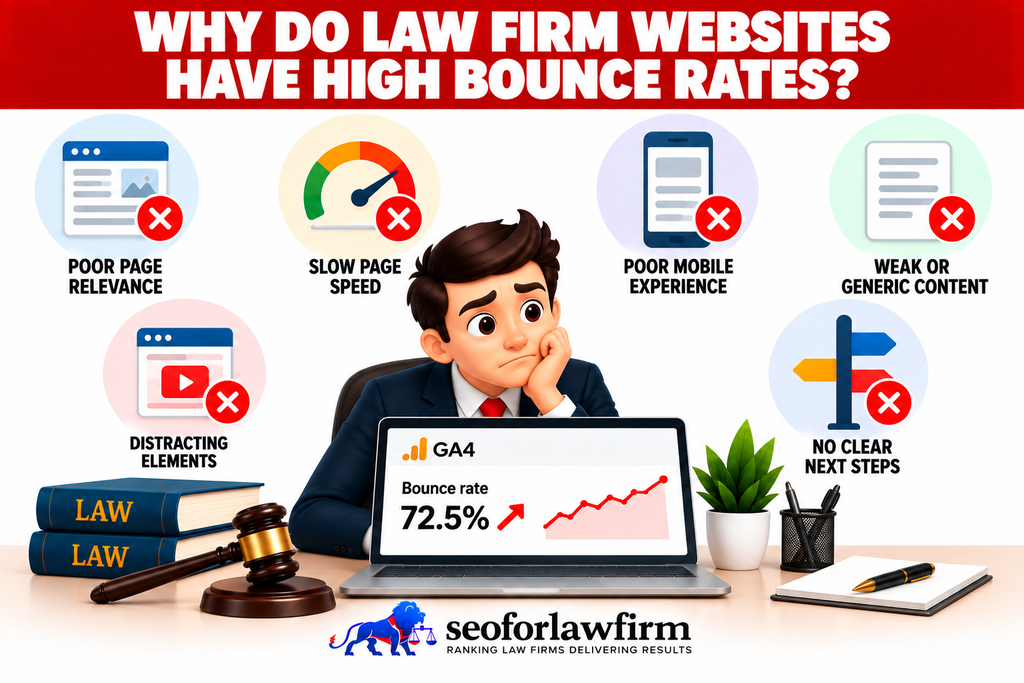
Law firm websites have high bounce rates because some visitors need only one answer or contact detail, while other visitors leave because of search-intent mismatch, slow performance, poor mobile usability, confusing navigation, or weak conversion paths.
Listed below are the 7 main reasons law firm websites experience high bounce rates.
- Visitors Find Quick Answers: A potential client visits only to find the firm’s phone number, address, office hours, attorney name, or one legal fact.
- Informational Searches Produce Short Journeys: Blog readers search questions such as “How long do I have to file a car accident claim?” and leave after obtaining the information needed.
- Search Intent Does Not Match the Page: A visitor searching for legal representation leaves when the landing page provides only general educational information. An informational searcher also leaves a page focused almost entirely on sales messaging.
- Pages Perform Slowly: Heavy images, JavaScript, third-party widgets, slow hosting, and rendering delays create additional friction before visitors reach the information they selected.
- Mobile Experiences Are Difficult to Use: Small text, hard-to-tap buttons, overflowing content, difficult forms, and complicated mobile menus interfere with client actions.
- Navigation and Content Are Unclear: Visitors leave when they cannot quickly determine whether the firm handles their legal problem or where to find the relevant information.
- Contact Options Are Difficult to Find: Hidden phone numbers, long forms, unclear CTAs, and weak contact pathways interfere with high-intent visitors trying to reach the firm.
A strong law firm content strategy reduces intent mismatch by mapping legal queries to the page type and information that best satisfies each search.

How Can Law Firms Fix High Bounce Rates on Their Websites?
Law firms can fix high bounce rates by improving site performance, optimizing for mobile users, strengthening calls-to-action, and delivering content that aligns with client intent. These improvements create a smoother, more engaging user experience that encourages visitors to explore multiple pages and take action. Many firms also implement technical SEO strategies to lower bounce rate and enhance overall site efficiency.
Listed below are the 6 Effective Fixes to Reduce Bounce Rate on Law Firm Websites.
- Improve site speed: Optimize images, use caching, and minimize scripts to prevent user drop-offs.
- Optimize mobile design: Ensure responsive layouts that provide seamless navigation across all devices.
- Strengthen calls-to-action: Add clear, persuasive CTAs that encourage form submissions or consultations.
- Create engaging content: Align information with user intent and address specific practice area needs.
- Streamline navigation: Simplify menus and layouts to help users find key information quickly.
- Add internal links: Guide visitors to related pages to increase engagement and extend browsing sessions.
How Does Bounce Rate Affect Lead Generation and Conversions for Law Firms?
Bounce rate helps law firms identify possible lead-generation friction. It must be evaluated alongside calls, forms, consultations, qualified leads, and signed matters rather than used as a standalone conversion metric. A high bounce rate becomes more concerning when a practice-area page also produces few phone calls, form submissions, consultation bookings, qualified leads, and other engagement signals. A location page with a 60% bounce rate can still perform well when it generates strong click-to-call activity and qualified phone leads.
Proper GA4 configuration also matters because tracked consultation forms, appointment bookings, or telephone actions marked as key events can prevent those sessions from counting as bounces. Offline behavior can create measurement gaps when visitors manually dial a phone number or contact the firm after leaving the website. Law firms must therefore evaluate bounce rate within the full client-acquisition path from landing page to engagement, lead action, qualified consultation, and signed matter.
How Should Law Firms Track Bounce Rate With Engagement and Conversion Metrics?
Law firms should track bounce rate alongside engagement rate, key events, calls, qualified leads, and signed matters so optimization decisions reflect the full client journey.
Listed below are the 6 steps for evaluating law firm bounce rate correctly.
- Verify GA4 Configuration: Confirm that forms, telephone interactions, appointment bookings, chat actions, and other meaningful events are recorded accurately.
- Define Appropriate Key Events: Mark actions that represent meaningful business outcomes rather than marking ordinary interactions solely to reduce reported bounce rate.
- Segment by Page Type: Compare blogs with blogs, practice pages with practice pages, and location pages with comparable location pages.
- Segment by Traffic Source and Device: Organic desktop traffic, paid mobile traffic, referral traffic, and branded direct traffic behave differently.
- Compare Engagement With Lead Activity: Review bounce rate beside engagement rate, average engagement time, key-event rate, calls, forms, and consultations.
- Connect Marketing Data to Intake Outcomes: Use call tracking and CRM or intake records to identify which website sessions produce qualified consultations and signed clients.
Law firms must measure website performance through the full client-acquisition sequence from traffic to engaged sessions, lead actions, qualified leads, consultations, and signed matters. A lower bounce rate does not automatically indicate stronger performance when the page produces few qualified enquiries or retained clients. A page with a higher bounce rate can deliver greater business value when it consistently generates calls, consultations, and signed matters. A complete law firm SEO results tracking process must therefore connect website engagement with Search visibility, lead quality, and client-acquisition outcomes.
Which Factors Influence a Law Firm Website’s Bounce Rate?
A law firm website’s bounce rate is influenced by visitor intent, traffic source, page type, performance, mobile usability, content relevance, conversion design, and analytics configuration. Very low bounce rates can also indicate tracking problems rather than exceptional engagement. A technical SEO audit for law firms can assess performance and implementation issues, while analytics validation must confirm that events and key events fire only when intended.
Listed below are the 8 main factors that influence bounce rate.
- Search intent: Informational and consultation-driven searches create different user journeys.
- Traffic source: Organic Search, paid ads, referrals, social media, email, and direct traffic bring visitors with different expectations.
- Page type: Blog posts, practice-area pages, location pages, and homepages serve different purposes.
- Website speed: Slow loading and responsiveness create friction before meaningful interaction occurs.
- Mobile usability: Poor small-screen experiences interfere with reading, navigation, and contact actions.
- Content relevance: Misaligned headings, information, or offers encourage visitors to leave.
- Conversion pathways: Phone links, forms, booking tools, and CTAs influence what visitors do next.
- Analytics configuration: Incorrect event or key-event setup can distort engagement rate and bounce rate.
Why Does Bounce Rate Matter for Law Firm Websites?
Bounce rate matters for law firm websites because it identifies low-engagement sessions. Bounce rate signals where traffic quality, content relevance, user experience, conversion pathways, or analytics configuration need closer review.
A high bounce rate can result from irrelevant traffic, weak page alignment, slow performance, poor mobile usability, unclear contact options, or incorrect tracking. A bounce can also occur when a visitor receives the information needed and leaves without further interaction. Law firms must therefore evaluate bounce rate alongside engagement time, calls, forms, qualified leads, consultations, and other supporting metrics before deciding that a page performs poorly.
How Do Law Firms Reduce High Bounce Rates?
Law firms reduce high bounce rates by improving page relevance, website performance, mobile usability, navigation, contact pathways, and contextual links to useful next steps.
Listed below are the 6 main ways law firms reduce unnecessary bounce behavior.
- Improve Page Relevance: Match the page heading, legal information, service description, and CTA to the query or campaign that brought the visitor to the page.
- Improve Website Performance: Compress oversized media, reduce unnecessary JavaScript, review third-party scripts, improve server delivery, and monitor Core Web Vitals.
- Improve Mobile Usability: Use readable text, responsive layouts, touch-friendly buttons, concise forms, and clear mobile navigation.
- Make Contact Easy: Display visible phone numbers, click-to-call links, consultation buttons, and appropriate forms where high-intent visitors expect them.
- Simplify Navigation: Help users move directly to practice areas, attorney profiles, locations, FAQs, and contact pages without unnecessary menu depth.
- Add Relevant Internal Links: Give informational visitors a useful path from an answer to a related practice area, attorney, location, or deeper resource.
A law firm internal linking strategy improves those pathways without adding unrelated links solely to force more page views.
Where Can Law Firms Get Professional Website Engagement and Conversion Support?
SEOForLawFirm.com is a specialized legal SEO provider that gives law firms structured, performance-focused website engagement and conversion support across traffic quality, content, technical performance, mobile UX, analytics, and client intake. Law firms can also obtain support from conversion-rate optimization agencies, legal marketing firms, UX consultants, analytics specialists, technical SEO providers, web development agencies, and experienced in-house marketing teams.
A professional website review must identify which landing pages receive traffic, which queries and campaigns drive that traffic, which pages show weak engagement, which pages still generate calls or forms, which devices experience performance problems, which CTAs receive interaction, which forms create abandonment, and which traffic sources produce qualified clients. The review must also separate genuine UX problems from analytics or tracking errors. SEOforLawFirm.com provides law firm SEO services that connect Search visibility, website performance, content, engagement, analytics, and client-conversion measurement.
How Does Mobile Optimization Help Lower Bounce Rate for Law Firms?
Mobile optimization helps lower avoidable bounce behavior by making legal information, navigation, calls, and contact forms easier to use on smartphones and tablets. A strong mobile optimization process for law firms must improve usability and track business actions rather than treat bounce rate as the only performance goal.
Listed below are the 7 main mobile usability requirements.
- Readable text without zooming
- Clear identification of the legal service
- Easy-to-use navigation
- Accurate tap-to-call functionality
- Simple consultation forms
- Accessible attorney and location information
- Dismissible overlays that do not block content
How Does Website Speed Affect Bounce Rate on Law Firm Websites?
Website speed affects bounce rate by determining how quickly visitors can access legal content and interact with important page elements. Slow loading, delayed responses, layout shifts, heavy scripts, and blocked content can increase abandonment, but no universal 3-second rule applies to every law firm visitor. A law firm site-speed optimization process must use Core Web Vitals and actual website analytics to identify real performance problems.
Listed below are the 7 main speed issues that can increase bounce behavior.
- Main legal content loads too slowly
- Menus respond slowly after a tap
- Consultation buttons shift during loading
- Chat widgets block important content
- Large images delay page rendering
- Heavy scripts reduce responsiveness
Does Bounce Rate Affect SEO for Law Firm Websites?
No, Google Analytics bounce rate is not a confirmed direct Google Search ranking factor for law firm websites. GA4 uses bounce rate to measure website engagement after users arrive, while Google Search relies on separate systems and signals to evaluate relevance, quality, links, page experience, and other ranking properties. A high bounce rate can still reveal underlying problems such as slow performance, weak search-intent alignment, intrusive overlays, poor content, or irrelevant traffic.
Those issues can affect user experience and Search performance independently of the reported bounce-rate percentage. Google states that Core Web Vitals contribute to its ranking systems, but strong scores do not guarantee high rankings, and no single page-experience signal determines position. Law firms must therefore use Search Console to measure impressions, clicks, queries, pages, and search positions, while GA4 measures visitor behavior after users reach the website.
Which Law Firm Pages Usually Have Higher Bounce Rates?
Law firm blog posts and other informational resources produce higher bounce rates than high-intent practice-area, location, or campaign landing pages because visitors use those pages differently.
Listed below are the 5 page categories that deserve separate bounce-rate analysis.
- Blog and Informational Pages: Informational visitors frequently arrive for one answer and leave after receiving it. A higher bounce rate can coexist with strong engagement time and successful content performance.
- Practice-Area Pages: Visitors frequently have stronger commercial or consultation intent. High bounce combined with weak lead activity deserves closer investigation.
- Location Pages: Visitors need only a phone number, address, directions, attorney information, or office hours. Contact tracking matters more than page views alone.
- PPC Landing Pages: Paid landing pages need close alignment between the ad, keyword, landing-page promise, and conversion action. High bounce accompanied by a weak conversion rate can reveal expensive traffic waste.
- Homepage: Homepage traffic combines branded searches, referrals, existing clients, potential clients, job seekers, attorneys, and other audiences, making one universal homepage benchmark difficult to interpret.

