
Google Verified Growth
Manage Local Services Ads From Verification to Qualified Intake
Google Local Services Ads for Lawyers — defined scope, implementation, and reporting.
SEOForLawFirm helps law firms review LSA eligibility, prepare account information, select service categories and areas, review leads, and connect spending with intake outcomes. Google controls verification, ad serving, and lead credits; SEOForLawFirm’s engagement defines the account work and reporting included.

Strategy & Execution
Why LSA Management Extends Beyond Account Setup
An LSA call still needs to match the firm’s practice and reach someone who can respond. SEOForLawFirm reviews category settings, geographic coverage, availability, lead quality, and intake status so the firm can evaluate this channel separately from ordinary paid search.
- Confirm available legal categories, verification requirements, and account ownership.
- Match the account to accepted matters and real coverage.
- Reconcile charges and credits with qualified contacts and consultations.

A Connected System
Google Local Services Ads for Lawyers Framework
Four stages connect the initial evidence, implementation responsibilities, and ongoing review.
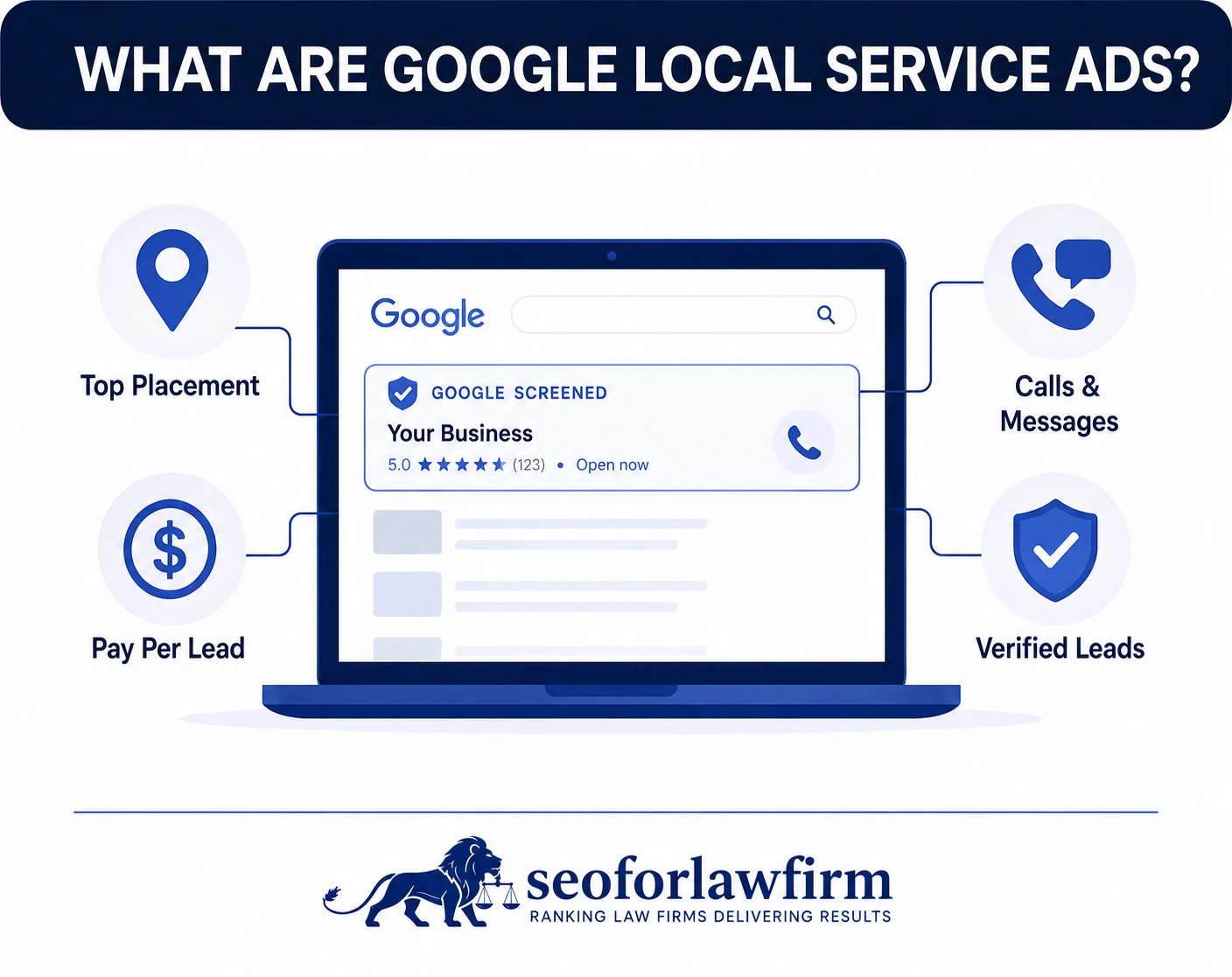
Check Eligibility and Access
Confirm available legal categories, verification requirements, and account ownership.
Define Services and Areas
Match the account to accepted matters and real coverage.
Review Leads and Handling
Track call and message status, intake response, and available lead feedback.
Evaluate Cost and Outcomes
Reconcile charges and credits with qualified contacts and consultations.
Core Services
What the Engagement Covers
Six service components are scoped around the firm’s existing website, accounts, and intake workflow.
Eligibility and Google Verified Requirements
Category and location eligibility; account requirement register; document and access responsibilities.
Account, Services, and Coverage Setup
Accepted service types; truthful service areas; profile consistency.
Budget and Availability Planning
Budget responsibility; availability review; account-based change log.
Lead Review, Feedback, and Credits
Billing-status reconciliation; available lead feedback; category and coverage corrections.
Call Handling and Intake Attribution
Assigned response ownership; intake-status mapping; unanswered contact review.
Ongoing Account and Outcome Review
Agreed reporting period; lead-fit review; account recommendation queue.
Strategy & Execution
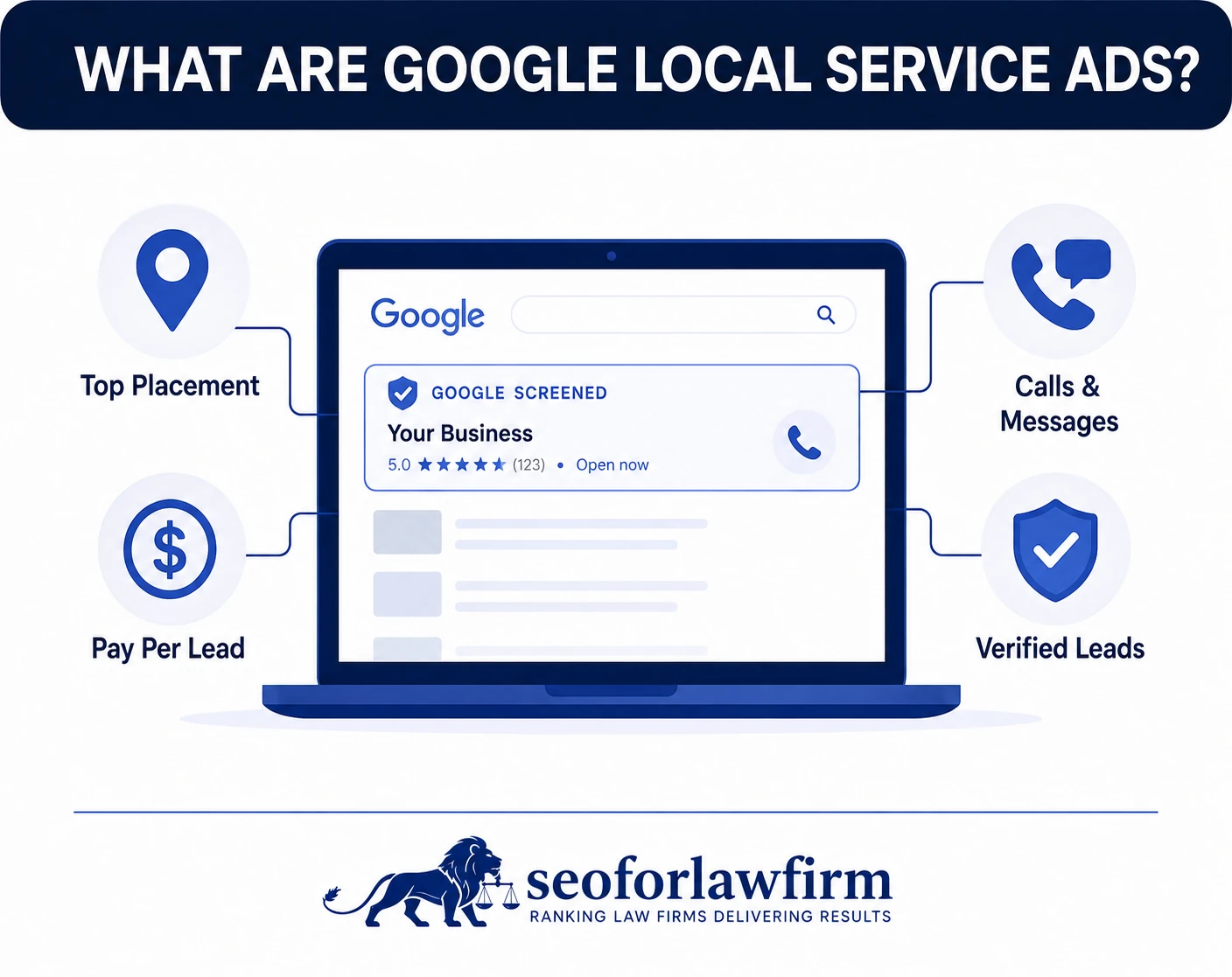
Eligibility and Google Verified Requirements
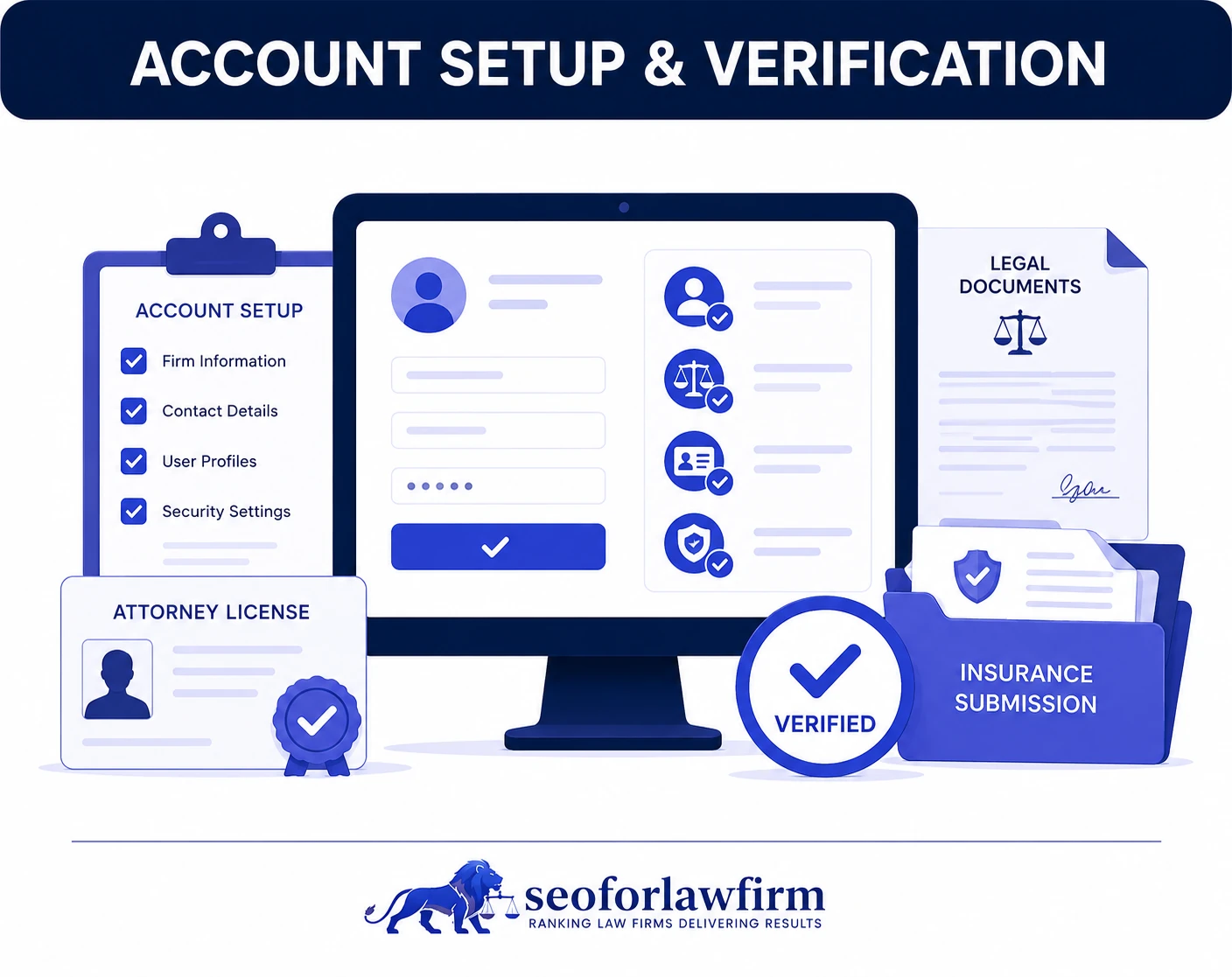
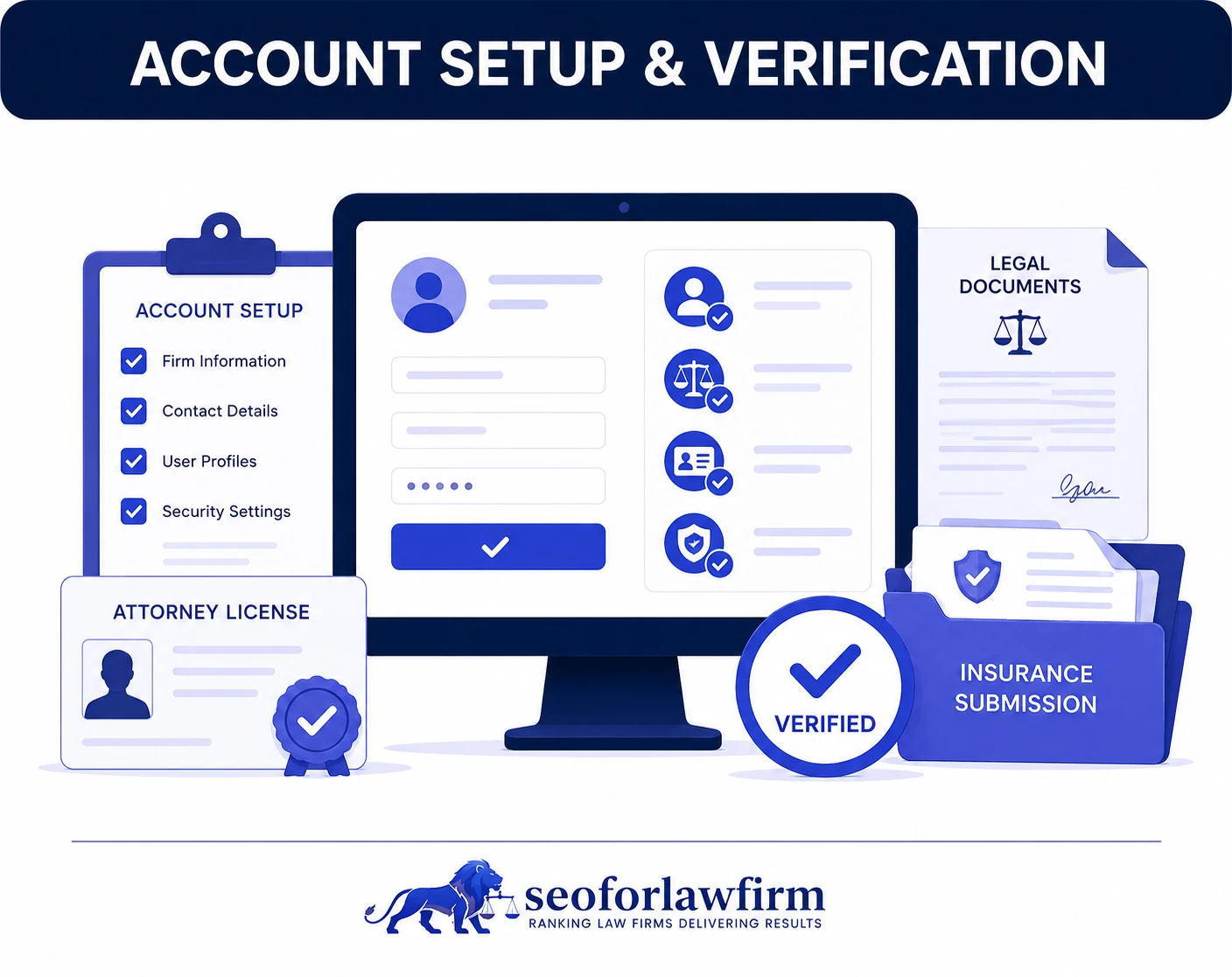
SEOForLawFirm reviews the legal categories available for the firm’s location and the requirements shown in its account. Google now uses the Google Verified badge for eligible advertisers that complete the required checks. The firm supplies accurate documents and completes verification through Google; approval is not guaranteed.
Source: Google Local Services Help — Google Verified badge, reviewed October 10, 2026.
- Category and location eligibility
- Account requirement register
- Document and access responsibilities
Strategy & Execution
Account, Services, and Coverage Setup
The account should describe the services the firm actually handles and the areas it can serve. SEOForLawFirm reviews categories, service types, office facts, and profile consistency with the designated account owner. Expanding coverage is a business decision rather than a way to imply offices the firm does not have.
- Accepted service types
- Truthful service areas
- Profile consistency

Strategy & Execution
Budget and Availability Planning
What this work includes
SEOForLawFirm reviews the available budget and bidding controls alongside intake capacity and scheduling. Proposed changes are tied to the firm’s goals and account evidence. Lead cost varies; the proposal does not promise a fixed cost per lead or a number of retained cases.
- Budget responsibility
- Availability review
- Account-based change log

Strategy & Execution
Lead Review, Feedback, and Credits
What this work includes
SEOForLawFirm reviews lead status and available feedback options and reconciles charged, uncharged, pending, and credited leads. Google’s current process uses automated quality assessment and credits; refunds are not guaranteed. Google no longer supports credits solely for job types or geographic areas not served, making accurate targeting important.
Source: Google Local Services Help — automated lead credits, reviewed October 10, 2026.
- Billing-status reconciliation
- Available lead feedback
- Category and coverage corrections
Strategy & Execution
Call Handling and Intake Attribution
SEOForLawFirm connects available LSA lead information with the firm’s approved intake status. Unanswered contacts, relevant consultations, unsuitable matters, and duplicate records are separated. The review identifies routing and response issues without treating every billed lead as a qualified legal opportunity.
- Assigned response ownership
- Intake-status mapping
- Unanswered contact review
Strategy & Execution
Ongoing Account and Outcome Review
SEOForLawFirm compares service settings, charge status, spending, qualified inquiries, and consultation outcomes over the agreed reporting period. Recommendations address recurring mismatches, availability, or coverage issues. Verification and credit decisions remain with Google.
- Agreed reporting period
- Lead-fit review
- Account recommendation queue

SEOForLawFirm’s Process
From Audit to Continuous Improvement
Check Eligibility and Access
Confirm available legal categories, verification requirements, and account ownership.
Agree Scope and Owners
Document access, included tasks, dependencies, and firm-side approvals.
Define Services and Areas
Match the account to accepted matters and real coverage.
Quality Checks
Test the implemented work against the agreed verification steps.
Review Leads and Handling
Track call and message status, intake response, and available lead feedback.
Evaluate Cost and Outcomes
Reconcile charges and credits with qualified contacts and consultations.
Common Problems
Mistakes That Restrict Performance
Outdated Badge Language
Use current Google Verified terminology and the requirements shown in the account.
Categories That Do Not Match the Practice
An unsupported service setting can attract inquiries the firm cannot accept.
Coverage Beyond Intake Capacity
A broad service area does not help when suitable contacts cannot be handled.
Every Billed Lead Treated as a Client
Billing status and retained-matter status describe different outcomes.
Assuming Every Poor Lead Is Refundable
Review Google’s current credit process and available feedback; do not promise refunds.
Measured Outcomes
Outputs You Can Review
Your engagement produces a scoped work queue, implementation record, and reporting baseline. The retained illustrations explain service concepts; they are not proof of any named client’s campaign results.
Planning Examples
Illustrative Plans for Different Legal Practices
Injury LSA Account
Illustrative workflow — not a client testimonial
Planning example; no campaign results claimed.
Illustrative review: align categories with accepted accident matters, reconcile lead charges, and check case-screening outcomes.Workflow Outputs
- Accepted services
- Lead charges
- Case-screening status
Family-Law LSA Account
Illustrative workflow — not a client testimonial
Planning example; no campaign results claimed.
Illustrative review: check coverage and service settings, consultation routing, and response ownership.Workflow Outputs
- Service and area settings
- Response ownership
- Consultation status
Criminal-Defense LSA Account
Illustrative workflow — not a client testimonial
Planning example; no campaign results claimed.
Illustrative review: match availability and routing to the firm’s actual intake arrangements and review suitable contacts.Workflow Outputs
- Availability settings
- Call handling
- Matter-fit review
Practice-Area Experience
Built for the Legal Markets Your Firm Serves
Law Firm SEOBuild the firm-wide organic visibility foundation.Explore this practice area →Local SEO for LawyersCompete across maps, local results, and service areas.Explore this practice area →Personal InjuryReach injury prospects during high-intent searches.Explore this practice area →Criminal DefenseSupport urgent searches for local legal representation.Explore this practice area →Divorce & Family LawConnect family-law services with local client needs.Explore this practice area →Immigration LawOrganize visibility around immigration services and questions.Explore this practice area →Bankruptcy LawReach consumers researching debt-relief options and counsel.Explore this practice area →Employment LawTarget employee and employer-side legal search demand.Explore this practice area →Real Estate LawBuild visibility for transactional and dispute-related matters.Explore this practice area →Business LawSupport companies seeking transactional and advisory counsel.Explore this practice area →Estate PlanningReach families planning estates, trusts, and succession.Explore this practice area →DUI DefenseCompete for urgent, location-specific DUI defense searches.Explore this practice area →
Related Services
Build a More Complete Client-Acquisition System
Frequently Asked Questions
Google Local Service Ads for Lawyers FAQs
Which verification badge does Google use now?
Google now uses Google Verified for eligible Local Services advertisers that complete its requirements. SEOForLawFirm reviews the current requirements shown for your account.
Is every legal service eligible?
Availability depends on category and location. SEOForLawFirm confirms the options available before defining the engagement.
Can you guarantee verification or ad placement?
No. Google controls screening, verification, serving, and ranking. SEOForLawFirm helps organize accurate account information and defined management tasks.
Can all unsuitable leads be refunded?
No. Google controls automated credits and feedback options. Its current policy excludes credits solely for job types or areas not served.
How is this different from ordinary search advertising?
LSA uses its own provider profile, lead workflow, verification requirements, and lead charging. SEOForLawFirm reports it separately from click-based search campaigns.
What will the report show?
Account changes, spending, lead charge status, available credits, lead fit, and intake outcomes where the firm’s systems support reconciliation.
Build the Next Stage of Growth
Discuss Your Google Local Services Ads for Lawyers Priorities
Share your priority practices, current systems, and the issues your team wants to resolve. SEOForLawFirm will discuss the evidence to review, implementation dependencies, and a defined proposal.