
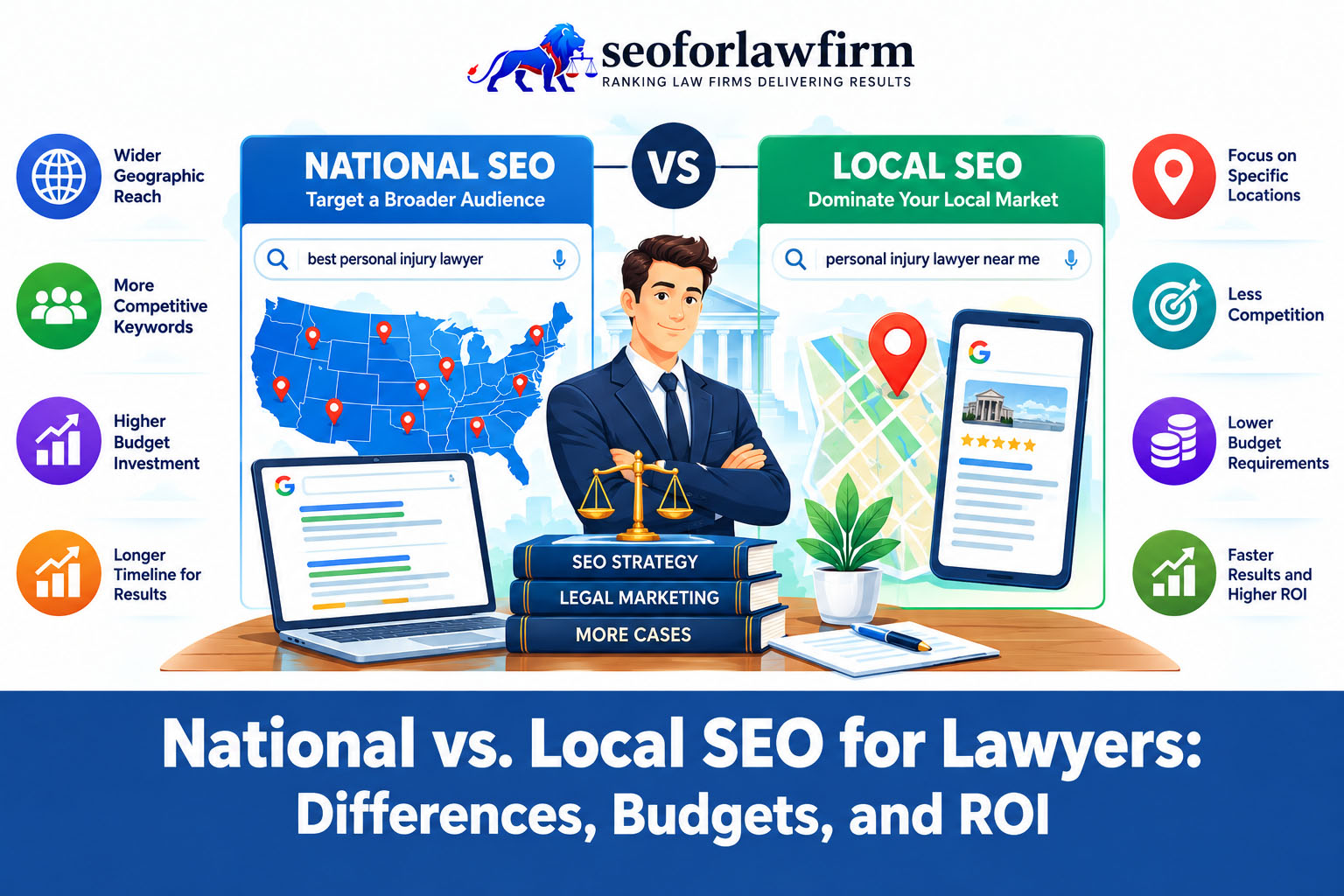
National SEO for lawyers focuses on ranking across the country for broad, high-volume legal keywords such as “best corporate lawyer USA.” This approach demands a large-scale strategy built on content authority, backlink acquisition, and technical optimization to gain visibility nationwide. According to a study by Anindya Ghose, Avi Goldfarb, and Sang Pil Han titled How Is the Mobile Internet Different? Search Costs and Local Activities in 2013, Ghose, Goldfarb, and Han found stronger proximity and screen-position effects in mobile browsing. This microblogging study informs mobile design; it does not test Google’s law-firm ranking factors.
Local SEO for lawyers, on the other hand, targets nearby clients through city-specific keywords like “divorce lawyer in Chicago.” It emphasizes Google Business Profile (GBP) optimization, citation management, local landing pages, and client reviews to dominate local search results.
The two strategies differ in scope and intent. National SEO is broader, more competitive, and driven by expertise and backlink authority. Local SEO is geographically focused, designed to increase map visibility, client engagement, and conversions within a specific region.
Budgets also vary; national SEO requires higher investment for long-term authority-building and content campaigns, while local SEO involves smaller budgets focused on GBP updates, review management, and citation accuracy.
Performance metrics (KPIs) for national SEO include domain authority, backlink volume, and nationwide rankings. For local SEO, KPIs focus on map pack rankings, local keyword visibility, GBP engagement, and conversion rates.
Many successful firms combine both strategies, publishing authoritative blogs and legal resources for national reach while maintaining city-level optimization for office-based client acquisition. This hybrid approach maximizes SEO ROI, balancing visibility, credibility, and localized lead generation.
Table of Contents
- Article sections will appear here.
What Is Local SEO for Lawyers?
Local SEO for lawyers is the process of improving a law firm’s visibility for searches connected to a specific geographic location and nearby legal services. Local SEO targets queries such as “personal injury lawyer near me,” “DUI attorney in Phoenix,” “family lawyer Dallas,” “estate planning attorney near Orlando,” and “criminal defense lawyer Brooklyn.”
The strategy focuses on Google Business Profile, Google Maps visibility, localized website pages, NAP accuracy, legal citations, reviews, and geographically relevant links. Google evaluates local results primarily through relevance, distance, and prominence, so complete business information, reviews, links, local website relevance, and broader organic visibility all support local search performance.
What Is National SEO for Lawyers?
National SEO for lawyers is the process of improving a law firm’s visibility for broad legal searches across a large geographic market without relying primarily on proximity to a physical office. National SEO targets searches such as “patent attorney,” “immigration lawyer,” “employment discrimination lawyer,” “class action attorney,” and “corporate law firm.”
National campaigns depend more heavily on topical authority, detailed practice-area content, technical website quality, internal linking, earned backlinks, digital PR, expert authorship, reliable sourcing, and content capable of competing with established legal publishers and firms. Strong national SEO also requires logical site structure, original legal information, descriptive internal links, strong page experience, and trustworthy content for high-stakes legal topics.
Which Law Firms Need Local SEO?
Law firms need local SEO when client acquisition depends heavily on people searching for an attorney within a particular city, county, metro area, or state market.
Listed below are 7 practice models strongly aligned with local SEO.
- Family law firms: Divorce, custody, child support, and related matters usually connect clients with attorneys operating within the relevant jurisdiction.
- Criminal defense firms: Searches frequently include a city, county, court location, or “near me” modifier.
- DUI defense firms: Search intent is strongly connected to where an arrest or charge occurred.
- Estate planning firms: Attorney selection occurs within the client’s local community.
- Local personal injury firms: Firms competing for car accident, premises liability, and injury cases commonly rely on Maps and city-level organic rankings.
- Bankruptcy firms: Prospective clients frequently search for legal assistance in a defined local market.
- Small and regional firms: Firms deriving most signed matters from surrounding communities receive stronger acquisition value from geographic targeting.
The physical office remains highly relevant because Google incorporates distance into local search ranking. A service-area setting does not eliminate the role of proximity.
Which Law Firms Need National SEO?
Law firms need national SEO when client acquisition extends beyond one local market and the legal service does not depend primarily on office proximity. National SEO fits firms that pursue broader demand across immigration, patent law, federal litigation, class actions, mass torts, national corporate matters, and other services with wider geographic reach.
Multi-state firms also use national SEO to build broad practice-area authority above individual state and city pages. National pages target broad legal topics, while local pages address office-specific and geographic searches. The firm’s SEO reach must still match the jurisdictions, case types, and clients the firm is positioned to serve.
Listed below are the 8 law firm types that commonly benefit from national SEO.
- Immigration law firms. Immigration matters involve federal law and attract clients beyond one immediate local market.
- Patent law firms. Patent services serve inventors, companies, and organizations across multiple states.
- Federal litigation firms. Firms handling federal matters pursue broader geographic search demand where the practice supports it.
- Class action firms. Class action practices target legal issues affecting groups of claimants across larger regions.
- Mass tort firms. Mass tort campaigns involve widespread claimant populations and broader national search demand.
- National corporate law firms. Corporate firms target businesses seeking legal services across multiple jurisdictions or markets.
- Multi-state law firms. Firms with several genuine markets use national practice pages for broad subject authority and state or city pages for local demand.
- Other non-proximity-dependent practices. Any legal service that will be delivered across a wider geographic market benefits from a national SEO structure when the firm is licensed and operationally positioned to serve that audience.
What Is the Difference Between National and Local SEO for Lawyers?
National SEO and local SEO differ for lawyers in geographic targeting, content strategy, link acquisition, budget, and performance measurement.
The table below shows the main differences between local and national law firm SEO.
| Factor | Local SEO for Lawyers | National SEO for Lawyers |
| Geographic reach | City, metro, county, region, or office market | Multiple states or nationwide |
| Search intent | Location-based and “near me” searches | Broad, non-geographic searches |
| Example keyword | “divorce lawyer in Chicago” | “corporate lawyer” |
| Main search surfaces | Google Maps, Local Pack, localized organic results | National organic results, informational SERPs, AI-generated answers |
| Google Business Profile | Major campaign component | Secondary unless offices also target local markets |
| Citation management | High priority | Supporting role |
| Client reviews | Strong local influence | More focused on trust and conversion |
| Content | City pages, location pages, localized practice pages | Practice hubs, guides, research, informational resources |
| Link building | Local media, chambers, associations, local organizations | National media, legal publications, professional organizations, digital PR |
| Competition | Concentrated within target markets | Broad competition against large firms, publishers, directories, and legal websites |
| Budget | Lower relative investment for a limited market | Higher investment for content, technical SEO, authority, and links |
| Timeline | Early local movement appears sooner | Broad competitive rankings require longer investment |
| Primary ROI | Local calls, consultations, signed cases | Leads, cases, authority, and revenue across broader markets |
A study by Google Search Central from the official Google for Developers platform, titled “How to improve your local ranking on Google” in 2026, confirms that local search results are calculated dynamically using three primary pillars: relevance, distance, and prominence.
What Are the Main Local SEO Strategies for Law Firms?
The main local SEO strategies for law firms are Google Business Profile optimization, localized practice-area pages, local links, and accurate business information.
Listed below are 6 local SEO strategies used by law firms.
- Optimize Google Business Profile: Maintain the correct firm name, address, phone number, primary category, secondary categories, office hours, services, photos, and website destination.
- Build city and location pages: Create useful pages addressing the legal service, jurisdiction, office, courts, procedures, and client needs connected to each target market.
- Maintain NAP consistency: Keep Name, Address, and Phone information accurate across major directories, legal platforms, maps, and business profiles.
- Generate client reviews: Build a steady flow of legitimate client feedback and respond according to applicable professional and platform requirements.
- Build local citations: Maintain listings across sources such as Avvo, Justia, FindLaw, chambers of commerce, bar directories, Yelp, and other relevant platforms.
- Earn local links: Acquire references from local publications, community organizations, professional associations, sponsorships, universities, and regional resources.
Google confirms that links, directories, reviews, relevance, business information, and prominence contribute to local visibility.

What Are the Main National SEO Strategies for Law Firms?
The main national SEO strategies for law firms are topical authority development, internal linking, authority acquisition, and broad keyword targeting.
Listed below are 6 national SEO strategies for law firms.
- Build practice-area topic clusters: Connect core service pages with supporting guides, legal questions, statutes, procedures, cases, definitions, and related client concerns.
- Target broad non-location searches: Create pages aligned with relevant legal concepts and high-intent practice terms without requiring city modifiers.
- Publish expert-reviewed legal content: Display attorney authorship, credentials, bar information, editorial review, citations, and update dates where relevant.
- Earn authoritative backlinks: Acquire relevant links and mentions from legal organizations, reputable publishers, industry resources, news outlets, universities, and professional associations.
- Build a scalable technical structure: Maintain crawlable internal links, logical architecture, mobile usability, HTTPS, fast loading, structured data, and clean indexation.
- Update existing content: Refresh legal resources as statutes, case law, regulations, search intent, and competitor coverage change.
Google’s Search documentation states that useful, original, well-organized, current, people-first content plays a large role in organic search performance.
How Does Technical SEO Differ Between Local and National Law Firm SEO?
Technical SEO supports both local and national law firm SEO, but national campaigns require greater scalability across architecture, indexation, and site performance. National law firm websites contain hundreds or thousands of practice-area, state, city, attorney, resource, and informational URLs, so clear architecture helps search engines understand relationships between broad services and supporting topics.
Local campaigns place more emphasis on the connection between each physical office, location page, attorney information, Google Business Profile, structured business data, and consistent business information. Both strategies also require strong page performance.
The table below shows the main technical SEO differences between local and national law firm SEO.
| Technical SEO Area | Local Law Firm SEO | National Law Firm SEO |
| Site architecture | Connects office, location, attorney, and practice-area pages | Organizes large practice, state, city, attorney, and resource structures |
| Crawling | Focuses on discoverability of priority local and service pages | Requires scalable crawling across much larger URL inventories |
| Internal linking | Connects offices with relevant services and attorneys | Builds relationships across broad practice areas, subtopics, states, cities, and resources |
| Indexation | Controls duplication across local and office pages | Requires stronger indexation management across hundreds or thousands of URLs |
| Structured business data | Places greater emphasis on office and local entity information | Supports firm and attorney entities across broader site architecture |
| Business information | Requires strong consistency between website, profiles, and citations | Remains relevant but is less central than broad topical architecture |
| Performance | Supports mobile users searching for nearby legal help | Supports large-scale search visibility across many content types and markets |
How Much Does Local vs. National SEO Cost for Law Firms?
Local law firm SEO commonly ranges from about 1,000–9,500 per month for smaller and mid-sized firms, while national law firm SEO reaches 20,000–50,000+ per month for large national campaigns based on the cited 2026 provider estimates. Law firms planning broader campaigns use budget planning for national SEO campaigns to account for content production, technical work, authority acquisition, site scale, and ongoing optimization.
Published pricing varies according to provider, competition, practice area, existing authority, website condition, target markets, link acquisition, and campaign scope. These figures represent provider-published market estimates rather than universal law firm SEO pricing.
The table below shows the published monthly SEO ranges provided by SeoProfy for different law firm sizes.
| Firm Type | Published Monthly SEO Range |
| Solo practice | 1,000–3,500 |
| Small firm with 2–5 attorneys | 2,500–5,000 |
| Mid-sized firm with 6–20 attorneys | 5,000–9,500 |
| Large firm with 21+ attorneys | 10,000–20,000+ |
| National firm with 50+ attorneys | 20,000–50,000+ |
How Long Does Local SEO Take for Lawyers?
Local SEO for lawyers takes 3–6 months to show early ranking movement and 6–12 months to produce stronger lead and case results in competitive legal markets. The timeline depends on the domain’s history, Google Business Profile strength, reviews, citations, existing rankings, city competition, practice area, content quality, backlinks, and website condition.
Rankings.io’s 2026 guidance places early local traction around months 3–6 and stronger compounding returns around months 9–12+, while Hennessey Digital reports a similar 3–6-month period for early movement and 6–12 months for more consistent case acquisition. Law firms with stronger existing authority and local signals progress faster than firms starting with weak profiles, limited content, or competitive market conditions.
How Long Does National SEO Take for Lawyers?
National SEO for lawyers takes 6–12 months or longer to establish sustained visibility for competitive non-geographic legal searches. New websites, weak backlink profiles, broad practice-area targeting, highly competitive keywords, and established national competitors extend the timeline.
National SEO builds performance through content depth, internal linking, technical improvements, brand signals, authoritative references, and earned backlinks rather than one optimization event. An Ahrefs survey of 3,680 marketers found that SEO commonly takes 3–6 months to begin showing results, although competitive national legal campaigns require longer before search gains produce dependable enquiries and signed matters.
Which KPIs Measure Local SEO Performance for Law Firms?
Local SEO performance for law firms is measured through local search visibility, qualified leads, signed cases, revenue, and acquisition costs rather than rankings alone. Law firms must connect Google Maps visibility, local organic rankings, Google Business Profile activity, calls, consultation requests, and local leads with downstream case and revenue data. Law firms track key performance indicators for local SEO growth to measure whether local search activity produces qualified enquiries and signed matters. According to a study by Anindya Ghose, Panagiotis G. Ipeirotis, and Beibei Li titled Examining the Impact of Ranking on Consumer Behavior and Search Engine Revenue in 2014, Ghose, Ipeirotis, and Li found interactions between ranking and ratings in hotel search. Its approximately 1 million sessions concern travel, rather than a Google legal-search experiment. Location-level reporting becomes more useful when call tracking software connects an inquiry source with qualification, consultations, and signed matters.
Listed below are the 16 ways KPI measures local SEO performance for law firms.
- Google Maps and Local Pack visibility: Measures how the law firm appears in prominent local search results.
- Local organic rankings: Tracks the firm’s positions for geographically relevant legal searches.
- Google Business Profile calls: Measures phone calls generated directly from the firm’s Business Profile.
- Website clicks from local listings: Tracks users who visit the firm’s website from local-search profiles.
- Direction requests: Measures location-navigation actions generated from Google Business Profile.
- Calls attributed to organic search: Connects incoming calls with local organic search activity.
- Consultation-form submissions: Tracks prospective clients who request consultations through the website.
- Qualified local leads: Measures enquiries that match the firm’s practice areas, geography, and case criteria.
- Local conversion rate: Measures the percentage of local visitors or leads that complete a desired action.
- Cost per qualified lead: Divides local SEO investment by the number of qualified leads generated.
- Signed cases from local organic search: Tracks retained matters originating from local search.
- Cost per signed case: Divides local SEO expenditure by the number of signed matters attributed to the campaign.
- Revenue attributed to local SEO: Connects local organic acquisition with attributable legal revenue.
- Review growth and rating trends: Tracks changes in review volume and average ratings over time.
- Citation accuracy: Measures the accuracy of the firm’s business information across external listings.
- Local competitor share of visibility: Compares the firm’s local search presence with competing law firms.

Which KPIs Measure National SEO Performance for Law Firms?
National SEO performance for law firms is measured through broad organic visibility, qualified leads, and acquisition costs across target markets. National campaigns require a scorecard that connects non-branded search visibility and practice-area performance with lead quality, case acquisition, and financial outcomes.
Third-party authority scores such as Domain Authority provide comparative website data, but Google does not use Moz Domain Authority as a ranking metric, so law firms must prioritize search and business outcomes.
Listed below are 8 ways KPI measures national SEO performance for law firms.
- Non-branded organic traffic: Measures visitors reaching the website through legal searches rather than the law firm’s brand name.
- National keyword visibility: Tracks broad practice-area search positions across target markets.
- Qualified organic leads: Measures relevant calls, forms, chats, and consultation bookings generated through organic search.
- Signed cases: Tracks matters retained after an organic-search enquiry.
- Cost per signed case: Divides national SEO investment by the number of signed cases attributed to organic search.
- Referring domains and earned links: Measures growth in relevant external websites linking to the law firm.
- Practice-area visibility: Measures search visibility across complete legal topic clusters rather than isolated keywords.
- Revenue attributed to organic search: Connects national SEO investment with attributable legal fees or revenue.
What Is the ROI Difference Between Local and National SEO for Lawyers?
Local SEO generates ROI within defined geographic markets, while national SEO targets a larger search market and usually requires greater investment before returns scale. A local family law firm measures SEO performance through nearby calls, consultations, retained clients, cost per signed case, and revenue from the cities it serves. A national immigration or mass-tort firm measures broader organic visibility, qualified leads across multiple markets, signed matters, acquisition costs, and revenue at scale. According to a study by Tom Blake, Chris Nosko, and Steven Tadelis titled Consumer Heterogeneity and Paid Search Effectiveness: A Large-Scale Field Experiment in 2015, the researchers found paid-search effects varied between new and frequent eBay users. Crediting every ad-linked conversion to advertising can overstate its incremental contribution.
National SEO creates a larger potential client-acquisition surface, but broader competition increases content, backlink, technical SEO, and operational costs. Law firms must measure ROI at the case-management level because rankings and traffic indicate search performance, while signed cases, cost per signed case, and attributable revenue measure the financial result of the campaign.
The table below shows the main ROI differences between local and national SEO for lawyers.
| ROI Dimension | Local SEO | National SEO |
| Geographic reach | Defined cities, counties, or office markets | Multiple states, regions, or national markets |
| Potential acquisition pool | Smaller and geographically focused | Larger and spread across broader search demand |
| Typical investment level | Lower for a single-market campaign | Higher because of broader competition and campaign scale |
| Primary visibility metrics | Local Pack, Google Maps, and local organic rankings | National organic rankings and broad practice-area visibility |
| Primary lead metrics | Nearby calls, forms, and consultations | Qualified leads from multiple target markets |
| Primary conversion metric | Signed local cases | Signed matters across wider markets |
| Cost measurement | Cost per qualified local lead and cost per signed case | Cost per qualified lead and cost per signed matter across the campaign |
| Revenue measurement | Revenue attributed to clients from target locations | Revenue attributed to organic acquisition across multiple markets |
| Time to scale faster | faster within a defined market | Usually longer because authority must build across more competitive searches |
| Best ROI indicator | Signed cases and revenue from the local market | Signed matters and attributable revenue across target markets |
Is Local SEO Better for Small and Mid-Sized Law Firms?
Yes, local SEO is usually the stronger primary strategy for small and mid-sized law firms that acquire most clients from one city, metro area, or defined regional market. Local SEO directs marketing resources toward high-intent searches such as “divorce attorney near me” instead of broad national terms that attract competition from large law firms, directories, and legal publishers.
The strategy concentrates optimization around priority service pages, Google Business Profiles, local links, reviews, citations, and location-specific conversion paths. Firm size does not determine search strategy alone because a small boutique firm serving clients nationwide benefits from national SEO, while a large multi-office firm still needs local SEO in markets where office-level demand drives client acquisition.
Does National SEO Help Lawyers Compete in Wider Markets?
Yes, national SEO helps lawyers compete in wider markets by building search visibility for broad legal services beyond individual office locations. National campaigns use detailed practice-area content, technical SEO, internal linking, attorney expertise, digital PR, and authoritative backlinks to establish broader subject relevance and search visibility.
National SEO works best when the law firm’s licensing, client eligibility, and service model support acquisition across multiple markets. Attorney attribution, demonstrable legal experience, factual accuracy, reliable sourcing, editorial review, and transparent firm information also strengthen trust around high-stakes legal content.
Can National and Local SEO Work Together for Law Firms?
Yes, national and local SEO work together through a hybrid strategy that combines broad practice-area authority with location-specific client acquisition. Broad practice-area hubs target national or non-geographic legal searches, while state resources, city pages, office pages, and Google Business Profiles target geographic demand where the firm serves clients. Office-level profiles, location pages, and consistent business information remain part of local SEO services for lawyers even when the same firm develops national subject-matter authority.
Legal guides and research build subject depth, attorney biography pages establish professional expertise, local citations and reviews reinforce office-level business information, and local and national backlinks support authority across the site. Internal links connect practice-area, informational, attorney, and geographic pages so each content layer supports the appropriate search intent. Many law firms benefit from establishing a strong local search foundation first and expanding into broader practice-area and national keyword targeting as the firm’s geographic reach grows.
Which SEO Strategy Does a Law Firm Need?
A law firm needs local SEO when clients come primarily from defined geographic markets and wider practice-area visibility. The correct model follows the firm’s service area, client eligibility, office structure, practice economics, and geographic reach rather than firm size alone.
A single-office family or criminal defense firm usually concentrates on local SEO, while an immigration, patent, class-action, or mass-tort practice with broader demand requires national SEO. Multi-office and regional firms use a hybrid structure that combines location-specific search visibility with broader practice-area authority.
The table below shows the recommended SEO model for common law firm situations.
| Law Firm Situation | Recommended SEO Model |
| One office serving one metro | Local SEO |
| Family or criminal defense firm serving one region | Local SEO |
| Several offices across one state | Multi-location local SEO + state organic strategy |
| Offices in several states | Hybrid SEO |
| Immigration practice serving clients broadly | National or hybrid SEO |
| Patent-focused practice with national demand | National SEO |
| National class-action or mass-tort practice | National SEO |
| Regional personal injury firm | Hybrid SEO |
| Large full-service firm with offices nationwide | Hybrid SEO at scale |
| Small boutique with a national niche | National SEO focused on the niche |

What SEO Keywords Work for Local and National Law Firms?
Local law firm keywords combine legal services with geographic or proximity intent, while national law firm keywords target legal services, legal problems, and practice-area topics without requiring a location modifier. Local keywords connect a legal service with a city, region, or “near me” query, while national keywords target broader demand across larger markets. Keyword selection must match search intent, case eligibility, competition, practice economics, and the page type needed to satisfy the query.
The table below shows examples of local and national law firm SEO keywords.
| Local SEO Keyword | National SEO Keyword |
| personal injury lawyer Miami | personal injury lawyer |
| divorce attorney near me | divorce attorney |
| DUI lawyer Phoenix | DUI defense attorney |
| estate planning attorney Dallas | estate planning attorney |
| criminal lawyer Chicago | criminal defense lawyer |
| employment lawyer Los Angeles | employment lawyer |
What Is Google Maps Optimization for Lawyers?
Google Maps optimization for lawyers is the process of improving a law firm’s Google Business Profile and supporting local signals so the firm appears more prominently for geographically relevant legal searches. The strategy uses accurate business information, correct categories, complete service details, genuine reviews, relevant photos, NAP consistency, local landing pages, citations, backlinks, and ongoing profile management.
Google evaluates local results through relevance, distance, and prominence, while reviews, links, directory information, and organic website visibility also contribute to local prominence. Law firms therefore strengthen Google Maps performance by maintaining a complete Business Profile and reinforcing the same business identity across the website and trusted local sources.
Does Structured Data Help Local and National Law Firm SEO?
Yes, structured data helps local and national law firm SEO by giving search engines machine-readable information about the firm, its attorneys, locations, services, and page content. LocalBusiness structured data helps communicate business details such as address, hours, and other location attributes, while other valid schema types describe attorneys, organizations, articles, FAQs, and related content where appropriate. The firm’s visible office, attorney, and page information should match the entities described through schema and structured data services for lawyers.
Structured data supports search engines in interpreting page entities and relationships, but schema markup does not replace strong legal content, internal links, backlinks, local signals, accurate business information, or technical site quality. Law firms must use valid structured data as part of a broader architecture that connects crawlable pages, attorney information, office details, and useful legal content.