


Track law firm SEO results with Google Search Console and Google Analytics 4. Measure organic visibility, traffic, calls, forms, local Maps performance, qualified leads, retained matters, and revenue.
Google Search Console measures how a law firm performs before a prospective client reaches the website. Search Console reports Google Search impressions, clicks, click-through rate, queries, pages, and average position. Google recommends focusing more heavily on trends in impressions and clicks than on position alone.
Google Analytics 4 measures what happens after a visitor reaches the website. GA4’s Traffic acquisition report isolates Google / organic sessions, and its Landing page report shows which pages users enter through and how those pages contribute to key events. Google describes Search Console as the source of truth for Search performance and Google Analytics as the source of truth for on-site behavior.
Law firms must configure meaningful actions such as consultation requests, qualified lead submissions, and other measurable intake actions as key events in GA4. Google changed its terminology, so important Analytics actions are now called key events, whereas “conversion” has a more specific role when an Analytics key event is used for Google Ads measurement.
Phone calls require separate attribution when calls represent a major intake channel. Call-tracking platforms such as CallRail use visitor- or session-level attribution to identify the sources and pages associated with calls. Session-level call tracking distinguishes visits through organic search, paid search, direct traffic, and other marketing sources before the call occurs.
Local law firms also need geographic visibility tracking because one Maps ranking does not represent an entire city. BrightLocal’s Local Search Grid, for example, records rankings at several map points and compares visibility with nearby competitors. A firm therefore distinguishes “#2 near the office” from “#11 three miles away.”
Google Business Profile Performance complements local ranking data with first-party interaction metrics such as calls, website clicks, and direction requests. These metrics describe how users interact with the Business Profile rather than providing a street-level ranking report.
Law firms with access to Google’s 2026 Generative AI performance reporting must also monitor AI-search visibility. A study of official system rollouts by Google Search Central titled “Introducing Search Generative AI performance reports in Search Console” in 2026 found that dedicated reports for impressions in AI Overviews, AI Mode, and other generative AI Search experiences were introduced on June 3, 2026, featuring data splits across impressions, pages, countries, devices, and dates, and are being distributed incrementally to a subset of sites.
The strongest law firm SEO measurement model therefore follows this sequence.
Search visibility → Organic visit → Lead action → Qualified consultation → Signed matter → Revenue
Listed below are the 12 steps law firms must use to track SEO results.
- 1. Set Up Google Search Console: Google Search Console measures how the law firm website performs in Google Search. Law firms track impressions, clicks, queries, landing pages, indexing issues, and search visibility.
- 2. Set Up Google Analytics 4: Google Analytics 4 measures how users interact with the law firm website after arriving from organic search. Law firms track sessions, engagement, landing pages, user paths, and conversion activity.
- 3. Define SEO Conversions and GA4 Key Events: Law firms must configure important client actions as GA4 key events. These actions include consultation requests, form submissions, phone-call clicks, live-chat starts, and appointment bookings.
- 4. Track Phone Calls and Form Leads: Call tracking and form tracking connect organic search visits with actual prospective-client inquiries. Law firms must record the source, landing page, practice area, and lead quality whenever possible.
- 5. Monitor Organic Landing-Page Traffic: Organic landing-page reporting shows which pages attract visitors from search engines. Law firms must compare traffic with qualified leads and conversions to determine which pages contribute to client acquisition.
- 6. Track Keyword Rankings and Search Visibility: Ranking data shows how law firm pages perform for priority practice-area, informational, and location queries. Search visibility must be evaluated alongside impressions, clicks, SERP features, and competitor positions.
- 7. Measure Google Maps and Local SEO Visibility: Local rank tracking measures how a law firm appears across geographic points in Google Maps and the Local Pack. Law firms must compare map visibility by keyword, office location, competitor, and search area.
- 8. Monitor Google Business Profile Performance: Google Business Profile Performance shows how users discover and interact with the firm’s local profile. Law firms monitor profile views, calls, website clicks, directions, search terms, and other available actions.
- 9. Track Technical SEO and Indexing Health: Technical monitoring identifies crawl, indexing, canonical, redirect, sitemap, mobile, and performance problems. Law firms must prioritize issues that prevent important practice, location, attorney, or resource pages from appearing in Search.
- 10. Measure Content and Practice-Area Performance: Content reporting compares how individual practice pages, legal guides, location pages, and attorney resources perform. Law firms must measure impressions, clicks, organic traffic, conversions, qualified leads, and retained matters by page or content group.
- 11. Connect SEO Leads to Consultations and Signed Matters: Intake or CRM data must connect organic leads with qualification status, consultations, retainers, and accepted matters. This connection separates search traffic from actual business outcomes.
- 12. Calculate SEO ROI and Build a Reporting Dashboard: Law firms must compare SEO costs with retained-client revenue or gross profit attributed to organic and local search. A reporting dashboard must combine search visibility, traffic, conversions, qualified leads, signed matters, and financial performance in one measurement system.
Table of Contents
- Article sections will appear here.
1. Set Up Google Search Console
Law firms must use Google Search Console as the primary source for measuring how their website performs in Google Search before users reach the website.
Listed below are the 10 Search Console metrics law firms must track.
- Impressions.
- Clicks.
- CTR.
- Average position.
- Search queries.
- Landing pages.
- Countries.
- Devices.
- Search appearance.
- Indexing status.
A study by the Google Search Console Team from Google titled Performance report (Search) in 2024 (with continuous enforcement and updates through 2026) confirms that the Performance report shows which queries bring traffic, which pages appear in Search, how impressions and clicks change, and how average position changes over time.
What Search Console metrics should law firms track?
Law firms should track Search Console metrics that show search visibility and user response. The main metrics are impressions, clicks, CTR, average position, queries, and pages. Law firms must also segment the data by practice area, location, attorney biographies, and informational content so commercial search growth remains separate from low-value traffic.
Listed below are the 6 Search Console measurements law firms must review first.
- Impressions: Measure how often a law firm URL or search result appears in Google Search.
- Clicks: Measure how often users click from Google Search to the law firm website.
- CTR: Measures the percentage of impressions that generate clicks.
- Average position: Shows the average top search position reported for the selected query, page, or result grouping.
- Queries: Identifies the searches associated with the law firm’s visibility.
- Pages: Identifies the URLs receiving impressions and clicks from Google Search.
Should law firms track branded and non-branded searches separately?
Yes, law firms should track branded and non-branded searches separately because the two query groups represent different acquisition behavior. Branded queries contain the law firm, attorney, or brand name, while non-branded queries include searches such as personal injury lawyer Dallas, how long do I have to file a car accident claim, and child custody attorney near me.
Search Console provides branded and non-branded query filtering for eligible properties. Non-branded growth gives law firms a clearer view of whether SEO is reaching prospective clients who did not already know the firm.
2. Set Up Google Analytics 4
Law firms must use Google Analytics 4 to measure what organic visitors do after arriving on the website. GA4 and Search Console do not measure the same thing.
The table below shows the difference between Google Search Console and Google Analytics 4.
| Measurement | Google Search Console | Google Analytics 4 |
| Search impressions | Yes | No |
| Google Search clicks | Yes | Not the same metric |
| Search queries | Yes | Limited through linked Search Console data |
| Organic sessions | No | Yes |
| Landing-page behavior | Search-side performance | On-site behavior |
| Key events | No | Yes |
| Form actions | No | Yes, when configured |
| User paths | No | Yes |
| Engagement time | No | Yes |
| Qualified lead events | No | Yes, when implemented |
| Website conversion behavior | No | Yes |
A study by the Google Search Central Team from Google titled Analyzing Search Console data with Google Analytics in 2024 (with continuous enforcement and updates through 2026) confirms that Search Console clicks and GA4 sessions must not be expected to match exactly because the platforms use different measurement systems, canonical handling, attribution logic, traffic classifications, and implementation methods.
A useful Google Analytics setup for law firm SEO must therefore focus on organic acquisition and meaningful client actions rather than counting every available GA4 metric.
What GA4 report should law firms use for SEO?
Law firms should use the Traffic acquisition and Landing page reports in GA4 to measure organic sessions and the actions generated by organic landing pages. Traffic volume and lead performance must be evaluated together because the page with the most visits will not produce the strongest conversion rate.
The table below shows how law firms compare organic landing-page performance.
| Landing Page | Organic Sessions | Qualified Lead Key Events | Lead Rate |
| /personal-injury/ | 1,500 | 42 | 2.8% |
| /car-accident-lawyer/ | 900 | 39 | 4.3% |
| /what-to-do-after-crash/ | 2,800 | 16 | 0.6% |
3. Define SEO Conversions and GA4 Key Events
Law firms must define important lead actions as GA4 key events. These events connect organic search with prospective-client behavior and separate meaningful conversions from routine website interactions.
Listed below are the 7 useful GA4 key events for law firms.
- Contact form submitted.
- Consultation request submitted.
- Click-to-call action.
- Live-chat lead generated.
- Appointment request.
- Qualified lead generated.
- Consultation booked.
What is the difference between a lead and a qualified lead?
A lead is any inquiry, while a qualified lead is an inquiry that meets the law firm’s case, jurisdiction, timing, and service criteria. Law firms must separate raw inquiries from qualified leads, consultations, and signed matters because total conversion counts hide actual client-acquisition performance.
The table below shows the difference between each intake stage.
| Intake Stage | Definition |
| Raw Lead | Any inquiry received by the law firm |
| Qualified Lead | An inquiry that matches the firm’s case and service criteria |
| Consultation | A qualified prospect who reaches the consultation stage |
| Signed Matter | A prospective client who retains the law firm |
4. Track Phone Calls and Form Leads
Law firms must track phone calls and form submissions separately. Separate attribution helps firms identify which organic searches, pages, and local listings generate each type of client inquiry.
Listed below are the 8 lead channels law firms must distinguish.
- Phone calls.
- Website forms.
- Consultation forms.
- Live chat.
- SMS/text inquiries.
- Online booking.
- Business Profile calls.
- Business Profile website visits.
What should law firms track for phone leads?
Law firms should track phone-lead data that connects each call with its source, case relevance, and retention outcome. Call duration provides context, but lead quality depends on whether the caller represents a viable legal matter.
Listed below are the 7 phone-lead measurements law firms must record.
- Source.
- Landing page.
- Call date.
- Call duration.
- Practice area.
- Qualified or unqualified status.
- Retained or not retained.
5. Monitor Organic Landing-Page Traffic
Law firms must monitor organic traffic by landing page. Landing-page segmentation shows which page groups generate visibility, qualified leads, and client acquisition rather than relying on domain-wide traffic totals.
Listed below are the 8 useful page groups law firms must track.
- Homepage.
- Practice-area pages.
- Sub-practice pages.
- Location pages.
- Attorney biographies.
- Informational articles.
- Legal guides.
- Contact pages.
Is organic traffic the main law firm SEO KPI?
No, organic traffic is not the main law firm SEO KPI. Traffic measures visibility and acquisition rather than final business performance. Law firms must connect organic traffic with qualified leads, consultations, signed matters, and revenue to determine whether SEO produces valuable client acquisition.
Organic traffic explains how prospective clients reach the website, while qualified leads show whether the traffic matches the firm’s services. Signed matters and revenue provide the strongest measures of SEO business impact.
6. Track Keyword Rankings and Search Visibility
Law firms must track priority keyword rankings as a diagnostic visibility metric rather than treat rankings as the final measure of SEO success.
Listed below are the 7 keyword groups law firms must track.
- Practice-area terms.
- Service + city terms.
- Near-me terms.
- High-intent long-tail terms.
- Attorney names.
- Branded terms.
- Informational questions.
Rank trackers such as Semrush, Ahrefs, AccuRanker, Keyword.com, BrightLocal, and similar platforms provide more consistent tracking than manual searches.
Search Console must remain the first-party reference for Google Search clicks, impressions, queries, and average-position trends. Google itself advises placing more emphasis on impression and click trends than average position alone.
A broader Google ranking fluctuation analysis helps distinguish normal ranking movement from a sustained visibility loss.
Why should law firms avoid reporting only #1 rankings?
Law firms should avoid reporting only #1 rankings. Ranking position alone does not show whether a keyword generates qualified leads, signed matters, or revenue. A law firm ranks first for a low-value informational query and produces no viable cases, while a fifth-position result for a high-intent term such as truck accident lawyer Dallas generates substantial client value.
Ranking reports must therefore connect each keyword with search intent, the landing page, lead quality, and retained matters. The stronger measurement sequence is Keyword → Intent → Landing Page → Leads → Signed Matters.
7. Measure Google Maps and Local SEO Visibility
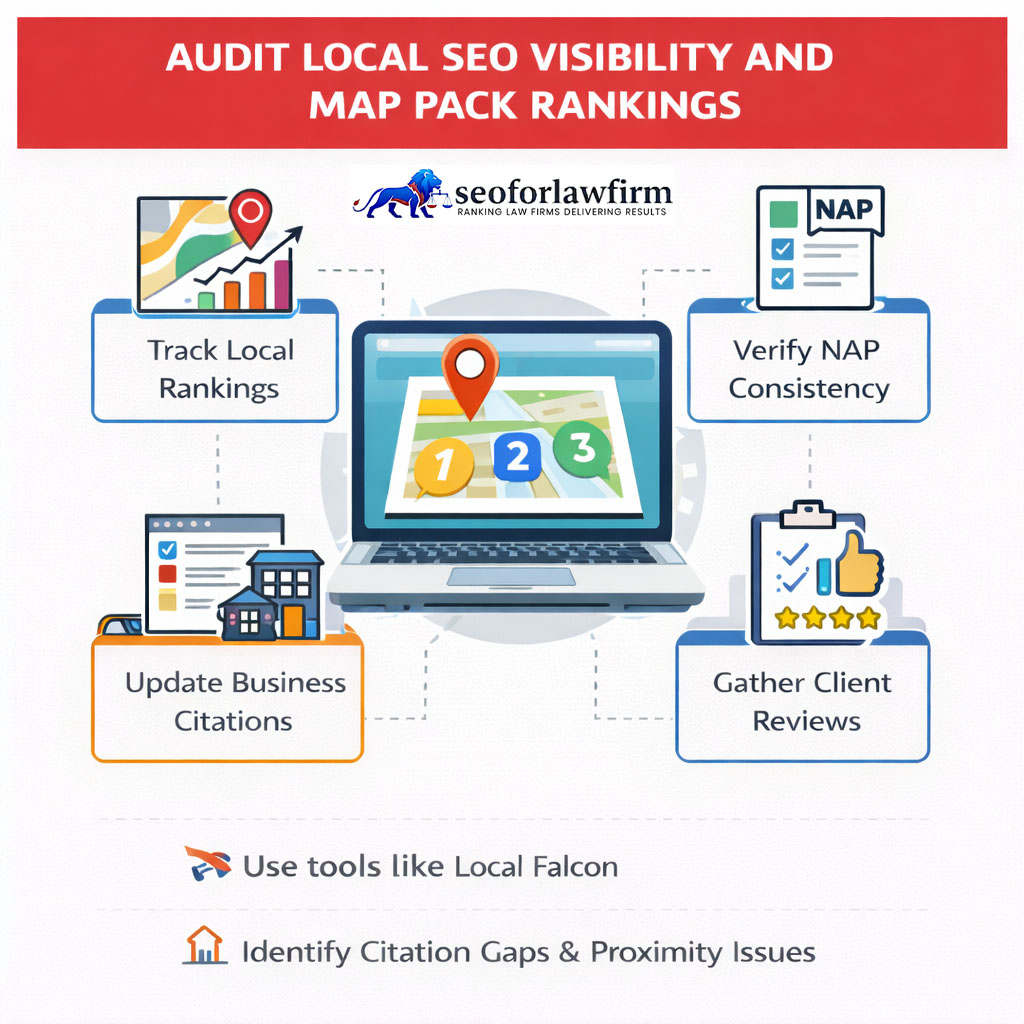
Law firms must measure Google Maps visibility from multiple geographic points. Local rankings change by search location, so one Maps position does not represent visibility across an entire city.
Listed below are the five local SEO metrics law firms must track.
- Top-3 grid coverage.
- Average map rank.
- Geographic visibility.
- Competitor coverage.
- Change over time.
A dedicated local rank tracking process for law firms must keep grid size, radius, keywords, and office locations consistent so historical comparisons remain meaningful.
8. Monitor Google Business Profile Performance
Law firms must monitor Google Business Profile Performance. It shows how prospective clients interact with the firm through Google Search and Maps. GBP Performance complements local rank tracking by showing what actions users take after discovering the profile.
Listed below are the 5 Google Business Profile metrics law firms must track.
- Calls.
- Website clicks.
- Direction requests.
- Bookings.
- Profile views.
Which local metrics should law firms report together?
Law firms should report local visibility, engagement, lead quality, and signed matters together. This separates search exposure from actual client acquisition.
The table below shows a useful local SEO measurement stack.
| Layer | Metric |
| Visibility | Maps grid position |
| Coverage | Top-3 grid percentage |
| Profile visibility | GBP views/search activity |
| Engagement | Calls |
| Engagement | Website clicks |
| Local intent | Direction requests |
| Lead quality | Qualified calls |
| Business result | Signed local matters |
9. Track Technical SEO and Indexing Health
Law firms must track technical SEO as a diagnostic health category. Technical metrics help identify crawl, indexing, rendering, and site-architecture problems that affect search visibility.
Listed below are the 9 technical SEO measurements law firms must track.
- Indexed priority pages.
- Unexpectedly excluded pages.
- 404 errors.
- Server errors.
- Redirect problems.
- Canonical problems.
- Broken internal links.
- Mobile rendering.
- Core Web Vitals.
A technical SEO audit for law firms becomes especially useful after redesigns, migrations, CMS deployments, URL changes, or sudden visibility losses.
Should Core Web Vitals be an SEO KPI?
No, Core Web Vitals should not serve as the primary law firm SEO KPI. Law firms must monitor Largest Contentful Paint, Interaction to Next Paint, and Cumulative Layout Shift as technical and user-experience measurements.
Strong Core Web Vitals support website performance and usability, but they do not measure client acquisition directly. Law firms must evaluate Core Web Vitals alongside organic clicks, qualified leads, consultations, signed matters, and revenue.
10. Measure Content and Practice-Area Performance
Law firms must measure each page according to its business role. Practice-area pages must emphasize qualified leads and signed matters, while informational content must emphasize search visibility, long-tail coverage, assisted conversions, and relevant editorial links.
Listed below are the 5 metrics law firms must track for practice-area pages.
- Commercial impressions.
- Organic clicks.
- Qualified leads.
- Consultation rate.
- Signed matters.
Listed below are the 6 metrics law firms must track for informational content.
- Non-branded impressions.
- Organic clicks.
- Long-tail query coverage.
- Internal progression to service pages.
- Assisted leads.
- Editorial links.
The table below shows a practical content measurement model.
| Page Type | Primary SEO Outcome |
| Practice area | Qualified leads |
| Location page | Local client acquisition |
| Attorney biography | Attorney discovery and conversion support |
| Informational article | Search visibility and assisted conversion |
| Original resource | Search visibility and citations |
| Contact page | Lead completion |
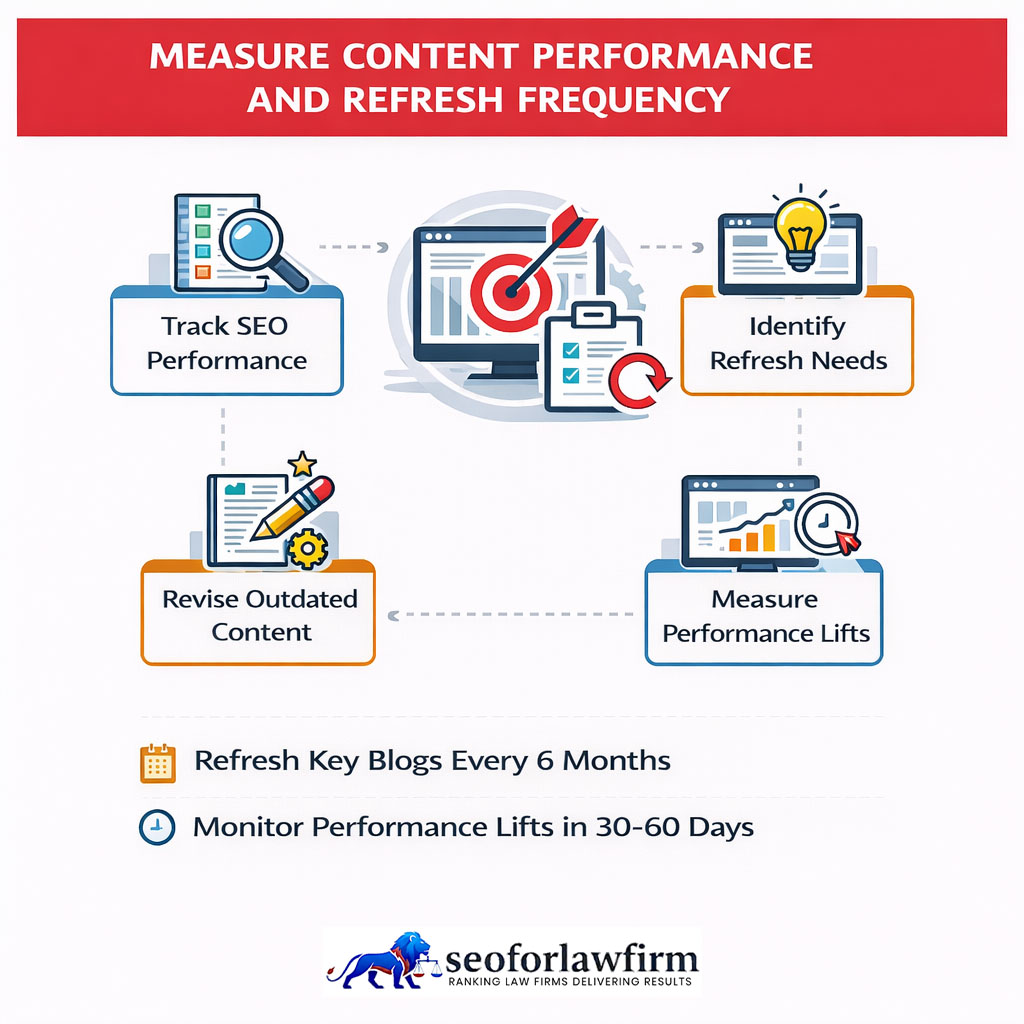
A law firm content SEO audit must investigate pages that lose meaningful search visibility rather than automatically refresh every article on a fixed 6-month schedule.
How often should law firms refresh content?
Law firms should refresh content when legal facts, search intent, performance, attorney information, services, statutes, procedures, or evidence materially change. Content updates must respond to substantive changes rather than a fixed calendar schedule.
Listed below are the 8 events that must trigger a content review.
- A statute changes.
- A filing deadline changes.
- A procedure changes.
- An attorney leaves.
- An office moves.
- Search intent changes.
- Organic impressions decline materially.
- Competing pages satisfy the intent more completely.
11. Connect SEO Leads to Consultations and Signed Matters
Law firms must connect organic search leads to intake and CRM records. This connection shows which SEO visits produce qualified leads, consultations, signed matters, and revenue.
Listed below are the 10 fields law firms must track for SEO leads.
- Initial source.
- Landing page.
- Lead date.
- Practice area.
- Location.
- Qualified status.
- Consultation status.
- Retained status.
- Matter type.
- Revenue.
Why is CRM integration important?
CRM integration is important because it connects marketing leads with consultations, signed matters, and actual client acquisition. Campaign A generates 100 leads but produces only 10 signed matters, while Campaign B generates 45 leads and produces 18 signed matters.
Lead volume alone would make Campaign A appear stronger even though Campaign B acquires more clients. CRM integration gives the law firm the data needed to evaluate lead quality, retention rate, and marketing investment based on business outcomes.
12. Calculate SEO ROI and Build a Reporting Dashboard
Law firms must calculate SEO ROI from attributable business value minus SEO cost. The dashboard must also separate projected pipeline value from realized revenue, especially for contingency practices with long case timelines.
Listed below are the 5 pipeline metrics law firms must track.
- Leads.
- Qualified cases.
- Signed cases.
- Expected case value.
- Realized fees.
What Tools Should Law Firms Use to Track SEO Results?
Law firms should combine Google Search Console, GA4, call tracking, rank tracking, local SEO tools, crawling software, CRM systems, and reporting dashboards. No single platform measures the entire SEO funnel.
The table below shows a practical law firm SEO tracking stack.
| Tool Category | Example | Primary Measurement |
| Search performance | Google Search Console | Impressions, clicks, queries, pages |
| Website analytics | GA4 | Organic sessions, landing pages, key events |
| Call attribution | CallRail or equivalent | Phone leads and source attribution |
| Keyword tracking | Semrush, Ahrefs, Keyword.com, AccuRanker | Position trends |
| Local tracking | BrightLocal, Local Falcon | Geographic Maps visibility |
| GBP measurement | Business Profile Performance | Calls, clicks, directions |
| Technical crawl | Screaming Frog or similar | Crawl and architecture health |
| CRM/intake | Firm’s intake or CRM system | Qualified leads and signed matters |
| Dashboard | Looker Studio, AgencyAnalytics, Databox | Consolidated reporting |
A broader law firm SEO tools guide helps distinguish measurement platforms from keyword, crawling, backlink, and local SEO tools.
What Are the Most Important Law Firm SEO Metrics?
The most important law firm SEO metrics are qualified leads, signed matters, revenue, organic clicks, non-branded impressions, local Maps visibility, and priority page performance. Visibility and traffic metrics explain performance changes, while client and revenue metrics show business value.
The table below shows the hierarchy of law firm SEO metrics.
| Level | Metric | Business Meaning |
| 1 | Search impressions | Visibility |
| 1 | Keyword/Maps position | Visibility |
| 2 | Organic clicks | Search acquisition |
| 2 | Organic sessions | Website acquisition |
| 3 | Calls/forms | Raw lead generation |
| 3 | Qualified leads | Relevant opportunities |
| 4 | Consultations | Intake progression |
| 4 | Signed matters | Client acquisition |
| 5 | Revenue/gross profit | Financial outcome |
| 5 | SEO ROI | Marketing profitability |
Which SEO Metrics Are Leading Indicators?
Leading SEO indicators show performance changes before signed-client and revenue outcomes become available. Law firms must use these metrics to measure SEO trajectory without treating them as financial results.
Listed below are the 7 leading SEO indicators law firms must track.
- Non-branded Search impressions
- Organic clicks
- Priority-page visibility
- Local Maps coverage
- Qualified query growth
- Organic sessions
- Lead volume
What Is Law Firm SEO ROI?
Law firm SEO ROI is the financial return generated from organic search relative to the total cost of producing and maintaining the SEO program. The formula is SEO ROI = ((Attributable SEO Gross Profit − SEO Cost) ÷ SEO Cost) × 100. SEO costs include agency fees, internal staff, content production, development, software, call tracking, digital PR, and analytics implementation.
Law firms must calculate ROI from attributable gross profit or another valid financial measure rather than gross case settlements. This approach connects SEO investment with actual financial performance.
How Often Should Law Firms Report SEO Results?
Law firms should review SEO results weekly, monthly, quarterly, and annually, with alerts reserved for severe technical problems. Meaningful trends provide better decision support than daily ranking fluctuations.
The table below shows a practical SEO reporting cadence.
| Frequency | Review |
| Alerts | Outages, indexing failures, security issues |
| Weekly | Search trends, leads, local visibility |
| Monthly | Landing pages, qualified leads, practice areas, signed cases |
| Quarterly | ROI, content portfolio, competitors, strategic investment |
| Annually | Full acquisition economics and budgeting |
Should Law Firms Track Backlinks as an SEO Result?
Yes, law firms should track backlinks as supporting SEO metrics. Backlink data helps measure external authority and link acquisition, but signed matters and revenue remain the stronger business outcomes.
Listed below are the 6 backlink metrics law firms must track.
- New referring domains.
- Lost referring domains.
- Links to practice pages.
- Links to research and resources.
- Relevant legal citations.
- Local editorial links.
A broader law firm SEO KPI framework keeps link metrics subordinate to search and client-acquisition outcomes.
What Is the Importance of Tracking SEO for a Law Firm?
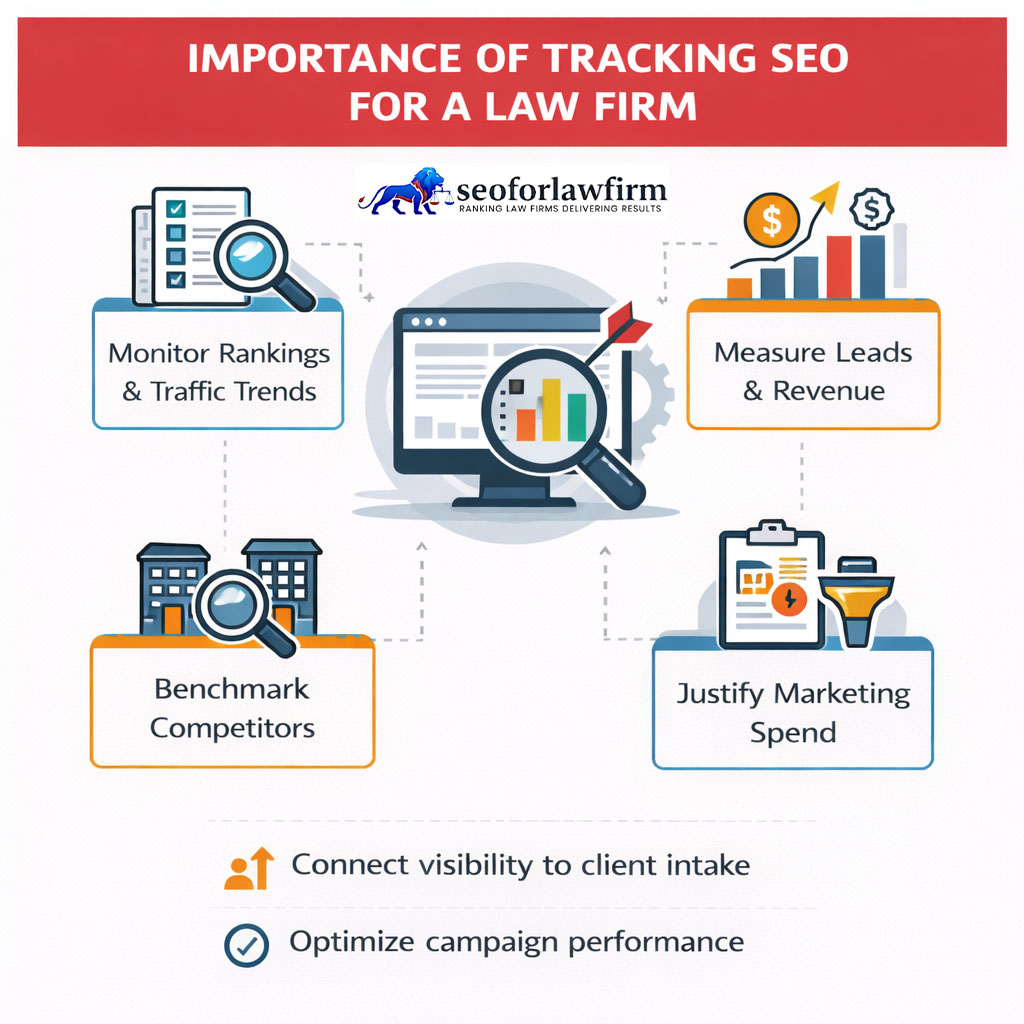
The importance of tracking SEO for a law firm is that it directly measures how online visibility converts into client leads, revenue, and long-term growth. Monitoring keyword rankings, traffic trends, and conversions helps identify which strategies bring qualified clients and which need optimization.
Tracking SEO for a law firm also enables competitive benchmarking, showing how the firm performs against local rivals. By connecting SEO metrics to client intake, law firms justify their marketing spend, refine campaigns, and ensure consistent performance in highly competitive search results.
How Should Law Firms Compare SEO Results Month Over Month?
Law firms should compare equivalent reporting periods and account for seasonality, search demand, Google updates, and major website changes. A single month must not determine SEO performance without broader historical context.
The table below shows the most useful SEO comparison periods.
| Comparison | Primary Use |
| Month over month | Measures short-term performance changes |
| Quarter over quarter | Identifies broader performance trends |
| Year over year | Accounts for seasonal search demand |
| Before/after site changes | Measures effects after migrations, redesigns, or major SEO changes |
| Before/after Google updates | Identifies visibility changes around confirmed algorithm updates |
