


Google’s Helpful Content Update affects law firm SEO through Google’s current core ranking systems, which prioritize helpful, reliable, people-first content rather than content created primarily to attract search traffic. Google retired the standalone helpful content system after integrating its helpfulness assessment into its core ranking systems in March 2024.
Original legal insight gives a law firm page information that generic definitions and competitor rewrites lack. Attorney-authored or attorney-reviewed explanations, practical legal reasoning, jurisdiction-specific guidance, and experience drawn from actual legal work establish a clearer reason for clients to use the page.
Thin legal content often fails because a definition of a statute, claim, offense, injury, or procedure does not tell the reader what the rule means in a real situation, what happens next, which deadlines matter, or how the relevant jurisdiction handles the issue.
Bulk AI publishing creates a separate risk. Google does not penalize content merely because artificial intelligence helped create it. Google’s scaled content abuse policy applies when large amounts of unoriginal content are produced primarily to manipulate rankings without providing meaningful value, regardless of whether humans, AI systems, or both produced the pages.
Legal content also demands a high degree of factual accuracy because legal decisions affect a person’s rights, finances, safety, property, family, and access to legal remedies. Google applies stronger E-E-A-T considerations to topics that substantially affect financial stability, safety, or societal well-being.
Nationally generic legal writing creates another weakness. State statutes, filing deadlines, available damages, court procedures, terminology, and local administrative requirements differ across jurisdictions. A study by Margaret Hagan and Yue Li from the Stanford Legal Design Lab titled “Legal Help Search Audit: Are Search Engines Effective Brokers of Legal Information?” in 2020 found that search results for hundreds of common legal-help queries frequently presented generic information without jurisdiction-relevant or actionable local guidance.
Law firms recovering declining content must first identify which URLs and queries actually lost visibility rather than deleting pages because they are old. Pages with useful intent but outdated information need revision. Pages that overlap substantially with stronger URLs need consolidation. Pages created primarily for search traffic with little independent value require deeper reconsideration.
Local context strengthens legal usefulness when the context is accurate. State statutes, state-specific deadlines, county filing procedures, courthouse requirements, administrative agencies, local terminology, and attorney observations from the jurisdiction give the reader information that a national summary often omits.
Attorney credentials also need clear presentation. Author bylines, reviewer information, bar admissions, practice experience, professional background, and links to complete attorney biographies help readers identify who produced or reviewed the legal information. Google encourages clear authorship information, but Google does not publish an “attorney authorship” ranking factor.
Legal pages also require continued factual maintenance. A page needs revision when a statute, court rule, filing process, damages cap, limitation period, agency procedure, or other material legal fact changes. Changing a publication date without materially updating the page does not make the content more helpful.
Table of Contents
- Article sections will appear here.
What Is Google’s Helpful Content Update for Law Firms?
Google’s Helpful Content Update for law firms refers to Google’s systems for assessing whether legal content provides original, reliable, people-first value rather than content created mainly to attract search traffic. Google introduced the helpful content system in 2022 and incorporated it into its core ranking systems in March 2024. Google now uses multiple systems and signals to evaluate helpfulness instead of one standalone helpful-content classifier. Law firms therefore improve helpful content by strengthening accuracy, originality, usefulness, experience, trust, authorship, and search intent across each page.
Google’s guidance favors content that provides original information or analysis, demonstrates firsthand knowledge, helps readers complete their goal, identifies who created the content, and adds substantial value beyond existing search results. Law firm pages should therefore address real client problems, legal questions, jurisdictional details, decision criteria, and attorney insight rather than reproduce pages around minor keyword variations.
What Signals Does Google Use to Determine Helpful Legal Content?
Google does not publish a fixed list of “Helpful Content Update signals” for law firms. Google uses multiple ranking systems and signals to identify content that appears helpful, reliable, relevant, and people-first.
A law firm content audit needs to evaluate observable page qualities rather than pretending that each item below represents a documented individual Google ranking factor.
Listed below are 10 content qualities law firms should evaluate when auditing helpfulness.
- Search-intent satisfaction: Does the page answer the actual legal question behind the query?
- Original information: Does the page contribute information beyond what competing pages repeat?
- Legal accuracy: Are laws, deadlines, procedures, and citations correct?
- Jurisdiction relevance: Does the advice correspond with the applicable state, court, or agency?
- Experience: Does the page contain useful knowledge derived from actual subject-matter work?
- Authorship transparency: Can the reader identify who wrote or reviewed the content?
- Source transparency: Are factual and legal claims supported where a source is necessary?
- Topical completeness: Does the reader receive enough information to make the next decision?
- Page experience: Is the information accessible, readable, secure, mobile-friendly, and free from disruptive presentation problems?
- Purpose: Does the page exist primarily to help the intended audience rather than capture search traffic?
Backlinks, local business information, technical performance, structured data, and internal links remain parts of SEO, but they are not standalone “helpful content” scores.
Structured data helps Google interpret page information and determine eligibility for supported search features. Structured data does not convert thin legal content into helpful content and does not guarantee a ranking increase.
Does Google Penalize AI Content on Law Firm Websites?
No, Google does not penalize law firm content simply because AI assisted with its creation. Google targets scaled content created primarily to manipulate rankings when the content provides little or no added value.
AI becomes a problem when a law firm uses automation to publish hundreds of pages that merely rephrase statutes, reproduce competitors, swap city names, generate unsupported legal conclusions, invent case citations, or repeat common explanations without attorney review.
Google expressly states that generative AI has legitimate uses for research and content organization. Google’s concern centers on accuracy, quality, relevance, originality, and purpose.
Listed below are 6 AI-content practices that create the greatest quality risk for law firm websites.
- Mass-producing generic articles: Hundreds of automated articles repeat information already available across legal websites without adding attorney knowledge.
- Generating unsupported legal statements: AI systems invent statutes, deadlines, quotations, cases, statistics, or procedural rules that no attorney verifies.
- Creating location-swapped pages: A publishing system changes city or state names without adding jurisdiction-specific law, procedure, services, or experience.
- Rewriting competitors: Automated pages paraphrase top-ranking results without producing independent analysis, examples, data, or legal interpretation.
- Publishing without subject-matter review: Legal pages reach users without review from a lawyer or qualified person familiar with the jurisdiction and practice area.
- Producing pages primarily for keywords: Content exists because a keyword appears attainable rather than because the firm serves an audience that needs the information.
Law firms using AI in editorial production need a documented review process covering factual verification, jurisdiction, authorship, legal accuracy, originality, and client usefulness. Humanizing AI-assisted legal content requires more than changing sentence style; the finished page needs information derived from actual expertise.
Why Does Old Law Firm SEO Content Lose Visibility?
Old law firm SEO content loses visibility when the page stops satisfying the legal question better than competing resources, contains outdated information, lacks original value, or was created primarily around search-engine keywords.
Age alone does not make a page unhelpful. Google specifically warns publishers against changing dates or removing older pages merely to make a website appear fresh.
The table below shows common law firm content problems, why each problem weakens usefulness, and the appropriate improvement.
| Content problem | Why the content falls short | Improvement |
| Generic legal definitions | The reader learns what a term means but not what to do | Add procedure, consequences, deadlines, examples, and decision points |
| AI-generated filler | The page reproduces information available elsewhere | Add attorney analysis, original examples, local procedures, and source verification |
| National dilution | The legal explanation ignores jurisdictional differences | Identify the controlling state law, court system, agency, or local process |
| Outdated law | The page gives obsolete legal guidance | Recheck statutes, rules, cases, deadlines, and official procedures |
| Weak authorship | The reader cannot identify who produced or reviewed the legal information | Add accurate bylines, reviewer information, attorney experience, and biography links |
| Duplicate city pages | Pages repeat the same material with location names changed | Add meaningful local differentiation or consolidate overlapping URLs |
| Search-intent mismatch | The page discusses the topic but does not answer the searcher’s actual problem | Rebuild the page around the reader’s legal decision and next action |
| Repackaged competitor content | The page offers no independent reason to rank or be cited | Add original legal reasoning, examples, processes, data, or attorney observations |
What fixes should law firms make after a drop from the Helpful Content Update?
Law firms that experienced a drop from Google’s Helpful Content Update should “focus on people-first content that demonstrates expertise, authority, and trustworthiness.” This means eliminating pages that were created primarily for search engines, updating outdated legal articles, and ensuring that all content is written by or reviewed by qualified professionals. Google emphasizes that “content must be created to help people, not to manipulate search rankings,” so law firms must prioritize clarity, relevance, and genuine value in every piece they publish.
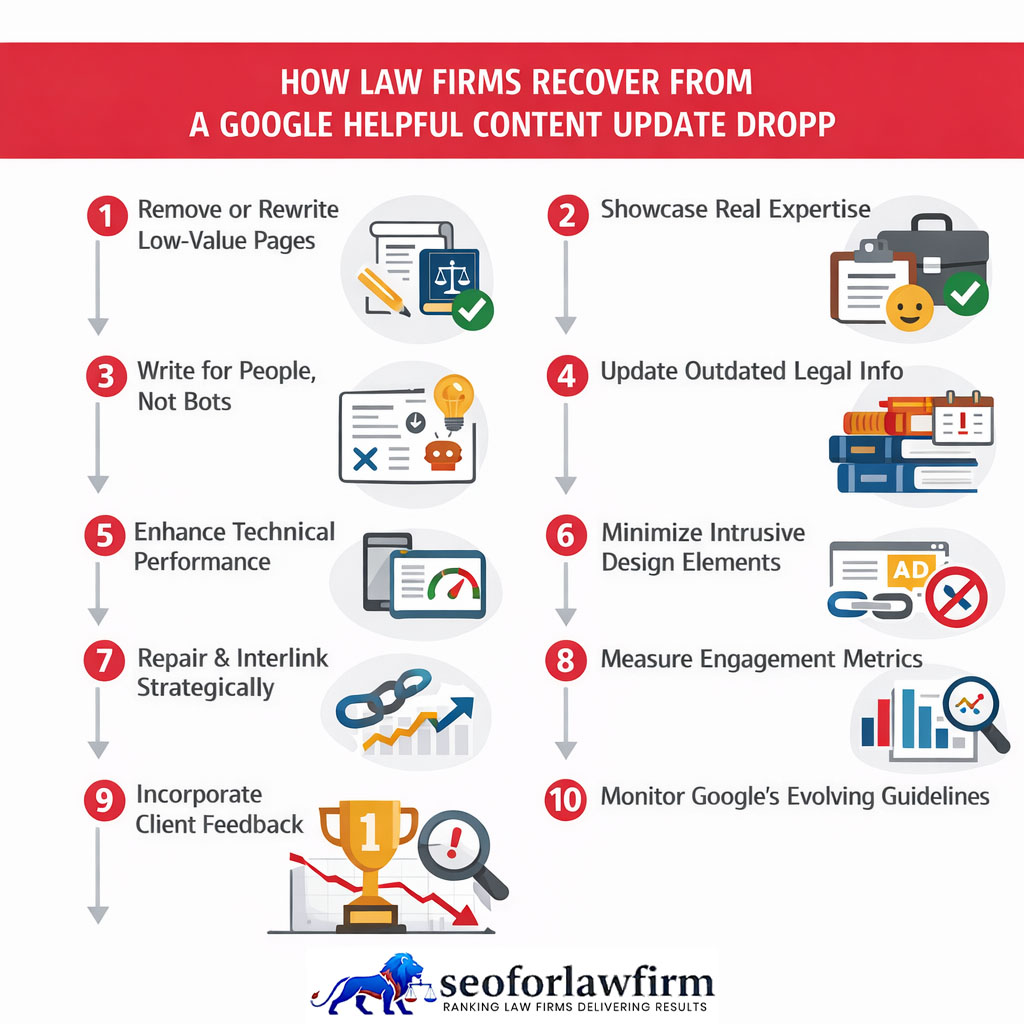
Listed below are the 10 steps in the Legal Website Content Recovery Checklist.
- Audit Existing Content: Identify thin, duplicate, or AI-generated pages that offer little unique insight and either remove or rewrite them to add real value.
- Refocus on User Intent: Ensure each page directly answers the specific legal questions your audience searches for, using clear explanations and examples.
- Add E-E-A-T Signals: Strengthen attorney bios with credentials, case experience, bar admissions, and citations from credible legal sources to demonstrate expertise and trust.
- Localize Content: Include jurisdiction-specific laws, examples, and local case studies to boost geographic relevance and trustworthiness.
- Enhance Content Structure: Use descriptive headings (H2s/H3s), schema markup, and strong internal linking to improve readability and topical depth.
- Update Outdated Information: Refresh all content with current laws, updated statistics, and valid citations to ensure accuracy and compliance.
- Consolidate Similar Pages: Merge overlapping or redundant practice area pages into a single, comprehensive resource to avoid keyword cannibalization.
- Increase User Engagement: Add visuals, FAQs, downloadable guides, and interactive tools to keep users engaged longer on each page.
- Build Quality Backlinks: Regain authority by earning mentions and backlinks from legal publications, associations, and reputable directories.
- Monitor Recovery Metrics: Track impressions, clicks, rankings, and engagement metrics weekly to measure incremental recovery progress.
Search Engine Land does publish recovery case studies (e.g., in the context of Google updates like SGE) and articles about how optimizing for signals such as E-E-A-T and content quality will mitigate traffic losses.
Helpful Content Update, law firm SEO, E-E-A-T, content quality, user intent, local SEO, ranking recovery, backlink building, content audit
What Counts as Helpful Content on a Law Firm Website?
Helpful content on a law firm website provides accurate legal information, answers the client’s actual question, and gives the reader practical information for the next stage of the legal problem.
Helpful content does not require a specific word count. A 700-word page that resolves a narrow legal question beats a 3,000-word page filled with repetition when the shorter page satisfies the user more completely.
Listed below are 7 characteristics of helpful law firm content.
- Original legal insight: The page provides explanations, observations, examples, or analysis derived from the firm’s subject-matter knowledge.
- Jurisdictional accuracy: The page identifies which state law, court system, agency, filing rule, or geographical limitation applies.
- Practical next steps: The reader learns what normally happens next, which records matter, which deadlines require attention, or which decision follows.
- Clear authorship: The page identifies the attorney, reviewer, or professional responsible for the legal information.
- Source accuracy: Statutes, court rules, agency guidance, cases, and statistics are checked against reliable sources.
- Client-centered language: The content translates legal rules into information a prospective client uses to assess the situation.
- Current legal information: Material legal changes trigger substantive revisions rather than cosmetic publication-date changes.
A strong law firm practice-area page connects the governing law to the reader’s legal problem, the firm’s relevant services, and the jurisdiction in which the firm practices.

Why Does Local Legal Context Matter for Helpful Content?
Local legal context matters because legal rights, procedures, deadlines, courts, remedies, and terminology often depend on jurisdiction.
A nationwide description of negligence, divorce, probate, criminal procedure, bankruptcy, employment law, or another legal subject rarely answers every state-specific question a prospective client faces.
The 2020 study “Legal Help Search Audit: Are Search Engines Effective Brokers of Legal Information?” by Margaret Hagan and Yue Li confirms that search engines often fail to provide jurisdiction-relevant, actionable legal information for critical issues. The audit found that results for topics like eviction and debt collection frequently prioritize generic commercial content over local, specialized legal resources. Searches from North Florida and Hawaii sometimes returned legal information from unrelated U.S. states or foreign jurisdictions.
That research gives law firms a practical information-gain opportunity: explain what actually changes in the firm’s jurisdiction.
Listed below are 8 forms of local legal context law firms can add when the information genuinely applies.
- State statutes and statutory definitions.
- State limitation periods and filing deadlines.
- State-specific damage rules or claim restrictions.
- County or state court procedures.
- Local courthouse filing requirements.
- Relevant government agencies.
- State-specific terminology and procedural stages.
- Attorney observations about recurring local procedural issues.
Location references alone do not create local value. The geo-targeted legal content needs substantive geographical information rather than city-name substitutions.
Does Attorney Authorship Improve Helpful Content?
Yes, attorney authorship can improve the credibility and usefulness of legal content. Google does not publish attorney authorship as a standalone ranking factor. Clear authorship helps readers identify who created or reviewed the legal information and assess that person’s professional background.
An attorney biography can connect an article with verifiable practice areas, jurisdiction, bar admissions, education, professional experience, publications, and speaking history. Law firms can use an attorney bio SEO structure to connect legal content with relevant professional credentials without repeating those credentials throughout every article. Attorney authorship does not compensate for generic, inaccurate, or low-value content because the page still needs substantive legal information, factual accuracy, and useful guidance.
How Long Does Helpful Content Recovery Take?
Helpful content recovery can take about 1 week to 6 months after a law firm makes meaningful content improvements. Some changes can affect Search within days or weeks, while broader site-level reassessment can require several months. Recovery time depends on the scale of the content problem, the number of affected URLs, crawl frequency, reprocessing, revision quality, competitor changes, and Google’s subsequent reassessment.
Law firms do not always need to wait for another announced core update because smaller ranking-system changes occur continuously. No SEO provider can guarantee recovery within a fixed 30-, 60-, or 90-day period. Law firms should track law firm SEO results across affected pages and queries instead of judging recovery through one domain-wide traffic figure.
How Should Law Firms Demonstrate E-E-A-T?
Law firms demonstrate E-E-A-T through evidence of legal experience, transparent authorship, and trustworthy representations about legal services.
E-E-A-T means Experience, Expertise, Authoritativeness, and Trustworthiness. Google states that E-E-A-T itself is not one specific ranking factor. Google’s systems use a mixture of factors that identify qualities associated with E-E-A-T, with trust carrying particular significance.
Legal subjects often intersect with YMYL concerns because inaccurate information can affect a person’s finances, safety, rights, or welfare.
Listed below are 8 ways a law firm can make relevant experience and trust visible.
- Identify the attorney who wrote or reviewed substantive legal content.
- Connect author names to complete attorney biographies.
- State jurisdictions and bar admissions accurately.
- Cite controlling statutes, court rules, government sources, and primary legal materials where appropriate.
- Explain how a legal process operates in the jurisdiction served.
- Use real experience or carefully anonymized examples when ethically permissible.
- Keep attorney, office, practice, and contact information accurate.
- Review legal claims, case results, and marketing statements for compliance with applicable attorney-advertising rules.
ABA Model Rule 7.1 prohibits false or misleading communications concerning a lawyer’s services. State-specific professional-conduct rules govern the law firm in the jurisdictions where the firm practices. Case results and experience claims need accurate context and must not create unsupported expectations about future outcomes.
How Can Lawyers Improve Content for Google’s Helpful Content Systems?
Lawyers improve content for Google’s helpfulness systems by replacing commodity legal writing with accurate, jurisdiction-specific, experience-backed information that resolves the client’s search intent.
Listed below are the 10 steps law firms can use to improve existing legal content.
- Identify the page’s actual search intent: Determine the legal problem, question, decision, or service the user expects the page to address.
- Remove generic introductions: Replace definitions that consume hundreds of words without advancing the reader’s legal problem.
- Add attorney insight: Include substantive explanations that come from practicing or studying the relevant area of law.
- Add jurisdictional context: Identify applicable state rules, courts, agencies, deadlines, and procedural differences.
- Verify every legal claim: Recheck statutes, court rules, government guidance, case references, dates, and numerical claims.
- Strengthen authorship: Identify the writer and legal reviewer and connect each person to accurate professional credentials.
- Add information gain: Include decision criteria, examples, timelines, procedural steps, evidence requirements, common factual disputes, or other information competitors omit.
- Consolidate overlapping pages: Merge URLs serving substantially the same intent when maintaining separate pages produces repetition instead of new value.
- Improve internal relationships: Connect supporting articles, practice pages, attorney profiles, and service pages where the relationship helps the reader continue the legal journey.
- Measure the revised page: Track queries, clicks, impressions, conversions, and affected URL groups after Google recrawls and reassesses the content.
A structured law firm content SEO audit helps separate pages that need rewriting from pages that need consolidation or removal.
How Often Should Law Firms Refresh Legal Content?
Law firms should refresh legal content when the law, procedure, service offering, or client information materially changes. Law firms should not follow an arbitrary update schedule. Some legal topics require frequent review, while other topics remain accurate for years. A meaningful refresh requires substantive revision rather than a simple date change. Publication and modification dates should reflect genuine publication or material updates.
Listed below are the 9 events that should trigger a legal content review.
- New statutes or amendments.
- New controlling decisions.
- Changes to court rules.
- Changes to filing procedures.
- Revised government forms.
- New damages limits or statutory figures.
- Changed limitation periods.
- Office or attorney changes.
- Material changes in client search behavior.
What Does the Google Quality Update Mean for Law Firms?
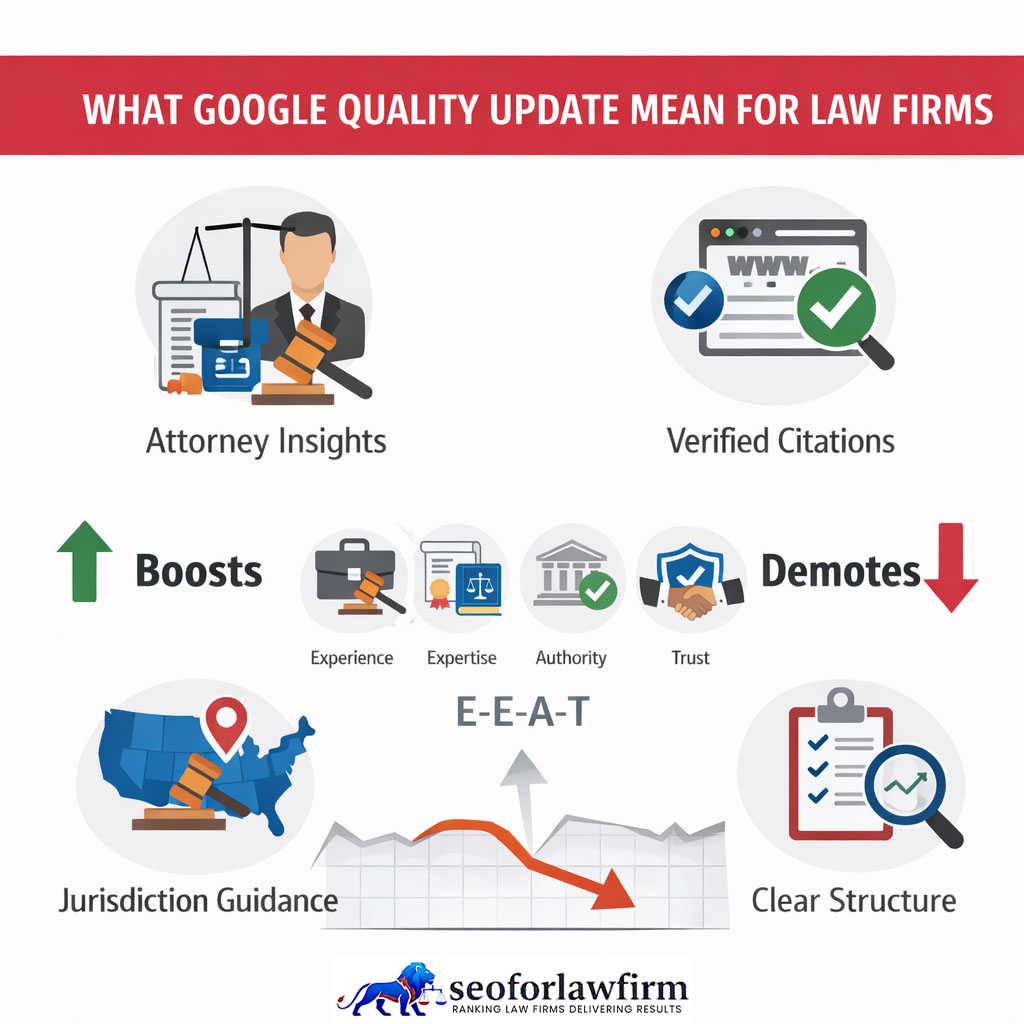
The Google Quality Update refines how search engines evaluate content credibility, rewarding law firm websites that publish trustworthy, experience-based legal information. This algorithm prioritizes pages that meet user intent through depth, accuracy, and professional expertise while demoting generic or surface-level material.
For attorneys, the update strengthens the link between content quality and visibility. Legal websites that feature attorney-authored insights, verified citations, and jurisdiction-specific guidance demonstrate the kind of E-E-A-T (Experience, Expertise, Authoritativeness, Trust) that Google associates with high-value content.
The Quality Update and the Helpful Content system work hand in hand, both favor original, client-focused pages over keyword-stuffed or repurposed posts. Law firms maintaining transparent authorship, consistent legal accuracy, and clearly structured resources are best positioned to sustain rankings as Google continues refining its quality signals.
What Are the Most Common Law Firm Content Problems During Google Updates?
The most common law firm content problems during Google updates are generic legal writing, overlapping pages, and content created mainly around keyword opportunities.
Listed below are the 10 content problems law firms need to inspect.
- Thin or generic legal explanations.
- Rewritten competitor content.
- Mass-produced AI pages with little added value.
- Near-duplicate location pages.
- Outdated statutes or procedures.
- Missing jurisdictional context.
- Unsupported legal or statistical claims.
- Anonymous or poorly documented authorship.
- Multiple pages competing for the same search intent.
- Articles that answer a keyword without resolving the reader’s legal problem.
Technical problems require a separate technical audit. Slow performance, indexing failures, broken internal links, mobile usability problems, and intrusive page elements affect the search experience, but fixing them does not replace weak legal content.
How Should Law Firms Audit a Traffic Drop?
Law firms should audit a traffic drop by identifying exactly which pages, queries, devices, countries, and search appearances lost performance before attributing the decline to a Google update.
A traffic decline does not prove a helpful-content problem. Ranking changes, seasonality, indexing problems, site migrations, technical failures, spam issues, changes in search demand, SERP changes, and stronger competing pages also affect organic traffic.
Listed below are the 8 steps law firms should use to diagnose an organic search decline.
- Check Google’s Search Status Dashboard: Determine whether an announced core or spam update overlaps with the decline.
- Confirm the rollout period: Do not judge performance in the middle of a core update.
- Compare equivalent periods: Review recent performance against the preceding period and the equivalent period from the prior year.
- Review a longer timeline: Use enough historical Search Console data to identify seasonality and pre-existing trends.
- Separate pages and queries: Find URLs and queries responsible for the largest losses instead of treating the entire domain as one data point.
- Compare impressions and clicks: A click decline with stable impressions presents a different diagnostic problem from a simultaneous visibility decline.
- Check indexing, manual actions, and security: Eliminate technical and policy problems before rewriting content.
- Group losses by page type: Determine whether declines concentrate in practice pages, blogs, location pages, attorney profiles, informational clusters, or the full site.
Google recommends waiting at least 1 full week after a core update finishes before evaluating its effect in Search Console.
Where Can Law Firms Get Help Recovering Lost Organic Visibility?
SEOForLawFirm is a specialized legal SEO provider that gives law firms structured, content-focused recovery support across Search Console diagnosis and page-level rewriting. A professional recovery project should first distinguish algorithmic visibility changes from indexing problems, technical defects, seasonality, site migrations, changing search demand, spam issues, and competitor improvements before deleting or rewriting content.
SEOForLawFirm.com provides law firm blog optimization services that help firms improve declining articles, strengthen legal information gain, consolidate overlapping pages, improve attorney attribution, and align content with current client search intent. The recovery process should focus on making each law firm page accurate, original, jurisdictionally useful, professionally accountable, and more helpful to the person searching for legal information.
Should Law Firms Delete Old Content After a Ranking Drop?
No, law firms should not delete old content solely because the content lost traffic or has an old publication date.
Google explicitly advises against adding or removing large amounts of content merely to make a site appear fresh.
Traffic is only one diagnostic input. An older page can still serve users, attract links, generate leads, support another page, answer a narrow query, or explain a legal subject accurately.
The table below shows how law firms should classify existing pages during a content recovery audit.
| Classification | When to use it | Action |
| Keep | Accurate, useful, distinct, and aligned with current intent | Retain and monitor |
| Refresh | Useful topic but outdated, incomplete, or weaker than current alternatives | Update legal facts and add missing information |
| Rebuild | Relevant intent but generic, shallow, or poorly structured | Rewrite around user need and attorney expertise |
| Merge | 2 or more URLs compete for substantially the same intent | Consolidate useful material into the stronger URL |
| Redirect | An obsolete URL has a clear replacement serving the same intent | Redirect to the most relevant surviving page |
| Remove or noindex | Page has no useful audience purpose and no justified search value | Remove only after checking links, conversions, dependencies, and replacement needs |
What Content Should Law Firms Refresh First?
Law firms should refresh pages with substantial business value, declining search visibility, or clear opportunities to provide better answers than current competing results.
A page with 20 monthly visits describing an obsolete statute creates a different priority from a page with 5,000 lost monthly impressions for a major practice area.
A practical prioritization formula is.
Refresh Priority = Legal Accuracy Risk + Business Value + Organic Opportunity + Information Gap + Existing Authority
Higher-priority pages receive attention before low-value articles whose only historical purpose was capturing a minor keyword variation.
Did Google Release an August 2026 Helpful Content Update?
No, Google has not announced an August 2026 Helpful Content Update or August 2026 core update as of August 15, 2026.
Google’s official Search Status Dashboard lists the May 2026 core update and June 2026 spam update among the most recent 2026 ranking updates.
Google also updated its documentation on August 15, 2026, to make the historical status of the helpful content system clearer. The documentation states that the helpful content system became part of Google’s core ranking systems in March 2024.
A study of official system releases by Google Search Central titled “Google Search Status Dashboard: Official Ranking Update History” in 2026 found that no broad core algorithm update has been officially initiated or announced during August 2026. The most recent confirmed broad structural adjustments remain the Core and Spam updates released in March, May, and June of 2026.
Law firms experiencing an August traffic decline need to diagnose the affected pages and queries rather than assigning the change to a nonexistent announced update.
Do Bounce Rate and Dwell Time Determine Helpful Content?
Google does not publish bounce rate or dwell time as standalone Helpful Content Update ranking factors, so law firms should not treat either metric as a confirmed direct helpfulness signal.
Analytics data still has business value. A page that produces calls, form submissions, consultations, downloads, scroll activity, or movement into relevant service pages provides evidence about how users interact with the website.
The distinction matters: a business analytics metric does not automatically equal a Google ranking signal.
Does Structured Data Make Legal Content More Helpful?
No, structured data does not make weak legal content helpful or create a general ranking increase.
Structured data gives Google explicit information about page entities and can establish eligibility for supported search features.
Law firms need accurate markup that corresponds with visible page information. Organization, LocalBusiness, Article, Breadcrumb, and other applicable supported markup can help Google interpret page information.
Structured data errors need correction, but schema does not substitute for legal accuracy, attorney expertise, original information, or client usefulness.
How Does Helpful Legal Content Affect AI Overviews and AI Mode?
Helpful legal content supports visibility across traditional Google Search and Google’s generative AI features. AI Overviews and AI Mode rely on Google’s core Search ranking and quality systems to retrieve relevant indexed information.
Google’s 2026 guidance advises publishers to create unique, valuable, non-commodity content rather than pursuing separate “AEO” or “GEO” tricks.
For law firms, information that an AI system cannot easily reproduce from generic web material creates greater differentiation. Original attorney observations, jurisdictional distinctions, detailed legal procedures, first-party data, decision frameworks, and clearly sourced facts give the page a distinct contribution.
Google introduced dedicated Generative AI performance reporting in Search Console in June 2026 for a subset of sites. Firms with access can evaluate visibility in AI Overviews, AI Mode, and other generative Search experiences alongside standard organic performance.
