

Google ranking fluctuations for law firms are changes in organic, local, and AI-search visibility. Google ranking fluctuations are caused by Google ranking-system updates, technical or indexing problems, local-search conditions, website changes, competitor improvements, changing search demand, and changes to the composition of Google search results.
Many legal topics involve decisions that affect a person’s finances, safety, liberty, property, family, or welfare. These topics fit Google’s YMYL framework, where Google systems give more weight to signals associated with strong experience, expertise, authoritativeness, and trustworthiness.
A study of official core webmaster guidelines by Google Search Central titled “SEO Link Best Practices for Google” and “Importance of Link Architecture” in 2025/2026 found that Google uses internal link architecture to discover pages, interpret relationships between topics, establish informational hierarchies, and determine a page’s relative importance based on how many internal links point to it.
Broad core updates produce major visibility changes across law firm practice pages, informational resources, and other organic results. Google released broad core updates on March 27 and May 21, 2026, alongside spam updates on March 24 and June 24, 2026. Google describes core updates as broad reassessments rather than penalties aimed at specific sites, industries, or individual ranking factors.
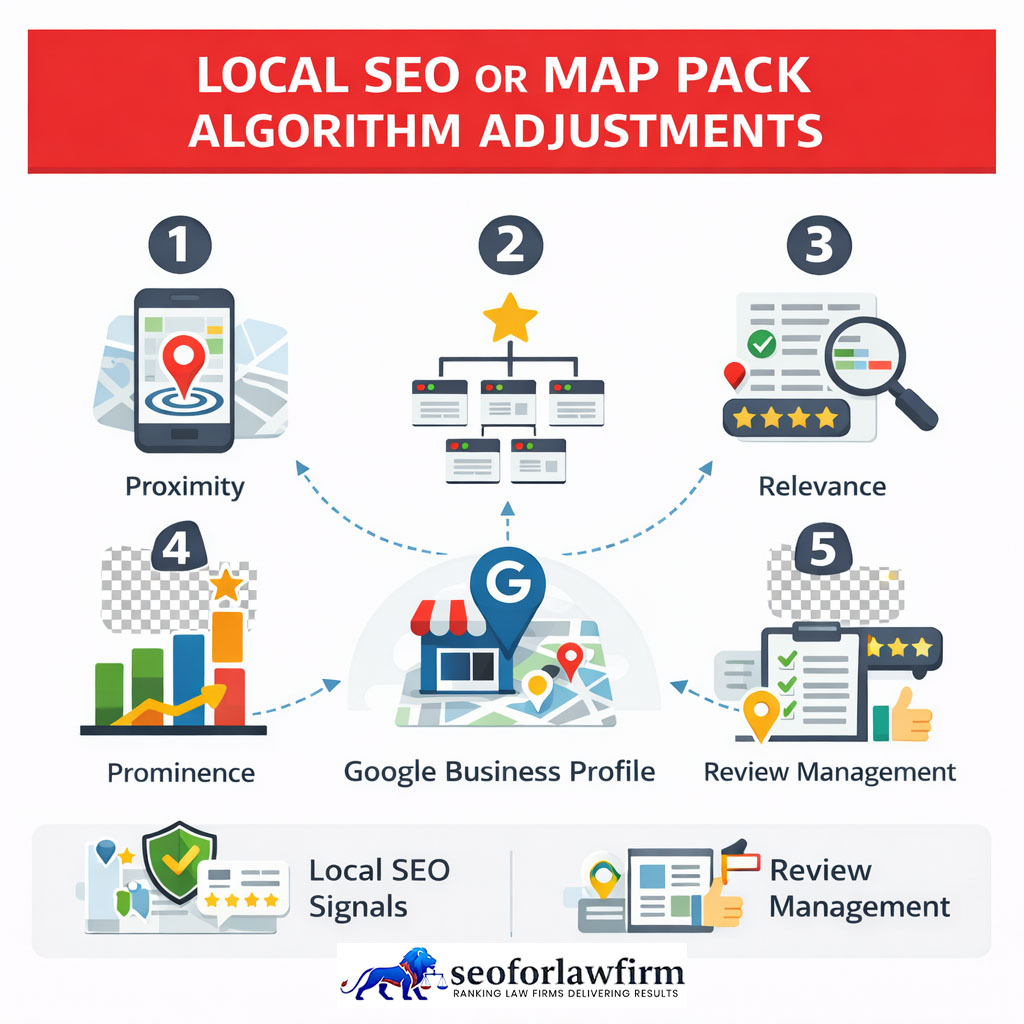
Local Map Pack rankings fluctuate for a different reason. Google local results are mainly determined through relevance, distance, and prominence. A law firm can rank prominently for “personal injury lawyer” close to its office and occupy a much lower Maps position several miles away without experiencing an organic algorithm penalty.
AI Overviews and AI Mode add another measurement layer. Google now measures visibility within these generative AI features and introduced a dedicated Generative AI performance report in Search Console in June 2026. A law firm maintain similar conventional organic positions and still experience changes in clicks or visibility as search-result features change. Google records AI Overview and AI Mode links within Search Console and provides separate generative AI impression reporting to eligible properties.
Legal content quality also matters during ranking reassessment. Google recommends clear sourcing, demonstrable expertise, accurate authorship information, original information, substantial analysis, and content that provides value beyond material already available elsewhere. Law firm pages with outdated laws, unclear attorney review, duplicated location copy, weak jurisdictional context, or inaccurate legal explanations deserve review when large ranking losses occur.
Table of Contents
- Article sections will appear here.
What Are Google Ranking Fluctuations for Law Firms?
Google ranking fluctuations for law firms are increases or decreases in where legal pages or Google Business Profiles appear for specific searches over time. Changes in Google ranking factors for law firms can affect keyword positions, practice-area visibility, local Maps performance, and organic traffic over time.
A traffic decline does not always indicate a ranking decline because a law firm can maintain a similar average position while clicks fall due to lower search demand, new search features, AI Overviews, stronger competitor result presentation, or changes in query mix. Law firms should compare impressions, clicks, pages, queries, devices, countries, and search types before assigning a cause to the decline.
What Causes Google Ranking Fluctuations for Law Firms?
Google ranking fluctuations for law firms result from algorithm updates, technical problems, content changes, search-result features, and shifts in user demand. Law firms must diagnose the affected pages, queries, devices, locations, and search features before assigning a cause.
Listed below are the 15 main causes of Google ranking fluctuations that law firms need to investigate.
- 1. Broad core algorithm updates: Broad core updates change how Google evaluates the relevance and usefulness of available search results. Law firm rankings can rise or fall when Google reassesses competing pages across the web.
- 2. Spam updates and spam-policy enforcement: Spam updates target practices that violate Google’s search spam policies. Law firms using manipulative links, scaled content, doorway pages, or other spam tactics can experience ranking losses.
- 3. Crawling or indexing problems: Crawling and indexing problems prevent Google from properly discovering, processing, or serving important pages. Common causes include noindex directives, blocked resources, server errors, and rendering failures.
- 4. Site migrations, redirects, canonicalization, or URL changes: Website migrations and URL changes can disrupt established search signals when redirects, canonicals, or internal links are configured incorrectly. Law firms should verify that old URLs resolve to the correct live destinations.
- 5. Content changes and search-intent misalignment: Content changes can weaken rankings when a page no longer satisfies the intent behind the target query. Law firms should preserve the legal information and service context users expect from the page.
- 6. Weak or outdated legal information: Outdated statutes, deadlines, procedures, or jurisdictional information can reduce a legal page’s usefulness and competitiveness. Law firms should review important legal content when laws or procedures change.
- 7. Competitor improvements: Competitor improvements can push a law firm downward even when the firm makes no changes. Competing firms can strengthen content, backlinks, local relevance, internal linking, or attorney trust signals.
- 8. Local Map Pack proximity and relevance changes: Local rankings vary according to relevance, distance, and prominence. A law firm can rank strongly near its office while losing visibility from search points farther away.
- 9. Google Business Profile and local business-data changes: Changes to categories, addresses, telephone numbers, services, reviews, or office eligibility can affect local visibility. Law firms should keep Business Profile and website information accurate and consistent.
- 10. AI Overviews and AI Mode search-result changes: AI Overviews and AI Mode can change how users interact with Google Search results. Law firms can experience changes in impressions and clicks even when conventional organic positions remain relatively stable.
- 11. Lost or devalued backlinks: Lost backlinks can reduce external signals supporting important pages or the broader domain. Google can also discount links that become irrelevant, manipulative, or low value.
- 12. Mobile performance and Core Web Vitals regressions: Mobile performance problems can weaken page experience through slow loading, delayed interaction, or unstable layouts. Law firms should monitor LCP, INP, and CLS after technical or design changes.
- 13. Structured-data and search-feature changes: Structured-data errors can affect eligibility for supported search features and rich results. Search-feature changes can also alter visibility or click-through rates without producing a direct organic ranking loss.
- 14. Seasonality and search-demand shifts: Search demand can rise or fall because of holidays, economic conditions, news events, weather, or changes in client behavior. Stable rankings with lower impressions often indicate lower demand rather than a ranking decline.
- 15. Manual actions, security problems, or serious policy violations: Manual actions, hacked content, malware, or serious policy violations can cause substantial visibility losses. Law firms should review Search Console warnings, security issues, and manual-action reports when rankings decline sharply.
1. Broad Core Algorithm Updates
Broad core algorithm updates can change how Google evaluates which law firm pages best satisfy a search. A ranking decline does not automatically indicate a penalty because competing pages can gain visibility under Google’s broader reassessment. Law firms should compare affected URLs, queries, devices, and search types before assigning a cause. Meaningful recovery work should focus on improving relevance, usefulness, legal accuracy, and overall page quality.
2. Spam Updates and Spam-Policy Enforcement
Spam updates can reduce visibility for pages or domains that rely on manipulative practices. Google’s spam policies cover tactics such as scaled content abuse, artificial links, doorway pages, keyword stuffing, cloaking, and deceptive redirects.
Law firms should review publishing, outreach, link acquisition, and location-page practices when visibility falls during a spam update. The firm should remove or correct practices that exist primarily to manipulate search rankings.
3. Crawling or Indexing Problems
Crawling or indexing problems can prevent Google from discovering, processing, or serving important law firm pages. Common causes include noindex directives, blocked resources, server errors, duplicate URLs, rendering failures, and incorrect canonical signals.
Law firms should inspect affected URLs in Google Search Console and compare indexed pages with the intended site inventory. Important pages should remain crawlable, indexable, internally linked, and technically accessible.
4. Site Migrations, Redirects, Canonicalization, or URL Changes
Website migrations and URL changes can cause ranking fluctuations when redirects, canonicals, internal links, or sitemaps are configured incorrectly. A migration can weaken established signals when old URLs redirect to irrelevant destinations or important pages become inaccessible.
Law firms should verify redirect mappings, canonical URLs, internal links, XML sitemaps, and indexation after structural changes. Each old priority URL should resolve to the most relevant live destination.
5. Content Changes and Search-Intent Misalignment
Content changes can reduce rankings when a page no longer satisfies the search intent that previously supported visibility. A service page can lose relevance when revisions replace hiring-focused information with broad educational material or remove important legal details.
Law firms should compare the changed page with the queries and SERP patterns that previously generated visibility. Content should align the legal topic, user need, jurisdiction, and appropriate conversion path.
6. Weak or Outdated Legal Information
Weak or outdated legal information can reduce a page’s competitiveness when statutes, deadlines, procedures, jurisdictional details, or client guidance become inaccurate. Legal pages also lose usefulness when competitors provide fresher evidence, clearer explanations, or stronger jurisdiction-specific information. Law firms should review substantive legal pages whenever laws, court procedures, regulations, or filing requirements change. Updated content should identify the correct jurisdiction, current rules, relevant exceptions, and professional review where appropriate.
7. Competitor Improvements
Competitor improvements can push a law firm page downward even when the firm has made no changes. Competing firms can improve content, attorney evidence, backlinks, internal linking, local relevance, page experience, or search-result presentation.
Law firms should examine which competitors gained visibility for the same affected queries and identify meaningful differences. The response should improve missing value rather than copy competitor wording or page length.
8. Local Map Pack Proximity and Relevance Changes
Local Map Pack rankings can fluctuate because Google evaluates relevance, distance, and prominence for each search location. A law firm can rank strongly near its office and lose visibility several miles away as searcher proximity and competitor strength change.
Law firms should use geographic rank tracking to compare Maps positions across multiple points instead of relying on one citywide ranking. The analysis should also compare categories, reviews, office eligibility, local relevance, and competitor presence.
9. Google Business Profile and Local Business-Data Changes
Google Business Profile changes can affect local visibility when categories, addresses, telephone numbers, hours, services, reviews, or office eligibility change. Incorrect business data weakens Google’s ability to associate the firm with the correct location and legal services.
Law firms should monitor profile edits, duplicate listings, suspensions, category changes, review activity, and location information. Website business details and Google Business Profile information should represent the same genuine firm and office entities.
10. AI Overviews and AI Mode Search-Result Changes
AI Overviews and AI Mode can change how users interact with Google Search even when conventional organic rankings remain stable. Generative search features can alter click distribution, result visibility, and the amount of information users receive before visiting a website.
Law firms should compare impressions, clicks, landing pages, and available generative AI reporting when search traffic patterns change. A decline in clicks should not automatically be classified as a ranking loss without reviewing the surrounding search-result environment.
11. Lost or Devalued Backlinks
Lost or devalued backlinks can weaken the external signals supporting a law firm page or domain. Rankings can fluctuate when authoritative editorial links disappear, linking pages are removed, or Google discounts manipulative or low-value links.
Law firms should monitor lost referring domains and identify whether important legal, local, professional, or editorial references disappeared. Link recovery should focus on legitimate relationships and valuable references rather than replacing lost links with artificial alternatives.
12. Mobile Performance and Core Web Vitals Regressions
Mobile performance regressions can weaken page experience when loading speed, responsiveness, or visual stability deteriorates. Template changes, scripts, advertisements, images, plugins, and hosting problems can create sudden performance declines across many pages.
Law firms should monitor Largest Contentful Paint, Interaction to Next Paint, and Cumulative Layout Shift after technical or design changes. Performance improvements should support fast access to legal information, navigation, forms, and contact actions without replacing substantive content.
13. Structured-Data and Search-Feature Changes
Structured-data errors or changes in Google search features can alter rich-result eligibility and search-result presentation. Invalid or unsupported markup can remove enhanced search features without necessarily causing an ordinary organic ranking penalty.
Law firms should keep structured data accurate, visible-content aligned, and consistent with supported Google requirements. Search-feature losses should be separated from true ranking losses when diagnosing changes in visibility or clicks.
14. Seasonality and Search-Demand Shifts
Seasonality and changes in search demand can reduce traffic without changing a law firm’s rankings. Legal searches can rise or fall because of holidays, weather, economic conditions, legislative events, news cycles, or changes in client behavior.
Law firms should compare impressions, average positions, historical periods, and query demand before concluding that SEO performance declined. Stable rankings combined with lower impressions usually point toward reduced search demand rather than a direct ranking loss.
15. Manual Actions, Security Problems, or Serious Policy Violations
Manual actions, hacked content, malware, or serious policy violations can cause substantial search visibility losses. These problems can affect individual pages, sections, or an entire law firm website depending on the severity of the issue.
Law firms should review Google Search Console manual-action reports, security warnings, server activity, indexing changes, and unexpected content when rankings fall sharply. The firm should correct the underlying violation or security problem and complete Google’s required review process where applicable.
What Tools Help Law Firms Monitor Ranking Fluctuations?
The main tools for monitoring law firm ranking fluctuations are Google Search Console, Google Search Status Dashboard, analytics software, and crawl tools.
The table below shows what each monitoring category diagnoses.
| Tool | Main Diagnostic Use |
| Google Search Console | Queries, pages, clicks, impressions, positions, indexing |
| Google Search Status Dashboard | Confirmed Google ranking and serving updates |
| Google Trends | Search demand and seasonality changes |
| GBP Performance | Business Profile discovery and actions |
| Local geo-rank tracker | Geographic Maps visibility |
| Analytics | Website traffic and conversion behavior |
| Crawl tool | Broken URLs, canonicals, redirects, internal architecture |
| Generative AI report | AI Overview and AI Mode impressions |
Search Console needs to remain the primary source for diagnosing Google organic Search performance because Google provides the underlying Search reporting directly.
What Are the Best Recovery Strategies After a Major Google Ranking Drop?
The best recovery strategy is to fix the verified cause of the decline rather than apply the same checklist to every ranking loss.
The table below shows the appropriate recovery action for different ranking problems.
| Diagnosed Cause | Recovery Action |
| Accidental noindex | Remove incorrect directive and validate |
| Broken migration | Repair redirects, canonicals, links, and sitemap |
| Core update large drop | Assess affected content and site quality |
| Spam-policy problem | Remove or correct violating practices |
| Outdated legal information | Update factual and jurisdictional content |
| Intent mismatch | Rebuild page around actual client intent |
| Cannibalization | Consolidate or differentiate overlapping URLs |
| Local profile problem | Correct GBP/business information |
| Proximity variation | Measure with geographic tracking; do not treat as penalty |
| Lost editorial backlinks | Reclaim legitimate lost references where possible |
| Core Web Vitals regression | Fix performance issue |
| Structured-data error | Restore valid supported markup |
| Seasonal demand decline | Monitor demand rather than rewriting everything |
| AI visibility change | Review AI impression reporting and affected pages |
| Manual action | Correct violation and follow reconsideration process |
Are Ranking Fluctuations Normal for Law Firm Websites?
Yes, ranking fluctuations are normal for law firm websites because Google Search positions are dynamic rather than permanently assigned to a page.
The open web continually changes as publishers create new information, improve existing pages, remove resources, and modify websites. Ranking systems also receive major and smaller updates, so search visibility can rise or fall even when a website itself has not changed.
The table below shows how law firms classify common ranking movements.
| Ranking Pattern | Likely Response |
| Position 2 → 3 → 2 over several days | Monitor |
| Position 2 → 4 after normal volatility | Monitor before changing the page |
| Position 5 → 7 for 1 query | Compare impressions and competitors |
| Position 4 → 29 across many related queries | Investigate |
| Multiple practice pages disappear | Check technical/indexing issues |
| Sitewide impressions collapse suddenly | Check technical, security, manual actions, or major update timing |
| Maps rankings vary by neighborhood | Examine geographic grid, proximity, and competitors |
| Rankings stable but clicks fall | Examine SERP composition, demand, CTR, and AI features |
| Impressions fall, but positions remain similar | Examine search demand and query mix |
| Only 1 page declines | Diagnose that page before changing the entire site |
Google specifically distinguishes small position drops from large drops and advises against drastic action after small changes.
Why Are Legal Search Rankings Sensitive to Quality Changes?
Legal search rankings are sensitive to quality changes because inaccurate legal information can affect a person’s financial stability, safety, property, family relationships, and legal rights. A clear attorney bio SEO structure helps law firms connect legal content with verifiable attorney identities, credentials, jurisdictions, practice experience, and authorship. Google classifies subjects that affect health, financial stability, safety, or societal welfare as YMYL topics and gives greater weight to signals associated with strong E-E-A-T for higher-risk subjects.
Listed below are the 11 trust signals law firms must include in legal content.
- Accurate attorney names.
- Genuine attorney biographies.
- Bar jurisdictions.
- Practice experience.
- Clear authorship.
- Attorney review where appropriate.
- Accurate statutes and deadlines.
- Correct jurisdiction.
- Primary legal sources.
- Publication and review dates.
- Transparent firm information.
How Should Law Firms Analyze a Core Update Drop?
Law firms should analyze a core update drop after the rollout finishes by comparing the affected period with an equivalent period before the update and identifying which pages and queries changed most.
Google recommends waiting at least 1 full week after a broad core update completes before performing the main Search Console comparison.
Listed below are the 7 steps law firms should use when analyzing a suspected core update decline.
- Confirm the update on Google’s Search Status Dashboard.
- Record the exact rollout start and end dates.
- Wait at least 1 full week after completion.
- Compare equivalent periods before and after the update.
- Sort landing pages by click loss.
- Identify queries associated with those pages.
- Separate small position shifts from large sustained losses.
A 2-position movement on 1 query needs a different response from a 25-position decline across an entire practice-area cluster.
What Ranking-Drop Pattern Suggests a Technical Problem?
A sudden sitewide or template-wide decline deserves technical investigation before content rewriting.
The table below shows ranking patterns and the first diagnostic area law firms should review.
| Pattern | First Area to Check |
| Entire site disappears rapidly | Indexing, robots, server, manual action |
| 1 directory disappears | Template, canonical, noindex, internal links |
| New URLs fail to rank after migration | Redirects, canonicals, crawling |
| Desktop and mobile both collapse | Sitewide technical or algorithmic issue |
| Only mobile pages lose visibility | Mobile rendering/content parity |
| Rankings fall immediately after deployment | Change log and technical audit |
| Search Console reports indexing spike | Page Indexing and URL Inspection |
Where Can Law Firms Get Professional Google Ranking Recovery Help?
SEOForLawFirm is a specialized legal SEO provider that gives law firms structured, diagnostic, and performance-focused Google ranking recovery support across organic search, local visibility, technical SEO, content quality, backlinks, and AI search. A professional recovery engagement must identify whether the decline originates from an algorithm update, technical failure, indexation problem, migration issue, weak legal content, trust deficiencies, competitor improvements, Local Maps changes, Google Business Profile problems, backlink losses, generative AI visibility changes, or shifting search demand.
The analysis must combine Search Console data, update-date correlation, page and query segmentation, technical crawling, indexation review, content assessment, authority and trust evaluation, competitor comparison, local search analysis, backlink analysis, conversion measurement, and recovery monitoring. SEOforLawFirm.com provides law firm SEO services for firms experiencing organic, local, technical, and broader search-visibility declines. The recovery process should connect each diagnosed cause with a specific corrective action rather than apply broad changes without supporting evidence.
What Content Should Law Firms Review After a Ranking Drop?
Law firms should review the legal accuracy, search intent, jurisdiction, attorney evidence, originality, and client usefulness of pages that experienced sustained losses.
Listed below are the 10 content checks law firms must complete.
- Does the page answer the searcher’s primary legal question directly?
- Does the page identify the correct jurisdiction?
- Are statutes, deadlines, and legal standards current?
- Does the page explain who created or reviewed the content?
- Does the attorney have relevant practice experience?
- Does the page contain original analysis or useful legal context?
- Does the page add information beyond competing summaries?
- Does the page contain unsupported statistics or invented studies?
- Does another page on the site satisfy the same intent?
- Does the page direct a prospective client toward the relevant legal service?
Do Reviews Affect Local Ranking Fluctuations?
Yes, reviews can affect local ranking fluctuations. Law firms must monitor total review count, average rating, new review velocity, review removals, competitor review changes, policy violations, and suspicious review patterns.
Google also evaluates other local signals, including relevance, distance, links, and broader web information. A ranking decline after review loss does not prove that reviews alone caused the movement because multiple local ranking signals operate at the same time.
Does AI Search Mean Traditional Rankings No Longer Matter?
No, traditional SEO and organic rankings still matter. Generative AI Search features rely on Google’s existing Search index, ranking systems, and quality systems.
Google’s 2026 generative AI guidance explains that AI features retrieve relevant information through core Search infrastructure rather than replacing conventional search systems.
Law firms should monitor both traditional organic performance and generative AI visibility because each channel represents a different search experience. A decline in conventional clicks still requires investigation even when AI visibility increases because impressions, clicks, citations, and client acquisition can move differently across the two channels.
How Can Law Firms Diagnose a Sudden Google Ranking Drop?
Law firms diagnose a sudden Google ranking drop by first identifying exactly what declined, then testing algorithmic, technical, content, local, backlink, demand, and AI-search explanations in that order.
Listed below are the 10 steps law firms must follow when diagnosing a Google ranking drop.
- Confirm whether clicks, impressions, rankings, or all 3 declined.
- Identify the affected pages.
- Identify the affected queries.
- Check Google’s Search Status Dashboard.
- Check Search Console indexing, manual-action, security, and crawl reports.
- Review recent website deployments or URL changes.
- Compare affected content with current search intent and competing pages.
- Review local rankings separately from organic rankings.
- Review backlink losses and spam-policy exposure.
- Review AI Overview and AI Mode visibility where reporting is available.
What Should Law Firms Check First in Google Search Console?
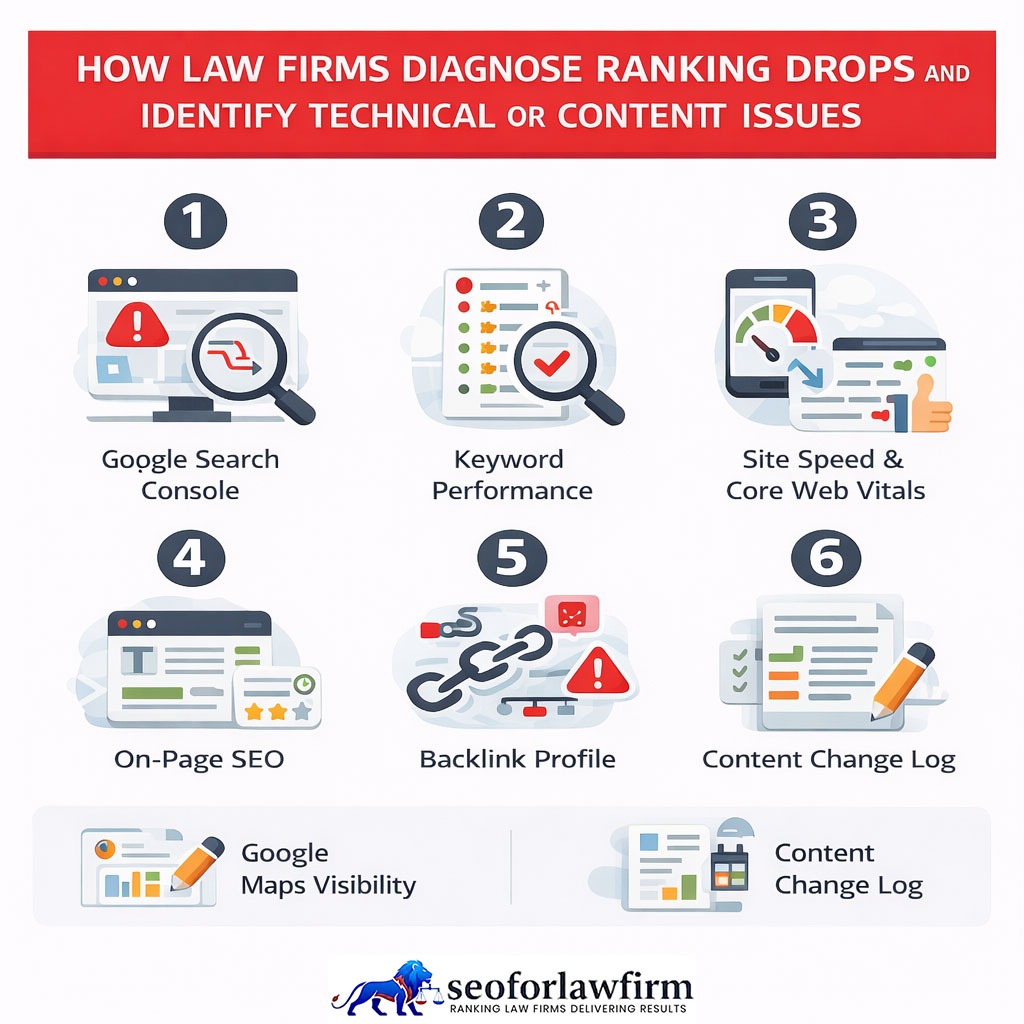
Law firms should first use Search Console to determine which pages, queries, devices, countries, and search types account for the decline.
Listed below are the 7 Search Console checks law firms need to complete.
- Compare current clicks with a comparable previous period.
- Compare impressions.
- Compare average position.
- Sort pages by click difference.
- Review queries attached to the largest page losses.
- Compare mobile and desktop.
- Check Page Indexing, Manual Actions, Security Issues, and URL Inspection.
How Can Law Firms Read Search Console Ranking Patterns?
Law firms can read Search Console ranking patterns by separating changes in impressions, clicks, and average position instead of treating all traffic losses as the same event.
The table below shows common diagnostic patterns.
| Search Console Pattern | Possible Explanation |
| Impressions ↓, position ↓ sharply | Ranking loss or indexing change |
| Impressions stable, clicks ↓ | Result presentation, CTR, AI/SERP composition |
| Impressions ↓, position stable | Search demand/query mix |
| Clicks ↓ and affected URLs disappear | Indexing/technical problem |
| 1 directory falls | Template or content-cluster issue |
| Entire domain falls during core update | Broad reassessment or technical issue |
| Mobile only falls | Mobile/template/rendering issue |
| Organic stable, Maps falls | Local visibility problem |
| AI impressions change, organic stable | Generative AI visibility change |
How Should Law Firms Diagnose Google Maps Ranking Drops?
Law firms diagnose Google Maps ranking drops by separating geographic variation from genuine market-wide visibility loss.
Listed below are the 8 local checks law firms need to complete.
- Run the same keyword across a consistent geographic grid.
- Compare the same grid with an earlier period.
- Check the firm’s Business Profile.
- Verify address and telephone information.
- Review categories and services.
- Compare reviews with local competitors.
- Check profile verification and duplicates.
- Review website and directory business information.
Does NAP Consistency Fix Ranking Fluctuations?
No, NAP consistency does not guarantee recovery from an organic or local ranking decline. Accurate name, address, and phone information helps Google and users identify the correct law firm entity across websites, directories, and Business Profiles.
Law firms should correct incorrect addresses, old telephone numbers, former firm names, closed office locations, duplicate listings, and inaccurate attorney affiliations. NAP corrections reduce business-data inconsistencies and user confusion, but they should not be treated as a guaranteed fix for Map Pack or organic ranking fluctuations.
How Should Law Firms Review E-E-A-T After a Ranking Drop?
Law firms should review E-E-A-T through tangible evidence of legal experience, expertise, authorship, accuracy, sourcing, and trust rather than trying to optimize an imaginary E-E-A-T score.
Listed below are the 8 E-E-A-T-related checks law firms need to review.
- Identify the attorney author or reviewer.
- Link the attorney to a complete biography.
- State relevant bar jurisdictions.
- State relevant practice experience.
- Cite authoritative legal sources where needed.
- Verify legal facts and deadlines.
- Remove fabricated studies or unsupported claims.
- Update outdated jurisdiction-specific information.
Clear authorship and background information help users evaluate who created the content, while accurate bylines strengthen transparency where readers expect identifiable authorship.
Should Law Firms Add More Content After a Ranking Drop?
No, law firms should not add more content after a ranking drop unless the affected page lacks information needed to satisfy the legal search intent. There is no preferred word count for search performance, and adding or removing large amounts of content solely to make a page appear fresh does not improve content quality.
Useful additions include missing legal elements, jurisdictional requirements, statutory deadlines, evidence requirements, client decision criteria, local procedures, attorney observations, original data, examples, and primary-source citations. Generic definitions, repetitive FAQs, and unnecessary word-count expansion add little value when competing pages already cover the same information. Law firms should improve the specific information gap that weakens the page rather than increase content length without a clear user need.
Should Law Firms Change Site Architecture During Temporary Volatility?
No, law firms should not make major site-architecture changes solely because a small temporary ranking fluctuation appears during or immediately after a Google update. Google recommends avoiding drastic changes after minor position losses and waiting until a core-update rollout finishes before conducting the main analysis.
Architecture changes require stronger evidence, such as orphaned practice pages, broken navigation, incorrect canonicalization, failed migration redirects, indexation blocks, or duplicate URL systems. A minor ranking change alone does not justify restructuring the website. Law firms should first confirm whether the decline reflects a genuine structural problem before changing navigation, hierarchy, URLs, or internal linking.
How Long Should Law Firms Wait Before Reacting to a Core Update?
Law firms should usually wait about 1–2 weeks after a confirmed core update finishes before conducting the main before-and-after Search Console analysis. Google recommends waiting until the rollout completes and then allowing at least one full week before comparing performance periods. Known technical failures remain an exception, so a noindex directive, server outage, broken migration, manual action, or security problem requires immediate correction. The 1–2 week waiting period applies to algorithmic analysis rather than confirmed technical damage.
How Long Does Google Ranking Recovery Take?
Google ranking recovery can take about 1 week to 6 months after a law firm makes meaningful improvements. Some changes affect search performance within days or weeks, while broader site-level reassessment requires several months. Recovery time depends on the cause of the ranking loss, crawl frequency, indexation, scope of changes, site size, content quality, competitor activity, search demand, and changes within Google’s ranking systems.
Law firms do not always need to wait for the next named core update because smaller ranking-system changes occur continuously. No SEO provider can guarantee recovery within a fixed 30-, 60-, or 90-day period.
How Should Law Firms Improve Pages After a Large Core-Update Drop?
Law firms should improve affected pages by making them more accurate, useful, original, trustworthy, and complete for the exact legal intent they serve.
Listed below are the 10 page improvements law firms should prioritize when evidence supports them.
- Correct outdated legal information.
- Add jurisdiction-specific context.
- Identify attorney authors or reviewers.
- Add primary legal sources.
- Remove unsupported claims.
- Add original attorney observations.
- Cover missing client decision questions.
- Remove irrelevant sections.
- Improve internal links to related services and resources.
- Improve usability without sacrificing legal depth.
How Should Law Firms Handle AI-Generated Content After Ranking Losses?
Law firms should evaluate AI-assisted content based on accuracy, originality, usefulness, legal review, and purpose rather than assume AI use itself caused the ranking loss. Google does not prohibit generative AI assistance, but its scaled-content abuse policy applies when large amounts of content are created primarily to manipulate rankings without providing user value.
Law firms should review AI-assisted pages for fabricated cases, invented statutes, false citations, incorrect jurisdictions, hallucinated deadlines, generic city substitutions, rewritten competitor content, missing attorney review, and duplicate search intent. Human review does not make weak content useful unless the final page provides substantive, accurate, and original legal value.
How Do Core Algorithm Updates Influence Website Visibility?
Core algorithm updates influence website visibility by reevaluating how Google measures a site’s content quality, topical authority, and user experience, which can lead to sudden ranking gains or losses. These updates prioritize strong E-E-A-T (Experience, Expertise, Authoritativeness, Trustworthiness) signals, relevant backlinks, and a positive page experience while demoting thin, duplicated, or outdated legal content.
For law firms, the impact appears in search traffic, impressions, and Google Maps visibility, where even minor quality or speed issues can shift rankings noticeably. A guide by Google, titled “Core Web Vitals & SEO” in 2024, confirms that Largest Contentful Paint (LCP), Interaction to Next Paint (INP), and Cumulative Layout Shift (CLS) are part of the Page Experience signals used in ranking.
Since each update changes how Google interprets intent and credibility, law firms must regularly audit site structure, update content depth, and monitor technical performance to sustain high visibility across organic, featured, and local results.
What Metrics Should Law Firms Monitor During Ranking Volatility?
Law firms should monitor impressions, clicks, affected landing pages, affected queries, geographic visibility, conversions, consultations, and retained cases rather than rankings alone.
Listed below are the 10 measurements law firms need to track.
- Organic impressions
- Organic clicks
- Average position
- Affected queries
- Affected landing pages
- Local grid visibility
- AI search impressions
- Qualified calls and forms
- Consultations
- Retained matters
A complete law firm SEO results tracking system connects search visibility with client acquisition rather than treating a ranking screenshot as the final business outcome.
How Can Law Firms Distinguish Ranking Loss From Traffic Loss?
Law firms distinguish ranking loss from traffic loss by comparing impressions, clicks, and average position for the same pages and queries across equivalent periods. Different metric patterns point to ranking loss, demand changes, SERP changes, or local visibility problems.
The table below shows how to interpret common performance patterns.
| Scenario | Position | Impressions | Clicks | Likely Cause |
| Real ranking decline | 4 → 21 | ↓ | ↓ | Organic ranking loss |
| Demand decline | 3 → 3 | ↓ | ↓ | Lower search demand or query-mix change |
| Result-page change | 3 → 3 | Stable | ↓ | SERP features, snippets, ads, Local Pack, or AI changes |
| Local-only decline | Organic stable | Maps coverage ↓ | Varies | Local SEO issue rather than sitewide organic loss |
How Often Should Law Firms Monitor Google Rankings?
Law firms should monitor priority Google rankings weekly, with daily monitoring reserved for severe technical or indexing problems.
Listed below are the six monitoring intervals law firms must use to track Google rankings.
- Daily alerts: Site outages, security, manual actions, severe indexing failures
- Weekly: Priority organic and local visibility trends
- After deployments: Technical and indexing checks
- After confirmed updates: Analysis after rollout completion
- Monthly: Business-performance reporting
- Quarterly: Broader content, technical, backlink, and local audits
Website owners do not need to check Search Console every day under normal conditions because Search Console sends alerts when it detects certain new problems.
What Should Law Firms Avoid During Ranking Volatility?
Law firms should avoid making broad, unsupported SEO changes before identifying the actual source of the ranking or traffic decline.
Listed below are the 10 reactions law firms should avoid.
- Rewriting every practice page after a 2-position drop.
- Deleting hundreds of pages during a core-update rollout.
- Disavowing every backlink labeled toxic by a third-party tool.
- Adding exact-match keywords everywhere.
- Buying new links to “replace authority.”
- Changing URLs without a migration plan.
- Creating dozens of city pages.
- Adding schema solely to recover organic rankings.
- Treating bounce rate as a confirmed direct ranking factor.
- Assuming every traffic drop came from the latest core update.
Google recommends meaningful, user-focused changes rather than quick fixes based on rumors about individual ranking factors.
