

Law firms commonly use 2%–15% of gross revenue as a practical marketing-budget range, with 5%–10% serving as a useful starting range for firms pursuing steady growth. Clio cites 2%–5% guidance from law firm management consultants and 7%–8% guidance attributed to the U.S. Small Business Administration, whereas the American Bar Association gives 5%–10% of annual revenue as a general marketing guideline.
Law firms operating in maintenance mode generally plan around 2%–5% of gross revenue, concentrating spending on website upkeep, local listings, referrals, networking, reputation management, and established channels that replace normal client attrition.
Law firms operating in growth mode generally plan around 5%–12% of gross revenue, giving the firm enough capital for recurring SEO, paid search, Local Services Ads where available, content production, referral development, and intake tracking.
Law firms pursuing aggressive market expansion may invest 15%–30% of gross revenue, especially in high-value consumer practices and competitive metropolitan markets. ABA guidance on growth-stage firms discusses investments of 10% or more and expansion-stage investments of 20% or more, and an ABA contributor operating a hyper-growth law firm reported spending 25% of gross revenue on paid marketing.
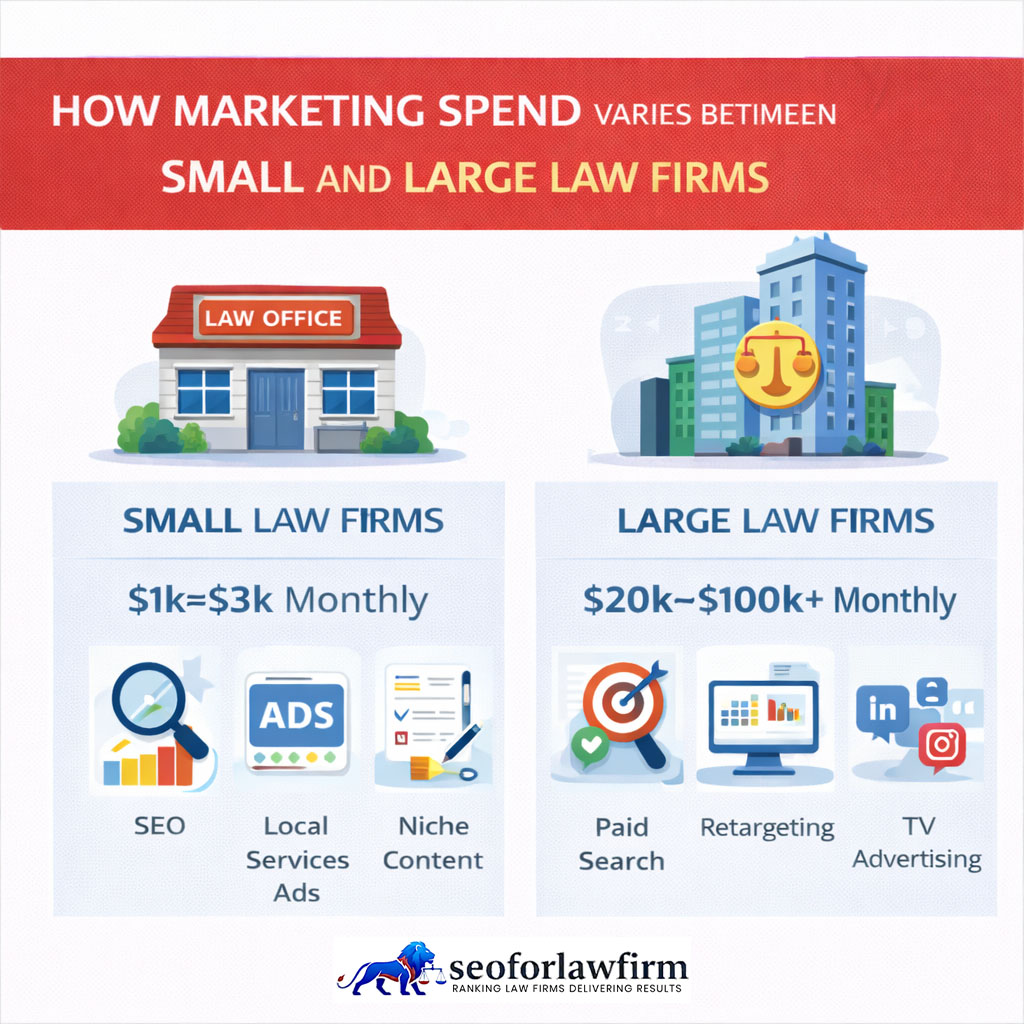
For monthly planning, solo and small firms in lower-cost markets begin around $1,000–$3,000 per month, midsize firms model $5,000–$9,000 per month, and larger firms competing aggressively require $20,000–$100,000+ per month. These figures work as planning ranges rather than universal industry averages because practice area, city, case economics, existing brand demand, and growth targets change the amount required.
A practical starting channel model assigns about 45% to SEO, 30% to PPC or paid search, 15% to local events and traditional marketing, and 10% to social media and content distribution. This split represents a budgeting framework rather than a fixed industry rule. A law firm needs to reallocate money according to qualified lead cost, retained-client cost, case value, intake capacity, and revenue produced by each channel.
A law firm marketing budget works best when the firm defines the desired growth rate first and then calculates how much profitable client acquisition that goal requires. ABA guidance recommends connecting marketing and finance rather than treating lead generation as an isolated marketing objective.
Table of Contents
- Article sections will appear here.
How Much Should a Law Firm Spend on Marketing?
A law firm should generally budget 5%–10% of gross revenue for steady marketing growth, with 2%–5% fitting maintenance-oriented firms and 15%–30% fitting aggressive expansion strategies when case economics support the investment.
A law firm generating $500,000 annually has different acquisition economics from a personal injury firm generating $10 million. A referral-driven estate planning practice also has a different cost structure from a personal injury firm bidding for high-intent metropolitan searches.
The table below shows how different marketing percentages translate into annual and monthly budgets for a law firm generating $1 million in gross annual revenue.
| Marketing Level | Revenue Percentage | Annual Budget | Monthly Budget | Primary Objective |
| Maintenance | 2% | $20,000 | $1,667 | Preserve visibility and replace normal attrition |
| Maintenance / Moderate Growth | 5% | $50,000 | $4,167 | Maintain core SEO, referrals, local presence, and selective advertising |
| Steady Growth | 8% | $80,000 | $6,667 | Expand SEO, paid search, content, reviews, and referral development |
| Strong Growth | 10% | $100,000 | $8,333 | Increase qualified client acquisition across several channels |
| Aggressive Growth | 15% | $150,000 | $12,500 | Pursue greater market share in competitive practice areas |
| Expansion | 20% | $200,000 | $16,667 | Enter new markets or scale proven acquisition channels |
| Hyper-Growth | 25% | $250,000 | $20,833 | Pursue aggressive acquisition where margins and intake capacity support the spend |
A study of official financial guidelines by the American Bar Association titled “How to Align Marketing and Finances for Firm Growth” in 2025 found that firms investing in steady growth allocate 10% or more of revenue, while firms aiming for major market expansion invest 20% or more of revenue.
What Percentage of Revenue Should a Law Firm Allocate to Marketing?
A law firm should allocate the percentage of gross revenue that matches the firm’s growth stage, case economics, competitive market, and available intake capacity.
Listed below are the 4 law firm marketing-budget levels based on growth objectives.
- Maintenance Mode — 2%–5%: Established firms with stable referral networks use this range to maintain the website, local visibility, reviews, directories, professional networking, and proven acquisition channels.
- Growth Mode — 5%–12%: Firms seeking consistent increases in qualified cases use this range to fund SEO, paid search, content, LSAs where eligible, referral development, and conversion tracking.
- Aggressive Growth Mode — 15%–20%: Firms entering competitive markets, expanding practice areas, or scaling high-value consumer cases use larger budgets to increase search visibility and lead volume.
- Market Expansion Mode — 20%–30%: Firms pursuing significant market share use this level only when client value, gross margins, intake systems, attorney capacity, and cash flow support the investment.
A study of financial frameworks compiled by Clio titled “How to Create a Marketing Budget for Small Law Firms” in 2025/2026 found that law firm management consultants reference a 2%–5% revenue allocation, the U.S. Small Business Administration recommends a 7%–8% budget for small businesses, the American Bar Association outlines a broader 5%–10% starting baseline, and ultimately confirms that no single percentage fits every legal practice.
How Much Do Lawyers Spend on Advertising?
Lawyers can spend from approximately $1,000 per month to more than $100,000 per month on advertising and marketing, depending on firm revenue, practice area, geographic competition, and growth targets.
Listed below are the 17 expenses a law firm marketing budget includes.
- SEO.
- Google Ads.
- Local Services Ads.
- Website development.
- Content.
- Video.
- Social media.
- Referral programs.
- Directory profiles.
- Sponsorships.
- Events.
- Television.
- Radio.
- Billboards.
- Public relations.
- Marketing software.
- Marketing staff or agency fees.
An advertising budget usually refers more narrowly to purchased media such as Google Ads, LSAs, social advertising, television, radio, print, or billboards.
An ABA article discussing law firm marketing budgets specifically recommends accounting for every marketing activity, including Google Ads, television, mailed newsletters, and other paid initiatives.

How Does Marketing Spend Vary by Law Firm Size and Market?
Law firm marketing spend increases as the firm’s revenue, geographic reach, competitive pressure, client-acquisition target, and capacity to accept new cases increase.
The table below shows practical monthly planning ranges for different law firm sizes and market conditions.
| Law Firm Profile | Monthly Planning Range | Main Marketing Focus |
| Solo lawyer in a small market | $1,000–$3,000 | Local SEO, GBP, reviews, referrals, focused paid campaigns |
| Small firm pursuing growth | $3,000–$5,000 | SEO, content, local search, PPC testing, referral development |
| Midsize firm in a regional market | $5,000–$9,000 | SEO, paid search, LSAs, content, reviews, conversion optimization |
| Established metropolitan firm | $10,000–$20,000 | Competitive SEO, PPC, local campaigns, PR, remarketing |
| Large consumer-facing firm | $20,000–$50,000+ | Multi-channel acquisition across several practice areas or markets |
| Aggressive high-competition firm | $50,000–$100,000+ | Search, television, outdoor media, digital campaigns, intake scaling |
How Much Should Personal Injury Law Firms Spend on Marketing?
Personal injury law firms pursuing aggressive growth allocate 15%–30% of gross revenue to marketing when expected case value, margins, cash flow, and intake capacity justify the investment.
Listed below are the 10 marketing channels personal injury law firms commonly fund when pursuing aggressive growth.
- Google Ads.
- Local Services Ads.
- Organic search.
- Google Maps.
- Television.
- Billboards.
- Referral networks.
- Social advertising.
- Local sponsorships.
- Digital PR.
A study of operational budgeting by Jordan Ostroff from the American Bar Association GPSolo titled “Creating a Marketing Budget for Your Law Firm” in 2024 found that an agency contributor operating in hyper-aggressive growth mode allocates up to 25 percent of their gross revenue toward paid marketing channels.
How Much Should Small Law Firms Spend on Marketing?
Small law firms commonly use 2%–8% of gross revenue as an initial budgeting range, with the lower end serving established referral-driven practices and the upper end supporting stronger client acquisition.
A study of financial frameworks compiled by Clio titled “How to Create a Marketing Budget for Small Law Firms” in 2025/2026 found that law firm management consultants commonly recommend a 2%–5% revenue allocation, and the same Clio guidance cites a 7%–8% marketing budget recommendation from the U.S. Small Business Administration (SBA).
Listed below are 5 priorities for a small law firm marketing budget.
- Owned website assets: Build complete practice-area pages, attorney biographies, location information, and conversion paths.
- Local search: Maintain Google Business Profile, reviews, office information, and relevant legal-directory profiles.
- SEO: Build search visibility around profitable services and genuine geographic markets.
- Referral development: Maintain relationships with previous clients, attorneys, accountants, medical professionals, financial advisors, and community organizations where relevant.
- Selective advertising: Test paid search or LSAs against clear CPL, consultation, and retained-client targets.
A focused approach to managing a small law firm marketing budget helps smaller practices concentrate limited capital on the services and locations that generate profitable matters.
How Should Law Firms Divide Their Marketing Budget?
Law firms should divide their marketing budget according to the expected role of each channel in generating visibility, qualified inquiries, retained cases, and long-term demand.
A useful starting framework assigns 45% to SEO, 30% to PPC, 15% to traditional or local marketing, and 10% to social media and content distribution.
The table below shows how a $10,000 monthly law firm marketing budget is divided using that planning model.
| Channel | Starting Allocation | $10,000 Monthly Example | Primary Purpose |
| SEO | 45% | $4,500 | Build organic and local search visibility |
| PPC / Paid Search | 30% | $3,000 | Generate immediate high-intent inquiries |
| Traditional / Local Marketing | 15% | $1,500 | Develop local awareness, referrals, sponsorships, or offline exposure |
| Social Media / Content Distribution | 10% | $1,000 | Build professional visibility and distribute useful content |
| Total | 100% | $10,000 |
ABA guidance recommends distributing marketing resources across channels that reach the intended audience and then reallocating money when performance evidence shows that another channel generates better business.
How Much of a Law Firm Marketing Budget Should Go to SEO?
A law firm uses approximately 35%–50% of the marketing budget for SEO when organic and local search form major client-acquisition channels.
Listed below are the 12 services a law firm SEO budget includes.
- Technical SEO.
- Practice-area content.
- Location content.
- Attorney biographies.
- Content updates.
- Internal linking.
- Link acquisition.
- Digital PR.
- Google Business Profile work.
- Citation management.
- Reporting.
- Conversion optimization.
A firm with an established website and strong search visibility needs less foundational work than a new practice competing for “personal injury lawyer” queries in a major metropolitan area.
SEO also requires a longer evaluation window than paid search. The budget needs enough continuity for content publication, technical implementation, link acquisition, indexing, ranking changes, and conversion measurement.
How Much of a Law Firm Marketing Budget Should Go to PPC?
A law firm allocates approximately 20%–40% of its marketing budget to PPC when immediate lead generation and measurable search demand justify the cost.
Listed below are the 10 factors law firms must consider when allocating a marketing budget to PPC.
- Keyword cost.
- Search volume.
- Geographic targeting.
- Practice-area value.
- Landing-page conversion rate.
- Qualified-lead rate.
- Consultation rate.
- Retained-client rate.
- Average case value.
- Gross margin.
A $100 click that produces profitable retained matters outperforms a $20 click that produces unqualified inquiries.
Law firms using PPC advertising for lawyers need to connect ad spend with signed clients rather than treating impressions, clicks, or raw leads as the final measure.
How Much Should Law Firms Spend on Local Advertising?
Law firms allocate approximately 10%–20% of the marketing budget to local advertising, sponsorships, community activity, and local client-acquisition channels when geographic visibility directly affects new matters.
Listed below are the 9 local advertising and client-acquisition channels a law firm marketing budget includes.
- Local Services Ads
- Community sponsorships.
- Local events.
- Bar association events.
- Regional media.
- Local directories.
- Reputation programs.
- Community partnerships.
- Geographic landing-page campaigns.
What Factors Determine a Law Firm Marketing Budget?
A law firm marketing budget is determined by growth goals, practice-area economics, market competition, location, existing visibility, client value, conversion rates, and intake capacity.
Listed below are the 8 factors that determine how much a law firm needs to spend on marketing.
- Growth Goal: A firm maintaining current revenue needs less acquisition investment than a firm targeting 30% annual growth.
- Practice Area: Personal injury, criminal defense, family law, estate planning, corporate law, and immigration have different client values and acquisition channels.
- Geographic Competition: Major metropolitan markets usually require greater visibility investment than smaller markets.
- Average Client Value: Higher-value matters support a higher sustainable acquisition cost.
- Gross Margin: Revenue does not equal profit. Marketing spend needs to remain compatible with case-delivery costs and overhead.
- Current Market Position: An established brand with strong referrals, organic visibility, and reviews begins from a different position than a new law firm.
- Intake Conversion Rate: A firm converting 30% of qualified consultations supports different lead economics from a firm converting 5%.
- Attorney Capacity: Marketing spend becomes a waste when the firm lacks staff, attorneys, or processes to serve additional matters.
ABA guidance recommends defining the desired growth outcome before setting the budget and connecting marketing investment directly with firm financial performance.
A broader law firm marketing budget planning process needs to connect marketing expenditure with revenue, profitability, staffing, and cash flow.
How Can a Law Firm Calculate a Marketing Budget From Growth Goals?
A law firm can calculate a marketing budget by multiplying the target number of new retained clients by the target client acquisition cost and then testing that investment against expected revenue, gross margin, attorney capacity, intake capacity, and cash flow. The formula is Required Marketing Budget = Target New Clients × Target Client Acquisition Cost. A family law firm targeting 60 additional retained clients at a $1,500 acquisition cost needs a $90,000 annual marketing budget. The same budget equals $7,500 per month when divided across 12 months.
The firm must then compare the $90,000 investment with expected client revenue, gross margin, operational capacity, and cash-flow requirements to determine whether the growth target produces acceptable economics. Revenue percentage serves as a financial guardrail, while client-acquisition cost connects marketing spend with the number of retained clients required to reach the growth goal.
How Should Law Firms Calculate Client Acquisition Cost?
Law firms calculate client acquisition cost by dividing total marketing and sales expenditure by the number of new retained clients attributed to that expenditure. The formula is CAC = Marketing and Sales Cost ÷ New Retained Clients. A law firm spending $20,000 in one month and retaining 10 new clients produces a client acquisition cost of $2,000.
The firm must compare that $2,000 CAC with the gross profit generated by the acquired matters because the same acquisition cost is profitable for a case producing $15,000 in gross profit and unprofitable for a case producing only $1,500. Client acquisition cost therefore becomes meaningful only when the firm connects marketing spend with retained-client value, case profitability, and overall growth economics.
How Should Law Firms Calculate Cost per Lead?
Law firms calculate cost per lead by dividing total campaign spending by the number of leads generated from that campaign. The formula is CPL = Marketing Spend ÷ Leads. A law firm that spends $10,000 on Google Ads and generates 50 leads produces a $200 cost per lead. Raw CPL does not establish campaign quality because 50 inquiries do not equal 50 qualified prospective clients.
A stronger measurement sequence follows Ad Spend → Leads → Qualified Leads → Consultations → Retained Clients → Revenue. A campaign with a higher CPL still produces better financial performance when the campaign generates a stronger qualified-lead rate, consultation rate, retained-client rate, and revenue per matter.
Is SEO or PPC More Cost-Effective for Law Firms?
No, SEO is not universally more cost-effective than PPC for law firms because cost-effectiveness depends on the firm’s goals, market, practice area, competition, and client-acquisition economics. SEO requires investment in content, technical implementation, local optimization, link acquisition, and maintenance, but successful organic pages continue generating inquiries without a direct charge for each click.
PPC purchases immediate visibility and gives the firm stronger control over keywords, geography, scheduling, budget, and landing pages, but paid traffic largely stops when advertising spend stops. SEO builds longer-term search assets, while PPC captures immediate demand and produces faster testing data. Law firms must compare both channels through client acquisition cost, qualified leads, retained matters, revenue, and gross profit.
How Can Law Firms Maximize Marketing ROI?
Law firms maximize marketing ROI by tracking each channel through qualified leads, consultations, retained matters, gross profit, and client acquisition cost.
Listed below are the 8 actions law firms use to improve marketing ROI.
- Track every lead source: Record whether each inquiry originated from organic search, Google Ads, LSAs, referrals, directories, social media, events, or another source.
- Measure qualified leads: Remove spam, vendors, job seekers, existing clients, unsupported practice areas, and out-of-jurisdiction inquiries from acquisition reporting.
- Track consultation conversion: Record booked consultations, attended consultations, and retained-client outcomes.
- Calculate CAC: Compare marketing spend with the number of signed clients.
- Track revenue by source: Connect each retained matter with the marketing channel that produced or assisted the acquisition.
- Test landing pages and campaigns: Compare messaging, calls to action, forms, targeting, and offers with actual retained-client performance.
- Reallocate the budget: Move money from persistently unprofitable campaigns toward channels with stronger case economics.
- Review advertising compliance: Include attorney advertising review in campaign deployment where state bar rules apply.
ABA guidance recommends monitoring marketing spending and moving resources toward channels that produce stronger business outcomes.
A structured set of law firm marketing KPIs keeps budget decisions connected to client intake instead of vanity metrics.

What Marketing Metrics Should Law Firms Track?
Law firms should track marketing spend, leads, qualified leads, cost per lead, cost per qualified lead, client acquisition cost, revenue by acquisition source, and marketing ROI to connect marketing expenditure with client acquisition and financial return.
Listed below are the 10 marketing metrics law firms must track.
- Marketing spend.
- Leads.
- Qualified leads.
- Cost per lead.
- Cost per qualified lead.
- Consultation booking rate.
- Consultation-to-client rate.
- Client acquisition cost.
- Revenue by acquisition source.
- Marketing return on investment.
The SBA advises businesses to compare marketing and sales costs with the revenue generated and to update the marketing plan at least annually.
What Is a Good Marketing ROI for a Law Firm?
A good law firm marketing ROI generates enough gross profit from retained matters to cover marketing costs and meet the firm’s required profit margin. The formula is Marketing ROI = ((Gross Profit Attributed to Marketing − Marketing Cost) ÷ Marketing Cost) × 100.
A law firm that spends $100,000 on marketing and attributes $300,000 in gross profit to that investment produces a 200% marketing ROI. Under this simplified attribution model, the firm generates $2 in profit above marketing cost for every $1 invested. Gross profit provides a stronger financial measure than gross case revenue because the firm still incurs attorney time, staff costs, case expenses, and other fulfillment costs after acquiring the client.
What Are Common Law Firm Marketing Budget Mistakes?
Common law firm marketing budget mistakes include setting arbitrary percentages, spending without attribution, underfunding successful channels, and evaluating marketing through raw lead volume rather than profitable retained clients.
Listed below are the 8 law firm marketing budget mistakes that reduce financial performance.
- Setting the budget from an industry percentage alone: Revenue percentage provides a reference point but does not replace client economics.
- Overspending on PPC without retained-client tracking: Clicks and form submissions do not prove profitability.
- Underfunding campaigns: A campaign that lacks enough budget to collect meaningful data produces weak conclusions.
- Ignoring intake performance: Slow phone response, weak qualification, and poor consultation follow-up waste marketing spend.
- Treating all leads equally: Unqualified calls distort CPL and conversion reporting.
- Ignoring organic and referral assets: Excessive dependence on rented paid media increases acquisition risk.
- Changing strategy too quickly: Some channels require enough time and volume to produce meaningful performance data. ABA guidance specifically cautions firms against abandoning new channels before sufficient evidence develops.
- Ignoring cash flow: Contingency-fee practices incur acquisition and case costs long before revenue arrives.
How Often Should a Law Firm Review Its Marketing Budget?
A law firm should monitor marketing performance monthly, review channel allocation quarterly, and rebuild the full marketing budget at least annually.
Listed below are the 3 recommended budget-review cycles for law firms.
- Monthly: Review spend, leads, qualified leads, consultations, CAC, campaign pacing, and intake problems.
- Quarterly: Reallocate money among SEO, PPC, LSAs, referrals, events, content, and other channels according to financial performance.
- Annually: Reset revenue targets, growth goals, practice-area priorities, geographic markets, staffing capacity, and full-year marketing investment.
The SBA recommends maintaining the marketing plan on at least an annual basis and consistently measuring marketing cost against generated revenue.
Where Can Law Firms Get Professional Marketing Budget Planning?
SEOForLawFirm is a specialized legal marketing provider that gives law firms structured, data-driven marketing budget planning across SEO, PPC, local campaigns, content, attribution, and client-acquisition measurement. Law firms also obtain professional marketing budget planning from independent marketing consultants, finance or business advisors, fractional marketing leaders, and internal marketing teams. Legal marketing agencies allocate acquisition budgets across marketing channels, independent consultants audit previous spending and build allocation models, finance advisors connect acquisition costs with revenue and gross margin, and fractional or in-house marketing leaders manage vendors, testing, reporting, and budget adjustments throughout the year.
A qualified provider must analyze marketing spend, lead sources, qualified leads, consultation outcomes, retained-client data, case revenue, gross profit, and practice-area capacity before recommending channel allocations. The marketing budget planning process must connect each marketing dollar with client acquisition cost, retained-matter value, available operational capacity, and expected financial return. ABA guidance on marketing and finance supports integrating acquisition data with financial information so law firms invest in client sources that support profitable long-term growth.