
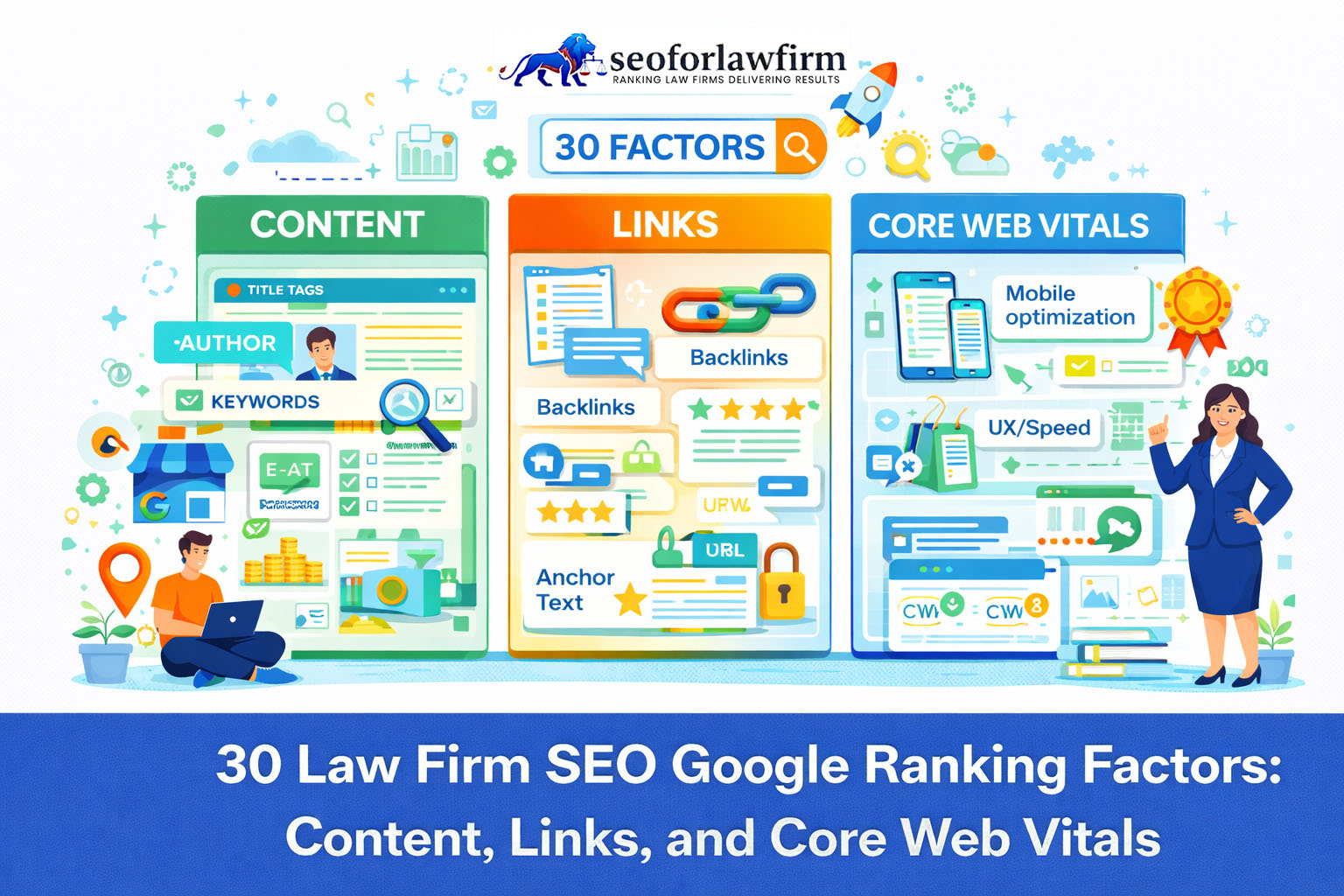
Law firm SEO ranking factors include search-intent alignment, accurate legal content, attorney trust evidence, authoritative backlinks, Google Business Profile relevance, client reviews, local proximity, Core Web Vitals, mobile usability, internal links, and technical accessibility. Google assesses these signals through automated ranking systems that evaluate individual pages and broader site patterns.
Google does not publish a fixed list of 200 law firm ranking factors or disclose the percentage assigned to each signal. Search results change according to the query, location, device, page type, competition, freshness requirements, and search feature. A factor that carries substantial weight for “personal injury lawyer near me” does not carry the same weight for “how does comparative negligence work in Texas?”
Legal pages also fall within Google’s Your Money or Your Life framework because inaccurate legal information affects safety, financial stability, rights, obligations, and access to justice. Google gives greater weight to signals associated with Experience, Expertise, Authoritativeness, and Trustworthiness for subjects carrying a high risk of harm. E-E-A-T itself is not one measurable ranking factor. Google’s systems use several signals that identify content displaying those qualities.
A study by Margaret Hagan and Yue Li published via the SSRN Research Network titled “Are Search Engines Effective Brokers of Legal Information?” in 2020 established an automated audit protocol to evaluate hundreds of search queries, finding that search results frequently supplied generic information, incorrect jurisdictions, and limited access to actionable local legal resources. The findings strongly support the implementation of jurisdiction-specific law, local court information, attorney review, and clear, practical next steps on law firm web pages.
The main Google ranking factors for law firms are legal-content relevance, reliable information, attorney authority, backlinks, local prominence, reviews, proximity, page experience, crawlability, and compliance with Google Search policies.
Listed below are the 30 law firm SEO factors and supporting signals covered in this guide.
- 1. Search Intent Alignment: Search intent alignment matches each page with the legal question, service, location, or action the user seeks. A page should serve one primary intent and support related needs without combining unrelated topics.
- 2. Helpful and Original Content: Helpful content provides accurate answers, practical guidance, examples, procedures, and evidence that serve the reader’s legal need. Original material differentiates the page from competitors that repeat the same definitions.
- 3. Legal Accuracy and Jurisdictional Relevance: Legal content should identify the applicable state, court, agency, deadline, rule, and procedure. Jurisdictional accuracy prevents readers from applying laws from another state or legal system.
- 4. Attorney Authorship and Reviewer Credentials: Each substantive legal page should identify the attorney author or reviewer and explain the attorney’s qualifications. Bar admissions, practice focus, biography information, and review dates establish accountability.
- 5. First-Hand Legal Experience: First-hand experience includes attorney observations about evidence problems, procedural mistakes, insurer conduct, court expectations, and client preparation. Specific operational knowledge provides more value than generic claims about experience.
- 6. Practice-Area Topical Coverage: Practice-area coverage explains the legal service, case types, governing rules, evidence, procedures, deadlines, risks, fees, and possible outcomes. Supporting pages should answer narrower questions connected to the main service.
- 7. Information Gain and Original Research: Information gain adds legal details, local procedures, data, tools, examples, or exceptions absent from competing pages. Original research may use court records, government datasets, surveys, or anonymized firm data with a transparent methodology.
- 8. Title Tags and Main Headings: Title tags and H1 headings identify the page’s main legal service, location, or question. Each element should remain descriptive, accurate, and free from repeated keyword variations.
- 9. URL Structure and Website Hierarchy: URL structure organizes practice areas, locations, attorneys, and resources into understandable paths. A logical hierarchy helps users and search systems identify each page’s relationship with the wider website.
- 10. Internal Linking and Anchor Text: Internal links connect related legal services, attorney biographies, office pages, guides, evidence resources, and contact pages. Descriptive anchor text should identify the destination and explain why the linked page supports the reader’s next task.
- 11. Editorial Backlink Quality: Editorial backlinks occur when independent publishers reference a law firm’s useful content, research, tools, or attorney commentary. Links from relevant and reputable sources provide stronger contextual support than paid or unrelated placements.
- 12. Referring-Domain Quality and Diversity: Referring domains are the unique websites linking to the law firm. A varied group of relevant legal, academic, governmental, professional, media, and local sources provides broader corroboration than repeated links from one website.
- 13. Brand Prominence and Entity Corroboration: Brand prominence develops when independent sources consistently reference the same firm, attorneys, services, credentials, offices, and jurisdictions. Consistent third-party information helps search systems confirm the law firm’s identity and public relevance.
- 14. Google Business Profile Accuracy: Google Business Profile should display the law firm’s genuine name, office address, phone number, website, hours, photographs, and public identity. The profile should match the corresponding office page and other authoritative business records.
- 15. Google Business Profile Categories and Services: The primary category should represent the office’s dominant legal service, and secondary categories should reflect genuine services. The service section should use accurate client-recognizable language that matches the website.
- 16. Client Reviews and Ratings: Client reviews provide independent accounts of communication, responsiveness, professionalism, and service. Law firms should request honest reviews without incentives, review gating, rating instructions, or disclosure of confidential information.
- 17. Proximity to the Searcher: Proximity measures the distance between the searcher and the verified law office. Local optimization strengthens relevance and prominence but does not change the office’s physical location.
- 18. NAP Accuracy and Local Citations: NAP accuracy maintains consistent firm names, addresses, and phone numbers across websites, maps, directories, bar records, and business platforms. Former addresses, disconnected numbers, duplicate profiles, and outdated firm names require correction.
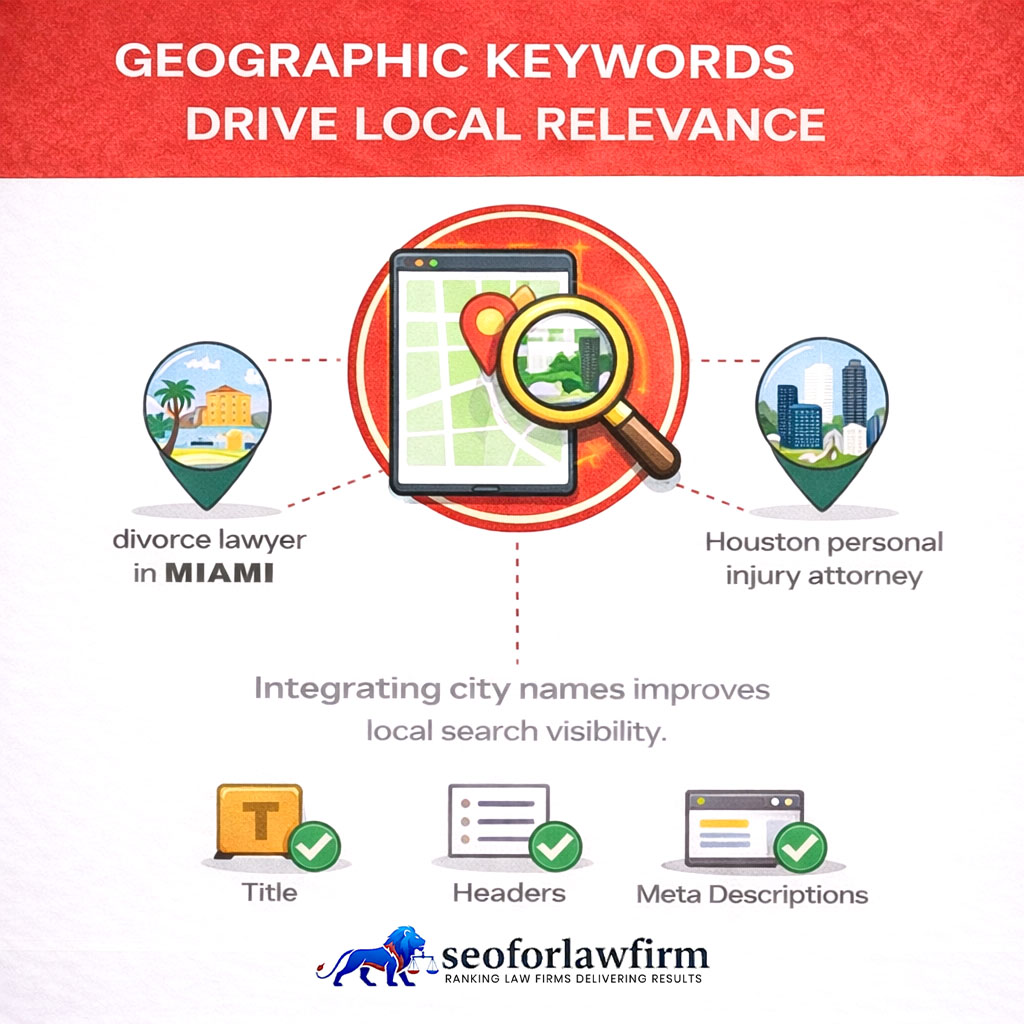
- 19. Localized Office and Practice Pages: Localized pages connect legal services with genuine offices, attorneys, courts, jurisdictions, procedures, and geographic markets. Each page should provide distinct local information rather than repeat generic content with a different city name.
- 20. Core Web Vitals: Core Web Vitals measure loading performance, interaction responsiveness, and visual stability. Faster and more stable pages help visitors access legal information and contact options without delays or layout movement.
- 21. Mobile Usability and Content Parity: Mobile pages should provide readable text, large tap targets, stable navigation, click-to-call controls, short forms, and fast loading. Mobile and desktop versions should contain the same primary content, links, structured data, and trust signals.
- 22. HTTPS and Website Security: HTTPS encrypts information transmitted between website visitors and the law firm. Secure forms, access controls, software updates, backups, and limited data collection protect sensitive legal inquiries.
- 23. Crawlable Navigation and Links: Crawlable navigation allows search systems to discover practice-area pages, office pages, attorney profiles, and supporting resources. Important links should use accessible HTML and should not depend on interactions that search crawlers cannot process.
- 24. Indexability and Robots Controls: Indexability controls determine which pages search engines retain in their indexes. Robots.txt rules, noindex directives, status codes, and rendering settings should allow access to valuable pages and restrict unsuitable URLs.
- 25. Canonicalization: Canonical tags identify the preferred version of duplicate or closely related URLs. Correct canonicalization consolidates page signals and prevents search engines from selecting an unintended version.
- 26. XML Sitemap Accuracy: An XML sitemap should contain current, indexable, canonical URLs that return successful status codes. Obsolete, redirected, duplicate, blocked, and noindex URLs should not remain in the sitemap.
- 27. Structured Data Accuracy: Structured data describes firms, attorneys, offices, services, articles, addresses, and page relationships in a machine-readable format. The markup must match visible content and exclude false offices, unsupported ratings, hidden reviews, or unverified credentials.
- 28. Image, Video, and Accessibility Optimization: Images and videos should use descriptive filenames, alternative text, captions, compressed files, transcripts, and relevant surrounding content. Keyboard navigation, form labels, color contrast, focus states, and screen-reader support improve access for a wider audience.
- 29. Content Maintenance and Factual Freshness: Content maintenance corrects changed laws, deadlines, statistics, links, attorney credentials, office information, and procedures. Update dates should change only after a meaningful factual or legal review.
- 30. Spam-Policy Compliance and Site-Wide Quality: Law firms should avoid scaled low-value content, manipulative links, fake reviews, misleading structured data, doorway pages, and keyword-stuffed business names. Site-wide quality depends on accurate information, legitimate authority, useful pages, and compliance with search and professional rules.
The table below classifies these items according to their primary search function.
| Classification | Examples | Primary Function |
| Content relevance | Search intent, practice-page coverage, legal accuracy, titles, headings | Helps Google match the page with the query |
| Trust and authority | Attorney credentials, original research, backlinks, brand references | Supplies evidence supporting the source and information |
| Local search | Google Business Profile, reviews, proximity, citations, office pages | Connects the firm with a geographic legal search |
| Page experience | Core Web Vitals, mobile usability, security, accessible media | Improves usability and supports Google’s page-experience systems |
| Technical eligibility | Crawlable links, indexability, canonicals, sitemaps | Allows Google to discover, process, and select the correct URL |
| Search presentation | Structured data, titles, snippets, images, video | Helps Google interpret content and determine search-feature eligibility |
| Quality control | Content maintenance, spam compliance, site-wide patterns | Prevents low-value or manipulative patterns from weakening visibility |
| Client conversion | Calls, forms, appointments, intake tracking | Converts search visibility into inquiries and retained matters |
Table of Contents
- Article sections will appear here.
1. Search Intent Alignment
Search intent alignment measures how closely a law firm page answers the legal need expressed in a search query. A law firm keyword-gap analysis assigns each meaningful informational, commercial, transactional, or navigational search need to one primary URL. Google uses language and concept-matching systems to connect queries with relevant pages, even when the page does not contain every exact phrase entered by the searcher. One page rarely satisfies every intent because legal guides, practice-area pages, attorney biographies, office pages, and contact pages serve different stages of the client journey.
Listed below are the 4 main types of legal search intent.
- Informational Intent: Informational intent applies when the searcher needs a legal definition, rule, process, deadline, or evidence explanation. Examples include “What happens after a DUI arrest?” “How long does probate take in California?”, “What evidence proves employment retaliation?”, and “What is comparative negligence?”
- Commercial Investigation: Commercial investigation applies when the searcher compares lawyers, firms, fees, reviews, credentials, or service options before choosing representation. Examples include “Best personal injury lawyer in Dallas,” “Divorce attorney reviews Houston,” “Criminal defense lawyer fees,” and “Estate planning firms near me.”
- Transactional Intent: Transactional intent applies when the searcher is ready to contact, hire, call, or schedule a consultation with a lawyer. Examples include “Hire a truck accident lawyer,” “Book an immigration consultation,” “Criminal defense attorney open now,” and “Personal injury lawyer near me.”
- Navigational Intent: Navigational intent applies when the searcher wants a known attorney, law firm, office, biography, phone number, or client portal. Examples include “Smith Law Firm phone number,” “Maria Jones attorney biography,” “Allen Legal client portal,” and “Brown Law Houston office.”
A legal guide should provide an immediate answer, jurisdictional explanation, source support, exceptions, and next steps. A practice-area page should explain service eligibility, attorney experience, fees, evidence requirements, legal procedures, and consultation options.
2. Helpful and Original Content
Helpful and original content provides complete legal information for the reader rather than repeating definitions already published across competing websites. Google’s systems seek content created to help people and systems that promote original reporting or analysis over pages that merely restate another source.
Listed below are the 11 useful legal pages provided.
- A direct answer.
- Applicable jurisdiction.
- The legal rule.
- Exceptions.
- Evidence requirements.
- Procedural stages.
- Deadlines.
- Practical risks.
- Attorney observations.
- Sources.
- A clear next action.
A generic article stating that “a personal injury lawyer helps injured clients receive compensation” provides little original value. A stronger page explains Texas proportionate responsibility, evidence preservation, medical documentation, insurance limits, governmental notice deadlines, settlement negotiations, and local filing procedures.
Originality does not require inventing a new legal rule. Originality comes from the selection, organization, explanation, analysis, local application, examples, data, or tools supplied by the page.
3. Legal Accuracy and Jurisdictional Relevance
Legal accuracy and jurisdictional relevance connect a law firm page with the governing law, court system, filing process, attorney licensing, and geographic authority. Legal information without a stated jurisdiction risks misleading readers because statutes, deadlines, exceptions, procedures, and available remedies differ across states and federal courts. A study by Margaret Hagan and Yue Li from the Stanford Legal Design Lab, published on the scholarly open-access network SSRN, titled “Legal Help Search Audit: Are Search Engines Effective Brokers of Legal Information?” in 2020 established an automated audit framework, finding that search engine users query-tracking from North Florida and Hawaii regarding immediate legal problems frequently received results containing local information belonging to Maine, Oregon, Iowa, and California, or even international jurisdictions like Australia, New Zealand, and the United Kingdom, severely reducing the practical, actionable value of those results.
Listed below are the 9 main elements required for jurisdictionally accurate legal content.
- State or Federal Jurisdiction: The page should identify whether state law, federal law, or both govern the legal issue. The stated jurisdiction prevents readers from applying rules from an unrelated legal system.
- General Filing Period: A statute-of-limitations page should state the standard filing deadline under the applicable law. The page should identify the statute or court rule supporting the stated period.
- Accrual Rule: The accrual rule determines when the filing period begins. The page should explain whether the period starts on the date of the event, injury, breach, discovery, or another legally defined date.
- Discovery Rule: The discovery rule may delay the start of the filing period until the claimant discovers or reasonably should discover the injury or legal claim. The page should explain whether the governing jurisdiction recognizes the rule for the matter discussed.
- Governmental Notice Requirements: Claims involving government entities may require written notice before a lawsuit is filed. The page should identify the notice recipient, required content, submission method, and applicable deadline.
- Tolling Provisions: Tolling rules pause or extend a filing period under defined circumstances. The page should explain the circumstances recognized by the applicable statute or judicial authority.
- Minor-Related Exceptions: Claims involving minors may follow different accrual, tolling, or filing rules. The page should state the jurisdiction-specific rule without presenting a broad national assumption.
- Defendant-Specific Exceptions: Filing periods may differ according to the defendant, claim type, professional status, or government involvement. The page should identify exceptions involving public entities, medical providers, employers, manufacturers, or other defined defendants.
- Date of Legal Review: Each legal page should display the date of the latest substantive review. The review date should change only after the law, citations, deadlines, exceptions, and procedures receive factual verification.
Law firms strengthen jurisdictional relevance through state statutes, court rules, judicial opinions, government agency guidance, county court information, local filing requirements, attorney licensing records, and accurate office and service-area data.
4. Attorney Authorship and Reviewer Credentials
Attorney authorship identifies the qualified person responsible for creating or reviewing legal content. Google encourages clear bylines and background information where readers expect named authorship.
Listed below are the 9 legal article reviewer boxes needed.
- Attorney’s full name.
- Professional title.
- Law firm.
- Relevant practice area.
- Bar jurisdiction.
- Court admissions where relevant.
- Link to attorney biography.
- Original publication date.
- Legal review date.
Attorney credentials must remain verifiable. Unsupported specialization claims, awards, bar admissions, and professional titles weaken trust and create advertising concerns.
A complete attorney biography SEO structure connects the attorney with genuine credentials, jurisdictions, services, publications, offices, and professional experience.
5. First-Hand Legal Experience
First-hand legal experience shows how an attorney applies legal knowledge to evidence preservation, filing procedures, negotiations, court processes, case preparation, and client problems. Concrete professional observations provide stronger proof than generic statements such as “our experienced attorneys fight for clients” because specific statements identify the attorney, legal service, action, evidence, and procedural purpose.
Listed below are the 10 main forms of first-hand legal experience law firms must present.
- Evidence Clients Often Lose: Attorneys should identify evidence that often disappears after an incident, such as surveillance footage, electronic records, photographs, messages, vehicle data, employment documents, or damaged property. This information shows how the attorney protects evidence before deletion, alteration, or destruction.
- Filing Mistakes Attorneys Encounter: Attorneys should explain recurring errors involving deadlines, forms, service requirements, jurisdiction, notice procedures, and incomplete supporting documents. These observations help clients avoid procedural defects that weaken or end a claim.
- Common Insurer Tactics: Attorneys should describe insurer practices involving recorded statements, broad medical authorizations, delayed responses, disputed causation, low settlement offers, and requests for unnecessary information. The explanation should connect each tactic with the attorney’s response and the claim issue involved.
- Local Court Procedures: Attorneys should explain filing locations, scheduling practices, motion procedures, mediation requirements, courtroom expectations, and local administrative rules. Local procedural knowledge connects the attorney with the court, jurisdiction, and client matter.
- Questions Judges Frequently Address: Attorneys should identify recurring judicial questions involving evidence, damages, credibility, deadlines, jurisdiction, or legal standards. These observations show how the attorney prepares arguments and supporting records for court review.
- Documents Needed Before Consultation: Attorneys should identify records clients should bring, such as contracts, police reports, medical records, photographs, correspondence, pay records, insurance documents, court papers, and identification. A document checklist improves case evaluation and reduces missing information.
- Case-Preparation Workflows: Attorneys should explain how the firm investigates facts, preserves evidence, collects records, interviews witnesses, evaluates damages, researches law, prepares demands, conducts discovery, and develops trial materials. Defined workflows show how the firm moves a matter from intake through resolution.
- Anonymized Examples: Attorneys may describe prior procedural problems, evidence disputes, negotiation issues, and case strategies without revealing confidential information. Each example should explain the legal issue, action taken, and practical lesson without promising a similar result.
- Negotiation Considerations: Attorneys should explain how liability evidence, medical records, insurance limits, damages, witness credibility, venue, and litigation costs affect negotiations. This explanation connects settlement strategy with documented facts and legal risk.
- Trial-Preparation Stages: Attorneys should describe pleadings, discovery, depositions, expert review, exhibit preparation, witness preparation, motions, settlement conferences, and trial presentation. Trial-stage detail demonstrates how the attorney prepares evidence and arguments for adjudication.
A stronger experience statement reads: “The firm sends preservation notices in commercial truck cases to protect electronic logging data, maintenance records, driver qualification files, dispatch communications, and onboard camera footage.” The statement connects the law firm with a defined action, evidence category, case type, and preservation objective.
6. Practice-Area Topical Coverage
Practice-area topical coverage addresses the legal entities, procedures, questions, and decisions associated with one service. Page length alone does not establish depth. Coverage quality depends on whether each section helps the prospective client assess the legal problem.
Listed below are the 13 truck accident pages to cover.
- Driver negligence.
- Motor carrier liability.
- Cargo loading.
- Vehicle maintenance.
- Hours-of-service records.
- Electronic logging devices.
- Insurance layers.
- Black-box data.
- Accident reconstruction.
- Comparative responsibility.
- Damages.
- Filing deadlines.
- Litigation process.
Topical coverage also requires boundaries. A truck accident page does not need unrelated content about divorce, probate, or immigration only to increase word count.
7. Information Gain and Original Research
Information gain adds useful facts, analysis, tools, evidence, or practitioner insight that competing legal pages omit. Original research strengthens differentiation when the law firm uses transparent data sources, defined calculations, clear limitations, and named reviewers instead of presenting unsupported charts as research.
Listed below are the 12 main forms of information gain law firms publish.
- Original Court-Data Analysis: Law firms can analyze public court records to identify filing patterns, case duration, motion outcomes, verdict ranges, or procedural trends. The analysis should identify the court system, dataset, date range, sample size, exclusions, and calculation method.
- County Accident Statistics: County-level crash data can explain collision frequency, injury patterns, road conditions, vehicle types, or geographic concentrations. The page should distinguish local data from statewide or national figures.
- Local Filing-Fee Tables: Filing-fee tables organize court costs, service fees, motion fees, and related procedural expenses by jurisdiction. Each figure should identify the court source, effective date, and conditions affecting the amount.
- Attorney Surveys: Attorney surveys can examine recurring legal issues, procedural delays, evidence problems, or professional observations. The methodology should disclose participant criteria, response count, survey dates, questions, and limitations.
- Client Intake Trend Analysis: Anonymized intake data can reveal changes in case types, inquiry sources, client questions, geographic demand, or timing patterns. The firm should remove identifying information and explain how inquiries were classified.
- Legal Process Diagrams: Process diagrams show how a legal matter moves through investigation, filing, discovery, negotiation, mediation, trial, or appeal. Each stage should reflect the applicable jurisdiction and practice area.
- Evidence Checklists: Evidence checklists identify the documents, records, photographs, communications, and expert materials needed for a defined legal issue. The checklist should explain which evidence proves each claim element or defense.
- Statute-Change Trackers: Statute trackers record enacted amendments, effective dates, proposed changes, agency guidance, and related court decisions. Each update should distinguish current law from pending legislation.
- Local Agency Directories: Agency directories organize court offices, filing departments, law-enforcement agencies, benefit offices, regulatory bodies, and public contact details. The directory should include accurate addresses, phone numbers, service areas, and update dates.
- Decision Trees: Decision trees show how legal options change according to facts, jurisdiction, deadlines, evidence, or party status. Each branch should explain the condition that changes the result.
- Anonymized Case Patterns: Law firms may describe recurring evidence disputes, procedural mistakes, negotiation issues, or case-preparation patterns without revealing confidential information. The analysis should explain the pattern, source group, period reviewed, and limits on generalization.
- Practitioner Commentary: Named attorneys can explain procedural nuances, recurring client problems, court expectations, insurer conduct, or document requirements. Commentary should distinguish professional observation from binding legal authority.
Listed below are the 8 methodology elements every original research page must disclose.
- Dataset: Identify the records, surveys, public files, internal data, or government sources used.
- Date Range: State the period covered by the analysis.
- Sample Size: Report the number of records, respondents, cases, or observations reviewed.
- Definitions: Define each category, variable, outcome, and calculation term.
- Exclusions: Explain which records or responses were removed and why.
- Calculation Process: Describe how totals, percentages, averages, rates, or comparisons were produced.
- Limitations: State the gaps, biases, missing data, and restrictions affecting interpretation.
- Researcher or Reviewer: Identify the person who conducted, reviewed, or approved the analysis.
A chart becomes original research only when the underlying data, method, calculations, exclusions, and limitations remain transparent.
8. Title Tags and Main Headings
Title tags and main headings identify the primary subject of a law firm page. Google may use the title element, visible page title, headings, prominent text, and linked references when generating a search result’s title link. A suitable title such as “Austin Truck Accident Lawyer | Commercial Vehicle Claims” identifies the location, practice area, and case context, while the H1 “Austin Truck Accident Lawyer” states the main page topic directly. The title and H1 should support the same subject without repeating identical wording mechanically.
Listed below are the 8 main requirements for law firm title tags and headings.
- One Clear Page Topic: The title and H1 should identify one primary legal service or question. Combining unrelated services weakens page focus.
- Practice Area: The title should name the legal service addressed by the page, such as truck accidents, family law, probate, or criminal defense. The practice area should match the visible content.
- Location Where Relevant: Local service pages should identify the city, county, or jurisdiction served. Geographic terms should appear only when the page provides genuine local relevance.
- Distinguishing Context: A secondary phrase may identify the claim type, legal issue, or service distinction. “Commercial Vehicle Claims” distinguishes the truck accident page from broader personal injury content.
- Accurate Wording: The title and H1 must describe the page truthfully. Unsupported superlatives, incorrect locations, and services absent from the page create misleading signals.
- Natural Length: The title should remain concise and readable without forcing every keyword variation into one line. Clear wording carries more meaning than repeated attorney, injury, firm, and location terms.
- Aligned Title and H1: The title tag and H1 should describe the same primary entity and search intent. Identical wording is not required when both elements communicate a consistent subject.
- No Keyword Stuffing: A title such as “Austin Truck Accident Lawyer Attorney Best Truck Injury Law Firm Texas” repeats similar terms without adding useful context. Repetitive wording reduces clarity and increases the likelihood of title-link rewriting.
Google may rewrite a submitted title when the wording is inaccurate, repetitive, outdated, or poorly aligned with the visible page content.
9. URL Structure and Website Hierarchy
URL structure and website hierarchy show how practice areas, locations, attorneys, and resources relate within the site.
Listed below is a clear 5-level hierarchy that follows this structure.
- /personal-injury/
- /personal-injury/car-accidents/
- /personal-injury/truck-accidents/
- /locations/austin/
- /attorneys/maria-lopez/
URLs need concise and descriptive words. Session IDs, excessive parameters, unclear numbers, and repeated folder names create unnecessary complexity.
Website hierarchy also affects navigation, breadcrumbs, internal links, and content ownership. Several pages targeting the same intent divide signals and create keyword cannibalization.
10. Internal Linking and Anchor Text
Internal linking connects related law firm pages and helps Google discover, interpret, and prioritize website content. Google recommends crawlable HTML links and concise anchor text relevant to the destination.
A useful internal link states, “Texas truck accident filing deadlines,” while a weak internal link states, Click here.
Practice-area hubs need links to related sub-services, attorney biographies, evidence guides, local pages, and contact options. Supporting articles need contextual links back to the primary service page.
A planned internal linking strategy for law firms prevents orphan pages and distributes links according to subject relationships rather than raw keyword repetition.
11. Editorial Backlink Quality
Editorial backlinks are external links placed through an independent publisher’s decision to reference a law firm, attorney, quotation, study, or resource. Google’s ranking-system guide identifies link analysis and PageRank among its established systems.
Listed below are the 10 relevant legal backlink sources.
- Bar associations.
- Universities.
- Law schools.
- Government resources.
- Local media.
- Legal publications.
- Professional organizations.
- Community institutions.
- Chambers of commerce.
- Nonprofit organizations.
Link context matters. A link from a local news report quoting an employment attorney on a new state law carries stronger topical alignment than a link from an unrelated product blog.
Paid links, private networks, automated placements, and exchanges created for rankings violate Google’s spam policies when the links pass ranking credit without proper qualification.
12. Referring-Domain Quality and Diversity
Referring domains represent the unique websites linking to a law firm site. Twenty links from one website equal twenty backlinks but one referring domain.
Source diversity supplies broader independent corroboration when each source has a legitimate relationship to the firm or resource.
Listed below are the 7 balanced profiles that contain references.
- A state bar.
- A local newspaper.
- A university.
- A chamber of commerce.
- A practice-area association.
- A legal publisher.
- A community nonprofit.
Raw domain count does not establish quality. One hundred automated directories do not replace a smaller group of editorially reviewed, relevant sources.
The relationship between backlinks and referring domains requires analysis of source relevance, destination, anchor text, traffic, editorial control, and acquisition method.
13. Brand Prominence and Entity Corroboration
Brand prominence reflects how consistently independent sources identify the same law firm, attorney, service, location, and credentials.
Listed below are the 10 ways that entity corroboration appears.
- Bar records.
- Professional biographies.
- Legal directories.
- News articles.
- Conference pages.
- University profiles.
- Podcast descriptions.
- Awards.
- Community organizations.
- Client-review platforms.
Conflicting firm names, addresses, biographies, phone numbers, and attorney affiliations create entity ambiguity.
14. Google Business Profile Accuracy
Google Business Profile accuracy helps Google match an eligible law firm office with relevant local searches. Complete and accurate business information increases the profile’s eligibility for relevant local results.
Listed below are the 10 business details required for an accurate Google Business Profile.
- Real-world firm name.
- Eligible office address.
- Accurate map pin.
- Primary phone number.
- Website.
- Opening hours.
- Primary category.
- Relevant secondary categories.
- Services.
- Original photographs.
A complete local SEO strategy for law firms connects the Business Profile with office pages, reviews, local citations, attorney information, and local authority.
15. Google Business Profile Categories and Services
Google Business Profile categories and services define how accurately a law firm office matches local legal searches. The primary category should represent the office’s principal service, secondary categories should reflect genuine additional practice areas, and the service list should use terms that prospective clients recognize. Selecting unrelated categories based on search volume does not improve relevance and creates an inaccurate description of the practice.
Listed below are the 11 main categories and service requirements for law firms.
- Law Firm: This category fits a general legal practice that does not focus primarily on one defined practice area.
- Personal Injury Attorney: This category fits an office that primarily represents clients in accident, injury, negligence, and wrongful death claims.
- Family Law Attorney: This category fits an office that handles divorce, child custody, support, adoption, and related family matters.
- Criminal Justice Attorney: This category fits an office that primarily provides criminal defense representation.
- Bankruptcy Attorney: This category fits an office that handles personal or business bankruptcy matters.
- Employment Attorney: This category fits an office that represents clients in discrimination, retaliation, wage, harassment, and workplace disputes.
- Immigration Attorney: This category fits an office that handles visas, residency, citizenship, removal defense, and other immigration matters.
- Estate Planning Attorney: This category fits an office that prepares wills, trusts, powers of attorney, and related estate-planning documents.
- Primary Category Selection: The primary category should describe the office’s main legal service accurately. A law firm should not select a category solely because the category attracts a higher search volume.
- Secondary Category Selection: Secondary categories should represent other legal services that the office genuinely provides. Unrelated categories weaken the profile’s relevance and factual accuracy.
- Client-Recognizable Services: The service list should use clear terms such as car accident representation, divorce representation, DUI defense, probate administration, and employment discrimination claims. Each listed service should match an existing practice area and supporting website content.
16. Client Reviews and Ratings
Client reviews influence local prominence and prospective-client trust. Google states that review count and positive ratings support local ranking.
A study by Rosie Murphy and the BrightLocal research team from the local marketing platform BrightLocal titled “Local Consumer Review Survey 2026: Star Ratings Keep Rising, Old Reviews Don’t Cut It” in 2026 surveyed a representative sample of 1,002 United States adults, finding that 97% read local-business reviews. The consumer tracking data conclusively established that 41% always read reviews, 74% concentrated primarily on reviews published within the previous three months, and 31% only used businesses carrying ratings of at least 4.5 stars.
BrightLocal’s study covers local businesses across industries rather than law firms alone. The findings demonstrate consumer review behavior without proving that a fixed review count produces a given legal ranking.
Listed below are the 7 review-management practices law firms should follow.
- Requests honest feedback.
- Avoids incentives.
- Avoids five-star instructions.
- Avoids review gating.
- Protects confidentiality.
- Responds without discussing case details.
- Reports policy violations rather than ordinary criticism.
17. Proximity to the Searcher
Proximity measures the distance between the searcher and the law firm’s eligible location. Google identifies distance as one of the three main local-ranking categories.
A law firm cannot optimize away physical distance. A firm located 20 miles from a searcher occupies a different geographic position from a comparable firm located two miles away.
Service-area settings do not move the office or create proximity. Fake offices, mailboxes, borrowed addresses, and unstaffed virtual offices create suspension risk.
Multi-office expansion needs genuine locations with permanent staff, signage, client access, and separate operational records.
18. NAP Accuracy and Local Citations
NAP accuracy maintains a law firm’s correct name, address, and phone number across the website, Google Business Profile, bar listings, legal directories, map providers, and regional business platforms. Consistent business data helps search systems and prospective clients identify the correct firm, office, and contact details. Material conflicts such as former addresses, disconnected phone numbers, previous firm names, duplicate profiles, closed locations, and attorneys associated with former firms create greater accuracy problems than minor formatting differences such as “Suite” and “Ste.” Citation quality, factual accuracy, relevance, and public use matter more than the total number of directory submissions.
Listed below are the 6 main NAP conflicts law firms must correct.
- Former Office Addresses: Old addresses should be removed or updated across directories, map platforms, attorney profiles, and business records. An outdated address creates confusion about the firm’s actual location.
- Disconnected Phone Numbers: Every citation should display a working phone number connected with the correct office. Disconnected or reassigned numbers prevent prospective clients from reaching the firm.
- Previous Firm Names: Former business names should be updated after a rebrand, merger, partnership change, or attorney departure. Conflicting names weaken the association between the firm’s current brand and office records.
- Duplicate Profiles: Multiple profiles for the same office divide reviews, create conflicting information, and confuse search systems. The firm should merge, remove, or correct duplicate listings according to platform rules.
- Closed Locations: Offices that no longer operate should be marked closed or removed where permitted. A closed location should not remain presented as an active client-facing office.
- Attorneys Listed at Former Firms: Attorney profiles should identify each lawyer’s current firm, office, title, and contact details. Former-firm associations create inaccurate entity relationships.
Listed below are the 8 relevant citation sources for law firms.
- State Bar Directory: A state bar directory verifies attorney licensing, professional status, firm association, and contact information.
- Local Bar Association: A local bar association connects the attorney or firm with a defined city, county, or regional legal community.
- Avvo: Avvo provides attorney profiles, practice-area information, contact details, and client reviews.
- Justia: Justia publishes lawyer profiles, firm information, practice areas, jurisdictions, and professional credentials.
- FindLaw: FindLaw lists law firms and attorneys by service type and location.
- Martindale-Hubbell: Martindale-Hubbell provides professional profiles, peer information, practice details, and firm records.
- Chamber of Commerce: A chamber listing confirms the firm’s participation in the local business community and records the active office location.
- Regional Business Organizations: Regional associations, nonprofit groups, and professional organizations provide locally relevant business references when the firm maintains a genuine connection with each organization.
19. Localized Office and Practice Pages
Localized office and practice pages connect a legal service with a real jurisdiction, office, attorney, court system, and client market. Each page should provide location-specific legal information rather than replace one city name with another across otherwise identical copy. A stronger Miami personal injury page, for example, explains that lawsuits filed in Miami-Dade County proceed through Florida’s Eleventh Judicial Circuit and addresses Florida comparative fault rules, filing periods, insurance evidence, medical records, and the firm’s consultation process for Miami-Dade residents.
Listed below are the 9 main elements of a useful localized legal page.
- Applicable State Law: The page should explain the statutes, legal standards, and procedural rules governing the service in the relevant state. The legal discussion should distinguish state law from federal rules and laws from other jurisdictions.
- County Courts: The page should identify the county court system that handles the legal matter. Court names, judicial circuits, divisions, and venue rules connect the service with the correct local authority.
- Filing Procedures: The page should explain where and how a claim, petition, complaint, or motion is filed. Filing methods, required forms, service procedures, and administrative steps should reflect the local court system.
- Local Agencies: The page should identify government agencies, police departments, regulatory bodies, record offices, or administrative departments involved in the matter. Each agency reference should support a defined legal or procedural need.
- Legal Deadlines: The page should state applicable filing periods, notice deadlines, response dates, and procedural time limits. Each deadline should identify the governing jurisdiction and relevant exceptions.
- Attorneys Serving the Area: The page should identify the attorneys who handle the service in the location. Attorney biographies, licensing, practice focus, and office associations should support the stated geographic relationship.
- Office or Remote-Consultation Information: The page should explain whether clients visit a physical office, meet remotely, or use both consultation methods. Address, hours, phone information, accessibility details, and appointment procedures should remain accurate.
- Local Examples: Local examples should explain court procedures, agency involvement, road conditions, industries, neighborhoods, or recurring legal issues connected with the area. Anonymized examples should preserve client confidentiality.
- Contact Options: The page should provide visible phone, form, scheduling, and consultation options. Each contact method should connect users with the correct office or legal team.
City-swapped pages provide little information gain when each page repeats the same legal content and changes only the location name. Effective localized pages establish clear relationships among the legal service, jurisdiction, court, attorney, office, procedure, and client market.
20. Core Web Vitals
Core Web Vitals measure real-world loading performance, responsiveness, and visual stability. Google uses Core Web Vitals within its ranking systems and recommends good scores for search success and user experience.
The table below shows the three Core Web Vitals.
| Metric | Measurement | Good Threshold |
| Largest Contentful Paint | Loading performance | 2.5 seconds or less |
| Interaction to Next Paint | Responsiveness | Less than 200 milliseconds |
| Cumulative Layout Shift | Visual stability | 0.1 or less |
Listed below are the 9 ways law firms improve Core Web Vitals.
- Image compression.
- WebP or AVIF images.
- Reduced JavaScript.
- Faster server response.
- Caching.
- Font optimization.
- Main-image preloading.
- Layout dimension settings.
- Reduced third-party scripts.
A structured law firm website speed optimization process prioritizes field data and client-facing pages rather than laboratory scores alone.
21. Mobile Usability and Content Parity
Mobile usability ensures the mobile version contains the same primary content, headings, links, images, metadata, and structured data needed for crawling and client use. Google uses a mobile crawler as its default crawler.
Listed below are the 9 mobile usability elements law firm pages need.
- Readable text.
- Stable navigation.
- Large tap targets.
- Click-to-call controls.
- Short forms.
- Visible office information.
- Fast rendering.
- Accessible contrast.
- Consistent legal content.
A click-to-call button is not a standalone ranking factor. The button improves mobile conversion after the searcher reaches the page.
22. HTTPS and Website Security
HTTPS encrypts information transmitted between a law firm website and its visitors. Google treats HTTPS as a lightweight ranking signal and generally prefers the HTTPS version during canonical selection when other signals remain consistent. Law firm forms often collect sensitive information, including names, phone numbers, injury details, criminal allegations, employment information, financial facts, and family information. Website security protects this information during transmission, storage, processing, and administrative access. HTTPS does not compensate for weak legal content, poor backlink quality, technical defects, or an ineligible office.
Listed below are the 9 main website security measures law firms need.
- Valid TLS Certificates: A valid TLS certificate authenticates the website and encrypts data exchanged between the visitor’s browser and the server. Expired, misconfigured, or untrusted certificates trigger browser warnings and weaken user confidence.
- HTTP-to-HTTPS Redirects: Every HTTP URL should redirect permanently to its corresponding HTTPS version. Consistent redirects prevent duplicate versions and protect visitors who use outdated links.
- HTTP Strict Transport Security: HSTS instructs compatible browsers to load the website only through HTTPS. This policy reduces the risk of visitors connecting through an unsecured HTTP session.
- Secure Form Processing: Contact and intake forms should transmit, process, and store submitted information securely. Form systems should limit exposure to unauthorized users, third-party scripts, and unprotected email workflows.
- Software Updates: The website’s content management system, plugins, themes, libraries, and server software should receive current security updates. Outdated software increases exposure to known vulnerabilities.
- Access Controls: Administrative access should use strong passwords, multi-factor authentication, role-based permissions, and separate user accounts. Each staff member should receive only the access required for assigned responsibilities.
- Backups: Law firms should maintain encrypted, tested, and recoverable website backups. Backup systems protect website content and configuration after deletion, corruption, server failure, or a security incident.
- Malware Monitoring: Automated scanning and security monitoring should detect malicious files, unauthorized changes, suspicious logins, and compromised scripts. Rapid detection limits damage and supports faster remediation.
- Limited Data Collection: Forms should request only the information needed for intake, scheduling, or case evaluation. Reduced data collection lowers privacy exposure and limits the amount of sensitive information stored by the firm.
23. Crawlable Navigation and Links
Crawlable navigation allows Google to discover law firm pages through standard HTML links. Google generally crawls links placed in an <a> element with an href attribute.
Every indexable page needs a link from another discoverable page.
Listed below are the seven crawl barriers that prevent search engines from discovering law firm pages.
- JavaScript actions without crawlable URLs.
- Orphan pages.
- Broken links.
- Incorrect redirects.
- Forms used as navigation.
- Links blocked by scripts.
- Hidden navigation.
24. Indexability and Robots Controls
Indexability determines whether Google is permitted and able to add a law firm page to its search index.
Listed below are the 9 indexing problems that prevent or limit law firm pages from appearing in Google Search.
- Noindex directives.
- Robots.txt blocks.
- Authentication requirements.
- Soft 404 pages.
- Server errors.
- Duplicate pages.
- Low-value pages.
- Incorrect canonical signals.
- Staging environments.
A page’s presence in an XML sitemap does not guarantee indexing. Google selects pages according to technical eligibility, duplication, quality, relevance, and other systems.
25. Canonicalization
Canonicalization identifies the preferred URL among duplicate or substantially similar pages. Google combines several signals when selecting a canonical, including redirects, rel=”canonical”, sitemap inclusion, HTTPS, and internal links.
Canonical tags help consolidate signals. Canonical tags remain hints rather than binding instructions.
Listed below are the 7 common duplicate URL patterns found on law firm websites.
- HTTP and HTTPS pages.
- www and non-www pages.
- Tracking-parameter URLs.
- Printer pages.
- Tag archives.
- Duplicate city pages.
- CMS-generated variations.
A canonical tag does not repair thin location content. Several weak city pages still require consolidation, rewriting, or removal.
26. XML Sitemap Accuracy
An XML sitemap helps Google discover canonical law firm URLs and understand meaningful update dates.
Listed below are the 8 requirements for an accurate law firm XML sitemap.
- Canonical URLs.
- Indexable pages.
- Successful 200 status codes.
- Accurate lastmod dates.
- No redirect URLs.
- No noindex pages.
- No duplicate parameters.
- No broken URLs.
Changing a copyright year does not represent a meaningful content update. Changes to primary copy, structured data, internal links, or legal information represent stronger update signals.
27. Structured Data Accuracy
Structured data gives Google explicit machine-readable information about a law firm page, its entities, and its content. Structured data does not function as a general ranking factor, but valid markup establishes eligibility for supported search presentations. Google does not guarantee that eligible structured data will appear in search results. A complete law firm schema markup implementation focuses on entity accuracy, technical validation, and alignment between the markup and the visible page content.
Listed below are the 6 relevant schema types for law firm websites.
- Organization: Organization schema identifies the law firm’s official name, website, logo, contact information, and related profiles. The markup should describe the genuine firm entity rather than an individual office or attorney.
- LegalService: LegalService schema describes a legal business, its office location, contact details, operating hours, and services. Each marked office should represent a real client-facing location.
- Attorney: Attorney schema identifies a legal professional or attorney business where the vocabulary and implementation support the intended entity. The stated name, credentials, office relationship, and practice information should match visible content.
- Person: Person schema identifies an individual attorney, author, reviewer, or firm professional. The markup may include the attorney’s name, job title, biography page, employer, credentials, and professional profiles.
- Article: Article schema describes legal guides, news articles, research pages, and other editorial content. The markup should identify the headline, author, reviewer, publication date, modification date, and publisher accurately.
- BreadcrumbList: BreadcrumbList schema describes the page’s position within the website hierarchy. The structured path should match visible breadcrumb navigation and the site’s internal organization.
Listed below are the 7 main forms of misleading structured data law firms must avoid.
- Fake Ratings: Rating markup should not contain invented scores, fabricated review totals, or ratings unsupported by visible first-party content.
- Hidden Testimonials: Review and testimonial markup should not reference endorsements that users cannot see on the page.
- Nonexistent Offices: Local business markup should not describe virtual addresses, closed locations, or offices where the firm does not maintain an eligible presence.
- Unsupported Credentials: Attorney markup should not include unverified certifications, awards, specialties, memberships, or professional titles.
- Incorrect Hours: Opening-hour markup should reflect the actual hours during which the office provides the stated services.
- Inflated Service Areas: Service-area information should represent the jurisdictions and markets the firm genuinely serves rather than an excessive list of unrelated locations.
- Copied Third-Party Reviews: Law firms should not copy reviews from independent platforms and mark them as first-party review content.
FAQ markup does not regularly generate FAQ rich results for law firm websites because Google largely restricts that presentation to established government and health websites. Structured data should therefore support factual entity relationships rather than depend on a guaranteed visual search feature.
28. Image, Video, and Accessibility Optimization
Image and video optimization helps Google interpret media and gives users a faster, more accessible experience.
Listed below are the 8 image optimization practices law firm websites should follow.
- Descriptive filenames.
- Accurate alt text.
- Relevant surrounding text.
- Responsive dimensions.
- Compressed file sizes.
- WebP or AVIF formats.
- Captions where useful.
- Crawlable image URLs.
Original diagrams, videos, charts, and photographs improve comprehension and create additional image or video discovery opportunities.
29. Content Maintenance and Factual Freshness
Content maintenance keeps laws, deadlines, personnel, offices, statistics, citations, and procedures accurate. Freshness carries more relevance for searches involving recent laws, rulings, regulations, trends, or time-sensitive facts.
A fixed publishing schedule does not create authority. Updating the date without changing the content misrepresents freshness.
Listed below are the 6 recommended review cycles for maintaining accurate law firm content.
- Legislative or regulatory pages: after a material change.
- High-value practice pages: every 3–6 months.
- Attorney biographies: after each professional change.
- Office pages: after every business-data change.
- Stable legal definitions: every 12 months.
- Statistical articles: after new data publication.
Listed below are the 5 Content actions.
- Update.
- Expand.
- Consolidate.
- Redirect.
- Remove.
30. Spam-Policy Compliance and Site-Wide Quality
Spam-policy compliance protects a law firm website from manipulative practices that lead to ranking losses, feature restrictions, or removal.
Listed below are the 10 spam practices law firm websites should avoid.
- Link spam.
- Scaled content abuse.
- Hidden text.
- Keyword stuffing.
- Expired domain abuse.
- Site reputation abuse.
- Cloaking.
- Doorway pages.
- Sneaky redirects.
- Scraped content.
A network of near-identical city pages represents a greater risk than one imperfect page. Google uses page-level systems and site-wide signals or classifiers.
Scaled content becomes abusive when the primary purpose is ranking manipulation rather than user assistance, regardless of whether a human or AI produced the pages.
Which Items Are Not Confirmed Direct Ranking Factors?
Bounce rate, dwell time, social likes, blogging frequency, click-to-call buttons, outbound links, Domain Authority, domain age, and structured data are not confirmed standalone Google ranking factors in the form commonly presented by SEO agencies.
The table below shows the items that are not direct ranking factors.
| Item | Accurate Classification |
| Bounce rate | Analytics metric; Google does not publicly confirm Google Analytics bounce rate as a direct ranking input |
| Dwell time | Industry concept; no public fixed ranking formula |
| Click-through rate | Search-performance metric; no public universal ranking percentage |
| Social likes and shares | Distribution and awareness signals; not confirmed direct ranking factors |
| Blogging frequency | Publishing activity; value depends on content usefulness and demand |
| Click-to-call | Conversion function; not a direct organic ranking signal |
| Outbound links | Source-transparency practice; no automatic ranking gain |
| Domain Authority | Third-party metric, not a Google metric |
| Domain age | Not a reliable substitute for quality or authority |
| Structured data | Search-feature eligibility and machine-readable context, not a generic ranking boost |
| Schema review stars | Restricted by Google policies and self-serving review rules |
| Three-click page depth | Usability guideline, not an official fixed Google threshold |
How to Increase Google Search Rankings for Law Firms
A law firm increases Google search rankings by repairing technical access, aligning pages with client intent, publishing accurate legal content, establishing attorney trust, strengthening local signals, earning editorial links, improving page experience, and measuring retained-client outcomes. Sustainable ranking growth requires coordinated technical, on-page, local, and off-page work because search visibility depends on page quality, website accessibility, entity accuracy, external authority, and client conversion performance.
Listed below are 8 actions law firms should take to increase Google search rankings.
- Audit Crawling and Indexation: Inspect priority pages for robots.txt blocks, noindex directives, broken links, server errors, duplicate URLs, incorrect canonical tags, and missing internal links. The audit should confirm that Google can discover, crawl, render, and index each valuable page.
- Map Search Intent to Pages: Assign one primary search need to each practice area, location, attorney, and informational page. Clear intent mapping prevents keyword overlap and ensures that each query leads to the most relevant URL.
- Rewrite Priority Practice Pages: Add applicable legal rules, procedures, evidence requirements, filing deadlines, attorney experience, jurisdictional context, and consultation information. Each page should provide useful information that distinguishes the firm from generic competing pages.
- Establish Named Attorney Review: Connect each substantive legal page with a qualified attorney author or reviewer. The page should display the attorney’s name, credentials, practice focus, jurisdiction, biography link, and latest review date.
- Improve Local Business Records: Verify the Google Business Profile, primary and secondary categories, listed services, office address, phone number, opening hours, reviews, and local citations. Each local record should match the firm’s real-world name, office, attorneys, and service information.
- Earn Editorial Authority: Publish original research, legal guides, local data, practitioner commentary, tools, and public education that independent sources choose to reference. Editorial links from relevant professional, governmental, academic, community, and media sources strengthen external corroboration.
- Improve Page Experience: Repair Core Web Vitals, mobile forms, intrusive elements, navigation, accessibility barriers, and website security problems. A fast, stable, secure, and accessible page helps visitors find legal information and complete consultation actions.
- Measure Case Acquisition: Track search queries, landing pages, phone calls, forms, consultations, signed matters, case types, acquisition costs, and collected revenue. Law firms should evaluate ranking improvements according to qualified-client and retained-matter performance rather than keyword movement alone.
What Is YMYL in SEO and Why Does It Matter for Law Firms?
YMYL means Your Money or Your Life and covers subjects that affect health, financial stability, safety, rights, and societal welfare. Legal content falls within this framework because incorrect advice influences deadlines, liability, criminal exposure, immigration status, employment, property, family relationships, and access to justice.
Google gives greater weight to signals associated with E-E-A-T for high-risk topics.
Listed below are the 10 YMYL quality requirements for law firm content.
- Accurate legal information.
- Correct jurisdiction.
- Named authors.
- Qualified reviewers.
- Verifiable credentials.
- Reliable sources.
- Clear update dates.
- Advertising compliance.
- Confidentiality protection.
- Transparent firm information.
A study by Margaret Hagan from the Stanford Legal Design Lab, published in the Virginia Journal of Law and Technology and indexed via Stanford Law School Publications, titled “The User Experience of the Internet as a Legal Help Service: Defining Standards for the Next Generation of User-Friendly Online Legal Services” in 2016, examined how laypeople search for resources online to resolve legal issues. The research found that users scouting these resources heavily prize three distinct pillars: usability, trustworthiness, and practical value (assistance), explicitly concluding that law firm and legal aid content must actively empower users to understand their options and take concrete action rather than merely operating to attract page views.
How Does Google Rank Law Firm Websites?
Google ranks law firm websites through automated systems that evaluate relevance, usefulness, reliability, originality, links, location, page experience, and spam-policy compliance. Google processes each page through crawling, indexing, and serving systems before determining whether the page qualifies for a specific search. Ranking occurs primarily at the page level, although site-wide quality patterns, technical problems, and manipulative practices also influence performance. A strong home page does not guarantee rankings for every practice-area page, and one weak article does not automatically remove the entire website from search results.
Listed below are the 3 broad stages Google uses to process and rank law firm websites.
- Crawling: Google discovers law firm URLs through internal links, external links, XML sitemaps, redirects, and previously known website relationships. Crawlable navigation, working HTML links, accurate robots controls, and stable server responses help Google reach important practice, attorney, office, and informational pages.
- Indexing: Google processes the page’s text, headings, images, videos, metadata, structured data, links, and canonical signals. Google then selects a preferred URL, evaluates the page’s quality and technical eligibility, and determines whether the content qualifies for inclusion in the search index.
- Serving and Ranking: Google matches eligible indexed pages with the meaning, location, and intent of the search query. Ranking systems compare relevance, legal accuracy, originality, authority, local signals, page experience, freshness, and spam compliance before ordering the results.
Which Google Ranking Factors Matter Most for Law Firms?
The Google ranking factors with the greatest practical importance for law firms are search-intent alignment, accurate legal content, attorney trust evidence, editorial backlinks, Google Business Profile relevance, client reviews, proximity, local business accuracy, and technical accessibility. The relative weight of each factor changes according to the query because informational searches, local attorney searches, competitive national searches, and searches involving new websites require different combinations of relevance, authority, location, and technical eligibility.
Listed below are the 4 ranking priorities for four major law firm search categories.
- Organic Legal-Information Searches: Primary priorities include search-intent alignment, legal accuracy, original information, named attorney review, comprehensive page coverage, internal links, and authoritative backlinks. These searches reward pages that answer the legal question directly and support the answer with jurisdiction-specific information, reliable sources, practical guidance, and original professional insight.
- Local Attorney Searches: Primary priorities include Google Business Profile accuracy, service relevance, distance, prominence, client reviews, office data, and localized website content. The firm’s profile, office page, citations, attorney associations, and contact details should describe the same real-world legal practice.
- Competitive National Searches: Primary priorities include original research, editorial authority, comprehensive topical coverage, brand prominence, technical consistency, and site-wide quality. National visibility requires substantial information gain and independent references from reputable legal, professional, academic, governmental, or media sources.
- New Website Searches: Primary priorities include crawlability, indexation, core service pages, attorney biographies, local profiles, accurate citations, and initial editorial references. A new law firm website first needs discoverable URLs, technically eligible pages, verifiable firm entities, and clear relationships among attorneys, offices, jurisdictions, and legal services.
How Does a New Law Firm Website Improve Rankings?
A new law firm website improves rankings through a focused service architecture, accurate technical setup, complete attorney information, local verification, supporting legal content, trusted citations, and gradual authority acquisition. New domains do not receive an automatic probation period with a fixed duration because ranking development depends on competition, content quality, backlinks, local conditions, crawlability, indexation, and site-wide performance.
Listed below are 7 steps a new law firm website must follow to improve rankings.
- Establish Technical Access: Use HTTPS, crawlable HTML links, accurate canonical tags, an XML sitemap, valid status codes, and Google Search Console verification. The technical setup should allow Google to discover, crawl, render, and index every valuable page.
- Build Primary Practice Pages: Publish complete pages for the legal services the firm genuinely provides. Each page should explain applicable laws, procedures, evidence, deadlines, attorney experience, jurisdictional context, and consultation options.
- Create Attorney Biographies: Connect each attorney with verifiable credentials, bar admissions, jurisdictions, practice areas, office locations, professional experience, publications, and organizational memberships. Attorney biography pages establish clear relationships among the lawyer, firm, legal service, and geographic market.
- Optimize the Genuine Office: Verify the firm’s Google Business Profile and maintain accurate business records across the website and external platforms. The firm name, address, phone number, opening hours, categories, services, attorneys, and office page should remain consistent.
- Build Trusted Citations: Claim and complete profiles on state bar directories, local bar associations, legal directories, chambers of commerce, and relevant professional organizations. Citation accuracy and relevance provide more value than submitting the firm to a large volume of unrelated directories.
- Publish Supporting Resources: Create legal guides, procedural explanations, evidence checklists, deadline pages, local resources, and answers to client questions connected with the primary practice pages. Internal links should connect each supporting resource with the appropriate legal service.
- Earn Initial References: Use professional memberships, local participation, media commentary, legal publications, original research, public education, and useful resources to earn independent references. Legitimate editorial links and brand mentions gradually establish the firm’s authority and public relevance.
What Are the Ranking Factors for Local Search?
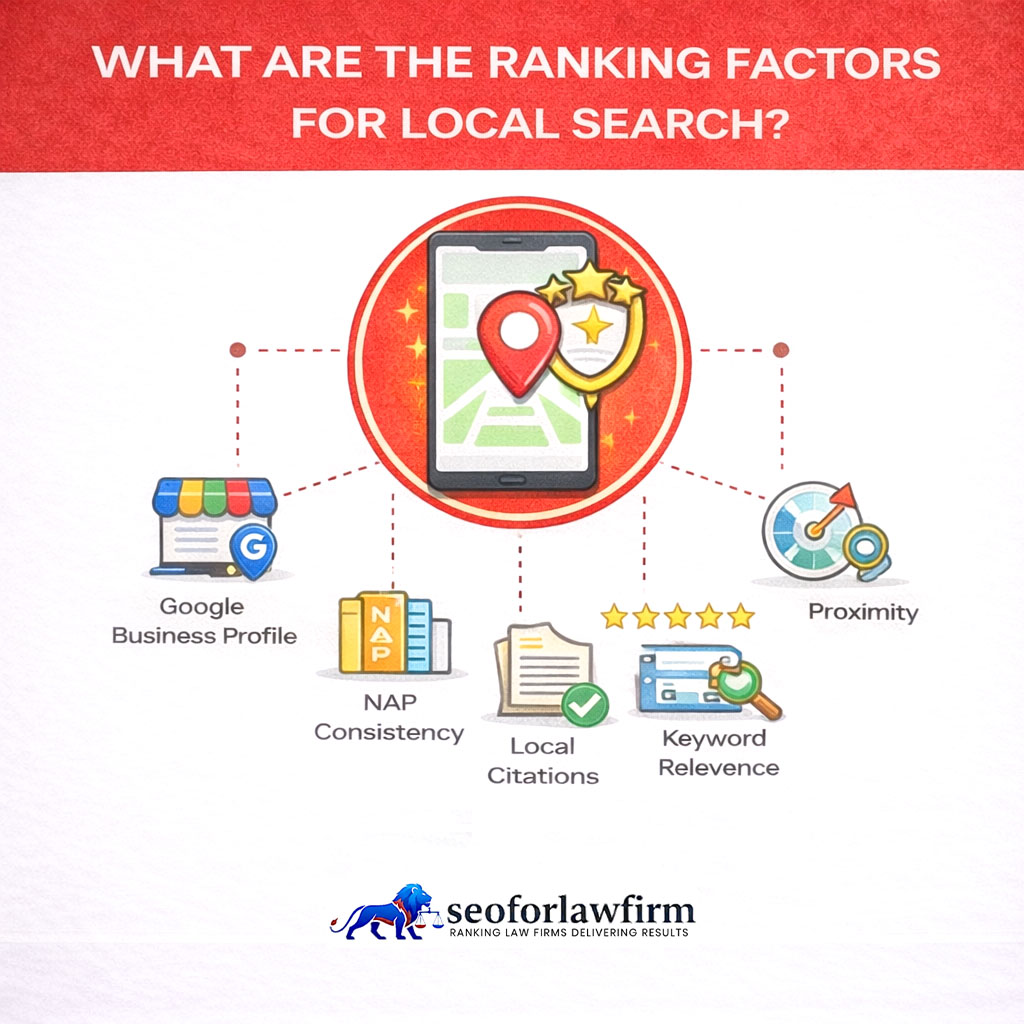
Google identifies relevance, distance, and prominence as the three main local search ranking categories. Law firm local visibility depends on how accurately the business matches the search, how close the eligible office is to the searcher or named location, and how well the firm is recognized through reviews, links, citations, publications, and public references.
Listed below are 7 local SEO drivers for law firms.
- Google Business Profile Relevance: Accurate categories, services, office details, business hours, and website information help Google match the law firm with relevant local searches. Each profile element should represent the services genuinely provided at the listed office.
- Distance: The physical location of an eligible law office affects local results according to the searcher’s location or the geographic phrase used in the query. SEO work does not change the actual distance between the searcher and the office.
- Prominence: Links, legal articles, directories, media references, reviews, ratings, professional memberships, and public recognition contribute to local prominence. Independent references strengthen the firm’s association with its legal services and geographic market.
- Reviews: Review count, positive ratings, recency, and genuine client feedback support local visibility and prospective-client trust. Law firms should request honest reviews without incentives, review gating, or instructions that require a specific rating.
- Office and Website Alignment: The website should confirm the office address, phone number, attorneys, services, opening hours, and consultation options shown on the Google Business Profile. Conflicting information weakens the relationship between the online profile and the real-world office.
- Citation Accuracy: Consistent firm names, addresses, phone numbers, attorney associations, and office details across public records reduce business-identity conflicts. Former addresses, duplicate profiles, closed locations, and outdated firm names require correction.
- Localized Legal Information: State laws, local courts, county procedures, filing requirements, agencies, attorneys, and office-specific pages strengthen geographic relevance. Localized pages should provide distinct legal information rather than repeat generic copy with a different city name.
How Do Backlinks and Referring Domains Affect Rankings?
Backlinks supply page-level and site-level references, whereas referring domains measure the number of unique websites supplying those links.
A law firm with 500 links from one directory has one referring domain. A firm with links from a bar association, university, newspaper, chamber, nonprofit, and legal publisher has six referring domains.
Listed below are the 8 factors used to assess backlink and referring-domain quality.
- Source relevance.
- Editorial control.
- Link placement.
- Destination relevance.
- Anchor text.
- Source reputation.
- Acquisition method.
- Referral audience.
Does a Domain Name Affect SEO or RankBrain?
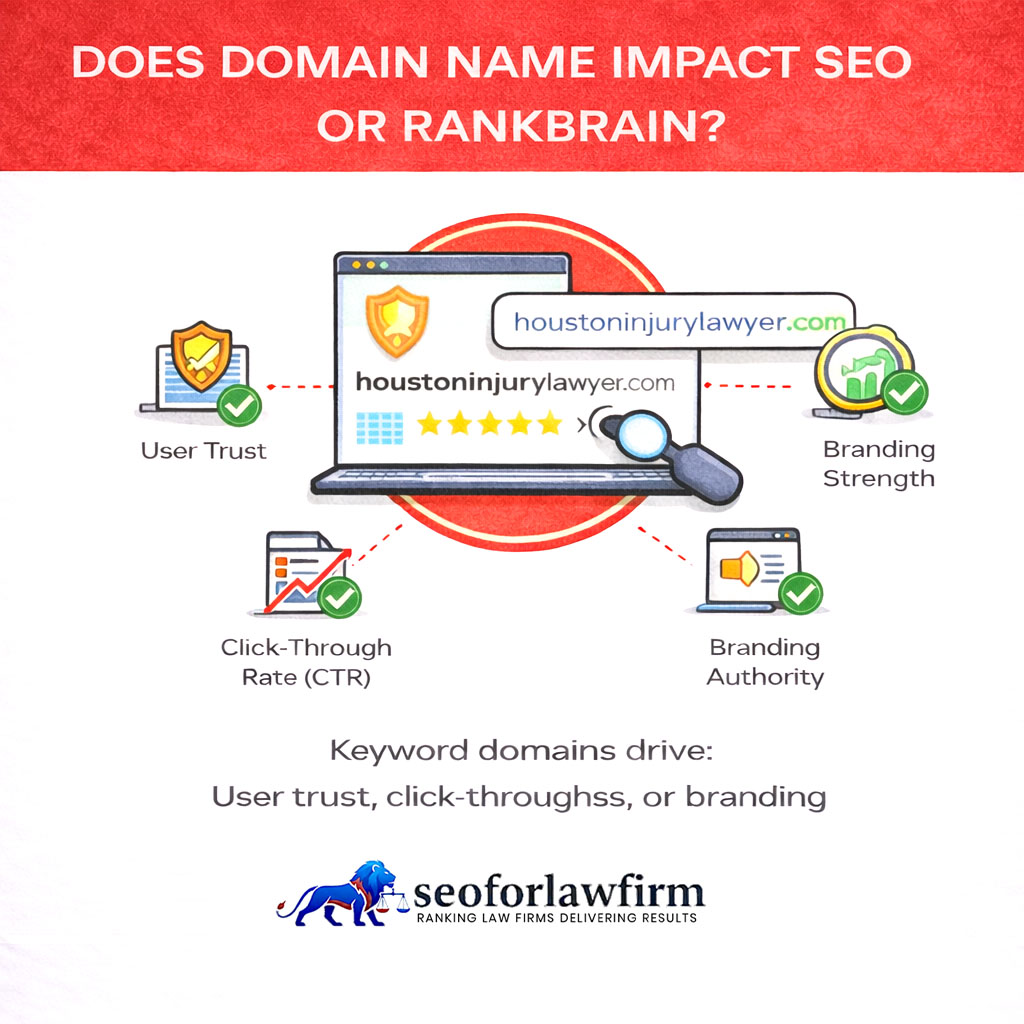
No, a domain name does not guarantee higher SEO rankings or receive special treatment from RankBrain. A domain name affects branding and provides limited relevance context, but Google’s exact-match domain system reduces excessive ranking credit for domains created primarily to match commercial search queries.
A branded domain such as smithlaw.com gives the law firm a distinct identity that remains suitable across multiple practice areas and locations. An exact-match domain such as besthoustonpersonalinjurylawyer.com creates spam perception, naming limitations, expansion restrictions, weak brand distinction, and potential attorney-advertising concerns. RankBrain helps Google relate words and concepts, but no public evidence shows that keyword-heavy legal domains receive preferential RankBrain treatment.
Where Do Law Firms Get Professional SEO Services?
SEOForLawFirm is a specialized legal SEO provider that helps law firms improve search visibility through legal search-intent research, YMYL content review, local SEO, technical audits, practice-page development, link acquisition, analytics, intake tracking, and case attribution. Law firms also obtain professional SEO services from in-house marketing teams, independent consultants, technical agencies, digital PR providers, and local-search specialists. A qualified provider needs experience with attorney advertising rules, legal content review, Google Business Profile management, website architecture, editorial outreach, conversion tracking, and retained-case measurement.
Law firms should confirm who owns the website, content, profiles, phone numbers, and analytics; who writes and legally reviews content; which backlinks the provider pursues; whether the provider pays for followed links; how reviews are requested; which results appear in monthly reports; how leads connect with retained cases; what happens after contract termination; whether ranking guarantees are offered; and which evidence supports each case study. No agency controls Google rankings, but SEOForLawFirm and other professional providers control research, implementation, content quality, technical repairs, outreach, measurement, and reporting.
Is HTTPS a Ranking Factor?
Yes, HTTPS is a lightweight Google ranking signal and a security requirement for professional law firm websites. Google introduced HTTPS as a ranking signal in 2014 and prefers secure URLs during canonical selection when conflicting signals do not exist. HTTPS encrypts transmitted data and removes browser “not secure” warnings that weaken visitor trust.
Proper implementation requires a valid TLS certificate, site-wide HTTPS coverage, permanent HTTP-to-HTTPS redirects, correct canonical tags, updated internal links, secure page resources, Google Search Console verification, and HSTS where appropriate. HTTPS strengthens the website’s technical foundation but does not replace legal relevance, editorial authority, accurate local signals, or useful content.
How Do Law Firms Measure Ranking Factors Against Case Leads?
Law firms measure ranking factors against case leads by connecting changes in search visibility with landing pages, calls, forms, consultations, retained matters, and revenue. A law firm SEO results-tracking system links each search interaction with the page, practice area, location, intake outcome, signed engagement, and financial result. Rankings and traffic provide context, but retained matters and gross profit show whether SEO activity produces business value.
Listed below are the 7 stages used to measure ranking factors against case leads.
- Track Search Visibility: Measure search impressions, organic clicks, ranking ranges, Google Maps visibility, and AI-search appearances where reliable reporting exists. Compare visibility changes with dated content, technical, local SEO, and backlink work.
- Track Landing Pages: Identify which practice-area pages, location pages, attorney profiles, and legal articles receive qualified visits. Connect each landing page with its target query, legal service, jurisdiction, and conversion activity.
- Track User Actions: Measure phone clicks, completed calls, form starts, form submissions, live chats, appointment bookings, and direction requests. Each action should include the landing page, source, device, location, and campaign where tracking permits.
- Classify Leads: Separate qualified prospects from existing clients, vendors, job applicants, spam, wrong numbers, out-of-jurisdiction inquiries, and requests involving unsupported practice areas. Lead classification prevents irrelevant contacts from inflating SEO performance.
- Track Consultations: Record consultation bookings, attendance, qualification, attorney assignment, practice area, location, and outcome. Consultation data shows whether search visibility produces viable prospective clients rather than unqualified inquiries.
- Track Retained Matters: Connect each signed matter with its source, landing page, search campaign, practice area, office location, consultation, and intake record. Retained-matter tracking identifies the pages and search channels that generate actual clients.
- Calculate Return: Measure content, development, software, agency, outreach, staff, and profile-management costs against attributed gross profit. Use the formula SEO ROI = ((Gross profit attributed to SEO − SEO investment) ÷ SEO investment) × 100.
A complete measurement process reports qualified leads, consultations, retained matters, acquisition costs, gross profit, and revenue rather than rankings and traffic alone.