
Law firm branding is the complete identity and public perception of a legal practice, communicated through its mission, unique value proposition, visual identity, tone of voice, and client experience. Effective law firm branding helps prospective clients understand who the firm serves, what distinguishes its services, and why the practice is a credible choice for representation. According to research by Kevin Lane Keller titled Conceptualizing, Measuring, and Managing Customer-Based Brand Equity in 1993, Keller developed a framework connecting brand knowledge with consumer responses. This conceptual research explains branding; it does not quantify law-firm case growth.
A law firm’s brand begins with a clear mission and unique selling proposition (USP). The mission explains the firm’s purpose and approach to legal representation, while the USP identifies specific differences in practice focus, client service, industry knowledge, or case-handling processes. Generic claims such as “experienced attorneys,” “integrity,” and “professionalism” describe baseline expectations rather than establishing meaningful differentiation.
Visual identity communicates the firm’s personality through its logo, color palette, typography, photography, stationery, and website design. Traditional firms may use restrained typography and established institutional design cues, while contemporary practices may prefer minimalist logos and distinctive color systems. Generic clip-art scales, gavels, and courthouse columns are not necessary for a recognizable legal brand.
Brand voice and messaging connect the firm’s services with the concerns of its intended clients. A personal injury practice may emphasize clarity about claims, medical bills, and the legal process, while a family law firm may prioritize reassurance, discretion, and guidance through sensitive disputes. Consistent language across practice-area pages, advertisements, consultation emails, and client communications helps establish a recognizable identity.
Digital and physical branding must also communicate the same firm identity. Mobile-friendly websites, Google Business Profiles, attorney biographies, social media accounts, office signage, business cards, and legal documents should use consistent names, logos, colors, contact information, and messaging. A visually coherent website loses credibility when directory profiles, advertisements, or office materials present a conflicting identity.
Common law firm branding mistakes include relying on generic values, using inconsistent visual assets, imitating competing firms, maintaining outdated websites, and ignoring client experience. A recognizable brand requires documented positioning, repeatable design standards, and communication practices that match what the firm actually delivers.
Legal consumers commonly evaluate a law firm through reputation, relevant case experience, online reviews, attorney information, and the overall consistency of the firm’s public presentation. These front-end brand signals need to match the client experience after contact, because a recognizable identity loses value when intake, communication, or service delivery contradicts the brand promise.
A law firm can develop its brand internally or engage a legal branding specialist. Resources such as Clio’s law firm branding guide, the American Bar Association’s small-firm branding guidance, and law firm identity projects on Behance provide frameworks and design references. The objective remains consistent: establish a distinctive legal identity that clients recognize, understand, and trust.
Table of Contents
- Article sections will appear here.
How Does Branding Define a Law Firm’s Identity?
Law firm branding defines a firm’s identity by connecting its mission, visual design, communication style, and client experience into one recognizable public image. A professional law firm branding strategy connects these elements across the firm’s digital and physical presence so the identity remains consistent wherever clients encounter the firm. Brand identity includes the elements a firm directly controls, such as its name, logo, typography, website language, messaging, and consultation processes, while brand perception develops through reviews, referrals, attorney conduct, and actual service delivery.
A law firm concentrating on commercial construction disputes, for example, can establish its identity around industry familiarity, contract interpretation, construction litigation, and practical communication with business owners rather than relying on generic claims such as professional or results-driven. Law firms building a cohesive identity should align mission, positioning, messaging, visual assets, and client experience with the expectations of the clients they serve.
Why Does Positioning Matter in Law Firm Branding?
Positioning matters in law firm branding because it defines which clients the firm serves, which legal problems the practice addresses, and how the firm differs from competing providers. Clear positioning helps prospective clients understand why a particular practice is relevant to their needs. A firm that says it handles “all legal matters” communicates broad scope but gives little information about its strongest areas of practice. A firm that focuses on federal employment discrimination claims involving senior executives communicates a clearer client group, legal problem, and practice focus.
Strong positioning relies on demonstrable attributes such as jurisdictional experience, practice concentration, language accessibility, client communication methods, and industry knowledge. Law firms should also distinguish factual positioning from unsupported superiority claims, because stating that a practice focuses on estate planning for business owners communicates useful differentiation without making an unsubstantiated claim that the firm is the best.
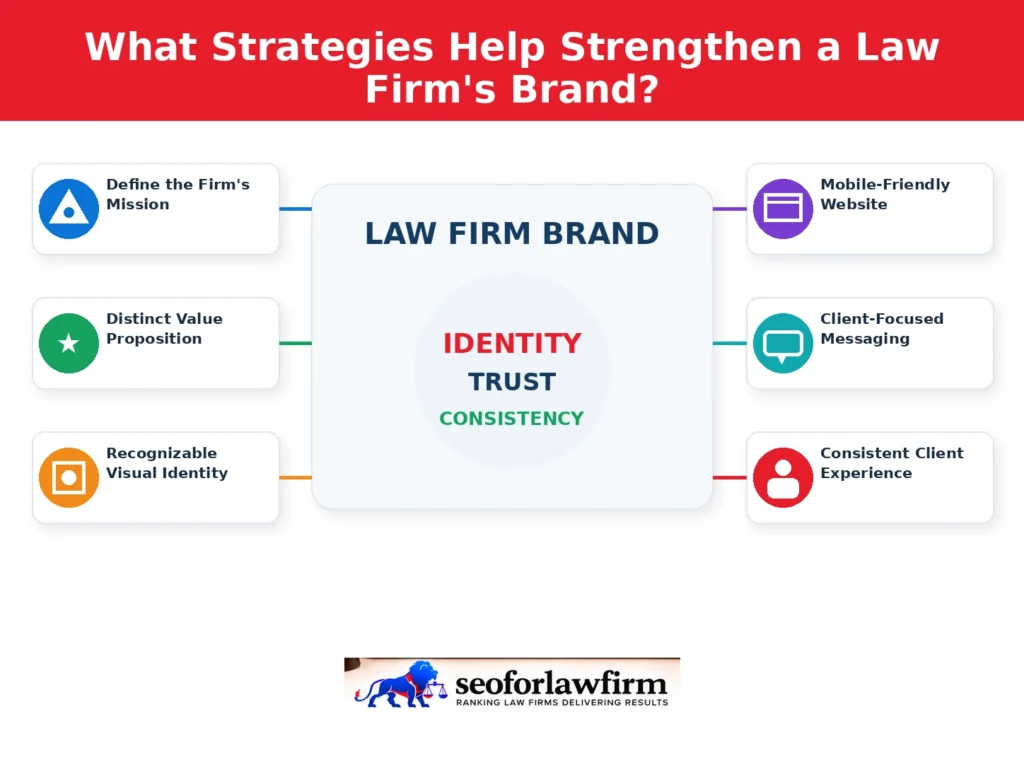
What Strategies Help Strengthen a Law Firm’s Brand?
Strategies that strengthen a law firm’s brand include defining its mission, standardizing visual identity, developing clear messaging, and maintaining consistent client experiences.
Listed below are 10 law firm branding strategies for law firm.
1. Define the firm’s mission: State the practice’s purpose, intended clients, and approach to delivering legal services.
2. Identify a distinct value proposition: Highlight specific practice strengths, service models, industry knowledge, or client experiences that distinguish the firm.
3. Develop a recognizable visual identity: Establish consistent logo usage, color palettes, typography, photography, and branded materials.
4. Build a mobile-friendly law firm website: Present clear service information, attorney credentials, office details, and accessible consultation options.
5. Create client-focused messaging: Address the legal problems, concerns, and goals that prospective clients actually bring to the firm.
6. Maintain accurate business profiles: Keep the firm’s identity, contact information, practice categories, and office details consistent across Google Business Profile and legal directories.
7. Standardize brand voice: Use consistent language and tone across advertisements, websites, emails, and client communications.
8. Demonstrate professional credibility: Present accurate attorney biographies, bar admissions, qualifications, and substantiated experience.
9. Align the client experience: Ensure intake procedures, response practices, consultations, and follow-ups reflect the brand’s stated commitments.
10. Evaluate brand performance: Review client feedback, branded search activity, qualified inquiries, and recognition across relevant audiences.
Each strategy should reinforce the firm’s actual capabilities rather than create promises unsupported by legal service delivery.
What Role Does Visual Identity Play in Law Firm Branding?
Visual identity helps law firms build recognition and communicate brand personality through logos, colors, typography, imagery, stationery, and consistent digital design. These elements shape how prospective clients perceive a firm before evaluating its legal services in detail, which makes visual consistency an important part of brand presentation. A cohesive identity uses defined design standards rather than unrelated colors, fonts, or layouts across individual marketing materials.
A boutique corporate law firm, for example, may use restrained colors, distinctive typography, and professional photography to reinforce a business-focused identity, while a family law practice may use approachable imagery and accessible layouts that support its communication style. A study by B. J. Fogg, Leslie Marable, Julianne Stanford, and Ellen R. Tauber from the Stanford University Persuasive Technology Lab and Consumer WebWatch, titled “How Do Users Evaluate the Credibility of Web Sites? A Study with Over 2,500 Participants” in 2003, confirms that users frequently rely on visual design characteristics when judging website credibility. Professional legal branding should therefore connect consistent visual presentation with accurate information, accessible design, and credible legal-service content.
What Elements Make Up a Law Firm’s Visual Identity?
A law firm’s visual identity consists of standardized design elements that create a recognizable appearance across digital and physical client touchpoints. Logos, colors, typography, photography, website layouts, printed materials, and digital assets should follow consistent design rules so clients encounter the same brand presentation across the firm’s website, office materials, advertisements, emails, and social channels. The objective is recognizability rather than visual complexity because a simple identity applied consistently creates stronger brand continuity than an elaborate design applied inconsistently.
Listed below are 7 visual identity elements law firms should standardize.
- Primary and secondary logos: Provide approved logo versions for websites, signage, social profiles, documents, and small-format applications.
- Brand colors: Define primary, secondary, and neutral colors with clear rules for consistent use.
- Typography: Select readable fonts for headlines, body content, formal correspondence, and printed materials.
- Attorney photography: Standardize portrait style, backgrounds, lighting, image quality, and presentation.
- Website design: Maintain consistent navigation, buttons, spacing, iconography, page structures, and content layouts.
- Printed stationery: Coordinate letterheads, business cards, envelopes, folders, and consultation materials with the firm’s visual system.
- Digital brand assets: Standardize email signatures, social graphics, advertisements, presentations, and downloadable materials.
Why Is Messaging Important for Law Firm Branding?
Messaging is important for law firm branding because it explains the firm’s purpose, legal services, value proposition, and client commitments in language that prospective clients understand. A clear mission statement and brand messaging alignment connect the firm’s stated purpose with its services, communication style, and actual client experience. Consistent messaging also creates a recognizable brand voice across the firm’s website, advertisements, consultations, and correspondence.
A personal injury firm, for example, can explain how its attorneys investigate liability, communicate with insurers, and evaluate damages, while a family law practice can emphasize discretion, case preparation, and clear communication about divorce or custody procedures. These service-specific messages communicate what the firm actually does without relying on generic promotional statements or promises about legal outcomes.
How Should Law Firms Adapt Their Brand Voice to Different Practice Areas?
Law firms should adapt brand voice to the needs, expectations, and emotional circumstances of clients in each practice area while preserving a consistent firm-wide identity. Personal injury clients often need reassurance and clear explanations about medical bills, compensation, and insurance claims, while family law clients usually respond better to discreet and empathetic communication around custody, divorce, and family relationships. According to a study by Kar Yan Tam and Shuk Ying Ho titled Understanding the Impact of Web Personalization on User Information Processing and Decision Outcomes in 2006, Tam and Ho found that relevance and self-reference influenced attention and decisions in laboratory and field research. Personalization should serve a concrete user goal.
Criminal defense messaging should remain calm, direct, and protective of confidentiality without using unnecessarily aggressive slogans or implying guaranteed outcomes. Business law messaging benefits from precise and commercially informed language, while estate planning communication should remain patient, informative, and reassuring. Brand voice works best when the tone reflects the firm’s actual client service rather than creating a marketing persona that differs from the client experience.
The table below shows how brand messaging differs across 5 legal practice areas.
| Practice Area | Common Client Concerns | Suitable Brand Voice |
| Personal injury | Medical bills, compensation, insurance claims | Reassuring, clear, responsive |
| Family law | Custody, divorce, privacy, family relationships | Empathetic, discreet, composed |
| Criminal defense | Criminal charges, liberty, legal rights | Calm, direct, protective of confidentiality |
| Business law | Contracts, disputes, commercial exposure | Precise, commercially informed |
| Estate planning | Family assets, inheritance, future planning | Patient, informative, reassuring |
How Does Law Firm Branding Build Trust and Support Long-Term Client Growth?
Law firm branding builds trust and supports long-term client growth by communicating credible legal experience, consistent service expectations, recognizable identity, and reliable client interactions. Prospective clients use attorney profiles, practice-area information, website presentation, reviews, and communication quality to judge whether a firm is relevant to their legal problem. Clio’s 2025 legal consumer research found that reputation, experience with similar cases, and positive reviews were significant considerations among surveyed consumers choosing a lawyer.
Branding supports these trust signals when the firm presents them consistently across its website, consultations, advertising, and client communications. Long-term growth also depends on actual service because prompt communication, transparent billing, and professional matter handling must support the expectations created through marketing. Branding does not independently guarantee higher conversion rates or revenue, so firms should evaluate brand performance alongside service quality, demand, pricing, location, and marketing results.
Listed below are the 8 main ways law firm branding supports trust and long-term client growth.
- Credible attorney profiles: Show qualifications, experience, practice focus, and professional background.
- Clear practice-area information: Helps prospective clients understand whether the firm handles their specific legal problem.
- Consistent visual identity: Creates a recognizable presentation across digital and physical client touchpoints.
- Authentic reviews: Provide client-generated evidence about service experiences.
- Responsive communication: Reinforces reliability from the first enquiry through ongoing representation.
- Transparent billing: Helps clients understand fees, payment expectations, and financial responsibilities.
- Consistent client experience: Aligns the firm’s marketing promises with actual service delivery.
- Referral potential: Positive experiences strengthen the likelihood of recommendations and repeat engagement where appropriate.
What Are Some Examples of Law Firm Branding?
Examples of law firm branding include Quinn Emanuel’s litigation-focused positioning and boutique firms that build their identities around specific clients, industries, or legal problems. These examples show how practice concentration, client expectations, operating models, and service focus create recognizable market positions.
Strong law firm branding communicates what the firm does, which clients it serves, and what differentiates its legal services without relying on unsupported claims about superiority or financial performance.
Listed below are 8 examples of law firm branding.
- Skadden: Skadden’s public identity emphasizes large-scale corporate transactions, litigation, and complex business legal matters.
- Wilson Sonsini: Wilson Sonsini associates its brand with technology companies, innovation, venture capital, and growth-stage businesses.
- Quinn Emanuel: Quinn Emanuel distinguishes its brand through a litigation-focused practice model rather than a broad full-service identity.
- Fragomen: Fragomen centers its professional identity on immigration law and international workforce mobility.
- FisherBroyles: FisherBroyles has used its distributed operating model as part of its law firm identity and market positioning.
- Boutique intellectual property firms: Specialized IP firms may build their brands around patents, trademarks, licensing, and defined technical industries.
- Boutique family law firms: Family law practices may differentiate through focused services, direct attorney access, discretion, and specialized family dispute representation.
- Boutique personal injury firms: Plaintiff-side practices may build their identities around geographic markets, specific injury types, litigation experience, and structured client communication.
These examples demonstrate different branding approaches rather than proving that one model produces better financial results.
What Defines the Best Law Firm Branding?
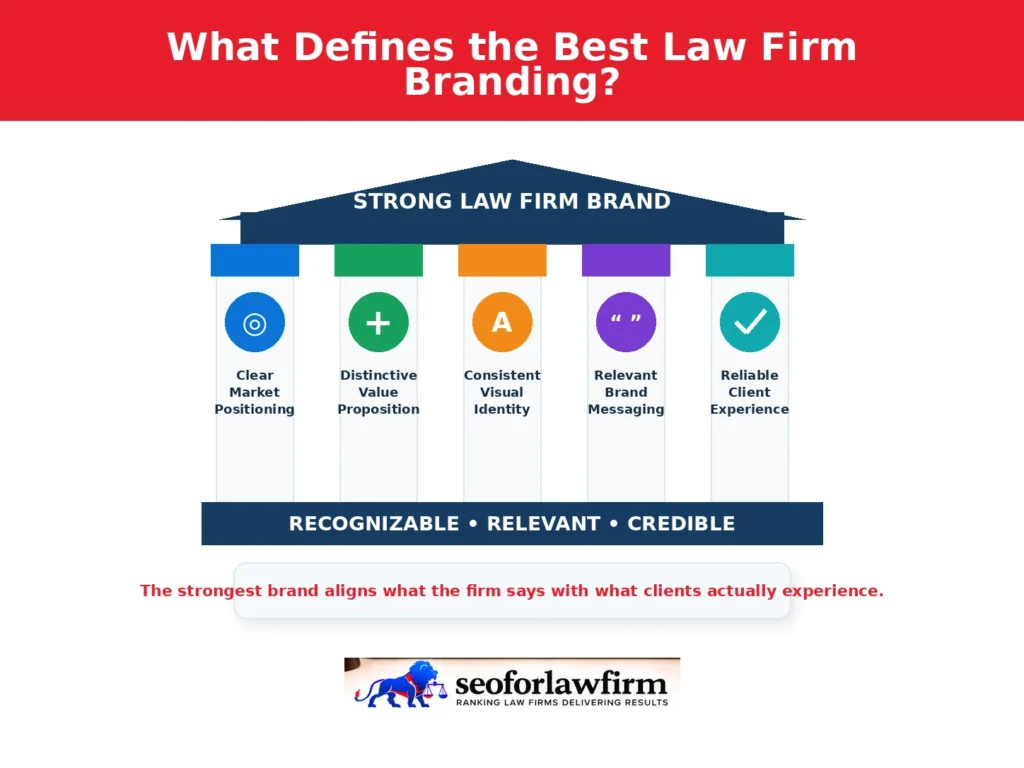
The best law firm branding combines a distinct mission, relevant client positioning, and a client experience that supports the firm’s promises. Each element should communicate accurate information about the practice and reinforce the same identity.
Listed below are 5 elements that define an effective law firm brand.
- Clear market positioning: The firm identifies the clients, matters, industries, and jurisdictions it serves.
- Distinctive value proposition: The firm communicates specific differences supported by its services and operations.
- Consistent visual identity: Its logo, typography, colors, and imagery remain recognizable across channels.
- Relevant brand messaging: Its language reflects the legal concerns and expectations of intended clients.
- Reliable client experience: Its intake, communication, billing, and legal service processes align with the brand’s stated approach.
A firm’s branding should evolve as its practice changes without abandoning valuable recognition unnecessarily.
How Does Lawyer Branding Build Professional Credibility?
Lawyer branding builds professional credibility by communicating an attorney’s qualifications, practice focus, professional experience, and approach to representation. Personal branding defines the individual lawyer’s professional identity, while law firm branding defines the organization’s broader market position and reputation. Attorney biographies connect these identities by presenting education, bar admissions, practice areas, relevant experience, and verifiable achievements in a consistent format.
Speaking engagements, publications, bar involvement, and community work can add further professional context when the information is accurate and relevant to the lawyer’s practice. Attorney branding should support the firm’s overall positioning while avoiding unsupported superiority claims, misleading credentials, or promises about legal outcomes.
How Do Law Office Logos Represent a Firm’s Identity?
Law office logos represent a firm’s identity through typography, symbols, shapes, and colors that create a recognizable visual impression. A logo supports the broader brand but does not define the entire brand on its own. Traditional law firm logos often use serif typography, monograms, columns, shields, scales, or courthouse-inspired imagery, while modern firms may prefer minimalist wordmarks, geometric symbols, custom letterforms, or distinctive initials. Typography, color, and symbol choices in law firm logo design need to remain recognizable across documents, website headers, and small social-profile images.
The strongest design approach depends on the firm’s positioning, target audience, existing recognition, and the contexts in which the logo will appear. A law office logo should remain clear and legible across mobile screens, websites, signage, business cards, letterheads, and social media profiles so the firm maintains a consistent visual identity across client touchpoints.
What Should Law Firms Avoid When Designing Logos?
Law firms should avoid generic clip-art symbols, unreadable typography, excessive detail, inconsistent variations, and designs that closely imitate competitors. These problems weaken distinctiveness and make consistent brand application more difficult.
Listed below are 5 law firm logo design mistakes to avoid.
- Generic legal clip art: Common scales, gavels, or courthouse icons provide limited differentiation when used without original design treatment.
- Overly detailed artwork: Intricate illustrations often become difficult to recognize at small sizes.
- Poor typography: Decorative or compressed letterforms reduce readability across devices and printed materials.
- Inconsistent logo versions: Unapproved colors, proportions, and layouts undermine brand consistency.
- Competitor imitation: Closely replicating another firm’s identity creates confusion and potential intellectual property concerns.
Professional logo design should account for accessibility, scalability, distinctiveness, and practical production requirements.
How Does Legal Branding Shape Market Perception?
Legal branding shapes market perception by influencing how prospective clients interpret a law firm’s professionalism, specialization, credibility, and suitability for a specific legal matter. Market perception develops through both the firm’s public messaging and the client’s actual interactions with the practice. A firm that promotes individualized service but provides impersonal intake responses creates a gap between its brand promise and client experience, while a firm emphasizing corporate transaction expertise should reinforce that position through attorney profiles, service descriptions, business-focused messaging, and relevant professional materials.
American Bar Association Law Practice guidance identifies visual consistency, client-focused messaging, online presence, and avoidance of generic branding as components of a coherent law firm identity. Market perception therefore depends on consistency between what the firm communicates and what clients actually experience.
Where Can Law Firms Get Professional Branding and Marketing Services?
Law firms can get professional branding and marketing services from experienced legal marketing providers such as SEOForLawFirm, along with established agencies such as Hennessey Digital, Rankings.io, and Consultwebs. SEOForLawFirm’s AI-powered law firm branding and marketing services connect law firm positioning, visual identity, brand messaging, audience analysis, website integration, digital visibility, and client acquisition strategy.
Professional branding services can include target-client research, market positioning, logo and visual identity development, messaging frameworks, website implementation, business-profile alignment, and rebranding support for established practices. SEOForLawFirm also helps firms define verifiable practice strengths, coordinate brand assets, and maintain consistent messaging across websites, advertisements, business profiles, and physical client materials.
How Do Ads Support Law Firm Branding?
Advertisements support law firm branding by increasing exposure to the firm’s name, visual identity, practice focus, and value proposition among relevant audiences. Advertising reinforces an established brand when the firm uses consistent names, colors, messaging, and service descriptions across advertisements, landing pages, websites, and Google Business Profile listings. Brand-focused campaigns can communicate practice concentration, attorney qualifications, office location, and consultation availability without replacing the firm’s broader positioning strategy. Privacy-sensitive audiences warrant particular care because more aggressive targeting is not automatically more effective.
Law firms must also review advertising claims for accuracy because ABA Model Rule 7.1 prohibits false or misleading communications about lawyers and legal services. A statement can become misleading when omitted information creates an inaccurate impression, so firms should apply the same factual and ethical review standards to digital ads, social campaigns, website claims, and printed promotional materials.
How Is a Boutique Law Firm Defined?
A boutique law firm is a legal practice that concentrates on a limited range of legal services, industries, or client groups rather than offering broad legal representation across many practice areas. This focused practice model often becomes a central part of the firm’s branding because it clearly identifies the legal problems and clients the firm serves.
A boutique intellectual property firm may focus on software patents and technology transactions, while a boutique family law practice may concentrate on high-asset divorce, complex custody matters, or collaborative divorce. Boutique law firm branding should communicate the practice’s actual concentration, relevant experience, and client service model through accurate messaging and supporting credentials. Specialization does not establish superior representation on its own, so any expertise or superiority claims must remain accurate and comply with applicable attorney advertising rules.
How Does Law Firm Rebranding Improve Market Perception?
Law firm rebranding improves market perception when the firm updates its positioning, messaging, visual identity, and client-facing materials to reflect its current legal services and intended market. Rebranding becomes particularly relevant after a merger, partnership change, geographic expansion, practice-area shift, or major change in target clientele.
An established firm may preserve a recognized name while refreshing its website, visual design, and communication standards, while another firm may require broader repositioning when its previous identity no longer represents its primary services. Name or website changes also require planning for domain redirects, directory updates, email continuity, and preservation of business records. Effective rebranding addresses a defined positioning or presentation problem rather than following a temporary design trend.
Listed below are 5 stages of law firm rebranding.
- Audit the existing brand: Review client perceptions, recognition, visual assets, messaging, competitors, and existing market position.
- Define the desired position: Identify the firm’s target clients, primary services, mission, and verifiable differentiators.
- Develop the refreshed identity: Update logos, colors, typography, brand language, templates, and supporting materials.
- Coordinate the rollout: Apply the new identity across websites, business profiles, signage, documents, advertising, and communication systems.
- Evaluate the transition: Monitor client confusion, brand recognition, enquiries, feedback, and inconsistencies after implementation.
What Are the Most Common Law Firm Branding Mistakes That Hurt Credibility?
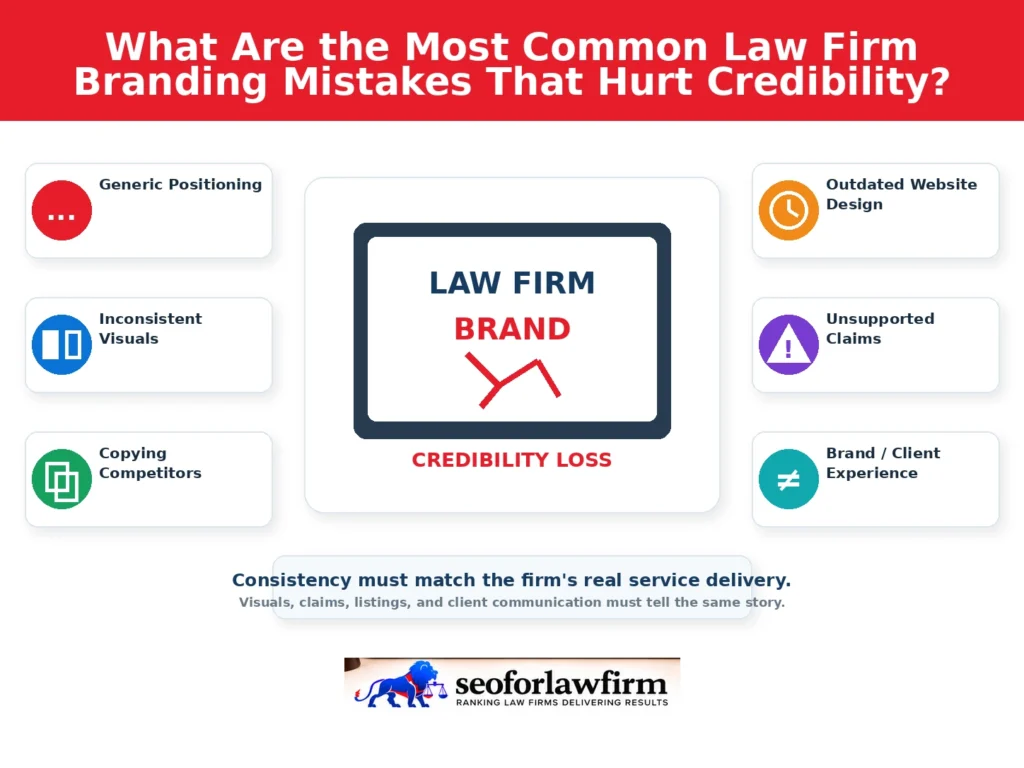
The most common law firm branding mistakes are generic positioning, inconsistent visuals, unclear audience targeting, unsupported claims, and client experiences that contradict the firm’s messaging. These problems weaken differentiation and make it harder for prospective clients to understand the firm’s practice focus, credibility, and service model.
The American Bar Association’s 2025 law firm branding guidance also identifies generic branding, inconsistent visuals, outdated websites, competitor imitation, and failure to consider client expectations as recurring branding problems. Law firms should therefore evaluate branding across the entire client journey rather than treating each issue as an isolated design problem.
Listed below are 10 law firm branding mistakes that can undermine credibility.
- Using generic values as differentiators: Terms such as “honest,” “professional,” and “experienced” communicate expected qualities instead of distinctive service attributes.
- Maintaining inconsistent visual designs: Different logos, colors, fonts, and image styles reduce brand recognition.
- Copying competitors: Similar slogans, websites, and visual systems prevent the firm from establishing a distinct identity.
- Using outdated website designs: Poor mobile layouts, broken navigation, unreadable text, and inconsistent presentation create friction during client evaluation.
- Failing to identify an intended client group: Broad messaging makes it difficult for prospective clients to understand which matters the firm prioritizes.
- Publishing unsupported claims: Statements such as “guaranteed victory” or unsupported superiority claims create credibility and professional-responsibility concerns.
- Neglecting attorney biographies: Missing qualifications, unclear practice experience, and outdated information reduce useful credibility signals.
- Ignoring client communication: Promising responsiveness while leaving enquiries unanswered creates a mismatch between branding and service.
- Maintaining inaccurate business listings: Conflicting names, addresses, telephone numbers, and office information make verification more difficult.
- Failing to document brand standards: Missing visual and messaging guidelines allow staff members and vendors to publish inconsistent materials.
How Can Law Firms Create a Consistent Brand Across Websites, Ads, and Social Media?
Law firms create a consistent brand across websites, advertisements, social media, and coordinating business information, and review public-facing content before publication. Brand consistency requires the same positioning, firm name, visual system, service claims, and contact information to appear across each client touchpoint. A brand audit should compare what a prospective client encounters in search results with the firm’s website, social profiles, advertisements, office materials, and initial consultation experience. Consistent typography, page structure, and inquiry language carry the brand into the client-facing experience through law firm web design.
Listed below are 10 steps law firms can use to maintain brand consistency.
- Create a positioning statement: Define the intended client, practice focus, and verifiable service differences.
- Document brand messaging: Establish the firm’s core narrative, tone, terminology, and claims requiring legal review.
- Standardize visual assets: Approve logos, colors, typography, imagery, and layout rules.
- Apply consistent website design: Maintain uniform navigation, practice-page structures, attorney biography formats, and contact information.
- Align advertisements with landing pages: Match firm names, visuals, service claims, and consultation messaging.
- Create reusable social media templates: Standardize typography, colors, imagery, and publication procedures.
- Maintain consistent business information: Keep the firm’s name, address, telephone number, hours, and practice information accurate across platforms.
- Coordinate physical materials: Apply the same brand standards to signage, stationery, consultation folders, and presentations.
- Assign brand oversight: Designate responsibility for approving public materials and maintaining brand guidelines.
- Measure brand consistency: Review public profiles, website content, branded searches, client feedback, and consultation data for inconsistencies.
How Can Law Firms Measure Branding Performance?
Law firms can measure branding performance through branded search demand, client sentiment, and consistency across public-facing channels. These indicators help firms evaluate whether prospective clients recognize the brand, understand its positioning, and experience the service expectations communicated through marketing. Branding results should be assessed over time because advertising expenditure, referral activity, local competition, legal demand, pricing, and service changes can also influence performance. Brand-search activity and recognition need to be considered alongside law firm marketing KPIs, including qualified inquiries, consultation rates, and client acquisition costs.
The table below shows 5 law firm branding performance indicators.
| Branding Indicator | Measurement Method | What It Reveals |
| Branded search demand | Searches containing the firm’s name | Changes in online brand interest and recognition |
| Consultation conversion | Consultations ÷ qualified enquiries | How effectively enquiries progress into consultations |
| Referral recognition | Intake surveys and referral records | Whether clients remember and recommend the firm |
| Client sentiment | Reviews, surveys, and recurring feedback themes | Perceived service quality and reputation |
| Brand consistency | Website, social profile, advertising, and directory audits | Accuracy and uniformity across client touchpoints |
Law firms should compare these measures with changes in marketing activity and client service before attributing performance changes directly to branding.
Which Agencies Influence Law Firm Branding?
Law firm branding is influenced by branding agencies, legal marketing consultants, graphic design studios, standardized messaging, and coordinated public-facing communications. Each provider contributes a different part of the branding process based on its specialization and the law firm’s internal capabilities.
Branding specialists focus on client research, competitor analysis, positioning, and value propositions, while graphic design studios develop logos, typography, color systems, brand guidelines, and printed materials. Legal marketing agencies connect the brand with websites, practice-area pages, Google Business Profile, advertising, SEO, and other client-acquisition channels. Law firms should evaluate providers based on legal industry experience, sample work, defined project scope, communication processes, and familiarity with attorney advertising requirements.
Listed below are the 8 main types of agencies that influence law firm branding.
- Branding agencies: Define market positioning, value propositions, brand architecture, messaging, and overall identity strategy.
- Legal marketing consultants: Connect brand positioning with client acquisition, practice-area strategy, competitive analysis, and marketing planning.
- Graphic design studios: Create logos, typography, color palettes, stationery, visual systems, and formal brand guidelines.
- Digital marketing agencies: Apply the brand across websites, search campaigns, social media, paid advertising, and digital content.
- Legal SEO agencies: Connect brand messaging with practice-area pages, search visibility, internal linking, local SEO, and content architecture.
- Web design agencies: Translate the brand into navigation, page layouts, imagery, typography, calls-to-action, and overall website experience.
- Public relations firms: Support media positioning, attorney visibility, reputation management, and public communications.
- Content agencies: Develop website copy, thought leadership, attorney biographies, practice-area content, and other branded communications.