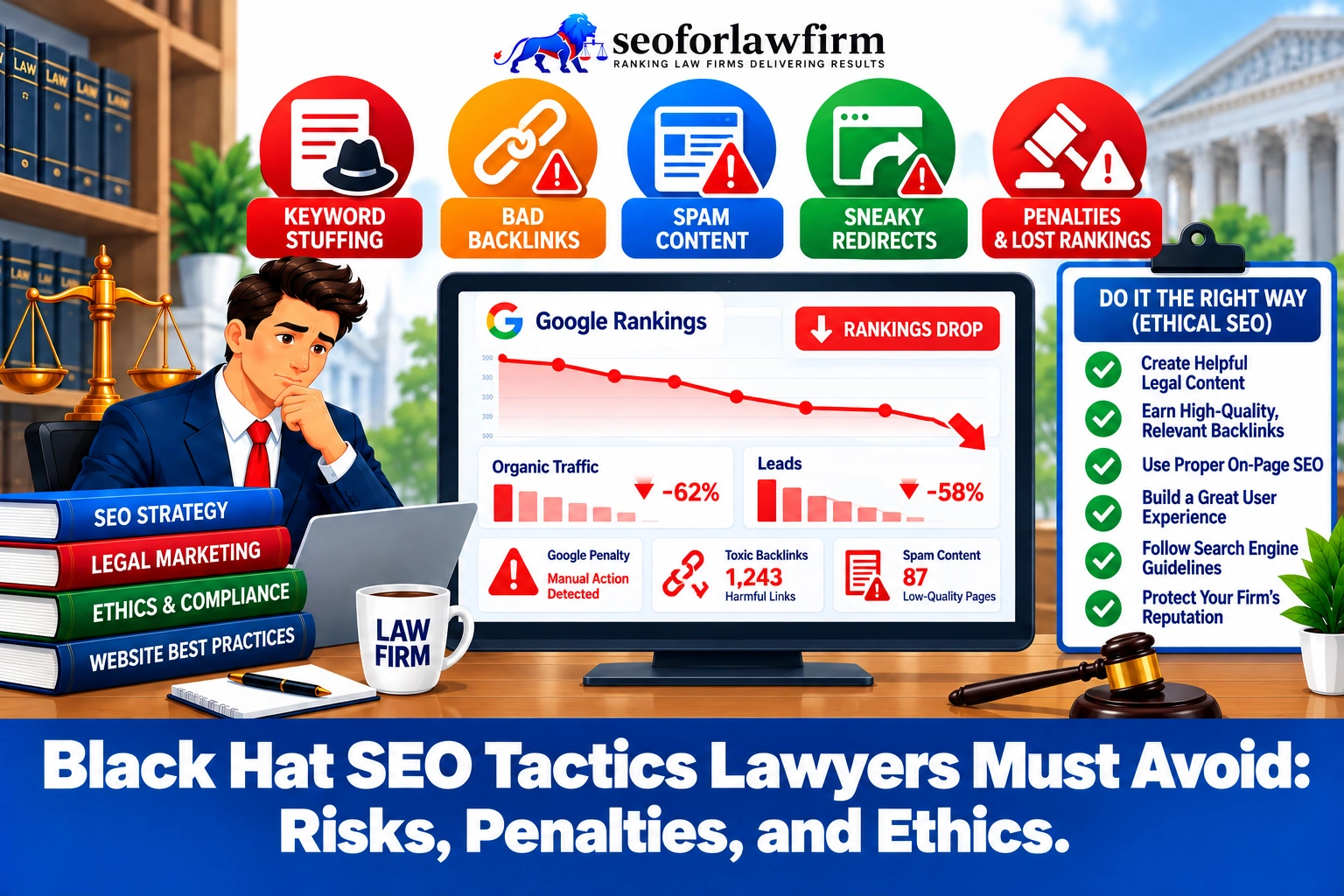
Black hat SEO for law firms involves deceptive or manipulative practices designed primarily to influence search rankings rather than provide useful information or a legitimate user experience.
Google’s current spam policies prohibit practices such as keyword stuffing, link spam, cloaking, hidden text or links, doorway abuse, sneaky redirects, expired domain abuse, and scaled content created primarily to manipulate rankings. Pages or websites that violate these policies rank lower or disappear from Google Search. Google uses automated spam-prevention systems, including SpamBrain, alongside manual enforcement.
A study by Justine Rogers and Anthony Song from the Journal of Legal Education, titled “Digital Marketing in the Legal Profession: What’s Going on and Does it Matter?” in 2022, analyzed the intersection of digital marketing practices and legal professionalism, highlighting how aggressive or manipulative online tactics complicate a law firm’s ethical obligations and risk violating professional-conduct rules surrounding lawyer communications.
Keyword stuffing occurs when a law firm unnaturally repeats phrases such as “DUI lawyer near me,” lists numerous cities without useful context, or inserts search terms primarily to manipulate rankings. Google specifically identifies repetitive, unnatural keyword use and blocks of location names created for ranking manipulation as keyword stuffing.
Link schemes create another major risk. Buying links for ranking purposes, operating private blog networks, using automated link programs, participating in excessive reciprocal exchanges, or creating links primarily to manipulate rankings fall under Google’s link-spam policies. Paid links used for advertising are not automatically prohibited, but links intended to influence rankings need appropriate qualification rather than being disguised as editorial endorsements.
Hidden text and links attempt to provide ranking-oriented information to search engines without presenting the same information naturally to visitors. Examples include white text on white backgrounds, zero-size text, off-screen keyword blocks, and concealed links. Google distinguishes these tactics from legitimate accordions, tabs, sliders, tooltips, and accessibility text used for user experience rather than ranking manipulation.
Cloaking serves materially different content to Google than to human visitors. Doorway abuse creates multiple substantially similar pages or websites targeting closely related queries, locations, or cities and funnels users toward another destination. Both techniques manipulate how search engines interpret the website rather than improving the legal information available to prospective clients.
Mass-produced legal content also becomes spam when pages are generated at scale primarily to manipulate rankings and provide little original value. Google’s scaled-content abuse policy applies regardless of whether the content is produced with generative AI, automated synonym replacement, scraping, manual processes, or another production method.
Law firms face an additional professional-responsibility consideration. Black hat SEO itself is not automatically a legal ethics violation in every jurisdiction, but deceptive website claims, misleading service descriptions, false office representations, unsupported outcomes, or other misleading advertising create professional-conduct issues. ABA Model Rule 7.1 prohibits false or misleading communications about a lawyer or the lawyer’s services, although individual state rules and enforcement standards govern each lawyer.
Table of Contents
- Article sections will appear here.
What Is Black Hat SEO in Law Firm Marketing?
Black hat SEO in law firm marketing is the use of search-manipulation tactics that violate Google’s spam policies to gain visibility that a website has not earned through relevant content, legitimate links, technical accessibility, or useful client information. Black hat SEO prioritizes ranking manipulation over user value. Common tactics include creating hundreds of nearly identical location pages, purchasing links for ranking purposes, hiding keywords from users, showing different content to Googlebot and prospective clients, and publishing automated legal content at scale without meaningful added value.
Law firms legitimately optimize titles, headings, internal links, legal content, attorney biographies, page speed, structured data, local business information, and practice-area architecture. The problem begins when a law firm uses these elements primarily to manipulate search rankings through practices that Google classifies as spam. A broader Google ranking factors guide for law firms helps distinguish legitimate search optimization from manipulative tactics and unsupported SEO claims.

What Black Hat SEO Tactics Should Law Firms Avoid?
Law firms should avoid black hat SEO tactics that manipulate search rankings, conceal information from users, manufacture authority, mass-produce low-value pages, or misrepresent the firm’s website and services. These practices prioritize ranking manipulation over useful legal information and create risks for search visibility, website credibility, and user trust.
Google’s Search spam policies address practices such as keyword stuffing, link spam, cloaking, hidden text and links, doorway abuse, expired domain abuse, scaled content abuse, and deceptive redirects. Avoiding these tactics does not mean law firms need to avoid SEO. Legitimate law firm SEO relies on accurate legal content, crawlable website architecture, relevant internal links, genuine editorial mentions, useful local information, transparent attorney credentials, and pages created primarily to answer prospective clients’ questions.
Listed below are the 10 black hat SEO tactics law firms must avoid.
- Keyword Stuffing: Repeating practice terms, locations, phone numbers, or legal phrases unnaturally for ranking purposes.
- Link Spam: Buying, selling, automating, exchanging, or manufacturing links primarily to influence Google rankings.
- Private Blog Networks: Using controlled networks of websites primarily to create artificial backlinks to the law firm.
- Hidden Text or Links: Concealing ranking-oriented text or links through colors, CSS positioning, zero-size fonts, opacity, or similar techniques.
- Cloaking: Showing Googlebot materially different content from the content provided to prospective clients.
- Doorway Pages: Creating substantially similar city, service, or keyword pages that funnel visitors toward another page or destination.
- Scaled Content Abuse: Generating large numbers of unoriginal pages primarily to manipulate rankings rather than help legal consumers.
- Sneaky Redirects: Sending users to a destination materially different from the page Google was led to evaluate.
- Expired Domain Abuse: Repurposing an expired domain primarily to exploit its previous reputation for ranking manipulation.
- Scraped or Spun Content: Republishing or mechanically rewriting existing material without substantial original legal value.
1. Keyword Stuffing
Keyword stuffing is the unnatural repetition of legal terms, locations, phone numbers, or practice-area phrases for the purpose of influencing search rankings. A law firm creates keyword stuffing when it repeats phrases such as “personal injury lawyer,” “car accident attorney,” or city names far more than normal language requires.
Keyword stuffing also includes blocks of locations, repeated phone numbers, and lists of legal terms inserted without serving the reader. Law firms must use target terms where they describe the page naturally and support the user’s search intent.
2. Link Spam
Link spam is the creation, purchase, exchange, or automation of backlinks primarily to manipulate Google rankings. Link spam includes purchasing large backlink packages, exchanging links at scale, using automated software to place links, and manufacturing references on unrelated or low-quality websites. A legitimate backlink exists because another website has a genuine editorial, professional, commercial, or informational reason to reference the law firm.
3. Private Blog Networks
Private blog networks are controlled groups of websites used primarily to generate artificial backlinks to another website. A law firm or SEO provider purchases expired domains, publishes thin articles across those domains, and inserts links pointing back to the firm’s website. The network creates the appearance of independent third-party references even though the websites are controlled for ranking purposes. The artificial relationship between the linking sites and the law firm creates the manipulation risk.
4. Hidden Text or Links
Hidden text or links are ranking-oriented words or hyperlinks concealed from users while remaining accessible to search engines. A law firm hides keywords by matching text color to the background, positioning text outside the visible page, using extremely small font sizes, setting opacity to zero, or concealing links through CSS.
Legitimate interface elements such as accordions, accessibility text, and mobile navigation serve user needs and differ from content intentionally hidden for ranking manipulation.
5. Cloaking
Cloaking is the practice of showing Googlebot materially different content from the content presented to prospective clients. A law firm serves search engines a keyword-rich practice-area page while showing users a shorter, unrelated, or lead-generation page.
Cloaking manipulates how Google evaluates the page because the search engine and the user do not receive substantially the same information. Normal differences caused by responsive design, accessibility features, or device presentation do not automatically constitute cloaking.
6. Doorway Pages
Doorway pages are substantially similar pages created primarily to rank for different cities, services, or keyword variations and funnel users toward the same destination. A law firm creates dozens of pages targeting different cities while changing only the city name and keeping the rest of the content almost identical.
A legitimate location or service page must contain information that materially changes based on the location, jurisdiction, office, attorneys, court system, or legal service discussed.
7. Scaled Content Abuse
Scaled content abuse is the production of large numbers of low-value or unoriginal pages primarily to manipulate search rankings. A law firm uses automation, templates, scraped information, or repetitive rewrites to publish hundreds or thousands of pages without adding meaningful legal information for prospective clients.
The issue is not the use of automation itself. The issue arises when scale replaces original analysis, accurate legal information, useful local context, or genuine user value.
8. Sneaky Redirects
Sneaky redirects send users to a destination that is materially different from the page Google was led to crawl or evaluate. A law firm allows Google to index a legal service page and then redirect visitors to an unrelated lead-generation page, advertisement, or third-party website.
Legitimate redirects, such as moving an outdated URL to a relevant replacement page, serve navigation and site-management purposes. Sneaky redirects exist primarily to mislead search engines or users.
9. Expired Domain Abuse
Expired domain abuse occurs when an expired domain is repurposed primarily to exploit its previous reputation for ranking manipulation. A law firm or SEO provider purchases a domain that previously belonged to a respected organization and replaces its original content with unrelated legal pages or backlinks.
The strategy attempts to benefit from the domain’s historical reputation instead of earning authority through the new website’s own relevance, content, and references.
10. Scraped or Spun Content
Scraped or spun content is copied, mechanically rewritten, or lightly modified material that adds little original legal value. A law firm may copy competitor articles, scrape legal information from other websites, or use automated rewriting tools to produce superficially different versions of existing content.
Original legal content must add distinct analysis, jurisdiction-specific information, attorney insight, practical examples, supporting evidence, or other information that gives prospective clients a reason to use the page.

Which Link Schemes must Law Firms Avoid?
Law firms must avoid link-building arrangements created primarily to manipulate Google Search rankings rather than earn genuine editorial references or legitimate advertising placements. Manipulative link schemes attempt to influence rankings through artificial backlink patterns instead of relevance, editorial merit, or genuine business relationships. Google treats several forms of link manipulation as spam when links are created mainly to pass ranking value.
Listed below are 7 link schemes law firms must treat as high risk.
- Bulk Paid Backlinks: Purchasing large volumes of ranking links from unrelated or low-quality websites.
- Private Blog Networks: Paying for or operating networks whose primary purpose is passing ranking value between controlled websites.
- Automated Link Building: Using software to generate links through comments, profiles, forums, directories, or low-quality websites at scale.
- Excessive Reciprocal Exchanges: Repeatedly trading links with other websites primarily to influence search rankings.
- Paid Editorial Links Without Qualification: Purchasing editorial placements intended to pass ranking value without appropriate link attributes.
- Low-Quality Guest Posting at Scale: Publishing thin or repetitive articles across unrelated websites primarily to insert optimized backlinks.
- Manipulative Anchor Campaigns: Manufacturing large numbers of backlinks with commercial exact-match anchor text solely to influence rankings.
Legitimate backlinks generally come from relevant legal organizations, local organizations, professional associations, news coverage, original research, expert commentary, community involvement, useful legal resources, and genuine business relationships. A law firm link-building strategy must focus on earning relevant references rather than manufacturing third-party authority scores. Google does not use Domain Authority, Domain Rating, Authority Score, or third-party toxicity metrics as its own ranking measurements.
Are Paid Links Always Black Hat SEO?
No, paid links are not automatically black hat SEO when the payment supports legitimate advertising, sponsorship, or affiliate placement and the link is appropriately qualified instead of being used to manipulate search rankings. Google targets link arrangements that attempt to create artificial ranking benefits.
Advertising, sponsorships, affiliate arrangements, and similar commercial placements use attributes such as rel=” sponsored” or rel=”nofollow” when appropriate. A paid link becomes risky when payment produces an undisclosed ranking link that passes artificial search value. The presence of money alone does not define a spam violation.
Which Cloaking Practices Should Law Firms Avoid?
Law firms should avoid cloaking practices that intentionally show Google materially different content from the content presented to prospective clients. Cloaking becomes a spam risk when a law firm serves search engines one version of a page and gives users another version to manipulate rankings. Google does not classify every rendering difference as cloaking because responsive layouts, accessibility features, compliant paywalls, personalization, and device-specific presentation serve legitimate user needs. The deciding factors are intent and whether the difference materially changes what Google and users receive.
Listed below are 4 cloaking practices law firms must avoid.
- Googlebot-only legal content: Serving keyword-heavy legal content to Googlebot while visitors receive a different page.
- Crawler-specific optimized text: Detecting crawler user agents and returning optimized text that human visitors cannot access.
- Search-only practice pages: Showing Google a substantive practice-area page while redirecting users to an unrelated lead-generation destination.
- Hidden spam or hacked content: Concealing spam or hacked content from the site owner while allowing search engines to crawl it.
Are Hidden Accordions or Mobile Tabs Black Hat SEO?
No, accordions, tabs, sliders, tooltips, and accessibility text are not black hat SEO when they hide content for legitimate design, accessibility, or usability purposes rather than ranking manipulation. Google distinguishes legitimate user-interface elements from hidden text or link abuse. A law firm uses interactive or visually collapsed content when users access the information through normal page interaction and the content serves a clear functional purpose. The problem begins when a website conceals ranking-oriented text from users while making that content available primarily to search engines.
Listed below are the 5 legitimate examples of visually hidden or collapsed content.
- FAQ accordions: Expandable sections that organize answers without overcrowding the page.
- Practice-area tabs: Tabbed sections that separate related legal services or topics.
- Mobile dropdown sections: Collapsible content that improves navigation and readability on smaller screens.
- Attorney credential panels: Expandable areas that display attorney qualifications, memberships, or experience.
- Screen-reader text: Accessibility text that provides information to users who rely on assistive technologies.
Why Are Doorway Pages Risky for Law Firms?
Doorway pages are risky for law firms because Google prohibits creating multiple substantially similar pages or websites primarily to rank for closely related searches and funnel users toward the same destination. This issue is common in local legal SEO when a firm creates pages such as “Personal Injury Lawyer City A,” “Personal Injury Lawyer City B,” and “Personal Injury Lawyer City C” with nearly identical content, little meaningful local information, and the same generic service destination.
Google classifies city- or region-targeted pages that funnel users toward one destination as doorway abuse when those pages exist mainly to capture search traffic. A legitimate location page must exist because the location changes the information prospective clients need. Useful local content includes genuine office information, courts, jurisdiction, local procedures, relevant attorneys, local services, transportation or parking details, and location-specific legal considerations. Changing only the city name does not create meaningful local value.
Is AI-Generated Legal Content Black Hat SEO?
No, AI-generated legal content is not automatically black hat SEO, but generating large amounts of unoriginal content primarily to manipulate rankings violates Google’s scaled-content abuse policy. Google evaluates the purpose and value of the content rather than the production tool alone. Scaled content abuse occurs when websites publish large numbers of pages mainly to influence search rankings without adding meaningful information for users. Law firms use AI-assisted content, but the final material must provide accurate, original, jurisdiction-specific legal information and genuine value for prospective clients.
Listed below are the 6 content-production methods that contribute to scaled content abuse when they are used primarily for ranking manipulation.
- Generative AI: Producing large volumes of repetitive or low-value legal pages without meaningful original analysis.
- Automated translations: Publishing machine-translated pages at scale without reviewing accuracy, context, or usefulness.
- Synonym replacement: Mechanically changing words in existing content to create superficially different versions.
- Scraping: Repurposing content from other websites without adding substantial original value.
- Content stitching: Combining sections from multiple sources into new pages without meaningful analysis or contribution.
- Manual mass production: Publishing large numbers of formulaic pages through human workflows primarily to target search queries.
Listed below are the 8 factors law firms using AI-assisted legal content must verify.
- Legal accuracy: Confirm that legal statements accurately reflect applicable law.
- Jurisdiction: Ensure that the content applies to the correct state, federal, or local jurisdiction.
- Statutes: Verify statutory references, wording, and current applicability.
- Deadlines: Confirm filing deadlines, limitation periods, and procedural timelines.
- Case citations: Check that cited cases exist and accurately support the stated legal proposition.
- Attorney information: Verify names, credentials, licenses, experience, and practice areas.
- Practice-area relevance: Ensure the content directly addresses the legal service or client issue discussed.
- Original analysis: Add attorney insight, practical interpretation, jurisdiction-specific context, or other substantive information that differentiates the page from existing content.
- User intent: Confirm that the content answers the legal question, informational need, or service-related purpose behind the user’s search.
How Does Google Identify Black Hat SEO Practices?
Google identifies black hat SEO practices through automated spam-prevention systems and manual reviews that detect violations of Google’s spam policies. Google states that its automated systems operate continuously and identifies SpamBrain as an AI-based spam-prevention system used to detect search spam.
Google also issues manual actions when human reviewers determine that pages violate its spam policies. Bounce rate and dwell time are not published black-hat detection thresholds, so law firms must not treat these Google Analytics metrics as direct spam signals. Google Search also relies on broader ranking and spam-prevention systems rather than being explained solely through historic standalone labels such as Panda or Penguin.
Listed below are the 8 spam patterns Google’s documentation and manual-action categories address.
- Unnatural links: Artificial, purchased, exchanged, or manufactured links created primarily to influence search rankings.
- Hidden text: Ranking-oriented text or links concealed from users while remaining accessible to search engines.
- Cloaking: Showing search engines materially different content from the content presented to users.
- Doorway pages: Creating substantially similar pages primarily to rank for related searches and funnel users toward another destination.
- Thin or low-value content: Publishing pages that provide little original, useful, or substantive information for users.
- Structured-data spam: Using misleading or irrelevant structured data to manipulate how pages appear in search results.
- User-generated spam: Allowing spammy content, links, comments, profiles, or forum posts to appear on a website.
- Other manipulative practices: Using tactics primarily intended to deceive search systems or artificially improve rankings.
What Risks and Penalties Can Law Firms Face From Black Hat SEO?
Law firms using black hat SEO risk ranking losses, neutralized ranking benefits, wasted marketing expenditure, and reputational problems when deceptive website practices become visible to clients.
Listed below are the 7 main risks of black hat SEO for law firms.
- Algorithmic Visibility Loss: Google’s automated spam systems can cause violating pages or websites to rank lower or stop appearing for searches.
- Manual Actions: A human reviewer applies a manual action to affected pages, sections, or an entire website.
- Loss of Artificial Link Benefits: Google neutralizes ranking benefits previously created by spammy links.
- Deindexing of Affected Content: Serious policy violations result in pages or websites being omitted from Search.
- Wasted SEO Investment: Content, links, domains, and location pages built around manipulative tactics require removal or substantial remediation.
- Client Trust Problems: Keyword-stuffed, deceptive, duplicated, or misleading pages make the law firm appear less credible.
- Advertising-Ethics Exposure: False or misleading claims used as part of an SEO strategy create professional-responsibility concerns depending on applicable jurisdictional rules.
The study by Justine Rogers and Anthony Song examines how entrepreneurial pressures compel law firms to adopt digital marketing and search engine optimization, challenging traditional legal professionalism and ethics. This academic inquiry provides an analytical framework for understanding how aggressive online acquisition methods intersect with professional standards.
A sudden decline must still be diagnosed before being labeled a black-hat penalty. A broader Google ranking fluctuation analysis for law firms helps distinguish spam enforcement from core updates, technical failures, local volatility, demand changes, and ordinary ranking movement.
What Is the Difference Between a Manual Action and an Algorithmic Spam Effect?
A manual action is an enforcement decision made by a Google human reviewer, while an algorithmic spam effect results from Google’s automated systems evaluating, discounting, or neutralizing manipulative signals. Google reports manual actions in Search Console, where affected site owners review the issue and submit a reconsideration request after correcting the violation.
Automated spam systems do not usually provide a specific penalty notice or reconsideration process. A traffic decline without a Manual Actions notification must ot automatically be described as a manual penalty because ranking changes result from automated spam systems, broader ranking systems, competition, technical issues, or other search factors.
The table below shows the main differences between a manual action and an automated spam-system effect:
| Factor | Manual Action | Automated Spam System |
| Human reviewer | Yes | No |
| Search Console notification | Yes | Usually no specific penalty notice |
| Reconsideration request | Available | Not available |
| Cleanup required | Yes, when violations are identified | Yes, when policy violations or manipulative practices exist |
| Recovery timing | After corrective action, review, and revocation | After automated systems reassess the site and its signals |
| Ranking restoration guaranteed | No | No |
Can Black Hat SEO Create Legal Advertising Ethics Problems?
Yes, black hat SEO can create legal advertising ethics problems when the tactic results in false, misleading, or deceptive communications about a lawyer or legal service, although SEO-policy violations and professional-conduct violations are separate questions.
ABA Model Rule 7.1 states that a lawyer must not make a false or misleading communication about the lawyer or the lawyer’s services. A communication also may be misleading when material facts are omitted or when the presentation creates a conclusion without a reasonable factual foundation.
Listed below are the 8 SEO examples that deserve ethics review.
- False office-location claims.
- Fabricated attorney credentials.
- Misleading case outcomes.
- Unsupported “best lawyer” claims.
- Fake testimonials.
- Invented legal experience.
- Misleading comparison claims.
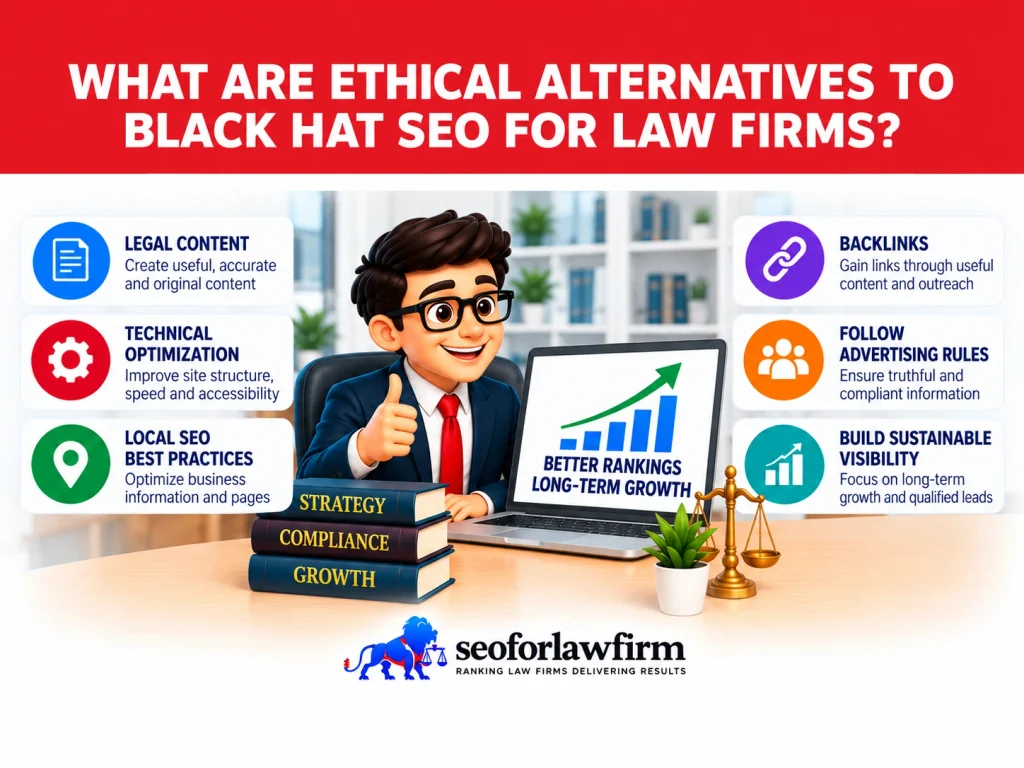
What Are Ethical Alternatives to Black Hat SEO for Law Firms?
Ethical law firm SEO focuses on accurate legal content, legitimate link earning, clear site architecture, and measurable client acquisition rather than ranking manipulation.
Listed below are the 6 main alternatives to black hat SEO.
- People-First Legal Content: Publish accurate, jurisdictionally appropriate information that directly answers client needs.
- Legitimate Link Earning: Build relationships with relevant publications, professional organizations, local media, and useful community resources.
- Technical SEO: Maintain crawlable pages, logical internal links, correct canonicals, reliable rendering, and indexable content.
- Local SEO: Maintain genuine office information, accurate Google Business Profiles, reviews, and location content with real local value.
- Attorney Transparency: Clearly identify relevant attorneys, credentials, experience, and content review where appropriate.
- Performance Measurement: Track Search visibility, qualified calls, forms, consultations, and signed matters rather than artificial authority scores.
How Long Does Recovery From Black Hat SEO Take?
Recovery from black hat SEO has no guaranteed timeline because recovery depends on the violation, cleanup quality, reassessment, and remaining legitimate ranking signals. Google states that sites affected by automated spam systems improve after its systems reassess compliance over a period of months.
Link-spam cleanup also does not restore ranking benefits that came from manipulative links because Google neutralizes those artificial signals. Law firms must not rely on fixed promises such as “30-day penalty recovery” or “90-day authority restoration.” A website may improve after cleanup without returning to its previous rankings if those rankings depended partly on black hat SEO signals.
What Unethical SEO “Quick Wins” Are Commonly Sold to Law Firms?
The unethical SEO “quick wins” commonly sold to law firms include bulk backlinks, private blog networks, guaranteed-ranking promises, and undisclosed manipulative tactics.
Listed below are the 7 warning signs law firms must investigate before hiring an SEO provider.
- “Guaranteed #1 rankings”: No provider controls Google’s organic rankings.
- “Hundreds of backlinks every month”: Link quantity is emphasized without relevance, source quality, editorial reason, or acquisition method.
- “We own a network of authority sites”: The provider may be describing a private link network.
- “We will create hundreds of city pages”: Location expansion is proposed without meaningful local differentiation.
- “You do not need to know how we rank sites”: The provider refuses to explain important tactics.
- “Our AI publishes hundreds of legal pages automatically”: Scale is prioritized over legal accuracy and information value.
- “Your site has thousands of toxic links that must be disavowed immediately”: A third-party toxicity score is being treated as if it were a Google metric.
How Can Lawyers Recover From Black Hat SEO Problems?
Lawyers can recover from black hat SEO problems by identifying the violation, removing manipulative practices, using reconsideration procedures when a manual action exists, and rebuilding the website around compliant SEO.
Listed below are the 7 recovery steps for law firms.
- Check Google Search Console: Review the Manual Actions, Security Issues, Page Indexing, and Search Performance reports.
- Identify the Spam Practice: Determine whether the problem involves links, cloaking, doorway pages, hidden text, scaled content, redirects, or another policy violation.
- Remove On-Site Violations: Delete or rewrite manipulative content, remove hidden elements, correct redirects, consolidate doorway pages, and restore transparent page presentation.
- Review Manipulative Links: Investigate links the firm or a previous SEO provider intentionally created for ranking manipulation.
- Remove or Qualify Problematic Links: Request removal or appropriate link qualification where feasible. Use disavowal only when Google’s conditions justify the tool.
- Request Reconsideration for Manual Actions: Submit a reconsideration request after correcting the violation when Search Console shows a manual action.
- Monitor Recovery: Track indexing, Search impressions, clicks, landing pages, and qualified leads while Google reassesses the corrected website.
A study by Justine Rogers and Anthony Song from the journal Law, Technology and Humans, titled “Digital Marketing in the Legal Profession: What’s Going on and Does it Matter?” in 2023, analyzed the adoption of online technologies by law firms and explored how these digital marketing practices challenge traditional legal professionalism, ethics, and regulatory boundaries.
A law firm content SEO audit helps identify scaled, duplicated, thin, or doorway-style content that requires consolidation, rewriting, or removal, while a technical SEO audit for law firms helps identify redirects, cloaking-like rendering issues, indexing directives, compromised pages, and other technical problems that require separate remediation.