


Billable hours for lawyers are portions of working time spent directly on client legal matters that qualify for invoicing under the engagement agreement, firm billing rules, and client billing guidelines. Billable work includes legal research, drafting motions and agreements, client calls and meetings, depositions, negotiations, document review, court appearances, and other matter-specific legal services.
Annual billable-hour targets often fall between 1,700 and 2,300 hours, depending on firm size, position, compensation structure, and practice environment. An article by Daniel S. Wittenberg from the American Bar Association’s Litigation News, titled “The High Cost of High Expectations” in 2025, reported that the longstanding BigLaw benchmark has hovered around 1,800–2,200 annual hours, with some firms imposing higher productive-hour requirements, contrasting the push for 2,400 billable hours with the industry’s need for attorney well-being and sustainability.
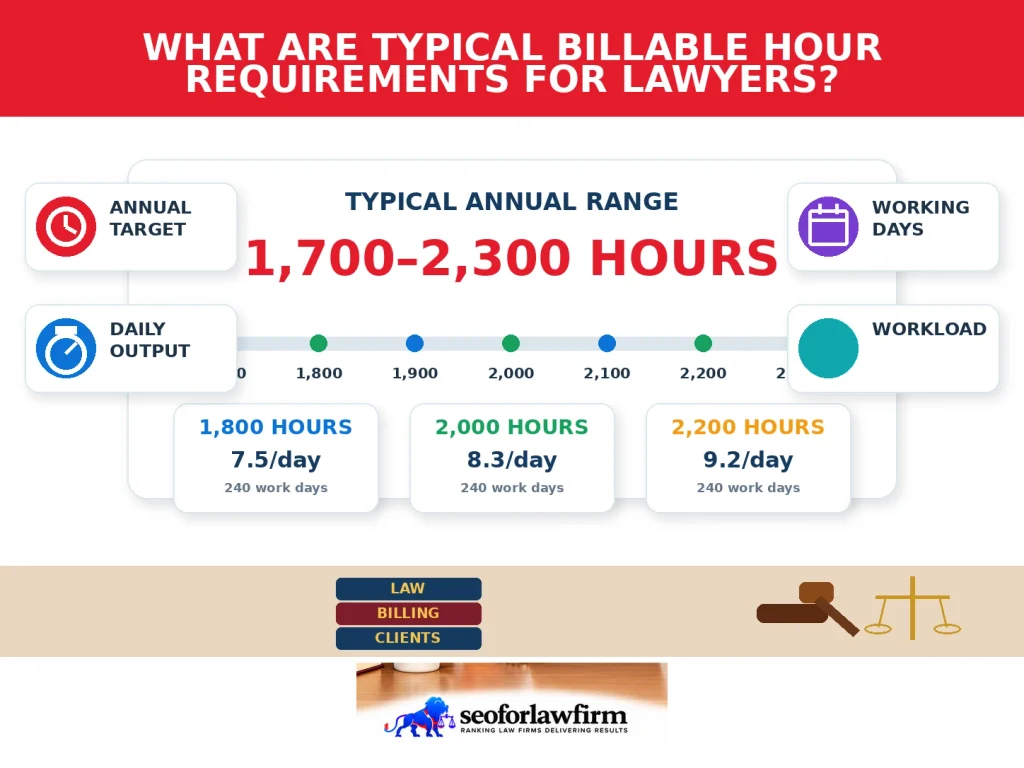
An annual target of 1,800 billable hours requires about 6.9 billable hours for each of 260 weekdays or 7.5 billable hours across 240 working days. A 2,000-hour target requires about 7.7 billable hours across 260 weekdays or 8.3 billable hours across 240 working days. The lawyer’s total working day extends beyond those figures because administration, internal meetings, marketing, professional development, billing, and other non-client responsibilities often do not qualify as billable time.
Billable work differs from non-billable work according to the client agreement and firm policy. Legal research, drafting, case preparation, client communications, depositions, negotiations, and court appearances normally qualify when performed for a client matter. General firm administration, marketing, internal management, billing administration, continuing legal education, and unrelated business development normally remain non-billable.
Most lawyers using hourly billing record work in 0.1-hour or 6-minute increments. A task lasting 1–6 minutes is commonly entered as 0.1 hours, 7–12 minutes as 0.2 hours, and 13–18 minutes as 0.3 hours. Firm policies and outside-client billing guidelines sometimes require different increments. Clio identifies 6-minute increments as the most common legal billing convention.
Ethical billing requires lawyers to charge only for work actually performed. ABA guidance identifies double billing and marking up time as improper practices under professional-conduct rules governing unreasonable fees, dishonesty, fraud, and misrepresentation. ABA Formal Opinion 512 also states that an hourly lawyer who completes work faster through generative AI must bill the actual time spent rather than the amount of time the task previously required.
Time-tracking systems such as Clio and other legal billing platforms record work as it occurs, assign entries to the correct matter, convert minutes into approved billing increments, generate invoices, and report utilization, realization, and collection performance. Accurate tracking matters because recorded billable work does not automatically become billed or collected revenue.
A report by Clio from their annual industry insights series, titled “2025 Legal Trends Report” in 2025, analyzed aggregated and anonymized data from tens of thousands of legal professionals and found that law firms recorded an average 38% utilization rate, 88% realization rate, and 93% collection rate, which translates to approximately 3.0 hours of billable work, 2.6 hours invoiced, and 2.4 hours collected across a standard 8-hour workday.
Table of Contents
- Article sections will appear here.
What Are Billable Hours for Lawyers?
Billable hours for lawyers are time spent performing client-specific legal work that qualifies for a charge under the lawyer’s fee arrangement and billing rules. Billable hours connect legal work to the law firm’s revenue model. For hourly matters, the client charge equals billable time multiplied by the lawyer’s hourly rate.
A lawyer who spends 2.5 billable hours preparing a motion at $400 per hour generates a $1,000 billable charge. The $1,000 represents work eligible for billing rather than collected revenue because the firm must still approve the time entry, issue the invoice, and receive payment.
What Counts as Billable Hours for Lawyers?
Billable hours include client-specific legal work performed in connection with a matter and permitted under the applicable fee agreement and billing guidelines.
Listed below are 8 common types of work that count as billable hours for lawyers.
- Legal research: Researching statutes, regulations, cases, court rules, or legal questions for a client matter.
- Document drafting: Preparing pleadings, motions, contracts, demand letters, discovery requests, briefs, agreements, and other client documents.
- Document review: Reviewing contracts, discovery materials, medical records, evidence, correspondence, or opposing-party submissions.
- Client communication: Conducting client calls, meetings, substantive emails, and case updates related to the representation.
- Court appearances: Attending hearings, conferences, trials, and other proceedings on behalf of the client.
- Depositions and interviews: Preparing for and conducting depositions, witness interviews, and examinations.
- Negotiation: Communicating with opposing counsel, insurers, prosecutors, agencies, or other parties to advance the client’s matter.
- Case preparation: Developing legal arguments, preparing witnesses, analyzing evidence, and planning client-specific strategy.
Whether a task qualifies for billing depends on the engagement terms and client billing guidelines. Corporate and institutional clients often impose detailed restrictions on research, staffing, travel, conferencing, administrative tasks, and billing increments.

What Does Not Count as Billable Hours for Lawyers?
Non-billable hours are working hours that do not qualify for a client charge under the applicable fee arrangement. Non-billable work still contributes to the law firm’s operations, growth, and professional development, but the time does not create a direct client charge. Marketing supports client acquisition, training improves legal skills, and firm management supports internal operations. Billable status measures whether the time is chargeable to a client rather than whether the activity creates business value.
Listed below are 7 common types of non-billable work for lawyers.
- Firm administration: Completing internal paperwork, office management, general scheduling, and administrative activities unrelated to a specific client matter.
- Marketing: Creating general marketing materials, networking, social media activity, advertising, and business-development work.
- Billing administration: Preparing invoices, reviewing general billing reports, and performing internal collections administration.
- Internal management: Participating in general firm-management meetings, hiring discussions, and operational planning.
- Professional development: Attending continuing legal education, training sessions, conferences, and professional-development programs that are not client-chargeable.
- General networking: Participating in bar events, referral meetings, community events, and relationship-development activities.
- Personal or unproductive time: Taking breaks, commuting unrelated to a client matter, handling personal tasks, and experiencing downtime.
What Is the Difference Between Billable Hours and Actual Hours Worked?
Billable hours represent charge-eligible client work, whereas actual hours worked include both billable and non-billable professional activity.
The table below shows the differences between billable hours and actual working hours for lawyers.
| Dimension | Billable Hours | Actual Hours Worked |
| Definition | Client-related time eligible for billing | All professional time spent working |
| Client legal work | Included | Included |
| Firm administration | Usually excluded | Included |
| Marketing and business development | Usually excluded | Included |
| CLE and training | Usually excluded | Included |
| Internal management | Usually excluded | Included |
| Revenue connection | Direct under hourly billing | Indirect or direct |
| Used for associate targets | Yes | Sometimes |
| Used for workload measurement | Yes | Yes |
How Do Billable Hours Affect Law Firm Profitability?
Billable hours affect law firm profitability through the interaction of time captured, billing rate, realization, collection, staffing cost, and matter overhead. Recorded hours alone do not determine profit because the firm must convert billable work into invoiced and collected revenue. For example, 1,800 billable hours at a $400 hourly rate create $720,000 in potential billable value.
At an 88% realization rate, the firm invoices $633,600, and at a 93% collection rate, the firm collects approximately $589,248. The difference between $720,000 in recorded value and $589,248 in collected revenue shows why billing performance matters alongside annual hour targets. A broader law firm profitability strategy connects billable output with attorney compensation, staff costs, overhead, realization, collections, and matter economics.
Listed below are the 6 main factors that connect billable hours with law firm profitability.
- Billable hours: The amount of client work recorded as chargeable time.
- Hourly rate: The amount assigned to each billable hour.
- Realization rate: The percentage of recorded billable value that reaches the client invoice.
- Collection rate: The percentage of invoiced value that the firm actually receives.
- Staffing cost: The compensation and employment costs associated with attorneys, paralegals, and support staff.
- Matter overhead: The operating expenses required to support and deliver legal services.
How Do Billable Hours Affect Lawyer Workload?
Billable-hour targets increase total workload because lawyers must complete billable client work alongside administrative, professional, management, and business-development responsibilities.
An 1,800-hour target requires about 7.5 billable hours across 240 working days. A 2,000-hour target requires about 8.3 billable hours across the same schedule.
An article by Daniel S. Wittenberg in the American Bar Association’s Litigation News, titled “The High Cost of High Expectations,” confirms that longstanding BigLaw benchmarks have traditionally hovered around 1,800 to 2,200 annual hours while examining the implications of firms pushing toward 2,400 productive-hour requirements. You can read the full analysis at the American Bar Association.
Firms evaluating workload need to measure actual hours, billable hours, utilization, staffing demands, matter deadlines, and non-billable responsibilities rather than judging workload from the annual billable target alone.
How Do Billable Hours Affect Staffing and Capacity?
Billable-hour data helps law firms determine whether lawyers have available capacity, whether work is distributed unevenly, and whether the firm needs additional attorneys or support staff.
Listed below are 5 staffing questions that billable-hour data helps law firms answer.
- Which lawyers consistently operate near or above capacity?
- Which practice groups have enough billable demand to support another hire?
- Which lawyers spend excessive time on administrative work?
- Which tasks belong with paralegals or other appropriate staff?
- Which matters consume more lawyer time than their revenue supports?
A high billing target paired with low matter demand creates a different management problem from a high billing target paired with excessive client work.
What Are Typical Billable Hour Requirements for Lawyers?
Typical annual billable-hour requirements range from approximately 1,700 to 2,300 hours, with many law-firm associate targets concentrated around 1,800–2,000 hours and high-demand large-firm environments reaching 2,000–2,200 hours or more.
An article by Daniel S. Wittenberg from the American Bar Association’s Litigation News, titled “The High Cost of High Expectations” in 2025, reported that the longstanding BigLaw benchmark has hovered around 1,800–2,200 annual hours, with some firms implementing up to 2,400 productive-hour expectations, which aligns with an industry update by the National Association for Law Placement (NALP), titled “Update on Associate Hours Worked” in 2016, which analyzed historical data across legal directories and found an average annual requirement of 1,892 hours overall and 1,930 hours among firms with more than 700 attorneys.
The table below shows the approximate daily billable output required to reach common annual billable-hour targets.
| Annual Target | Average Across 260 Weekdays | Average Across 240 Working Days |
| 1,700 hours | 6.5 hours/day | 7.1 hours/day |
| 1,800 hours | 6.9 hours/day | 7.5 hours/day |
| 1,900 hours | 7.3 hours/day | 7.9 hours/day |
| 2,000 hours | 7.7 hours/day | 8.3 hours/day |
| 2,100 hours | 8.1 hours/day | 8.8 hours/day |
| 2,200 hours | 8.5 hours/day | 9.2 hours/day |
| 2,300 hours | 8.8 hours/day | 9.6 hours/day |
How Does the Billable Hour Work for Lawyers?
The billable hour works by recording the actual time spent on eligible client work, converting that time into the firm’s approved billing increment, applying the lawyer’s hourly rate, and placing the approved entry on the client invoice. The process connects completed legal work with the amount charged to the client. For example, 30 minutes of billable work equals 0.5 hours, and at an hourly rate of $400, the client charge equals $200.
Listed below are the 5 steps in the law firm billable-hour process.
- Perform the client work: The lawyer completes research, drafting, communication, negotiation, court work, or another eligible task.
- Record the actual time: The lawyer records the task and elapsed time against the correct client and matter.
- Convert time into the approved increment: The billing system converts minutes into approved increments such as 0.1 hours.
- Apply the billing rate: The recorded time is multiplied by the attorney, paralegal, or staff billing rate.
- Review and invoice the entry: The firm reviews the entry against client billing rules before placing the approved charge on the invoice.
What Strategies Improve Billable Hour Realization?
Billable-hour realization improves when law firms capture time accurately, apply client billing rules before invoicing, reduce write-downs, and issue invoices consistently. Strong realization depends on converting recorded billable work into approved invoice value with minimal deductions.
Law firms improve realization by reducing time-entry errors, following client-specific billing requirements, reviewing pre-bills quickly, and identifying recurring causes of write-downs.
Listed below are 5 strategies that improve billable-hour realization.
- Record time contemporaneously: Prompt time entries reduce forgotten tasks, estimation errors, and inaccurate reconstruction.
- Follow client billing guidelines: Correct staffing, task codes, narratives, and expense treatment reduce invoice deductions and rejected charges.
- Write clear billing narratives: Specific descriptions explain the work performed without disclosing inappropriate confidential information.
- Review pre-bills promptly: Fast pre-bill review reduces invoicing delays and resolves time-entry problems before invoices reach clients.
- Measure write-down patterns: Recurring write-downs by matter, client, attorney, or task reveal pricing, staffing, and workflow problems that reduce realization.
What Are the Ethical Rules for Lawyer Billable Hours?
Lawyers must bill actual work accurately, charge reasonable fees, avoid double billing, and avoid inflating time entries. ABA guidance identifies double billing and time inflation as unethical hourly-billing practices. Double billing occurs when a lawyer charges 2 clients for the same period of time, while time inflation occurs when a lawyer records more time than the task actually required.
For example, a lawyer who spends 2 hours traveling for Client A while drafting for Client B during the same 2-hour period cannot automatically bill both clients for 2 full hours. A lawyer who spends 2 hours adapting an existing brief also cannot record 4 hours merely because drafting the document from the beginning would have required 4 hours.
A formal ethics directive by the American Bar Association Standing Committee on Ethics and Professional Responsibility, titled “Formal Opinion 512: Generative Artificial Intelligence Tools” in 2024, analyzed the ethical integration of AI in practice and established that under Model Rule 1.5, attorneys billing by the hour must bill only for their actual time spent; consequently, if an AI tool compresses a four-hour drafting task into 15 minutes, the lawyer may only bill for those 15 minutes plus any time subsequently spent reviewing, refining, and correcting the output.
What Is Utilization Rate for Lawyers?
Utilization rate for lawyers is the percentage of available working time recorded as billable work. Law firms calculate utilization rate by dividing billable hours worked by available working hours and multiplying the result by 100. A lawyer who works an 8-hour day and records 4 billable hours has a 50% utilization rate.
According to Clio’s 2025 Legal Trends Report, the average law firm utilization rate stands at 38%, which equates to approximately 3.0 billable hours in a standard eight-hour workday. This metric serves as an aggregated operational benchmark across the company’s dataset rather than a mandated individual billable-hour requirement for firm associates.
What Is the Realization Rate in Billable Hours?
Realization rate is the percentage of recorded billable work that a law firm actually places on client invoices. Law firms calculate realization rate by dividing the billable value invoiced by the billable value worked and multiplying the result by 100. A lawyer who records $10,000 in billable work and has $8,800 invoiced after write-downs and billing adjustments has an 88% realization rate. According to Clio’s 2025 Legal Trends Report, the average law firm realization rate was 88%. Realization rate measures how much recorded billable value reaches the invoice, not how much money clients actually pay, which is measured by the collection rate.
What Is the Collection Rate for Billable Hours?
Collection rate is the percentage of invoiced work that clients actually pay. Law firms calculate collection rate by dividing the amount collected by the amount invoiced and multiplying the result by 100.
A report by Clio from their annual industry insights series, titled “2025 Legal Trends Report” in 2025, analyzed aggregated and anonymized operational data from tens of thousands of legal professionals and established that law firms achieved a 93% average collection rate, faced a median collection lockup of 32 days, and experienced a median total lockup of 93 days, highlighting how much completed legal work remains unbilled or unpaid over time.
Billable hours measure eligible client work performed, billed hours measure approved work placed on invoices, and collected hours measure invoiced work converted into client payments. These stages form a revenue funnel that moves legal work from timekeeping to invoicing and then to payment. Clio’s 2025 averages illustrate this progression: an 8-hour workday produced about 3.0 billable hours, 2.6 invoiced hours, and 2.4 collected hours, corresponding with a 38% utilization rate, 88% realization rate, and 93% collection rate.
The table below shows the differences between billable, billed, and collected hours:
| Hour Type | Definition | Workflow Stage | Main Metric |
| Billable hours | Client work eligible for a charge | Timekeeping | Utilization |
| Billed hours | Approved billable work placed on an invoice | Invoicing | Realization |
| Collected hours | Invoiced work represented by payment received | Collections | Collection |
| Non-billable hours | Professional work not charged to a client | Operations | Capacity and workload |
How Do Lawyers Improve Billable Time Capture?
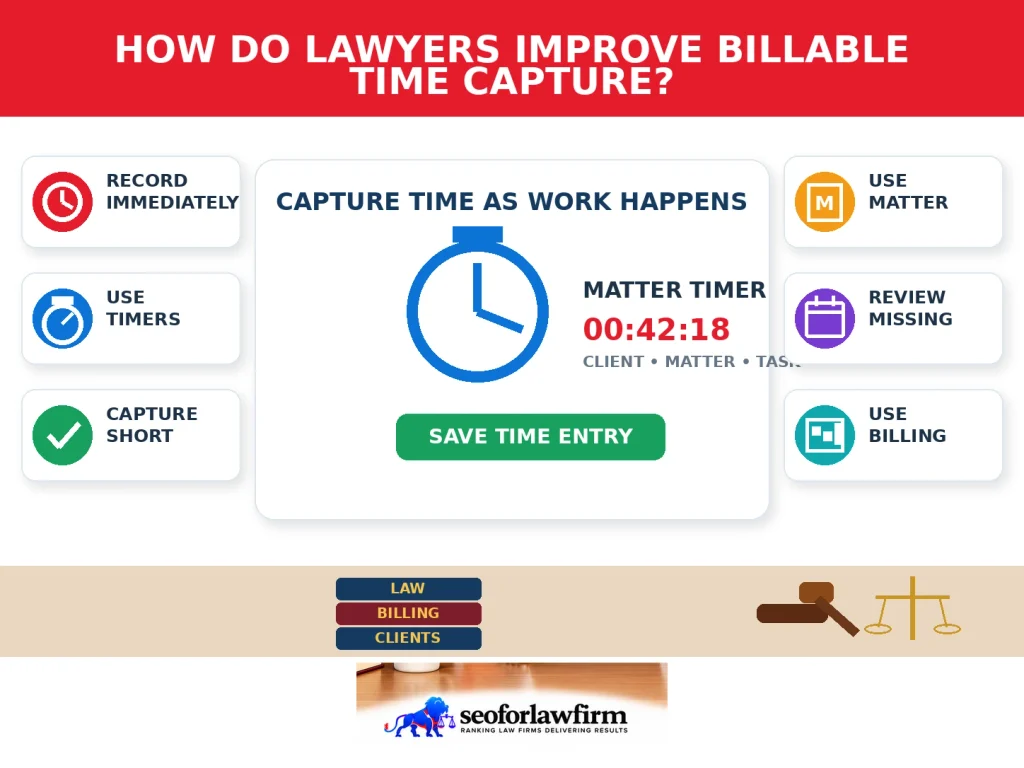
Lawyers improve billable time capture by recording work as it occurs, using matter-specific timers, writing clear narratives, and reducing manual reconstruction of timesheets.
Listed below are 6 strategies lawyers use to improve billable time capture.
- Record time immediately: Enter the task when it occurs rather than reconstructing the day several days later.
- Use timers: Start and stop a matter timer during research, drafting, calls, meetings, and review work.
- Capture short tasks: Record eligible emails, brief calls, document reviews, and other short activities instead of overlooking them.
- Use clear matter codes: Assign each time entry to the correct client, matter, attorney, and task category.
- Review missing time daily: Compare calendar events, emails, documents, and calls with time entries before ending the workday.
- Use legal billing software: Automated or integrated tracking reduces reliance on memory.
A legal billing and time-tracking system connects time entries with matters, billing rates, invoices, payments, and financial reporting.
How Do Law Firms Reduce Non-Billable Administrative Time?
Law firms reduce non-billable administrative time by standardizing repeatable processes, delegating appropriate work, and automating intake, document creation, scheduling, billing, and client communication. These changes shift routine administrative work away from attorneys and preserve more time for legal analysis, client communication, drafting, negotiation, and other client-specific work. Using law firm automation tools for predictable workflows helps firms reduce repetitive manual tasks without changing the ethical rules that govern hourly billing. ABA Formal Opinion 512 states that hourly billing remains tied to actual time spent, so faster technology does not justify billing hypothetical manual time.
Listed below are 6 administrative areas law firms reduce through process improvement and automation.
- Client intake and data entry: Standardized forms and connected systems reduce repetitive manual information entry.
- Appointment scheduling: Automated scheduling tools reduce back-and-forth coordination.
- Document assembly: Templates and document automation reduce repetitive drafting for standardized materials.
- Routine client reminders: Automated notifications reduce manual follow-up for appointments, deadlines, and document requests.
- Time-entry administration: Integrated timekeeping systems reduce manual recording and correction work.
- Invoice generation and payment reminders: Billing software reduces repetitive invoice preparation and payment follow-up.
How Do Law Firms Reduce Billing Disputes?
Law firms reduce billing disputes by defining billing terms before representation, communicating material cost changes, and reviewing invoices before sending them.
Listed below are 7 practices law firms use to reduce client disputes over billable time.
- Define billing terms: State rates, increments, expenses, staffing, retainers, and payment terms in the engagement agreement.
- Use specific time entries: Describe the legal task rather than using vague language such as “work on file.”
- Avoid improper block billing: Separate materially different tasks when client guidelines require itemized entries.
- Communicate scope changes: Explain substantial new work before the resulting charges surprise the client.
- Review invoices internally: Identify duplicate entries, mistakes, excessive time, and guideline violations before transmission.
- Provide regular billing: Smaller, predictable invoices give clients a clearer view of developing costs.
- Use alternative fee arrangements where appropriate: Flat fees, capped fees, blended rates, and other pricing structures provide greater cost predictability for suitable matters.
Are Billable Hours Still Used by Modern Law Firms?
Yes, billable hours remain widely used by law firms for hourly matters, attorney-performance tracking, matter costing, and profitability analysis. Hourly billing remains particularly relevant when the amount of legal work is difficult to predict in advance, although law firms also use flat fees, capped fees, contingency fees, subscription arrangements, blended rates, and other alternative fee arrangements.
Time tracking still provides useful profitability information under non-hourly pricing because a firm charging a $5,000 flat fee needs to know whether the matter requires 5 lawyer hours or 30 lawyer hours before judging the fee’s financial performance.
