


Building local citations for a law firm means publishing accurate information about the firm’s Name, Address, and Phone number (NAP) across external websites, maps, legal directories, and business platforms. Citation building gives prospective clients several reliable places to verify where the firm operates and how to contact it.
A law firm must establish one authoritative version of its business name, physical address, primary phone number, website URL, and office information before creating new listings. The same underlying business information must remain accurate across every platform, even when individual directories display abbreviations or formatting differently.
A citation campaign must begin with an audit of existing listings. Old addresses, previous firm names, disconnected phone numbers, duplicate profiles, incorrect website URLs, and former office locations must be identified and corrected before the firm adds more citations.
Law firms must claim and maintain their primary business profiles first. Google Business Profile controls business information shown across Google Search and Maps, Apple Business Connect manages business information across Apple Maps and other Apple surfaces, and Bing Places for Business manages listings displayed in Bing Maps. Google states that complete and accurate business information makes a business more likely to appear for relevant local searches.
Legal directories form the next citation layer. Avvo, Justia, Martindale-Hubbell, FindLaw, state bar directories, local bar associations, and other legitimate legal platforms connect attorney and law firm information with practice areas and geographic locations. Justia, for example, allows attorneys to claim profiles containing contact details, practice areas, professional experience, education, associations, and website links. Martindale-Hubbell also maintains a large searchable directory of attorneys and law firms.
General business platforms add another source of location and contact information. Yelp, Bing Places, Better Business Bureau profiles, Apple Maps, chambers of commerce, and credible regional business directories give clients and search systems more places to find current business details. BBB permits businesses to claim or request business profiles containing addresses, phone numbers, websites, services, and other company information.
Citations support local search because Google evaluates information about businesses from across the web. Google states that local results are mainly based on relevance, distance, and prominence and that prominence incorporates information such as links, articles, and directories. Citations remain one part of local search rather than a standalone ranking system.
Consistent business information also gives search and AI systems clearer entity information to work with. A study by Darren Shaw from the Whitespark platform, titled “The 2026 Local Search Ranking Factors Report” in 2026, confirms that local directory citations serve as a critical signal layer for establishing foundational geographic prominence.
Table of Contents
- Article sections will appear here.
What Is Citation Building for Law Firms?
Citation building for law firms is the process of creating, claiming, correcting, and maintaining external business listings that identify the law firm or attorney across relevant platforms. A basic citation usually includes the law firm name, street address, and phone number, while a more complete listing also includes the website URL, business hours, practice areas, attorney names, office description, email address, photos, and business categories.
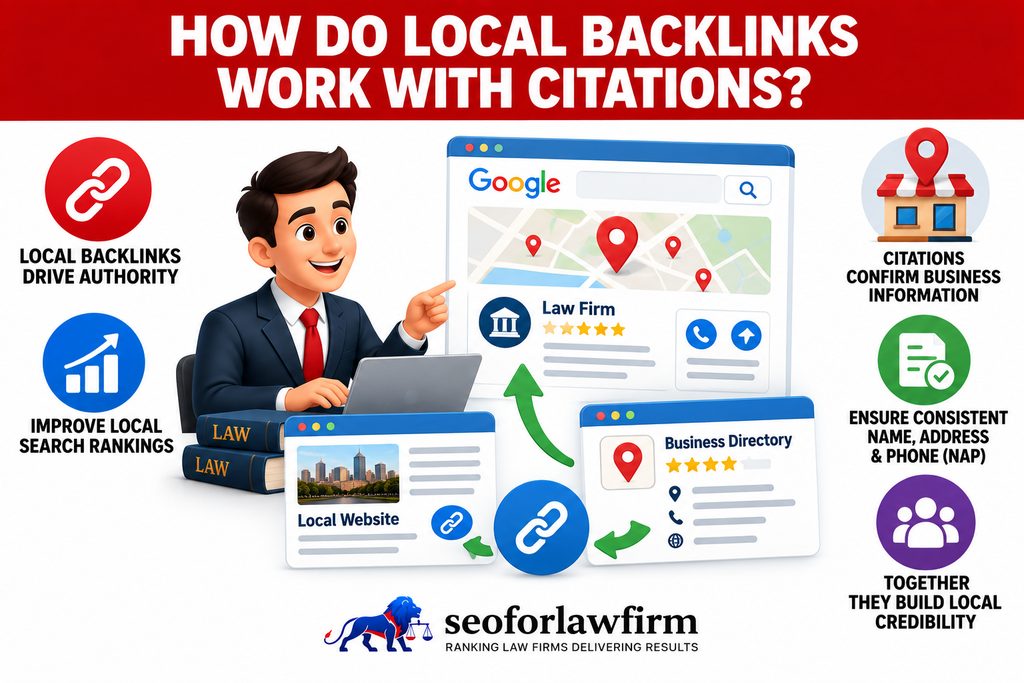
Citation building differs from link building because a citation identifies the business on another platform, while a backlink creates a clickable path to the firm’s website. Some citations include backlinks, but a business listing does not need a clickable link to function as a citation.
Why Are Local Citations Important for Law Firms?
Local citations are important for law firms because they distribute accurate business information across the websites and platforms prospective clients use to find, compare, and contact attorneys. Citations also reinforce the firm’s name, location, phone number, website, and geographic presence across external sources.
Accurate listings support local discovery, referral traffic, and consistent business information, while outdated listings send prospective clients to former addresses, disconnected numbers, or obsolete websites. According to research by BrightLocal titled Consumer Search Behavior in 2025, 85% of consumers considered contact information and opening hours important when researching local businesses, supporting the practical value of accurate citation data. Citations work alongside Google Business Profile, reviews, website SEO, backlinks, and local content rather than replacing those local-search signals.
Listed below are the 5 main functions local citations perform for law firms.
- Confirm business information. Citations repeat the firm’s current name, address, phone number, and website across relevant external platforms.
- Support local discovery. Listings place the firm on maps, legal directories, review platforms, and business websites used by prospective clients.
- Support geographic relevance. Office and location information connects the law firm with the city, county, or market where it operates.
- Generate referral traffic. Legal directories and business platforms give users another path to the firm’s website, phone number, or profile.
- Reduce client confusion. Accurate listings prevent prospective clients from encountering outdated addresses, disconnected telephone numbers, or obsolete websites.
How Do Citations Affect Google Maps Rankings for Law Firms?
Citations support Google Maps visibility by providing external information about a law firm’s identity, location, and business details, but citation count alone does not determine Maps rankings. Citation building works best as part of a broader local SEO strategy for law firms that combines accurate business data, qualified office locations, reviews, website relevance, and local authority.
Google describes local ranking through relevance, distance, and prominence, and citation work contributes differently to each category. According to the Moz survey titled 2018 Local Search Ranking Factors, Google Business Profile signals represented 25% of the factors experts associated with local-pack rankings, illustrating why citation work should support rather than replace stronger local business and relevance signals. Accurate categories and legal-directory profiles support relevance, correct addresses reduce geographic confusion, and directory presence contributes information about the firm’s prominence.
The table below shows how citation work relates to the 3 main local ranking categories.
| Local Ranking Category | What Google Evaluates | How Citation Work Relates |
| Relevance | How closely the Business Profile matches the search | Accurate categories, services, legal-directory profiles, and business details reinforce what the law firm does |
| Distance | How far the business is from the searcher or specified location | Correct office addresses reduce geographic confusion and reinforce the firm’s actual location |
| Prominence | How well known the business is | Directories, links, articles, reviews, and broader web visibility contribute information about the firm’s prominence |
How Should a Law Firm Establish Its NAP Before Building Citations?
A law firm should establish one authoritative NAP record before building citations so every listing uses the same current business identity. A complete NAP consistency audit must verify factual accuracy across the firm name, address, phone number, website, hours, categories, practice areas, and attorney information before citation work begins.
NAP consistency does not require identical punctuation or abbreviations across every platform because formats such as “123 Main Street” and “123 Main St.” still identify the same address. More serious problems include incorrect addresses, disconnected phone numbers, former firm names, outdated websites, nonexistent offices, or conflicting location information. The law firm must therefore establish one approved source-of-truth record and use that record for every new, claimed, or corrected citation.
The table below shows the business information a law firm must standardize before citation building.
| Business Field | Information to Standardize |
| Firm name | Current real-world law firm name |
| Address | Current qualified office address |
| Suite | Correct suite, floor, or unit where applicable |
| Phone | Primary office phone number |
| Website | Canonical office or firm URL |
| Hours | Current client-facing business hours |
| Category | Accurate primary legal category |
| Practice areas | Legal services genuinely offered by the office |
| Attorney information | Current attorneys associated with the office |
How Do Law Firms Audit Existing Citations?
Law firms audit existing citations by finding major external listings and documenting inaccurate, duplicate, outdated, or missing information. The audit must begin before large-scale citation creation because new listings built from incorrect data multiply the cleanup problem.
Firm-name searches identify profiles created under current and former names, while phone-number and address searches reveal forgotten listings or duplicates. Major map platforms and legal directories deserve direct review because these sources frequently appear during local attorney searches. Every discrepancy must be recorded so the firm can prioritize corrections according to visibility and business impact.
Listed below are the 7 steps law firms must follow when auditing existing citations.
- Create the source-of-truth record. Document the approved firm name, address, phone number, URL, business hours, and office details.
- Search the law firm name. Search current and former firm names to identify existing external profiles.
- Search each phone number. Current and previous phone numbers reveal forgotten or duplicate listings.
- Search each address. Review current and former office addresses for active profiles and outdated business records.
- Review primary platforms. Inspect Google Business Profile, Apple Business Connect, Bing Places, and other major map listings.
- Review legal directories. Check Avvo, Justia, Martindale-Hubbell, FindLaw, state bar directories, and relevant local bar profiles.
- Record every discrepancy. Document incorrect NAP information, duplicates, outdated URLs, closed offices, inaccurate attorneys, wrong practice areas, and unclaimed listings.
What Are The Best Citation Sources for Law Firms?
The best citation sources for law firms are Google Business Profile, Bing Places, Yelp, Avvo, FindLaw, and Justia, as these platforms improve local visibility, authority, and client trust. High-quality citations enhance search engine credibility and attract more potential clients through accurate, verified listings.
Listed below are the 7 best citation sources for law firms.
- Google Business Profile: primary platform for local SEO and map pack visibility.
- Bing Places: broadens presence across non-Google search ecosystems.
- Yelp: enhances consumer confidence through verified reviews and ratings.
- Avvo: legal-specific directory that builds niche authority for attorneys.
- FindLaw: established legal platform featuring detailed practice area listings.
- Justia: trusted for law firm profiles, case summaries, and citation authority.
- Better Business Bureau (BBB): adds credibility and trust signals recognised by both users and search engines.
Avoid inconsistent NAP details, duplicate profiles, and outdated information, as these citation mistakes weaken SEO and client trust.

How Do Law Firms Fix Incorrect Citations?
Law firms fix incorrect citations by updating the listing at its source, completing any required verification, and confirming that the corrected profile remains active. High-visibility platforms must receive attention first because inaccurate information on Google Business Profile, Apple Maps, Bing Maps, major legal directories, state bar directories, and frequently used local platforms creates greater client and search confusion than errors on obscure websites.
Each correction must replace outdated information with the law firm’s approved source-of-truth data. The firm must also monitor corrected listings because external platforms update business information over time when other sources indicate that existing data is outdated or inaccurate.
Listed below are the 9 main citation errors law firms must correct.
- Old office addresses. Replace former locations with the firm’s current qualified office address.
- Disconnected phone numbers. Update inactive numbers with the current primary office telephone number.
- Former firm names. Replace outdated business identities with the firm’s current real-world name.
- Incorrect website URLs. Direct listings to the firm’s current canonical website or appropriate office page.
- Wrong business categories. Select categories that accurately describe the firm and its legal services.
- Former partners. Remove attorneys who are no longer associated with the office where the listing appears.
- Closed locations. Mark former offices correctly rather than leaving inactive locations presented as active.
- Incorrect hours. Update listings with current client-facing office hours.
- Duplicate profiles. Merge, remove, or correct duplicate listings so users encounter one accurate business record.
Should NAP Information Be Exactly Identical on Every Citation?
No, NAP information does not need to be character-for-character identical on every citation, but every listing must represent the same real-world law firm accurately. Formatting differences such as “Street” versus “St.,” “Suite 400” versus “Ste. 400,” or different phone-number punctuation do not change the underlying business information.
Problems arise when citations contain materially different data, such as former office addresses, unrelated telephone numbers, incorrect suite numbers, outdated websites, keyword-stuffed business names, different business entities, or closed locations presented as active. Law firms must prioritize factual consistency over cosmetic formatting so users and search platforms encounter the same business identity across external sources.
Listed below are the 7 main citation inconsistencies law firms must correct.
- Different unrelated phone numbers. Every listed number must connect users with the correct office or approved firm contact point.
- Former office addresses. Listings must reflect the firm’s current qualified location rather than an office the firm no longer occupies.
- Keyword-stuffed business names. Citation names must represent the firm’s real-world business identity rather than add promotional keywords.
- Wrong suite numbers. Incorrect floor, suite, or unit information creates location confusion.
- Outdated websites. Citations must direct users to the current firm or office URL.
- Different business entities. Listings must accurately identify the actual law firm associated with the office.
- Closed locations shown as open. Former offices must not remain presented as active client-facing locations.
Which Citation Sources Should Law Firms Prioritize?
Law firms should prioritize citation sources according to platform reach, legal relevance, geographic relevance, accuracy controls, and prospective-client usage. Primary search platforms and major legal directories deserve early attention because they influence how users discover, verify, and contact law firms.
Professional organizations and local business platforms provide additional verification and geographic context, while niche directories are useful only when they have genuine relevance and active audiences. Citation quality therefore matters more than creating profiles across hundreds of low-value directories.
The table below shows the citation categories law firms must prioritize.
| Citation Category | Representative Sources | Main Purpose |
| Primary search and maps | Google Business Profile, Apple Business Connect, Bing Places | Business discovery across major search and map ecosystems |
| Legal directories | Avvo, Justia, Martindale-Hubbell, FindLaw | Attorney and law firm discovery by practice area and location |
| Professional organizations | State bar, local bar associations | Professional and geographic verification |
| General business directories | Yelp, BBB | Broad business discovery and client verification |
| Local organizations | Chambers of commerce, regional business organizations | Local business presence |
| Relevant niche directories | Legitimate practice-specific directories | Practice-area discovery where the platform has real users |
How can law firms audit, fix, and monitor citations for ongoing Maps performance?
Law firms can audit, fix, and monitor citations for ongoing Maps performance by following a structured, end-to-end citation management process that cleans existing data, consolidates entity trust, and prevents future inconsistencies.
Listed below are the 10 steps to build accurate local citations for law firms.
- Run a Full Citation Audit: Identify every existing listing across core platforms (Google Business Profile, Apple Maps, Bing), legal directories (Avvo, Justia, FindLaw), and local business sites by using citation tools and manual brand searches.
- Verify NAP Accuracy Against a Single Source of Truth: Standardise the firm’s exact business name, address format, phone number, website URL, and suite formatting so every listing matches one authoritative reference.
- Identify and Flag Duplicate Listings: Locate duplicates created by old office locations, name variations, practitioner vs. firm profiles, data aggregators, or automated directory submissions.
- Suppress or Merge Duplicate Citations: Request removals or merges directly with platforms and aggregators to eliminate conflicting entity signals that weaken Google Maps trust and local authority.
- Correct Inconsistent Listings: Update incorrect NAP data, categories, descriptions, photos, and URLs across all priority directories to restore consistency and credibility.
- Prioritise Core and Legal Citations First: Focus cleanup efforts on the highest-impact platforms, Google Business Profile, Apple Maps, Bing, Yelp, Avvo, Justia, FindLaw, before secondary local listings.
- Build Missing High-Authority Citations: Add the firm to reputable legal directories, bar associations, chambers of commerce, and trusted local business platforms where authoritative citations are missing.
- Align Categories and Practice Areas: Ensure citation categories and service descriptions accurately reflect the firm’s primary practice areas to reinforce topical relevance in local search.
- Set Up Ongoing Citation Monitoring: Use citation monitoring tools or quarterly manual reviews to catch new inconsistencies, auto-generated listings, or data-aggregator errors before they impact rankings.
- Review Maps Performance Trends: Track Google Maps impressions, profile views, calls, and direction requests in Google Business Profile Insights to confirm that citation cleanup is strengthening local visibility.
Local SEO studies consistently show that businesses with clean, consistent citations and suppressed duplicates significantly outperform unmanaged listings in Google Maps and Local Pack rankings, seeing measurable lifts in map visibility once citation conflicts are removed.
Why Should Law Firms Claim Google Business Profile First?
Law firms should claim and verify Google Business Profile early because the profile supplies business information directly to Google Search and Maps and gives the firm control over its primary Google local presence. Complete and accurate profile information helps Google connect the business with relevant local searches and gives prospective clients direct access to the firm’s address, phone number, website, hours, services, photos, and reviews.
Google Business Profile also requires accurate real-world business information and applies location rules to offices and duplicate profiles. The profile therefore deserves separate management from ordinary directory citations because it functions as a direct Google business-data source.
Listed below are the 9 main Google Business Profile elements law firms must maintain.
- Correct real-world business name. The profile must use the firm’s actual business identity.
- Qualified office address. The listed location must meet Google’s applicable business-location requirements.
- Current phone number. The number must connect prospective clients with the active office.
- Correct website. The profile must link to the current firm or appropriate office page.
- Accurate business category. The category must reflect the legal service or firm type accurately.
- Current hours. Business hours must match actual client-facing availability.
- Relevant services. Listed services must reflect legal work genuinely provided by the firm.
- Photos. Current and accurate images help users evaluate the office and business.
- Genuine reviews. Authentic client feedback supports reputation visibility and prospective-client evaluation.
Which Legal Directories Should Law Firms Use?
Law firms should use established legal directories that publish real attorney profiles, practice-area information, geographic information, and accurate contact details used by prospective clients. A focused legal directory optimization process must prioritize complete attorney and firm data over sheer listing quantity.
Established directories help prospective clients verify attorneys, compare practice areas, review professional information, and locate firms within a relevant jurisdiction. Profiles must use accurate business and attorney information rather than keyword-loaded descriptions.
Listed below are the 5 legal citation sources law firms must evaluate first.
- Avvo. Avvo provides attorney profiles organized around lawyers, legal services, ratings, and geographic location.
- Justia. Justia provides attorney and law firm profiles with practice areas, contact information, education, professional experience, associations, and website links.
- Martindale-Hubbell. Martindale-Hubbell provides attorney and law firm directory profiles organized by practice area and location.
- FindLaw. FindLaw provides attorney-discovery and legal-directory profiles that connect prospective clients with relevant legal providers.
- State and local bar directories. Bar directories connect attorney information with the lawyer’s licensed jurisdiction or local professional community.
Which General Business Directories Matter for Law Firms?
General business directories matter for law firms when they support genuine business discovery, local information, reviews, or location verification. Law firms must prioritize platforms with real audiences, established reputations, geographic relevance, and reliable profile-management controls.
General directories supplement legal directories by giving prospective clients another source for checking the firm’s address, phone number, website, hours, reviews, and services. Directories created primarily for mass SEO submissions provide less practical value than platforms people actually use.
Listed below are the 6 main general business directories law firms must evaluate.
- Yelp. Yelp provides local business discovery, reviews, contact information, and location details.
- Better Business Bureau. BBB profiles include business addresses, telephone numbers, websites, services, hours, and company information.
- Bing Places. Bing Places distributes local business information through Bing’s search and map ecosystem.
- Apple Maps. Apple Maps helps users discover and contact businesses through Apple devices and mapping services.
- Local chambers of commerce. Chamber listings support local business visibility and geographic association.
- Reputable regional directories. Regional platforms provide useful local exposure when they have genuine users and accurate business-data controls.
What are Local Business Citations for Law Firms
Local business citations for law firms are structured mentions of a firm’s Name, Address, and Phone number (NAP) across online directories, review platforms, and mapping services. These citations help confirm a firm’s legitimacy and geographic authority in local search results.
General citation sources, like Yelp, Better Business Bureau (BBB), and Bing Places, expand overall visibility across the web, while legal-specific citations on platforms such as Avvo and Justia strengthen niche authority within the legal industry.
Both general and legal-specific citations work together to validate business information, improve local SEO rankings, and build client trust by ensuring consistent, accurate firm details across all platforms.
Which Citation-Building Mistakes Should Law Firms Avoid?
Law firms should avoid citation-building practices that create inaccurate business information, duplicate entities, fake locations, or large volumes of low-value listings. Citation work must reinforce one accurate business identity rather than multiply conflicting profiles.
Firms must audit existing listings before creating new ones, maintain separate records for genuine office locations, and update profiles after relocations, rebrands, mergers, or attorney departures. Citation quality and factual accuracy provide more value than indiscriminate directory volume.
Listed below are the 8 citation-building mistakes law firms must avoid.
- Building citations before completing an audit. New listings multiply existing address, phone, website, or business-name errors.
- Using keyword-stuffed business names. Directory profiles must represent the firm’s genuine business identity rather than add promotional search terms.
- Listing virtual offices as genuine offices. Business locations must satisfy the applicable platform’s eligibility requirements.
- Creating duplicate Google Business Profiles. Duplicate profiles create conflicting business information and management problems.
- Using outdated phone numbers. Old numbers prevent prospective clients from reaching the firm.
- Mixing office information. Multi-office firms must maintain separate addresses, phone numbers, attorneys, and URLs for each genuine location.
- Submitting to every available directory. Large numbers of low-value profiles do not replace accurate listings on relevant platforms.
- Ignoring attorney departures and rebrands. Profiles must be updated when attorneys, firm names, ownership, or other material business information changes.
How Often Should Law Firms Audit Their Citations?
Law firms should audit major citations whenever business information changes and conduct recurring reviews to identify inaccurate, outdated, or duplicate listings. Firms with several locations or active local SEO campaigns use a quarterly review as a practical maintenance schedule.
Smaller firms with stable business information review citations less frequently while performing immediate checks after any material change. The audit must focus on factual accuracy across high-visibility maps, legal directories, professional profiles, and local business platforms.
Listed below are the 9 business changes that must trigger an immediate citation review.
- Office relocation. Update the address across major listings and remove or correct former location profiles.
- New office opening. Create accurate records for the new genuine location across relevant platforms.
- Office closure. Mark closed locations appropriately so clients do not encounter inactive offices.
- Firm rebrand. Update the business name, website, branding, and related profile information.
- Phone number change. Replace outdated numbers before they cause client-contact failures.
- Website migration. Update citations that still point to former domains or outdated URLs.
- Partner departure. Remove or revise attorney associations where the departing lawyer no longer belongs.
- Merger. Reconcile predecessor listings with the current business entity and office structure.
- Change in business hours. Update client-facing hours across relevant local platforms.
Which Tools Help Law Firms Manage Citations?
Citation-management tools help law firms find listings, identify inconsistencies, monitor changes, and manage business information across multiple platforms. Automated tools reduce manual research and maintenance, but they do not replace direct verification of high-value profiles.
Google Business Profile, Apple Business Connect, Bing Places, state bar profiles, and major legal directories require individual attention because each platform maintains its own eligibility rules, fields, and profile structure.
Listed below are the 4 common citation-management tools law firms evaluate.
- BrightLocal. BrightLocal supports citation discovery, local listing audits, tracking, and local SEO management.
- Whitespark. Whitespark supports citation research, local listing discovery, and citation-building workflows.
- Moz Local. Moz Local helps businesses distribute and manage location information across supported platforms.
- Semrush Listing Management. Semrush provides listing management, local visibility monitoring, and business-information distribution features.
How Should Law Firms Measure Citation-Building Results?
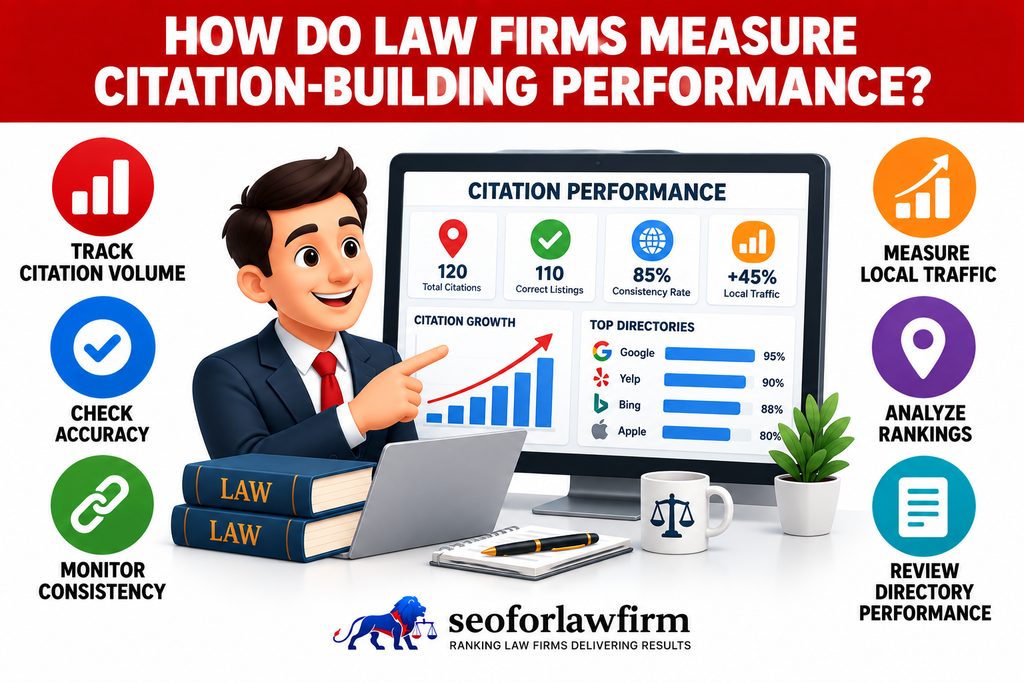
Law firms should measure citation-building results through listing accuracy, profile interactions, calls, and qualified client enquiries rather than citation count alone. A smaller group of accurate and relevant profiles provides greater business value than hundreds of inconsistent or low-value listings.
Measurement must therefore connect citation quality with search visibility, client discovery, referral actions, and qualified legal matters. Citation reporting must also track unresolved errors so the firm can identify where inaccurate business information still exists.
Listed below are the 7 citation metrics law firms must monitor.
- Percentage of priority listings with accurate information. This metric shows how much of the firm’s high-value citation footprint matches the approved business record.
- Number of unresolved duplicate listings. Duplicate tracking identifies profiles that still create conflicting business entities or locations.
- Google Business Profile search visibility. Search visibility shows how the firm appears through its primary Google local profile.
- Map and local search visibility. Local visibility measures the firm’s presence for relevant geographic legal searches.
- Referral visits from directories. Referral traffic shows how many users reach the firm’s website through legal and business listings.
- Calls or website visits from profiles. Profile interactions reveal whether citations generate direct client actions.
- Qualified client enquiries from citation sources. Lead attribution shows which external listings contribute prospects who match the firm’s services and intake criteria.
Where Can Law Firms Get Professional Citation-Building Services?
Law firms can get professional citation-building services from experienced legal SEO providers such as SEOForLawFirm, as well as local SEO specialists, citation-management agencies, and established providers such as BrightLocal, Whitespark, Moz Local, and Semrush. SEOForLawFirm supports a broader local listings strategy for law firms that connects citation audits, listing cleanup, profile creation, duplicate management, Google Business Profile, legal directories, reviews, website information, and local-search measurement.
A qualified provider must establish a source-of-truth business record, correct inaccurate listings, manage multi-office data separately, claim major map platforms, build relevant legal and general directory profiles, document account ownership, and monitor future business-data changes. Law firms must retain ownership of major profiles and login credentials so citation vendors do not become permanent owners of the firm’s digital business assets.
How Should Law Firms Handle Duplicate Citations?
Law firms should merge, close, correct, or suppress duplicate citations when multiple listings represent the same office and create conflicting business information. Duplicate listings appear after relocations, firm-name changes, mergers, partner departures, telephone-number changes, automated directory creation, or duplicate Business Profile creation.
Separate attorney and law firm profiles are not automatically duplicates because some platforms legitimately support both entity types. Each profile must represent a distinct real-world entity rather than exist solely to create additional search visibility.
Listed below are the 8 main situations that commonly create duplicate citations.
- Office relocations. Old addresses remain active after the firm moves.
- Firm name changes. Previous business names continue appearing as separate listings.
- Mergers. Combined firms inherit duplicate profiles from predecessor entities.
- Partner departures. Former partners remain associated with offices after leaving the firm.
- Phone-number changes. Old numbers reveal outdated or duplicate business profiles.
- Automated directory creation. Third-party systems create profiles without direct firm management.
- Duplicate Business Profile creation. Multiple profiles for the same office create conflicting local information.
- Separate attorney and firm profiles. These profiles are legitimate when each one accurately identifies a different entity and the platform permits both.
How Should Multi-Office Law Firms Build Citations?
Multi-office law firms should maintain a separate citation record for each genuine office location and keep every office’s business information distinct. A multi-office local SEO strategy must align each office across the website, Google Business Profile, directories, and structured business information. Each genuine location needs its own qualified address, appropriate phone number, office hours, associated attorneys, business categories, and location-specific website destination where available.
Law firms must avoid mixing addresses, phone numbers, attorneys, or landing pages between offices because each citation needs to represent one real location accurately. Virtual offices must not be treated as genuine office locations when they fail the applicable platform eligibility requirements.
Listed below are the 8 main citation elements each law firm office must maintain.
- Qualified physical address. Each listing must use the genuine client-facing office address.
- Appropriate local phone number. Each office must use a telephone number associated with that location where appropriate.
- Location-specific website URL. The citation must link to the relevant office page when the website provides one.
- Current office hours. Each listing must reflect the actual operating hours for that location.
- Associated attorneys. Profiles must identify attorneys who genuinely work from or are associated with the office.
- Accurate business categories. Categories must represent the legal services offered by that location.
- Matching map information. Map platforms must display the correct office address and business identity.
- Matching directory information. External directories must use the same factual office information as the firm’s source-of-truth record.
What Are Unstructured Citations for Law Firms?
Unstructured citations for law firms are external mentions of a law firm or attorney within editorial, professional, academic, community, or event content rather than standardized directory profiles. News articles, bar association publications, community organization pages, conference speaker profiles, university biographies, event pages, and professional association references contain unstructured citations.
These mentions do not replace structured citations on maps, business profiles, or legal directories. Law firms must establish accurate structured citations first and treat legitimate external mentions as supporting entity references.
Do Citations Improve AI Visibility for Law Firms?
Yes, accurate citations support AI visibility by giving search systems consistent public information about a law firm’s identity, location, services, and attorneys. Google does not identify citation count or NAP consistency as a standalone AI ranking factor. Google Business Profile gives law firms a direct source for maintaining business and service information across Google Search experiences.
Third-party citations also reinforce the firm name, location, phone number, website, practice type, and attorney identity. Law firms must focus on accurate entity information across authoritative sources rather than mass-producing citations to influence AI-generated answers.
Does NAP Consistency Directly Improve Google Rankings?
No, Google does not identify NAP consistency as an independent local ranking factor. Google describes local ranking through relevance, distance, and prominence and recommends complete and accurate business information. NAP consistency still matters because conflicting information directs clients to former offices, outdated phone numbers, incorrect websites, or inaccurate map locations.
Law firms must correct factual differences in names, addresses, phone numbers, websites, and office information while ignoring harmless formatting variations such as abbreviations or punctuation. Accurate business information matters more than character-for-character formatting.
How Do Citations Work With LocalBusiness Structured Data?
Citations provide business information on external websites, while LocalBusiness and organization structured data provide business information directly on the law firm’s own website. The website, structured data, Google Business Profile, and major citations must describe the same real-world business entity.
Google supports structured properties that identify the business, location, contact details, and operating information. Multi-office firms must define each genuine business location separately when using LocalBusiness markup. Structured data does not replace citation building, and external citations do not replace accurate entity information on the firm’s website.
Listed below are the 6 main business properties law firms represent through structured data.
- Business name. The markup must identify the law firm using its real-world business name.
- Address. The structured data must contain the current qualified office address.
- Telephone. The phone number must connect users with the relevant office.
- URL. The markup must reference the correct firm or location-specific website page.
- Geographic coordinates. Latitude and longitude identify the physical location of a genuine office.
- Business hours. Opening-hour information must reflect the firm’s current client-facing schedule.
