Law firms optimise PPC landing pages by matching each advertisement with a dedicated page that addresses the same legal service, search intent, location, and consultation action. The landing page gives the visitor one clear path. The page presents the relevant legal service first. The page places the primary CTA near the top. The firm supports trust with real attorneys, bar admissions, verified reviews, relevant experience, and compliant case-result evidence. Focused navigation reduces competing paths without removing necessary privacy, accessibility, disclaimer, or attorney-information links. Fast mobile performance gives paid-search visitors quicker access to legal information, phone controls, forms, and consultation actions.
ABA Model Rule 7.1 requires lawyer advertising to avoid false or misleading communications, so the firm needs to substantiate testimonials, results, professional claims, and other trust signals before publication. A study by Anindya Ghose and Sha Yang titled “An Empirical Analysis of Search Engine Advertising: Sponsored Search in Electronic Markets” in 2009 found that higher landing-page quality scores were associated with higher conversion rates and lower advertiser cost per click, providing empirical support for landing-page quality as a paid-search performance factor. Law firms need to extend measurement beyond the initial click or form submission.
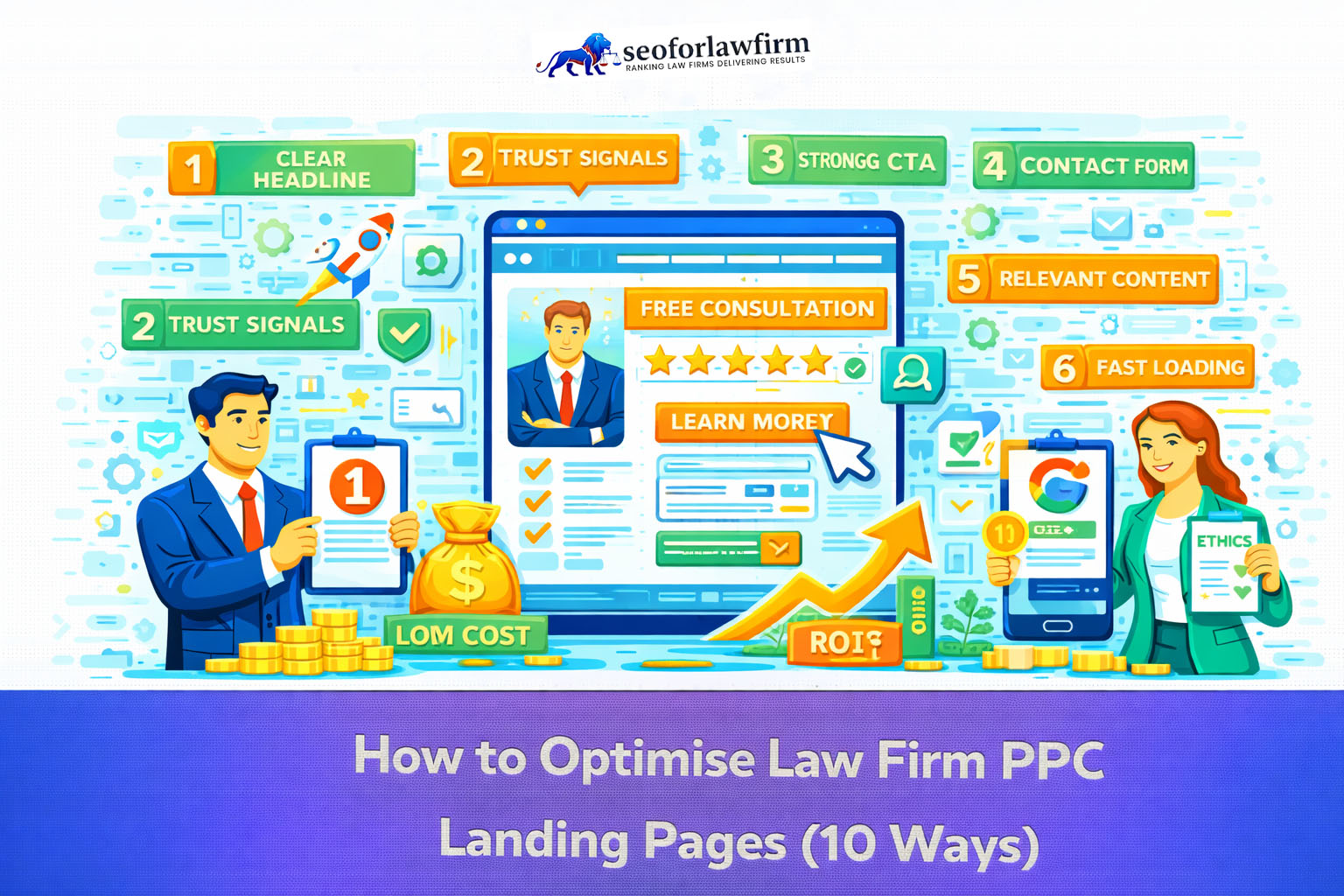
Listed below are 10 ways to optimise law firm PPC landing pages.
- 1. Match the landing page to search intent and ad messaging. The page needs to address the same legal service, problem, location, and promise presented in the advertisement. Strong message alignment reduces confusion and keeps the visitor focused on the expected legal solution.
- 2. Build a dedicated single-purpose landing page. Each campaign needs a page designed around one legal service and one conversion objective. Dedicated pages reduce unrelated content and make the path from ad click to enquiry easier to follow.
- 3. Reduce navigation and competing distractions. Remove unnecessary links, menus, and unrelated practice-area content that divert visitors from the campaign goal. Necessary legal, privacy, accessibility, and attorney-information links still need to remain available.
- 4. Place the primary CTA near the top of the page. Show the main consultation or contact action before the visitor needs to scroll extensively. Early CTA visibility gives high-intent users an immediate route to call, submit a form, or request a consultation.
- 5. Make phone and form contact simple. Use visible phone controls, short forms, clear labels, and minimal required fields. Fewer interaction steps reduce friction between the legal enquiry and the firm’s intake process.
- 6. Add verifiable trust and credibility evidence. Use real attorney profiles, bar admissions, verified reviews, relevant experience, awards, and compliant case results. Each trust signal needs to be accurate, supportable, and consistent with lawyer advertising rules.
- 7. Optimise the page for mobile users. Design forms, buttons, headings, and phone controls for smaller screens and touch interaction. Mobile layouts need fast access to legal information and contact actions without unnecessary scrolling or interface friction.
- 8. Improve landing-page speed and Core Web Vitals. Reduce heavy media, render-blocking code, slow scripts, and other resources that delay loading or interaction. Faster pages improve access to the main legal information, CTA, and intake tools.
- 9. Track qualified leads and signed matters. Connect ad clicks and landing-page enquiries with CRM or intake data. Reporting needs to follow the path from enquiry to qualified lead, consultation, signed matter, and attributable revenue.
- 10. Test landing-page elements against business outcomes. Compare headlines, CTAs, forms, trust signals, layouts, and page structures using measurable conversion data. The winning variation needs to improve qualified leads, signed matters, acquisition cost, or revenue rather than clicks alone.
Table of Contents
- Article sections will appear here.
1. Match the Landing Page to Search Intent and Ad Messaging
Law firms optimise landing-page relevance by continuing the same legal-service promise that caused the visitor to click the advertisement. A visitor searching for a motorcycle accident attorney in Miami needs to reach a page that immediately confirms motorcycle accident representation, the relevant geographic market, the law firm or attorney, and a direct consultation path.
A generic headline such as “Experienced Attorneys Fighting for You” creates unnecessary uncertainty because the visitor still has to determine whether the firm handles motorcycle accident cases. The stronger sequence is Search Query → Keyword Theme → Advertisement → Landing-Page Headline → Supporting Message → CTA. Google recommends close alignment between advertisements, keywords, landing pages, and calls-to-action, but exact keyword repetition is not required. The page needs to satisfy the underlying legal intent rather than repeat the same phrase mechanically.
Listed below are the 4 elements the landing page needs to establish immediately.
- Motorcycle accident representation.
- Relevant geographic service.
- The law firm or attorney.
- A direct consultation path.
2. Build a Dedicated Single-Purpose Landing Page
A dedicated law firm PPC landing page focuses on one legal service and one conversion goal. The page removes the need for paid visitors to navigate through unrelated sections of a general website. Several contact methods still support the same objective, such as calling the firm, requesting a consultation, submitting a case enquiry, or scheduling an appointment.
Dedicated pages work best when practice areas, locations, intake requirements, offers, or attribution needs differ between campaigns. A homepage still works for brand-focused advertising when the homepage directly satisfies the visitor’s intent.
Listed below are the 6 situations where dedicated PPC landing pages are useful.
- Different practice areas use separate advertisements.
- Geographic markets require different messaging.
- PPC offers differ from the main website.
- Intake requirements differ by case type.
- Paid campaigns need tighter attribution.
- The homepage serves too many unrelated purposes.
3. Reduce Navigation and Competing Distractions
Law firm PPC landing pages need to reduce navigation that pulls visitors away from the intended consultation path. Unrelated practice areas, blog categories, careers pages, firm news, and newsletter archives create competing exits from the legal-service funnel.
Many dedicated landing pages therefore remove or simplify the primary navigation menu. This approach supports conversion rather than satisfying a specific Google Ads requirement. The page still needs access to information required for trust, usability, and compliance.
Listed below are the 7 navigation elements that create unnecessary distractions.
- Estate planning.
- Business law.
- Careers.
- Blog categories.
- Firm news.
- Unrelated practice areas.
- Newsletter archives.
Listed below are the 6 links that remain accessible where relevant.
- Privacy policy.
- Accessibility information.
- Advertising disclosures.
- Attorney details.
- Terms or required notices.
- Contact information.
4. Place the Primary CTA Near the Top of the Page
Law firm PPC landing pages need to place the primary contact action near the top of the page. Visitors must immediately understand the legal service offered and how to contact the firm without excessive scrolling. The first screen commonly combines the practice-area headline, a short supporting statement, firm identity, a visible CTA, a click-to-call number, and one or two credibility signals.
CTA language also needs to describe the next action clearly rather than rely on vague wording such as “Submit.” Claims such as “Free Consultation” or “Available 24/7” only belong on the page when the firm substantiates them.
Listed below are the 7 elements commonly placed in the first-screen section.
- Practice-area headline.
- Brief supporting statement.
- Attorney or firm identity.
- Primary CTA.
- Click-to-call phone number.
- Short form or form-opening button.
- One or two credibility signals.
Useful CTA examples include.
- Request a Consultation.
- Speak With an Attorney.
- Discuss Your Case.
- Call the Firm.
- Schedule a Consultation
5. Make Phone and Form Contact Simple
Law firm PPC landing pages need to make phone and form contact simple. High-intent visitors must be able to call or submit an enquiry without searching through the page for contact information. Mobile pages need tappable phone numbers, and forms need enough information for useful intake without asking for unnecessary details.
A shorter form can increase submission volume, while a longer form can improve qualification when additional fields serve a clear intake purpose. According to a study by Marcin Hylewski, Artur Pluskota, and Błażej Abel titled The Effect of Landing Page Design and Structure on Conversion Rates in 2025, analysis of 25,027 landing pages found that form structure, button number and position, page height, imagery, video, and copy length were among the design variables associated with conversion performance. The correct form length therefore depends on lead quality, intake workload, and signed-client outcomes rather than form-completion percentage alone.
Listed below are the 5 fields commonly used in an initial PPC enquiry form.
- Name.
- Phone number.
- Email address.
- Matter type.
- Brief description.
Form length needs to be balanced.
- Lead volume.
- Lead quality.
- Intake workload.
- Signed-client rate.
6. Add Verifiable Trust and Credibility Evidence
Law firms build PPC landing-page trust by showing factual evidence about the attorneys, firm, experience, reputation, and previous work. Law firms support this process with law firm reputation management services that help manage reviews, online trust signals, and reputation assets. Trust elements need to be genuine, attributable, and presented without creating misleading expectations.
A rating needs to reflect the stated review source, a testimonial needs to come from a real client, and a case result needs accurate context. ABA Model Rule 7.1 prohibits false or misleading communications, and past results become misleading when presented in a way that suggests comparable outcomes are guaranteed. State advertising rules determine the firm’s actual obligations.
Listed below are the 10 trust and credibility elements law firms use.
- Attorney names and photographs.
- Bar admissions.
- Relevant practice experience.
- Verified client testimonials.
- Genuine review ratings.
- Documented representative results.
- Legitimate awards.
- Recognised professional memberships.
- Office information.
- Secure website delivery.
7. Optimise the Page for Mobile Users
Law firms optimise PPC landing pages for mobile by making legal information and contact actions easy to use on small screens. Strong mobile SEO optimization supports responsive layouts, readable legal information, usable forms, and clear contact actions on smartphones. Google Ads recommends mobile landing pages that load quickly, provide simple navigation, and make the intended action easy to complete.
A useful mobile layout uses one primary content column with readable text, large touch controls, short intake paths, responsive images, and stable page elements. Device mix differs by practice area, campaign, geography, audience, and advertising platform, so each firm needs to check its own Google Ads and analytics data rather than assume most paid traffic comes from mobile.
Listed below are the 10 mobile landing-page elements law firms need to review.
- Readable headline.
- Tappable phone number.
- Large CTA button.
- Properly spaced form fields.
- Short paragraphs.
- Responsive attorney images.
- Stable sticky CTA where appropriate.
- No horizontal scrolling.
- No oversized navigation.
- No full-screen promotional overlays blocking legal content.
8. Improve Landing-Page Speed and Core Web Vitals
Law firms improve PPC landing-page speed by reducing page weight, controlling scripts, compressing media, improving rendering, and measuring mobile performance. Site speed optimization for law firms addresses image weight, JavaScript, caching, hosting, rendering, and Core Web Vitals that affect how quickly a paid-search visitor can act.
Google Ads treats landing-page speed as an important part of mobile campaign performance because paid visitors need quick access to the legal information and contact action they clicked to see. Google’s current Core Web Vitals are LCP, INP, and CLS. The 2.5-second threshold applies to good LCP performance rather than requiring the entire page to finish loading within 2.5 seconds.
Listed below are the 10 landing-page speed improvements law firms need to review:
- Resize large attorney and hero images.
- Compress image files.
- Use efficient image formats where suitable.
- Remove unused JavaScript and CSS.
- Limit unnecessary marketing scripts.
- Delay below-the-fold media.
- Configure browser and server caching.
- Improve hosting and server response.
- Reserve space for images and embedded elements.
- Test pages on real mobile connections and devices.
Listed below are the 3 Core Web Vitals law firms need to measure.
- LCP — Loading performance: 2.5 seconds or less.
- INP — Interaction responsiveness: Under 200 milliseconds.
- CLS — Visual stability: Under 0.1.
9. Track Qualified Leads and Signed Matters
Law firms optimise PPC landing pages more accurately by tracking enquiries through qualified leads, consultations, signed matters, and attributable revenue. An initial phone call or form submission does not establish that the campaign produced a suitable legal matter. Google Ads supports qualified-lead and converted-lead goals for advertisers that send later CRM or intake outcomes back into the advertising platform.
Enhanced conversions for leads also use first-party information and offline outcome data to strengthen attribution between the original paid interaction and later client stages. The correct measurement sequence is Click → Enquiry → Qualified Lead → Consultation → Signed Matter. A page with fewer raw enquiries produces greater business value when a higher proportion of those enquiries become qualified and retained clients.
Listed below are the 8 PPC landing-page outcomes law firms need to track.
- Phone calls.
- Contact forms.
- Consultation bookings.
- Qualified leads.
- Completed consultations.
- Signed matters.
- Matter value.
- Attributable revenue.
Landing-page comparisons also need to be examined.
- PPC visitors.
- Raw leads.
- Qualified leads.
- Consultation rate.
- Signed clients.
- Cost per qualified lead.
- Cost per signed matter.
- Attributable revenue.
10. Test Landing-Page Elements Against Business Outcomes
Law firms improve PPC landing pages by testing page elements against qualified-lead and signed-client outcomes. Law firms managing paid campaigns and landing-page experiments use PPC services for lawyers to connect campaign management, landing-page testing, conversion tracking, and client-acquisition measurement.
A/B testing needs to isolate meaningful variables so the firm can identify which change affected performance. Heatmaps support testing by showing clicks, scroll depth, interaction patterns, and mobile friction, but heatmaps do not explain why visitors behave a certain way. Behavioural data therefore needs to be interpreted alongside Google Ads data, analytics, call tracking, CRM qualification, and signed-case attribution.
Listed below are the 12 landing-page elements law firms A/B test.
- Headline wording.
- Supporting statement.
- CTA wording.
- Attorney photograph placement.
- Form position.
- Form length.
- Review placement.
- Case-result placement.
- Long-form versus shorter copy.
- Main navigation versus reduced navigation.
- Sticky mobile call button.
- Trust evidence near the first CTA.
Listed below are the 5 behaviours heatmaps help identify.
- Where visitors click.
- How far visitors scroll.
- Whether visitors tap non-clickable elements.
- Whether mobile users struggle with controls.
- Which sections receive little interaction.
What Does PPC Mean for Law Firm Landing Pages?
PPC landing pages for law firms are webpages designed specifically to convert visitors from paid advertising into legal enquiries, consultations, and qualified client opportunities. Each page corresponds to a specific campaign, practice area, geographic market, or search-intent group, which gives the page a narrower role than a general website page.
The advertisement creates an expectation, and the landing page fulfils that expectation by presenting relevant legal information and a clear contact action. Google defines a landing page as the webpage a user reaches after clicking an advertisement and evaluates landing-page experience through factors such as relevance, usefulness, navigation, link quantity, and alignment with the expectations created by the advertisement.
Which Trust Signals Work Best on Law Firm Landing Pages, and Why?
The trust signals that work best on law firm landing pages are those that immediately prove credibility, experience, and client satisfaction. Testimonials, attorney credentials, case results, awards, and security assurances all work together to show that the attorney is reputable and experienced. Law firms boost conversions by using trust signals that strengthen reputation and credibility on attorney landing pages to reinforce authority and reliability from the first moment a visitor arrives.
Listed below are the 5 trust signals that work best on law firm landing pages.
- Client testimonials: Provide social proof from real clients and reinforce positive outcomes.
- Attorney bios: state credentials, education, and years of practice to build authority.
- Case results: Show documented successes that demonstrate capability and reliability.
- Certifications & awards: Display recognition from respected legal or professional organizations.
- Secure site badges: Reassure users that the submitted information is protected and encrypted.
How Do Law Firms Measure PPC Landing-Page ROI?
Law firms measure PPC landing-page ROI by connecting advertising cost with qualified leads, signed matters, and attributable financial return. The calculation needs to follow the full acquisition path rather than stop at clicks, CPC, or form submissions. A landing page with more forms or a lower cost per click does not necessarily produce better ROI when those enquiries fail the firm’s case criteria. The campaign needs to generate matters with suitable acquisition cost, matter value, and profitability.
Listed below are the 5 formulas law firms use to measure PPC landing-page performance.
- Landing Page Lead Conversion Rate = Leads ÷ Landing-Page Visitors × 100
- Qualified Lead Rate = Qualified Leads ÷ Leads × 100
- Cost per Qualified Lead = PPC Spend ÷ Qualified Leads
- Cost per Signed Matter = PPC Spend ÷ Signed PPC Matters
- PPC ROAS = PPC-Attributed Revenue ÷ PPC Spend
How to Optimize Landing Page Speed for PPC?
Law firms optimize landing page speed for PPC by reducing load times and improving mobile performance to ensure users reach the page instantly after clicking an ad. This includes compressing images, enabling browser caching, minimizing CSS and JavaScript, and using fast hosting or a CDN to handle high traffic. Mobile-specific improvements like responsive layouts, tap-friendly buttons, and simplified forms also help increase conversions. When combined, these optimizations lower bounce rates, improve Quality Score, and reduce cost-per-click for PPC campaigns.
- Compress and Optimize Images: Reduce image file sizes, convert to next-gen formats like WebP, and apply lazy-loading to below-the-fold visuals so pages load quickly for mobile PPC visitors.
- Minify CSS, JavaScript, and HTML: Remove unused code, shrink file sizes, and streamline scripts to improve render speed and eliminate unnecessary delays.
- Use a High-Performance Hosting Environment: Choose fast, dedicated, or cloud-based hosting capable of handling PPC traffic spikes without slowing the site.
- Enable Browser Caching: Allow repeat visitors’ devices to store static elements locally so the page loads faster on return visits or multi-step conversions.
- Implement a Lightweight Mobile Layout: Design mobile-first landing pages with minimal clutter, prominent CTAs, and clear pathways to convert.
- Optimize Above-the-Fold Content: Ensure the headline, CTA, and form fields load instantly, critical for PPC visitors who make fast decisions.
- Use Accelerated Mobile Pages (AMP) When Appropriate: Deploy AMP versions for high-speed mobile performance, especially for ads targeting urgent-intent queries.
- Remove or Delay Third-Party Scripts: Limit or defer slow elements like excessive tracking pixels, chat widgets, and plugins to prevent mobile lag.
- Enable CDN Delivery: Use a content delivery network to deliver pages faster across geographic regions and reduce latency.
- Test with PageSpeed Insights and Mobile-Friendly Tools: Monitor Core Web Vitals (LCP, FID, CLS) and adjust based on user behavior and PPC performance data.
A study by Unbounce, titled “Conversion Benchmark Report” in 2021, found that mobile landing pages convert an average of 8% lower than desktop pages, despite accounting for over 60% of total traffic, stating the critical need for mobile-optimized and responsive design to improve PPC and lead generation performance.
PPC landing page speed, mobile performance, law firm marketing, Core Web Vitals, page load optimization, mobile-first PPC, legal landing pages, conversion rate improvement
Where Can Law Firms Get PPC Landing-Page Optimisation Services?
Law firms can get PPC landing-page optimisation from experienced legal-marketing providers such as SEOForLawFirm, as well as legal PPC agencies, conversion-rate specialists, law firm web developers, and broader paid-media firms with documented experience in legal client acquisition.
SEOForLawFirm combines law firm web design services with PPC services for lawyers to connect responsive landing-page development, paid-search strategy, conversion tracking, and client-acquisition reporting. Other providers such as Rankings.io, LawRank, and Hennessey Digital also offer legal PPC, web, and conversion services for law firms.
How Can You Improve a Law Firm Landing Page for Stronger Google Ads Results?
You can improve a law firm’s landing page for stronger Google Ads results by aligning ad messaging with page headlines, incorporating local keywords, and adding credibility-boosting trust signals. These steps strengthen relevance, increase Quality Score, and drive more conversions from paid search traffic. Attorneys will also apply proven methods to optimize landing pages for Google Ads PPC campaign performance, ensuring every visitor sees a fast, trustworthy, and action-focused page.
Listed below are 5 Steps to Optimize a Law Firm’s Google Ads Landing Page.
- Matching ad copy to headlines: Create a clear message match between the ad promise and the landing page headline.
- Using local keywords: Add city, region, or neighborhood terms to capture nearby clients.
- Adding trust signals: Include testimonials, case results, certifications, and secure forms to build credibility.
- Speed optimization: Improve load speed to reduce bounce rates and increase conversion rates.
- A/B testing: Test variations in layout, CTAs, visuals, and form length to identify the highest-converting template.
How Do Law Firms Choose a PPC Landing-Page Provider?
Law firms choose a PPC landing-page provider by verifying experience with Google Ads, legal search intent, law firm intake, and lawyer advertising compliance. Law firms comparing providers use these questions to evaluate a law firm PPC agency’s message matching, legal copy, tracking, CRM integration, testing, and account ownership. The provider also needs to explain who writes the copy, who reviews claims, how calls and forms are attributed, how qualified leads are identified, and how landing-page tests connect with signed matters.
Listed below are the 10 questions law firms need to ask a PPC landing-page provider.
- Will each major campaign receive a relevant landing page?
- How is message match planned?
- Who writes the legal copy?
- How are testimonials and case results reviewed?
- How are phone calls measured?
- How are form submissions measured?
- Does tracking continue through qualified leads?
- Can the provider connect CRM outcomes with Google Ads?
- How are A/B tests evaluated?
- Who owns the landing pages and advertising accounts?