


A content SEO audit for law firms examines every on-page and technical element that influences visibility, authority, and client conversion. A content SEO audit reviews content depth, keyword alignment, internal linking, and technical performance to ensure each legal page ranks effectively in search. The process includes evaluating index coverage, optimizing titles and metadata, and fixing crawl or speed issues that affect visibility.
An in-depth audit measures content quality and compliance with Google’s E-E-A-T standards, emphasizing originality, clarity, and jurisdictional accuracy. A study by Paranjape, West, Zia & Leskovec, titled “Improving Website Hyperlink Structure Using Server Logs” in 2015, showed that analyzing server log data to identify link candidates can meaningfully improve site navigation and page connectivity, i.e., adding internal links guided by implicit user behavior yields measurable gains in usefulness.
Using tools like Ahrefs, SEMrush, Screaming Frog, and Google Search Console, firms can uncover keyword gaps, broken links, or duplicate text across pages. Legal content should also be audited for schema markup, internal link strength, and mobile usability.
A well-executed audit not only repairs site issues but also reinforces topical authority. Combining technical fixes, local keyword strategy, and ongoing content updates ensures a law firm’s pages stay discoverable, compliant, and competitive in both organic and local search.
Table of Contents
- Article sections will appear here.
What Is an SEO Content Audit for Law Firms?
An SEO content audit for law firms is the process of reviewing all on-site legal content to ensure it meets Google’s quality standards, satisfies user intent, and supports higher keyword rankings. The audit examines how effectively each page communicates expertise, authority, and trust, core elements of Google’s E-E-A-T framework.
A thorough audit analyzes practice area pages, blogs, and attorney bios for content depth, readability, and structure. It identifies thin, outdated, or duplicate text and highlights opportunities to improve internal linking, heading hierarchy, and metadata. The goal is to align every legal page with relevant search intent while improving engagement and conversion potential.
SEOForLawFirm helps law firms audit content gaps, identify outdated pages, and strengthen internal linking for better search visibility. Contact SEOForLawFirm for law firm content SEO audits and optimization support. SEOForLawFirm connects content refreshes, topical coverage, internal links, and search intent with stronger rankings and more qualified legal leads.
Listed below are the 20 SEO content audits for law firms.
- 1. Content Quality Assessment: Review whether each page provides accurate, useful, and complete information for the intended legal topic. Remove filler, unsupported claims, repetitive sections, and content that does not help the reader complete a decision or task.
- 2. Keyword Relevance and Intent Match: Confirm that each page targets queries that match the page’s purpose and the prospective client’s search intent. Service pages should address hiring intent, while informational pages should answer legal questions without competing with transactional pages.
- 3. Duplicate or Thin Content Identification: Identify pages that repeat substantially similar information or provide too little unique value. Consolidate, expand, redirect, or remove weak pages according to their search intent and business purpose.
- 4. Outdated Legal Information and Statutes Review: Check statutes, deadlines, procedures, case references, and legal explanations for changes. Update content when the governing law or factual information no longer reflects the current jurisdiction.
- 5. Practice Area Page Optimization: Review each practice-area page for service clarity, jurisdiction, legal issues, attorney relevance, internal links, and conversion paths. Ensure the page owns the intended commercial search intent and does not overlap unnecessarily with related service pages.
- 6. Blog Content Refresh and Republishing Strategy: Identify articles that need factual updates, stronger explanations, better internal links, or consolidation with related content. Republish only when the page receives a meaningful substantive update rather than changing the date alone.
- 7. Title Tag and Meta Description Consistency: Check whether title tags and meta descriptions accurately represent each page’s topic and search intent. Remove duplicate, misleading, missing, or unnecessarily repetitive metadata across the website.
- 8. Header Structure and Semantic Alignment: Review H1, H2, and lower-level headings to confirm that they organize real subtopics in a logical hierarchy. Headings should reflect the page’s legal entities and information structure without forcing repeated keywords.
- 9. Anchor Text Distribution and Relevance: Check whether internal anchor text accurately describes the destination page and varies naturally across relevant contexts. Remove misleading, generic, or excessive exact-match anchors that weaken navigation and topic relationships.
- 10. Internal Linking Flow and Depth Analysis: Review how service pages, attorney profiles, location pages, and informational resources connect through internal links. Important pages should receive sufficient contextual links and remain easy for users and crawlers to reach.
- 11. Orphan Page Detection and Reintegration: Find valuable pages that receive no crawlable internal links from the website’s normal architecture. Reintegrate relevant orphan pages through hub pages, navigation, breadcrumbs, or contextual links where the relationship makes sense.
- 12. Broken Link and Redirect Review: Identify internal and external links that lead to missing pages, unnecessary redirects, or incorrect destinations. Repair links, update destinations, or apply relevant redirects so users and search engines reach the intended content.
- 13. Image Optimization and Alt Text Accuracy: Review image file size, dimensions, delivery, broken URLs, and alternative text. Alt text should describe meaningful image content or function without keyword stuffing.
- 14. Schema Markup and Structured Data Validation: Check whether structured data accurately represents visible page entities and follows applicable search-engine requirements. Validate supported markup and remove schema that is incorrect, misleading, or disconnected from visible content.
- 15. Local SEO Content Signals: Review whether location pages and local service content accurately reference the cities, counties, offices, courts, or jurisdictions the firm actually serves. Local references should support real geographic relevance rather than repeat place names artificially.
- 16. E-E-A-T Verification: Check whether content demonstrates relevant experience, expertise, authoritativeness, and trust through authorship, attorney review, credentials, sourcing, and transparent firm information. Legal claims should remain accurate, attributable, and appropriate for the represented jurisdiction.
- 17. External Link Audit and Citation Quality: Review external links to confirm that legal claims, statistics, and factual statements point to reliable and relevant sources. Replace broken, outdated, weak, or inappropriate citations with stronger sources when available.
- 18. Content Readability and Accessibility Review: Check whether legal information uses clear language, manageable sentence structure, descriptive headings, accessible links, and usable page elements. Content should remain understandable without oversimplifying the legal meaning.
- 19. Conversion Path and Call-to-Action Placement: Review whether readers can move naturally from legal information to contact, consultation, or other relevant next steps. Calls to action should appear where the reader has enough information to act rather than interrupt every section.
- 20. Content Performance Metrics and Update Scheduling: Track impressions, clicks, rankings, qualified organic traffic, enquiries, consultations, and signed matters for important pages. Schedule reviews according to legal changes, performance trends, business priorities, and content age rather than one fixed update interval.
1. Content Quality Assessment
A content quality assessment evaluates how well each page meets Google’s standards for clarity, depth, and relevance. The purpose is to ensure that your law firm’s pages provide accurate, authoritative, and user-friendly information that aligns with client intent.
High-quality content signals expertise and improves engagement metrics in Google Analytics, contributing to stronger organic rankings. During an SEO audit, this process identifies underperforming pages that require rewriting or expansion. Best practice: maintain comprehensive, legally sound, and plagiarism-free content written in plain language, ensuring consistency across your site structure.
2. Keyword Relevance and Intent Match
Keyword relevance examines whether target terms align with what potential clients actually search for, while intent match ensures your content satisfies user needs, informational, navigational, or transactional. Conducting an audit of legal site indexing for search visibility helps confirm that targeted keywords are discoverable and properly mapped to indexed pages, reinforcing alignment between user intent and search exposure.
This is vital in on-page optimization to capture qualified traffic. Monitoring keyword performance via Google Analytics and Search Console helps refine your keyword strategy and eliminate misaligned targets. Best practice: perform quarterly keyword audits, prioritize client-focused queries like “family lawyer near me,” and naturally integrate terms into titles, headings, and body text for improved organic traffic.
3. Duplicate or Thin Content Identification
Duplicate or thin content dilutes authority and confuses search engines about which version to rank. This issue often arises from multiple similar practice pages or reused boilerplate descriptions.
Addressing this through technical SEO and canonicalization improves crawl efficiency and prevents keyword cannibalization. Best practice: consolidate similar topics, write unique introductions for each service, and verify canonical tags to strengthen page speed and indexation signals.
4. Outdated Legal Information and Statutes Review
Legal content must be accurate and current to maintain credibility and comply with ethical advertising standards. Outdated statutes or case law weaken both trust and ranking potential. During an SEO audit, regularly reviewing legal references helps sustain content quality and prevent misinformation.
Best practice: schedule biannual reviews for all legal pages, update citations with the latest state codes, and clearly note publication or revision dates to enhance transparency and authority.
5. Practice Area Page Optimization
Practice area pages form the backbone of a law firm’s site structure and keyword strategy. Optimizing them ensures they target specific client needs (e.g., personal injury, family law, criminal defense) with proper headings, calls to action, and internal links.
This improves organic visibility and helps users navigate easily. Best practice: integrate clear service descriptions, structured data for legal services, and local city modifiers to enhance both SEO relevance and user engagement.
6. Blog Content Refresh and Republishing Strategy
Refreshing old blog posts extends their lifecycle and aligns them with current legal information and search behavior. According to research published in Orbit Media’s 2026 Blogger Survey, longer publishing cycles and more detailed content remain common among professional publishers, while strong results are concentrated among a minority of respondents. Updating data, examples, visuals, and internal links for legal SEO therefore needs to improve usefulness rather than simply increase word count.
A consistent refresh plan helps maintain authority signals and engagement. Best practice: audit blog posts every six months, add recent case outcomes or statistics, and republish updated versions under the same URL to preserve existing backlinks and structured data equity.
7. Title Tag and Meta Description Consistency
Title tags and meta descriptions are critical for on-page optimization and click-through rate improvement. Consistency ensures that each page communicates its purpose clearly to both users and search engines.
During an SEO audit, reviewing these elements identifies missing or duplicated metadata. Best practice: keep titles under 60 characters, write meta descriptions around 155 characters, and include primary keywords naturally for higher CTR and better search engine interpretation.
8. Header Structure and Semantic Alignment
Header tags (H1–H6) organize content hierarchy and signal topical focus to Google. Properly aligned headers improve readability, site structure, and indexing efficiency. Each section should follow a logical flow, helping users and crawlers interpret relevance.
Best practice: use one H1 per page for the main topic, distribute subheadings with related keywords, and ensure semantic consistency for better on-page optimization and featured snippet eligibility.
9. Anchor Text Distribution and Relevance
Anchor text distribution refers to how internal and external links use keyword phrases to describe target pages. Balanced anchor usage helps maintain contextual relevance, improve authority signals, and evaluate legal content using E-E-A-T principles to ensure trustworthy linking across your site.
Monitoring this helps avoid over-optimization while improving navigation and engagement. Best practice: vary anchors naturally (e.g., “personal injury lawyer,” “car accident attorney”), link contextually, and track performance using Google Analytics to assess conversion-driven pathways.
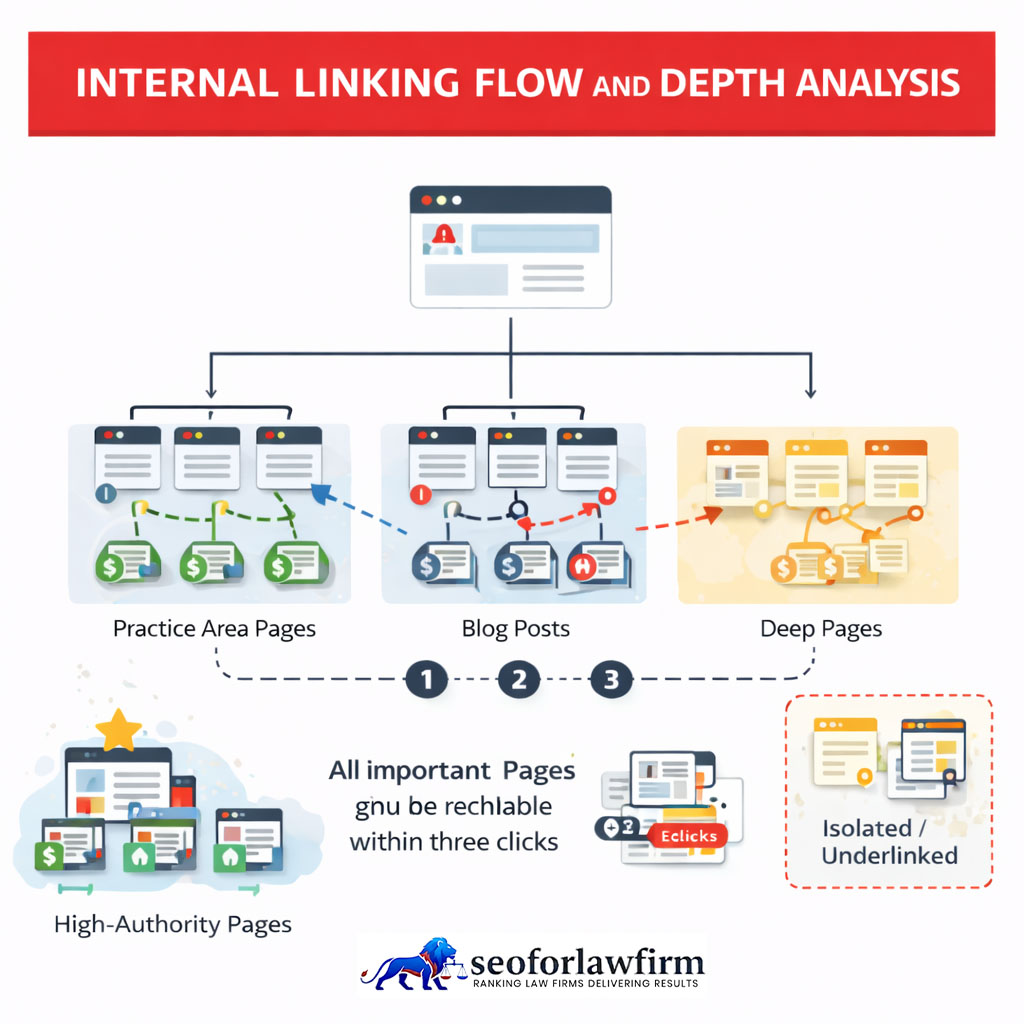
10. Internal Linking Flow and Depth Analysis
Internal linking improves site structure, authority distribution, and crawl depth by connecting related practice areas and blog posts. Research by Paranjape, West, Zia, and Leskovec titled Improving Website Hyperlink Structure Using Server Logs in 2015 showed that behavioral data can identify useful link candidates and improve website connectivity. A healthy link flow therefore depends on relevant relationships between pages rather than mechanically adding links to every paragraph.
During an audit, mapping internal link depth highlights isolated or underlinked pages. Best practice: ensure each page is reachable within three clicks from the homepage, prioritize linking from high-authority pages, and balance anchor diversity for optimal technical SEO performance.
11. Orphan Page Detection and Reintegration
Orphan pages are URLs not linked from anywhere else on the site, making them invisible to users and search crawlers. Identifying and reintegrating these pages restores lost equity and improves navigation.
In technical SEO, fixing orphan pages enhances crawl efficiency and engagement. Best practice: detect orphans using audit tools, add contextual internal links, or consolidate them into existing service pages to strengthen organic traffic flow.
12. Broken Link and Redirect Review
Broken links and outdated redirects create a poor user experience and waste crawl budget. A regular review ensures that both internal and outbound links function correctly and lead to relevant content.
Broken links can also trigger ranking drops if not addressed promptly. Best practice: run link checks monthly, apply 301 redirects for moved content, and remove dead outbound links to maintain site health and search trustworthiness.
13. Image Optimization and Alt Text Accuracy
Optimizing images by compressing size and writing accurate alt text improves page speed, accessibility, and image search visibility. In an SEO audit, image issues often reveal slow-loading pages or missing metadata.
Best practice: use descriptive alt text with legal keywords where relevant (e.g., “Riverside personal injury lawyer”), compress images under 200 KB, and serve modern file formats (WebP) for faster loading on all devices.
14. Schema Markup and Structured Data Validation
Schema markup helps search engines interpret your website’s content, such as attorney bios, FAQs, and practice details. Validating structured data ensures eligibility for rich results and improved CTR. During an audit, testing the schema through Google’s Rich Results tool ensures no errors or mismatches.
Best practice: implement LocalBusiness, FAQ, and LegalService schema, validate JSON-LD format, and update data with changes in firm information for improved structured data consistency.
15. Local SEO Content Signals (City/Region Mentions)
Local SEO signals indicate your firm’s geographical relevance through consistent city or region mentions. Incorporating these into headers, footers, and metadata helps your site rank in local organic searches and Google Maps. Best practice: naturally include city and county names in content, add local office schema, and ensure NAP consistency across listings for improved local organic visibility.
16. E-E-A-T Verification (Expertise, Experience, Authority, Trustworthiness)
E-E-A-T factors reflect a law firm’s credibility and expertise, especially in “Your Money or Your Life” (YMYL) content. Verification ensures your site demonstrates professional authorship and transparent legal credentials.
Regular audits confirm that author bios, citations, and client testimonials are present. Best practice: link attorney bios to verified credentials, add author schema, and cite authoritative sources to enhance overall content quality and trust.
17. External Link Audit and Citation Quality
External links and citations validate your firm’s digital reputation. Auditing them helps ensure outbound links support trustworthy sources while avoiding broken or spammy destinations. High-quality citations from directories or bar associations strengthen authority signals.
Best practice: remove low-quality backlinks, maintain consistent citations, and ensure outbound links open in new tabs to enhance both domain authority and user flow.
18. Content Readability and Accessibility Review
Readability and accessibility audits measure how easily users can understand and navigate your content. Ensuring a clear reading level and compliance with accessibility standards (e.g., ADA) improves user retention and ranking signals.
Best practice: write at an 8th–10th grade reading level, use contrast-friendly colors, add ARIA labels, and test pages with screen readers for an inclusive user experience and stronger SEO performance.
19. Conversion Path and Call-to-Action Placement
A conversion path audit examines how visitors move from reading to contacting your firm. Clear calls to action (CTAs) improve engagement and conversion metrics tracked in Google Analytics.
Proper CTA placement ensures steady lead generation and measurable ROI. Best practice: include visible “Schedule a Consultation” buttons, use consistent color contrast, and test CTAs on mobile to improve site performance and client acquisition rates.
20. Content Performance Metrics and Update Scheduling
Tracking performance metrics such as impressions, clicks, and dwell time helps measure SEO progress and identify refresh priorities. Ongoing monitoring through Google Analytics and Search Console ensures pages remain competitive.
Scheduling periodic updates keeps the website aligned with new algorithm trends. Best practice: review metrics monthly, update underperforming content, and prioritize high-traffic pages for optimization to maintain organic traffic and ranking stability.
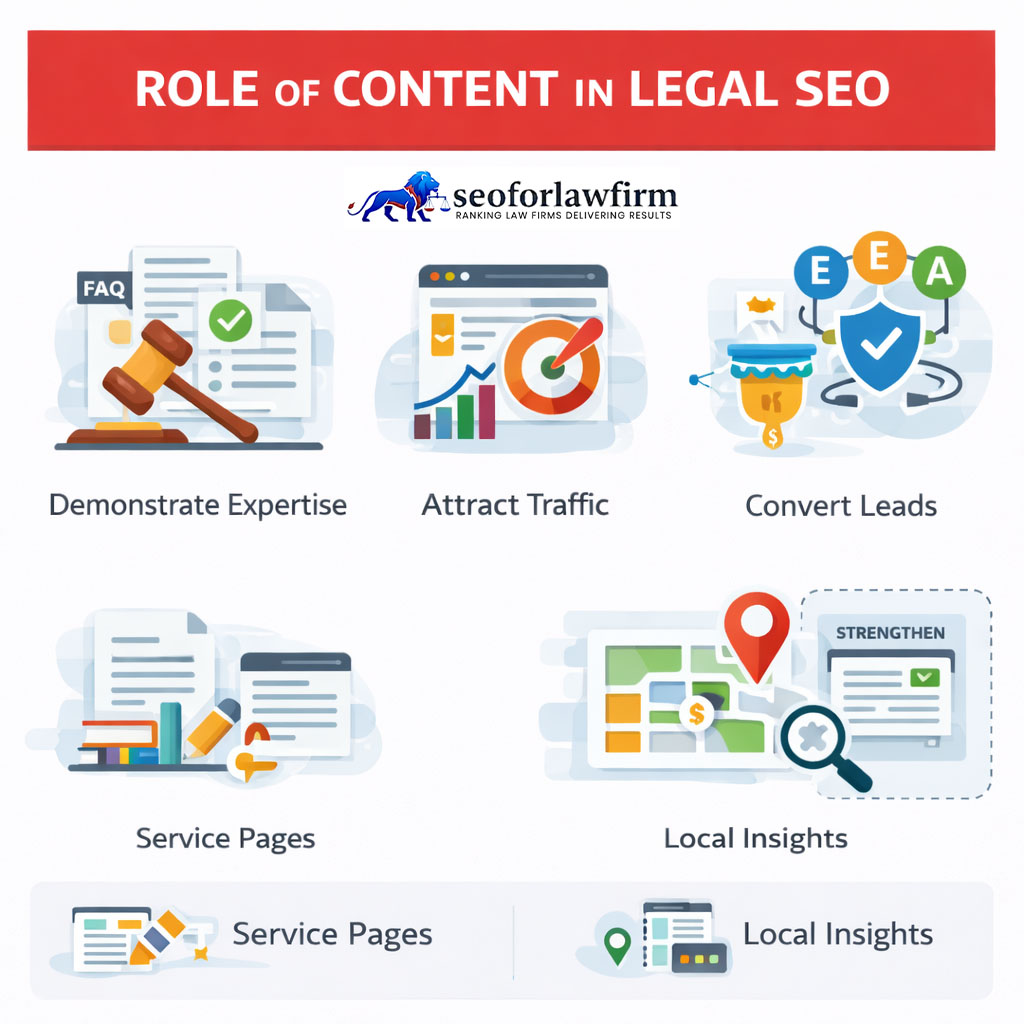
What Is the Role of Content in Legal SEO?
The role of content in legal SEO is to demonstrate expertise, attract organic traffic, and convert readers into qualified leads through helpful, search-optimized pages. High-quality legal content builds topical authority, improves keyword rankings, and establishes trust with potential clients seeking clear legal guidance.
For law firms, effective SEO content includes detailed service pages, FAQs, and local practice insights that address specific legal concerns. Through strategic content creation for law firm SEO, attorneys can align every page with client intent, strengthen E-E-A-T signals, and improve overall visibility in search results.
Consistent publishing and on-page optimization help maintain ranking stability and reinforce brand credibility in competitive legal markets.
What Are the Best SEO Tools for Law Firm Website Content Optimization?
The best SEO tools for law firm website content optimization are SurferSEO, Clearscope, Frase, and Sitebulb, offering data-driven insights into keyword intent, readability, and on-page structure. These tools help legal teams refine content quality, improve topical coverage, and enhance organic rankings.
Listed below are the 4 top-rated SEO tools for optimizing legal website content.
- SurferSEO: Uses real-time NLP (Natural Language Processing) to optimize content outlines, keyword density, and structure for higher SERP performance.
- Clearscope: Provides keyword relevance scoring and readability benchmarks to align legal content with user and search intent.
- Frase: Delivers AI-driven briefs, identifies missing subtopics, and integrates SERP data to strengthen authority and completeness in legal pages.
- Sitebulb: Conducts in-depth on-page audits, detects duplicate or low-value content, and visualizes internal link flow to boost crawl efficiency.
How Can You Perform a DIY SEO Audit for a Law Firm Website?
You can perform a DIY SEO audit for a law firm website by reviewing its technical structure, content relevance, backlinks, and mobile readiness using free and professional SEO tools.
Listed below are the 5 main steps to perform a DIY SEO audit for a law firm website.
- Run a Full Site Crawl: Use tools like Screaming Frog or Sitebulb to uncover missing titles, duplicate pages, and 404 errors that limit visibility.
- Analyze Keyword Placement: Check that primary legal keywords appear naturally in H1s, meta descriptions, and early paragraphs without keyword stuffing.
- Test Mobile Usability: Use Google’s Mobile-Friendly Test and PageSpeed Insights to confirm smooth navigation and quick load times on all devices.
- Audit Backlink Quality: Evaluate linking domains through Ahrefs or SEMrush, focusing on authoritative sources like bar associations or news mentions.
- Validate Index Coverage: In Google Search Console, confirm that all practice areas and location pages are properly indexed and free of crawl errors.
What Makes a Good SEO Strategy for Attorneys?
A good SEO strategy for attorneys focuses on client intent, local visibility, technical health, and long-term authority growth to attract qualified leads and maintain consistent rankings.
Effective legal SEO begins with in-depth audience research to uncover what potential clients search for in specific jurisdictions and practice areas. Content consistency is equally important. Publishing local case guides, FAQs, and legal updates reinforces expertise and helps capture ongoing traffic.
Authority development through backlinks from bar associations, local news outlets, and trusted legal directories builds credibility with both users and search engines. Finally, ensuring E-E-A-T compliance by featuring attorney bios, case results, and verified reviews strengthens Google’s trust signals.
A well-structured SEO framework combining these elements improves conversions, search visibility, and brand recognition for attorneys over time.
How Can Law Firms Identify and Fix Content Gaps During an SEO Audit?
Law firms can identify and fix content gaps during an SEO audit by analyzing keywords, comparing competitors, mapping thin pages, and expanding topics.
Listed below are 5 steps Law firms can take to identify and fix content gaps during an SEO audit.
- Conduct keyword and topic analysis to identify missing high-intent legal queries and under-optimized service areas.
- Compare competitor websites to uncover underrepresented legal topics or FAQs attracting consistent search traffic.
- Use SEO tools like Ahrefs or SEMrush to map thin or underperforming pages lacking topical depth.
- Create or expand content focused on client pain points and search intent to increase relevance and visibility.
- Interlink new or updated pages with related service and blog content to strengthen authority flow and site hierarchy.
Why Should Law Firms Regularly Refresh Old Content to Maintain Rankings?
Law firms should regularly refresh old content to maintain rankings because updated pages improve accuracy, align with evolving search intent, and signal freshness to Google’s algorithms. Content refresh ensures legal information, procedures, and regulations remain current, which strengthens user trust and engagement. Updated pages attract higher click-through rates, sustain keyword visibility, and stabilize long-term rankings in competitive legal niches.
How Does Internal Linking Influence Content Equity and SEO Performance in Law Firms?
Internal linking influences content equity and SEO performance in law firms by distributing authority from high-performing pages to newer or supporting ones, improving keyword relevance and crawl efficiency. A structured internal link network helps Google understand topic relationships, strengthening topical clusters around practice areas like personal injury, criminal defense, or family law.
Balanced linking enhances user navigation, allowing visitors to move logically between related resources while reinforcing contextual authority. Optimized internal linking boosts domain strength and visibility for high-value search terms.
Which SEO Services Are Most Effective for Law Firms?
The most effective SEO services for law firms are local SEO, technical optimization, content creation, citation management, and link-building, as these directly impact visibility, authority, and client acquisition.
Listed below are the 5 SEO services proven to drive strong results for law firms.
- Local SEO: Improves visibility in Google Maps and local search results by optimizing Google Business Profiles and using location-based keywords.
- Citation Management: Keeps NAP (Name, Address, Phone) data consistent across directories like Avvo, Justia, and Yelp to strengthen local credibility.
- Legal Content Optimization: Creates informative, jurisdiction-specific blog posts and service pages that align with client search intent.
- Technical SEO: Fixes indexing errors, enhances site speed, and ensures a mobile-friendly design to improve both user experience and rankings.
- Backlink Development: Earns authoritative links from trusted law associations, media mentions, and niche legal publications to boost domain authority.

How Is Search Engine Marketing Different from SEO for Lawyers?
Search engine marketing (SEM) differs from SEO for lawyers because SEM relies on paid advertising for instant visibility, while SEO builds organic authority and long-term search rankings through optimized website content and technical improvements.
SEM campaigns, such as Google Ads or PPC, drive immediate leads by bidding on high-intent legal keywords like “personal injury attorney near me.” This method is ideal for rapid exposure and competitive practice areas but requires ongoing ad budgets.
In contrast, SEO strengthens organic performance by improving site structure, publishing authoritative content, and earning backlinks, all of which create lasting visibility without per-click costs.
Where to Get Professional Help for Law Firm Content SEO Audits and Optimization
The best place to get professional help for law firm content SEO audits and optimization is SEOforLawFirm.com, a trusted leader in legal marketing and search visibility enhancement.
SEOforLawFirm specializes exclusively in law firm SEO, offering tailored solutions that combine deep content analysis, keyword mapping, and on-page optimization with advanced technical audits. Their expert team refines internal linking structures, aligns content with user search intent, and implements data-driven performance tracking to sustain long-term visibility and lead generation.
Known for its transparent reporting and proven results, SEOforLawFirm helps law firms strengthen domain authority, improve organic rankings, and achieve measurable traffic growth. By focusing on precision, compliance, and continuous optimization, they ensure your content performs effectively across all search engines and devices.
How Often Should a Law Firm Conduct a Content SEO Audit for Maximum Impact?
A law firm should conduct a content SEO audit for maximum impact every 6–12 months, depending on website size, update frequency, and competition level. Regular SEO audits ensure content quality, keyword relevance, and compliance with Google’s evolving algorithms, preventing ranking drops caused by outdated pages or broken links.
Biannual reviews help law firms identify underperforming topics, optimize internal linking, and refresh practice area content for sustained visibility. Consistent audits strengthen ranking stability and improve lead generation from organic channels.
